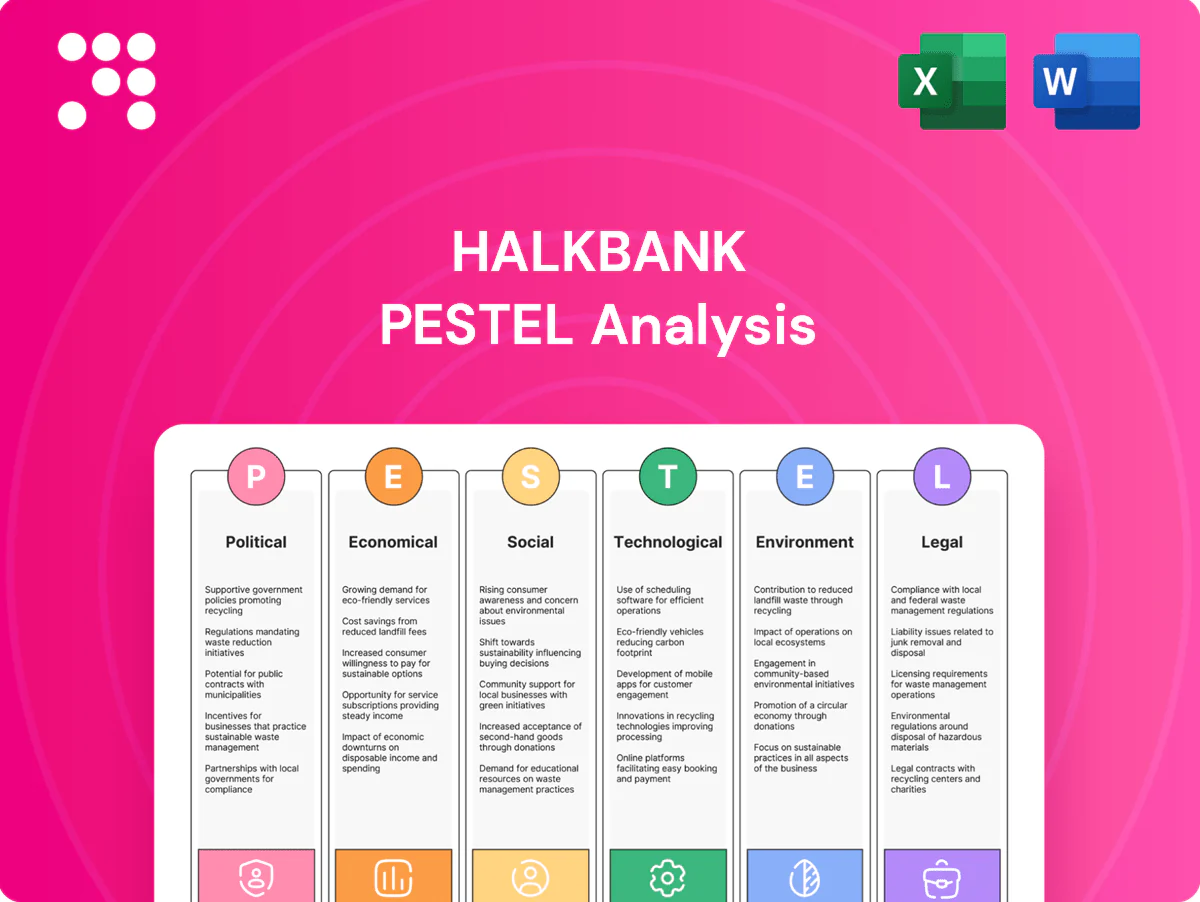
Halkbank PESTLE Analysis

Skip the Research. Get the Strategy.
Discover how political, economic, social, technological, legal and environmental forces are reshaping Halkbank's strategy and risk profile. Our concise PESTLE highlights regulatory exposures, macro risks and digital disruptors affecting growth. Ideal for investors and strategists, it's fully editable and board-ready. Purchase the full analysis to access detailed, actionable insights.
Political factors

State ownership influence
As a majority state-owned bank (state ownership retained as of 2024), Halkbank faces government-driven lending targets that shape pricing and sector focus, especially for SMEs. Acting as Turkey's policy bank for SMEs, it is often asked to support strategic programs at compressed margins, enhancing franchise value while introducing non-commercial objectives. Management must balance policy mandates with profitability and risk limits to preserve capital and asset quality.
Monetary policy transmission
Central Bank rate decisions and liquidity tools (with policy moves exceeding 1,000 bps across 2023–24) directly alter Halkbank funding costs and loan repricing, driving NIM swings; past episodes showed NIM volatility compressing or widening by up to ~200–300 bps. Rapid policy shifts in Turkey raise credit risk; aligning asset‑liability durations and active regulator dialogue help anticipate transmission lags.

Geopolitical exposure
Regional tensions and trade realignments alter cross-border flows and correspondent-banking access — World Bank data shows correspondent relationships fell about 14% since 2011 — affecting Halkbank’s FX funding and investor sentiment amid Türkiye’s $269bn 2024 exports. Risk appetite for international deals requires constant recalibration; contingency plans for alternative payment channels reduce disruption.

Public sector credit programs
Public-sector credit guarantees and subsidized schemes (Turkey’s Credit Guarantee Fund, established 1992) can accelerate SME lending, crucial given SMEs comprise about 99.8% of Turkish enterprises (TÜİK). They de-risk portions of Halkbank’s book but add operational complexity and heightened monitoring needs; program roll-offs create cliff risks for clients and concentrations. Transparent, reported performance metrics keep credit discipline and limit moral hazard.
- Accelerates SME lending — supports 99.8% of firms (TÜİK)
- De-risks portfolio but increases monitoring burden
- Roll-offs create cliff/default concentration risks
- Transparent metrics required to maintain discipline
Election and policy cycles
Election periods, notably Turkey's May 2023 presidential/parliamentary vote, raise policy uncertainty and typically amplify demand for directed lending; Halkbank's majority state ownership (Treasury ~51.1%) heightens exposure to such policy shifts. Budget dynamics can shift public deposits and fee policies; scenario planning for continuity or reversal and clear stakeholder communication preserve confidence.
- election_date: May 2023
- state_stake: ~51.1%
- risk: directed lending surge
- mitigation: scenario planning + stakeholder comms
State majority steers SME lending; CBRT swings and FX stress raise cross-border funding risk
Majority state ownership (~51.1% Treasury) drives directed SME lending and policy mandates, balancing profitability and asset quality. CBRT policy volatility (policy rate swings >1,000bps in 2023–24) and FX/liquidity shifts materially affect NIM and funding. Regional tensions, correspondent banking declines (~14% since 2011) and Turkey exports ~$269bn (2024) heighten cross‑border funding risk.
| Tag | Value |
|---|---|
| state_stake | ~51.1% |
| CBRT_volatility | >1,000bps (2023–24) |
| corr_banks_drop | ~14% since 2011 |
| exports_2024 | $269bn |
What is included in the product
 Detailed Word Document
Explores how Political, Economic, Social, Technological, Environmental and Legal forces uniquely impact Halkbank, with data-driven trends and region-specific regulatory context; designed to help executives, advisors and investors identify risks, opportunities and forward-looking scenarios for strategy and funding decisions.

 Customizable Excel Spreadsheet
A concise, visually segmented Halkbank PESTLE summary that clarifies regulatory, economic, political and technological risks for quick presentation, editable for local context and easily shareable across teams to streamline planning and risk discussions.
Economic factors

Inflation and FX volatility
High inflation (annual CPI >50% in 2024) and ~30% TRY depreciation vs USD in 2024 shifted deposits to short-term FX and gold, compressing real loan yields and raising funding costs for Halkbank. FX-linked corporate and retail exposures amplify translation and credit risk when borrowers earn TRY, as seen in rising NPL pressure in 2024. Pricing models require frequent re-indexing and dynamic floors; hedging and stricter collateral policies became pivotal to contain risk.
Interest rate swings
Sharp rate cycles in Türkiye have materially altered Halkbank’s NIM through higher prepayments and widening duration gaps, while deposit betas and demand for time deposits shifted rapidly in 2024–25. Active ALM, repricing ladders and hedges have been used to protect spreads. Stress testing should include parallel and non-parallel shocks across tenor and currency buckets to capture tail risks.

SME credit cycle
SMEs, which constitute about 99% of firms globally and roughly 50% of employment, are highly sensitive to input costs, energy price swings and demand shocks; in Turkey 2023–24 energy volatility coincided with margin compression and faster NPL buildup. Absent timely restructuring NPLs can spike, but sectoral diversification and state-backed guarantee schemes (eg Türkiye KGF) cushion losses. Advisory services and cash-flow lending have reduced defaults where applied.

Trade and tourism flows
Exporters’ financing needs track global demand and freight-rate volatility, affecting Halkbank’s working-capital draws and acceptances.
Tourism inflows bolster FX liquidity and card volumes—Türkiye recorded about 64 million visitors and roughly $51bn in tourism receipts in 2023, supporting seasonal FX buffers.
Tailored trade-finance and supply-chain solutions capture fee income; monitoring seasonality improves liquidity planning and risk limits.
- Export demand ↔ financing drawdowns
- Tourism (64m visitors; ~$51bn receipts 2023) → FX/card flows
- Fees from trade & supply-chain products
- Seasonality monitoring → liquidity optimization
Capital markets access
- Diversify investors and tenors — lowers rollover risk
- Collateral optimization — enables cheaper secured funding
- Maintain contingent lines — mitigates abrupt market closures
State majority steers SME lending; CBRT swings and FX stress raise cross-border funding risk
High 2024 inflation (>50%) and ~30% TRY depreciation shifted deposits to FX/gold, compressing real loan yields and raising funding costs; 5y sovereign CDS ~400bps (Jun 2025) tightened market funding. NPLs rose as FX-linked credits stressed TRY earners; Halkbank used re-indexing, hedges and stricter collateral to limit losses. Tourism (64m visitors; $51bn receipts 2023) and exports support seasonal FX liquidity.
| Metric | Value |
|---|---|
| 2024 CPI | >50% |
| TRY vs USD 2024 | ~-30% |
| 5y CDS (Jun 2025) | ~400bps |
| Tourism 2023 | 64m visitors / $51bn |
Same Document Delivered
Halkbank PESTLE Analysis
The preview shown here is the exact Halkbank PESTLE analysis you’ll receive after purchase—fully formatted and ready to use. It contains political, economic, social, technological, legal, and environmental insights tailored to Halkbank. No placeholders or teasers—this is the final, professionally structured file available for immediate download.

Skip the Research. Get the Strategy.
Discover how political, economic, social, technological, legal and environmental forces are reshaping Halkbank's strategy and risk profile. Our concise PESTLE highlights regulatory exposures, macro risks and digital disruptors affecting growth. Ideal for investors and strategists, it's fully editable and board-ready. Purchase the full analysis to access detailed, actionable insights.
Political factors
State ownership influence
As a majority state-owned bank (state ownership retained as of 2024), Halkbank faces government-driven lending targets that shape pricing and sector focus, especially for SMEs. Acting as Turkey's policy bank for SMEs, it is often asked to support strategic programs at compressed margins, enhancing franchise value while introducing non-commercial objectives. Management must balance policy mandates with profitability and risk limits to preserve capital and asset quality.
Monetary policy transmission
Central Bank rate decisions and liquidity tools (with policy moves exceeding 1,000 bps across 2023–24) directly alter Halkbank funding costs and loan repricing, driving NIM swings; past episodes showed NIM volatility compressing or widening by up to ~200–300 bps. Rapid policy shifts in Turkey raise credit risk; aligning asset‑liability durations and active regulator dialogue help anticipate transmission lags.
Geopolitical exposure
Regional tensions and trade realignments alter cross-border flows and correspondent-banking access — World Bank data shows correspondent relationships fell about 14% since 2011 — affecting Halkbank’s FX funding and investor sentiment amid Türkiye’s $269bn 2024 exports. Risk appetite for international deals requires constant recalibration; contingency plans for alternative payment channels reduce disruption.
Public sector credit programs
Public-sector credit guarantees and subsidized schemes (Turkey’s Credit Guarantee Fund, established 1992) can accelerate SME lending, crucial given SMEs comprise about 99.8% of Turkish enterprises (TÜİK). They de-risk portions of Halkbank’s book but add operational complexity and heightened monitoring needs; program roll-offs create cliff risks for clients and concentrations. Transparent, reported performance metrics keep credit discipline and limit moral hazard.
- Accelerates SME lending — supports 99.8% of firms (TÜİK)
- De-risks portfolio but increases monitoring burden
- Roll-offs create cliff/default concentration risks
- Transparent metrics required to maintain discipline
Election and policy cycles
Election periods, notably Turkey's May 2023 presidential/parliamentary vote, raise policy uncertainty and typically amplify demand for directed lending; Halkbank's majority state ownership (Treasury ~51.1%) heightens exposure to such policy shifts. Budget dynamics can shift public deposits and fee policies; scenario planning for continuity or reversal and clear stakeholder communication preserve confidence.
- election_date: May 2023
- state_stake: ~51.1%
- risk: directed lending surge
- mitigation: scenario planning + stakeholder comms
State majority steers SME lending; CBRT swings and FX stress raise cross-border funding risk
Majority state ownership (~51.1% Treasury) drives directed SME lending and policy mandates, balancing profitability and asset quality. CBRT policy volatility (policy rate swings >1,000bps in 2023–24) and FX/liquidity shifts materially affect NIM and funding. Regional tensions, correspondent banking declines (~14% since 2011) and Turkey exports ~$269bn (2024) heighten cross‑border funding risk.
| Tag | Value |
|---|---|
| state_stake | ~51.1% |
| CBRT_volatility | >1,000bps (2023–24) |
| corr_banks_drop | ~14% since 2011 |
| exports_2024 | $269bn |
What is included in the product
Detailed Word Document
Explores how Political, Economic, Social, Technological, Environmental and Legal forces uniquely impact Halkbank, with data-driven trends and region-specific regulatory context; designed to help executives, advisors and investors identify risks, opportunities and forward-looking scenarios for strategy and funding decisions.
Customizable Excel Spreadsheet
A concise, visually segmented Halkbank PESTLE summary that clarifies regulatory, economic, political and technological risks for quick presentation, editable for local context and easily shareable across teams to streamline planning and risk discussions.
Economic factors
Inflation and FX volatility
High inflation (annual CPI >50% in 2024) and ~30% TRY depreciation vs USD in 2024 shifted deposits to short-term FX and gold, compressing real loan yields and raising funding costs for Halkbank. FX-linked corporate and retail exposures amplify translation and credit risk when borrowers earn TRY, as seen in rising NPL pressure in 2024. Pricing models require frequent re-indexing and dynamic floors; hedging and stricter collateral policies became pivotal to contain risk.
Interest rate swings
Sharp rate cycles in Türkiye have materially altered Halkbank’s NIM through higher prepayments and widening duration gaps, while deposit betas and demand for time deposits shifted rapidly in 2024–25. Active ALM, repricing ladders and hedges have been used to protect spreads. Stress testing should include parallel and non-parallel shocks across tenor and currency buckets to capture tail risks.
SME credit cycle
SMEs, which constitute about 99% of firms globally and roughly 50% of employment, are highly sensitive to input costs, energy price swings and demand shocks; in Turkey 2023–24 energy volatility coincided with margin compression and faster NPL buildup. Absent timely restructuring NPLs can spike, but sectoral diversification and state-backed guarantee schemes (eg Türkiye KGF) cushion losses. Advisory services and cash-flow lending have reduced defaults where applied.
Trade and tourism flows
Exporters’ financing needs track global demand and freight-rate volatility, affecting Halkbank’s working-capital draws and acceptances.
Tourism inflows bolster FX liquidity and card volumes—Türkiye recorded about 64 million visitors and roughly $51bn in tourism receipts in 2023, supporting seasonal FX buffers.
Tailored trade-finance and supply-chain solutions capture fee income; monitoring seasonality improves liquidity planning and risk limits.
- Export demand ↔ financing drawdowns
- Tourism (64m visitors; ~$51bn receipts 2023) → FX/card flows
- Fees from trade & supply-chain products
- Seasonality monitoring → liquidity optimization
Capital markets access
- Diversify investors and tenors — lowers rollover risk
- Collateral optimization — enables cheaper secured funding
- Maintain contingent lines — mitigates abrupt market closures
State majority steers SME lending; CBRT swings and FX stress raise cross-border funding risk
High 2024 inflation (>50%) and ~30% TRY depreciation shifted deposits to FX/gold, compressing real loan yields and raising funding costs; 5y sovereign CDS ~400bps (Jun 2025) tightened market funding. NPLs rose as FX-linked credits stressed TRY earners; Halkbank used re-indexing, hedges and stricter collateral to limit losses. Tourism (64m visitors; $51bn receipts 2023) and exports support seasonal FX liquidity.
| Metric | Value |
|---|---|
| 2024 CPI | >50% |
| TRY vs USD 2024 | ~-30% |
| 5y CDS (Jun 2025) | ~400bps |
| Tourism 2023 | 64m visitors / $51bn |
Same Document Delivered
Halkbank PESTLE Analysis
The preview shown here is the exact Halkbank PESTLE analysis you’ll receive after purchase—fully formatted and ready to use. It contains political, economic, social, technological, legal, and environmental insights tailored to Halkbank. No placeholders or teasers—this is the final, professionally structured file available for immediate download.
Original: $10.00
-65%$10.00
$3.50Description
Skip the Research. Get the Strategy.
Discover how political, economic, social, technological, legal and environmental forces are reshaping Halkbank's strategy and risk profile. Our concise PESTLE highlights regulatory exposures, macro risks and digital disruptors affecting growth. Ideal for investors and strategists, it's fully editable and board-ready. Purchase the full analysis to access detailed, actionable insights.
Political factors
State ownership influence
As a majority state-owned bank (state ownership retained as of 2024), Halkbank faces government-driven lending targets that shape pricing and sector focus, especially for SMEs. Acting as Turkey's policy bank for SMEs, it is often asked to support strategic programs at compressed margins, enhancing franchise value while introducing non-commercial objectives. Management must balance policy mandates with profitability and risk limits to preserve capital and asset quality.
Monetary policy transmission
Central Bank rate decisions and liquidity tools (with policy moves exceeding 1,000 bps across 2023–24) directly alter Halkbank funding costs and loan repricing, driving NIM swings; past episodes showed NIM volatility compressing or widening by up to ~200–300 bps. Rapid policy shifts in Turkey raise credit risk; aligning asset‑liability durations and active regulator dialogue help anticipate transmission lags.
Geopolitical exposure
Regional tensions and trade realignments alter cross-border flows and correspondent-banking access — World Bank data shows correspondent relationships fell about 14% since 2011 — affecting Halkbank’s FX funding and investor sentiment amid Türkiye’s $269bn 2024 exports. Risk appetite for international deals requires constant recalibration; contingency plans for alternative payment channels reduce disruption.
Public sector credit programs
Public-sector credit guarantees and subsidized schemes (Turkey’s Credit Guarantee Fund, established 1992) can accelerate SME lending, crucial given SMEs comprise about 99.8% of Turkish enterprises (TÜİK). They de-risk portions of Halkbank’s book but add operational complexity and heightened monitoring needs; program roll-offs create cliff risks for clients and concentrations. Transparent, reported performance metrics keep credit discipline and limit moral hazard.
- Accelerates SME lending — supports 99.8% of firms (TÜİK)
- De-risks portfolio but increases monitoring burden
- Roll-offs create cliff/default concentration risks
- Transparent metrics required to maintain discipline
Election and policy cycles
Election periods, notably Turkey's May 2023 presidential/parliamentary vote, raise policy uncertainty and typically amplify demand for directed lending; Halkbank's majority state ownership (Treasury ~51.1%) heightens exposure to such policy shifts. Budget dynamics can shift public deposits and fee policies; scenario planning for continuity or reversal and clear stakeholder communication preserve confidence.
- election_date: May 2023
- state_stake: ~51.1%
- risk: directed lending surge
- mitigation: scenario planning + stakeholder comms
State majority steers SME lending; CBRT swings and FX stress raise cross-border funding risk
Majority state ownership (~51.1% Treasury) drives directed SME lending and policy mandates, balancing profitability and asset quality. CBRT policy volatility (policy rate swings >1,000bps in 2023–24) and FX/liquidity shifts materially affect NIM and funding. Regional tensions, correspondent banking declines (~14% since 2011) and Turkey exports ~$269bn (2024) heighten cross‑border funding risk.
| Tag | Value |
|---|---|
| state_stake | ~51.1% |
| CBRT_volatility | >1,000bps (2023–24) |
| corr_banks_drop | ~14% since 2011 |
| exports_2024 | $269bn |
What is included in the product
Detailed Word Document
Explores how Political, Economic, Social, Technological, Environmental and Legal forces uniquely impact Halkbank, with data-driven trends and region-specific regulatory context; designed to help executives, advisors and investors identify risks, opportunities and forward-looking scenarios for strategy and funding decisions.
Customizable Excel Spreadsheet
A concise, visually segmented Halkbank PESTLE summary that clarifies regulatory, economic, political and technological risks for quick presentation, editable for local context and easily shareable across teams to streamline planning and risk discussions.
Economic factors
Inflation and FX volatility
High inflation (annual CPI >50% in 2024) and ~30% TRY depreciation vs USD in 2024 shifted deposits to short-term FX and gold, compressing real loan yields and raising funding costs for Halkbank. FX-linked corporate and retail exposures amplify translation and credit risk when borrowers earn TRY, as seen in rising NPL pressure in 2024. Pricing models require frequent re-indexing and dynamic floors; hedging and stricter collateral policies became pivotal to contain risk.
Interest rate swings
Sharp rate cycles in Türkiye have materially altered Halkbank’s NIM through higher prepayments and widening duration gaps, while deposit betas and demand for time deposits shifted rapidly in 2024–25. Active ALM, repricing ladders and hedges have been used to protect spreads. Stress testing should include parallel and non-parallel shocks across tenor and currency buckets to capture tail risks.
SME credit cycle
SMEs, which constitute about 99% of firms globally and roughly 50% of employment, are highly sensitive to input costs, energy price swings and demand shocks; in Turkey 2023–24 energy volatility coincided with margin compression and faster NPL buildup. Absent timely restructuring NPLs can spike, but sectoral diversification and state-backed guarantee schemes (eg Türkiye KGF) cushion losses. Advisory services and cash-flow lending have reduced defaults where applied.
Trade and tourism flows
Exporters’ financing needs track global demand and freight-rate volatility, affecting Halkbank’s working-capital draws and acceptances.
Tourism inflows bolster FX liquidity and card volumes—Türkiye recorded about 64 million visitors and roughly $51bn in tourism receipts in 2023, supporting seasonal FX buffers.
Tailored trade-finance and supply-chain solutions capture fee income; monitoring seasonality improves liquidity planning and risk limits.
- Export demand ↔ financing drawdowns
- Tourism (64m visitors; ~$51bn receipts 2023) → FX/card flows
- Fees from trade & supply-chain products
- Seasonality monitoring → liquidity optimization
Capital markets access
- Diversify investors and tenors — lowers rollover risk
- Collateral optimization — enables cheaper secured funding
- Maintain contingent lines — mitigates abrupt market closures
State majority steers SME lending; CBRT swings and FX stress raise cross-border funding risk
High 2024 inflation (>50%) and ~30% TRY depreciation shifted deposits to FX/gold, compressing real loan yields and raising funding costs; 5y sovereign CDS ~400bps (Jun 2025) tightened market funding. NPLs rose as FX-linked credits stressed TRY earners; Halkbank used re-indexing, hedges and stricter collateral to limit losses. Tourism (64m visitors; $51bn receipts 2023) and exports support seasonal FX liquidity.
| Metric | Value |
|---|---|
| 2024 CPI | >50% |
| TRY vs USD 2024 | ~-30% |
| 5y CDS (Jun 2025) | ~400bps |
| Tourism 2023 | 64m visitors / $51bn |
Same Document Delivered
Halkbank PESTLE Analysis
The preview shown here is the exact Halkbank PESTLE analysis you’ll receive after purchase—fully formatted and ready to use. It contains political, economic, social, technological, legal, and environmental insights tailored to Halkbank. No placeholders or teasers—this is the final, professionally structured file available for immediate download.











