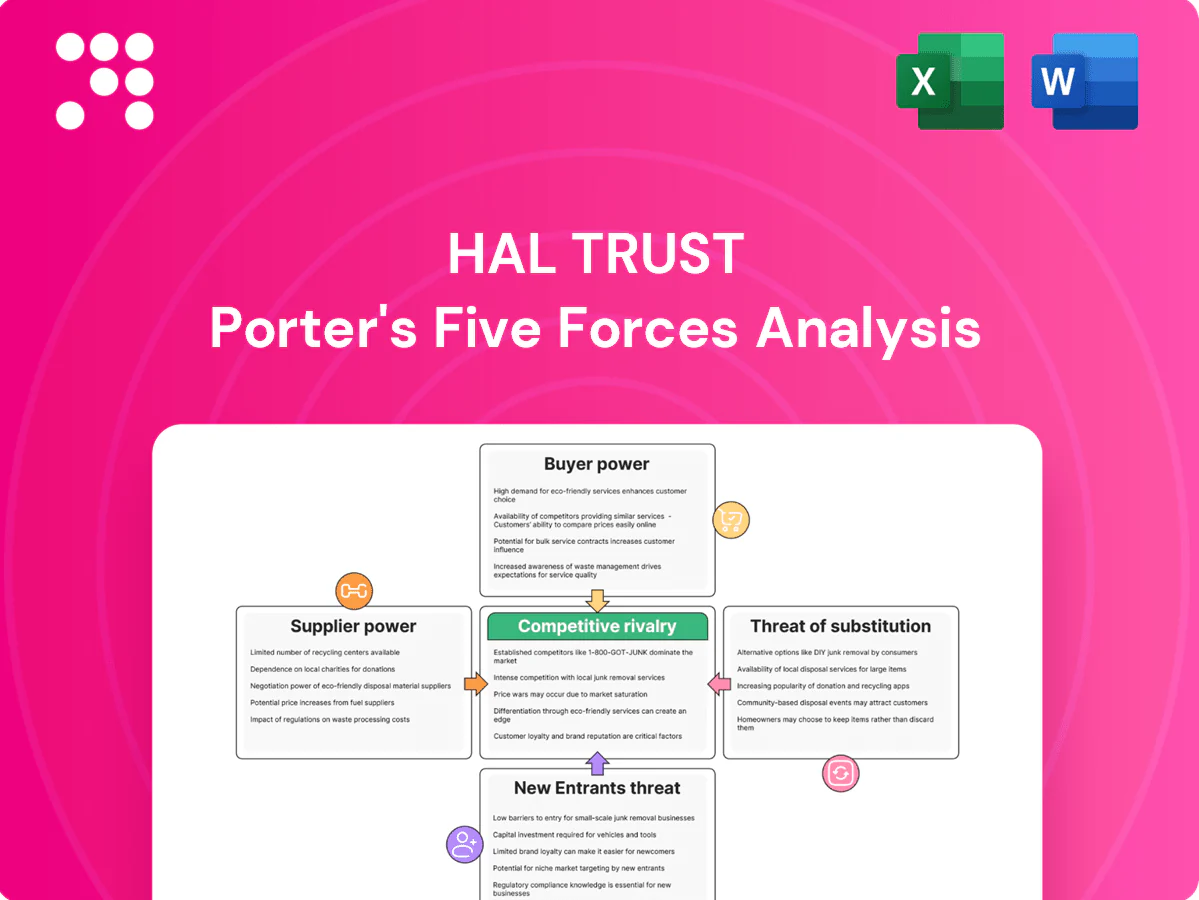
HAL Trust Porter's Five Forces Analysis

Don't Miss the Bigger Picture
HAL Trust’s competitive landscape is shaped by concentrated supplier relationships, moderate buyer power, and capital-intensive entry barriers that limit new rivals. Substitutes and rivalry vary across its niche assets. This snapshot highlights key pressures and strategic implications. Unlock the full Porter's Five Forces Analysis for force-by-force ratings, visuals, and actionable recommendations.
Suppliers Bargaining Power

Concentrated deal sources
Quality targets in 2024 still originate from a narrow set of founders, family owners and corporates divesting non-core assets, enabling sellers to command strong terms for resilient, cash-generative businesses.
HAL offsets supplier power through a long-standing reputation, transaction speed and a demonstrated ability to hold investments long term, enhancing bid competitiveness.
Nonetheless, the scarcity of top-tier assets in 2024 sustains elevated supplier leverage, keeping purchase discipline and deal selectivity critical for HAL.
Capital market lenders
Banks and bondholders supply leverage to HAL’s portfolio and holding structures, and tighter credit cycles in 2024 pushed pricing higher as the US federal funds rate ended 2024 at 5.25–5.50%, increasing lender bargaining power. Covenant scrutiny and pricing tightened industry-wide per 2024 bank surveys, raising funding costs and compressing returns under systemic stress. HAL’s conservative balance sheet and long-standing bank relationships can secure relatively better terms, but broad credit stress still squeezes margins.

Specialist advisors and networks
Legal, tax and sector experts are essential for HAL in complex cross-border deals, and scarcity of niche advisors lifts fees and timing risk, especially when specialized regulatory advice is required.

Management talent
Skilled CEOs and operating teams drive HAL Trust value creation; proven leaders are scarce and thus command significant compensation and autonomy when negotiating with investors. HAL’s active operational support and stated long-term horizon improve attraction and retention of management, moderating supplier power. Private equity competition for senior talent, often offering equity-rich packages and faster exits, sustains pressure on terms and retention.
- Scarcity: proven leaders have high bargaining leverage
- HAL advantages: active support + long-term horizon
- Counterforce: PE equity packages increase competition
- Net effect: moderated but persistent supplier power
Regulatory gatekeepers
Regulatory gatekeepers — licensing, antitrust and sectoral approvals — determine feasibility of HAL Trust deals across shipping, optics retail and real estate by controlling timing, permitted structures and operational access; clearance timelines commonly extend from months to over a year, shaping deal cadence and commitments.
- Regulatory approvals: shape deal timing
- Licensing bodies: control market access
- Antitrust: influence structure and commitments
- Result: situational bargaining power over terms
Reputation, speed and long-hold capability counter elevated seller leverage and tight 2024 credit
Supplier power is elevated in 2024 as a narrow seller base of founders, families and corporates commands strong terms for cash-generative assets; HAL mitigates this with reputation, speed and long-hold capability. Tighter credit (US fed funds 5.25–5.50% end-2024) raised lender leverage and funding costs. Scarcity of top-tier CEOs and niche advisors sustains fee and compensation pressure.
| Metric | 2024 |
|---|---|
| Fed funds rate | 5.25–5.50% |
| Regulatory clearance | 3–12+ months |
| Talent scarcity | High |
What is included in the product
 Detailed Word Document
Comprehensive Porter's Five Forces analysis tailored for HAL Trust, uncovering competitive drivers, buyer and supplier power, entry barriers, substitute threats, and disruptive forces that shape pricing and profitability; includes strategic commentary and industry context for use in investor materials or internal strategy decks.

 Customizable Excel Spreadsheet
Concise Porter's Five Forces for HAL Trust—one-sheet spider chart with adjustable pressure levels, copy-ready for decks and boardrooms; no macros, easy integration with Excel and the Word report to accelerate strategic decisions and relieve analysis bottlenecks.
Customers Bargaining Power

Public shareholders
Public shareholders can reprice HAL Trust by widening its discount to NAV — as seen in 2024 when the trust traded persistently below NAV — implicitly pressuring capital allocation decisions. Persistent discounts force management toward buybacks, higher dividends or asset disposals to shrink the gap. HAL’s regular NAV disclosure and a long compounding track record dampen investor bargaining power, but market downturns in 2024 amplified shareholder influence.
Co-investors and partners
Family offices, institutions and syndicate partners negotiate entry terms, fees and governance, with family offices collectively managing over $7 trillion globally in 2024, increasing bargaining weight. In competitive deals partners push for favorable economics and fee breaks. HAL’s control orientation and deal-by-deal flexibility help retain alignment. Still, cornerstone partners can demand protective rights that dilute HAL’s latitude.

Exit market buyers
Strategics and public markets set exit multiples and liquidity; with global private equity dry powder near USD 1.9tn in 2024 and M&A volume roughly 25% below 2021 peaks, scarce buyers push for warranties and price concessions. HAL’s long-hold stance lets it time exits to stronger cycles, softening buyer leverage, but secular multiple compression (lower public comps) can still cap realized outcomes.

Portfolio company customers
End-customers in optical retail, shipping and industrials directly shape portfolio cash flows, with large B2B clients able to press pricing and payment terms that compress margins and working capital across holdings. Diversified end-markets in 2024 limit HAL Trust’s single-customer concentration risk, but acute buyer power in any sector can transmit to holding-level returns and NAV volatility.
- Customer influence: high in shipping and industrials
- Large B2B clients: can force price/term concessions
- Diversification 2024: reduces concentration risk
- Sector shocks: can still affect HAL-level returns
Debt investors in portfolio
Debt investors in HAL Trust’s portfolio — loan and bond holders to subsidiaries — can impose covenants that constrain strategic moves, and upcoming refinancing windows in 2024 increase creditor leverage over pricing. Strong cash generation and asset backing across subsidiaries mitigate this bargaining power, but under stress scenarios creditors gain decisive control.
- Covenants restrict strategic flexibility
- 2024 refinancing windows amplify pricing leverage
- Cash flow and asset backing soften pressure
- Stress shifts power to creditors
High B2B bargaining, sector shocks widen trust discount and raise shareholder pressure
Customer bargaining varies by sector: high in shipping/industrials where large B2B clients can force price and payment concessions, lower in diversified retail/optical holdings. 2024 market stress widened HAL Trust discount, increasing shareholder pressure on capital allocation. Portfolio diversification and strong cashflows mitigate but sector shocks and key-customer concentration remain material risks.
| Metric | 2024 value | Implication |
|---|---|---|
| Family offices AUM | $7tn | ↑ partner leverage |
| PE dry powder | $1.9tn | exit timing influence |
Preview Before You Purchase
HAL Trust Porter's Five Forces Analysis
This preview shows the exact HAL Trust Porter's Five Forces Analysis you'll receive immediately after purchase—no surprises, no placeholders. The file you see is professionally formatted, complete and ready for download the moment you buy. Use it as-is for decision-making, presentations, or further research.

Don't Miss the Bigger Picture
HAL Trust’s competitive landscape is shaped by concentrated supplier relationships, moderate buyer power, and capital-intensive entry barriers that limit new rivals. Substitutes and rivalry vary across its niche assets. This snapshot highlights key pressures and strategic implications. Unlock the full Porter's Five Forces Analysis for force-by-force ratings, visuals, and actionable recommendations.
Suppliers Bargaining Power
Concentrated deal sources
Quality targets in 2024 still originate from a narrow set of founders, family owners and corporates divesting non-core assets, enabling sellers to command strong terms for resilient, cash-generative businesses.
HAL offsets supplier power through a long-standing reputation, transaction speed and a demonstrated ability to hold investments long term, enhancing bid competitiveness.
Nonetheless, the scarcity of top-tier assets in 2024 sustains elevated supplier leverage, keeping purchase discipline and deal selectivity critical for HAL.
Capital market lenders
Banks and bondholders supply leverage to HAL’s portfolio and holding structures, and tighter credit cycles in 2024 pushed pricing higher as the US federal funds rate ended 2024 at 5.25–5.50%, increasing lender bargaining power. Covenant scrutiny and pricing tightened industry-wide per 2024 bank surveys, raising funding costs and compressing returns under systemic stress. HAL’s conservative balance sheet and long-standing bank relationships can secure relatively better terms, but broad credit stress still squeezes margins.
Specialist advisors and networks
Legal, tax and sector experts are essential for HAL in complex cross-border deals, and scarcity of niche advisors lifts fees and timing risk, especially when specialized regulatory advice is required.
Management talent
Skilled CEOs and operating teams drive HAL Trust value creation; proven leaders are scarce and thus command significant compensation and autonomy when negotiating with investors. HAL’s active operational support and stated long-term horizon improve attraction and retention of management, moderating supplier power. Private equity competition for senior talent, often offering equity-rich packages and faster exits, sustains pressure on terms and retention.
- Scarcity: proven leaders have high bargaining leverage
- HAL advantages: active support + long-term horizon
- Counterforce: PE equity packages increase competition
- Net effect: moderated but persistent supplier power
Regulatory gatekeepers
Regulatory gatekeepers — licensing, antitrust and sectoral approvals — determine feasibility of HAL Trust deals across shipping, optics retail and real estate by controlling timing, permitted structures and operational access; clearance timelines commonly extend from months to over a year, shaping deal cadence and commitments.
- Regulatory approvals: shape deal timing
- Licensing bodies: control market access
- Antitrust: influence structure and commitments
- Result: situational bargaining power over terms
Reputation, speed and long-hold capability counter elevated seller leverage and tight 2024 credit
Supplier power is elevated in 2024 as a narrow seller base of founders, families and corporates commands strong terms for cash-generative assets; HAL mitigates this with reputation, speed and long-hold capability. Tighter credit (US fed funds 5.25–5.50% end-2024) raised lender leverage and funding costs. Scarcity of top-tier CEOs and niche advisors sustains fee and compensation pressure.
| Metric | 2024 |
|---|---|
| Fed funds rate | 5.25–5.50% |
| Regulatory clearance | 3–12+ months |
| Talent scarcity | High |
What is included in the product
Detailed Word Document
Comprehensive Porter's Five Forces analysis tailored for HAL Trust, uncovering competitive drivers, buyer and supplier power, entry barriers, substitute threats, and disruptive forces that shape pricing and profitability; includes strategic commentary and industry context for use in investor materials or internal strategy decks.
Customizable Excel Spreadsheet
Concise Porter's Five Forces for HAL Trust—one-sheet spider chart with adjustable pressure levels, copy-ready for decks and boardrooms; no macros, easy integration with Excel and the Word report to accelerate strategic decisions and relieve analysis bottlenecks.
Customers Bargaining Power
Public shareholders
Public shareholders can reprice HAL Trust by widening its discount to NAV — as seen in 2024 when the trust traded persistently below NAV — implicitly pressuring capital allocation decisions. Persistent discounts force management toward buybacks, higher dividends or asset disposals to shrink the gap. HAL’s regular NAV disclosure and a long compounding track record dampen investor bargaining power, but market downturns in 2024 amplified shareholder influence.
Co-investors and partners
Family offices, institutions and syndicate partners negotiate entry terms, fees and governance, with family offices collectively managing over $7 trillion globally in 2024, increasing bargaining weight. In competitive deals partners push for favorable economics and fee breaks. HAL’s control orientation and deal-by-deal flexibility help retain alignment. Still, cornerstone partners can demand protective rights that dilute HAL’s latitude.
Exit market buyers
Strategics and public markets set exit multiples and liquidity; with global private equity dry powder near USD 1.9tn in 2024 and M&A volume roughly 25% below 2021 peaks, scarce buyers push for warranties and price concessions. HAL’s long-hold stance lets it time exits to stronger cycles, softening buyer leverage, but secular multiple compression (lower public comps) can still cap realized outcomes.
Portfolio company customers
End-customers in optical retail, shipping and industrials directly shape portfolio cash flows, with large B2B clients able to press pricing and payment terms that compress margins and working capital across holdings. Diversified end-markets in 2024 limit HAL Trust’s single-customer concentration risk, but acute buyer power in any sector can transmit to holding-level returns and NAV volatility.
- Customer influence: high in shipping and industrials
- Large B2B clients: can force price/term concessions
- Diversification 2024: reduces concentration risk
- Sector shocks: can still affect HAL-level returns
Debt investors in portfolio
Debt investors in HAL Trust’s portfolio — loan and bond holders to subsidiaries — can impose covenants that constrain strategic moves, and upcoming refinancing windows in 2024 increase creditor leverage over pricing. Strong cash generation and asset backing across subsidiaries mitigate this bargaining power, but under stress scenarios creditors gain decisive control.
- Covenants restrict strategic flexibility
- 2024 refinancing windows amplify pricing leverage
- Cash flow and asset backing soften pressure
- Stress shifts power to creditors
High B2B bargaining, sector shocks widen trust discount and raise shareholder pressure
Customer bargaining varies by sector: high in shipping/industrials where large B2B clients can force price and payment concessions, lower in diversified retail/optical holdings. 2024 market stress widened HAL Trust discount, increasing shareholder pressure on capital allocation. Portfolio diversification and strong cashflows mitigate but sector shocks and key-customer concentration remain material risks.
| Metric | 2024 value | Implication |
|---|---|---|
| Family offices AUM | $7tn | ↑ partner leverage |
| PE dry powder | $1.9tn | exit timing influence |
Preview Before You Purchase
HAL Trust Porter's Five Forces Analysis
This preview shows the exact HAL Trust Porter's Five Forces Analysis you'll receive immediately after purchase—no surprises, no placeholders. The file you see is professionally formatted, complete and ready for download the moment you buy. Use it as-is for decision-making, presentations, or further research.
Original: $10.00
-65%$10.00
$3.50Description
Don't Miss the Bigger Picture
HAL Trust’s competitive landscape is shaped by concentrated supplier relationships, moderate buyer power, and capital-intensive entry barriers that limit new rivals. Substitutes and rivalry vary across its niche assets. This snapshot highlights key pressures and strategic implications. Unlock the full Porter's Five Forces Analysis for force-by-force ratings, visuals, and actionable recommendations.
Suppliers Bargaining Power
Concentrated deal sources
Quality targets in 2024 still originate from a narrow set of founders, family owners and corporates divesting non-core assets, enabling sellers to command strong terms for resilient, cash-generative businesses.
HAL offsets supplier power through a long-standing reputation, transaction speed and a demonstrated ability to hold investments long term, enhancing bid competitiveness.
Nonetheless, the scarcity of top-tier assets in 2024 sustains elevated supplier leverage, keeping purchase discipline and deal selectivity critical for HAL.
Capital market lenders
Banks and bondholders supply leverage to HAL’s portfolio and holding structures, and tighter credit cycles in 2024 pushed pricing higher as the US federal funds rate ended 2024 at 5.25–5.50%, increasing lender bargaining power. Covenant scrutiny and pricing tightened industry-wide per 2024 bank surveys, raising funding costs and compressing returns under systemic stress. HAL’s conservative balance sheet and long-standing bank relationships can secure relatively better terms, but broad credit stress still squeezes margins.
Specialist advisors and networks
Legal, tax and sector experts are essential for HAL in complex cross-border deals, and scarcity of niche advisors lifts fees and timing risk, especially when specialized regulatory advice is required.
Management talent
Skilled CEOs and operating teams drive HAL Trust value creation; proven leaders are scarce and thus command significant compensation and autonomy when negotiating with investors. HAL’s active operational support and stated long-term horizon improve attraction and retention of management, moderating supplier power. Private equity competition for senior talent, often offering equity-rich packages and faster exits, sustains pressure on terms and retention.
- Scarcity: proven leaders have high bargaining leverage
- HAL advantages: active support + long-term horizon
- Counterforce: PE equity packages increase competition
- Net effect: moderated but persistent supplier power
Regulatory gatekeepers
Regulatory gatekeepers — licensing, antitrust and sectoral approvals — determine feasibility of HAL Trust deals across shipping, optics retail and real estate by controlling timing, permitted structures and operational access; clearance timelines commonly extend from months to over a year, shaping deal cadence and commitments.
- Regulatory approvals: shape deal timing
- Licensing bodies: control market access
- Antitrust: influence structure and commitments
- Result: situational bargaining power over terms
Reputation, speed and long-hold capability counter elevated seller leverage and tight 2024 credit
Supplier power is elevated in 2024 as a narrow seller base of founders, families and corporates commands strong terms for cash-generative assets; HAL mitigates this with reputation, speed and long-hold capability. Tighter credit (US fed funds 5.25–5.50% end-2024) raised lender leverage and funding costs. Scarcity of top-tier CEOs and niche advisors sustains fee and compensation pressure.
| Metric | 2024 |
|---|---|
| Fed funds rate | 5.25–5.50% |
| Regulatory clearance | 3–12+ months |
| Talent scarcity | High |
What is included in the product
Detailed Word Document
Comprehensive Porter's Five Forces analysis tailored for HAL Trust, uncovering competitive drivers, buyer and supplier power, entry barriers, substitute threats, and disruptive forces that shape pricing and profitability; includes strategic commentary and industry context for use in investor materials or internal strategy decks.
Customizable Excel Spreadsheet
Concise Porter's Five Forces for HAL Trust—one-sheet spider chart with adjustable pressure levels, copy-ready for decks and boardrooms; no macros, easy integration with Excel and the Word report to accelerate strategic decisions and relieve analysis bottlenecks.
Customers Bargaining Power
Public shareholders
Public shareholders can reprice HAL Trust by widening its discount to NAV — as seen in 2024 when the trust traded persistently below NAV — implicitly pressuring capital allocation decisions. Persistent discounts force management toward buybacks, higher dividends or asset disposals to shrink the gap. HAL’s regular NAV disclosure and a long compounding track record dampen investor bargaining power, but market downturns in 2024 amplified shareholder influence.
Co-investors and partners
Family offices, institutions and syndicate partners negotiate entry terms, fees and governance, with family offices collectively managing over $7 trillion globally in 2024, increasing bargaining weight. In competitive deals partners push for favorable economics and fee breaks. HAL’s control orientation and deal-by-deal flexibility help retain alignment. Still, cornerstone partners can demand protective rights that dilute HAL’s latitude.
Exit market buyers
Strategics and public markets set exit multiples and liquidity; with global private equity dry powder near USD 1.9tn in 2024 and M&A volume roughly 25% below 2021 peaks, scarce buyers push for warranties and price concessions. HAL’s long-hold stance lets it time exits to stronger cycles, softening buyer leverage, but secular multiple compression (lower public comps) can still cap realized outcomes.
Portfolio company customers
End-customers in optical retail, shipping and industrials directly shape portfolio cash flows, with large B2B clients able to press pricing and payment terms that compress margins and working capital across holdings. Diversified end-markets in 2024 limit HAL Trust’s single-customer concentration risk, but acute buyer power in any sector can transmit to holding-level returns and NAV volatility.
- Customer influence: high in shipping and industrials
- Large B2B clients: can force price/term concessions
- Diversification 2024: reduces concentration risk
- Sector shocks: can still affect HAL-level returns
Debt investors in portfolio
Debt investors in HAL Trust’s portfolio — loan and bond holders to subsidiaries — can impose covenants that constrain strategic moves, and upcoming refinancing windows in 2024 increase creditor leverage over pricing. Strong cash generation and asset backing across subsidiaries mitigate this bargaining power, but under stress scenarios creditors gain decisive control.
- Covenants restrict strategic flexibility
- 2024 refinancing windows amplify pricing leverage
- Cash flow and asset backing soften pressure
- Stress shifts power to creditors
High B2B bargaining, sector shocks widen trust discount and raise shareholder pressure
Customer bargaining varies by sector: high in shipping/industrials where large B2B clients can force price and payment concessions, lower in diversified retail/optical holdings. 2024 market stress widened HAL Trust discount, increasing shareholder pressure on capital allocation. Portfolio diversification and strong cashflows mitigate but sector shocks and key-customer concentration remain material risks.
| Metric | 2024 value | Implication |
|---|---|---|
| Family offices AUM | $7tn | ↑ partner leverage |
| PE dry powder | $1.9tn | exit timing influence |
Preview Before You Purchase
HAL Trust Porter's Five Forces Analysis
This preview shows the exact HAL Trust Porter's Five Forces Analysis you'll receive immediately after purchase—no surprises, no placeholders. The file you see is professionally formatted, complete and ready for download the moment you buy. Use it as-is for decision-making, presentations, or further research.











