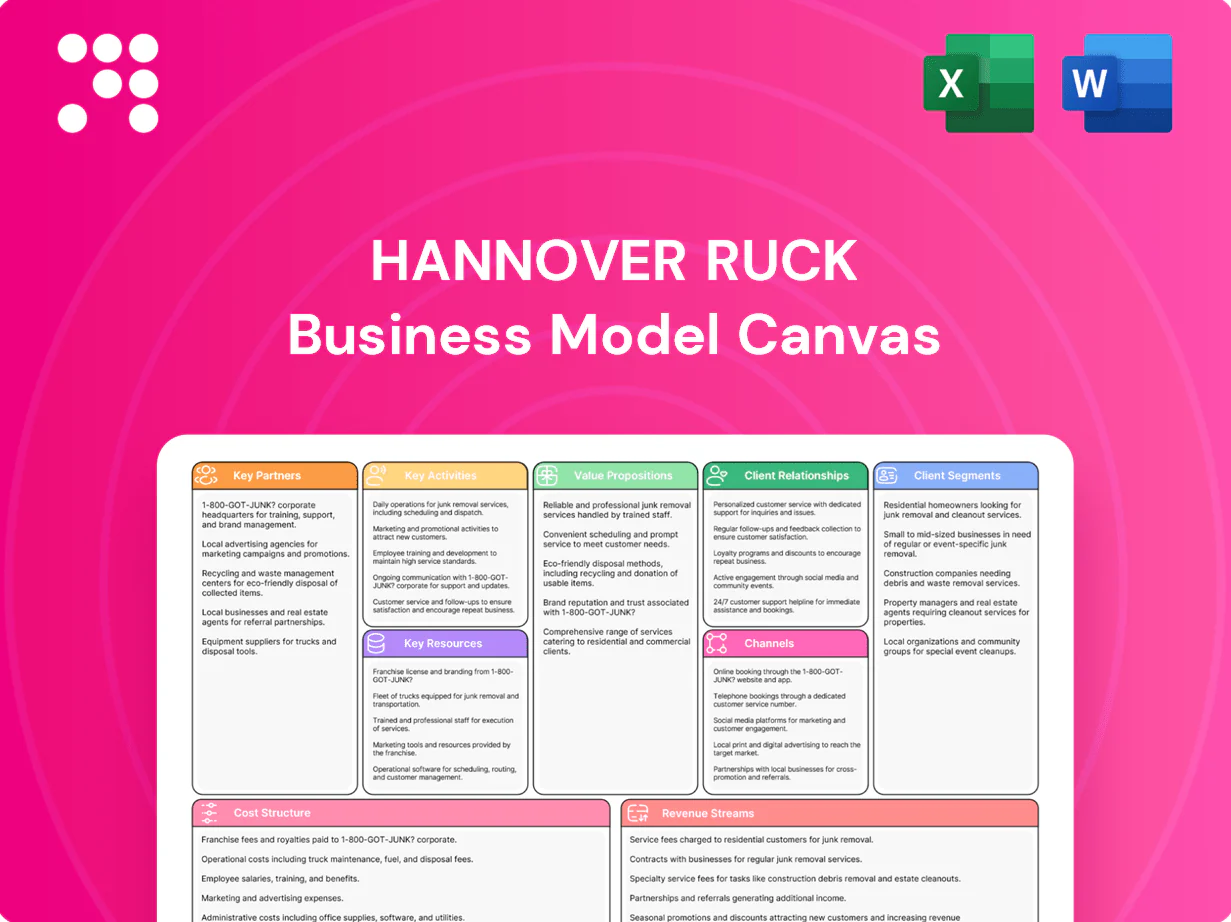
Hannover Ruck Business Model Canvas

Unlock the full strategic blueprint behind Hannover Ruck with our in-depth Business Model Canvas—three to five pages of company-specific insights that reveal how value is created, monetized, and scaled. Ideal for investors, consultants, and founders seeking actionable strategy. Download the editable Word & Excel files to benchmark and implement proven tactics.
Partnerships

Primary insurers and cedents
Primary insurers and cedents supply Hannover Rück with diverse P&C and Life & Health risk portfolios, underpinning a predictable flow of business via multi-year treaties that represent multiple billions in annual premium exposure. Collaborative underwriting and product innovation have measurably improved risk selection and margin stability. Mutual trust enables cycle-resilient capacity deployment across market up- and down-cycles.
Reinsurance brokers
Reinsurance brokers expand Hannover Ruck’s market access and facilitate complex placements across lines, accelerating reach into specialty and retrocession markets. They aggregate demand and provide benchmarking while streamlining negotiations, supporting efficient treaty and facultative placements. Broker data and analytics enhanced pricing insights in 2024 as global reinsurance premiums exceeded $300bn, and strategic broker ties accelerate global deal flow.

Retrocessionaires and sidecars
Retrocessionaires and sidecars absorb peak and tail risks, enabling Hannover Re to optimize capital usage and limit peak catastrophe strain; retrocession programs commonly cover up to 30% of peak CAT exposure. Retrocession smooths underwriting volatility and supports solvency metrics, helping maintain capital ratios through cycles. Sidecar investors align on risk-return, providing scalable capacity—sidecar formations grew materially in 2023–2024 market activity—while dynamic retro programs allow active cycle management.

Capital markets and ILS investors
Hannover Rück partners with capital markets and ILS investors to place catastrophe bonds, collateralized re and structured risk-transfer solutions; 2024 cat bond issuance reached about 8.7bn and global ILS capacity totaled roughly 100bn, adding alternative capacity and real-time pricing signals. Co-developing ILS vehicles widens the investor base and aligning triggers and terms increases market depth and tradability.
- cat-bonds: 8.7bn (2024)
- ILS capacity: ~100bn (2024)
- focus: co-development
- benefit: improved pricing & depth
Data, tech, and modeling providers
Cat models, health analytics and cyber tools sharpen Hannover Rück’s risk assessment and loss modeling; Hannover Re ranked among the top three reinsurers by gross premiums in 2024. Cloud, AI and APIs drive pricing automation and reporting, shortening time-to-bind and claims cycles. External datasets complement proprietary risk views and partnerships accelerate innovation and operational efficiency.
- tag:cat_models
- tag:ai_cloud
- tag:external_data
- tag:partnerships_speed
Primary cedents & brokers grow treaty flow; ILS ~100bn, cat bonds 8.7bn
Primary cedents and brokers drive multibillion treaty flow and broaden specialty reach; retrocessionaires and sidecars cap peak-CAT strain (~30% cover), while capital markets/ILS (2024 cat bonds 8.7bn; ILS capacity ~100bn) supply alternative scalable capacity; advanced models, AI and data partnerships sharpen pricing and speed to bind.
| Metric | 2024 |
|---|---|
| Cat bonds | 8.7bn |
| ILS capacity | ~100bn |
| Retro cover (peak CAT) | ~30% |
What is included in the product
 Detailed Word Document
A comprehensive, pre-written Business Model Canvas for Hannover Rück that maps all 9 blocks with detailed customer segments, channels, value propositions and revenue/cost structures reflecting real-world reinsurance operations and strategy. Ideal for presentations and investor funding, it includes competitive advantage analysis, SWOT-linked insights, and a polished format to validate decisions and support stakeholders.

 Customizable Excel Spreadsheet
High-level, editable Business Model Canvas for Hannover Rück that condenses reinsurance strategy into a clean one-page snapshot—saving hours of structuring while enabling quick comparisons, team collaboration, and board-ready summaries.
Activities

Technical underwriting
Technical underwriting at Hannover Rück selects and prices treaty and facultative risks using actuarial approaches, catastrophe models and exposure analytics to quantify tail risk and portfolio correlations. In 2024 underwriting focused on terms, limits and attachment points to sculpt loss profiles amid market rate increases of roughly 10–30% in property-cat segments. Discipline enforces cycle-adjusted targets, seeking combined ratios in the mid-90s to preserve profitability.
Portfolio and capital management
Aggregate monitoring of accumulations and tail exposure informs capital buffers and retrocession placement, leveraging the ILS market that topped $100bn in 2024 to optimize risk transfer and capital allocation. Scenario testing and ORSA feed solvency projections to support regulatory SCR coverage and credit ratings. Dynamic rebalancing of assets and retrocession aligns capital with evolving risk appetite and loss metrics.

Claims management and reserving
Timely claims handling preserves client trust and outcomes, with Hannover Rück—founded 1966 and active in over 150 countries—prioritising rapid settlement to protect relationships. Robust reserving aligned with Solvency II standards underpins balance-sheet strength and capital adequacy. Data-driven triage and leakage control reduce loss ratios through early fraud detection and cost management. Continuous feedback loops feed underwriting refinements and pricing adjustments.

Product and structuring
Product and structuring delivers bespoke treaties, stop-loss, quota share and structured solutions that target solvency relief, volatility smoothing and growth while using parametric and alternative triggers to expand insurability; documentation aligns incentives and transparency across cedants and capital providers.
- Bespoke treaties
- Stop-loss & QS
- Parametric triggers
- Solvency relief & smoothing
- Aligned documentation
Client advisory and analytics
Client advisory and analytics supports pricing, capital planning and risk engineering for cedents, delivering market insights, benchmarking and stress tests to inform underwriting and solvency decisions; co-creation workshops accelerate solution fit while deep technical expertise strengthens long-term partnerships in 2024.
- Supports pricing, capital planning, risk engineering
- Market insights, benchmarking, stress tests
- Co-creation workshops for faster fit
- Deep expertise → durable relationships
Underwriting: property-cat +10–30%, ILS >$100bn, target mid‑90s CRs
Technical underwriting prices treaty and facultative risks using actuarial models and exposure analytics; 2024 saw property-cat rate rises ~10–30% and target combined ratios in the mid‑90s. Accumulation control and ILS retrocession (ILS market >$100bn in 2024) optimise capital; claims & reserving follow Solvency II standards across 150+ countries.
| Metric | 2024 |
|---|---|
| Property-cat rate change | +10–30% |
| ILS market | >$100bn |
| Target combined ratio | mid‑90s% |
| Global reach | 150+ countries |
What You See Is What You Get
Business Model Canvas
The document previewed here is the actual Hannover Rück Business Model Canvas, not a mockup or sample. When you purchase, you’ll receive this same complete, ready-to-use file with all content and structure preserved. It’s fully editable and formatted for immediate use in presentations or analysis.

Unlock the full strategic blueprint behind Hannover Ruck with our in-depth Business Model Canvas—three to five pages of company-specific insights that reveal how value is created, monetized, and scaled. Ideal for investors, consultants, and founders seeking actionable strategy. Download the editable Word & Excel files to benchmark and implement proven tactics.
Partnerships
Primary insurers and cedents
Primary insurers and cedents supply Hannover Rück with diverse P&C and Life & Health risk portfolios, underpinning a predictable flow of business via multi-year treaties that represent multiple billions in annual premium exposure. Collaborative underwriting and product innovation have measurably improved risk selection and margin stability. Mutual trust enables cycle-resilient capacity deployment across market up- and down-cycles.
Reinsurance brokers
Reinsurance brokers expand Hannover Ruck’s market access and facilitate complex placements across lines, accelerating reach into specialty and retrocession markets. They aggregate demand and provide benchmarking while streamlining negotiations, supporting efficient treaty and facultative placements. Broker data and analytics enhanced pricing insights in 2024 as global reinsurance premiums exceeded $300bn, and strategic broker ties accelerate global deal flow.
Retrocessionaires and sidecars
Retrocessionaires and sidecars absorb peak and tail risks, enabling Hannover Re to optimize capital usage and limit peak catastrophe strain; retrocession programs commonly cover up to 30% of peak CAT exposure. Retrocession smooths underwriting volatility and supports solvency metrics, helping maintain capital ratios through cycles. Sidecar investors align on risk-return, providing scalable capacity—sidecar formations grew materially in 2023–2024 market activity—while dynamic retro programs allow active cycle management.
Capital markets and ILS investors
Hannover Rück partners with capital markets and ILS investors to place catastrophe bonds, collateralized re and structured risk-transfer solutions; 2024 cat bond issuance reached about 8.7bn and global ILS capacity totaled roughly 100bn, adding alternative capacity and real-time pricing signals. Co-developing ILS vehicles widens the investor base and aligning triggers and terms increases market depth and tradability.
- cat-bonds: 8.7bn (2024)
- ILS capacity: ~100bn (2024)
- focus: co-development
- benefit: improved pricing & depth
Data, tech, and modeling providers
Cat models, health analytics and cyber tools sharpen Hannover Rück’s risk assessment and loss modeling; Hannover Re ranked among the top three reinsurers by gross premiums in 2024. Cloud, AI and APIs drive pricing automation and reporting, shortening time-to-bind and claims cycles. External datasets complement proprietary risk views and partnerships accelerate innovation and operational efficiency.
- tag:cat_models
- tag:ai_cloud
- tag:external_data
- tag:partnerships_speed
Primary cedents & brokers grow treaty flow; ILS ~100bn, cat bonds 8.7bn
Primary cedents and brokers drive multibillion treaty flow and broaden specialty reach; retrocessionaires and sidecars cap peak-CAT strain (~30% cover), while capital markets/ILS (2024 cat bonds 8.7bn; ILS capacity ~100bn) supply alternative scalable capacity; advanced models, AI and data partnerships sharpen pricing and speed to bind.
| Metric | 2024 |
|---|---|
| Cat bonds | 8.7bn |
| ILS capacity | ~100bn |
| Retro cover (peak CAT) | ~30% |
What is included in the product
Detailed Word Document
A comprehensive, pre-written Business Model Canvas for Hannover Rück that maps all 9 blocks with detailed customer segments, channels, value propositions and revenue/cost structures reflecting real-world reinsurance operations and strategy. Ideal for presentations and investor funding, it includes competitive advantage analysis, SWOT-linked insights, and a polished format to validate decisions and support stakeholders.
Customizable Excel Spreadsheet
High-level, editable Business Model Canvas for Hannover Rück that condenses reinsurance strategy into a clean one-page snapshot—saving hours of structuring while enabling quick comparisons, team collaboration, and board-ready summaries.
Activities
Technical underwriting
Technical underwriting at Hannover Rück selects and prices treaty and facultative risks using actuarial approaches, catastrophe models and exposure analytics to quantify tail risk and portfolio correlations. In 2024 underwriting focused on terms, limits and attachment points to sculpt loss profiles amid market rate increases of roughly 10–30% in property-cat segments. Discipline enforces cycle-adjusted targets, seeking combined ratios in the mid-90s to preserve profitability.
Portfolio and capital management
Aggregate monitoring of accumulations and tail exposure informs capital buffers and retrocession placement, leveraging the ILS market that topped $100bn in 2024 to optimize risk transfer and capital allocation. Scenario testing and ORSA feed solvency projections to support regulatory SCR coverage and credit ratings. Dynamic rebalancing of assets and retrocession aligns capital with evolving risk appetite and loss metrics.
Claims management and reserving
Timely claims handling preserves client trust and outcomes, with Hannover Rück—founded 1966 and active in over 150 countries—prioritising rapid settlement to protect relationships. Robust reserving aligned with Solvency II standards underpins balance-sheet strength and capital adequacy. Data-driven triage and leakage control reduce loss ratios through early fraud detection and cost management. Continuous feedback loops feed underwriting refinements and pricing adjustments.
Product and structuring
Product and structuring delivers bespoke treaties, stop-loss, quota share and structured solutions that target solvency relief, volatility smoothing and growth while using parametric and alternative triggers to expand insurability; documentation aligns incentives and transparency across cedants and capital providers.
- Bespoke treaties
- Stop-loss & QS
- Parametric triggers
- Solvency relief & smoothing
- Aligned documentation
Client advisory and analytics
Client advisory and analytics supports pricing, capital planning and risk engineering for cedents, delivering market insights, benchmarking and stress tests to inform underwriting and solvency decisions; co-creation workshops accelerate solution fit while deep technical expertise strengthens long-term partnerships in 2024.
- Supports pricing, capital planning, risk engineering
- Market insights, benchmarking, stress tests
- Co-creation workshops for faster fit
- Deep expertise → durable relationships
Underwriting: property-cat +10–30%, ILS >$100bn, target mid‑90s CRs
Technical underwriting prices treaty and facultative risks using actuarial models and exposure analytics; 2024 saw property-cat rate rises ~10–30% and target combined ratios in the mid‑90s. Accumulation control and ILS retrocession (ILS market >$100bn in 2024) optimise capital; claims & reserving follow Solvency II standards across 150+ countries.
| Metric | 2024 |
|---|---|
| Property-cat rate change | +10–30% |
| ILS market | >$100bn |
| Target combined ratio | mid‑90s% |
| Global reach | 150+ countries |
What You See Is What You Get
Business Model Canvas
The document previewed here is the actual Hannover Rück Business Model Canvas, not a mockup or sample. When you purchase, you’ll receive this same complete, ready-to-use file with all content and structure preserved. It’s fully editable and formatted for immediate use in presentations or analysis.
Original: $10.00
-65%$10.00
$3.50Description
Unlock the full strategic blueprint behind Hannover Ruck with our in-depth Business Model Canvas—three to five pages of company-specific insights that reveal how value is created, monetized, and scaled. Ideal for investors, consultants, and founders seeking actionable strategy. Download the editable Word & Excel files to benchmark and implement proven tactics.
Partnerships
Primary insurers and cedents
Primary insurers and cedents supply Hannover Rück with diverse P&C and Life & Health risk portfolios, underpinning a predictable flow of business via multi-year treaties that represent multiple billions in annual premium exposure. Collaborative underwriting and product innovation have measurably improved risk selection and margin stability. Mutual trust enables cycle-resilient capacity deployment across market up- and down-cycles.
Reinsurance brokers
Reinsurance brokers expand Hannover Ruck’s market access and facilitate complex placements across lines, accelerating reach into specialty and retrocession markets. They aggregate demand and provide benchmarking while streamlining negotiations, supporting efficient treaty and facultative placements. Broker data and analytics enhanced pricing insights in 2024 as global reinsurance premiums exceeded $300bn, and strategic broker ties accelerate global deal flow.
Retrocessionaires and sidecars
Retrocessionaires and sidecars absorb peak and tail risks, enabling Hannover Re to optimize capital usage and limit peak catastrophe strain; retrocession programs commonly cover up to 30% of peak CAT exposure. Retrocession smooths underwriting volatility and supports solvency metrics, helping maintain capital ratios through cycles. Sidecar investors align on risk-return, providing scalable capacity—sidecar formations grew materially in 2023–2024 market activity—while dynamic retro programs allow active cycle management.
Capital markets and ILS investors
Hannover Rück partners with capital markets and ILS investors to place catastrophe bonds, collateralized re and structured risk-transfer solutions; 2024 cat bond issuance reached about 8.7bn and global ILS capacity totaled roughly 100bn, adding alternative capacity and real-time pricing signals. Co-developing ILS vehicles widens the investor base and aligning triggers and terms increases market depth and tradability.
- cat-bonds: 8.7bn (2024)
- ILS capacity: ~100bn (2024)
- focus: co-development
- benefit: improved pricing & depth
Data, tech, and modeling providers
Cat models, health analytics and cyber tools sharpen Hannover Rück’s risk assessment and loss modeling; Hannover Re ranked among the top three reinsurers by gross premiums in 2024. Cloud, AI and APIs drive pricing automation and reporting, shortening time-to-bind and claims cycles. External datasets complement proprietary risk views and partnerships accelerate innovation and operational efficiency.
- tag:cat_models
- tag:ai_cloud
- tag:external_data
- tag:partnerships_speed
Primary cedents & brokers grow treaty flow; ILS ~100bn, cat bonds 8.7bn
Primary cedents and brokers drive multibillion treaty flow and broaden specialty reach; retrocessionaires and sidecars cap peak-CAT strain (~30% cover), while capital markets/ILS (2024 cat bonds 8.7bn; ILS capacity ~100bn) supply alternative scalable capacity; advanced models, AI and data partnerships sharpen pricing and speed to bind.
| Metric | 2024 |
|---|---|
| Cat bonds | 8.7bn |
| ILS capacity | ~100bn |
| Retro cover (peak CAT) | ~30% |
What is included in the product
Detailed Word Document
A comprehensive, pre-written Business Model Canvas for Hannover Rück that maps all 9 blocks with detailed customer segments, channels, value propositions and revenue/cost structures reflecting real-world reinsurance operations and strategy. Ideal for presentations and investor funding, it includes competitive advantage analysis, SWOT-linked insights, and a polished format to validate decisions and support stakeholders.
Customizable Excel Spreadsheet
High-level, editable Business Model Canvas for Hannover Rück that condenses reinsurance strategy into a clean one-page snapshot—saving hours of structuring while enabling quick comparisons, team collaboration, and board-ready summaries.
Activities
Technical underwriting
Technical underwriting at Hannover Rück selects and prices treaty and facultative risks using actuarial approaches, catastrophe models and exposure analytics to quantify tail risk and portfolio correlations. In 2024 underwriting focused on terms, limits and attachment points to sculpt loss profiles amid market rate increases of roughly 10–30% in property-cat segments. Discipline enforces cycle-adjusted targets, seeking combined ratios in the mid-90s to preserve profitability.
Portfolio and capital management
Aggregate monitoring of accumulations and tail exposure informs capital buffers and retrocession placement, leveraging the ILS market that topped $100bn in 2024 to optimize risk transfer and capital allocation. Scenario testing and ORSA feed solvency projections to support regulatory SCR coverage and credit ratings. Dynamic rebalancing of assets and retrocession aligns capital with evolving risk appetite and loss metrics.
Claims management and reserving
Timely claims handling preserves client trust and outcomes, with Hannover Rück—founded 1966 and active in over 150 countries—prioritising rapid settlement to protect relationships. Robust reserving aligned with Solvency II standards underpins balance-sheet strength and capital adequacy. Data-driven triage and leakage control reduce loss ratios through early fraud detection and cost management. Continuous feedback loops feed underwriting refinements and pricing adjustments.
Product and structuring
Product and structuring delivers bespoke treaties, stop-loss, quota share and structured solutions that target solvency relief, volatility smoothing and growth while using parametric and alternative triggers to expand insurability; documentation aligns incentives and transparency across cedants and capital providers.
- Bespoke treaties
- Stop-loss & QS
- Parametric triggers
- Solvency relief & smoothing
- Aligned documentation
Client advisory and analytics
Client advisory and analytics supports pricing, capital planning and risk engineering for cedents, delivering market insights, benchmarking and stress tests to inform underwriting and solvency decisions; co-creation workshops accelerate solution fit while deep technical expertise strengthens long-term partnerships in 2024.
- Supports pricing, capital planning, risk engineering
- Market insights, benchmarking, stress tests
- Co-creation workshops for faster fit
- Deep expertise → durable relationships
Underwriting: property-cat +10–30%, ILS >$100bn, target mid‑90s CRs
Technical underwriting prices treaty and facultative risks using actuarial models and exposure analytics; 2024 saw property-cat rate rises ~10–30% and target combined ratios in the mid‑90s. Accumulation control and ILS retrocession (ILS market >$100bn in 2024) optimise capital; claims & reserving follow Solvency II standards across 150+ countries.
| Metric | 2024 |
|---|---|
| Property-cat rate change | +10–30% |
| ILS market | >$100bn |
| Target combined ratio | mid‑90s% |
| Global reach | 150+ countries |
What You See Is What You Get
Business Model Canvas
The document previewed here is the actual Hannover Rück Business Model Canvas, not a mockup or sample. When you purchase, you’ll receive this same complete, ready-to-use file with all content and structure preserved. It’s fully editable and formatted for immediate use in presentations or analysis.











