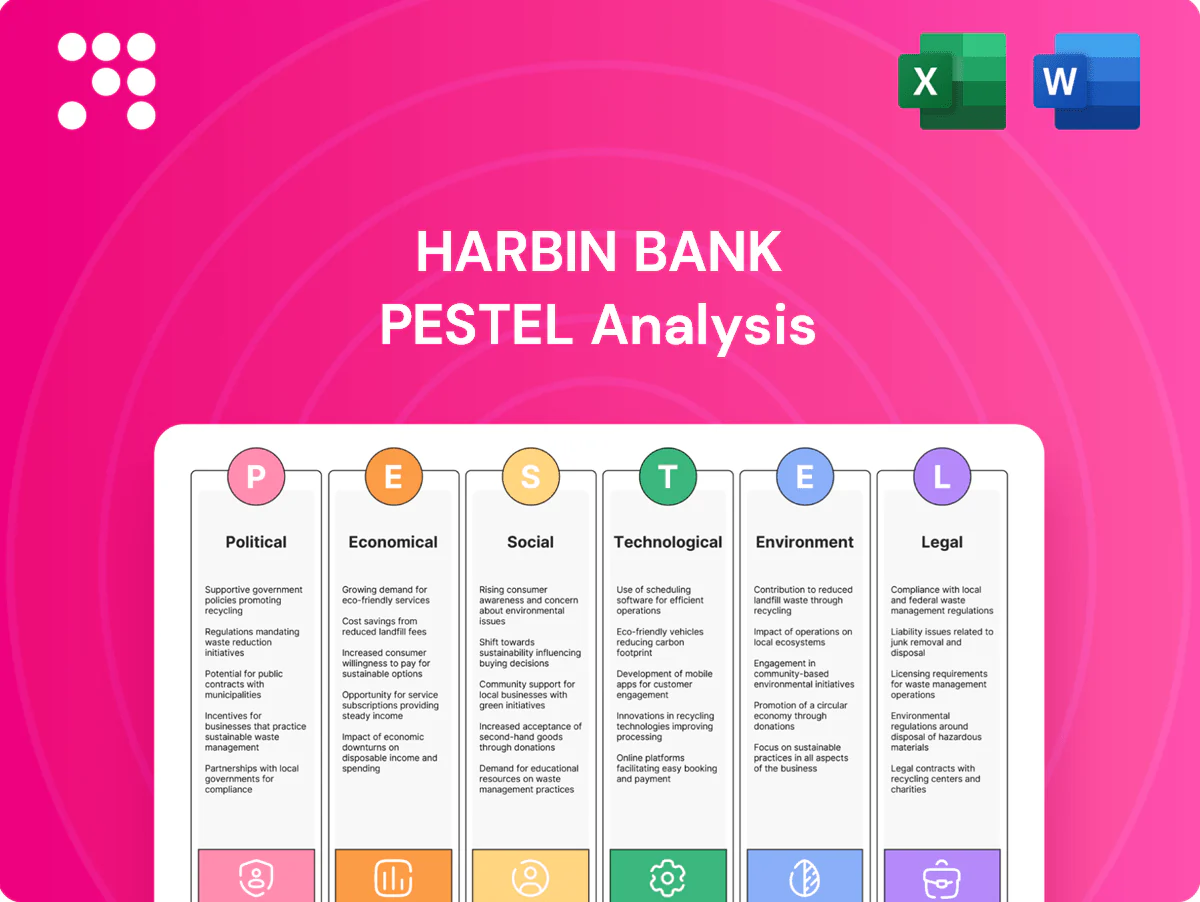
Harbin Bank PESTLE Analysis

Your Shortcut to Market Insight Starts Here
Gain a competitive edge with our PESTLE analysis of Harbin Bank. Analyze how political, economic, social, technological, legal and environmental forces shape its strategy and risk profile. Purchase the full report for actionable insights, charts and ready-to-use recommendations.
Political factors

State policy steering
China’s banking sector is tightly guided by central policy priorities that shape credit allocation and pricing, requiring Harbin Bank to steer loans toward initiatives like Northeast revitalization and SME support. Policy-driven lending can boost volumes but tends to compress margins and raise asset-quality risk. Close coordination with regulators and local party committees is essential to maintain stability and preserve the bank’s license to operate.
Monetary and credit controls
PBOC tools—reserve requirement ratio adjustments, benchmark LPR moves and window guidance—directly shift Harbin Bank’s funding costs and loan growth, with easing cycles boosting NIM-sensitive retail and SME lending while compressing margins.
Tightening to rein in leverage or property risk can slow asset expansion and elevate NPL formation, requiring close monitoring of sector exposures. Balance-sheet flexibility—liquidity buffers, duration management and capital planning—is essential to adjust swiftly to policy shifts.

Geopolitical exposure
Heightened US–China tensions and expanding sanctions regimes increase compliance complexity and counterparty risk for Harbin Bank, forcing investment in screening systems and legal teams. Restrictions can raise costs and limit access to foreign-currency funding even as China held about $3.2 trillion in FX reserves in 2024. Export-dependent corporate clients face greater cash-flow volatility, so the bank must diversify correspondent networks and upgrade sanctions screening.

Local government linkages
Regional banks like Harbin Bank often channel local policy goals, financing infrastructure and LGFVs; China issued about RMB 4.9 trillion in local government special bonds in 2023, supporting pipelines but concentrating credit in cyclical sectors. Debt-restructuring rules influence recoveries and provisioning, while active dialogue with authorities secures risk-sharing and contingency measures.
- Supports pipelines: strong local bond issuance (RMB 4.9tn, 2023)
- Concentration risk: infrastructure/LGFVs cyclical exposure
- Restructuring impact: affects recoveries/provisions
- Mitigation: active authority dialogue for risk-sharing
Common prosperity agenda
Beijing’s common prosperity push is shifting Harbin Bank toward inclusive finance—product design and pricing now favor microloans, rural services and capped-fee offerings, which can compress yields and raise the need for scale efficiencies.
- Shift: expand microfinance/rural services
- Impact: lower NIM pressure, needs scale
- Incentives: policy support if demonstrable impact
Policy-driven lending boosts volumes, squeezes NIM and raises asset-quality and compliance risks
Harbin Bank must align lending with Beijing’s priorities (Northeast revitalization, SMEs, common prosperity), which boosts volumes but compresses margins and raises asset-quality risk. PBOC tools (RRR, LPR, window guidance) directly affect funding costs and loan growth; easing narrows NIM. Geopolitical tensions and sanctions increase compliance costs and constrain FX access (China FX reserves $3.2tn, 2024).
| Metric | 2023–24 |
|---|---|
| Local govt special bonds | RMB 4.9tn (2023) |
| China FX reserves | $3.2tn (2024) |
What is included in the product
 Detailed Word Document
Provides a concise PESTLE evaluation of Harbin Bank, examining Political, Economic, Social, Technological, Environmental and Legal drivers with data-backed insights and forward-looking implications; tailored for executives and investors, it reflects regional market and regulatory dynamics and is formatted for direct use in reports, plans, or decks.

 Customizable Excel Spreadsheet
A concise, visually segmented Harbin Bank PESTLE analysis that’s easy to drop into presentations or share across teams, helping stakeholders quickly align on external risks, regulatory shifts, and market positioning for faster decision-making.
Economic factors

Growth moderation
Slower GDP growth—around 5% in 2024—and an uneven recovery depress loan demand and raise borrower credit risk for Harbin Bank. Prolonged corporate capex cycles, with fixed-asset investment expanding only about 3–4% in 2024, squeeze corporate banking pipelines. Tepid retail sentiment weakens deposit inflows and consumer lending growth, while stress tests must embed lower-for-longer GDP and rate scenarios.
Property sector stress
Developers’ liquidity strains—highlighted by distress at Evergrande, Sunac and Country Garden—plus new home sales down 8.8% YoY in 2024 raise real-estate and supply-chain NPL risks and push LGD higher as collateral values stay volatile. Mortgage growth is slowing and restructurings are rising, so tight underwriting and sector exposure caps are critical for Harbin Bank’s resilience.

Margin compression
Harbin Bank saw margin compression as 2024 rate cuts and intense local competition pushed asset yields down faster than liability repricing, squeezing NIM by roughly 25 basis points to about 2.05% year‑on‑year.
Deposit rate reforms and rising certificate‑of‑deposit costs increased funding expense, making fee income from wealth management and transaction services critical to offset interest shortfalls.
Tighter ALM discipline and targeted growth in low‑cost deposits (current and savings) have been prioritized to stabilize net interest income and preserve capital ratios.

SME and manufacturing cycle
Policy favors SME lending while SMEs — which generate roughly 60% of China GDP and 80% of urban jobs — remain sensitive to demand swings and rising input costs; manufacturing upgrades create equipment-finance and supply-chain finance opportunities. Risk-adjusted pricing, guarantees and data-driven underwriting improve returns and control heterogenous SME risk.
- SME exposure: high cyclicality
- Equipment finance: upgrade demand
- Pricing: risk-adjusted+guarantees
- Underwriting: data-driven segmentation
FX and liquidity dynamics
RMB volatility shapes trade-client settlements and treasury positioning, with Chinaʼs foreign-exchange reserves at about US$3.2 trillion at end-2024 providing a backstop; interbank liquidity swings drive funding stability and pricing, so Harbin Bank must hold prudent liquidity buffers and diversify wholesale channels; treasury decisions should align duration with expected rate path to manage mark-to-market and margin risks.
- RMB volatility — reserves ~US$3.2tn (end-2024)
- Interbank liquidity — impacts funding cost and roll-over risk
- Liquidity buffers — require conservative LCR/NSFR management
- Duration — align with rate forecasts to limit PV and funding mismatches
Policy-driven lending boosts volumes, squeezes NIM and raises asset-quality and compliance risks
Slower GDP (~5% in 2024) and softer retail/CapEx depress loan demand and raise credit risk; NIM compressed ~25bps to ~2.05% in 2024. Property stress (new home sales -8.8% YoY) and developer strains lift NPL/LGD risk; SMEs (≈60% GDP, 80% urban jobs) drive policy-led SME lending but remain cyclical. FX reserves ~US$3.2tn (end‑2024) and interbank swings force higher liquidity buffers and conservative ALM.
| Metric | Value (2024) |
|---|---|
| GDP growth | ~5% |
| NIM | ~2.05% (-25bps) |
| Home sales YoY | -8.8% |
| FX reserves | US$3.2tn |
| SME share | ≈60% GDP / 80% jobs |
Full Version Awaits
Harbin Bank PESTLE Analysis
The Harbin Bank PESTLE Analysis you see here is the exact document you’ll receive after purchase—fully formatted and ready to use. It provides a concise evaluation of political, economic, social, technological, legal, and environmental factors affecting Harbin Bank, with actionable insights for investors and strategists. No placeholders or teasers—this is the final, professional file available for immediate download.

Your Shortcut to Market Insight Starts Here
Gain a competitive edge with our PESTLE analysis of Harbin Bank. Analyze how political, economic, social, technological, legal and environmental forces shape its strategy and risk profile. Purchase the full report for actionable insights, charts and ready-to-use recommendations.
Political factors
State policy steering
China’s banking sector is tightly guided by central policy priorities that shape credit allocation and pricing, requiring Harbin Bank to steer loans toward initiatives like Northeast revitalization and SME support. Policy-driven lending can boost volumes but tends to compress margins and raise asset-quality risk. Close coordination with regulators and local party committees is essential to maintain stability and preserve the bank’s license to operate.
Monetary and credit controls
PBOC tools—reserve requirement ratio adjustments, benchmark LPR moves and window guidance—directly shift Harbin Bank’s funding costs and loan growth, with easing cycles boosting NIM-sensitive retail and SME lending while compressing margins.
Tightening to rein in leverage or property risk can slow asset expansion and elevate NPL formation, requiring close monitoring of sector exposures. Balance-sheet flexibility—liquidity buffers, duration management and capital planning—is essential to adjust swiftly to policy shifts.
Geopolitical exposure
Heightened US–China tensions and expanding sanctions regimes increase compliance complexity and counterparty risk for Harbin Bank, forcing investment in screening systems and legal teams. Restrictions can raise costs and limit access to foreign-currency funding even as China held about $3.2 trillion in FX reserves in 2024. Export-dependent corporate clients face greater cash-flow volatility, so the bank must diversify correspondent networks and upgrade sanctions screening.
Local government linkages
Regional banks like Harbin Bank often channel local policy goals, financing infrastructure and LGFVs; China issued about RMB 4.9 trillion in local government special bonds in 2023, supporting pipelines but concentrating credit in cyclical sectors. Debt-restructuring rules influence recoveries and provisioning, while active dialogue with authorities secures risk-sharing and contingency measures.
- Supports pipelines: strong local bond issuance (RMB 4.9tn, 2023)
- Concentration risk: infrastructure/LGFVs cyclical exposure
- Restructuring impact: affects recoveries/provisions
- Mitigation: active authority dialogue for risk-sharing
Common prosperity agenda
Beijing’s common prosperity push is shifting Harbin Bank toward inclusive finance—product design and pricing now favor microloans, rural services and capped-fee offerings, which can compress yields and raise the need for scale efficiencies.
- Shift: expand microfinance/rural services
- Impact: lower NIM pressure, needs scale
- Incentives: policy support if demonstrable impact
Policy-driven lending boosts volumes, squeezes NIM and raises asset-quality and compliance risks
Harbin Bank must align lending with Beijing’s priorities (Northeast revitalization, SMEs, common prosperity), which boosts volumes but compresses margins and raises asset-quality risk. PBOC tools (RRR, LPR, window guidance) directly affect funding costs and loan growth; easing narrows NIM. Geopolitical tensions and sanctions increase compliance costs and constrain FX access (China FX reserves $3.2tn, 2024).
| Metric | 2023–24 |
|---|---|
| Local govt special bonds | RMB 4.9tn (2023) |
| China FX reserves | $3.2tn (2024) |
What is included in the product
Detailed Word Document
Provides a concise PESTLE evaluation of Harbin Bank, examining Political, Economic, Social, Technological, Environmental and Legal drivers with data-backed insights and forward-looking implications; tailored for executives and investors, it reflects regional market and regulatory dynamics and is formatted for direct use in reports, plans, or decks.
Customizable Excel Spreadsheet
A concise, visually segmented Harbin Bank PESTLE analysis that’s easy to drop into presentations or share across teams, helping stakeholders quickly align on external risks, regulatory shifts, and market positioning for faster decision-making.
Economic factors
Growth moderation
Slower GDP growth—around 5% in 2024—and an uneven recovery depress loan demand and raise borrower credit risk for Harbin Bank. Prolonged corporate capex cycles, with fixed-asset investment expanding only about 3–4% in 2024, squeeze corporate banking pipelines. Tepid retail sentiment weakens deposit inflows and consumer lending growth, while stress tests must embed lower-for-longer GDP and rate scenarios.
Property sector stress
Developers’ liquidity strains—highlighted by distress at Evergrande, Sunac and Country Garden—plus new home sales down 8.8% YoY in 2024 raise real-estate and supply-chain NPL risks and push LGD higher as collateral values stay volatile. Mortgage growth is slowing and restructurings are rising, so tight underwriting and sector exposure caps are critical for Harbin Bank’s resilience.
Margin compression
Harbin Bank saw margin compression as 2024 rate cuts and intense local competition pushed asset yields down faster than liability repricing, squeezing NIM by roughly 25 basis points to about 2.05% year‑on‑year.
Deposit rate reforms and rising certificate‑of‑deposit costs increased funding expense, making fee income from wealth management and transaction services critical to offset interest shortfalls.
Tighter ALM discipline and targeted growth in low‑cost deposits (current and savings) have been prioritized to stabilize net interest income and preserve capital ratios.
SME and manufacturing cycle
Policy favors SME lending while SMEs — which generate roughly 60% of China GDP and 80% of urban jobs — remain sensitive to demand swings and rising input costs; manufacturing upgrades create equipment-finance and supply-chain finance opportunities. Risk-adjusted pricing, guarantees and data-driven underwriting improve returns and control heterogenous SME risk.
- SME exposure: high cyclicality
- Equipment finance: upgrade demand
- Pricing: risk-adjusted+guarantees
- Underwriting: data-driven segmentation
FX and liquidity dynamics
RMB volatility shapes trade-client settlements and treasury positioning, with Chinaʼs foreign-exchange reserves at about US$3.2 trillion at end-2024 providing a backstop; interbank liquidity swings drive funding stability and pricing, so Harbin Bank must hold prudent liquidity buffers and diversify wholesale channels; treasury decisions should align duration with expected rate path to manage mark-to-market and margin risks.
- RMB volatility — reserves ~US$3.2tn (end-2024)
- Interbank liquidity — impacts funding cost and roll-over risk
- Liquidity buffers — require conservative LCR/NSFR management
- Duration — align with rate forecasts to limit PV and funding mismatches
Policy-driven lending boosts volumes, squeezes NIM and raises asset-quality and compliance risks
Slower GDP (~5% in 2024) and softer retail/CapEx depress loan demand and raise credit risk; NIM compressed ~25bps to ~2.05% in 2024. Property stress (new home sales -8.8% YoY) and developer strains lift NPL/LGD risk; SMEs (≈60% GDP, 80% urban jobs) drive policy-led SME lending but remain cyclical. FX reserves ~US$3.2tn (end‑2024) and interbank swings force higher liquidity buffers and conservative ALM.
| Metric | Value (2024) |
|---|---|
| GDP growth | ~5% |
| NIM | ~2.05% (-25bps) |
| Home sales YoY | -8.8% |
| FX reserves | US$3.2tn |
| SME share | ≈60% GDP / 80% jobs |
Full Version Awaits
Harbin Bank PESTLE Analysis
The Harbin Bank PESTLE Analysis you see here is the exact document you’ll receive after purchase—fully formatted and ready to use. It provides a concise evaluation of political, economic, social, technological, legal, and environmental factors affecting Harbin Bank, with actionable insights for investors and strategists. No placeholders or teasers—this is the final, professional file available for immediate download.
Original: $10.00
-65%$10.00
$3.50Description
Your Shortcut to Market Insight Starts Here
Gain a competitive edge with our PESTLE analysis of Harbin Bank. Analyze how political, economic, social, technological, legal and environmental forces shape its strategy and risk profile. Purchase the full report for actionable insights, charts and ready-to-use recommendations.
Political factors
State policy steering
China’s banking sector is tightly guided by central policy priorities that shape credit allocation and pricing, requiring Harbin Bank to steer loans toward initiatives like Northeast revitalization and SME support. Policy-driven lending can boost volumes but tends to compress margins and raise asset-quality risk. Close coordination with regulators and local party committees is essential to maintain stability and preserve the bank’s license to operate.
Monetary and credit controls
PBOC tools—reserve requirement ratio adjustments, benchmark LPR moves and window guidance—directly shift Harbin Bank’s funding costs and loan growth, with easing cycles boosting NIM-sensitive retail and SME lending while compressing margins.
Tightening to rein in leverage or property risk can slow asset expansion and elevate NPL formation, requiring close monitoring of sector exposures. Balance-sheet flexibility—liquidity buffers, duration management and capital planning—is essential to adjust swiftly to policy shifts.
Geopolitical exposure
Heightened US–China tensions and expanding sanctions regimes increase compliance complexity and counterparty risk for Harbin Bank, forcing investment in screening systems and legal teams. Restrictions can raise costs and limit access to foreign-currency funding even as China held about $3.2 trillion in FX reserves in 2024. Export-dependent corporate clients face greater cash-flow volatility, so the bank must diversify correspondent networks and upgrade sanctions screening.
Local government linkages
Regional banks like Harbin Bank often channel local policy goals, financing infrastructure and LGFVs; China issued about RMB 4.9 trillion in local government special bonds in 2023, supporting pipelines but concentrating credit in cyclical sectors. Debt-restructuring rules influence recoveries and provisioning, while active dialogue with authorities secures risk-sharing and contingency measures.
- Supports pipelines: strong local bond issuance (RMB 4.9tn, 2023)
- Concentration risk: infrastructure/LGFVs cyclical exposure
- Restructuring impact: affects recoveries/provisions
- Mitigation: active authority dialogue for risk-sharing
Common prosperity agenda
Beijing’s common prosperity push is shifting Harbin Bank toward inclusive finance—product design and pricing now favor microloans, rural services and capped-fee offerings, which can compress yields and raise the need for scale efficiencies.
- Shift: expand microfinance/rural services
- Impact: lower NIM pressure, needs scale
- Incentives: policy support if demonstrable impact
Policy-driven lending boosts volumes, squeezes NIM and raises asset-quality and compliance risks
Harbin Bank must align lending with Beijing’s priorities (Northeast revitalization, SMEs, common prosperity), which boosts volumes but compresses margins and raises asset-quality risk. PBOC tools (RRR, LPR, window guidance) directly affect funding costs and loan growth; easing narrows NIM. Geopolitical tensions and sanctions increase compliance costs and constrain FX access (China FX reserves $3.2tn, 2024).
| Metric | 2023–24 |
|---|---|
| Local govt special bonds | RMB 4.9tn (2023) |
| China FX reserves | $3.2tn (2024) |
What is included in the product
Detailed Word Document
Provides a concise PESTLE evaluation of Harbin Bank, examining Political, Economic, Social, Technological, Environmental and Legal drivers with data-backed insights and forward-looking implications; tailored for executives and investors, it reflects regional market and regulatory dynamics and is formatted for direct use in reports, plans, or decks.
Customizable Excel Spreadsheet
A concise, visually segmented Harbin Bank PESTLE analysis that’s easy to drop into presentations or share across teams, helping stakeholders quickly align on external risks, regulatory shifts, and market positioning for faster decision-making.
Economic factors
Growth moderation
Slower GDP growth—around 5% in 2024—and an uneven recovery depress loan demand and raise borrower credit risk for Harbin Bank. Prolonged corporate capex cycles, with fixed-asset investment expanding only about 3–4% in 2024, squeeze corporate banking pipelines. Tepid retail sentiment weakens deposit inflows and consumer lending growth, while stress tests must embed lower-for-longer GDP and rate scenarios.
Property sector stress
Developers’ liquidity strains—highlighted by distress at Evergrande, Sunac and Country Garden—plus new home sales down 8.8% YoY in 2024 raise real-estate and supply-chain NPL risks and push LGD higher as collateral values stay volatile. Mortgage growth is slowing and restructurings are rising, so tight underwriting and sector exposure caps are critical for Harbin Bank’s resilience.
Margin compression
Harbin Bank saw margin compression as 2024 rate cuts and intense local competition pushed asset yields down faster than liability repricing, squeezing NIM by roughly 25 basis points to about 2.05% year‑on‑year.
Deposit rate reforms and rising certificate‑of‑deposit costs increased funding expense, making fee income from wealth management and transaction services critical to offset interest shortfalls.
Tighter ALM discipline and targeted growth in low‑cost deposits (current and savings) have been prioritized to stabilize net interest income and preserve capital ratios.
SME and manufacturing cycle
Policy favors SME lending while SMEs — which generate roughly 60% of China GDP and 80% of urban jobs — remain sensitive to demand swings and rising input costs; manufacturing upgrades create equipment-finance and supply-chain finance opportunities. Risk-adjusted pricing, guarantees and data-driven underwriting improve returns and control heterogenous SME risk.
- SME exposure: high cyclicality
- Equipment finance: upgrade demand
- Pricing: risk-adjusted+guarantees
- Underwriting: data-driven segmentation
FX and liquidity dynamics
RMB volatility shapes trade-client settlements and treasury positioning, with Chinaʼs foreign-exchange reserves at about US$3.2 trillion at end-2024 providing a backstop; interbank liquidity swings drive funding stability and pricing, so Harbin Bank must hold prudent liquidity buffers and diversify wholesale channels; treasury decisions should align duration with expected rate path to manage mark-to-market and margin risks.
- RMB volatility — reserves ~US$3.2tn (end-2024)
- Interbank liquidity — impacts funding cost and roll-over risk
- Liquidity buffers — require conservative LCR/NSFR management
- Duration — align with rate forecasts to limit PV and funding mismatches
Policy-driven lending boosts volumes, squeezes NIM and raises asset-quality and compliance risks
Slower GDP (~5% in 2024) and softer retail/CapEx depress loan demand and raise credit risk; NIM compressed ~25bps to ~2.05% in 2024. Property stress (new home sales -8.8% YoY) and developer strains lift NPL/LGD risk; SMEs (≈60% GDP, 80% urban jobs) drive policy-led SME lending but remain cyclical. FX reserves ~US$3.2tn (end‑2024) and interbank swings force higher liquidity buffers and conservative ALM.
| Metric | Value (2024) |
|---|---|
| GDP growth | ~5% |
| NIM | ~2.05% (-25bps) |
| Home sales YoY | -8.8% |
| FX reserves | US$3.2tn |
| SME share | ≈60% GDP / 80% jobs |
Full Version Awaits
Harbin Bank PESTLE Analysis
The Harbin Bank PESTLE Analysis you see here is the exact document you’ll receive after purchase—fully formatted and ready to use. It provides a concise evaluation of political, economic, social, technological, legal, and environmental factors affecting Harbin Bank, with actionable insights for investors and strategists. No placeholders or teasers—this is the final, professional file available for immediate download.











