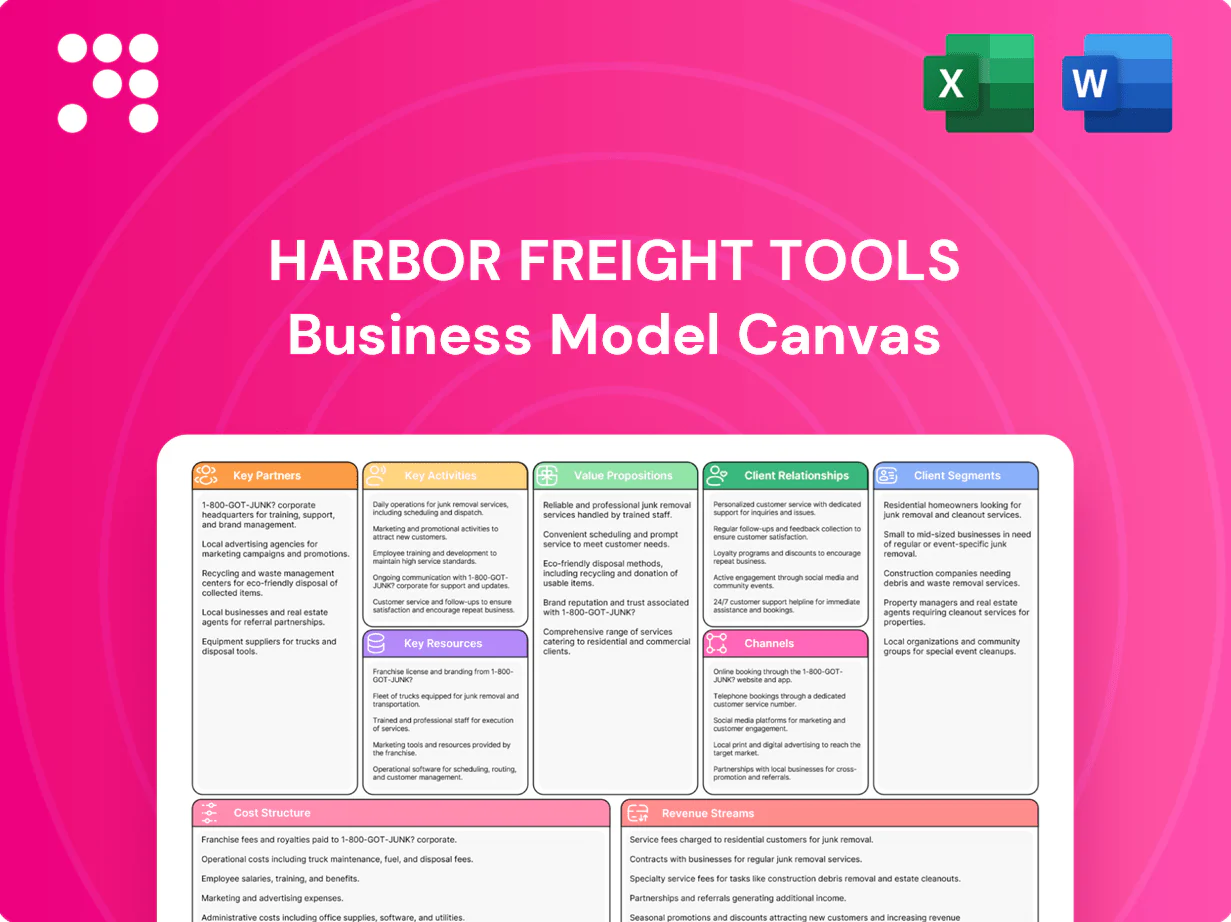
Harbor Freight Tools Business Model Canvas

Unlock a low-cost retail tools playbook: Business Model Canvas for margin-driven growth
Unlock the strategic blueprint behind Harbor Freight Tools with a concise Business Model Canvas that maps customer segments, value propositions, channels, and revenue streams. Discover how low-cost sourcing, proprietary brands, and store footprint drive margin and growth. Ideal for investors, advisors, and founders seeking actionable insights—download the full, editable canvas for a section-by-section playbook.
Partnerships

Overseas manufacturers
Harbor Freight sources private‑label tools from a broad network of Asian and global factories, enabling direct sourcing that cuts intermediaries and supports aggressive pricing; the chain operates over 1,400 stores and roughly 20,000 employees (2024), while long‑term supplier ties ensure consistent quality and volume and vendor diversification reduces supply risk and capacity constraints.
Logistics and freight providers
Ocean carriers, freight forwarders and drayage partners move high-volume containers to U.S. ports and Harbor Freight distribution centers, supporting over 1,400 U.S. stores and roughly $8 billion revenue in 2024. Reliable logistics keep in-stock rates high and lead times predictable. Consolidation and routing optimization lower landed costs, while capacity reservations and flexible contracts smooth seasonal surges.

Distribution and 3PL partners
Regional DCs and third-party logistics partners support nationwide replenishment for Harbor Freight's network of over 1,400 stores (2024), enabling consistent store stock levels. Cross-docking and pallet optimization accelerate store turns and reduce carrying costs. Service-level agreements maintain uptime and delivery windows. Real-time data sharing with 3PLs improves demand forecasting and shelf slotting.

Payment and financing partners
Card processors, BNPL providers (Klarna reports AOV lifts of ~44%) and commercial credit partners enable seamless checkout both online and in‑store, helping combat a 2024 cart abandonment rate of ~69.6% (Baymard). Integrated risk management reduces chargebacks and fraud, while financing for big-ticket items raises average order value and conversion.
- payment-processors
- bnpl-44%_AOV
- commercial-credit
- risk-reduction
- higher-AOV
Marketing and marketplace partners
Marketing and marketplace partners drive Harbor Freight Tools' customer acquisition across digital advertising and affiliate programs, feeding both online orders and traffic to 1,400+ U.S. stores (2024). Email, SMS and retargeting partners power time-sensitive promotions and clearance flows, while selective marketplace integrations expand reach in strategic categories. Analytics partners attribute spend to sales and continuously optimize ROAS.
- Digital ads + affiliates: primary traffic drivers
- Email/SMS/retargeting: promotion + clearance execution
- Marketplaces: selective reach expansion
- Analytics: spend-to-sales attribution, ROAS optimization
Private‑label sourcing, logistics & BNPL drive sales across 1,400+ stores
Harbor Freight relies on private‑label Asian/global suppliers for low‑cost SKUs, supporting 1,400+ stores and ~20,000 employees (2024) and enabling ~$8B revenue; ocean carriers, drayage and 3PLs keep replenishment stable and reduce landed costs; payment partners and BNPL (Klarna-like AOV +44%) lift conversion amid a 69.6% cart abandonment rate; marketing/analytics partners drive ROAS and store traffic.
| Partnership | Role | 2024 Metric |
|---|---|---|
| Suppliers | Private‑label sourcing | 1,400+ stores; ~$8B rev |
| Logistics | Ocean/3PL/DCs | High in‑stock, lower landed cost |
| Payments | Processors/BNPL | BNPL +44% AOV; 69.6% cart abandon |
| Marketing | Digital/analytics | ROAS optimization |
What is included in the product
 Detailed Word Document
A comprehensive Business Model Canvas for Harbor Freight Tools detailing customer segments, channels, value propositions, revenue streams, key activities and partners across the 9 BMC blocks. Ideal for investors and analysts, it includes competitive advantages, SWOT-linked insights and operational narratives to support strategic decisions and funding discussions.

 Customizable Excel Spreadsheet
High-level Business Model Canvas for Harbor Freight Tools that pinpoints operational pain points—supply-chain strain, pricing/margin levers, store expansion trade-offs, and customer retention—so teams can quickly prioritize fixes with an editable one-page snapshot for fast decision-making and collaboration.
Activities

Direct sourcing and procurement
Direct sourcing at Harbor Freight centers on negotiating factory contracts and MOQs to sustain cost leadership across its over 1,400 stores in 2024. Tight specification control enforces consistent private‑label quality and SKU economics. Regular vendor audits and lab sampling manage quality and compliance, while currency hedging and centralized FX decisions protect gross margins against volatile USD moves.
Assortment and merchandising
Curating a broad yet focused tool lineup balances traffic and profitability across Harbor Freight’s more than 1,400 stores (2024), prioritizing high-turn SKUs and private-label depth. Planograms and endcaps highlight value and seasonal needs to boost basket size and clear slow items. A price architecture ladders good‑better‑best tiers while promotion calendars clear inventory and drive repeat visits.

Inventory and supply planning
Demand forecasting synchronizes imports, DC capacity and replenishment across Harbor Freight’s network of over 1,400 U.S. stores, using weekly SKU-level models to cut stockouts. Safety stocks and automated reorder points preserve on‑shelf availability while markdown and dynamic allocation reduce overstocks. Lead‑time compression from suppliers shortens DIO, improving cash conversion.

Retail operations and e‑commerce
Store execution, staffing and checkout speed directly shape customer experience across Harbor Freights over 1,400 stores (2024), driving basket size and repeat visits; fast, staffed registers reduce abandoned purchases. BOPIS and ship-to-home link online discovery with in-store fulfillment to increase convenience and reduce last-mile costs. Website optimization improves findability and conversion, while robust post-purchase support cuts returns and builds loyalty.
- Store network: over 1,400 stores (2024)
- Checkout speed: critical to conversion
- BOPIS/ship-to-home: bridges channels
- Site UX: increases online conversion
- Post-purchase support: lowers returns, boosts loyalty
Quality and compliance management
Product testing verifies safety and performance against claims, feeding warranty processes that capture defects and root causes; Harbor Freight operated over 1,500 stores in 2024 and scales testing to limit liability. Regulatory compliance prevents penalties and import delays, protecting inventory flow. Continuous improvement programs target lower failure rates and reduced warranty costs.
- Testing: safety/performance validation
- Warranty: defect capture & root-cause analysis
- Compliance: avoid penalties/import delays
- CI: lower failures, cut warranty costs
Direct sourcing, tight private‑label specs and weekly SKU forecasts drive low costs and high service
Direct sourcing and tight private‑label specs sustain cost leadership across Harbor Freight’s over 1,400 stores (2024). Weekly SKU‑level demand forecasts sync imports, DCs and replenishment to cut stockouts and DIO. Store execution, fast checkout and BOPIS/ship‑to‑home link digital discovery to in‑store fulfillment, while testing and warranty programs limit liability and reduce returns.
| Metric | Value (2024) |
|---|---|
| Store count | over 1,400 |
| Forecast cadence | weekly SKU models |
| Channels | BOPIS, ship‑to‑home, online |
| Quality controls | testing, audits, warranty |
Preview Before You Purchase
Business Model Canvas
The document previewed here is the exact Harbor Freight Tools Business Model Canvas you’ll receive after purchase. It’s not a mockup—this live preview reflects the final, fully editable file with the same structure, content, and formatting. After purchase you’ll instantly download this precise document ready for editing, presenting, and sharing.

Unlock a low-cost retail tools playbook: Business Model Canvas for margin-driven growth
Unlock the strategic blueprint behind Harbor Freight Tools with a concise Business Model Canvas that maps customer segments, value propositions, channels, and revenue streams. Discover how low-cost sourcing, proprietary brands, and store footprint drive margin and growth. Ideal for investors, advisors, and founders seeking actionable insights—download the full, editable canvas for a section-by-section playbook.
Partnerships
Overseas manufacturers
Harbor Freight sources private‑label tools from a broad network of Asian and global factories, enabling direct sourcing that cuts intermediaries and supports aggressive pricing; the chain operates over 1,400 stores and roughly 20,000 employees (2024), while long‑term supplier ties ensure consistent quality and volume and vendor diversification reduces supply risk and capacity constraints.
Logistics and freight providers
Ocean carriers, freight forwarders and drayage partners move high-volume containers to U.S. ports and Harbor Freight distribution centers, supporting over 1,400 U.S. stores and roughly $8 billion revenue in 2024. Reliable logistics keep in-stock rates high and lead times predictable. Consolidation and routing optimization lower landed costs, while capacity reservations and flexible contracts smooth seasonal surges.
Distribution and 3PL partners
Regional DCs and third-party logistics partners support nationwide replenishment for Harbor Freight's network of over 1,400 stores (2024), enabling consistent store stock levels. Cross-docking and pallet optimization accelerate store turns and reduce carrying costs. Service-level agreements maintain uptime and delivery windows. Real-time data sharing with 3PLs improves demand forecasting and shelf slotting.
Payment and financing partners
Card processors, BNPL providers (Klarna reports AOV lifts of ~44%) and commercial credit partners enable seamless checkout both online and in‑store, helping combat a 2024 cart abandonment rate of ~69.6% (Baymard). Integrated risk management reduces chargebacks and fraud, while financing for big-ticket items raises average order value and conversion.
- payment-processors
- bnpl-44%_AOV
- commercial-credit
- risk-reduction
- higher-AOV
Marketing and marketplace partners
Marketing and marketplace partners drive Harbor Freight Tools' customer acquisition across digital advertising and affiliate programs, feeding both online orders and traffic to 1,400+ U.S. stores (2024). Email, SMS and retargeting partners power time-sensitive promotions and clearance flows, while selective marketplace integrations expand reach in strategic categories. Analytics partners attribute spend to sales and continuously optimize ROAS.
- Digital ads + affiliates: primary traffic drivers
- Email/SMS/retargeting: promotion + clearance execution
- Marketplaces: selective reach expansion
- Analytics: spend-to-sales attribution, ROAS optimization
Private‑label sourcing, logistics & BNPL drive sales across 1,400+ stores
Harbor Freight relies on private‑label Asian/global suppliers for low‑cost SKUs, supporting 1,400+ stores and ~20,000 employees (2024) and enabling ~$8B revenue; ocean carriers, drayage and 3PLs keep replenishment stable and reduce landed costs; payment partners and BNPL (Klarna-like AOV +44%) lift conversion amid a 69.6% cart abandonment rate; marketing/analytics partners drive ROAS and store traffic.
| Partnership | Role | 2024 Metric |
|---|---|---|
| Suppliers | Private‑label sourcing | 1,400+ stores; ~$8B rev |
| Logistics | Ocean/3PL/DCs | High in‑stock, lower landed cost |
| Payments | Processors/BNPL | BNPL +44% AOV; 69.6% cart abandon |
| Marketing | Digital/analytics | ROAS optimization |
What is included in the product
Detailed Word Document
A comprehensive Business Model Canvas for Harbor Freight Tools detailing customer segments, channels, value propositions, revenue streams, key activities and partners across the 9 BMC blocks. Ideal for investors and analysts, it includes competitive advantages, SWOT-linked insights and operational narratives to support strategic decisions and funding discussions.
Customizable Excel Spreadsheet
High-level Business Model Canvas for Harbor Freight Tools that pinpoints operational pain points—supply-chain strain, pricing/margin levers, store expansion trade-offs, and customer retention—so teams can quickly prioritize fixes with an editable one-page snapshot for fast decision-making and collaboration.
Activities
Direct sourcing and procurement
Direct sourcing at Harbor Freight centers on negotiating factory contracts and MOQs to sustain cost leadership across its over 1,400 stores in 2024. Tight specification control enforces consistent private‑label quality and SKU economics. Regular vendor audits and lab sampling manage quality and compliance, while currency hedging and centralized FX decisions protect gross margins against volatile USD moves.
Assortment and merchandising
Curating a broad yet focused tool lineup balances traffic and profitability across Harbor Freight’s more than 1,400 stores (2024), prioritizing high-turn SKUs and private-label depth. Planograms and endcaps highlight value and seasonal needs to boost basket size and clear slow items. A price architecture ladders good‑better‑best tiers while promotion calendars clear inventory and drive repeat visits.
Inventory and supply planning
Demand forecasting synchronizes imports, DC capacity and replenishment across Harbor Freight’s network of over 1,400 U.S. stores, using weekly SKU-level models to cut stockouts. Safety stocks and automated reorder points preserve on‑shelf availability while markdown and dynamic allocation reduce overstocks. Lead‑time compression from suppliers shortens DIO, improving cash conversion.
Retail operations and e‑commerce
Store execution, staffing and checkout speed directly shape customer experience across Harbor Freights over 1,400 stores (2024), driving basket size and repeat visits; fast, staffed registers reduce abandoned purchases. BOPIS and ship-to-home link online discovery with in-store fulfillment to increase convenience and reduce last-mile costs. Website optimization improves findability and conversion, while robust post-purchase support cuts returns and builds loyalty.
- Store network: over 1,400 stores (2024)
- Checkout speed: critical to conversion
- BOPIS/ship-to-home: bridges channels
- Site UX: increases online conversion
- Post-purchase support: lowers returns, boosts loyalty
Quality and compliance management
Product testing verifies safety and performance against claims, feeding warranty processes that capture defects and root causes; Harbor Freight operated over 1,500 stores in 2024 and scales testing to limit liability. Regulatory compliance prevents penalties and import delays, protecting inventory flow. Continuous improvement programs target lower failure rates and reduced warranty costs.
- Testing: safety/performance validation
- Warranty: defect capture & root-cause analysis
- Compliance: avoid penalties/import delays
- CI: lower failures, cut warranty costs
Direct sourcing, tight private‑label specs and weekly SKU forecasts drive low costs and high service
Direct sourcing and tight private‑label specs sustain cost leadership across Harbor Freight’s over 1,400 stores (2024). Weekly SKU‑level demand forecasts sync imports, DCs and replenishment to cut stockouts and DIO. Store execution, fast checkout and BOPIS/ship‑to‑home link digital discovery to in‑store fulfillment, while testing and warranty programs limit liability and reduce returns.
| Metric | Value (2024) |
|---|---|
| Store count | over 1,400 |
| Forecast cadence | weekly SKU models |
| Channels | BOPIS, ship‑to‑home, online |
| Quality controls | testing, audits, warranty |
Preview Before You Purchase
Business Model Canvas
The document previewed here is the exact Harbor Freight Tools Business Model Canvas you’ll receive after purchase. It’s not a mockup—this live preview reflects the final, fully editable file with the same structure, content, and formatting. After purchase you’ll instantly download this precise document ready for editing, presenting, and sharing.
Description
Unlock a low-cost retail tools playbook: Business Model Canvas for margin-driven growth
Unlock the strategic blueprint behind Harbor Freight Tools with a concise Business Model Canvas that maps customer segments, value propositions, channels, and revenue streams. Discover how low-cost sourcing, proprietary brands, and store footprint drive margin and growth. Ideal for investors, advisors, and founders seeking actionable insights—download the full, editable canvas for a section-by-section playbook.
Partnerships
Overseas manufacturers
Harbor Freight sources private‑label tools from a broad network of Asian and global factories, enabling direct sourcing that cuts intermediaries and supports aggressive pricing; the chain operates over 1,400 stores and roughly 20,000 employees (2024), while long‑term supplier ties ensure consistent quality and volume and vendor diversification reduces supply risk and capacity constraints.
Logistics and freight providers
Ocean carriers, freight forwarders and drayage partners move high-volume containers to U.S. ports and Harbor Freight distribution centers, supporting over 1,400 U.S. stores and roughly $8 billion revenue in 2024. Reliable logistics keep in-stock rates high and lead times predictable. Consolidation and routing optimization lower landed costs, while capacity reservations and flexible contracts smooth seasonal surges.
Distribution and 3PL partners
Regional DCs and third-party logistics partners support nationwide replenishment for Harbor Freight's network of over 1,400 stores (2024), enabling consistent store stock levels. Cross-docking and pallet optimization accelerate store turns and reduce carrying costs. Service-level agreements maintain uptime and delivery windows. Real-time data sharing with 3PLs improves demand forecasting and shelf slotting.
Payment and financing partners
Card processors, BNPL providers (Klarna reports AOV lifts of ~44%) and commercial credit partners enable seamless checkout both online and in‑store, helping combat a 2024 cart abandonment rate of ~69.6% (Baymard). Integrated risk management reduces chargebacks and fraud, while financing for big-ticket items raises average order value and conversion.
- payment-processors
- bnpl-44%_AOV
- commercial-credit
- risk-reduction
- higher-AOV
Marketing and marketplace partners
Marketing and marketplace partners drive Harbor Freight Tools' customer acquisition across digital advertising and affiliate programs, feeding both online orders and traffic to 1,400+ U.S. stores (2024). Email, SMS and retargeting partners power time-sensitive promotions and clearance flows, while selective marketplace integrations expand reach in strategic categories. Analytics partners attribute spend to sales and continuously optimize ROAS.
- Digital ads + affiliates: primary traffic drivers
- Email/SMS/retargeting: promotion + clearance execution
- Marketplaces: selective reach expansion
- Analytics: spend-to-sales attribution, ROAS optimization
Private‑label sourcing, logistics & BNPL drive sales across 1,400+ stores
Harbor Freight relies on private‑label Asian/global suppliers for low‑cost SKUs, supporting 1,400+ stores and ~20,000 employees (2024) and enabling ~$8B revenue; ocean carriers, drayage and 3PLs keep replenishment stable and reduce landed costs; payment partners and BNPL (Klarna-like AOV +44%) lift conversion amid a 69.6% cart abandonment rate; marketing/analytics partners drive ROAS and store traffic.
| Partnership | Role | 2024 Metric |
|---|---|---|
| Suppliers | Private‑label sourcing | 1,400+ stores; ~$8B rev |
| Logistics | Ocean/3PL/DCs | High in‑stock, lower landed cost |
| Payments | Processors/BNPL | BNPL +44% AOV; 69.6% cart abandon |
| Marketing | Digital/analytics | ROAS optimization |
What is included in the product
Detailed Word Document
A comprehensive Business Model Canvas for Harbor Freight Tools detailing customer segments, channels, value propositions, revenue streams, key activities and partners across the 9 BMC blocks. Ideal for investors and analysts, it includes competitive advantages, SWOT-linked insights and operational narratives to support strategic decisions and funding discussions.
Customizable Excel Spreadsheet
High-level Business Model Canvas for Harbor Freight Tools that pinpoints operational pain points—supply-chain strain, pricing/margin levers, store expansion trade-offs, and customer retention—so teams can quickly prioritize fixes with an editable one-page snapshot for fast decision-making and collaboration.
Activities
Direct sourcing and procurement
Direct sourcing at Harbor Freight centers on negotiating factory contracts and MOQs to sustain cost leadership across its over 1,400 stores in 2024. Tight specification control enforces consistent private‑label quality and SKU economics. Regular vendor audits and lab sampling manage quality and compliance, while currency hedging and centralized FX decisions protect gross margins against volatile USD moves.
Assortment and merchandising
Curating a broad yet focused tool lineup balances traffic and profitability across Harbor Freight’s more than 1,400 stores (2024), prioritizing high-turn SKUs and private-label depth. Planograms and endcaps highlight value and seasonal needs to boost basket size and clear slow items. A price architecture ladders good‑better‑best tiers while promotion calendars clear inventory and drive repeat visits.
Inventory and supply planning
Demand forecasting synchronizes imports, DC capacity and replenishment across Harbor Freight’s network of over 1,400 U.S. stores, using weekly SKU-level models to cut stockouts. Safety stocks and automated reorder points preserve on‑shelf availability while markdown and dynamic allocation reduce overstocks. Lead‑time compression from suppliers shortens DIO, improving cash conversion.
Retail operations and e‑commerce
Store execution, staffing and checkout speed directly shape customer experience across Harbor Freights over 1,400 stores (2024), driving basket size and repeat visits; fast, staffed registers reduce abandoned purchases. BOPIS and ship-to-home link online discovery with in-store fulfillment to increase convenience and reduce last-mile costs. Website optimization improves findability and conversion, while robust post-purchase support cuts returns and builds loyalty.
- Store network: over 1,400 stores (2024)
- Checkout speed: critical to conversion
- BOPIS/ship-to-home: bridges channels
- Site UX: increases online conversion
- Post-purchase support: lowers returns, boosts loyalty
Quality and compliance management
Product testing verifies safety and performance against claims, feeding warranty processes that capture defects and root causes; Harbor Freight operated over 1,500 stores in 2024 and scales testing to limit liability. Regulatory compliance prevents penalties and import delays, protecting inventory flow. Continuous improvement programs target lower failure rates and reduced warranty costs.
- Testing: safety/performance validation
- Warranty: defect capture & root-cause analysis
- Compliance: avoid penalties/import delays
- CI: lower failures, cut warranty costs
Direct sourcing, tight private‑label specs and weekly SKU forecasts drive low costs and high service
Direct sourcing and tight private‑label specs sustain cost leadership across Harbor Freight’s over 1,400 stores (2024). Weekly SKU‑level demand forecasts sync imports, DCs and replenishment to cut stockouts and DIO. Store execution, fast checkout and BOPIS/ship‑to‑home link digital discovery to in‑store fulfillment, while testing and warranty programs limit liability and reduce returns.
| Metric | Value (2024) |
|---|---|
| Store count | over 1,400 |
| Forecast cadence | weekly SKU models |
| Channels | BOPIS, ship‑to‑home, online |
| Quality controls | testing, audits, warranty |
Preview Before You Purchase
Business Model Canvas
The document previewed here is the exact Harbor Freight Tools Business Model Canvas you’ll receive after purchase. It’s not a mockup—this live preview reflects the final, fully editable file with the same structure, content, and formatting. After purchase you’ll instantly download this precise document ready for editing, presenting, and sharing.











