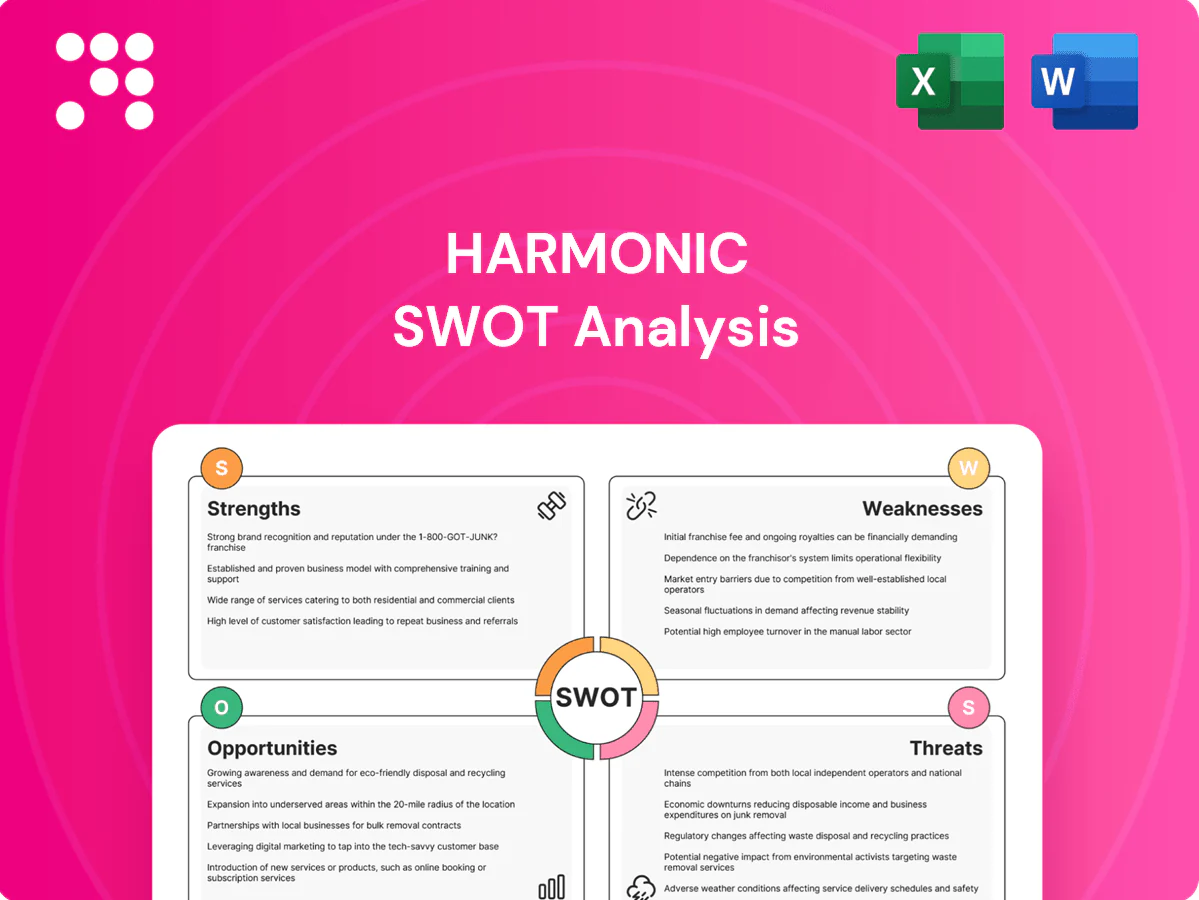
Harmonic SWOT Analysis

Your Strategic Toolkit Starts Here
Discover how Harmonic’s competitive edge, hidden risks, and growth levers shape its market trajectory in our concise SWOT snapshot. This preview highlights key strengths and vulnerabilities—but the full SWOT delivers deep, research-driven analysis, financial context, and tactical recommendations. Purchase the complete report for a professionally formatted Word file and editable Excel matrix. Equip your strategy, pitch, or investment decision with expert insight.
Strengths

End-to-end video workflow coverage
Harmonic offers an end-to-end video workflow—contribution, playout, encoding, packaging, delivery and monetization—in a unified stack, reducing vendor sprawl and integration risk for broadcasters and streamers. This consolidation streamlines operations, accelerates launches and lowers total cost of ownership. The integrated approach differentiates Harmonic versus point-solution competitors by simplifying deployment and support.
Cloud-native, software-first portfolio
Cloud-native, software-first portfolio enables elastic scaling for live and VOD peaks (often requiring up to 10x burst capacity), delivers faster feature velocity and lower capex attractive to OTT and hybrid broadcasters, and drives subscription-recurring revenue that can lift visibility (recurring mixes often ~60%), while portability across public clouds and on-prem edge reduces vendor lock-in and deployment time.

Proven broadcast-grade quality
Optimized codecs and per-title encoding cut required bitrates by roughly 30–50%, enabling 4K/HDR and low-latency delivery at lower cost. Proven reliability with marquee events and 99.99% SLAs supports premium contracts. Strength in live sports and news boosts brand trust and viewership retention. Quality-led delivery can lower CDN egress costs by as much as 30–40% for customers.

Monetization and SSAI capabilities
Harmonic's server-side ad insertion and targeted ad tech capitalize on FAST and AVOD growth by enabling seamless, scalable ad delivery that matches current streaming demand.
Dynamic ad replacement increases yield and circumvents client-side ad-blockers, improving CPM realization for media customers.
Tight integration with measurement and DRM reduces deployment friction and supports a clear ROI narrative for broadcasters and advertisers.
- SSAI-driven yield uplift
- Ad-blocking mitigation
- Measurement + DRM integration
- Clear ROI for media clients
Global customer base and partnerships
Harmonic's installed base across tier‑1 media companies and service providers de‑risks adoption by delivering proven deployments and repeatable ROI; ecosystem integrations with AWS, Azure, major CDNs and DRM vendors shorten sales cycles and simplify proofs of concept. Reference wins across APAC, EMEA and AMER in 2024 support regional expansion, while post‑sales services deepen relationships and drive renewals.
- Installed base: proven deployments with tier‑1 operators
- Cloud/CDN/DRM integrations: faster sales cycles
- 2024 reference wins: multi‑region validation
- Post‑sales services: increased renewals and upsell
Cloud-native media: 10x burst scaling, ~60% recurring mix
End-to-end stack reduces vendor sprawl, shortens launches and lowers TCO. Cloud-native portfolio enables elastic 10x burst scaling and drives ~60% recurring revenue mix (2024). Codec optimizations cut bitrates ~30–50%, lowering CDN egress ~30–40% and supporting 4K/HDR; proven 99.99% SLAs and 2024 tier‑1 wins across APAC/EMEA/AMER.
| Metric | Value (2024/2025) |
|---|---|
| Recurring mix | ~60% |
| Bitrate reduction | 30–50% |
| CDN egress savings | 30–40% |
| SLA | 99.99% |
| Burst scaling | up to 10x |
What is included in the product
 Detailed Word Document
Provides a concise SWOT assessment of Harmonic, highlighting internal strengths and weaknesses alongside external opportunities and threats to inform strategic decisions and competitive positioning.

 Customizable Excel Spreadsheet
Harmonic SWOT Analysis consolidates strengths, weaknesses, opportunities, and threats into a harmonized, visual framework to quickly resolve conflicting priorities and align teams. Its editable layout accelerates decision-making and keeps strategy adaptable as conditions change.
Weaknesses

Exposure to media capex cycles
Exposure to media capex cycles ties Harmonic to cyclical, event-driven broadcast and telco budgets, where political/seasonal spend spikes create project-timing risk and revenue lumpiness. Macro slowdowns delayed upgrades and migrations in 2023–24; Gartner forecast global IT spending growth at 3.9% in 2024, tightening upgrade cycles and making forecasting more challenging.
Intense competitive landscape
Harmonic competes directly with hyperscalers—AWS, Azure, GCP—which together held about 67% of the global cloud market in 2024 per Synergy Research, enabling bundled media services that pressure standalone encoding and delivery vendors. Price compression in commoditized transcoding and CDN functions erodes margins and forces continuous R&D investment to sustain differentiation. Larger competitors leverage bundling to undercut on total cost of ownership.

Dependence on hyperscale clouds
SaaS delivery depends on third-party hyperscale clouds (Gartner 2024: AWS, Microsoft, Google ~66% combined), concentrating operational and pricing leverage; volatile cloud pricing and egress charges squeeze gross margins, partner platform API or service changes create roadmap and delivery risk, and persistent coopetition with cloud providers can shift customers or force margin-dilutive concessions.

Legacy hardware and integration burden
Supporting mixed on-prem and cloud estates increases complexity for Harmonic, with Gartner 2024 reporting 73% of enterprises operating hybrid environments, driving longer integration cycles and higher engineering overhead. Custom integrations routinely extend deployment timelines by months, elevating field support costs that pressured margins in 2024. Migration friction is slowing SaaS adoption, reducing recurring-revenue velocity.
- Hybrid prevalence: Gartner 2024 — 73%
- Longer deployments: custom integrations add months
- Field support: weight on 2024 margins
- Migration friction: slower SaaS ARR growth
Customer concentration risk
Large accounts can represent a substantial share of Harmonic’s revenue; in FY2024 Harmonic reported $377.3 million in revenue with its largest customer accounting for about 18% of sales, concentrating cashflow risk. Contract renewals frequently carry pricing pressure as tier-1 operators seek lower unit costs, and losing a top customer would materially impact results and margins. Negotiating leverage often favors tier-1 operators given scale and alternative suppliers.
- Top-customer concentration ~18%
- FY2024 revenue $377.3M
- Renewals face pricing pressure
- Loss of top client = material impact
Hyperscaler pressure and top-customer concentration compress margins, raise cashflow risk
Exposure to volatile media capex and customer seasonality creates revenue lumpiness; hyperscaler competition and commoditization (cloud providers ~67% share, Synergy 2024) compress prices; dependency on hyperscale clouds (~66% combined, Gartner 2024) and egress/variable pricing squeeze margins; top-customer concentration (FY2024 revenue $377.3M; largest ~18%) amplifies cashflow risk.
| Metric | Value |
|---|---|
| FY2024 revenue | $377.3M |
| Top-customer share | ~18% |
| Hyperscaler market (2024) | ~67% (Synergy) |
| Hybrid enterprise prevalence | 73% (Gartner 2024) |
| Global IT spend growth 2024 | 3.9% (Gartner) |
What You See Is What You Get
Harmonic SWOT Analysis
This preview is the actual Harmonic SWOT Analysis document you’ll receive upon purchase—no samples or placeholders. The excerpt below is taken directly from the full, editable report. Purchase unlocks the complete, professionally formatted analysis ready for download and use. Buy to access the entire detailed file.

Your Strategic Toolkit Starts Here
Discover how Harmonic’s competitive edge, hidden risks, and growth levers shape its market trajectory in our concise SWOT snapshot. This preview highlights key strengths and vulnerabilities—but the full SWOT delivers deep, research-driven analysis, financial context, and tactical recommendations. Purchase the complete report for a professionally formatted Word file and editable Excel matrix. Equip your strategy, pitch, or investment decision with expert insight.
Strengths
End-to-end video workflow coverage
Harmonic offers an end-to-end video workflow—contribution, playout, encoding, packaging, delivery and monetization—in a unified stack, reducing vendor sprawl and integration risk for broadcasters and streamers. This consolidation streamlines operations, accelerates launches and lowers total cost of ownership. The integrated approach differentiates Harmonic versus point-solution competitors by simplifying deployment and support.
Cloud-native, software-first portfolio
Cloud-native, software-first portfolio enables elastic scaling for live and VOD peaks (often requiring up to 10x burst capacity), delivers faster feature velocity and lower capex attractive to OTT and hybrid broadcasters, and drives subscription-recurring revenue that can lift visibility (recurring mixes often ~60%), while portability across public clouds and on-prem edge reduces vendor lock-in and deployment time.
Proven broadcast-grade quality
Optimized codecs and per-title encoding cut required bitrates by roughly 30–50%, enabling 4K/HDR and low-latency delivery at lower cost. Proven reliability with marquee events and 99.99% SLAs supports premium contracts. Strength in live sports and news boosts brand trust and viewership retention. Quality-led delivery can lower CDN egress costs by as much as 30–40% for customers.
Monetization and SSAI capabilities
Harmonic's server-side ad insertion and targeted ad tech capitalize on FAST and AVOD growth by enabling seamless, scalable ad delivery that matches current streaming demand.
Dynamic ad replacement increases yield and circumvents client-side ad-blockers, improving CPM realization for media customers.
Tight integration with measurement and DRM reduces deployment friction and supports a clear ROI narrative for broadcasters and advertisers.
- SSAI-driven yield uplift
- Ad-blocking mitigation
- Measurement + DRM integration
- Clear ROI for media clients
Global customer base and partnerships
Harmonic's installed base across tier‑1 media companies and service providers de‑risks adoption by delivering proven deployments and repeatable ROI; ecosystem integrations with AWS, Azure, major CDNs and DRM vendors shorten sales cycles and simplify proofs of concept. Reference wins across APAC, EMEA and AMER in 2024 support regional expansion, while post‑sales services deepen relationships and drive renewals.
- Installed base: proven deployments with tier‑1 operators
- Cloud/CDN/DRM integrations: faster sales cycles
- 2024 reference wins: multi‑region validation
- Post‑sales services: increased renewals and upsell
Cloud-native media: 10x burst scaling, ~60% recurring mix
End-to-end stack reduces vendor sprawl, shortens launches and lowers TCO. Cloud-native portfolio enables elastic 10x burst scaling and drives ~60% recurring revenue mix (2024). Codec optimizations cut bitrates ~30–50%, lowering CDN egress ~30–40% and supporting 4K/HDR; proven 99.99% SLAs and 2024 tier‑1 wins across APAC/EMEA/AMER.
| Metric | Value (2024/2025) |
|---|---|
| Recurring mix | ~60% |
| Bitrate reduction | 30–50% |
| CDN egress savings | 30–40% |
| SLA | 99.99% |
| Burst scaling | up to 10x |
What is included in the product
Detailed Word Document
Provides a concise SWOT assessment of Harmonic, highlighting internal strengths and weaknesses alongside external opportunities and threats to inform strategic decisions and competitive positioning.
Customizable Excel Spreadsheet
Harmonic SWOT Analysis consolidates strengths, weaknesses, opportunities, and threats into a harmonized, visual framework to quickly resolve conflicting priorities and align teams. Its editable layout accelerates decision-making and keeps strategy adaptable as conditions change.
Weaknesses
Exposure to media capex cycles
Exposure to media capex cycles ties Harmonic to cyclical, event-driven broadcast and telco budgets, where political/seasonal spend spikes create project-timing risk and revenue lumpiness. Macro slowdowns delayed upgrades and migrations in 2023–24; Gartner forecast global IT spending growth at 3.9% in 2024, tightening upgrade cycles and making forecasting more challenging.
Intense competitive landscape
Harmonic competes directly with hyperscalers—AWS, Azure, GCP—which together held about 67% of the global cloud market in 2024 per Synergy Research, enabling bundled media services that pressure standalone encoding and delivery vendors. Price compression in commoditized transcoding and CDN functions erodes margins and forces continuous R&D investment to sustain differentiation. Larger competitors leverage bundling to undercut on total cost of ownership.
Dependence on hyperscale clouds
SaaS delivery depends on third-party hyperscale clouds (Gartner 2024: AWS, Microsoft, Google ~66% combined), concentrating operational and pricing leverage; volatile cloud pricing and egress charges squeeze gross margins, partner platform API or service changes create roadmap and delivery risk, and persistent coopetition with cloud providers can shift customers or force margin-dilutive concessions.
Legacy hardware and integration burden
Supporting mixed on-prem and cloud estates increases complexity for Harmonic, with Gartner 2024 reporting 73% of enterprises operating hybrid environments, driving longer integration cycles and higher engineering overhead. Custom integrations routinely extend deployment timelines by months, elevating field support costs that pressured margins in 2024. Migration friction is slowing SaaS adoption, reducing recurring-revenue velocity.
- Hybrid prevalence: Gartner 2024 — 73%
- Longer deployments: custom integrations add months
- Field support: weight on 2024 margins
- Migration friction: slower SaaS ARR growth
Customer concentration risk
Large accounts can represent a substantial share of Harmonic’s revenue; in FY2024 Harmonic reported $377.3 million in revenue with its largest customer accounting for about 18% of sales, concentrating cashflow risk. Contract renewals frequently carry pricing pressure as tier-1 operators seek lower unit costs, and losing a top customer would materially impact results and margins. Negotiating leverage often favors tier-1 operators given scale and alternative suppliers.
- Top-customer concentration ~18%
- FY2024 revenue $377.3M
- Renewals face pricing pressure
- Loss of top client = material impact
Hyperscaler pressure and top-customer concentration compress margins, raise cashflow risk
Exposure to volatile media capex and customer seasonality creates revenue lumpiness; hyperscaler competition and commoditization (cloud providers ~67% share, Synergy 2024) compress prices; dependency on hyperscale clouds (~66% combined, Gartner 2024) and egress/variable pricing squeeze margins; top-customer concentration (FY2024 revenue $377.3M; largest ~18%) amplifies cashflow risk.
| Metric | Value |
|---|---|
| FY2024 revenue | $377.3M |
| Top-customer share | ~18% |
| Hyperscaler market (2024) | ~67% (Synergy) |
| Hybrid enterprise prevalence | 73% (Gartner 2024) |
| Global IT spend growth 2024 | 3.9% (Gartner) |
What You See Is What You Get
Harmonic SWOT Analysis
This preview is the actual Harmonic SWOT Analysis document you’ll receive upon purchase—no samples or placeholders. The excerpt below is taken directly from the full, editable report. Purchase unlocks the complete, professionally formatted analysis ready for download and use. Buy to access the entire detailed file.
Original: $10.00
-65%$10.00
$3.50Description
Your Strategic Toolkit Starts Here
Discover how Harmonic’s competitive edge, hidden risks, and growth levers shape its market trajectory in our concise SWOT snapshot. This preview highlights key strengths and vulnerabilities—but the full SWOT delivers deep, research-driven analysis, financial context, and tactical recommendations. Purchase the complete report for a professionally formatted Word file and editable Excel matrix. Equip your strategy, pitch, or investment decision with expert insight.
Strengths
End-to-end video workflow coverage
Harmonic offers an end-to-end video workflow—contribution, playout, encoding, packaging, delivery and monetization—in a unified stack, reducing vendor sprawl and integration risk for broadcasters and streamers. This consolidation streamlines operations, accelerates launches and lowers total cost of ownership. The integrated approach differentiates Harmonic versus point-solution competitors by simplifying deployment and support.
Cloud-native, software-first portfolio
Cloud-native, software-first portfolio enables elastic scaling for live and VOD peaks (often requiring up to 10x burst capacity), delivers faster feature velocity and lower capex attractive to OTT and hybrid broadcasters, and drives subscription-recurring revenue that can lift visibility (recurring mixes often ~60%), while portability across public clouds and on-prem edge reduces vendor lock-in and deployment time.
Proven broadcast-grade quality
Optimized codecs and per-title encoding cut required bitrates by roughly 30–50%, enabling 4K/HDR and low-latency delivery at lower cost. Proven reliability with marquee events and 99.99% SLAs supports premium contracts. Strength in live sports and news boosts brand trust and viewership retention. Quality-led delivery can lower CDN egress costs by as much as 30–40% for customers.
Monetization and SSAI capabilities
Harmonic's server-side ad insertion and targeted ad tech capitalize on FAST and AVOD growth by enabling seamless, scalable ad delivery that matches current streaming demand.
Dynamic ad replacement increases yield and circumvents client-side ad-blockers, improving CPM realization for media customers.
Tight integration with measurement and DRM reduces deployment friction and supports a clear ROI narrative for broadcasters and advertisers.
- SSAI-driven yield uplift
- Ad-blocking mitigation
- Measurement + DRM integration
- Clear ROI for media clients
Global customer base and partnerships
Harmonic's installed base across tier‑1 media companies and service providers de‑risks adoption by delivering proven deployments and repeatable ROI; ecosystem integrations with AWS, Azure, major CDNs and DRM vendors shorten sales cycles and simplify proofs of concept. Reference wins across APAC, EMEA and AMER in 2024 support regional expansion, while post‑sales services deepen relationships and drive renewals.
- Installed base: proven deployments with tier‑1 operators
- Cloud/CDN/DRM integrations: faster sales cycles
- 2024 reference wins: multi‑region validation
- Post‑sales services: increased renewals and upsell
Cloud-native media: 10x burst scaling, ~60% recurring mix
End-to-end stack reduces vendor sprawl, shortens launches and lowers TCO. Cloud-native portfolio enables elastic 10x burst scaling and drives ~60% recurring revenue mix (2024). Codec optimizations cut bitrates ~30–50%, lowering CDN egress ~30–40% and supporting 4K/HDR; proven 99.99% SLAs and 2024 tier‑1 wins across APAC/EMEA/AMER.
| Metric | Value (2024/2025) |
|---|---|
| Recurring mix | ~60% |
| Bitrate reduction | 30–50% |
| CDN egress savings | 30–40% |
| SLA | 99.99% |
| Burst scaling | up to 10x |
What is included in the product
Detailed Word Document
Provides a concise SWOT assessment of Harmonic, highlighting internal strengths and weaknesses alongside external opportunities and threats to inform strategic decisions and competitive positioning.
Customizable Excel Spreadsheet
Harmonic SWOT Analysis consolidates strengths, weaknesses, opportunities, and threats into a harmonized, visual framework to quickly resolve conflicting priorities and align teams. Its editable layout accelerates decision-making and keeps strategy adaptable as conditions change.
Weaknesses
Exposure to media capex cycles
Exposure to media capex cycles ties Harmonic to cyclical, event-driven broadcast and telco budgets, where political/seasonal spend spikes create project-timing risk and revenue lumpiness. Macro slowdowns delayed upgrades and migrations in 2023–24; Gartner forecast global IT spending growth at 3.9% in 2024, tightening upgrade cycles and making forecasting more challenging.
Intense competitive landscape
Harmonic competes directly with hyperscalers—AWS, Azure, GCP—which together held about 67% of the global cloud market in 2024 per Synergy Research, enabling bundled media services that pressure standalone encoding and delivery vendors. Price compression in commoditized transcoding and CDN functions erodes margins and forces continuous R&D investment to sustain differentiation. Larger competitors leverage bundling to undercut on total cost of ownership.
Dependence on hyperscale clouds
SaaS delivery depends on third-party hyperscale clouds (Gartner 2024: AWS, Microsoft, Google ~66% combined), concentrating operational and pricing leverage; volatile cloud pricing and egress charges squeeze gross margins, partner platform API or service changes create roadmap and delivery risk, and persistent coopetition with cloud providers can shift customers or force margin-dilutive concessions.
Legacy hardware and integration burden
Supporting mixed on-prem and cloud estates increases complexity for Harmonic, with Gartner 2024 reporting 73% of enterprises operating hybrid environments, driving longer integration cycles and higher engineering overhead. Custom integrations routinely extend deployment timelines by months, elevating field support costs that pressured margins in 2024. Migration friction is slowing SaaS adoption, reducing recurring-revenue velocity.
- Hybrid prevalence: Gartner 2024 — 73%
- Longer deployments: custom integrations add months
- Field support: weight on 2024 margins
- Migration friction: slower SaaS ARR growth
Customer concentration risk
Large accounts can represent a substantial share of Harmonic’s revenue; in FY2024 Harmonic reported $377.3 million in revenue with its largest customer accounting for about 18% of sales, concentrating cashflow risk. Contract renewals frequently carry pricing pressure as tier-1 operators seek lower unit costs, and losing a top customer would materially impact results and margins. Negotiating leverage often favors tier-1 operators given scale and alternative suppliers.
- Top-customer concentration ~18%
- FY2024 revenue $377.3M
- Renewals face pricing pressure
- Loss of top client = material impact
Hyperscaler pressure and top-customer concentration compress margins, raise cashflow risk
Exposure to volatile media capex and customer seasonality creates revenue lumpiness; hyperscaler competition and commoditization (cloud providers ~67% share, Synergy 2024) compress prices; dependency on hyperscale clouds (~66% combined, Gartner 2024) and egress/variable pricing squeeze margins; top-customer concentration (FY2024 revenue $377.3M; largest ~18%) amplifies cashflow risk.
| Metric | Value |
|---|---|
| FY2024 revenue | $377.3M |
| Top-customer share | ~18% |
| Hyperscaler market (2024) | ~67% (Synergy) |
| Hybrid enterprise prevalence | 73% (Gartner 2024) |
| Global IT spend growth 2024 | 3.9% (Gartner) |
What You See Is What You Get
Harmonic SWOT Analysis
This preview is the actual Harmonic SWOT Analysis document you’ll receive upon purchase—no samples or placeholders. The excerpt below is taken directly from the full, editable report. Purchase unlocks the complete, professionally formatted analysis ready for download and use. Buy to access the entire detailed file.











