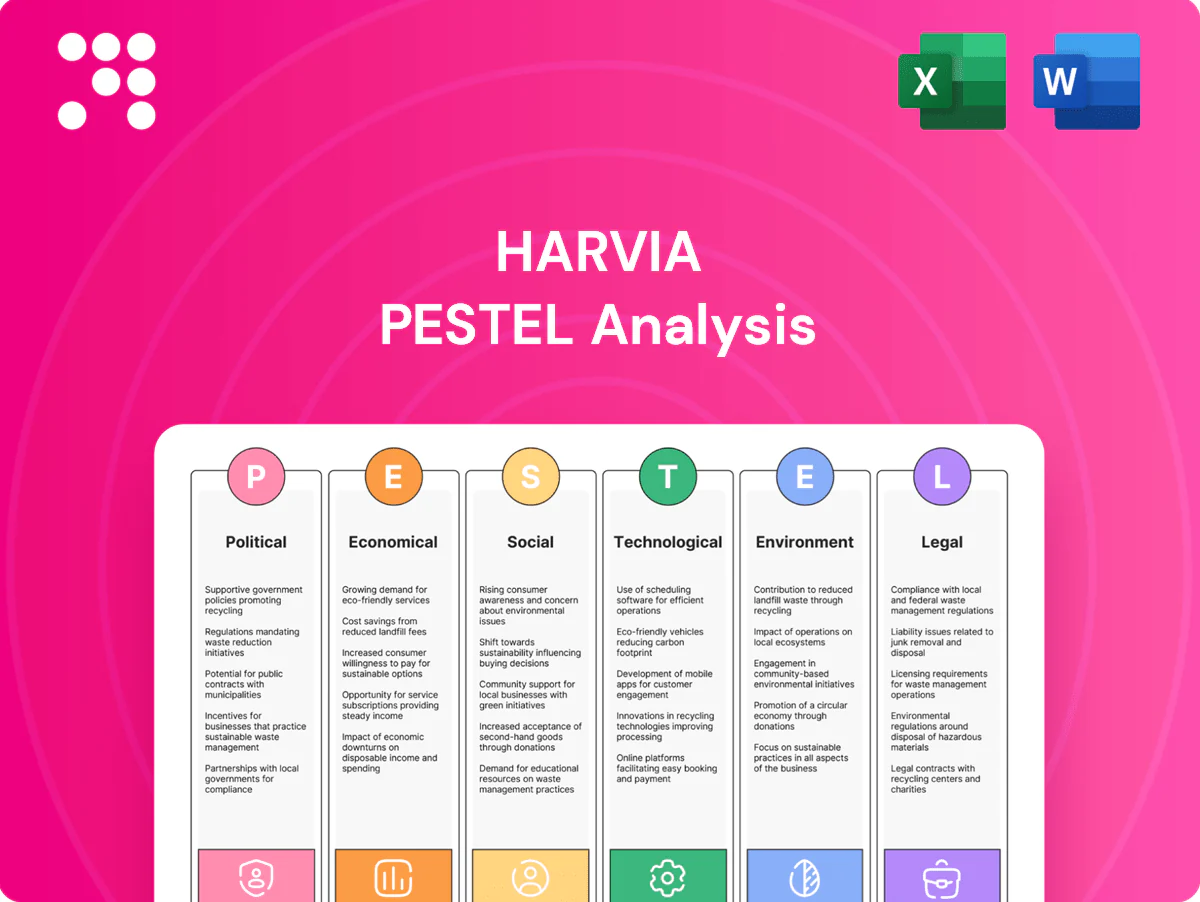
Harvia PESTLE Analysis

Plan Smarter. Present Sharper. Compete Stronger.
Unlock how political, economic, social, technological, legal, and environmental forces are reshaping Harvia’s market position and growth prospects. Our concise PESTLE highlights risks and opportunities you can act on today. Buy the full, downloadable analysis for a detailed, ready-to-use roadmap to inform strategy and investment decisions.
Political factors

Trade policy and tariffs
Import duties on steel and electronics—notably the US 25% Section 232 steel tariffs from 2018 and UK/EU duties up to ~25% on some lines—inflame Harvia pricing and margins by raising input costs for heaters. Shifts in EU, US and UK tariff regimes and sanctions on Russian steel since 2022 can change sourcing economics and add volatility. Favorable trade deals expand market access while quotas or sanctions disrupt supply chains. Continuous monitoring enables agile pricing and supplier diversification.
Energy and climate policy
Subsidies and efficiency mandates across the EU steer Harvia toward low-energy designs as demand shifts; EU Fit for 55 targets 55% GHG cuts by 2030. Policy emphasis on electrification versus biomass directly alters the balance between electric and wood-burning units. EU ETS carbon price ~€100/t in 2024–25 raises manufacturing and logistics costs. Aligning products with policy trends can unlock incentives and public-sector sauna projects under national programs and EU funds.

Geopolitical supply risk
Geopolitical tensions in 2024 around timber, metals and electronics hubs have increased lead-time volatility for Harvia, while 2023–2024 US‑led export controls on advanced semiconductors have constrained smart-product components. Regional instability has pushed freight and insurance costs higher on key routes, and Harvia mitigates risk via dual‑sourcing and nearshoring of suppliers to shorten chains and improve resilience.

Public health and wellness agendas
Government promotion of wellness and preventive healthcare can stimulate sauna adoption, especially in Finland where about 2 million saunas serve a population of ~5.6 million (2024), strengthening home and municipal demand. Conversely, public facility restrictions during health crises reduce commercial spa utilization and tender volumes. Grants and municipal procurements increase institutional orders, but compliance with hygiene guidelines is mandatory in tenders.
- Saunas in Finland: ~2,000,000 (2024)
- Population: ~5.6 million (2024)
- Hygiene compliance: required in public tenders
Building and housing policies
- Renovation Wave: demand boost
- EPBD/NZEB: efficiency mandates
- Social/hospitality projects: pipeline
- Permits: timing risk
Tariffs, carbon pricing and renovation wave raise sauna costs and boost retrofit demand
US/EU/UK tariffs (US steel 25%, EU/UK up to ~25%) and post‑2022 sanctions raise Harvia input costs and sourcing volatility. EU Fit for 55 + ETS (~€100/t 2024–25) drive electrification and efficiency, increasing compliance costs but unlocking grants. National renovation/wellness policies (Finland ~2M saunas/5.6M pop, 2024) bolster demand; public tenders require hygiene compliance.
| Factor | 2024–25 metric | Impact |
|---|---|---|
| Tariffs/sanctions | US steel 25% / EU up to ~25% | Higher input costs, sourcing shifts |
| Carbon price | ~€100/t | Manufacturing/logistics cost up |
| Finland demand | ~2,000,000 saunas; pop 5.6M | Stable domestic market |
| Renovation Wave | EU target: double rates by 2030 | Home retrofit demand |
What is included in the product
 Detailed Word Document
Explores how macro-environmental factors uniquely affect Harvia across Political, Economic, Social, Technological, Environmental and Legal dimensions, with data-driven, forward-looking insights reflecting regional market and regulatory dynamics; designed for executives, investors and consultants and formatted for direct use in plans and decks.

 Customizable Excel Spreadsheet
A concise, visually segmented PESTLE summary of Harvia that can be dropped into presentations, edited with region- or business-specific notes, and quickly shared to align teams and support risk and market-positioning discussions during planning sessions.
Economic factors

Consumer discretionary cycles
Saunas are partly discretionary and demand closely tracks household income and consumer confidence. In Finland, with roughly 5.5 million people and about 2 million saunas, domestic replacement and upgrades follow housing renovation cycles. Downturns delay upgrades while booms lift premium mix, and broader financing availability shifts renovation-bundle ticket sizes. Elastic pricing and clear entry tiers help hedge cycle risk.
Construction and real estate activity
New builds and renovations directly drive Harvia unit volumes for sauna rooms and heaters, with commercial orders from hospitality and wellness capex cycles accounting for roughly 25% of sales and backlogs reportedly up about 18% year‑on‑year in 2024. Backlogs track building permits and contractor capacity, while strategic partnerships with builders and installers help stabilize throughput and smooth quarterly revenue swings.

Commodity and logistics costs
Steel, timber, glass and electronics cost swings have shifted Harvia’s COGS, with steel and timber seeing ±20–35% moves since 2021 and component lead times easing to about 12 weeks in 2024. Freight rates and container availability, which fell from pandemic peaks above $10,000/FEU to roughly $1,500–2,000/FEU in 2024, affect delivery reliability. Hedging and multi‑year supplier contracts have been used to smooth input volatility. Ongoing cost engineering programs protect gross margins.

Foreign exchange exposure
Harvia, a Finland-based sauna exporter selling over 90% of output internationally, faces multi-currency sales and sourcing that create FX risk on revenues and input costs. Euro strength can compress export competitiveness, while euro weakness raises import and energy costs; the company reports active use of natural hedges and forward derivatives in its 2024 annual report to reduce P&L volatility. Price lists require periodic FX-driven adjustments to preserve margins.
- FX risk: multi-currency sales/sourcing
- Exposure: >90% exports (company disclosure)
- Mitigants: natural hedges + forwards (2024 report)
- Action: periodic price-list FX updates
Inflation and wage pressures
General inflation raised material and labor costs across Harvia’s value chain; euro area inflation was 2.4% in 2024 (Eurostat) and Finland CPI 2.6% in 2024 (Statistics Finland). Passing cost increases depends on competitive intensity and demand elasticity; productivity gains and automation investments offset wage drift. SKU rationalization and focus on higher-margin premium saunas support margin defense.
- inflation: euro area 2.4% (2024)
- finland cpi: 2.6% (2024)
- offset: automation & productivity
- margin tool: SKU rationalization
Tariffs, carbon pricing and renovation wave raise sauna costs and boost retrofit demand
Sauna demand tracks household income and renovation cycles, making upgrades cyclical; premium mix rises in booms. New builds/renovations plus commercial orders (~25% of sales) drove backlogs up ~18% YoY in 2024. Export exposure >90% creates FX risk mitigated by natural hedges and forwards per the 2024 report.
| Metric | Value |
|---|---|
| Exports | >90% (company) |
| Commercial sales | ~25% |
| Backlog | +18% YoY (2024) |
| EU inflation | 2.4% (2024) |
| Finland CPI | 2.6% (2024) |
| Freight | $1,500–2,000/FEU (2024) |
| Steel/timber | ±20–35% since 2021 |
Preview Before You Purchase
Harvia PESTLE Analysis
The preview shown here is the exact Harvia PESTLE Analysis document you’ll receive after purchase—fully formatted and ready to use. It includes the complete political, economic, social, technological, legal and environmental assessment as displayed, with no placeholders or edits. The layout, content, and structure visible here are exactly what you’ll download immediately after buying.

Plan Smarter. Present Sharper. Compete Stronger.
Unlock how political, economic, social, technological, legal, and environmental forces are reshaping Harvia’s market position and growth prospects. Our concise PESTLE highlights risks and opportunities you can act on today. Buy the full, downloadable analysis for a detailed, ready-to-use roadmap to inform strategy and investment decisions.
Political factors
Trade policy and tariffs
Import duties on steel and electronics—notably the US 25% Section 232 steel tariffs from 2018 and UK/EU duties up to ~25% on some lines—inflame Harvia pricing and margins by raising input costs for heaters. Shifts in EU, US and UK tariff regimes and sanctions on Russian steel since 2022 can change sourcing economics and add volatility. Favorable trade deals expand market access while quotas or sanctions disrupt supply chains. Continuous monitoring enables agile pricing and supplier diversification.
Energy and climate policy
Subsidies and efficiency mandates across the EU steer Harvia toward low-energy designs as demand shifts; EU Fit for 55 targets 55% GHG cuts by 2030. Policy emphasis on electrification versus biomass directly alters the balance between electric and wood-burning units. EU ETS carbon price ~€100/t in 2024–25 raises manufacturing and logistics costs. Aligning products with policy trends can unlock incentives and public-sector sauna projects under national programs and EU funds.
Geopolitical supply risk
Geopolitical tensions in 2024 around timber, metals and electronics hubs have increased lead-time volatility for Harvia, while 2023–2024 US‑led export controls on advanced semiconductors have constrained smart-product components. Regional instability has pushed freight and insurance costs higher on key routes, and Harvia mitigates risk via dual‑sourcing and nearshoring of suppliers to shorten chains and improve resilience.
Public health and wellness agendas
Government promotion of wellness and preventive healthcare can stimulate sauna adoption, especially in Finland where about 2 million saunas serve a population of ~5.6 million (2024), strengthening home and municipal demand. Conversely, public facility restrictions during health crises reduce commercial spa utilization and tender volumes. Grants and municipal procurements increase institutional orders, but compliance with hygiene guidelines is mandatory in tenders.
- Saunas in Finland: ~2,000,000 (2024)
- Population: ~5.6 million (2024)
- Hygiene compliance: required in public tenders
Building and housing policies
- Renovation Wave: demand boost
- EPBD/NZEB: efficiency mandates
- Social/hospitality projects: pipeline
- Permits: timing risk
Tariffs, carbon pricing and renovation wave raise sauna costs and boost retrofit demand
US/EU/UK tariffs (US steel 25%, EU/UK up to ~25%) and post‑2022 sanctions raise Harvia input costs and sourcing volatility. EU Fit for 55 + ETS (~€100/t 2024–25) drive electrification and efficiency, increasing compliance costs but unlocking grants. National renovation/wellness policies (Finland ~2M saunas/5.6M pop, 2024) bolster demand; public tenders require hygiene compliance.
| Factor | 2024–25 metric | Impact |
|---|---|---|
| Tariffs/sanctions | US steel 25% / EU up to ~25% | Higher input costs, sourcing shifts |
| Carbon price | ~€100/t | Manufacturing/logistics cost up |
| Finland demand | ~2,000,000 saunas; pop 5.6M | Stable domestic market |
| Renovation Wave | EU target: double rates by 2030 | Home retrofit demand |
What is included in the product
Detailed Word Document
Explores how macro-environmental factors uniquely affect Harvia across Political, Economic, Social, Technological, Environmental and Legal dimensions, with data-driven, forward-looking insights reflecting regional market and regulatory dynamics; designed for executives, investors and consultants and formatted for direct use in plans and decks.
Customizable Excel Spreadsheet
A concise, visually segmented PESTLE summary of Harvia that can be dropped into presentations, edited with region- or business-specific notes, and quickly shared to align teams and support risk and market-positioning discussions during planning sessions.
Economic factors
Consumer discretionary cycles
Saunas are partly discretionary and demand closely tracks household income and consumer confidence. In Finland, with roughly 5.5 million people and about 2 million saunas, domestic replacement and upgrades follow housing renovation cycles. Downturns delay upgrades while booms lift premium mix, and broader financing availability shifts renovation-bundle ticket sizes. Elastic pricing and clear entry tiers help hedge cycle risk.
Construction and real estate activity
New builds and renovations directly drive Harvia unit volumes for sauna rooms and heaters, with commercial orders from hospitality and wellness capex cycles accounting for roughly 25% of sales and backlogs reportedly up about 18% year‑on‑year in 2024. Backlogs track building permits and contractor capacity, while strategic partnerships with builders and installers help stabilize throughput and smooth quarterly revenue swings.
Commodity and logistics costs
Steel, timber, glass and electronics cost swings have shifted Harvia’s COGS, with steel and timber seeing ±20–35% moves since 2021 and component lead times easing to about 12 weeks in 2024. Freight rates and container availability, which fell from pandemic peaks above $10,000/FEU to roughly $1,500–2,000/FEU in 2024, affect delivery reliability. Hedging and multi‑year supplier contracts have been used to smooth input volatility. Ongoing cost engineering programs protect gross margins.
Foreign exchange exposure
Harvia, a Finland-based sauna exporter selling over 90% of output internationally, faces multi-currency sales and sourcing that create FX risk on revenues and input costs. Euro strength can compress export competitiveness, while euro weakness raises import and energy costs; the company reports active use of natural hedges and forward derivatives in its 2024 annual report to reduce P&L volatility. Price lists require periodic FX-driven adjustments to preserve margins.
- FX risk: multi-currency sales/sourcing
- Exposure: >90% exports (company disclosure)
- Mitigants: natural hedges + forwards (2024 report)
- Action: periodic price-list FX updates
Inflation and wage pressures
General inflation raised material and labor costs across Harvia’s value chain; euro area inflation was 2.4% in 2024 (Eurostat) and Finland CPI 2.6% in 2024 (Statistics Finland). Passing cost increases depends on competitive intensity and demand elasticity; productivity gains and automation investments offset wage drift. SKU rationalization and focus on higher-margin premium saunas support margin defense.
- inflation: euro area 2.4% (2024)
- finland cpi: 2.6% (2024)
- offset: automation & productivity
- margin tool: SKU rationalization
Tariffs, carbon pricing and renovation wave raise sauna costs and boost retrofit demand
Sauna demand tracks household income and renovation cycles, making upgrades cyclical; premium mix rises in booms. New builds/renovations plus commercial orders (~25% of sales) drove backlogs up ~18% YoY in 2024. Export exposure >90% creates FX risk mitigated by natural hedges and forwards per the 2024 report.
| Metric | Value |
|---|---|
| Exports | >90% (company) |
| Commercial sales | ~25% |
| Backlog | +18% YoY (2024) |
| EU inflation | 2.4% (2024) |
| Finland CPI | 2.6% (2024) |
| Freight | $1,500–2,000/FEU (2024) |
| Steel/timber | ±20–35% since 2021 |
Preview Before You Purchase
Harvia PESTLE Analysis
The preview shown here is the exact Harvia PESTLE Analysis document you’ll receive after purchase—fully formatted and ready to use. It includes the complete political, economic, social, technological, legal and environmental assessment as displayed, with no placeholders or edits. The layout, content, and structure visible here are exactly what you’ll download immediately after buying.
Original: $10.00
-65%$10.00
$3.50Description
Plan Smarter. Present Sharper. Compete Stronger.
Unlock how political, economic, social, technological, legal, and environmental forces are reshaping Harvia’s market position and growth prospects. Our concise PESTLE highlights risks and opportunities you can act on today. Buy the full, downloadable analysis for a detailed, ready-to-use roadmap to inform strategy and investment decisions.
Political factors
Trade policy and tariffs
Import duties on steel and electronics—notably the US 25% Section 232 steel tariffs from 2018 and UK/EU duties up to ~25% on some lines—inflame Harvia pricing and margins by raising input costs for heaters. Shifts in EU, US and UK tariff regimes and sanctions on Russian steel since 2022 can change sourcing economics and add volatility. Favorable trade deals expand market access while quotas or sanctions disrupt supply chains. Continuous monitoring enables agile pricing and supplier diversification.
Energy and climate policy
Subsidies and efficiency mandates across the EU steer Harvia toward low-energy designs as demand shifts; EU Fit for 55 targets 55% GHG cuts by 2030. Policy emphasis on electrification versus biomass directly alters the balance between electric and wood-burning units. EU ETS carbon price ~€100/t in 2024–25 raises manufacturing and logistics costs. Aligning products with policy trends can unlock incentives and public-sector sauna projects under national programs and EU funds.
Geopolitical supply risk
Geopolitical tensions in 2024 around timber, metals and electronics hubs have increased lead-time volatility for Harvia, while 2023–2024 US‑led export controls on advanced semiconductors have constrained smart-product components. Regional instability has pushed freight and insurance costs higher on key routes, and Harvia mitigates risk via dual‑sourcing and nearshoring of suppliers to shorten chains and improve resilience.
Public health and wellness agendas
Government promotion of wellness and preventive healthcare can stimulate sauna adoption, especially in Finland where about 2 million saunas serve a population of ~5.6 million (2024), strengthening home and municipal demand. Conversely, public facility restrictions during health crises reduce commercial spa utilization and tender volumes. Grants and municipal procurements increase institutional orders, but compliance with hygiene guidelines is mandatory in tenders.
- Saunas in Finland: ~2,000,000 (2024)
- Population: ~5.6 million (2024)
- Hygiene compliance: required in public tenders
Building and housing policies
- Renovation Wave: demand boost
- EPBD/NZEB: efficiency mandates
- Social/hospitality projects: pipeline
- Permits: timing risk
Tariffs, carbon pricing and renovation wave raise sauna costs and boost retrofit demand
US/EU/UK tariffs (US steel 25%, EU/UK up to ~25%) and post‑2022 sanctions raise Harvia input costs and sourcing volatility. EU Fit for 55 + ETS (~€100/t 2024–25) drive electrification and efficiency, increasing compliance costs but unlocking grants. National renovation/wellness policies (Finland ~2M saunas/5.6M pop, 2024) bolster demand; public tenders require hygiene compliance.
| Factor | 2024–25 metric | Impact |
|---|---|---|
| Tariffs/sanctions | US steel 25% / EU up to ~25% | Higher input costs, sourcing shifts |
| Carbon price | ~€100/t | Manufacturing/logistics cost up |
| Finland demand | ~2,000,000 saunas; pop 5.6M | Stable domestic market |
| Renovation Wave | EU target: double rates by 2030 | Home retrofit demand |
What is included in the product
Detailed Word Document
Explores how macro-environmental factors uniquely affect Harvia across Political, Economic, Social, Technological, Environmental and Legal dimensions, with data-driven, forward-looking insights reflecting regional market and regulatory dynamics; designed for executives, investors and consultants and formatted for direct use in plans and decks.
Customizable Excel Spreadsheet
A concise, visually segmented PESTLE summary of Harvia that can be dropped into presentations, edited with region- or business-specific notes, and quickly shared to align teams and support risk and market-positioning discussions during planning sessions.
Economic factors
Consumer discretionary cycles
Saunas are partly discretionary and demand closely tracks household income and consumer confidence. In Finland, with roughly 5.5 million people and about 2 million saunas, domestic replacement and upgrades follow housing renovation cycles. Downturns delay upgrades while booms lift premium mix, and broader financing availability shifts renovation-bundle ticket sizes. Elastic pricing and clear entry tiers help hedge cycle risk.
Construction and real estate activity
New builds and renovations directly drive Harvia unit volumes for sauna rooms and heaters, with commercial orders from hospitality and wellness capex cycles accounting for roughly 25% of sales and backlogs reportedly up about 18% year‑on‑year in 2024. Backlogs track building permits and contractor capacity, while strategic partnerships with builders and installers help stabilize throughput and smooth quarterly revenue swings.
Commodity and logistics costs
Steel, timber, glass and electronics cost swings have shifted Harvia’s COGS, with steel and timber seeing ±20–35% moves since 2021 and component lead times easing to about 12 weeks in 2024. Freight rates and container availability, which fell from pandemic peaks above $10,000/FEU to roughly $1,500–2,000/FEU in 2024, affect delivery reliability. Hedging and multi‑year supplier contracts have been used to smooth input volatility. Ongoing cost engineering programs protect gross margins.
Foreign exchange exposure
Harvia, a Finland-based sauna exporter selling over 90% of output internationally, faces multi-currency sales and sourcing that create FX risk on revenues and input costs. Euro strength can compress export competitiveness, while euro weakness raises import and energy costs; the company reports active use of natural hedges and forward derivatives in its 2024 annual report to reduce P&L volatility. Price lists require periodic FX-driven adjustments to preserve margins.
- FX risk: multi-currency sales/sourcing
- Exposure: >90% exports (company disclosure)
- Mitigants: natural hedges + forwards (2024 report)
- Action: periodic price-list FX updates
Inflation and wage pressures
General inflation raised material and labor costs across Harvia’s value chain; euro area inflation was 2.4% in 2024 (Eurostat) and Finland CPI 2.6% in 2024 (Statistics Finland). Passing cost increases depends on competitive intensity and demand elasticity; productivity gains and automation investments offset wage drift. SKU rationalization and focus on higher-margin premium saunas support margin defense.
- inflation: euro area 2.4% (2024)
- finland cpi: 2.6% (2024)
- offset: automation & productivity
- margin tool: SKU rationalization
Tariffs, carbon pricing and renovation wave raise sauna costs and boost retrofit demand
Sauna demand tracks household income and renovation cycles, making upgrades cyclical; premium mix rises in booms. New builds/renovations plus commercial orders (~25% of sales) drove backlogs up ~18% YoY in 2024. Export exposure >90% creates FX risk mitigated by natural hedges and forwards per the 2024 report.
| Metric | Value |
|---|---|
| Exports | >90% (company) |
| Commercial sales | ~25% |
| Backlog | +18% YoY (2024) |
| EU inflation | 2.4% (2024) |
| Finland CPI | 2.6% (2024) |
| Freight | $1,500–2,000/FEU (2024) |
| Steel/timber | ±20–35% since 2021 |
Preview Before You Purchase
Harvia PESTLE Analysis
The preview shown here is the exact Harvia PESTLE Analysis document you’ll receive after purchase—fully formatted and ready to use. It includes the complete political, economic, social, technological, legal and environmental assessment as displayed, with no placeholders or edits. The layout, content, and structure visible here are exactly what you’ll download immediately after buying.











