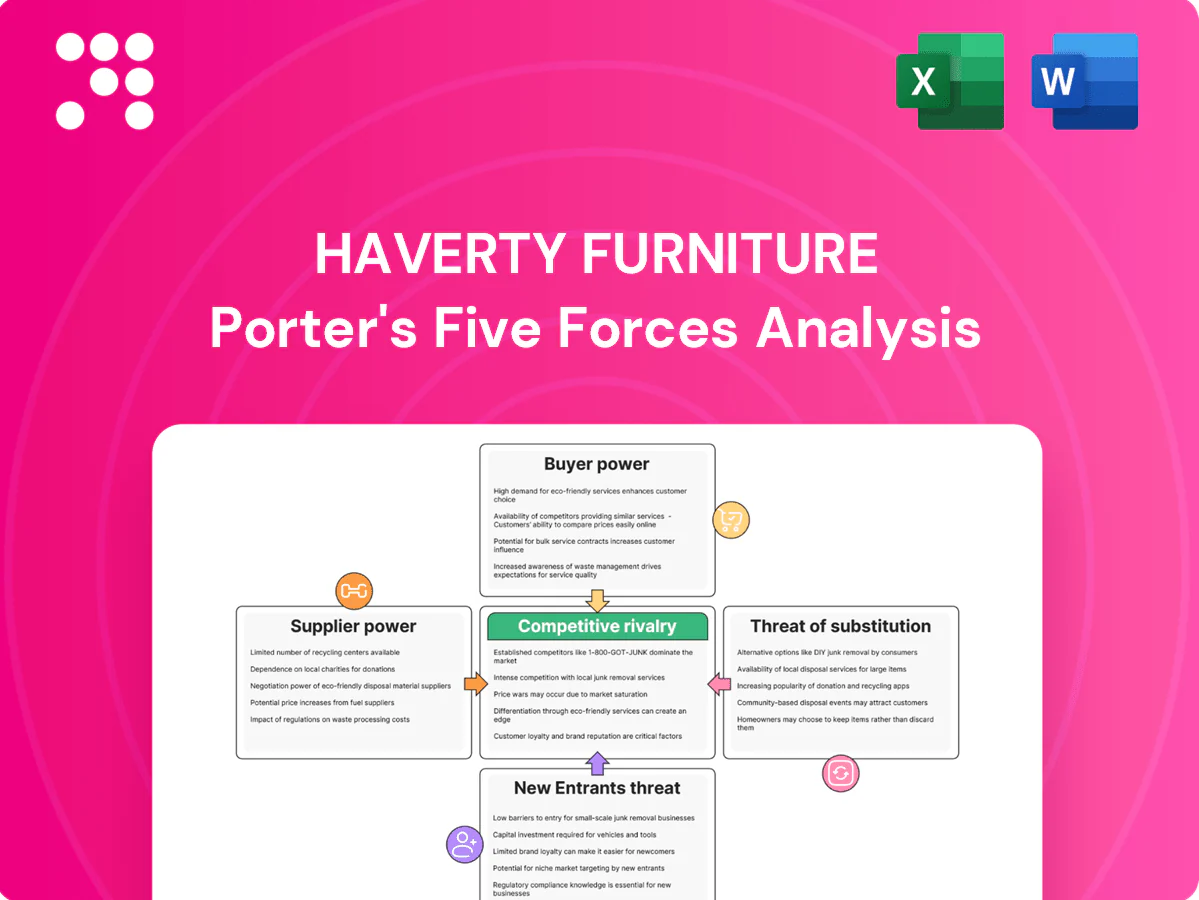
Haverty Furniture Porter's Five Forces Analysis

Go Beyond the Preview—Access the Full Strategic Report
Haverty Furniture faces moderate buyer power, intense rivalry from national and online retailers, constrained supplier leverage, low threat of substitutes for core products, and manageable barriers to entry—creating a stable but competitive landscape. This brief snapshot highlights key pressures on margins and growth. Unlock the full Porter's Five Forces Analysis to explore force-by-force ratings, visuals, and actionable strategy tailored to Haverty.
Suppliers Bargaining Power

Diverse vendor base lowers leverage
Haverty sources from multiple furniture manufacturers across styles and price points, supporting inventory for 122 retail locations in 2024 and reducing dependence on any single supplier; this diversification strengthens bargaining leverage to negotiate price and lead times. Underperforming vendors can be reallocated to others, though specialized or branded lines still create measurable switching frictions and limit full supplier substitution.
Input cost volatility passes through unevenly
Wood, upholstery, foam and freight cost swings in 2024 lifted supplier bargaining power during inflationary pressure, forcing Haverty to rely on demand strength to pass through price increases. Long-dated purchase orders and hedged freight programs have partly mitigated sudden spikes. When demand softens, suppliers have historically conceded on terms to preserve volumes, easing Haverty’s negotiating leverage.

Private-label and exclusives as counterweights
Exclusive collections and private-label programs reduce direct price comparability and improve margin control by shifting customer focus to retailer-curated assortments rather than national-brand SKUs. These programs transfer negotiating leverage from national manufacturers to retailers as suppliers value shelf space and design partnerships, fostering closer collaboration. Execution risk persists in inventory planning and maintaining style relevance, which can erode margins if assortments miss trends.

Logistics and lead time constraints matter
Large, bulky furniture requires coordinated manufacturing and delivery, giving reliable carriers and upstream suppliers greater bargaining power; post-pandemic logistics improvements shortened lead times but episodic disruptions persist, so domestic or nearshore vendors gain influence in tight windows. Haverty (about 121 stores, FY2023 net sales near $1.4B) uses regional scale to secure allocation.
- Reliable suppliers: higher power
- Post‑pandemic lead times: shorter but volatile
- Domestic/nearshore vendors: stronger in tight windows
- Haverty scale (≈121 stores; ~$1.4B sales): aids allocation
Compliance, quality, and warranty standards
Strict compliance, quality, and warranty standards narrow Haverty's supplier pool and raise onboarding time and switching costs; Haverty reported net sales of $1.59 billion in fiscal 2024, increasing the stakes for reliable vendors. Suppliers with lower defect and return rates secure better terms, while co-developed quality processes create mutual dependence that moderates extreme power shifts.
- Fewer acceptable suppliers
- Higher switching/onboarding costs
- Reliable suppliers command better terms
- Co-developed processes = mutual dependence
Diversified suppliers at 122 stores cut vendor risk; FY24 revenue $1.59B
Haverty's diversified supplier base for 122 stores in 2024 reduces single-vendor risk, but private-labels and strict quality raise switching costs; FY2024 net sales $1.59B. 2024 inflation and freight volatility increased supplier leverage despite hedges and long orders. Scale aids allocation but episodic logistics disruptions sustain supplier power.
| Metric | 2024 |
|---|---|
| Net sales | $1.59B |
| Stores | 122 |
| Supplier power | Elevated |
What is included in the product
 Detailed Word Document
Tailored Porter’s Five Forces analysis of Haverty Furniture uncovering competitive drivers, buyer and supplier power, threat of substitutes and new entrants, and strategic implications to protect market share and enhance profitability.

 Customizable Excel Spreadsheet
A concise one-sheet Porter's Five Forces for Haverty Furniture—instantly reveal supplier, buyer, competitor, entrant, and substitute pressures to streamline strategic decisions and prioritize relief actions.
Customers Bargaining Power

High price transparency via e-commerce
High price transparency via e-commerce lets customers compare prices and reviews across retailers instantly, raising their bargaining power and forcing Haverty to match offers and run promotions to convert traffic. Showroom experiences must demonstrably justify any price premiums through service and quality. Financing offers and curated bundles help offset transparency-driven margin pressure. In 2024 online channels represented roughly one-quarter of US furniture sales, intensifying comparison shopping.
Discretionary, postponable purchases
Furniture buying is often deferrable, giving customers leverage in weak macro periods; U.S. furniture and home furnishings retail sales were about $120 billion in 2024, highlighting cycle sensitivity. Promotions and clearance events became decisive as markdowns drive traffic and accelerate inventory turns. Design services pull forward demand by reducing decision friction, while consumer credit availability directly affects timing sensitivity.

Value segmentation across budgets
Haverty’s targets mid to upper-mid buyers who expect quality and service, not just low prices, with its 121-store footprint reinforcing a service-oriented model. These customers negotiate less than pure price shoppers but still demand clear value, making warranties, delivery, and setup key differentiators beyond ticket price. Loyalty programs and financing reduce price sensitivity over time and help sustain repeat purchases.

Customization and design expectations
Made-to-order options and in-home design raise buyer expectations for perfect fit and white‑glove service, increasing pressure on Haverty to deliver seamless execution.
Buyers can switch to custom studios or online bespoke sellers, and with US e‑commerce furniture penetration rising in 2024 buyers gained leverage on price and lead times.
Strong design outcomes boost stickiness and upsell potential, while missed timelines or delivery failures rapidly erode goodwill and repeat purchase rates.
- Haverty FY2024 net sales: $1.1B (company filings)
- 2024 trend: rising e‑commerce penetration increases switching options
- Design success = higher AOV and retention; delays = churn risk
Low switching costs between retailers
- Low switching: many alternatives
- Marginal frictions: returns/delivery
- Retention: assortment & experience
- Repeat business: quality post-sale service
Transparent pricing and ~25% online share raise consumer bargaining power
High price transparency and ~25% online penetration in US furniture (2024) raise customer bargaining power, forcing Haverty to match offers and promote. Low switching costs and abundant alternatives (121 stores; FY2024 net sales $1.1B) amplify leverage, while financing, design services and white‑glove delivery reduce price sensitivity and improve retention.
| Metric | Value (2024) |
|---|---|
| US furniture market | $120B |
| Online penetration | ~25% |
| Haverty stores | 121 |
| Haverty net sales | $1.1B |
Full Version Awaits
Haverty Furniture Porter's Five Forces Analysis
This preview shows the exact Haverty Furniture Porter's Five Forces analysis you'll receive immediately after purchase—fully written, formatted, and ready to use. No mockups or placeholders; the document displayed is the full deliverable you'll download instantly upon payment. It covers competitive rivalry, supplier and buyer power, and threats of entry and substitution with concise, actionable insights.

Go Beyond the Preview—Access the Full Strategic Report
Haverty Furniture faces moderate buyer power, intense rivalry from national and online retailers, constrained supplier leverage, low threat of substitutes for core products, and manageable barriers to entry—creating a stable but competitive landscape. This brief snapshot highlights key pressures on margins and growth. Unlock the full Porter's Five Forces Analysis to explore force-by-force ratings, visuals, and actionable strategy tailored to Haverty.
Suppliers Bargaining Power
Diverse vendor base lowers leverage
Haverty sources from multiple furniture manufacturers across styles and price points, supporting inventory for 122 retail locations in 2024 and reducing dependence on any single supplier; this diversification strengthens bargaining leverage to negotiate price and lead times. Underperforming vendors can be reallocated to others, though specialized or branded lines still create measurable switching frictions and limit full supplier substitution.
Input cost volatility passes through unevenly
Wood, upholstery, foam and freight cost swings in 2024 lifted supplier bargaining power during inflationary pressure, forcing Haverty to rely on demand strength to pass through price increases. Long-dated purchase orders and hedged freight programs have partly mitigated sudden spikes. When demand softens, suppliers have historically conceded on terms to preserve volumes, easing Haverty’s negotiating leverage.
Private-label and exclusives as counterweights
Exclusive collections and private-label programs reduce direct price comparability and improve margin control by shifting customer focus to retailer-curated assortments rather than national-brand SKUs. These programs transfer negotiating leverage from national manufacturers to retailers as suppliers value shelf space and design partnerships, fostering closer collaboration. Execution risk persists in inventory planning and maintaining style relevance, which can erode margins if assortments miss trends.
Logistics and lead time constraints matter
Large, bulky furniture requires coordinated manufacturing and delivery, giving reliable carriers and upstream suppliers greater bargaining power; post-pandemic logistics improvements shortened lead times but episodic disruptions persist, so domestic or nearshore vendors gain influence in tight windows. Haverty (about 121 stores, FY2023 net sales near $1.4B) uses regional scale to secure allocation.
- Reliable suppliers: higher power
- Post‑pandemic lead times: shorter but volatile
- Domestic/nearshore vendors: stronger in tight windows
- Haverty scale (≈121 stores; ~$1.4B sales): aids allocation
Compliance, quality, and warranty standards
Strict compliance, quality, and warranty standards narrow Haverty's supplier pool and raise onboarding time and switching costs; Haverty reported net sales of $1.59 billion in fiscal 2024, increasing the stakes for reliable vendors. Suppliers with lower defect and return rates secure better terms, while co-developed quality processes create mutual dependence that moderates extreme power shifts.
- Fewer acceptable suppliers
- Higher switching/onboarding costs
- Reliable suppliers command better terms
- Co-developed processes = mutual dependence
Diversified suppliers at 122 stores cut vendor risk; FY24 revenue $1.59B
Haverty's diversified supplier base for 122 stores in 2024 reduces single-vendor risk, but private-labels and strict quality raise switching costs; FY2024 net sales $1.59B. 2024 inflation and freight volatility increased supplier leverage despite hedges and long orders. Scale aids allocation but episodic logistics disruptions sustain supplier power.
| Metric | 2024 |
|---|---|
| Net sales | $1.59B |
| Stores | 122 |
| Supplier power | Elevated |
What is included in the product
Detailed Word Document
Tailored Porter’s Five Forces analysis of Haverty Furniture uncovering competitive drivers, buyer and supplier power, threat of substitutes and new entrants, and strategic implications to protect market share and enhance profitability.
Customizable Excel Spreadsheet
A concise one-sheet Porter's Five Forces for Haverty Furniture—instantly reveal supplier, buyer, competitor, entrant, and substitute pressures to streamline strategic decisions and prioritize relief actions.
Customers Bargaining Power
High price transparency via e-commerce
High price transparency via e-commerce lets customers compare prices and reviews across retailers instantly, raising their bargaining power and forcing Haverty to match offers and run promotions to convert traffic. Showroom experiences must demonstrably justify any price premiums through service and quality. Financing offers and curated bundles help offset transparency-driven margin pressure. In 2024 online channels represented roughly one-quarter of US furniture sales, intensifying comparison shopping.
Discretionary, postponable purchases
Furniture buying is often deferrable, giving customers leverage in weak macro periods; U.S. furniture and home furnishings retail sales were about $120 billion in 2024, highlighting cycle sensitivity. Promotions and clearance events became decisive as markdowns drive traffic and accelerate inventory turns. Design services pull forward demand by reducing decision friction, while consumer credit availability directly affects timing sensitivity.
Value segmentation across budgets
Haverty’s targets mid to upper-mid buyers who expect quality and service, not just low prices, with its 121-store footprint reinforcing a service-oriented model. These customers negotiate less than pure price shoppers but still demand clear value, making warranties, delivery, and setup key differentiators beyond ticket price. Loyalty programs and financing reduce price sensitivity over time and help sustain repeat purchases.
Customization and design expectations
Made-to-order options and in-home design raise buyer expectations for perfect fit and white‑glove service, increasing pressure on Haverty to deliver seamless execution.
Buyers can switch to custom studios or online bespoke sellers, and with US e‑commerce furniture penetration rising in 2024 buyers gained leverage on price and lead times.
Strong design outcomes boost stickiness and upsell potential, while missed timelines or delivery failures rapidly erode goodwill and repeat purchase rates.
- Haverty FY2024 net sales: $1.1B (company filings)
- 2024 trend: rising e‑commerce penetration increases switching options
- Design success = higher AOV and retention; delays = churn risk
Low switching costs between retailers
- Low switching: many alternatives
- Marginal frictions: returns/delivery
- Retention: assortment & experience
- Repeat business: quality post-sale service
Transparent pricing and ~25% online share raise consumer bargaining power
High price transparency and ~25% online penetration in US furniture (2024) raise customer bargaining power, forcing Haverty to match offers and promote. Low switching costs and abundant alternatives (121 stores; FY2024 net sales $1.1B) amplify leverage, while financing, design services and white‑glove delivery reduce price sensitivity and improve retention.
| Metric | Value (2024) |
|---|---|
| US furniture market | $120B |
| Online penetration | ~25% |
| Haverty stores | 121 |
| Haverty net sales | $1.1B |
Full Version Awaits
Haverty Furniture Porter's Five Forces Analysis
This preview shows the exact Haverty Furniture Porter's Five Forces analysis you'll receive immediately after purchase—fully written, formatted, and ready to use. No mockups or placeholders; the document displayed is the full deliverable you'll download instantly upon payment. It covers competitive rivalry, supplier and buyer power, and threats of entry and substitution with concise, actionable insights.
Description
Go Beyond the Preview—Access the Full Strategic Report
Haverty Furniture faces moderate buyer power, intense rivalry from national and online retailers, constrained supplier leverage, low threat of substitutes for core products, and manageable barriers to entry—creating a stable but competitive landscape. This brief snapshot highlights key pressures on margins and growth. Unlock the full Porter's Five Forces Analysis to explore force-by-force ratings, visuals, and actionable strategy tailored to Haverty.
Suppliers Bargaining Power
Diverse vendor base lowers leverage
Haverty sources from multiple furniture manufacturers across styles and price points, supporting inventory for 122 retail locations in 2024 and reducing dependence on any single supplier; this diversification strengthens bargaining leverage to negotiate price and lead times. Underperforming vendors can be reallocated to others, though specialized or branded lines still create measurable switching frictions and limit full supplier substitution.
Input cost volatility passes through unevenly
Wood, upholstery, foam and freight cost swings in 2024 lifted supplier bargaining power during inflationary pressure, forcing Haverty to rely on demand strength to pass through price increases. Long-dated purchase orders and hedged freight programs have partly mitigated sudden spikes. When demand softens, suppliers have historically conceded on terms to preserve volumes, easing Haverty’s negotiating leverage.
Private-label and exclusives as counterweights
Exclusive collections and private-label programs reduce direct price comparability and improve margin control by shifting customer focus to retailer-curated assortments rather than national-brand SKUs. These programs transfer negotiating leverage from national manufacturers to retailers as suppliers value shelf space and design partnerships, fostering closer collaboration. Execution risk persists in inventory planning and maintaining style relevance, which can erode margins if assortments miss trends.
Logistics and lead time constraints matter
Large, bulky furniture requires coordinated manufacturing and delivery, giving reliable carriers and upstream suppliers greater bargaining power; post-pandemic logistics improvements shortened lead times but episodic disruptions persist, so domestic or nearshore vendors gain influence in tight windows. Haverty (about 121 stores, FY2023 net sales near $1.4B) uses regional scale to secure allocation.
- Reliable suppliers: higher power
- Post‑pandemic lead times: shorter but volatile
- Domestic/nearshore vendors: stronger in tight windows
- Haverty scale (≈121 stores; ~$1.4B sales): aids allocation
Compliance, quality, and warranty standards
Strict compliance, quality, and warranty standards narrow Haverty's supplier pool and raise onboarding time and switching costs; Haverty reported net sales of $1.59 billion in fiscal 2024, increasing the stakes for reliable vendors. Suppliers with lower defect and return rates secure better terms, while co-developed quality processes create mutual dependence that moderates extreme power shifts.
- Fewer acceptable suppliers
- Higher switching/onboarding costs
- Reliable suppliers command better terms
- Co-developed processes = mutual dependence
Diversified suppliers at 122 stores cut vendor risk; FY24 revenue $1.59B
Haverty's diversified supplier base for 122 stores in 2024 reduces single-vendor risk, but private-labels and strict quality raise switching costs; FY2024 net sales $1.59B. 2024 inflation and freight volatility increased supplier leverage despite hedges and long orders. Scale aids allocation but episodic logistics disruptions sustain supplier power.
| Metric | 2024 |
|---|---|
| Net sales | $1.59B |
| Stores | 122 |
| Supplier power | Elevated |
What is included in the product
Detailed Word Document
Tailored Porter’s Five Forces analysis of Haverty Furniture uncovering competitive drivers, buyer and supplier power, threat of substitutes and new entrants, and strategic implications to protect market share and enhance profitability.
Customizable Excel Spreadsheet
A concise one-sheet Porter's Five Forces for Haverty Furniture—instantly reveal supplier, buyer, competitor, entrant, and substitute pressures to streamline strategic decisions and prioritize relief actions.
Customers Bargaining Power
High price transparency via e-commerce
High price transparency via e-commerce lets customers compare prices and reviews across retailers instantly, raising their bargaining power and forcing Haverty to match offers and run promotions to convert traffic. Showroom experiences must demonstrably justify any price premiums through service and quality. Financing offers and curated bundles help offset transparency-driven margin pressure. In 2024 online channels represented roughly one-quarter of US furniture sales, intensifying comparison shopping.
Discretionary, postponable purchases
Furniture buying is often deferrable, giving customers leverage in weak macro periods; U.S. furniture and home furnishings retail sales were about $120 billion in 2024, highlighting cycle sensitivity. Promotions and clearance events became decisive as markdowns drive traffic and accelerate inventory turns. Design services pull forward demand by reducing decision friction, while consumer credit availability directly affects timing sensitivity.
Value segmentation across budgets
Haverty’s targets mid to upper-mid buyers who expect quality and service, not just low prices, with its 121-store footprint reinforcing a service-oriented model. These customers negotiate less than pure price shoppers but still demand clear value, making warranties, delivery, and setup key differentiators beyond ticket price. Loyalty programs and financing reduce price sensitivity over time and help sustain repeat purchases.
Customization and design expectations
Made-to-order options and in-home design raise buyer expectations for perfect fit and white‑glove service, increasing pressure on Haverty to deliver seamless execution.
Buyers can switch to custom studios or online bespoke sellers, and with US e‑commerce furniture penetration rising in 2024 buyers gained leverage on price and lead times.
Strong design outcomes boost stickiness and upsell potential, while missed timelines or delivery failures rapidly erode goodwill and repeat purchase rates.
- Haverty FY2024 net sales: $1.1B (company filings)
- 2024 trend: rising e‑commerce penetration increases switching options
- Design success = higher AOV and retention; delays = churn risk
Low switching costs between retailers
- Low switching: many alternatives
- Marginal frictions: returns/delivery
- Retention: assortment & experience
- Repeat business: quality post-sale service
Transparent pricing and ~25% online share raise consumer bargaining power
High price transparency and ~25% online penetration in US furniture (2024) raise customer bargaining power, forcing Haverty to match offers and promote. Low switching costs and abundant alternatives (121 stores; FY2024 net sales $1.1B) amplify leverage, while financing, design services and white‑glove delivery reduce price sensitivity and improve retention.
| Metric | Value (2024) |
|---|---|
| US furniture market | $120B |
| Online penetration | ~25% |
| Haverty stores | 121 |
| Haverty net sales | $1.1B |
Full Version Awaits
Haverty Furniture Porter's Five Forces Analysis
This preview shows the exact Haverty Furniture Porter's Five Forces analysis you'll receive immediately after purchase—fully written, formatted, and ready to use. No mockups or placeholders; the document displayed is the full deliverable you'll download instantly upon payment. It covers competitive rivalry, supplier and buyer power, and threats of entry and substitution with concise, actionable insights.











