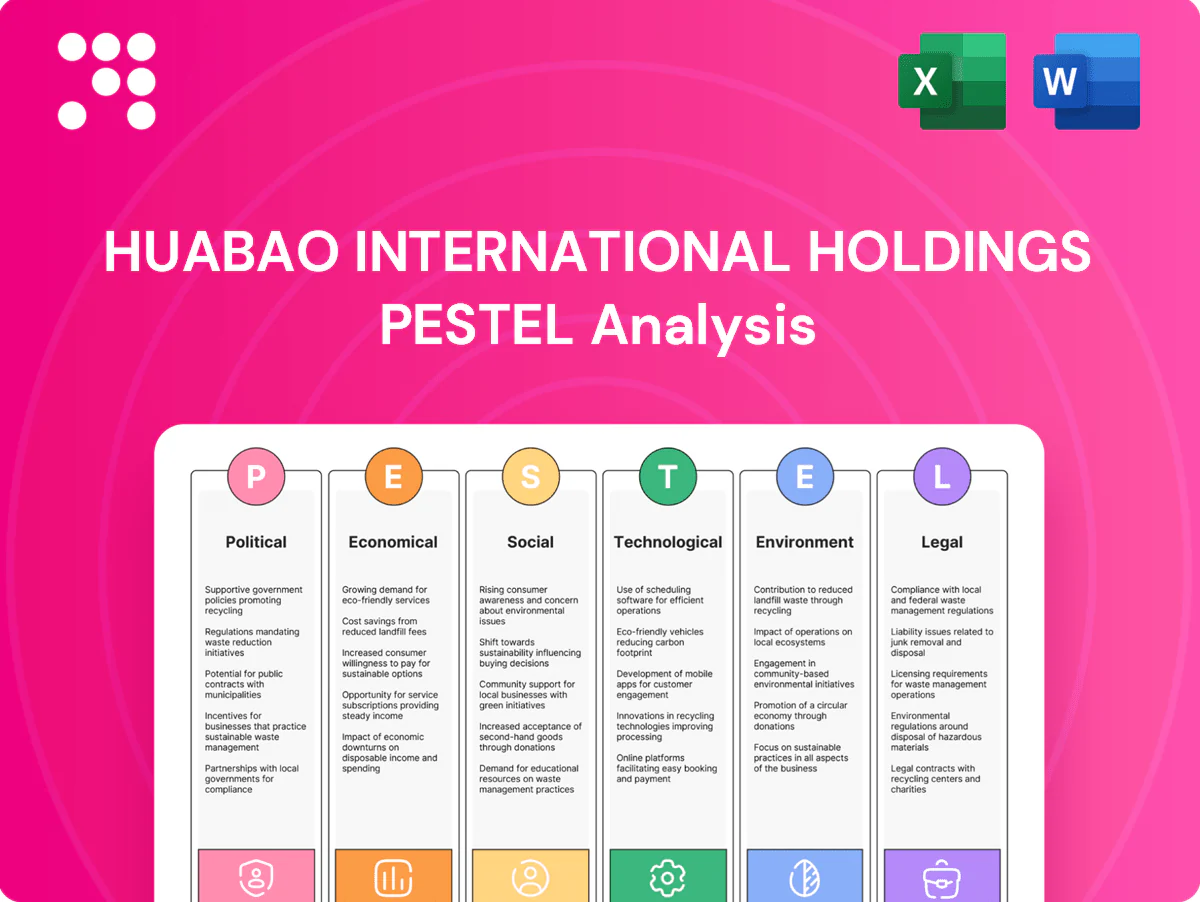
Huabao International Holdings PESTLE Analysis

Plan Smarter. Present Sharper. Compete Stronger.
Understand regulatory shifts, market demand, and tech trends affecting Huabao International Holdings. Our concise PESTLE flags risks and opportunities across politics, economy, society, technology, environment, and law. Ready for investor briefs and strategy sessions. Purchase the full PESTLE now for the complete, actionable report.
Political factors

China industrial policy direction
China’s push for advanced manufacturing and biochemicals (built on Made in China 2025 and follow-up plans) unlocks R&D grants and preferential regimes such as the 15% CIT rate for certified high-tech enterprises, improving project returns for flavor and fragrance R&D.
Priority clusters and over 160 national high‑tech zones shape plant siting and logistics, while policy pivots toward semiconductors or renewables can reallocate incentives, so close alignment with local governments is pivotal for capacity expansion.
State tobacco ecosystem dependencies
Supplying tobacco raw materials ties Huabao to the China National Tobacco Corporation, which oversees virtually all domestic procurement and can swing volumes by hundreds of millions of sticks through quota adjustments. China produced over 1.5 million tonnes of tobacco leaf in 2023, so specification shifts or quota changes materially affect ingredient demand. Regulatory campaigns since 2023 favoring reduced-risk products could reshape demand for humectants and flavors. Tight relationship management and rigorous compliance are critical to retain listings.

Trade policy and tariff exposure
Import tariffs on aroma chemicals, solvents and production equipment directly raise Huabao International’s input costs and compress margins, while export controls or retaliatory counter-tariffs can restrict overseas sales of flavours and fragrances. Diversifying supplier countries reduces exposure to geopolitical shocks and supply-chain concentration. Utilising free trade zones and bonded logistics shortens duty and VAT cash cycles, improving working capital efficiency.

Regional development and localization
Provincial incentives prioritize local sourcing and hiring, steering Huabao's supplier selection and joint-venture choices. Plant placement near end-markets reduces political and logistical risks and speeds local regulatory interactions and inspections; China has 31 provincial-level divisions. Multi-province footprints raise compliance complexity amid Beijing's 2024 GDP growth target of 5%.
- Local incentives drive supplier localization
- Near-market plants cut inspection and transport risk
- 31 provincial regions increase compliance layers
Geopolitical risk and supply security
US‑China and EU‑China tensions have already disrupted specialty chemical flows and IP collaboration, with China supplying roughly 45% of global chemical production in 2023, forcing finer sanctions screening and dual‑use diligence after over 300 China‑linked entities faced US export restrictions since 2018; strategic stockpiles and second‑source formulations cut exposure and logistics rerouting must be scenario‑planned.
- Sanctions screening: higher compliance costs
- Dual‑use: increased export controls
- Stockpiles/second‑sources: reduce single‑supplier risk
- Logistics reroute planning: operational necessity
15% CIT boosts R&D; tobacco ~1.5M t and China ~45% chemicals raise supply, regulatory risk
Huabao benefits from preferential 15% CIT for certified high‑tech firms, aiding R&D returns, but must align with local governments across 31 provincial regions to secure incentives. Reliance on China National Tobacco links volumes to ~1.5M t tobacco leaf (2023) and regulatory shifts toward reduced‑risk products. Geopolitical tensions matter: China made ~45% of global chemicals (2023) and >300 China‑linked entities faced US export curbs since 2018, so supplier diversification and compliance are essential.
| Metric | Value |
|---|---|
| High‑tech CIT rate | 15% |
| Tobacco leaf (2023) | ~1.5M tonnes |
| China share, chemicals (2023) | ~45% |
| Provincial units | 31 |
| US export‑restricted entities since 2018 | >300 |
| Beijing 2024 GDP target | 5% |
What is included in the product
 Detailed Word Document
Provides a concise PESTLE assessment of Huabao International Holdings, examining Political, Economic, Social, Technological, Environmental and Legal drivers shaping its flavor and fragrance business across China and export markets. Each section links current data and trends to strategic risks, opportunities and forward-looking implications for executives and investors.

 Customizable Excel Spreadsheet
A concise, visually segmented PESTLE summary for Huabao International that can be dropped into presentations or planning sessions, edited with region- or business-specific notes, and easily shared across teams to align on external risks and market positioning.
Economic factors

China consumption cycles
Flavor and fragrance demand closely tracks FMCG volumes in food, beverage and household goods, with slowdowns shifting mix toward value tiers while recoveries drive premiumization; category elasticity differs by product and channel. Retail sales growth of roughly 5–6% and e‑commerce GMV near RMB 14 trillion in 2024 are used as forward indicators to guide Huabao capacity and mix planning.
Input cost volatility
Petrochemical and natural-extract feedstock costs for Huabao track oil and crop cycles—Brent crude averaged about $86/bbl in 2024 with intra‑year swings near 20–30%, while key botanical yields showed year‑to‑year swings up to 25% in major sourcing regions. Cost‑plus contracts cushion selling margins but do not eliminate pressure on gross margin during spikes. Active hedging and multi‑year offtakes stabilize prices for core aroma molecules. Reformulation to lower‑cost equivalents is used tactically to defend gross margin in downcycles.

FX and RMB dynamics
RMB trading near 7.2 per USD in July 2025 means depreciation raises COGS for Huabao when key intermediates are imported while improving competitiveness on any USD‑priced exports; a 5–8% weaker RMB since 2021 materially shifts margins. Natural hedging via currency‑matched sourcing and invoicing can offset exposure, while explicit pricing clauses and shorter quote validity (months rather than quarters) reduce FX risk and margin volatility.

Industry consolidation and pricing power
Global majors such as Givaudan, Firmenich and Symrise and strong local players drive intense competition in China, forcing scale-based advantages in procurement and application lab coverage that support price realization for larger suppliers.
- Scale: procurement and lab networks improve gross margins
- Niche formulations: higher, defensible margins
- M&A: speeds portfolio and regional expansion
Capex intensity and utilization
Batch plants, extraction units and QA labs need steady capex refresh to maintain product quality and regulatory compliance; utilization swings in 2024 magnify ROIC volatility for Huabao International. Phased investments and modular lines limit downside and match demand. OEE gains convert to cash faster than greenfield builds.
- Capex refresh: sustain quality
- Utilization swings: amplify ROIC
- Phased/modular: lower downside
- OEE > greenfield payback speed
15% CIT boosts R&D; tobacco ~1.5M t and China ~45% chemicals raise supply, regulatory risk
Demand follows FMCG volumes (retail +5–6% in 2024) with premiumization on recovery; e‑commerce GMV ~RMB 14tn in 2024 guides mix. Feedstock cost volatility: Brent ~$86/bbl (2024) and botanical yield swings up to 25% press margins despite cost‑plus contracts and hedges. RMB ~7.2/USD (Jul 2025), ~5–8% weaker since 2021, shifts COGS and export competitiveness; scale, capex refresh and OEE gains determine ROIC resilience.
| Metric | 2024/2025 |
|---|---|
| Retail growth | +5–6% (2024) |
| E‑commerce GMV | RMB 14tn (2024) |
| Brent crude | $86/bbl (2024) |
| Botanical yield volatility | ±25% (major regions) |
| RMB/USD | 7.2 (Jul 2025); −5–8% vs 2021 |
Same Document Delivered
Huabao International Holdings PESTLE Analysis
This Huabao International Holdings PESTLE Analysis delivers concise insights on political, economic, social, technological, legal, and environmental factors affecting the company, with actionable implications for investors and strategists. The preview shown here is the exact document you’ll receive after purchase—fully formatted and ready to use. It’s the final, professionally structured file available for immediate download.

Plan Smarter. Present Sharper. Compete Stronger.
Understand regulatory shifts, market demand, and tech trends affecting Huabao International Holdings. Our concise PESTLE flags risks and opportunities across politics, economy, society, technology, environment, and law. Ready for investor briefs and strategy sessions. Purchase the full PESTLE now for the complete, actionable report.
Political factors
China industrial policy direction
China’s push for advanced manufacturing and biochemicals (built on Made in China 2025 and follow-up plans) unlocks R&D grants and preferential regimes such as the 15% CIT rate for certified high-tech enterprises, improving project returns for flavor and fragrance R&D.
Priority clusters and over 160 national high‑tech zones shape plant siting and logistics, while policy pivots toward semiconductors or renewables can reallocate incentives, so close alignment with local governments is pivotal for capacity expansion.
State tobacco ecosystem dependencies
Supplying tobacco raw materials ties Huabao to the China National Tobacco Corporation, which oversees virtually all domestic procurement and can swing volumes by hundreds of millions of sticks through quota adjustments. China produced over 1.5 million tonnes of tobacco leaf in 2023, so specification shifts or quota changes materially affect ingredient demand. Regulatory campaigns since 2023 favoring reduced-risk products could reshape demand for humectants and flavors. Tight relationship management and rigorous compliance are critical to retain listings.
Trade policy and tariff exposure
Import tariffs on aroma chemicals, solvents and production equipment directly raise Huabao International’s input costs and compress margins, while export controls or retaliatory counter-tariffs can restrict overseas sales of flavours and fragrances. Diversifying supplier countries reduces exposure to geopolitical shocks and supply-chain concentration. Utilising free trade zones and bonded logistics shortens duty and VAT cash cycles, improving working capital efficiency.
Regional development and localization
Provincial incentives prioritize local sourcing and hiring, steering Huabao's supplier selection and joint-venture choices. Plant placement near end-markets reduces political and logistical risks and speeds local regulatory interactions and inspections; China has 31 provincial-level divisions. Multi-province footprints raise compliance complexity amid Beijing's 2024 GDP growth target of 5%.
- Local incentives drive supplier localization
- Near-market plants cut inspection and transport risk
- 31 provincial regions increase compliance layers
Geopolitical risk and supply security
US‑China and EU‑China tensions have already disrupted specialty chemical flows and IP collaboration, with China supplying roughly 45% of global chemical production in 2023, forcing finer sanctions screening and dual‑use diligence after over 300 China‑linked entities faced US export restrictions since 2018; strategic stockpiles and second‑source formulations cut exposure and logistics rerouting must be scenario‑planned.
- Sanctions screening: higher compliance costs
- Dual‑use: increased export controls
- Stockpiles/second‑sources: reduce single‑supplier risk
- Logistics reroute planning: operational necessity
15% CIT boosts R&D; tobacco ~1.5M t and China ~45% chemicals raise supply, regulatory risk
Huabao benefits from preferential 15% CIT for certified high‑tech firms, aiding R&D returns, but must align with local governments across 31 provincial regions to secure incentives. Reliance on China National Tobacco links volumes to ~1.5M t tobacco leaf (2023) and regulatory shifts toward reduced‑risk products. Geopolitical tensions matter: China made ~45% of global chemicals (2023) and >300 China‑linked entities faced US export curbs since 2018, so supplier diversification and compliance are essential.
| Metric | Value |
|---|---|
| High‑tech CIT rate | 15% |
| Tobacco leaf (2023) | ~1.5M tonnes |
| China share, chemicals (2023) | ~45% |
| Provincial units | 31 |
| US export‑restricted entities since 2018 | >300 |
| Beijing 2024 GDP target | 5% |
What is included in the product
Detailed Word Document
Provides a concise PESTLE assessment of Huabao International Holdings, examining Political, Economic, Social, Technological, Environmental and Legal drivers shaping its flavor and fragrance business across China and export markets. Each section links current data and trends to strategic risks, opportunities and forward-looking implications for executives and investors.
Customizable Excel Spreadsheet
A concise, visually segmented PESTLE summary for Huabao International that can be dropped into presentations or planning sessions, edited with region- or business-specific notes, and easily shared across teams to align on external risks and market positioning.
Economic factors
China consumption cycles
Flavor and fragrance demand closely tracks FMCG volumes in food, beverage and household goods, with slowdowns shifting mix toward value tiers while recoveries drive premiumization; category elasticity differs by product and channel. Retail sales growth of roughly 5–6% and e‑commerce GMV near RMB 14 trillion in 2024 are used as forward indicators to guide Huabao capacity and mix planning.
Input cost volatility
Petrochemical and natural-extract feedstock costs for Huabao track oil and crop cycles—Brent crude averaged about $86/bbl in 2024 with intra‑year swings near 20–30%, while key botanical yields showed year‑to‑year swings up to 25% in major sourcing regions. Cost‑plus contracts cushion selling margins but do not eliminate pressure on gross margin during spikes. Active hedging and multi‑year offtakes stabilize prices for core aroma molecules. Reformulation to lower‑cost equivalents is used tactically to defend gross margin in downcycles.
FX and RMB dynamics
RMB trading near 7.2 per USD in July 2025 means depreciation raises COGS for Huabao when key intermediates are imported while improving competitiveness on any USD‑priced exports; a 5–8% weaker RMB since 2021 materially shifts margins. Natural hedging via currency‑matched sourcing and invoicing can offset exposure, while explicit pricing clauses and shorter quote validity (months rather than quarters) reduce FX risk and margin volatility.
Industry consolidation and pricing power
Global majors such as Givaudan, Firmenich and Symrise and strong local players drive intense competition in China, forcing scale-based advantages in procurement and application lab coverage that support price realization for larger suppliers.
- Scale: procurement and lab networks improve gross margins
- Niche formulations: higher, defensible margins
- M&A: speeds portfolio and regional expansion
Capex intensity and utilization
Batch plants, extraction units and QA labs need steady capex refresh to maintain product quality and regulatory compliance; utilization swings in 2024 magnify ROIC volatility for Huabao International. Phased investments and modular lines limit downside and match demand. OEE gains convert to cash faster than greenfield builds.
- Capex refresh: sustain quality
- Utilization swings: amplify ROIC
- Phased/modular: lower downside
- OEE > greenfield payback speed
15% CIT boosts R&D; tobacco ~1.5M t and China ~45% chemicals raise supply, regulatory risk
Demand follows FMCG volumes (retail +5–6% in 2024) with premiumization on recovery; e‑commerce GMV ~RMB 14tn in 2024 guides mix. Feedstock cost volatility: Brent ~$86/bbl (2024) and botanical yield swings up to 25% press margins despite cost‑plus contracts and hedges. RMB ~7.2/USD (Jul 2025), ~5–8% weaker since 2021, shifts COGS and export competitiveness; scale, capex refresh and OEE gains determine ROIC resilience.
| Metric | 2024/2025 |
|---|---|
| Retail growth | +5–6% (2024) |
| E‑commerce GMV | RMB 14tn (2024) |
| Brent crude | $86/bbl (2024) |
| Botanical yield volatility | ±25% (major regions) |
| RMB/USD | 7.2 (Jul 2025); −5–8% vs 2021 |
Same Document Delivered
Huabao International Holdings PESTLE Analysis
This Huabao International Holdings PESTLE Analysis delivers concise insights on political, economic, social, technological, legal, and environmental factors affecting the company, with actionable implications for investors and strategists. The preview shown here is the exact document you’ll receive after purchase—fully formatted and ready to use. It’s the final, professionally structured file available for immediate download.
Original: $10.00
-65%$10.00
$3.50Description
Plan Smarter. Present Sharper. Compete Stronger.
Understand regulatory shifts, market demand, and tech trends affecting Huabao International Holdings. Our concise PESTLE flags risks and opportunities across politics, economy, society, technology, environment, and law. Ready for investor briefs and strategy sessions. Purchase the full PESTLE now for the complete, actionable report.
Political factors
China industrial policy direction
China’s push for advanced manufacturing and biochemicals (built on Made in China 2025 and follow-up plans) unlocks R&D grants and preferential regimes such as the 15% CIT rate for certified high-tech enterprises, improving project returns for flavor and fragrance R&D.
Priority clusters and over 160 national high‑tech zones shape plant siting and logistics, while policy pivots toward semiconductors or renewables can reallocate incentives, so close alignment with local governments is pivotal for capacity expansion.
State tobacco ecosystem dependencies
Supplying tobacco raw materials ties Huabao to the China National Tobacco Corporation, which oversees virtually all domestic procurement and can swing volumes by hundreds of millions of sticks through quota adjustments. China produced over 1.5 million tonnes of tobacco leaf in 2023, so specification shifts or quota changes materially affect ingredient demand. Regulatory campaigns since 2023 favoring reduced-risk products could reshape demand for humectants and flavors. Tight relationship management and rigorous compliance are critical to retain listings.
Trade policy and tariff exposure
Import tariffs on aroma chemicals, solvents and production equipment directly raise Huabao International’s input costs and compress margins, while export controls or retaliatory counter-tariffs can restrict overseas sales of flavours and fragrances. Diversifying supplier countries reduces exposure to geopolitical shocks and supply-chain concentration. Utilising free trade zones and bonded logistics shortens duty and VAT cash cycles, improving working capital efficiency.
Regional development and localization
Provincial incentives prioritize local sourcing and hiring, steering Huabao's supplier selection and joint-venture choices. Plant placement near end-markets reduces political and logistical risks and speeds local regulatory interactions and inspections; China has 31 provincial-level divisions. Multi-province footprints raise compliance complexity amid Beijing's 2024 GDP growth target of 5%.
- Local incentives drive supplier localization
- Near-market plants cut inspection and transport risk
- 31 provincial regions increase compliance layers
Geopolitical risk and supply security
US‑China and EU‑China tensions have already disrupted specialty chemical flows and IP collaboration, with China supplying roughly 45% of global chemical production in 2023, forcing finer sanctions screening and dual‑use diligence after over 300 China‑linked entities faced US export restrictions since 2018; strategic stockpiles and second‑source formulations cut exposure and logistics rerouting must be scenario‑planned.
- Sanctions screening: higher compliance costs
- Dual‑use: increased export controls
- Stockpiles/second‑sources: reduce single‑supplier risk
- Logistics reroute planning: operational necessity
15% CIT boosts R&D; tobacco ~1.5M t and China ~45% chemicals raise supply, regulatory risk
Huabao benefits from preferential 15% CIT for certified high‑tech firms, aiding R&D returns, but must align with local governments across 31 provincial regions to secure incentives. Reliance on China National Tobacco links volumes to ~1.5M t tobacco leaf (2023) and regulatory shifts toward reduced‑risk products. Geopolitical tensions matter: China made ~45% of global chemicals (2023) and >300 China‑linked entities faced US export curbs since 2018, so supplier diversification and compliance are essential.
| Metric | Value |
|---|---|
| High‑tech CIT rate | 15% |
| Tobacco leaf (2023) | ~1.5M tonnes |
| China share, chemicals (2023) | ~45% |
| Provincial units | 31 |
| US export‑restricted entities since 2018 | >300 |
| Beijing 2024 GDP target | 5% |
What is included in the product
Detailed Word Document
Provides a concise PESTLE assessment of Huabao International Holdings, examining Political, Economic, Social, Technological, Environmental and Legal drivers shaping its flavor and fragrance business across China and export markets. Each section links current data and trends to strategic risks, opportunities and forward-looking implications for executives and investors.
Customizable Excel Spreadsheet
A concise, visually segmented PESTLE summary for Huabao International that can be dropped into presentations or planning sessions, edited with region- or business-specific notes, and easily shared across teams to align on external risks and market positioning.
Economic factors
China consumption cycles
Flavor and fragrance demand closely tracks FMCG volumes in food, beverage and household goods, with slowdowns shifting mix toward value tiers while recoveries drive premiumization; category elasticity differs by product and channel. Retail sales growth of roughly 5–6% and e‑commerce GMV near RMB 14 trillion in 2024 are used as forward indicators to guide Huabao capacity and mix planning.
Input cost volatility
Petrochemical and natural-extract feedstock costs for Huabao track oil and crop cycles—Brent crude averaged about $86/bbl in 2024 with intra‑year swings near 20–30%, while key botanical yields showed year‑to‑year swings up to 25% in major sourcing regions. Cost‑plus contracts cushion selling margins but do not eliminate pressure on gross margin during spikes. Active hedging and multi‑year offtakes stabilize prices for core aroma molecules. Reformulation to lower‑cost equivalents is used tactically to defend gross margin in downcycles.
FX and RMB dynamics
RMB trading near 7.2 per USD in July 2025 means depreciation raises COGS for Huabao when key intermediates are imported while improving competitiveness on any USD‑priced exports; a 5–8% weaker RMB since 2021 materially shifts margins. Natural hedging via currency‑matched sourcing and invoicing can offset exposure, while explicit pricing clauses and shorter quote validity (months rather than quarters) reduce FX risk and margin volatility.
Industry consolidation and pricing power
Global majors such as Givaudan, Firmenich and Symrise and strong local players drive intense competition in China, forcing scale-based advantages in procurement and application lab coverage that support price realization for larger suppliers.
- Scale: procurement and lab networks improve gross margins
- Niche formulations: higher, defensible margins
- M&A: speeds portfolio and regional expansion
Capex intensity and utilization
Batch plants, extraction units and QA labs need steady capex refresh to maintain product quality and regulatory compliance; utilization swings in 2024 magnify ROIC volatility for Huabao International. Phased investments and modular lines limit downside and match demand. OEE gains convert to cash faster than greenfield builds.
- Capex refresh: sustain quality
- Utilization swings: amplify ROIC
- Phased/modular: lower downside
- OEE > greenfield payback speed
15% CIT boosts R&D; tobacco ~1.5M t and China ~45% chemicals raise supply, regulatory risk
Demand follows FMCG volumes (retail +5–6% in 2024) with premiumization on recovery; e‑commerce GMV ~RMB 14tn in 2024 guides mix. Feedstock cost volatility: Brent ~$86/bbl (2024) and botanical yield swings up to 25% press margins despite cost‑plus contracts and hedges. RMB ~7.2/USD (Jul 2025), ~5–8% weaker since 2021, shifts COGS and export competitiveness; scale, capex refresh and OEE gains determine ROIC resilience.
| Metric | 2024/2025 |
|---|---|
| Retail growth | +5–6% (2024) |
| E‑commerce GMV | RMB 14tn (2024) |
| Brent crude | $86/bbl (2024) |
| Botanical yield volatility | ±25% (major regions) |
| RMB/USD | 7.2 (Jul 2025); −5–8% vs 2021 |
Same Document Delivered
Huabao International Holdings PESTLE Analysis
This Huabao International Holdings PESTLE Analysis delivers concise insights on political, economic, social, technological, legal, and environmental factors affecting the company, with actionable implications for investors and strategists. The preview shown here is the exact document you’ll receive after purchase—fully formatted and ready to use. It’s the final, professionally structured file available for immediate download.











