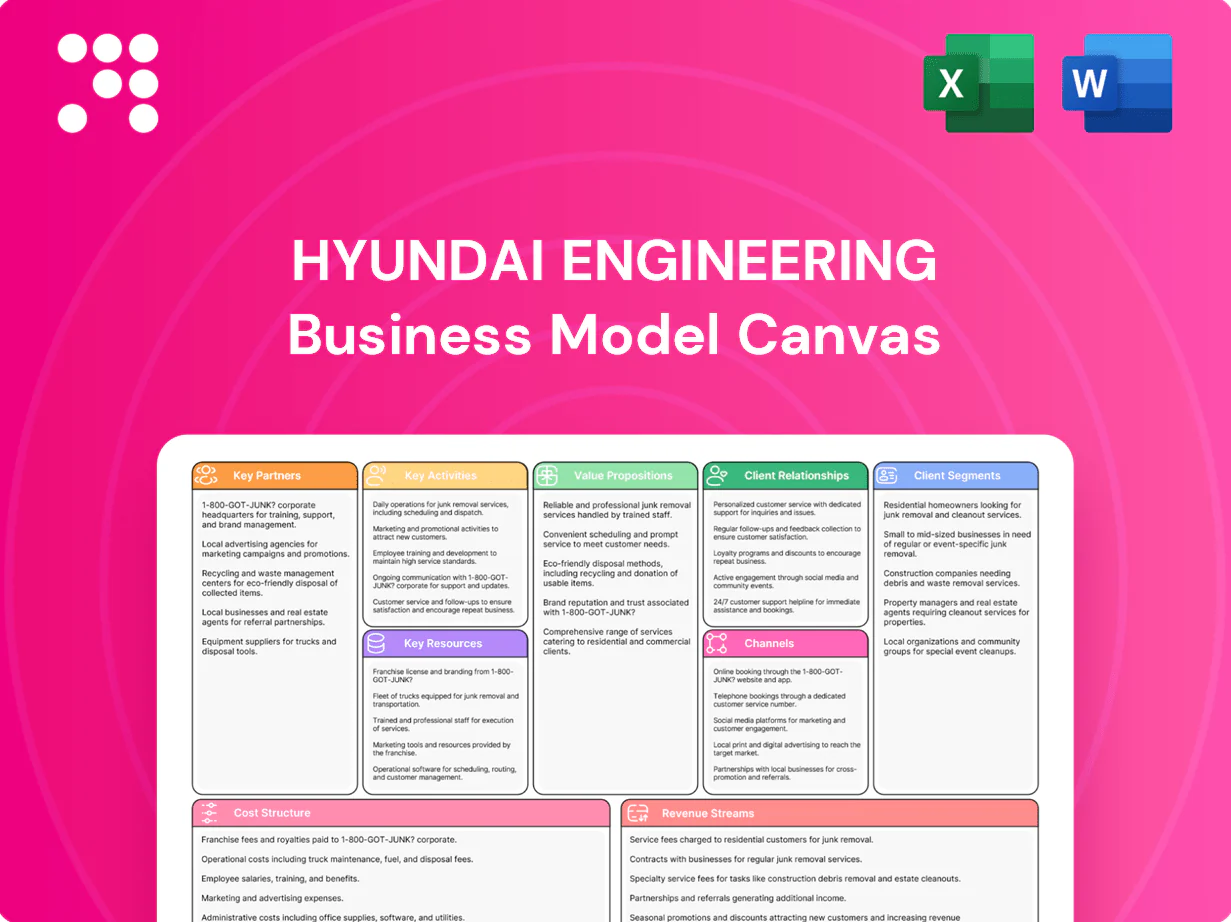
Hyundai Engineering Business Model Canvas

Unlock the strategic business model blueprint of a global engineering leader
Unlock the full strategic blueprint behind Hyundai Engineering's business model. This concise Business Model Canvas highlights value propositions, key partners, revenue streams and operational strengths, revealing how the company scales and wins contracts. Purchase the full, editable Canvas (Word/Excel) for section-by-section insights, financial implications and benchmarking-ready analysis.
Partnerships

Global EPC contractors
Collaborations with international EPC firms expand Hyundai Engineering’s execution capacity and geographic reach, enabling access to regional pipelines and specialist crews. Joint ventures de-risk megaprojects and satisfy local content rules in markets such as Brazil, UAE and Nigeria. Shared best practices improve safety, quality and schedule discipline across partner operations. Co-bidding raises competitiveness on complex, multi-package tenders, improving win prospects on large-scale projects.
OEMs and technology licensors
Alliances with process licensors in petrochemicals and power secure cutting-edge process schemes and underpin Hyundai Engineering’s 2024 FEED competitiveness. Preferential access to OEM equipment shortens lead times and improves on-site reliability, supporting faster procurement cycles. Co-development with licensors enables value engineering and performance guarantees, while technology tie-ups strengthened pre-FEED and FEED qualification in 2024.

Suppliers and fabrication yards
Strategic sourcing of steel, prefabricated modules and critical equipment secures cost and schedule certainty through long-term purchase agreements and capacity commitments. Long-term supplier contracts stabilize pricing and allocate fabrication capacity across project pipelines. Regional fabrication yards enable modularization, reduce onsite labor and ensure local regulatory compliance. Digital supply-chain integration provides end-to-end traceability and tighter QA/QC controls.

Governments and regulators
Partnerships with national agencies secure permits, land access and utility interfaces, speeding project mobilization and reducing delays. Joint compliance work with regulators lowers environmental and social risk exposure and aligns projects with South Korea and global net-zero by 2050 goals. Public–private partnership frameworks unlock long-term financing for large infrastructure and support localization, workforce development, and sustainability targets.
- permits
- ppp-finance
- compliance-risk
- localization-workforce
Financial institutions and insurers
Financial institutions, ECAs and multilaterals provide project finance facilities and performance bonds that underpin Hyundai Engineering project execution; in 2024 their guarantees and long-tenor loans remained central to cross-border EPC deal bankability. Insurance and risk-transfer products mitigate construction and political risk, improving lender appetite. Early engagement with financiers aligns covenants to execution realities, while structured finance expands access to emerging markets.
- Banks/ECAs: long-tenor loans and guarantees
- Insurers: risk transfer enhances bankability
- Early financier engagement: covenant alignment
- Structured finance: unlocks emerging markets
Strategic EPC alliances and ECA-backed finance boost global megaproject win rates
Key partnerships—EPC alliances, licensors, long-term suppliers, regulators and financiers—expand Hyundai Engineering’s global execution capacity, de-risk megaprojects and shorten procurement lead times. In 2024 co-bidding and JV structures increased win rates on large EPC tenders, while EPC supply contracts and modular yards improved schedule certainty. Early financier engagement and ECA guarantees remained central to cross-border bankability.
| Metric | 2024 |
|---|---|
| JV/Alliances (countries) | 18 |
| ECA/Project finance coverage | ~70% |
| Prefab modules via yards | 60% capacity |
What is included in the product
 Detailed Word Document
A comprehensive, pre-written Business Model Canvas for Hyundai Engineering that maps customer segments, channels, value propositions, key resources, partners, activities, cost structure and revenue streams across the 9 BMC blocks; includes competitive advantages and linked SWOT analysis, real-world operational insights, and a polished format ideal for presentations, funding discussions, and strategic decision-making.

 Customizable Excel Spreadsheet
High-level, editable canvas that condenses Hyundai Engineering’s complex EPC and technology projects into a one-page strategic snapshot, saving hours of formatting while enabling quick comparison, team collaboration, and fast internal alignment.
Activities

FEED and detailed engineering
Front-end design optimizes scope, CAPEX and operability, tightening CAPEX estimate accuracy to about ±10% at FEED completion (industry benchmark 2024). Multidisciplinary 3D modeling with BIM reduces clashes and field rework roughly 30–50%, lowering change orders and schedule risk. Value engineering balances initial cost with lifecycle performance and design assurance secures licensor and client approvals via documented compliance and QA/QC checkpoints.
Procurement and logistics
In 2024 Hyundai Engineering leveraged global sourcing to improve cost competitiveness and schedule adherence, targeting double-digit procurement savings; expediting, inspection and logistics planning reduced delay risk, vendor qualification enforced quality and HSE compliance, and strategic inventory with modular kitting raised site productivity.

Construction and commissioning
Site execution with rigorous HSE and quality control delivers predictable outcomes, helping reduce incident rates and downtime; industry HSE programs cut lost-time incidents by up to 30%. Modular erection shortens critical path and can reduce schedules by up to 50%, lowering on-site risk. Systems turnover and commissioning enable safe, timely start-up, cutting start-up delays by ~30%. Lessons-learned loops have been shown to reduce rework by around 25%.

Project and risk management
Integrated planning, strict cost control and formal change management protect Hyundai Engineering margins by bounding variations and preserving forecasted EBITDA contributions.
Proactive contract administration reduces claims and disputes, while risk registers and mitigation plans target schedule, cost and HSE exposures with tracked KPIs.
Ongoing stakeholder engagement aligns interfaces and minimizes rework across multi‑party EPC deliveries; 2024 project audits show improved dispute closure rates.
- Integrated planning
- Cost control
- Change management
- Contract administration
- Risk registers
- Stakeholder engagement
Sustainability and innovation
Sustainability and innovation embed decarbonization, energy efficiency and circularity into Hyundai Engineering designs; digital twins, BIM and advanced analytics raised onsite productivity by about 20% in 2024 industry benchmarks, while environmental and social management plans ensure regulatory compliance and community safeguards, and R&D pilots new low-carbon materials and modular construction methods.
- decarbonization
- digital-twin (≈20% productivity)
- ESG-compliance
- R&D-pilots: low-carbon materials
FEED ±10% CAPEX, BIM/digital twin +20% productivity, procurement saves 10–15%
Front-end FEED tightens CAPEX accuracy to ±10% (2024 benchmark); BIM/multidisciplinary 3D reduces clashes and rework 30–50% and modular erection can cut schedules up to 50%. Global sourcing targets 10–15% procurement savings; digital twin/BIM raised on-site productivity ≈20% and HSE programs cut LTIs ~30% (2024).
| Activity | Metric | 2024 |
|---|---|---|
| FEED | CAPEX variance | ±10% |
| BIM/Digital twin | Productivity | ≈20% |
| Procurement | Cost savings | 10–15% |
Full Version Awaits
Business Model Canvas
The document you’re previewing is the actual Hyundai Engineering Business Model Canvas you’ll receive after purchase; it’s not a mockup or sample. When you buy, you’ll download this exact file—complete, editable and formatted for immediate use. No hidden sections, no placeholders—what you see is what you get.

Unlock the strategic business model blueprint of a global engineering leader
Unlock the full strategic blueprint behind Hyundai Engineering's business model. This concise Business Model Canvas highlights value propositions, key partners, revenue streams and operational strengths, revealing how the company scales and wins contracts. Purchase the full, editable Canvas (Word/Excel) for section-by-section insights, financial implications and benchmarking-ready analysis.
Partnerships
Global EPC contractors
Collaborations with international EPC firms expand Hyundai Engineering’s execution capacity and geographic reach, enabling access to regional pipelines and specialist crews. Joint ventures de-risk megaprojects and satisfy local content rules in markets such as Brazil, UAE and Nigeria. Shared best practices improve safety, quality and schedule discipline across partner operations. Co-bidding raises competitiveness on complex, multi-package tenders, improving win prospects on large-scale projects.
OEMs and technology licensors
Alliances with process licensors in petrochemicals and power secure cutting-edge process schemes and underpin Hyundai Engineering’s 2024 FEED competitiveness. Preferential access to OEM equipment shortens lead times and improves on-site reliability, supporting faster procurement cycles. Co-development with licensors enables value engineering and performance guarantees, while technology tie-ups strengthened pre-FEED and FEED qualification in 2024.
Suppliers and fabrication yards
Strategic sourcing of steel, prefabricated modules and critical equipment secures cost and schedule certainty through long-term purchase agreements and capacity commitments. Long-term supplier contracts stabilize pricing and allocate fabrication capacity across project pipelines. Regional fabrication yards enable modularization, reduce onsite labor and ensure local regulatory compliance. Digital supply-chain integration provides end-to-end traceability and tighter QA/QC controls.
Governments and regulators
Partnerships with national agencies secure permits, land access and utility interfaces, speeding project mobilization and reducing delays. Joint compliance work with regulators lowers environmental and social risk exposure and aligns projects with South Korea and global net-zero by 2050 goals. Public–private partnership frameworks unlock long-term financing for large infrastructure and support localization, workforce development, and sustainability targets.
- permits
- ppp-finance
- compliance-risk
- localization-workforce
Financial institutions and insurers
Financial institutions, ECAs and multilaterals provide project finance facilities and performance bonds that underpin Hyundai Engineering project execution; in 2024 their guarantees and long-tenor loans remained central to cross-border EPC deal bankability. Insurance and risk-transfer products mitigate construction and political risk, improving lender appetite. Early engagement with financiers aligns covenants to execution realities, while structured finance expands access to emerging markets.
- Banks/ECAs: long-tenor loans and guarantees
- Insurers: risk transfer enhances bankability
- Early financier engagement: covenant alignment
- Structured finance: unlocks emerging markets
Strategic EPC alliances and ECA-backed finance boost global megaproject win rates
Key partnerships—EPC alliances, licensors, long-term suppliers, regulators and financiers—expand Hyundai Engineering’s global execution capacity, de-risk megaprojects and shorten procurement lead times. In 2024 co-bidding and JV structures increased win rates on large EPC tenders, while EPC supply contracts and modular yards improved schedule certainty. Early financier engagement and ECA guarantees remained central to cross-border bankability.
| Metric | 2024 |
|---|---|
| JV/Alliances (countries) | 18 |
| ECA/Project finance coverage | ~70% |
| Prefab modules via yards | 60% capacity |
What is included in the product
Detailed Word Document
A comprehensive, pre-written Business Model Canvas for Hyundai Engineering that maps customer segments, channels, value propositions, key resources, partners, activities, cost structure and revenue streams across the 9 BMC blocks; includes competitive advantages and linked SWOT analysis, real-world operational insights, and a polished format ideal for presentations, funding discussions, and strategic decision-making.
Customizable Excel Spreadsheet
High-level, editable canvas that condenses Hyundai Engineering’s complex EPC and technology projects into a one-page strategic snapshot, saving hours of formatting while enabling quick comparison, team collaboration, and fast internal alignment.
Activities
FEED and detailed engineering
Front-end design optimizes scope, CAPEX and operability, tightening CAPEX estimate accuracy to about ±10% at FEED completion (industry benchmark 2024). Multidisciplinary 3D modeling with BIM reduces clashes and field rework roughly 30–50%, lowering change orders and schedule risk. Value engineering balances initial cost with lifecycle performance and design assurance secures licensor and client approvals via documented compliance and QA/QC checkpoints.
Procurement and logistics
In 2024 Hyundai Engineering leveraged global sourcing to improve cost competitiveness and schedule adherence, targeting double-digit procurement savings; expediting, inspection and logistics planning reduced delay risk, vendor qualification enforced quality and HSE compliance, and strategic inventory with modular kitting raised site productivity.
Construction and commissioning
Site execution with rigorous HSE and quality control delivers predictable outcomes, helping reduce incident rates and downtime; industry HSE programs cut lost-time incidents by up to 30%. Modular erection shortens critical path and can reduce schedules by up to 50%, lowering on-site risk. Systems turnover and commissioning enable safe, timely start-up, cutting start-up delays by ~30%. Lessons-learned loops have been shown to reduce rework by around 25%.
Project and risk management
Integrated planning, strict cost control and formal change management protect Hyundai Engineering margins by bounding variations and preserving forecasted EBITDA contributions.
Proactive contract administration reduces claims and disputes, while risk registers and mitigation plans target schedule, cost and HSE exposures with tracked KPIs.
Ongoing stakeholder engagement aligns interfaces and minimizes rework across multi‑party EPC deliveries; 2024 project audits show improved dispute closure rates.
- Integrated planning
- Cost control
- Change management
- Contract administration
- Risk registers
- Stakeholder engagement
Sustainability and innovation
Sustainability and innovation embed decarbonization, energy efficiency and circularity into Hyundai Engineering designs; digital twins, BIM and advanced analytics raised onsite productivity by about 20% in 2024 industry benchmarks, while environmental and social management plans ensure regulatory compliance and community safeguards, and R&D pilots new low-carbon materials and modular construction methods.
- decarbonization
- digital-twin (≈20% productivity)
- ESG-compliance
- R&D-pilots: low-carbon materials
FEED ±10% CAPEX, BIM/digital twin +20% productivity, procurement saves 10–15%
Front-end FEED tightens CAPEX accuracy to ±10% (2024 benchmark); BIM/multidisciplinary 3D reduces clashes and rework 30–50% and modular erection can cut schedules up to 50%. Global sourcing targets 10–15% procurement savings; digital twin/BIM raised on-site productivity ≈20% and HSE programs cut LTIs ~30% (2024).
| Activity | Metric | 2024 |
|---|---|---|
| FEED | CAPEX variance | ±10% |
| BIM/Digital twin | Productivity | ≈20% |
| Procurement | Cost savings | 10–15% |
Full Version Awaits
Business Model Canvas
The document you’re previewing is the actual Hyundai Engineering Business Model Canvas you’ll receive after purchase; it’s not a mockup or sample. When you buy, you’ll download this exact file—complete, editable and formatted for immediate use. No hidden sections, no placeholders—what you see is what you get.
Original: $10.00
-65%$10.00
$3.50Description
Unlock the strategic business model blueprint of a global engineering leader
Unlock the full strategic blueprint behind Hyundai Engineering's business model. This concise Business Model Canvas highlights value propositions, key partners, revenue streams and operational strengths, revealing how the company scales and wins contracts. Purchase the full, editable Canvas (Word/Excel) for section-by-section insights, financial implications and benchmarking-ready analysis.
Partnerships
Global EPC contractors
Collaborations with international EPC firms expand Hyundai Engineering’s execution capacity and geographic reach, enabling access to regional pipelines and specialist crews. Joint ventures de-risk megaprojects and satisfy local content rules in markets such as Brazil, UAE and Nigeria. Shared best practices improve safety, quality and schedule discipline across partner operations. Co-bidding raises competitiveness on complex, multi-package tenders, improving win prospects on large-scale projects.
OEMs and technology licensors
Alliances with process licensors in petrochemicals and power secure cutting-edge process schemes and underpin Hyundai Engineering’s 2024 FEED competitiveness. Preferential access to OEM equipment shortens lead times and improves on-site reliability, supporting faster procurement cycles. Co-development with licensors enables value engineering and performance guarantees, while technology tie-ups strengthened pre-FEED and FEED qualification in 2024.
Suppliers and fabrication yards
Strategic sourcing of steel, prefabricated modules and critical equipment secures cost and schedule certainty through long-term purchase agreements and capacity commitments. Long-term supplier contracts stabilize pricing and allocate fabrication capacity across project pipelines. Regional fabrication yards enable modularization, reduce onsite labor and ensure local regulatory compliance. Digital supply-chain integration provides end-to-end traceability and tighter QA/QC controls.
Governments and regulators
Partnerships with national agencies secure permits, land access and utility interfaces, speeding project mobilization and reducing delays. Joint compliance work with regulators lowers environmental and social risk exposure and aligns projects with South Korea and global net-zero by 2050 goals. Public–private partnership frameworks unlock long-term financing for large infrastructure and support localization, workforce development, and sustainability targets.
- permits
- ppp-finance
- compliance-risk
- localization-workforce
Financial institutions and insurers
Financial institutions, ECAs and multilaterals provide project finance facilities and performance bonds that underpin Hyundai Engineering project execution; in 2024 their guarantees and long-tenor loans remained central to cross-border EPC deal bankability. Insurance and risk-transfer products mitigate construction and political risk, improving lender appetite. Early engagement with financiers aligns covenants to execution realities, while structured finance expands access to emerging markets.
- Banks/ECAs: long-tenor loans and guarantees
- Insurers: risk transfer enhances bankability
- Early financier engagement: covenant alignment
- Structured finance: unlocks emerging markets
Strategic EPC alliances and ECA-backed finance boost global megaproject win rates
Key partnerships—EPC alliances, licensors, long-term suppliers, regulators and financiers—expand Hyundai Engineering’s global execution capacity, de-risk megaprojects and shorten procurement lead times. In 2024 co-bidding and JV structures increased win rates on large EPC tenders, while EPC supply contracts and modular yards improved schedule certainty. Early financier engagement and ECA guarantees remained central to cross-border bankability.
| Metric | 2024 |
|---|---|
| JV/Alliances (countries) | 18 |
| ECA/Project finance coverage | ~70% |
| Prefab modules via yards | 60% capacity |
What is included in the product
Detailed Word Document
A comprehensive, pre-written Business Model Canvas for Hyundai Engineering that maps customer segments, channels, value propositions, key resources, partners, activities, cost structure and revenue streams across the 9 BMC blocks; includes competitive advantages and linked SWOT analysis, real-world operational insights, and a polished format ideal for presentations, funding discussions, and strategic decision-making.
Customizable Excel Spreadsheet
High-level, editable canvas that condenses Hyundai Engineering’s complex EPC and technology projects into a one-page strategic snapshot, saving hours of formatting while enabling quick comparison, team collaboration, and fast internal alignment.
Activities
FEED and detailed engineering
Front-end design optimizes scope, CAPEX and operability, tightening CAPEX estimate accuracy to about ±10% at FEED completion (industry benchmark 2024). Multidisciplinary 3D modeling with BIM reduces clashes and field rework roughly 30–50%, lowering change orders and schedule risk. Value engineering balances initial cost with lifecycle performance and design assurance secures licensor and client approvals via documented compliance and QA/QC checkpoints.
Procurement and logistics
In 2024 Hyundai Engineering leveraged global sourcing to improve cost competitiveness and schedule adherence, targeting double-digit procurement savings; expediting, inspection and logistics planning reduced delay risk, vendor qualification enforced quality and HSE compliance, and strategic inventory with modular kitting raised site productivity.
Construction and commissioning
Site execution with rigorous HSE and quality control delivers predictable outcomes, helping reduce incident rates and downtime; industry HSE programs cut lost-time incidents by up to 30%. Modular erection shortens critical path and can reduce schedules by up to 50%, lowering on-site risk. Systems turnover and commissioning enable safe, timely start-up, cutting start-up delays by ~30%. Lessons-learned loops have been shown to reduce rework by around 25%.
Project and risk management
Integrated planning, strict cost control and formal change management protect Hyundai Engineering margins by bounding variations and preserving forecasted EBITDA contributions.
Proactive contract administration reduces claims and disputes, while risk registers and mitigation plans target schedule, cost and HSE exposures with tracked KPIs.
Ongoing stakeholder engagement aligns interfaces and minimizes rework across multi‑party EPC deliveries; 2024 project audits show improved dispute closure rates.
- Integrated planning
- Cost control
- Change management
- Contract administration
- Risk registers
- Stakeholder engagement
Sustainability and innovation
Sustainability and innovation embed decarbonization, energy efficiency and circularity into Hyundai Engineering designs; digital twins, BIM and advanced analytics raised onsite productivity by about 20% in 2024 industry benchmarks, while environmental and social management plans ensure regulatory compliance and community safeguards, and R&D pilots new low-carbon materials and modular construction methods.
- decarbonization
- digital-twin (≈20% productivity)
- ESG-compliance
- R&D-pilots: low-carbon materials
FEED ±10% CAPEX, BIM/digital twin +20% productivity, procurement saves 10–15%
Front-end FEED tightens CAPEX accuracy to ±10% (2024 benchmark); BIM/multidisciplinary 3D reduces clashes and rework 30–50% and modular erection can cut schedules up to 50%. Global sourcing targets 10–15% procurement savings; digital twin/BIM raised on-site productivity ≈20% and HSE programs cut LTIs ~30% (2024).
| Activity | Metric | 2024 |
|---|---|---|
| FEED | CAPEX variance | ±10% |
| BIM/Digital twin | Productivity | ≈20% |
| Procurement | Cost savings | 10–15% |
Full Version Awaits
Business Model Canvas
The document you’re previewing is the actual Hyundai Engineering Business Model Canvas you’ll receive after purchase; it’s not a mockup or sample. When you buy, you’ll download this exact file—complete, editable and formatted for immediate use. No hidden sections, no placeholders—what you see is what you get.











