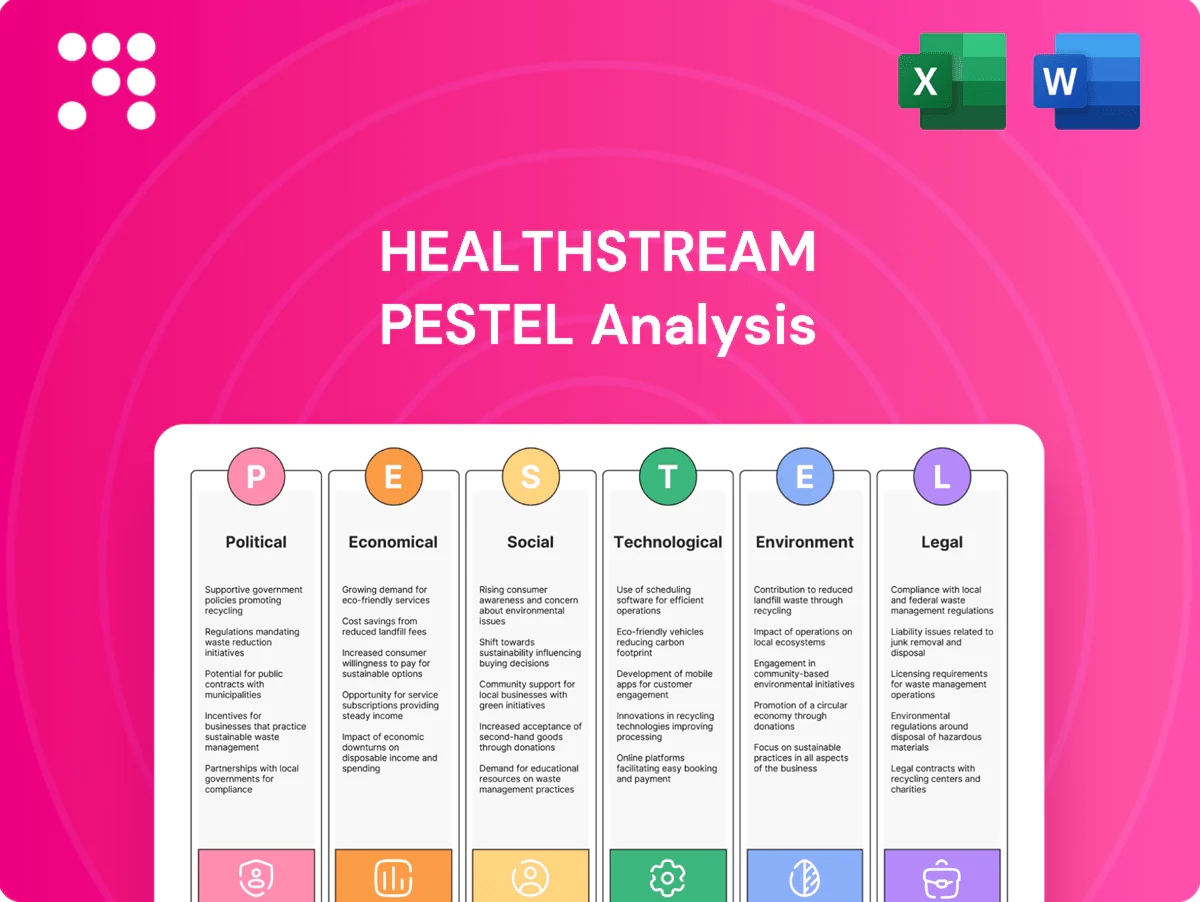
Healthstream PESTLE Analysis

Make Smarter Strategic Decisions with a Complete PESTEL View
Unlock strategic clarity with our PESTLE Analysis of HealthStream—three- to five-year trend insights showing how political, economic, social, technological, legal, and environmental forces will shape performance. Ideal for investors and strategists, the full report delivers actionable recommendations. Purchase now for the complete, editable analysis and stay ahead.
Political factors

Healthcare policy shifts and funding priorities
Changes in federal and state policies reshape provider budgets for workforce development and compliance training; US health spending hit $4.5 trillion in 2023, pressuring reallocations. Expansion or contraction of Medicare and Medicaid (combined ~150 million beneficiaries in 2024) shifts funds toward quality and safety education. HealthStream must align content roadmaps with emerging policy goals and actively monitor CMS rulemaking for timely course updates.
Regulatory oversight and accreditation influence
Mandates from CMS and state boards, plus The Joint Commission’s oversight of over 22,000 organizations, drive recurring compliance training demand across roughly 6,100 US hospitals and Medicare’s ~63 million beneficiaries. Policy emphasis on patient safety, infection control, and competency verification sustains platform use, while rapid regulatory updates force agile content authoring and distribution. Close ties with accrediting bodies shape product relevance.

Public health emergency preparedness
Government emergency declarations such as the March 13, 2020 national COVID-19 declaration drive spikes in demand for surge training and rapid credentialing, while the $2.2 trillion CARES Act enabled accelerated investments in workforce readiness. Preparedness grants (CDC PHEP cooperative agreements historically around $600–700 million annually) subsidize adoption of scalable learning platforms. Political focus on readiness favors vendors with fast deployment and verified content, and HealthStream’s ability to push urgent modules system-wide is a clear differentiator.

Workforce development initiatives and grants
National and state workforce programs such as NHSC and HRSA-funded initiatives incentivize reskilling/upskilling to address clinician shortages, channeling billions in grants annually and placing thousands of clinicians in underserved areas in 2024. Grants for rural and underserved areas can underwrite licenses and HealthStream content, lowering adoption barriers for budget-constrained systems. Aligning courses to grant criteria accelerates procurement and rollout; demonstrating measured outcomes increases eligibility for repeat funding.
- Funding scale: billions annually via HRSA/NHSC
- Reach: thousands of clinicians placed in underserved areas (2024)
- Impact: grants can cover LMS/content/licenses
- Strategy: map offerings to grant metrics to win renewals
Data sovereignty and cross-border operations
Evolving data localization and public-sector procurement rules shape HealthStream’s hosting and go-to-market plans; clarity reduces sales-cycle and compliance risk. Multi-state systems and government-affiliated providers require nuanced procurement navigation and regional data options, especially as HealthStream serves over 2,800 healthcare organizations. Policy certainty shortens procurement timelines and limits legal exposure.
- Data localization: affects hosting choices
- Procurement complexity: multi-state approvals
- Regional data options: needed for government providers
- Policy clarity: lowers compliance/sales risk
Policy shifts spur compliance training as US health spending hits $4.5T and ~150M beneficiaries
Federal/state policy and CMS rulemaking (monitoring required) redirect budgets toward compliance and quality training as US health spending reached $4.5T in 2023. Medicare and Medicaid (~150M beneficiaries in 2024) and mandates from The Joint Commission sustain recurring demand across ~6,100 hospitals. Grants and emergency funding (CARES, HRSA) accelerate adoption of scalable learning platforms and rapid credentialing.
| Metric | Value |
|---|---|
| US health spending (2023) | $4.5T |
| Medicare+Medicaid (2024) | ~150M beneficiaries |
| US hospitals | ~6,100 |
What is included in the product
 Detailed Word Document
Explores how macro-environmental forces uniquely affect HealthStream across Political, Economic, Social, Technological, Environmental and Legal dimensions, each backed by current data and trends to identify risks and opportunities; designed for executives and advisors with forward-looking insights and clean, report-ready formatting.

 Customizable Excel Spreadsheet
Concise, visually segmented PESTLE summary tailored to HealthStream that enables quick stakeholder alignment, easy insertion into presentations, and editable notes for regional or business-line specificity.
Economic factors

Provider margin pressure and budget cycles
Hospital financial stress from rising labor costs—labor represents roughly half of operating expenses—and payer mix variability compresses margins, pressuring SaaS renewals and upsells. Solutions that cut onboarding time and reduce turnover (nurse turnover near 20% in 2023–24) can win funding despite austerity. Clear ROI and productivity metrics strengthen business cases, and multi-year contracts smooth revenue through cycles.
Labor shortages and training demand
Staffing gaps in US hospitals have driven rapid competency ramp-up and cross-training needs as a majority of providers report ongoing shortages; replacing a bedside nurse is estimated to cost about $52,000 per NSI industry data. Automated learning paths that reduce preceptor time deliver direct cost benefits and let HealthStream price to value where training offsets premium labor costs. Workforce analytics tied to retention enable HealthStream to offer premium tiers to health systems seeking measurable turnover reduction.

Consolidation of health systems
M&A-driven consolidation enables enterprise-wide LMS standardization, and 2024 industry deals commonly cover 5,000–30,000 learner seats. However, larger buyer power increases pricing pressure, compressing license margins by an estimated 10–25%. Integration and migration services emerge as a 15–30% revenue lever per deal. Winning system-level RFPs can displace incumbents and drive rapid seat expansion and million-dollar ARR jumps.

Macroeconomic uncertainty and SaaS resilience
Macroeconomic uncertainty strengthens HealthStream’s defensive profile: recurring subscription revenue and compliance‑critical workforce training sustain demand in downturns, though 2024 capital constraints may slow upsell velocity for analytics and competency modules; tiered packaging helps protect ARR while preserving per‑customer value, and international expansion diversifies economic exposure.
- Defensive: recurring, compliance‑critical use cases
- Risk: slower upsell to analytics/competency if capital tight
- Mitigation: tiered packaging preserves ARR
- Opportunity: international expansion diversifies exposure
Pricing strategy and unit economics
Per-seat pricing tied to FTE counts must flex with staffing volatility to avoid revenue leakage as hospitals faced persistent staffing churn through 2024.
Bundled offers combining compliance, clinical content, and measurement raise ARPU by enabling upsells and deeper integrations.
Embedded workflows that lower churn increase LTV/CAC, while transparent ROI dashboards uphold price integrity and buyer trust.
- FTE-linked pricing: adapt to staffing volatility
- Bundles: lift ARPU via cross-sell
- Embedded workflows: reduce churn, raise LTV/CAC
- ROI dashboards: support price integrity
Policy shifts spur compliance training as US health spending hits $4.5T and ~150M beneficiaries
Hospitals spend ~50% of operating costs on labor; nurse turnover ~20% (2023–24) with replacement ~$52,000, driving demand for rapid training that reduces preceptor time. Consolidation yields 5,000–30,000 seat deals but creates 10–25% pricing pressure; integration/migration services add 15–30% revenue. Per‑seat FTE pricing must flex to avoid leakage amid 2024 staffing churn.
| Metric | Value |
|---|---|
| Labor % of Opex | ~50% |
| Nurse turnover | ~20% |
| Replacement cost | $52,000 |
| Deal size | 5k–30k seats |
| Price pressure | 10–25% |
| Integration rev | 15–30% |
Same Document Delivered
Healthstream PESTLE Analysis
The preview shown here is the exact Healthstream PESTLE Analysis you’ll receive after purchase—fully formatted, professionally structured, and ready to use. It contains the complete political, economic, social, technological, legal, and environmental assessment as displayed, with no placeholders or edits required. After payment you’ll instantly download this identical, final document.

Make Smarter Strategic Decisions with a Complete PESTEL View
Unlock strategic clarity with our PESTLE Analysis of HealthStream—three- to five-year trend insights showing how political, economic, social, technological, legal, and environmental forces will shape performance. Ideal for investors and strategists, the full report delivers actionable recommendations. Purchase now for the complete, editable analysis and stay ahead.
Political factors
Healthcare policy shifts and funding priorities
Changes in federal and state policies reshape provider budgets for workforce development and compliance training; US health spending hit $4.5 trillion in 2023, pressuring reallocations. Expansion or contraction of Medicare and Medicaid (combined ~150 million beneficiaries in 2024) shifts funds toward quality and safety education. HealthStream must align content roadmaps with emerging policy goals and actively monitor CMS rulemaking for timely course updates.
Regulatory oversight and accreditation influence
Mandates from CMS and state boards, plus The Joint Commission’s oversight of over 22,000 organizations, drive recurring compliance training demand across roughly 6,100 US hospitals and Medicare’s ~63 million beneficiaries. Policy emphasis on patient safety, infection control, and competency verification sustains platform use, while rapid regulatory updates force agile content authoring and distribution. Close ties with accrediting bodies shape product relevance.
Public health emergency preparedness
Government emergency declarations such as the March 13, 2020 national COVID-19 declaration drive spikes in demand for surge training and rapid credentialing, while the $2.2 trillion CARES Act enabled accelerated investments in workforce readiness. Preparedness grants (CDC PHEP cooperative agreements historically around $600–700 million annually) subsidize adoption of scalable learning platforms. Political focus on readiness favors vendors with fast deployment and verified content, and HealthStream’s ability to push urgent modules system-wide is a clear differentiator.
Workforce development initiatives and grants
National and state workforce programs such as NHSC and HRSA-funded initiatives incentivize reskilling/upskilling to address clinician shortages, channeling billions in grants annually and placing thousands of clinicians in underserved areas in 2024. Grants for rural and underserved areas can underwrite licenses and HealthStream content, lowering adoption barriers for budget-constrained systems. Aligning courses to grant criteria accelerates procurement and rollout; demonstrating measured outcomes increases eligibility for repeat funding.
- Funding scale: billions annually via HRSA/NHSC
- Reach: thousands of clinicians placed in underserved areas (2024)
- Impact: grants can cover LMS/content/licenses
- Strategy: map offerings to grant metrics to win renewals
Data sovereignty and cross-border operations
Evolving data localization and public-sector procurement rules shape HealthStream’s hosting and go-to-market plans; clarity reduces sales-cycle and compliance risk. Multi-state systems and government-affiliated providers require nuanced procurement navigation and regional data options, especially as HealthStream serves over 2,800 healthcare organizations. Policy certainty shortens procurement timelines and limits legal exposure.
- Data localization: affects hosting choices
- Procurement complexity: multi-state approvals
- Regional data options: needed for government providers
- Policy clarity: lowers compliance/sales risk
Policy shifts spur compliance training as US health spending hits $4.5T and ~150M beneficiaries
Federal/state policy and CMS rulemaking (monitoring required) redirect budgets toward compliance and quality training as US health spending reached $4.5T in 2023. Medicare and Medicaid (~150M beneficiaries in 2024) and mandates from The Joint Commission sustain recurring demand across ~6,100 hospitals. Grants and emergency funding (CARES, HRSA) accelerate adoption of scalable learning platforms and rapid credentialing.
| Metric | Value |
|---|---|
| US health spending (2023) | $4.5T |
| Medicare+Medicaid (2024) | ~150M beneficiaries |
| US hospitals | ~6,100 |
What is included in the product
Detailed Word Document
Explores how macro-environmental forces uniquely affect HealthStream across Political, Economic, Social, Technological, Environmental and Legal dimensions, each backed by current data and trends to identify risks and opportunities; designed for executives and advisors with forward-looking insights and clean, report-ready formatting.
Customizable Excel Spreadsheet
Concise, visually segmented PESTLE summary tailored to HealthStream that enables quick stakeholder alignment, easy insertion into presentations, and editable notes for regional or business-line specificity.
Economic factors
Provider margin pressure and budget cycles
Hospital financial stress from rising labor costs—labor represents roughly half of operating expenses—and payer mix variability compresses margins, pressuring SaaS renewals and upsells. Solutions that cut onboarding time and reduce turnover (nurse turnover near 20% in 2023–24) can win funding despite austerity. Clear ROI and productivity metrics strengthen business cases, and multi-year contracts smooth revenue through cycles.
Labor shortages and training demand
Staffing gaps in US hospitals have driven rapid competency ramp-up and cross-training needs as a majority of providers report ongoing shortages; replacing a bedside nurse is estimated to cost about $52,000 per NSI industry data. Automated learning paths that reduce preceptor time deliver direct cost benefits and let HealthStream price to value where training offsets premium labor costs. Workforce analytics tied to retention enable HealthStream to offer premium tiers to health systems seeking measurable turnover reduction.
Consolidation of health systems
M&A-driven consolidation enables enterprise-wide LMS standardization, and 2024 industry deals commonly cover 5,000–30,000 learner seats. However, larger buyer power increases pricing pressure, compressing license margins by an estimated 10–25%. Integration and migration services emerge as a 15–30% revenue lever per deal. Winning system-level RFPs can displace incumbents and drive rapid seat expansion and million-dollar ARR jumps.
Macroeconomic uncertainty and SaaS resilience
Macroeconomic uncertainty strengthens HealthStream’s defensive profile: recurring subscription revenue and compliance‑critical workforce training sustain demand in downturns, though 2024 capital constraints may slow upsell velocity for analytics and competency modules; tiered packaging helps protect ARR while preserving per‑customer value, and international expansion diversifies economic exposure.
- Defensive: recurring, compliance‑critical use cases
- Risk: slower upsell to analytics/competency if capital tight
- Mitigation: tiered packaging preserves ARR
- Opportunity: international expansion diversifies exposure
Pricing strategy and unit economics
Per-seat pricing tied to FTE counts must flex with staffing volatility to avoid revenue leakage as hospitals faced persistent staffing churn through 2024.
Bundled offers combining compliance, clinical content, and measurement raise ARPU by enabling upsells and deeper integrations.
Embedded workflows that lower churn increase LTV/CAC, while transparent ROI dashboards uphold price integrity and buyer trust.
- FTE-linked pricing: adapt to staffing volatility
- Bundles: lift ARPU via cross-sell
- Embedded workflows: reduce churn, raise LTV/CAC
- ROI dashboards: support price integrity
Policy shifts spur compliance training as US health spending hits $4.5T and ~150M beneficiaries
Hospitals spend ~50% of operating costs on labor; nurse turnover ~20% (2023–24) with replacement ~$52,000, driving demand for rapid training that reduces preceptor time. Consolidation yields 5,000–30,000 seat deals but creates 10–25% pricing pressure; integration/migration services add 15–30% revenue. Per‑seat FTE pricing must flex to avoid leakage amid 2024 staffing churn.
| Metric | Value |
|---|---|
| Labor % of Opex | ~50% |
| Nurse turnover | ~20% |
| Replacement cost | $52,000 |
| Deal size | 5k–30k seats |
| Price pressure | 10–25% |
| Integration rev | 15–30% |
Same Document Delivered
Healthstream PESTLE Analysis
The preview shown here is the exact Healthstream PESTLE Analysis you’ll receive after purchase—fully formatted, professionally structured, and ready to use. It contains the complete political, economic, social, technological, legal, and environmental assessment as displayed, with no placeholders or edits required. After payment you’ll instantly download this identical, final document.
Original: $10.00
-65%$10.00
$3.50Description
Make Smarter Strategic Decisions with a Complete PESTEL View
Unlock strategic clarity with our PESTLE Analysis of HealthStream—three- to five-year trend insights showing how political, economic, social, technological, legal, and environmental forces will shape performance. Ideal for investors and strategists, the full report delivers actionable recommendations. Purchase now for the complete, editable analysis and stay ahead.
Political factors
Healthcare policy shifts and funding priorities
Changes in federal and state policies reshape provider budgets for workforce development and compliance training; US health spending hit $4.5 trillion in 2023, pressuring reallocations. Expansion or contraction of Medicare and Medicaid (combined ~150 million beneficiaries in 2024) shifts funds toward quality and safety education. HealthStream must align content roadmaps with emerging policy goals and actively monitor CMS rulemaking for timely course updates.
Regulatory oversight and accreditation influence
Mandates from CMS and state boards, plus The Joint Commission’s oversight of over 22,000 organizations, drive recurring compliance training demand across roughly 6,100 US hospitals and Medicare’s ~63 million beneficiaries. Policy emphasis on patient safety, infection control, and competency verification sustains platform use, while rapid regulatory updates force agile content authoring and distribution. Close ties with accrediting bodies shape product relevance.
Public health emergency preparedness
Government emergency declarations such as the March 13, 2020 national COVID-19 declaration drive spikes in demand for surge training and rapid credentialing, while the $2.2 trillion CARES Act enabled accelerated investments in workforce readiness. Preparedness grants (CDC PHEP cooperative agreements historically around $600–700 million annually) subsidize adoption of scalable learning platforms. Political focus on readiness favors vendors with fast deployment and verified content, and HealthStream’s ability to push urgent modules system-wide is a clear differentiator.
Workforce development initiatives and grants
National and state workforce programs such as NHSC and HRSA-funded initiatives incentivize reskilling/upskilling to address clinician shortages, channeling billions in grants annually and placing thousands of clinicians in underserved areas in 2024. Grants for rural and underserved areas can underwrite licenses and HealthStream content, lowering adoption barriers for budget-constrained systems. Aligning courses to grant criteria accelerates procurement and rollout; demonstrating measured outcomes increases eligibility for repeat funding.
- Funding scale: billions annually via HRSA/NHSC
- Reach: thousands of clinicians placed in underserved areas (2024)
- Impact: grants can cover LMS/content/licenses
- Strategy: map offerings to grant metrics to win renewals
Data sovereignty and cross-border operations
Evolving data localization and public-sector procurement rules shape HealthStream’s hosting and go-to-market plans; clarity reduces sales-cycle and compliance risk. Multi-state systems and government-affiliated providers require nuanced procurement navigation and regional data options, especially as HealthStream serves over 2,800 healthcare organizations. Policy certainty shortens procurement timelines and limits legal exposure.
- Data localization: affects hosting choices
- Procurement complexity: multi-state approvals
- Regional data options: needed for government providers
- Policy clarity: lowers compliance/sales risk
Policy shifts spur compliance training as US health spending hits $4.5T and ~150M beneficiaries
Federal/state policy and CMS rulemaking (monitoring required) redirect budgets toward compliance and quality training as US health spending reached $4.5T in 2023. Medicare and Medicaid (~150M beneficiaries in 2024) and mandates from The Joint Commission sustain recurring demand across ~6,100 hospitals. Grants and emergency funding (CARES, HRSA) accelerate adoption of scalable learning platforms and rapid credentialing.
| Metric | Value |
|---|---|
| US health spending (2023) | $4.5T |
| Medicare+Medicaid (2024) | ~150M beneficiaries |
| US hospitals | ~6,100 |
What is included in the product
Detailed Word Document
Explores how macro-environmental forces uniquely affect HealthStream across Political, Economic, Social, Technological, Environmental and Legal dimensions, each backed by current data and trends to identify risks and opportunities; designed for executives and advisors with forward-looking insights and clean, report-ready formatting.
Customizable Excel Spreadsheet
Concise, visually segmented PESTLE summary tailored to HealthStream that enables quick stakeholder alignment, easy insertion into presentations, and editable notes for regional or business-line specificity.
Economic factors
Provider margin pressure and budget cycles
Hospital financial stress from rising labor costs—labor represents roughly half of operating expenses—and payer mix variability compresses margins, pressuring SaaS renewals and upsells. Solutions that cut onboarding time and reduce turnover (nurse turnover near 20% in 2023–24) can win funding despite austerity. Clear ROI and productivity metrics strengthen business cases, and multi-year contracts smooth revenue through cycles.
Labor shortages and training demand
Staffing gaps in US hospitals have driven rapid competency ramp-up and cross-training needs as a majority of providers report ongoing shortages; replacing a bedside nurse is estimated to cost about $52,000 per NSI industry data. Automated learning paths that reduce preceptor time deliver direct cost benefits and let HealthStream price to value where training offsets premium labor costs. Workforce analytics tied to retention enable HealthStream to offer premium tiers to health systems seeking measurable turnover reduction.
Consolidation of health systems
M&A-driven consolidation enables enterprise-wide LMS standardization, and 2024 industry deals commonly cover 5,000–30,000 learner seats. However, larger buyer power increases pricing pressure, compressing license margins by an estimated 10–25%. Integration and migration services emerge as a 15–30% revenue lever per deal. Winning system-level RFPs can displace incumbents and drive rapid seat expansion and million-dollar ARR jumps.
Macroeconomic uncertainty and SaaS resilience
Macroeconomic uncertainty strengthens HealthStream’s defensive profile: recurring subscription revenue and compliance‑critical workforce training sustain demand in downturns, though 2024 capital constraints may slow upsell velocity for analytics and competency modules; tiered packaging helps protect ARR while preserving per‑customer value, and international expansion diversifies economic exposure.
- Defensive: recurring, compliance‑critical use cases
- Risk: slower upsell to analytics/competency if capital tight
- Mitigation: tiered packaging preserves ARR
- Opportunity: international expansion diversifies exposure
Pricing strategy and unit economics
Per-seat pricing tied to FTE counts must flex with staffing volatility to avoid revenue leakage as hospitals faced persistent staffing churn through 2024.
Bundled offers combining compliance, clinical content, and measurement raise ARPU by enabling upsells and deeper integrations.
Embedded workflows that lower churn increase LTV/CAC, while transparent ROI dashboards uphold price integrity and buyer trust.
- FTE-linked pricing: adapt to staffing volatility
- Bundles: lift ARPU via cross-sell
- Embedded workflows: reduce churn, raise LTV/CAC
- ROI dashboards: support price integrity
Policy shifts spur compliance training as US health spending hits $4.5T and ~150M beneficiaries
Hospitals spend ~50% of operating costs on labor; nurse turnover ~20% (2023–24) with replacement ~$52,000, driving demand for rapid training that reduces preceptor time. Consolidation yields 5,000–30,000 seat deals but creates 10–25% pricing pressure; integration/migration services add 15–30% revenue. Per‑seat FTE pricing must flex to avoid leakage amid 2024 staffing churn.
| Metric | Value |
|---|---|
| Labor % of Opex | ~50% |
| Nurse turnover | ~20% |
| Replacement cost | $52,000 |
| Deal size | 5k–30k seats |
| Price pressure | 10–25% |
| Integration rev | 15–30% |
Same Document Delivered
Healthstream PESTLE Analysis
The preview shown here is the exact Healthstream PESTLE Analysis you’ll receive after purchase—fully formatted, professionally structured, and ready to use. It contains the complete political, economic, social, technological, legal, and environmental assessment as displayed, with no placeholders or edits required. After payment you’ll instantly download this identical, final document.











