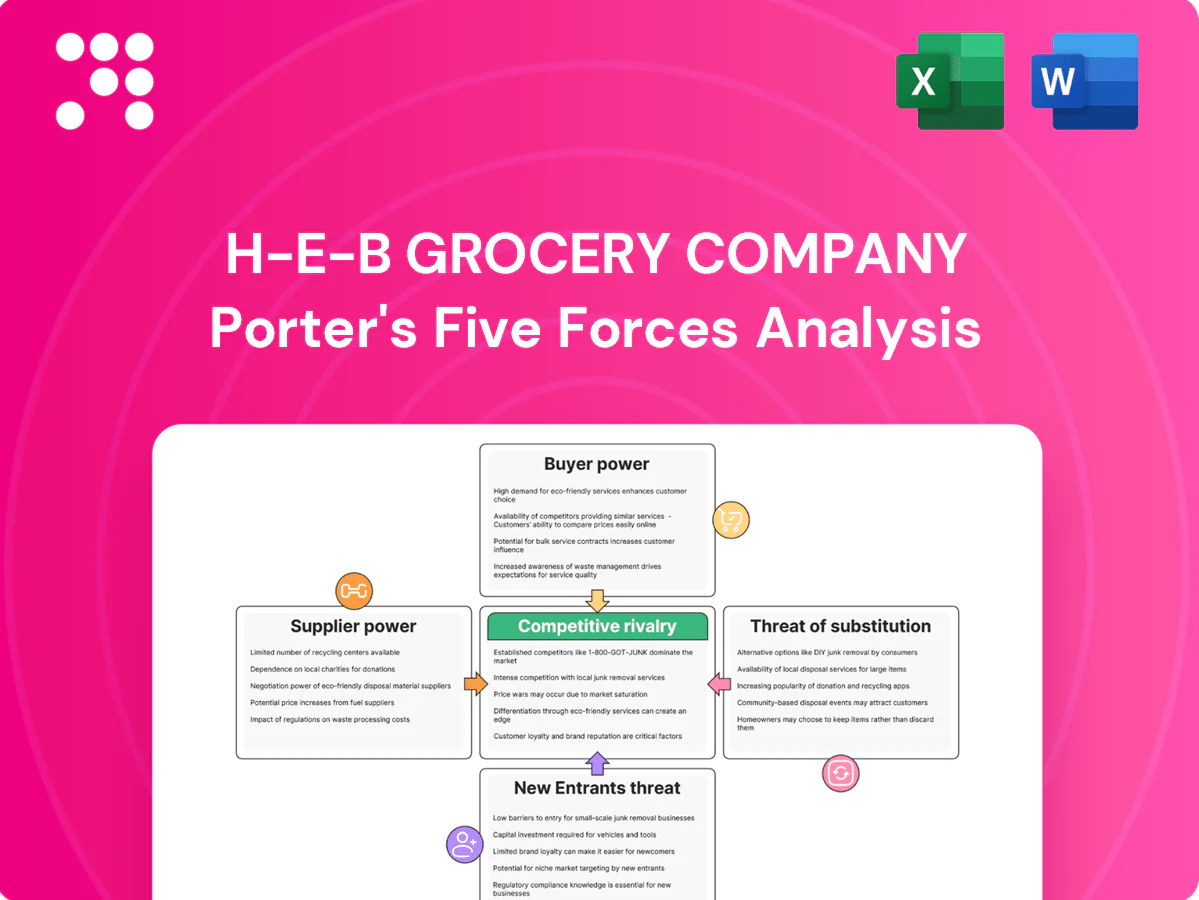
H-E-B Grocery Company Porter's Five Forces Analysis

A Must-Have Tool for Decision-Makers
H-E-B’s strong regional brand, private-label strategy, and tight supplier relationships limit supplier and entrant threats, while buyer power is moderated by loyalty and convenience; however, online grocers and price-sensitive rivals intensify rivalry. This brief snapshot only scratches the surface—unlock the full Porter's Five Forces Analysis for detailed, actionable insights.
Suppliers Bargaining Power

Diverse supplier base
HEB sources from national brands, private-label manufacturers and local producers across its network of more than 420 stores, reducing single-vendor dependence. This diversification limits switching costs and, combined with HEB’s scale—annual sales reported north of 36 billion USD in recent years—boosts negotiating leverage. It enables assortment differentiation and resilience to supply disruptions, moderating supplier power overall.
Private label leverage
H-E-B’s strong H‑E‑B and Central Market brands bolster bargaining power versus national CPGs, with private‑label assortments (over 3,000 SKUs in 2024) enabling margin control and swift substitution when vendor terms tighten.
Private label growth pressures suppliers to improve pricing and promotions; industry data show retailers with robust private labels can cut branded shelf share by double digits, reducing supplier pricing power.

Perishables and local dependency
Fresh produce, meat and bakery depend on time-sensitive regional suppliers with variable yields—USDA estimates fresh produce postharvest losses near 20%, so weather and seasonality can temporarily boost supplier power. H-E-B, operating over 400 stores, limits risk through multi-sourcing, long-term grower contracts and expanded cold-chain logistics, yet short-term yield shocks can still tighten supplier terms on key SKUs.

Scale and centralized buying
H-E-B’s scale—about 420 stores and roughly 33% Texas grocery market share in 2024—enables centralized procurement and volume discounts, improving leverage with national suppliers. Large, frequent orders combined with data-driven category management and private-label growth strengthen negotiating positions. Suppliers accept lower margins for access to H-E-B’s traffic, reducing average supplier power versus smaller chains.
- Centralized buying: volume discounts
- Large orders + analytics: stronger leverage
- Private-label growth: more bargaining power
- Suppliers trade margin for access: lowers supplier power vs small retailers
Regulatory and input shocks
Regulatory changes, commodity price spikes and FX shifts for cross-border goods let suppliers pass costs through, raising supplier leverage during input shocks; H-E-B mitigates this via hedging, forward contracts and assortment mix adjustments but rapid cost inflation can temporarily boost supplier power.
Transparent cost-change reporting and contract clauses help H-E-B and suppliers share burdens, smoothing pass-through timing and preserving margins.
- Commodity spikes: supplier pass-through risk
- FX shifts: impacts on imported items
- Compliance costs: often transferable
- H-E-B tools: hedging, forwards, assortment
- Transparency: shared contract mechanisms
Scale and sourcing reduce supplier power; ~36B sales, ~20% produce loss
HEB’s diversified sourcing across national brands, private‑label (3,000+ SKUs in 2024) and local growers, plus ~420 stores and ~33% Texas grocery share in 2024, reduces supplier dependence and boosts negotiating leverage. Scale and centralized buying (annual sales ~36+ billion USD) plus data-driven category management compress supplier margins. Time‑sensitive fresh categories and ~20% USDA produce postharvest loss can temporarily raise supplier power despite hedging and long‑term grower contracts.
| Metric | 2024 Value |
|---|---|
| Stores | ~420 |
| Annual sales | ~36+ billion USD |
| Private‑label SKUs | 3,000+ |
| TX market share | ~33% |
| Produce postharvest loss (USDA) | ~20% |
What is included in the product
 Detailed Word Document
Tailored Porter's Five Forces analysis for H‑E‑B Grocery Company uncovering key competitive drivers, supplier and buyer influence on pricing, threats from new entrants and substitutes, and disruptive forces—delivering strategic insights you can deploy in reports, investor materials, or internal decks.

 Customizable Excel Spreadsheet
A concise one-sheet Porter's Five Forces for H-E-B—quickly spot supplier/customer leverage, competitor threats, and regulatory pressures to guide tactical moves. Clean, simplified layout ready to copy into pitch decks or boardroom slides for fast decision-making.
Customers Bargaining Power

Price-sensitive shoppers
Grocery customers show high price elasticity on staples, forcing H-E-B—which operates over 400 stores and employs more than 140,000 people—to sustain everyday low prices and targeted promotions to protect share. Digital coupons and loyalty-data-driven offers let H-E-B tailor value and reduce churn. Elevated price sensitivity increases buyer power on core items, pressuring margins and merchandising strategy.
Abundant alternatives
Customers can easily switch to Walmart (≈4,700 US stores), Kroger (≈2,700), Aldi (≈2,200), Costco (≈614), Target (≈1,900) and ~34,000 dollar stores, while online grocery—about 10% of US grocery sales in 2024—and dense store networks lower switching costs.
HEB defends share through perceived quality, service and private‑label differentiation, but abundant substitutes sustain high buyer leverage.

Information transparency
Apps and price-comparison tools make pricing and availability visible, forcing implicit negotiation through choice. Reviews and social media amplify service expectations and shift power to consumers. H-E-B’s app, personalized offers and curbside pickup tie transparency to value across its 400+ stores and about 140,000 partners. Informed buyers leverage choice to extract better value.

Quality and freshness expectations
Shoppers demand consistent perishables quality and in-stock reliability; failures prompt immediate defection to competitors, especially in fresh categories. H‑E‑B, operating more than 420 stores and ~150,000 employees as of 2024, enforces strict sourcing standards and supply‑chain discipline to reduce churn. These high expectations give buyers indirect power by raising the cost of shopper recovery for H‑E‑B.
- High expectations = indirect buyer power
- In-stock reliability critical for retention
- Strict sourcing limits churn
- 420+ stores, ~150,000 employees (2024)
Omnichannel convenience
Pickup, delivery and rapid-fulfillment are now table stakes and customers quickly shift platforms if slots, fees or substitutions disappoint; H-E-B mitigates churn with strong digital UX and last-mile capacity, leveraging Favor (acquired 2018) and an expansive store network. Convenience therefore increases buyer influence as a lever over pricing and service terms.
- H-E-B operates more than 420 stores (2024)
- Favor acquisition (2018) strengthens last-mile
- Convenience raises buyer bargaining power
Price-sensitive shoppers push regional grocer toward EDLP, private labels and last-mile focus
Buyers are highly price-sensitive, pushing H-E-B (420+ stores, ~150,000 employees in 2024) to rely on EDLP, targeted promotions and private label to protect share. Low switching costs—Walmart ≈4,700; Kroger ≈2,700; Aldi ≈2,200; Target ≈1,900; Costco 614; ~34,000 dollar stores—and online grocery ≈10% of US sales (2024) raise buyer leverage. H-E-B counters with quality, loyalty-data personalization, Favor last-mile and strong in-store execution.
| Metric | Value |
|---|---|
| H-E-B stores (2024) | 420+ |
| Employees (2024) | ≈150,000 |
| Online grocery share (US, 2024) | ≈10% |
| Major competitor store counts | Walmart 4,700; Kroger 2,700; Aldi 2,200; Target 1,900; Costco 614; dollar stores ~34,000 |
Same Document Delivered
H-E-B Grocery Company Porter's Five Forces Analysis
This preview shows the exact Porter’s Five Forces analysis of H‑E‑B Grocery Company you'll receive immediately after purchase—no surprises, no placeholders. The document delivers a full assessment of supplier and buyer power, competitive rivalry, threats of entry and substitution, and strategic implications. It's professionally formatted and ready for use.

A Must-Have Tool for Decision-Makers
H-E-B’s strong regional brand, private-label strategy, and tight supplier relationships limit supplier and entrant threats, while buyer power is moderated by loyalty and convenience; however, online grocers and price-sensitive rivals intensify rivalry. This brief snapshot only scratches the surface—unlock the full Porter's Five Forces Analysis for detailed, actionable insights.
Suppliers Bargaining Power
Diverse supplier base
HEB sources from national brands, private-label manufacturers and local producers across its network of more than 420 stores, reducing single-vendor dependence. This diversification limits switching costs and, combined with HEB’s scale—annual sales reported north of 36 billion USD in recent years—boosts negotiating leverage. It enables assortment differentiation and resilience to supply disruptions, moderating supplier power overall.
Private label leverage
H-E-B’s strong H‑E‑B and Central Market brands bolster bargaining power versus national CPGs, with private‑label assortments (over 3,000 SKUs in 2024) enabling margin control and swift substitution when vendor terms tighten.
Private label growth pressures suppliers to improve pricing and promotions; industry data show retailers with robust private labels can cut branded shelf share by double digits, reducing supplier pricing power.
Perishables and local dependency
Fresh produce, meat and bakery depend on time-sensitive regional suppliers with variable yields—USDA estimates fresh produce postharvest losses near 20%, so weather and seasonality can temporarily boost supplier power. H-E-B, operating over 400 stores, limits risk through multi-sourcing, long-term grower contracts and expanded cold-chain logistics, yet short-term yield shocks can still tighten supplier terms on key SKUs.
Scale and centralized buying
H-E-B’s scale—about 420 stores and roughly 33% Texas grocery market share in 2024—enables centralized procurement and volume discounts, improving leverage with national suppliers. Large, frequent orders combined with data-driven category management and private-label growth strengthen negotiating positions. Suppliers accept lower margins for access to H-E-B’s traffic, reducing average supplier power versus smaller chains.
- Centralized buying: volume discounts
- Large orders + analytics: stronger leverage
- Private-label growth: more bargaining power
- Suppliers trade margin for access: lowers supplier power vs small retailers
Regulatory and input shocks
Regulatory changes, commodity price spikes and FX shifts for cross-border goods let suppliers pass costs through, raising supplier leverage during input shocks; H-E-B mitigates this via hedging, forward contracts and assortment mix adjustments but rapid cost inflation can temporarily boost supplier power.
Transparent cost-change reporting and contract clauses help H-E-B and suppliers share burdens, smoothing pass-through timing and preserving margins.
- Commodity spikes: supplier pass-through risk
- FX shifts: impacts on imported items
- Compliance costs: often transferable
- H-E-B tools: hedging, forwards, assortment
- Transparency: shared contract mechanisms
Scale and sourcing reduce supplier power; ~36B sales, ~20% produce loss
HEB’s diversified sourcing across national brands, private‑label (3,000+ SKUs in 2024) and local growers, plus ~420 stores and ~33% Texas grocery share in 2024, reduces supplier dependence and boosts negotiating leverage. Scale and centralized buying (annual sales ~36+ billion USD) plus data-driven category management compress supplier margins. Time‑sensitive fresh categories and ~20% USDA produce postharvest loss can temporarily raise supplier power despite hedging and long‑term grower contracts.
| Metric | 2024 Value |
|---|---|
| Stores | ~420 |
| Annual sales | ~36+ billion USD |
| Private‑label SKUs | 3,000+ |
| TX market share | ~33% |
| Produce postharvest loss (USDA) | ~20% |
What is included in the product
Detailed Word Document
Tailored Porter's Five Forces analysis for H‑E‑B Grocery Company uncovering key competitive drivers, supplier and buyer influence on pricing, threats from new entrants and substitutes, and disruptive forces—delivering strategic insights you can deploy in reports, investor materials, or internal decks.
Customizable Excel Spreadsheet
A concise one-sheet Porter's Five Forces for H-E-B—quickly spot supplier/customer leverage, competitor threats, and regulatory pressures to guide tactical moves. Clean, simplified layout ready to copy into pitch decks or boardroom slides for fast decision-making.
Customers Bargaining Power
Price-sensitive shoppers
Grocery customers show high price elasticity on staples, forcing H-E-B—which operates over 400 stores and employs more than 140,000 people—to sustain everyday low prices and targeted promotions to protect share. Digital coupons and loyalty-data-driven offers let H-E-B tailor value and reduce churn. Elevated price sensitivity increases buyer power on core items, pressuring margins and merchandising strategy.
Abundant alternatives
Customers can easily switch to Walmart (≈4,700 US stores), Kroger (≈2,700), Aldi (≈2,200), Costco (≈614), Target (≈1,900) and ~34,000 dollar stores, while online grocery—about 10% of US grocery sales in 2024—and dense store networks lower switching costs.
HEB defends share through perceived quality, service and private‑label differentiation, but abundant substitutes sustain high buyer leverage.
Information transparency
Apps and price-comparison tools make pricing and availability visible, forcing implicit negotiation through choice. Reviews and social media amplify service expectations and shift power to consumers. H-E-B’s app, personalized offers and curbside pickup tie transparency to value across its 400+ stores and about 140,000 partners. Informed buyers leverage choice to extract better value.
Quality and freshness expectations
Shoppers demand consistent perishables quality and in-stock reliability; failures prompt immediate defection to competitors, especially in fresh categories. H‑E‑B, operating more than 420 stores and ~150,000 employees as of 2024, enforces strict sourcing standards and supply‑chain discipline to reduce churn. These high expectations give buyers indirect power by raising the cost of shopper recovery for H‑E‑B.
- High expectations = indirect buyer power
- In-stock reliability critical for retention
- Strict sourcing limits churn
- 420+ stores, ~150,000 employees (2024)
Omnichannel convenience
Pickup, delivery and rapid-fulfillment are now table stakes and customers quickly shift platforms if slots, fees or substitutions disappoint; H-E-B mitigates churn with strong digital UX and last-mile capacity, leveraging Favor (acquired 2018) and an expansive store network. Convenience therefore increases buyer influence as a lever over pricing and service terms.
- H-E-B operates more than 420 stores (2024)
- Favor acquisition (2018) strengthens last-mile
- Convenience raises buyer bargaining power
Price-sensitive shoppers push regional grocer toward EDLP, private labels and last-mile focus
Buyers are highly price-sensitive, pushing H-E-B (420+ stores, ~150,000 employees in 2024) to rely on EDLP, targeted promotions and private label to protect share. Low switching costs—Walmart ≈4,700; Kroger ≈2,700; Aldi ≈2,200; Target ≈1,900; Costco 614; ~34,000 dollar stores—and online grocery ≈10% of US sales (2024) raise buyer leverage. H-E-B counters with quality, loyalty-data personalization, Favor last-mile and strong in-store execution.
| Metric | Value |
|---|---|
| H-E-B stores (2024) | 420+ |
| Employees (2024) | ≈150,000 |
| Online grocery share (US, 2024) | ≈10% |
| Major competitor store counts | Walmart 4,700; Kroger 2,700; Aldi 2,200; Target 1,900; Costco 614; dollar stores ~34,000 |
Same Document Delivered
H-E-B Grocery Company Porter's Five Forces Analysis
This preview shows the exact Porter’s Five Forces analysis of H‑E‑B Grocery Company you'll receive immediately after purchase—no surprises, no placeholders. The document delivers a full assessment of supplier and buyer power, competitive rivalry, threats of entry and substitution, and strategic implications. It's professionally formatted and ready for use.
Original: $10.00
-65%$10.00
$3.50Description
A Must-Have Tool for Decision-Makers
H-E-B’s strong regional brand, private-label strategy, and tight supplier relationships limit supplier and entrant threats, while buyer power is moderated by loyalty and convenience; however, online grocers and price-sensitive rivals intensify rivalry. This brief snapshot only scratches the surface—unlock the full Porter's Five Forces Analysis for detailed, actionable insights.
Suppliers Bargaining Power
Diverse supplier base
HEB sources from national brands, private-label manufacturers and local producers across its network of more than 420 stores, reducing single-vendor dependence. This diversification limits switching costs and, combined with HEB’s scale—annual sales reported north of 36 billion USD in recent years—boosts negotiating leverage. It enables assortment differentiation and resilience to supply disruptions, moderating supplier power overall.
Private label leverage
H-E-B’s strong H‑E‑B and Central Market brands bolster bargaining power versus national CPGs, with private‑label assortments (over 3,000 SKUs in 2024) enabling margin control and swift substitution when vendor terms tighten.
Private label growth pressures suppliers to improve pricing and promotions; industry data show retailers with robust private labels can cut branded shelf share by double digits, reducing supplier pricing power.
Perishables and local dependency
Fresh produce, meat and bakery depend on time-sensitive regional suppliers with variable yields—USDA estimates fresh produce postharvest losses near 20%, so weather and seasonality can temporarily boost supplier power. H-E-B, operating over 400 stores, limits risk through multi-sourcing, long-term grower contracts and expanded cold-chain logistics, yet short-term yield shocks can still tighten supplier terms on key SKUs.
Scale and centralized buying
H-E-B’s scale—about 420 stores and roughly 33% Texas grocery market share in 2024—enables centralized procurement and volume discounts, improving leverage with national suppliers. Large, frequent orders combined with data-driven category management and private-label growth strengthen negotiating positions. Suppliers accept lower margins for access to H-E-B’s traffic, reducing average supplier power versus smaller chains.
- Centralized buying: volume discounts
- Large orders + analytics: stronger leverage
- Private-label growth: more bargaining power
- Suppliers trade margin for access: lowers supplier power vs small retailers
Regulatory and input shocks
Regulatory changes, commodity price spikes and FX shifts for cross-border goods let suppliers pass costs through, raising supplier leverage during input shocks; H-E-B mitigates this via hedging, forward contracts and assortment mix adjustments but rapid cost inflation can temporarily boost supplier power.
Transparent cost-change reporting and contract clauses help H-E-B and suppliers share burdens, smoothing pass-through timing and preserving margins.
- Commodity spikes: supplier pass-through risk
- FX shifts: impacts on imported items
- Compliance costs: often transferable
- H-E-B tools: hedging, forwards, assortment
- Transparency: shared contract mechanisms
Scale and sourcing reduce supplier power; ~36B sales, ~20% produce loss
HEB’s diversified sourcing across national brands, private‑label (3,000+ SKUs in 2024) and local growers, plus ~420 stores and ~33% Texas grocery share in 2024, reduces supplier dependence and boosts negotiating leverage. Scale and centralized buying (annual sales ~36+ billion USD) plus data-driven category management compress supplier margins. Time‑sensitive fresh categories and ~20% USDA produce postharvest loss can temporarily raise supplier power despite hedging and long‑term grower contracts.
| Metric | 2024 Value |
|---|---|
| Stores | ~420 |
| Annual sales | ~36+ billion USD |
| Private‑label SKUs | 3,000+ |
| TX market share | ~33% |
| Produce postharvest loss (USDA) | ~20% |
What is included in the product
Detailed Word Document
Tailored Porter's Five Forces analysis for H‑E‑B Grocery Company uncovering key competitive drivers, supplier and buyer influence on pricing, threats from new entrants and substitutes, and disruptive forces—delivering strategic insights you can deploy in reports, investor materials, or internal decks.
Customizable Excel Spreadsheet
A concise one-sheet Porter's Five Forces for H-E-B—quickly spot supplier/customer leverage, competitor threats, and regulatory pressures to guide tactical moves. Clean, simplified layout ready to copy into pitch decks or boardroom slides for fast decision-making.
Customers Bargaining Power
Price-sensitive shoppers
Grocery customers show high price elasticity on staples, forcing H-E-B—which operates over 400 stores and employs more than 140,000 people—to sustain everyday low prices and targeted promotions to protect share. Digital coupons and loyalty-data-driven offers let H-E-B tailor value and reduce churn. Elevated price sensitivity increases buyer power on core items, pressuring margins and merchandising strategy.
Abundant alternatives
Customers can easily switch to Walmart (≈4,700 US stores), Kroger (≈2,700), Aldi (≈2,200), Costco (≈614), Target (≈1,900) and ~34,000 dollar stores, while online grocery—about 10% of US grocery sales in 2024—and dense store networks lower switching costs.
HEB defends share through perceived quality, service and private‑label differentiation, but abundant substitutes sustain high buyer leverage.
Information transparency
Apps and price-comparison tools make pricing and availability visible, forcing implicit negotiation through choice. Reviews and social media amplify service expectations and shift power to consumers. H-E-B’s app, personalized offers and curbside pickup tie transparency to value across its 400+ stores and about 140,000 partners. Informed buyers leverage choice to extract better value.
Quality and freshness expectations
Shoppers demand consistent perishables quality and in-stock reliability; failures prompt immediate defection to competitors, especially in fresh categories. H‑E‑B, operating more than 420 stores and ~150,000 employees as of 2024, enforces strict sourcing standards and supply‑chain discipline to reduce churn. These high expectations give buyers indirect power by raising the cost of shopper recovery for H‑E‑B.
- High expectations = indirect buyer power
- In-stock reliability critical for retention
- Strict sourcing limits churn
- 420+ stores, ~150,000 employees (2024)
Omnichannel convenience
Pickup, delivery and rapid-fulfillment are now table stakes and customers quickly shift platforms if slots, fees or substitutions disappoint; H-E-B mitigates churn with strong digital UX and last-mile capacity, leveraging Favor (acquired 2018) and an expansive store network. Convenience therefore increases buyer influence as a lever over pricing and service terms.
- H-E-B operates more than 420 stores (2024)
- Favor acquisition (2018) strengthens last-mile
- Convenience raises buyer bargaining power
Price-sensitive shoppers push regional grocer toward EDLP, private labels and last-mile focus
Buyers are highly price-sensitive, pushing H-E-B (420+ stores, ~150,000 employees in 2024) to rely on EDLP, targeted promotions and private label to protect share. Low switching costs—Walmart ≈4,700; Kroger ≈2,700; Aldi ≈2,200; Target ≈1,900; Costco 614; ~34,000 dollar stores—and online grocery ≈10% of US sales (2024) raise buyer leverage. H-E-B counters with quality, loyalty-data personalization, Favor last-mile and strong in-store execution.
| Metric | Value |
|---|---|
| H-E-B stores (2024) | 420+ |
| Employees (2024) | ≈150,000 |
| Online grocery share (US, 2024) | ≈10% |
| Major competitor store counts | Walmart 4,700; Kroger 2,700; Aldi 2,200; Target 1,900; Costco 614; dollar stores ~34,000 |
Same Document Delivered
H-E-B Grocery Company Porter's Five Forces Analysis
This preview shows the exact Porter’s Five Forces analysis of H‑E‑B Grocery Company you'll receive immediately after purchase—no surprises, no placeholders. The document delivers a full assessment of supplier and buyer power, competitive rivalry, threats of entry and substitution, and strategic implications. It's professionally formatted and ready for use.











