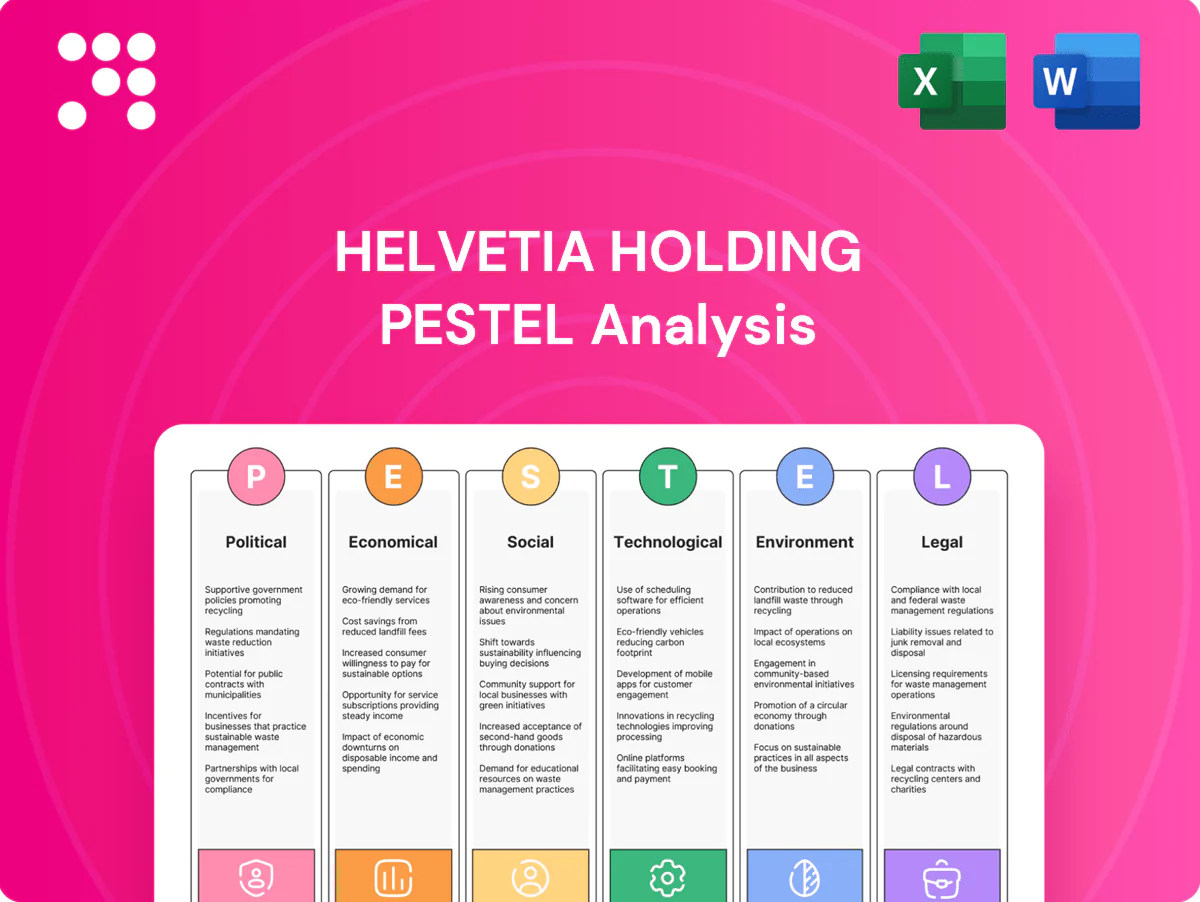
Helvetia Holding PESTLE Analysis

Plan Smarter. Present Sharper. Compete Stronger.
Gain a strategic edge with our PESTLE Analysis tailored to Helvetia Holding—uncover how political, economic, social, technological, legal and environmental forces are reshaping its prospects. This concise brief highlights key risks and opportunities investors and strategists need now. Purchase the full, downloadable analysis for the detailed insights and actionable recommendations you can use immediately.
Political factors

Swiss–EU regulatory alignment and market access
Switzerland is not an EU member but Helvetia serves EU markets, making alignment with EU insurance rules critical; Helvetia reported around CHF 11.5 billion in premiums (group GWP ~2024), underscoring EU exposure. Changes to bilateral accords or market-access frameworks since the 2021 breakdown of a wider institutional agreement can affect cross-border operations, passporting-like arrangements, and product approvals. Political frictions would raise compliance complexity and costs, while stable alignment supports predictable capital allocation and distribution planning.
Government healthcare and pension reforms
Policy shifts in Switzerland, Germany, Spain and Austria—where population aged 65+ stands near 19–22%—directly alter demand for life, health and annuity products as public schemes face cost pressure. Public–private burden sharing (e.g., Switzerland’s occupational system with ~CHF1.1trn in pillars) can expand or shrink insurer markets. Subsidies and tax incentives (notably pension tax relief) shape product mix and lapse rates. Frequent reform cycles increase pricing and reserve uncertainty for Helvetia.

Fiscal policy and insurance taxation
National budget priorities shape premium taxes, investment-income taxation and policyholder tax relief, altering demand and after-tax margins for Helvetia; Switzerland’s combined cantonal corporate tax rates averaged about 14–18% in 2024. Tax changes directly affect product attractiveness and margins, forcing repricing or reserve adjustments. Cross-border tax divergence (statutory CIT ranged roughly 9%–25% in 2024 per OECD) complicates product design and capital allocation, while predictable regimes improve long-term pricing discipline.

Geopolitical risk and sanctions exposure
European geopolitical tensions can disrupt cross-border supply chains, increase claims in specialty lines and depress asset markets, pressuring Helvetia’s investment and underwriting results.
Comprehensive sanctions regimes (EU, US) force robust screening and strict underwriting controls to avoid fines and reputational damage.
Political instability elevates reinsurance pricing and tightens catastrophe capacity; regular scenario planning supports solvency resilience under stress.
- Sanctions: require enhanced screening and KYC
- Supply chains: higher specialty-line claims risk
- Reinsurance: capacity tightening, upward pressure on rates
- Risk management: scenario planning to protect solvency
Public policy on housing and infrastructure
Government investment and regulation in housing and infrastructure—evidenced by the EU Recovery and Resilience Facility at €723.8bn—increase property insurance demand and can concentrate risks in growth corridors. Stricter building codes, retrofitting mandates and resilience subsidies tend to lower claims severity but raise compliance costs. Shifts in regional development alter portfolio accumulation, directing underwriting focus and pricing in property lines.
- Regulation: raises compliance costs, lowers severity
- Investment: boosts demand, concentrates exposure
- Regional shifts: change accumulation risk
- Policy direction: steers underwriting strategy
Swiss insurer faces EU rule alignment, aging markets and tax shifts amid CHF 11.5bn premium exposure
Switzerland non-EU status forces Helvetia to align with evolving EU insurance rules, affecting cross-border access; group GWP ~CHF 11.5bn (≈2024) highlights exposure. Aging populations (65+ ~19–22% in DE/ES/AT) and pension reforms shift demand toward life/annuity products. Tax and subsidy changes (Swiss cantonal tax ~14–18% in 2024) alter pricing, while sanctions and geopolitics raise compliance and reinsurance costs.
| Metric | Value |
|---|---|
| Group GWP (≈2024) | CHF 11.5bn |
| 65+ population (DE/ES/AT) | 19–22% |
| Swiss combined tax (2024) | 14–18% |
What is included in the product
 Detailed Word Document
Explores how Political, Economic, Social, Technological, Environmental and Legal forces specifically impact Helvetia Holding, with data-backed trends, industry- and region-specific examples, forward-looking insights for scenario planning, and actionable implications tailored for executives, investors and strategists.

 Customizable Excel Spreadsheet
A concise, visually segmented PESTLE summary for Helvetia Holding that relieves pain by turning complex external-risk analysis into an editable, presentation-ready brief—easy to drop into slides, share across teams, and use during planning to align stakeholders and support market-position discussions.
Economic factors

Interest rate and yield curve dynamics
Life insurance profitability and reserve adequacy hinge on interest rates and duration matching; Swiss 10‑year yields rose to about 1.1% in 2024, improving reinvestment yields but raising lapse and conversion risk. Yield curve shape (steepening or inversion) materially alters asset–liability management and can pressure Solvency II ratios via spread movements. Active hedging and prompt product repricing are critical to manage spread and duration risk.
Inflation and claims severity
Sustained inflation has pushed non-life repair, medical and legal costs higher, with P&C claims inflation in many markets running about 5–8% in 2023–24, pressuring Helvetia’s loss severity.
Indexation clauses and adequacy of sums insured need frequent updates to avoid underinsurance and reserve strain.
Pricing lag can compress underwriting margins during spikes, and reinsurers repriced capacity (renewals up ~5–15% in 2024), prompting recalibration of Helvetia’s reinsurance layers to control volatility.

Macroeconomic growth and employment
Premium growth for Helvetia closely tracks household income and corporate activity in core markets; group gross written premiums were about CHF 11.1bn in 2024, so GDP shocks press materially on top-line. Economic slowdowns raise lapses, reduce new business and heighten receivables credit risk. Strong labor markets (unemployment ~CH 2.1%, DE 3.5%, AT 4.6%) support group benefits and SME coverage, while diversification across CH, DE, ES, AT cushions country cycles.

Capital market volatility
Asset-side shocks under market-consistent regimes directly cut solvency capital and other comprehensive income; the MSCI World fell about 18.4% in 2022, illustrating how equity drawdowns and credit-spread widening (US IG OAS peaked near 210 bps in 2022) can depress own funds, while dynamic asset allocation and hedging reduce volatility of ratios. Liquidity buffers ensure claims and collateral needs are met under stress.
- Equity drawdowns: MSCI World -18.4% (2022)
- Credit spreads: US IG OAS ~210 bps peak (2022)
- Mitigants: dynamic allocation, hedging
- Operational: maintained liquidity buffers for claims/collateral
Reinsurance market pricing and capacity
Tight global reinsurance capacity and hardening rates reduced net retention flexibility and pressured profitability, with market rate-on-line increases around 20% in key treaties during 2023–24.
Elevated CAT aggregates and rising casualty severity shaped renewal outcomes after 2023 insured catastrophe losses near US$120bn, pushing buyers toward layered covers and higher retentions.
Optimizing structure—quota shares, sidecars—balances earnings volatility and capital efficiency, while long-term partnerships help secure capacity and terms through cycles.
- 20% rate-on-line increase (2023–24)
- ~US$120bn insured CAT losses (2023)
- Use quota shares/sidecars to manage volatility
- Long-term partnerships lock terms across cycles
Swiss insurer faces EU rule alignment, aging markets and tax shifts amid CHF 11.5bn premium exposure
Interest rates recovery (Swiss 10y ~1.1% in 2024) improved reinvestment yields but raised duration and conversion risks. Inflation pushed P&C claim severity ~5–8% (2023–24), pressuring loss ratios. Group GWP ~CHF 11.1bn (2024) makes GDP shocks material; reinsurer repricing ran +5–15% with rate‑on‑line +20% (2023–24). Insured CATs ~US$120bn (2023) lifted retentions and layered buying.
| Metric | Value |
|---|---|
| Swiss 10y (2024) | ~1.1% |
| GWP (2024) | CHF 11.1bn |
| P&C claims inflation | 5–8% (2023–24) |
| Reinsurer repricing | +5–15%; ROL +20% |
| Insured CAT losses (2023) | ~US$120bn |
Preview Before You Purchase
Helvetia Holding PESTLE Analysis
The Helvetia Holding PESTLE Analysis preview shown here is the exact document you’ll receive after purchase—fully formatted and ready to use. It contains the complete political, economic, social, technological, legal and environmental assessment for Helvetia. No placeholders or teasers; the layout, content and structure are identical to the downloadable final file.

Plan Smarter. Present Sharper. Compete Stronger.
Gain a strategic edge with our PESTLE Analysis tailored to Helvetia Holding—uncover how political, economic, social, technological, legal and environmental forces are reshaping its prospects. This concise brief highlights key risks and opportunities investors and strategists need now. Purchase the full, downloadable analysis for the detailed insights and actionable recommendations you can use immediately.
Political factors
Swiss–EU regulatory alignment and market access
Switzerland is not an EU member but Helvetia serves EU markets, making alignment with EU insurance rules critical; Helvetia reported around CHF 11.5 billion in premiums (group GWP ~2024), underscoring EU exposure. Changes to bilateral accords or market-access frameworks since the 2021 breakdown of a wider institutional agreement can affect cross-border operations, passporting-like arrangements, and product approvals. Political frictions would raise compliance complexity and costs, while stable alignment supports predictable capital allocation and distribution planning.
Government healthcare and pension reforms
Policy shifts in Switzerland, Germany, Spain and Austria—where population aged 65+ stands near 19–22%—directly alter demand for life, health and annuity products as public schemes face cost pressure. Public–private burden sharing (e.g., Switzerland’s occupational system with ~CHF1.1trn in pillars) can expand or shrink insurer markets. Subsidies and tax incentives (notably pension tax relief) shape product mix and lapse rates. Frequent reform cycles increase pricing and reserve uncertainty for Helvetia.
Fiscal policy and insurance taxation
National budget priorities shape premium taxes, investment-income taxation and policyholder tax relief, altering demand and after-tax margins for Helvetia; Switzerland’s combined cantonal corporate tax rates averaged about 14–18% in 2024. Tax changes directly affect product attractiveness and margins, forcing repricing or reserve adjustments. Cross-border tax divergence (statutory CIT ranged roughly 9%–25% in 2024 per OECD) complicates product design and capital allocation, while predictable regimes improve long-term pricing discipline.
Geopolitical risk and sanctions exposure
European geopolitical tensions can disrupt cross-border supply chains, increase claims in specialty lines and depress asset markets, pressuring Helvetia’s investment and underwriting results.
Comprehensive sanctions regimes (EU, US) force robust screening and strict underwriting controls to avoid fines and reputational damage.
Political instability elevates reinsurance pricing and tightens catastrophe capacity; regular scenario planning supports solvency resilience under stress.
- Sanctions: require enhanced screening and KYC
- Supply chains: higher specialty-line claims risk
- Reinsurance: capacity tightening, upward pressure on rates
- Risk management: scenario planning to protect solvency
Public policy on housing and infrastructure
Government investment and regulation in housing and infrastructure—evidenced by the EU Recovery and Resilience Facility at €723.8bn—increase property insurance demand and can concentrate risks in growth corridors. Stricter building codes, retrofitting mandates and resilience subsidies tend to lower claims severity but raise compliance costs. Shifts in regional development alter portfolio accumulation, directing underwriting focus and pricing in property lines.
- Regulation: raises compliance costs, lowers severity
- Investment: boosts demand, concentrates exposure
- Regional shifts: change accumulation risk
- Policy direction: steers underwriting strategy
Swiss insurer faces EU rule alignment, aging markets and tax shifts amid CHF 11.5bn premium exposure
Switzerland non-EU status forces Helvetia to align with evolving EU insurance rules, affecting cross-border access; group GWP ~CHF 11.5bn (≈2024) highlights exposure. Aging populations (65+ ~19–22% in DE/ES/AT) and pension reforms shift demand toward life/annuity products. Tax and subsidy changes (Swiss cantonal tax ~14–18% in 2024) alter pricing, while sanctions and geopolitics raise compliance and reinsurance costs.
| Metric | Value |
|---|---|
| Group GWP (≈2024) | CHF 11.5bn |
| 65+ population (DE/ES/AT) | 19–22% |
| Swiss combined tax (2024) | 14–18% |
What is included in the product
Detailed Word Document
Explores how Political, Economic, Social, Technological, Environmental and Legal forces specifically impact Helvetia Holding, with data-backed trends, industry- and region-specific examples, forward-looking insights for scenario planning, and actionable implications tailored for executives, investors and strategists.
Customizable Excel Spreadsheet
A concise, visually segmented PESTLE summary for Helvetia Holding that relieves pain by turning complex external-risk analysis into an editable, presentation-ready brief—easy to drop into slides, share across teams, and use during planning to align stakeholders and support market-position discussions.
Economic factors
Interest rate and yield curve dynamics
Life insurance profitability and reserve adequacy hinge on interest rates and duration matching; Swiss 10‑year yields rose to about 1.1% in 2024, improving reinvestment yields but raising lapse and conversion risk. Yield curve shape (steepening or inversion) materially alters asset–liability management and can pressure Solvency II ratios via spread movements. Active hedging and prompt product repricing are critical to manage spread and duration risk.
Inflation and claims severity
Sustained inflation has pushed non-life repair, medical and legal costs higher, with P&C claims inflation in many markets running about 5–8% in 2023–24, pressuring Helvetia’s loss severity.
Indexation clauses and adequacy of sums insured need frequent updates to avoid underinsurance and reserve strain.
Pricing lag can compress underwriting margins during spikes, and reinsurers repriced capacity (renewals up ~5–15% in 2024), prompting recalibration of Helvetia’s reinsurance layers to control volatility.
Macroeconomic growth and employment
Premium growth for Helvetia closely tracks household income and corporate activity in core markets; group gross written premiums were about CHF 11.1bn in 2024, so GDP shocks press materially on top-line. Economic slowdowns raise lapses, reduce new business and heighten receivables credit risk. Strong labor markets (unemployment ~CH 2.1%, DE 3.5%, AT 4.6%) support group benefits and SME coverage, while diversification across CH, DE, ES, AT cushions country cycles.
Capital market volatility
Asset-side shocks under market-consistent regimes directly cut solvency capital and other comprehensive income; the MSCI World fell about 18.4% in 2022, illustrating how equity drawdowns and credit-spread widening (US IG OAS peaked near 210 bps in 2022) can depress own funds, while dynamic asset allocation and hedging reduce volatility of ratios. Liquidity buffers ensure claims and collateral needs are met under stress.
- Equity drawdowns: MSCI World -18.4% (2022)
- Credit spreads: US IG OAS ~210 bps peak (2022)
- Mitigants: dynamic allocation, hedging
- Operational: maintained liquidity buffers for claims/collateral
Reinsurance market pricing and capacity
Tight global reinsurance capacity and hardening rates reduced net retention flexibility and pressured profitability, with market rate-on-line increases around 20% in key treaties during 2023–24.
Elevated CAT aggregates and rising casualty severity shaped renewal outcomes after 2023 insured catastrophe losses near US$120bn, pushing buyers toward layered covers and higher retentions.
Optimizing structure—quota shares, sidecars—balances earnings volatility and capital efficiency, while long-term partnerships help secure capacity and terms through cycles.
- 20% rate-on-line increase (2023–24)
- ~US$120bn insured CAT losses (2023)
- Use quota shares/sidecars to manage volatility
- Long-term partnerships lock terms across cycles
Swiss insurer faces EU rule alignment, aging markets and tax shifts amid CHF 11.5bn premium exposure
Interest rates recovery (Swiss 10y ~1.1% in 2024) improved reinvestment yields but raised duration and conversion risks. Inflation pushed P&C claim severity ~5–8% (2023–24), pressuring loss ratios. Group GWP ~CHF 11.1bn (2024) makes GDP shocks material; reinsurer repricing ran +5–15% with rate‑on‑line +20% (2023–24). Insured CATs ~US$120bn (2023) lifted retentions and layered buying.
| Metric | Value |
|---|---|
| Swiss 10y (2024) | ~1.1% |
| GWP (2024) | CHF 11.1bn |
| P&C claims inflation | 5–8% (2023–24) |
| Reinsurer repricing | +5–15%; ROL +20% |
| Insured CAT losses (2023) | ~US$120bn |
Preview Before You Purchase
Helvetia Holding PESTLE Analysis
The Helvetia Holding PESTLE Analysis preview shown here is the exact document you’ll receive after purchase—fully formatted and ready to use. It contains the complete political, economic, social, technological, legal and environmental assessment for Helvetia. No placeholders or teasers; the layout, content and structure are identical to the downloadable final file.
Original: $10.00
-65%$10.00
$3.50Description
Plan Smarter. Present Sharper. Compete Stronger.
Gain a strategic edge with our PESTLE Analysis tailored to Helvetia Holding—uncover how political, economic, social, technological, legal and environmental forces are reshaping its prospects. This concise brief highlights key risks and opportunities investors and strategists need now. Purchase the full, downloadable analysis for the detailed insights and actionable recommendations you can use immediately.
Political factors
Swiss–EU regulatory alignment and market access
Switzerland is not an EU member but Helvetia serves EU markets, making alignment with EU insurance rules critical; Helvetia reported around CHF 11.5 billion in premiums (group GWP ~2024), underscoring EU exposure. Changes to bilateral accords or market-access frameworks since the 2021 breakdown of a wider institutional agreement can affect cross-border operations, passporting-like arrangements, and product approvals. Political frictions would raise compliance complexity and costs, while stable alignment supports predictable capital allocation and distribution planning.
Government healthcare and pension reforms
Policy shifts in Switzerland, Germany, Spain and Austria—where population aged 65+ stands near 19–22%—directly alter demand for life, health and annuity products as public schemes face cost pressure. Public–private burden sharing (e.g., Switzerland’s occupational system with ~CHF1.1trn in pillars) can expand or shrink insurer markets. Subsidies and tax incentives (notably pension tax relief) shape product mix and lapse rates. Frequent reform cycles increase pricing and reserve uncertainty for Helvetia.
Fiscal policy and insurance taxation
National budget priorities shape premium taxes, investment-income taxation and policyholder tax relief, altering demand and after-tax margins for Helvetia; Switzerland’s combined cantonal corporate tax rates averaged about 14–18% in 2024. Tax changes directly affect product attractiveness and margins, forcing repricing or reserve adjustments. Cross-border tax divergence (statutory CIT ranged roughly 9%–25% in 2024 per OECD) complicates product design and capital allocation, while predictable regimes improve long-term pricing discipline.
Geopolitical risk and sanctions exposure
European geopolitical tensions can disrupt cross-border supply chains, increase claims in specialty lines and depress asset markets, pressuring Helvetia’s investment and underwriting results.
Comprehensive sanctions regimes (EU, US) force robust screening and strict underwriting controls to avoid fines and reputational damage.
Political instability elevates reinsurance pricing and tightens catastrophe capacity; regular scenario planning supports solvency resilience under stress.
- Sanctions: require enhanced screening and KYC
- Supply chains: higher specialty-line claims risk
- Reinsurance: capacity tightening, upward pressure on rates
- Risk management: scenario planning to protect solvency
Public policy on housing and infrastructure
Government investment and regulation in housing and infrastructure—evidenced by the EU Recovery and Resilience Facility at €723.8bn—increase property insurance demand and can concentrate risks in growth corridors. Stricter building codes, retrofitting mandates and resilience subsidies tend to lower claims severity but raise compliance costs. Shifts in regional development alter portfolio accumulation, directing underwriting focus and pricing in property lines.
- Regulation: raises compliance costs, lowers severity
- Investment: boosts demand, concentrates exposure
- Regional shifts: change accumulation risk
- Policy direction: steers underwriting strategy
Swiss insurer faces EU rule alignment, aging markets and tax shifts amid CHF 11.5bn premium exposure
Switzerland non-EU status forces Helvetia to align with evolving EU insurance rules, affecting cross-border access; group GWP ~CHF 11.5bn (≈2024) highlights exposure. Aging populations (65+ ~19–22% in DE/ES/AT) and pension reforms shift demand toward life/annuity products. Tax and subsidy changes (Swiss cantonal tax ~14–18% in 2024) alter pricing, while sanctions and geopolitics raise compliance and reinsurance costs.
| Metric | Value |
|---|---|
| Group GWP (≈2024) | CHF 11.5bn |
| 65+ population (DE/ES/AT) | 19–22% |
| Swiss combined tax (2024) | 14–18% |
What is included in the product
Detailed Word Document
Explores how Political, Economic, Social, Technological, Environmental and Legal forces specifically impact Helvetia Holding, with data-backed trends, industry- and region-specific examples, forward-looking insights for scenario planning, and actionable implications tailored for executives, investors and strategists.
Customizable Excel Spreadsheet
A concise, visually segmented PESTLE summary for Helvetia Holding that relieves pain by turning complex external-risk analysis into an editable, presentation-ready brief—easy to drop into slides, share across teams, and use during planning to align stakeholders and support market-position discussions.
Economic factors
Interest rate and yield curve dynamics
Life insurance profitability and reserve adequacy hinge on interest rates and duration matching; Swiss 10‑year yields rose to about 1.1% in 2024, improving reinvestment yields but raising lapse and conversion risk. Yield curve shape (steepening or inversion) materially alters asset–liability management and can pressure Solvency II ratios via spread movements. Active hedging and prompt product repricing are critical to manage spread and duration risk.
Inflation and claims severity
Sustained inflation has pushed non-life repair, medical and legal costs higher, with P&C claims inflation in many markets running about 5–8% in 2023–24, pressuring Helvetia’s loss severity.
Indexation clauses and adequacy of sums insured need frequent updates to avoid underinsurance and reserve strain.
Pricing lag can compress underwriting margins during spikes, and reinsurers repriced capacity (renewals up ~5–15% in 2024), prompting recalibration of Helvetia’s reinsurance layers to control volatility.
Macroeconomic growth and employment
Premium growth for Helvetia closely tracks household income and corporate activity in core markets; group gross written premiums were about CHF 11.1bn in 2024, so GDP shocks press materially on top-line. Economic slowdowns raise lapses, reduce new business and heighten receivables credit risk. Strong labor markets (unemployment ~CH 2.1%, DE 3.5%, AT 4.6%) support group benefits and SME coverage, while diversification across CH, DE, ES, AT cushions country cycles.
Capital market volatility
Asset-side shocks under market-consistent regimes directly cut solvency capital and other comprehensive income; the MSCI World fell about 18.4% in 2022, illustrating how equity drawdowns and credit-spread widening (US IG OAS peaked near 210 bps in 2022) can depress own funds, while dynamic asset allocation and hedging reduce volatility of ratios. Liquidity buffers ensure claims and collateral needs are met under stress.
- Equity drawdowns: MSCI World -18.4% (2022)
- Credit spreads: US IG OAS ~210 bps peak (2022)
- Mitigants: dynamic allocation, hedging
- Operational: maintained liquidity buffers for claims/collateral
Reinsurance market pricing and capacity
Tight global reinsurance capacity and hardening rates reduced net retention flexibility and pressured profitability, with market rate-on-line increases around 20% in key treaties during 2023–24.
Elevated CAT aggregates and rising casualty severity shaped renewal outcomes after 2023 insured catastrophe losses near US$120bn, pushing buyers toward layered covers and higher retentions.
Optimizing structure—quota shares, sidecars—balances earnings volatility and capital efficiency, while long-term partnerships help secure capacity and terms through cycles.
- 20% rate-on-line increase (2023–24)
- ~US$120bn insured CAT losses (2023)
- Use quota shares/sidecars to manage volatility
- Long-term partnerships lock terms across cycles
Swiss insurer faces EU rule alignment, aging markets and tax shifts amid CHF 11.5bn premium exposure
Interest rates recovery (Swiss 10y ~1.1% in 2024) improved reinvestment yields but raised duration and conversion risks. Inflation pushed P&C claim severity ~5–8% (2023–24), pressuring loss ratios. Group GWP ~CHF 11.1bn (2024) makes GDP shocks material; reinsurer repricing ran +5–15% with rate‑on‑line +20% (2023–24). Insured CATs ~US$120bn (2023) lifted retentions and layered buying.
| Metric | Value |
|---|---|
| Swiss 10y (2024) | ~1.1% |
| GWP (2024) | CHF 11.1bn |
| P&C claims inflation | 5–8% (2023–24) |
| Reinsurer repricing | +5–15%; ROL +20% |
| Insured CAT losses (2023) | ~US$120bn |
Preview Before You Purchase
Helvetia Holding PESTLE Analysis
The Helvetia Holding PESTLE Analysis preview shown here is the exact document you’ll receive after purchase—fully formatted and ready to use. It contains the complete political, economic, social, technological, legal and environmental assessment for Helvetia. No placeholders or teasers; the layout, content and structure are identical to the downloadable final file.











