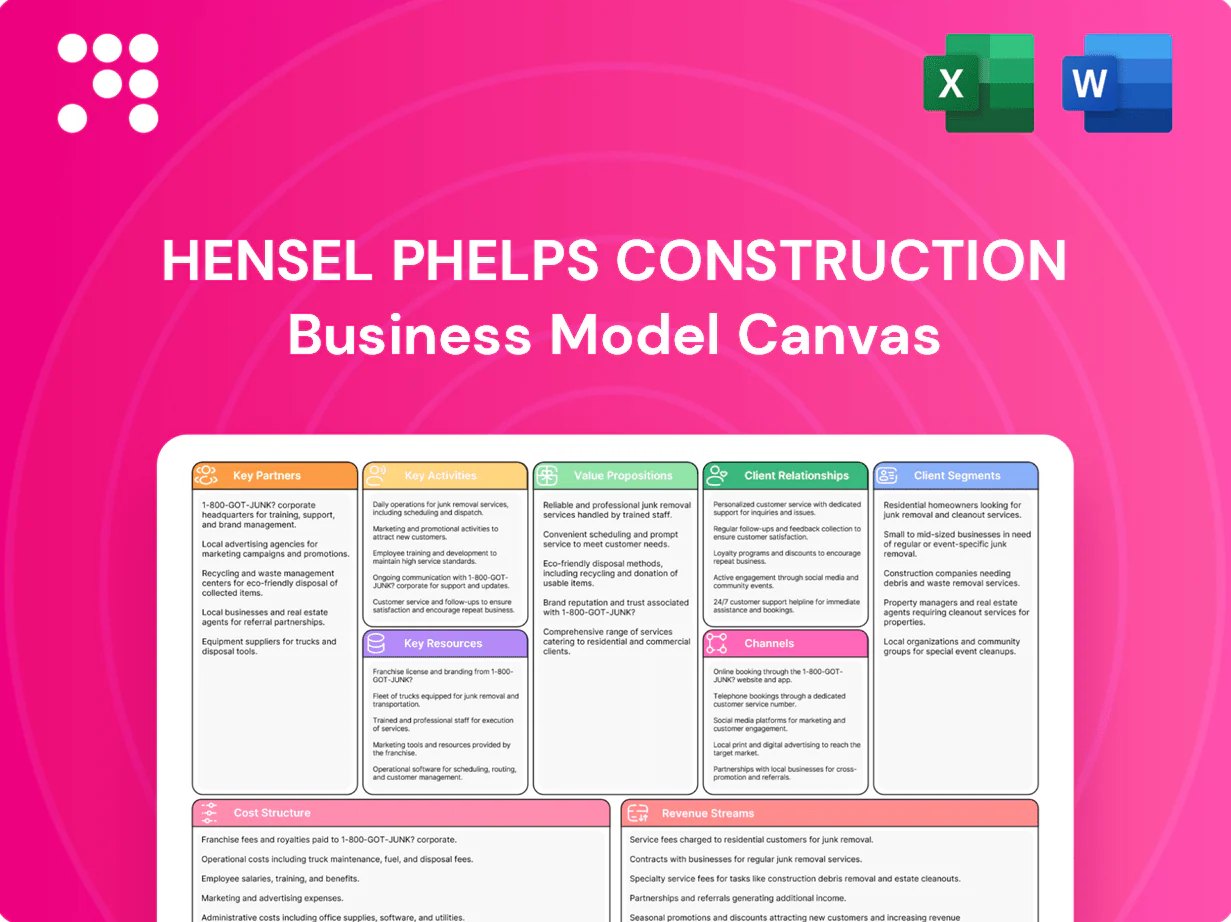
Hensel Phelps Construction Business Model Canvas

Business Model Canvas: Strategic Blueprint for a Leading Construction Firm
Unlock the strategic blueprint behind Hensel Phelps Construction with this concise Business Model Canvas summary—showing how they create value, scale projects, and sustain competitive advantage. Purchase the full, editable Canvas (Word & Excel) for a section-by-section analysis, financial implications, and ready-to-use insights for benchmarking or investor presentations.
Partnerships

Subcontractors and trade partners
Strategic relationships with specialty trades—who perform roughly 60–70% of project value—expand Hensel Phelps capacity and cross-discipline expertise. Reliable partners improve schedule certainty and quality, lowering rework risk on complex projects. Preferred networks enable competitive pricing and rapid mobilization, often deploying crews within 1–3 weeks. Joint planning elevates safety and constructability through coordinated preconstruction workflows.
Architects and engineering firms
Architects and engineering firms drive integrated design-build and CMAR delivery, with early alignment cutting rework and cost risk—Hensel Phelps reported approximately $4.8B revenue in 2024, underscoring scale benefits from collaboration. BIM/VDC coordination speeds decisions and clash resolution, often reducing RFIs and change orders by 20–30% on advanced projects. Shared standards and joint protocols enable predictable delivery and schedule adherence across multimillion-dollar builds.

Suppliers and equipment manufacturers
Direct ties with suppliers and equipment manufacturers secure critical materials and long-lead items (typically 6–18 months), reducing exposure to market shortages. Volume purchasing aggregates demand to tighten cost control and improve availability across portfolios. OEM technical support accelerates installation quality and commissioning, lowering rework rates. Coordinated logistics partners cut schedule risk through centralized tracking and just-in-time deliveries.

Public agencies and regulators
Public agencies and regulators provide permitting and compliance pathways that streamline approvals; early engagement reduces code, environmental, and safety risks and supports projects tapping the Bipartisan Infrastructure Law’s $1.2 trillion funding window. Transparent processes enable audit-ready documentation and meet funding conditions, while collaboration ensures smoother inspections and faster turnover.
- Permitting streamlines approvals
- Early engagement mitigates risks
- Transparency supports audits/funding
- Collaboration eases inspections/turnover
Technology and innovation providers
Technology partners supply BIM, project-management, and field-productivity platforms that streamline workflows and reduce rework; reality capture, drones, and IoT provide real-time progress and safety telemetry, while integrated data flows deliver actionable cost, schedule, and quality KPIs—continuous innovation preserves Hensel Phelps’ operational edge and margin resilience.
- Platforms: BIM + PM + field tools
- Reality capture: drones + LiDAR
- IoT: real-time safety/progress
- Data integrations: cost/schedule/quality KPIs
- Outcome: sustained competitive advantage
Specialty-trade delivery mobilizes fast, cuts RFIs 20–30%
Hensel Phelps leverages specialty trades (60–70% of project value) to scale delivery and meet mobilization targets of 1–3 weeks. Collaboration with A/E and tech partners reduced RFIs/change orders 20–30% on advanced projects; 2024 revenue: $4.8B. Supplier ties mitigate 6–18 month long-leads and support volume pricing; public agency engagement taps $1.2T infrastructure funding.
| Partner | Impact | Metric |
|---|---|---|
| Specialty trades | Capacity/speed | 60–70% value |
| A/E & Tech | Lower rework | -20–30% RFIs/COs |
| Suppliers | Availability | 6–18 mo lead |
What is included in the product
 Detailed Word Document
A concise, pre-built Business Model Canvas for Hensel Phelps detailing customer segments, channels, value propositions, key partners, resources, activities, cost structure and revenue streams, with competitive analysis, SWOT-linked insights and polished design for presentations and investor discussions.

 Customizable Excel Spreadsheet
High-level view of Hensel Phelps' business model with editable cells, enabling teams to quickly identify core construction, contracting, and project-delivery components and relieve planning and coordination bottlenecks.
Activities

Preconstruction and estimating
Detailed budgeting, scheduling, and constructability reviews establish project baselines that drive bid accuracy and timeline certainty. Value engineering refines scope to meet financial constraints while preserving performance. Market sourcing validates pricing and availability of key long‑lead items. Risk analysis quantifies contingencies and informs the optimal delivery strategy.
Design-build coordination
Integrated design-build teams at Hensel Phelps align design development to hit performance and cost targets, driving typical cost efficiencies of 3–5% per project. BIM-driven coordination detects 70–90% of clashes pre-construction, cutting redesign and rework substantially. Progressive approvals shorten procurement lead times by about 15%, while continuous stakeholder engagement preserves owner intent throughout delivery.

Construction management and self-perform
Field execution oversees safety, quality and productivity on Hensel Phelps projects, with crews aligned to meet 2024 site performance targets. Critical path management drives milestones and logistics to limit float and protect delivery dates. Select self-perform work stabilizes cost and schedule by controlling labor and key scopes. Commissioning sequences validate systems performance and ready assets for handover.

Quality and safety management
Rigorous programs enforce zero-incident goals through mandatory safety plans, PPE protocols, and site-specific controls that prioritize worker protection and project continuity. Regular inspections and material, structural, and system testing verify regulatory compliance and performance against contract specifications. Root-cause analysis of incidents and near-misses drives corrective actions that reduce defects and rework, while targeted training and independent audits sustain continuous improvement across projects.
Stakeholder, permits, and procurement
Owner communications align expectations and decisions, driving timely approvals and minimizing rework. Permitting and utility coordination remove roadblocks to mobilization and maintain schedule certainty. Strategic procurement secures long-lead items and competitive pricing while change management protects scope and schedule.
- Owner alignment
- Permits & utilities
- Long-lead procurement
- Change control
BIM + Design-Build: 3–5% savings, 70–90% clash detection
Detailed budgeting, VE and risk analysis set baselines; design-build and BIM yield 3–5% cost savings and 70–90% clash detection; progressive approvals cut procurement lead time ~15%; field execution, self-perform and commissioning drive schedule reliability and zero-incident safety programs.
| Metric | 2024 Target |
|---|---|
| Cost savings | 3–5% |
| Clash detection | 70–90% |
| Procurement lead time | -15% |
What You See Is What You Get
Business Model Canvas
The document you're previewing is the actual Hensel Phelps Construction Business Model Canvas—not a mockup. When you purchase, you’ll receive this exact file with all sections included, ready to edit and present. No surprises: what you see is what you’ll download.

Business Model Canvas: Strategic Blueprint for a Leading Construction Firm
Unlock the strategic blueprint behind Hensel Phelps Construction with this concise Business Model Canvas summary—showing how they create value, scale projects, and sustain competitive advantage. Purchase the full, editable Canvas (Word & Excel) for a section-by-section analysis, financial implications, and ready-to-use insights for benchmarking or investor presentations.
Partnerships
Subcontractors and trade partners
Strategic relationships with specialty trades—who perform roughly 60–70% of project value—expand Hensel Phelps capacity and cross-discipline expertise. Reliable partners improve schedule certainty and quality, lowering rework risk on complex projects. Preferred networks enable competitive pricing and rapid mobilization, often deploying crews within 1–3 weeks. Joint planning elevates safety and constructability through coordinated preconstruction workflows.
Architects and engineering firms
Architects and engineering firms drive integrated design-build and CMAR delivery, with early alignment cutting rework and cost risk—Hensel Phelps reported approximately $4.8B revenue in 2024, underscoring scale benefits from collaboration. BIM/VDC coordination speeds decisions and clash resolution, often reducing RFIs and change orders by 20–30% on advanced projects. Shared standards and joint protocols enable predictable delivery and schedule adherence across multimillion-dollar builds.
Suppliers and equipment manufacturers
Direct ties with suppliers and equipment manufacturers secure critical materials and long-lead items (typically 6–18 months), reducing exposure to market shortages. Volume purchasing aggregates demand to tighten cost control and improve availability across portfolios. OEM technical support accelerates installation quality and commissioning, lowering rework rates. Coordinated logistics partners cut schedule risk through centralized tracking and just-in-time deliveries.
Public agencies and regulators
Public agencies and regulators provide permitting and compliance pathways that streamline approvals; early engagement reduces code, environmental, and safety risks and supports projects tapping the Bipartisan Infrastructure Law’s $1.2 trillion funding window. Transparent processes enable audit-ready documentation and meet funding conditions, while collaboration ensures smoother inspections and faster turnover.
- Permitting streamlines approvals
- Early engagement mitigates risks
- Transparency supports audits/funding
- Collaboration eases inspections/turnover
Technology and innovation providers
Technology partners supply BIM, project-management, and field-productivity platforms that streamline workflows and reduce rework; reality capture, drones, and IoT provide real-time progress and safety telemetry, while integrated data flows deliver actionable cost, schedule, and quality KPIs—continuous innovation preserves Hensel Phelps’ operational edge and margin resilience.
- Platforms: BIM + PM + field tools
- Reality capture: drones + LiDAR
- IoT: real-time safety/progress
- Data integrations: cost/schedule/quality KPIs
- Outcome: sustained competitive advantage
Specialty-trade delivery mobilizes fast, cuts RFIs 20–30%
Hensel Phelps leverages specialty trades (60–70% of project value) to scale delivery and meet mobilization targets of 1–3 weeks. Collaboration with A/E and tech partners reduced RFIs/change orders 20–30% on advanced projects; 2024 revenue: $4.8B. Supplier ties mitigate 6–18 month long-leads and support volume pricing; public agency engagement taps $1.2T infrastructure funding.
| Partner | Impact | Metric |
|---|---|---|
| Specialty trades | Capacity/speed | 60–70% value |
| A/E & Tech | Lower rework | -20–30% RFIs/COs |
| Suppliers | Availability | 6–18 mo lead |
What is included in the product
Detailed Word Document
A concise, pre-built Business Model Canvas for Hensel Phelps detailing customer segments, channels, value propositions, key partners, resources, activities, cost structure and revenue streams, with competitive analysis, SWOT-linked insights and polished design for presentations and investor discussions.
Customizable Excel Spreadsheet
High-level view of Hensel Phelps' business model with editable cells, enabling teams to quickly identify core construction, contracting, and project-delivery components and relieve planning and coordination bottlenecks.
Activities
Preconstruction and estimating
Detailed budgeting, scheduling, and constructability reviews establish project baselines that drive bid accuracy and timeline certainty. Value engineering refines scope to meet financial constraints while preserving performance. Market sourcing validates pricing and availability of key long‑lead items. Risk analysis quantifies contingencies and informs the optimal delivery strategy.
Design-build coordination
Integrated design-build teams at Hensel Phelps align design development to hit performance and cost targets, driving typical cost efficiencies of 3–5% per project. BIM-driven coordination detects 70–90% of clashes pre-construction, cutting redesign and rework substantially. Progressive approvals shorten procurement lead times by about 15%, while continuous stakeholder engagement preserves owner intent throughout delivery.
Construction management and self-perform
Field execution oversees safety, quality and productivity on Hensel Phelps projects, with crews aligned to meet 2024 site performance targets. Critical path management drives milestones and logistics to limit float and protect delivery dates. Select self-perform work stabilizes cost and schedule by controlling labor and key scopes. Commissioning sequences validate systems performance and ready assets for handover.
Quality and safety management
Rigorous programs enforce zero-incident goals through mandatory safety plans, PPE protocols, and site-specific controls that prioritize worker protection and project continuity. Regular inspections and material, structural, and system testing verify regulatory compliance and performance against contract specifications. Root-cause analysis of incidents and near-misses drives corrective actions that reduce defects and rework, while targeted training and independent audits sustain continuous improvement across projects.
Stakeholder, permits, and procurement
Owner communications align expectations and decisions, driving timely approvals and minimizing rework. Permitting and utility coordination remove roadblocks to mobilization and maintain schedule certainty. Strategic procurement secures long-lead items and competitive pricing while change management protects scope and schedule.
- Owner alignment
- Permits & utilities
- Long-lead procurement
- Change control
BIM + Design-Build: 3–5% savings, 70–90% clash detection
Detailed budgeting, VE and risk analysis set baselines; design-build and BIM yield 3–5% cost savings and 70–90% clash detection; progressive approvals cut procurement lead time ~15%; field execution, self-perform and commissioning drive schedule reliability and zero-incident safety programs.
| Metric | 2024 Target |
|---|---|
| Cost savings | 3–5% |
| Clash detection | 70–90% |
| Procurement lead time | -15% |
What You See Is What You Get
Business Model Canvas
The document you're previewing is the actual Hensel Phelps Construction Business Model Canvas—not a mockup. When you purchase, you’ll receive this exact file with all sections included, ready to edit and present. No surprises: what you see is what you’ll download.
Original: $10.00
-65%$10.00
$3.50Description
Business Model Canvas: Strategic Blueprint for a Leading Construction Firm
Unlock the strategic blueprint behind Hensel Phelps Construction with this concise Business Model Canvas summary—showing how they create value, scale projects, and sustain competitive advantage. Purchase the full, editable Canvas (Word & Excel) for a section-by-section analysis, financial implications, and ready-to-use insights for benchmarking or investor presentations.
Partnerships
Subcontractors and trade partners
Strategic relationships with specialty trades—who perform roughly 60–70% of project value—expand Hensel Phelps capacity and cross-discipline expertise. Reliable partners improve schedule certainty and quality, lowering rework risk on complex projects. Preferred networks enable competitive pricing and rapid mobilization, often deploying crews within 1–3 weeks. Joint planning elevates safety and constructability through coordinated preconstruction workflows.
Architects and engineering firms
Architects and engineering firms drive integrated design-build and CMAR delivery, with early alignment cutting rework and cost risk—Hensel Phelps reported approximately $4.8B revenue in 2024, underscoring scale benefits from collaboration. BIM/VDC coordination speeds decisions and clash resolution, often reducing RFIs and change orders by 20–30% on advanced projects. Shared standards and joint protocols enable predictable delivery and schedule adherence across multimillion-dollar builds.
Suppliers and equipment manufacturers
Direct ties with suppliers and equipment manufacturers secure critical materials and long-lead items (typically 6–18 months), reducing exposure to market shortages. Volume purchasing aggregates demand to tighten cost control and improve availability across portfolios. OEM technical support accelerates installation quality and commissioning, lowering rework rates. Coordinated logistics partners cut schedule risk through centralized tracking and just-in-time deliveries.
Public agencies and regulators
Public agencies and regulators provide permitting and compliance pathways that streamline approvals; early engagement reduces code, environmental, and safety risks and supports projects tapping the Bipartisan Infrastructure Law’s $1.2 trillion funding window. Transparent processes enable audit-ready documentation and meet funding conditions, while collaboration ensures smoother inspections and faster turnover.
- Permitting streamlines approvals
- Early engagement mitigates risks
- Transparency supports audits/funding
- Collaboration eases inspections/turnover
Technology and innovation providers
Technology partners supply BIM, project-management, and field-productivity platforms that streamline workflows and reduce rework; reality capture, drones, and IoT provide real-time progress and safety telemetry, while integrated data flows deliver actionable cost, schedule, and quality KPIs—continuous innovation preserves Hensel Phelps’ operational edge and margin resilience.
- Platforms: BIM + PM + field tools
- Reality capture: drones + LiDAR
- IoT: real-time safety/progress
- Data integrations: cost/schedule/quality KPIs
- Outcome: sustained competitive advantage
Specialty-trade delivery mobilizes fast, cuts RFIs 20–30%
Hensel Phelps leverages specialty trades (60–70% of project value) to scale delivery and meet mobilization targets of 1–3 weeks. Collaboration with A/E and tech partners reduced RFIs/change orders 20–30% on advanced projects; 2024 revenue: $4.8B. Supplier ties mitigate 6–18 month long-leads and support volume pricing; public agency engagement taps $1.2T infrastructure funding.
| Partner | Impact | Metric |
|---|---|---|
| Specialty trades | Capacity/speed | 60–70% value |
| A/E & Tech | Lower rework | -20–30% RFIs/COs |
| Suppliers | Availability | 6–18 mo lead |
What is included in the product
Detailed Word Document
A concise, pre-built Business Model Canvas for Hensel Phelps detailing customer segments, channels, value propositions, key partners, resources, activities, cost structure and revenue streams, with competitive analysis, SWOT-linked insights and polished design for presentations and investor discussions.
Customizable Excel Spreadsheet
High-level view of Hensel Phelps' business model with editable cells, enabling teams to quickly identify core construction, contracting, and project-delivery components and relieve planning and coordination bottlenecks.
Activities
Preconstruction and estimating
Detailed budgeting, scheduling, and constructability reviews establish project baselines that drive bid accuracy and timeline certainty. Value engineering refines scope to meet financial constraints while preserving performance. Market sourcing validates pricing and availability of key long‑lead items. Risk analysis quantifies contingencies and informs the optimal delivery strategy.
Design-build coordination
Integrated design-build teams at Hensel Phelps align design development to hit performance and cost targets, driving typical cost efficiencies of 3–5% per project. BIM-driven coordination detects 70–90% of clashes pre-construction, cutting redesign and rework substantially. Progressive approvals shorten procurement lead times by about 15%, while continuous stakeholder engagement preserves owner intent throughout delivery.
Construction management and self-perform
Field execution oversees safety, quality and productivity on Hensel Phelps projects, with crews aligned to meet 2024 site performance targets. Critical path management drives milestones and logistics to limit float and protect delivery dates. Select self-perform work stabilizes cost and schedule by controlling labor and key scopes. Commissioning sequences validate systems performance and ready assets for handover.
Quality and safety management
Rigorous programs enforce zero-incident goals through mandatory safety plans, PPE protocols, and site-specific controls that prioritize worker protection and project continuity. Regular inspections and material, structural, and system testing verify regulatory compliance and performance against contract specifications. Root-cause analysis of incidents and near-misses drives corrective actions that reduce defects and rework, while targeted training and independent audits sustain continuous improvement across projects.
Stakeholder, permits, and procurement
Owner communications align expectations and decisions, driving timely approvals and minimizing rework. Permitting and utility coordination remove roadblocks to mobilization and maintain schedule certainty. Strategic procurement secures long-lead items and competitive pricing while change management protects scope and schedule.
- Owner alignment
- Permits & utilities
- Long-lead procurement
- Change control
BIM + Design-Build: 3–5% savings, 70–90% clash detection
Detailed budgeting, VE and risk analysis set baselines; design-build and BIM yield 3–5% cost savings and 70–90% clash detection; progressive approvals cut procurement lead time ~15%; field execution, self-perform and commissioning drive schedule reliability and zero-incident safety programs.
| Metric | 2024 Target |
|---|---|
| Cost savings | 3–5% |
| Clash detection | 70–90% |
| Procurement lead time | -15% |
What You See Is What You Get
Business Model Canvas
The document you're previewing is the actual Hensel Phelps Construction Business Model Canvas—not a mockup. When you purchase, you’ll receive this exact file with all sections included, ready to edit and present. No surprises: what you see is what you’ll download.











