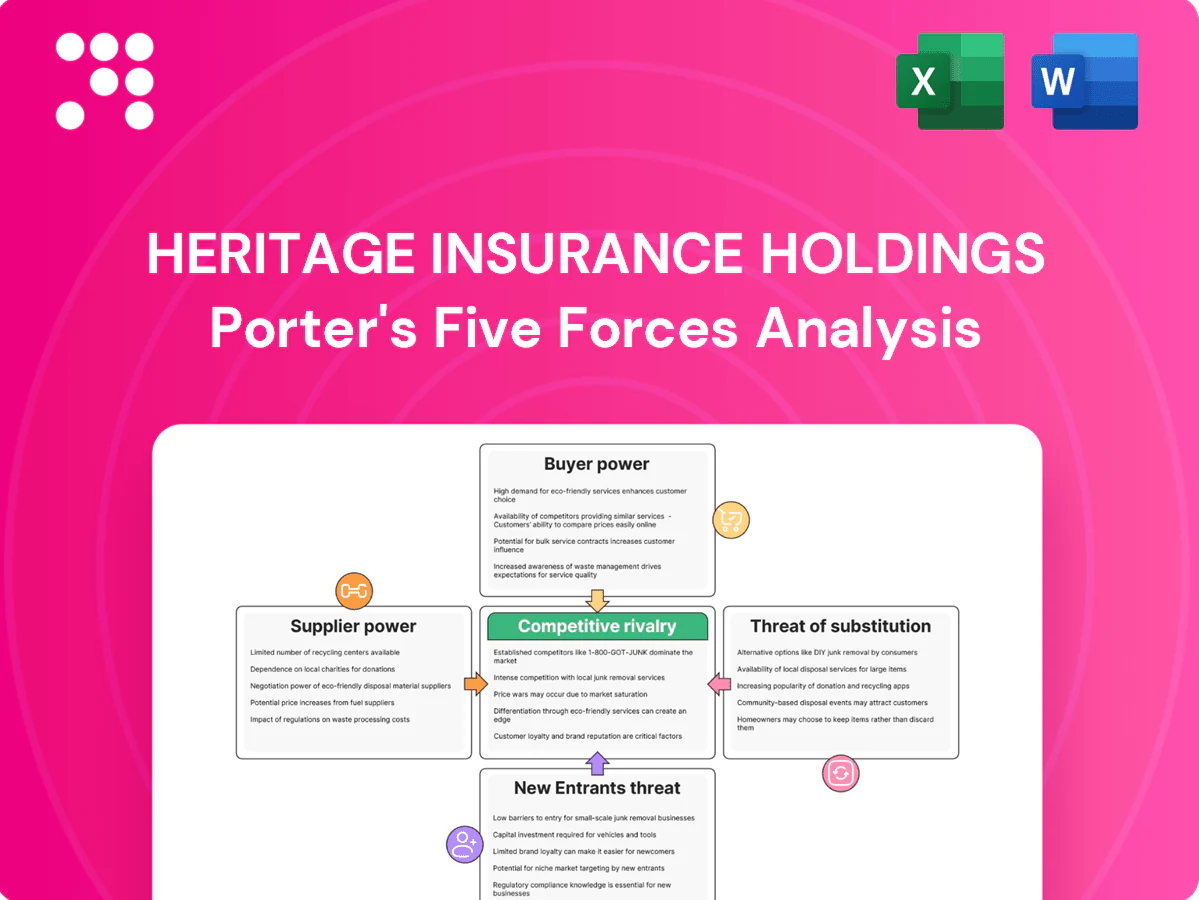
Heritage Insurance Holdings Porter's Five Forces Analysis

Go Beyond the Preview—Access the Full Strategic Report
Heritage Insurance Holdings faces moderate buyer power, concentrated regional competition, and regulatory pressures that shape pricing and product mix; digital distribution and scale are key defensive levers. Threats from new insurtech entrants and substitute risk are rising, while supplier influence remains limited. This snapshot highlights core dynamics—unlock the full Porter's Five Forces Analysis for force-by-force ratings, visuals, and actionable strategy.
Suppliers Bargaining Power

Reinsurance dependence
Heritage's heavy reliance on global reinsurers for catastrophe capacity gives top reinsurers leverage over price, terms, and collateral, with Aon noting US property reinsurance rate-on-line increases into 2024 of up to 30% in peak zones. Hard-market cycles tighten capacity and drive higher ceding rates and attachment points, while multi-year deals and portfolio diversification can temper supplier power. Peak-zone exposure and post-event renewals keep reinsurers influential in negotiations.
Cat modeling vendors
Heritage depends on a small set of cat-model vendors—notably RMS and Verisk—which concentrate supplier power and shaped industry practice in 2024. Methodology updates from these providers can immediately alter indicated rates, PMLs and reinsurance needs. Regulators and reinsurers demand validated models, limiting substitutability and entrenching vendor influence. Model blending and internal view-of-risk mitigate but do not remove this leverage.

Capital markets capacity
Cat bonds and ILS provide alternative capacity—market outstanding was about $50bn in 2024—yet investor risk appetite remains cyclical. Spread widening after heavy-loss years raises Heritage’s cost of risk transfer as transaction pricing resets. Deal execution hinges on modeling transparency, collateral triggers, and sponsor reputation. This supplier set gains power when traditional reinsurance also hardens.

Claims and repair ecosystem
Independent adjusters, restoration firms and materials suppliers gain leverage during surge events by pushing up loss costs and extending cycle times, while preferred networks and DRP contracts partially mitigate but do not eliminate price spikes driven by catastrophe demand.
- Labor/material shortages raise pricing and lead times
- Catastrophe demand spikes strengthen supplier bargaining power
- Litigation-prone jurisdictions amplify AOB vendor leverage
Rating agencies and data providers
Rating agencies such as A.M. Best act as quasi-suppliers for Heritage Insurance Holdings by gating distribution and reinsurance access; agency downgrades or methodology shifts can force higher collateral or capital, constraining growth. Catastrophe model and hazard feed markets remain concentrated—RMS, AIR and CoreLogic together control roughly 70–80% of model usage—so model changes can materially raise reinsurance costs. Dependence on strong ratings amplifies this supplier power and can translate into tens of millions in additional capital or higher reinsurance premiums in stressed scenarios.
- Key suppliers: A.M. Best, RMS, AIR, CoreLogic
- Market concentration: ~70–80% model share
- Impact: methodology/rating shifts → higher capital needs, constrained distribution
Supplier power squeezes insurers: R-o-L up to 30%, ILS $50bn, models 70-80% share
Heritage faces strong supplier power: reinsurers pushed US property rate-on-line up to 30% in peak zones into 2024, ILS capacity was about $50bn, and RMS/AIR/CoreLogic held ~70–80% model share—driving higher ceding costs, collateral and capital needs that can total tens of millions in stressed years.
| Supplier | 2024 metric | Impact |
|---|---|---|
| Reinsurers | R-o-L + up to 30% | Higher premiums/collateral |
| ILS | $50bn market | Alternative but cyclical |
| Model vendors | 70–80% share | Methodology risk |
What is included in the product
 Detailed Word Document
Concise Porter's Five Forces analysis tailored to Heritage Insurance Holdings, assessing competitive rivalry, buyer/supplier power, entry barriers, substitutes, and strategic threats to profitability.

 Customizable Excel Spreadsheet
One-sheet Porter's Five Forces for Heritage Insurance Holdings pinpoints competitive pressure and regulatory risks, enabling rapid strategic choices and clear mitigation plans for underwriting, pricing, and distribution pain points.
Customers Bargaining Power

Agent and broker influence
Intermediated distribution concentrates buying power with agencies and aggregators; in 2024 about two-thirds of U.S. property-casualty premium flowed through independent agents, amplifying their leverage over carriers like Heritage. They steer placement on commission levels, service and underwriting appetite, using contingent compensation and ease-of-doing-business as levers. In tight markets their influence wanes, but in normal markets placement leverage remains strong.
Price-sensitive homeowners
Price-sensitive personal-lines homeowners are highly elastic, with 2024 surveys showing roughly 50% shop at renewal and online quoting usage exceeding 60%, boosting transparency and bargaining power. Comparison tools compress rate spreads, forcing Heritage to compete on price and service. In coastal zones facing capacity shortages and reinsurance pullbacks, choice narrows and buyer power declines. Complex deductibles and coverage nuances limit direct apples-to-apples switching.

Commercial residential accounts
HOAs and condo associations aggregate premium dollars across units, boosting negotiation leverage with carriers; Heritage faces concentrated HOA accounts that often bid multi-million-dollar blocks. Risk-managed properties routinely secure tailored terms and credits, reducing loss costs and raising expectations for premium concessions. Brokers intensify competition across admitted and surplus lines, and 2024 coastal reinsurance tightening—rate-on-line up roughly 20%—can still curb customer power after major catastrophes.

Regulatory constraints on pricing
File-and-approve or prior-approval regimes (29 states using prior-approval in 2024) constrain pass-through of higher costs, indirectly boosting customer leverage over Heritage Insurance Holdings' rates. Delays in rate adequacy force underwriting discipline and slow growth; consumer appeals or hearings and scrutiny of policy terms further compress repricing flexibility.
- Regime: 29 states prior-approval (2024)
- Effect: stronger buyer leverage on rates
- Consequence: underwriting over growth
- Constraint: non-rate scrutiny limits repricing
Switching and churn dynamics
Cancellation and mid-term rewrites remain feasible, so churn risk persists for Heritage Insurance Holdings despite underwriting focus; customer defections accelerate where large carriers offer auto-home bundling. Loyalty discounts and risk-mitigation credits narrow buyer power by improving retention economics. Positive claim experience increases inertia, but poor service rapidly erodes loyalty and raises switching likelihood.
- Mid-term churn: feasible exit paths raise bargaining leverage
- Bundling threat: large carriers can poach bundled accounts
- Retention tools: discounts and credits reduce price sensitivity
- Claims service: key driver of short-term inertia vs long-term churn
Agents hold ≈66% share; renewal shoppers ≈50%; online quoting >60%
Intermediated distribution concentrates buying power with agents/aggregators (≈66% of P-C premium, 2024), who push on commissions, service and underwriting. Retail homeowners are price-sensitive (≈50% shop at renewal; online quoting >60%), raising transparency and switching. Prior-approval in 29 states limits rate pass-through, while reinsurance rate-on-line rose ~20% in 2024, intermittently reducing buyer leverage.
| Metric | 2024 Value |
|---|---|
| Agent-sold share | ≈66% |
| Renewal shopping | ≈50% |
| Online quoting | >60% |
| Prior-approval states | 29 |
| Reinsurance ROL change | +≈20% |
What You See Is What You Get
Heritage Insurance Holdings Porter's Five Forces Analysis
This preview shows the exact Porter's Five Forces analysis for Heritage Insurance Holdings you'll receive immediately after purchase—no surprises, no placeholders. It evaluates competitive rivalry, buyer and supplier power, threat of substitutes, and barriers to entry, with concise strategic implications. The document is fully formatted and ready for download and use the moment you buy.

Go Beyond the Preview—Access the Full Strategic Report
Heritage Insurance Holdings faces moderate buyer power, concentrated regional competition, and regulatory pressures that shape pricing and product mix; digital distribution and scale are key defensive levers. Threats from new insurtech entrants and substitute risk are rising, while supplier influence remains limited. This snapshot highlights core dynamics—unlock the full Porter's Five Forces Analysis for force-by-force ratings, visuals, and actionable strategy.
Suppliers Bargaining Power
Reinsurance dependence
Heritage's heavy reliance on global reinsurers for catastrophe capacity gives top reinsurers leverage over price, terms, and collateral, with Aon noting US property reinsurance rate-on-line increases into 2024 of up to 30% in peak zones. Hard-market cycles tighten capacity and drive higher ceding rates and attachment points, while multi-year deals and portfolio diversification can temper supplier power. Peak-zone exposure and post-event renewals keep reinsurers influential in negotiations.
Cat modeling vendors
Heritage depends on a small set of cat-model vendors—notably RMS and Verisk—which concentrate supplier power and shaped industry practice in 2024. Methodology updates from these providers can immediately alter indicated rates, PMLs and reinsurance needs. Regulators and reinsurers demand validated models, limiting substitutability and entrenching vendor influence. Model blending and internal view-of-risk mitigate but do not remove this leverage.
Capital markets capacity
Cat bonds and ILS provide alternative capacity—market outstanding was about $50bn in 2024—yet investor risk appetite remains cyclical. Spread widening after heavy-loss years raises Heritage’s cost of risk transfer as transaction pricing resets. Deal execution hinges on modeling transparency, collateral triggers, and sponsor reputation. This supplier set gains power when traditional reinsurance also hardens.
Claims and repair ecosystem
Independent adjusters, restoration firms and materials suppliers gain leverage during surge events by pushing up loss costs and extending cycle times, while preferred networks and DRP contracts partially mitigate but do not eliminate price spikes driven by catastrophe demand.
- Labor/material shortages raise pricing and lead times
- Catastrophe demand spikes strengthen supplier bargaining power
- Litigation-prone jurisdictions amplify AOB vendor leverage
Rating agencies and data providers
Rating agencies such as A.M. Best act as quasi-suppliers for Heritage Insurance Holdings by gating distribution and reinsurance access; agency downgrades or methodology shifts can force higher collateral or capital, constraining growth. Catastrophe model and hazard feed markets remain concentrated—RMS, AIR and CoreLogic together control roughly 70–80% of model usage—so model changes can materially raise reinsurance costs. Dependence on strong ratings amplifies this supplier power and can translate into tens of millions in additional capital or higher reinsurance premiums in stressed scenarios.
- Key suppliers: A.M. Best, RMS, AIR, CoreLogic
- Market concentration: ~70–80% model share
- Impact: methodology/rating shifts → higher capital needs, constrained distribution
Supplier power squeezes insurers: R-o-L up to 30%, ILS $50bn, models 70-80% share
Heritage faces strong supplier power: reinsurers pushed US property rate-on-line up to 30% in peak zones into 2024, ILS capacity was about $50bn, and RMS/AIR/CoreLogic held ~70–80% model share—driving higher ceding costs, collateral and capital needs that can total tens of millions in stressed years.
| Supplier | 2024 metric | Impact |
|---|---|---|
| Reinsurers | R-o-L + up to 30% | Higher premiums/collateral |
| ILS | $50bn market | Alternative but cyclical |
| Model vendors | 70–80% share | Methodology risk |
What is included in the product
Detailed Word Document
Concise Porter's Five Forces analysis tailored to Heritage Insurance Holdings, assessing competitive rivalry, buyer/supplier power, entry barriers, substitutes, and strategic threats to profitability.
Customizable Excel Spreadsheet
One-sheet Porter's Five Forces for Heritage Insurance Holdings pinpoints competitive pressure and regulatory risks, enabling rapid strategic choices and clear mitigation plans for underwriting, pricing, and distribution pain points.
Customers Bargaining Power
Agent and broker influence
Intermediated distribution concentrates buying power with agencies and aggregators; in 2024 about two-thirds of U.S. property-casualty premium flowed through independent agents, amplifying their leverage over carriers like Heritage. They steer placement on commission levels, service and underwriting appetite, using contingent compensation and ease-of-doing-business as levers. In tight markets their influence wanes, but in normal markets placement leverage remains strong.
Price-sensitive homeowners
Price-sensitive personal-lines homeowners are highly elastic, with 2024 surveys showing roughly 50% shop at renewal and online quoting usage exceeding 60%, boosting transparency and bargaining power. Comparison tools compress rate spreads, forcing Heritage to compete on price and service. In coastal zones facing capacity shortages and reinsurance pullbacks, choice narrows and buyer power declines. Complex deductibles and coverage nuances limit direct apples-to-apples switching.
Commercial residential accounts
HOAs and condo associations aggregate premium dollars across units, boosting negotiation leverage with carriers; Heritage faces concentrated HOA accounts that often bid multi-million-dollar blocks. Risk-managed properties routinely secure tailored terms and credits, reducing loss costs and raising expectations for premium concessions. Brokers intensify competition across admitted and surplus lines, and 2024 coastal reinsurance tightening—rate-on-line up roughly 20%—can still curb customer power after major catastrophes.
Regulatory constraints on pricing
File-and-approve or prior-approval regimes (29 states using prior-approval in 2024) constrain pass-through of higher costs, indirectly boosting customer leverage over Heritage Insurance Holdings' rates. Delays in rate adequacy force underwriting discipline and slow growth; consumer appeals or hearings and scrutiny of policy terms further compress repricing flexibility.
- Regime: 29 states prior-approval (2024)
- Effect: stronger buyer leverage on rates
- Consequence: underwriting over growth
- Constraint: non-rate scrutiny limits repricing
Switching and churn dynamics
Cancellation and mid-term rewrites remain feasible, so churn risk persists for Heritage Insurance Holdings despite underwriting focus; customer defections accelerate where large carriers offer auto-home bundling. Loyalty discounts and risk-mitigation credits narrow buyer power by improving retention economics. Positive claim experience increases inertia, but poor service rapidly erodes loyalty and raises switching likelihood.
- Mid-term churn: feasible exit paths raise bargaining leverage
- Bundling threat: large carriers can poach bundled accounts
- Retention tools: discounts and credits reduce price sensitivity
- Claims service: key driver of short-term inertia vs long-term churn
Agents hold ≈66% share; renewal shoppers ≈50%; online quoting >60%
Intermediated distribution concentrates buying power with agents/aggregators (≈66% of P-C premium, 2024), who push on commissions, service and underwriting. Retail homeowners are price-sensitive (≈50% shop at renewal; online quoting >60%), raising transparency and switching. Prior-approval in 29 states limits rate pass-through, while reinsurance rate-on-line rose ~20% in 2024, intermittently reducing buyer leverage.
| Metric | 2024 Value |
|---|---|
| Agent-sold share | ≈66% |
| Renewal shopping | ≈50% |
| Online quoting | >60% |
| Prior-approval states | 29 |
| Reinsurance ROL change | +≈20% |
What You See Is What You Get
Heritage Insurance Holdings Porter's Five Forces Analysis
This preview shows the exact Porter's Five Forces analysis for Heritage Insurance Holdings you'll receive immediately after purchase—no surprises, no placeholders. It evaluates competitive rivalry, buyer and supplier power, threat of substitutes, and barriers to entry, with concise strategic implications. The document is fully formatted and ready for download and use the moment you buy.
Original: $10.00
-65%$10.00
$3.50Description
Go Beyond the Preview—Access the Full Strategic Report
Heritage Insurance Holdings faces moderate buyer power, concentrated regional competition, and regulatory pressures that shape pricing and product mix; digital distribution and scale are key defensive levers. Threats from new insurtech entrants and substitute risk are rising, while supplier influence remains limited. This snapshot highlights core dynamics—unlock the full Porter's Five Forces Analysis for force-by-force ratings, visuals, and actionable strategy.
Suppliers Bargaining Power
Reinsurance dependence
Heritage's heavy reliance on global reinsurers for catastrophe capacity gives top reinsurers leverage over price, terms, and collateral, with Aon noting US property reinsurance rate-on-line increases into 2024 of up to 30% in peak zones. Hard-market cycles tighten capacity and drive higher ceding rates and attachment points, while multi-year deals and portfolio diversification can temper supplier power. Peak-zone exposure and post-event renewals keep reinsurers influential in negotiations.
Cat modeling vendors
Heritage depends on a small set of cat-model vendors—notably RMS and Verisk—which concentrate supplier power and shaped industry practice in 2024. Methodology updates from these providers can immediately alter indicated rates, PMLs and reinsurance needs. Regulators and reinsurers demand validated models, limiting substitutability and entrenching vendor influence. Model blending and internal view-of-risk mitigate but do not remove this leverage.
Capital markets capacity
Cat bonds and ILS provide alternative capacity—market outstanding was about $50bn in 2024—yet investor risk appetite remains cyclical. Spread widening after heavy-loss years raises Heritage’s cost of risk transfer as transaction pricing resets. Deal execution hinges on modeling transparency, collateral triggers, and sponsor reputation. This supplier set gains power when traditional reinsurance also hardens.
Claims and repair ecosystem
Independent adjusters, restoration firms and materials suppliers gain leverage during surge events by pushing up loss costs and extending cycle times, while preferred networks and DRP contracts partially mitigate but do not eliminate price spikes driven by catastrophe demand.
- Labor/material shortages raise pricing and lead times
- Catastrophe demand spikes strengthen supplier bargaining power
- Litigation-prone jurisdictions amplify AOB vendor leverage
Rating agencies and data providers
Rating agencies such as A.M. Best act as quasi-suppliers for Heritage Insurance Holdings by gating distribution and reinsurance access; agency downgrades or methodology shifts can force higher collateral or capital, constraining growth. Catastrophe model and hazard feed markets remain concentrated—RMS, AIR and CoreLogic together control roughly 70–80% of model usage—so model changes can materially raise reinsurance costs. Dependence on strong ratings amplifies this supplier power and can translate into tens of millions in additional capital or higher reinsurance premiums in stressed scenarios.
- Key suppliers: A.M. Best, RMS, AIR, CoreLogic
- Market concentration: ~70–80% model share
- Impact: methodology/rating shifts → higher capital needs, constrained distribution
Supplier power squeezes insurers: R-o-L up to 30%, ILS $50bn, models 70-80% share
Heritage faces strong supplier power: reinsurers pushed US property rate-on-line up to 30% in peak zones into 2024, ILS capacity was about $50bn, and RMS/AIR/CoreLogic held ~70–80% model share—driving higher ceding costs, collateral and capital needs that can total tens of millions in stressed years.
| Supplier | 2024 metric | Impact |
|---|---|---|
| Reinsurers | R-o-L + up to 30% | Higher premiums/collateral |
| ILS | $50bn market | Alternative but cyclical |
| Model vendors | 70–80% share | Methodology risk |
What is included in the product
Detailed Word Document
Concise Porter's Five Forces analysis tailored to Heritage Insurance Holdings, assessing competitive rivalry, buyer/supplier power, entry barriers, substitutes, and strategic threats to profitability.
Customizable Excel Spreadsheet
One-sheet Porter's Five Forces for Heritage Insurance Holdings pinpoints competitive pressure and regulatory risks, enabling rapid strategic choices and clear mitigation plans for underwriting, pricing, and distribution pain points.
Customers Bargaining Power
Agent and broker influence
Intermediated distribution concentrates buying power with agencies and aggregators; in 2024 about two-thirds of U.S. property-casualty premium flowed through independent agents, amplifying their leverage over carriers like Heritage. They steer placement on commission levels, service and underwriting appetite, using contingent compensation and ease-of-doing-business as levers. In tight markets their influence wanes, but in normal markets placement leverage remains strong.
Price-sensitive homeowners
Price-sensitive personal-lines homeowners are highly elastic, with 2024 surveys showing roughly 50% shop at renewal and online quoting usage exceeding 60%, boosting transparency and bargaining power. Comparison tools compress rate spreads, forcing Heritage to compete on price and service. In coastal zones facing capacity shortages and reinsurance pullbacks, choice narrows and buyer power declines. Complex deductibles and coverage nuances limit direct apples-to-apples switching.
Commercial residential accounts
HOAs and condo associations aggregate premium dollars across units, boosting negotiation leverage with carriers; Heritage faces concentrated HOA accounts that often bid multi-million-dollar blocks. Risk-managed properties routinely secure tailored terms and credits, reducing loss costs and raising expectations for premium concessions. Brokers intensify competition across admitted and surplus lines, and 2024 coastal reinsurance tightening—rate-on-line up roughly 20%—can still curb customer power after major catastrophes.
Regulatory constraints on pricing
File-and-approve or prior-approval regimes (29 states using prior-approval in 2024) constrain pass-through of higher costs, indirectly boosting customer leverage over Heritage Insurance Holdings' rates. Delays in rate adequacy force underwriting discipline and slow growth; consumer appeals or hearings and scrutiny of policy terms further compress repricing flexibility.
- Regime: 29 states prior-approval (2024)
- Effect: stronger buyer leverage on rates
- Consequence: underwriting over growth
- Constraint: non-rate scrutiny limits repricing
Switching and churn dynamics
Cancellation and mid-term rewrites remain feasible, so churn risk persists for Heritage Insurance Holdings despite underwriting focus; customer defections accelerate where large carriers offer auto-home bundling. Loyalty discounts and risk-mitigation credits narrow buyer power by improving retention economics. Positive claim experience increases inertia, but poor service rapidly erodes loyalty and raises switching likelihood.
- Mid-term churn: feasible exit paths raise bargaining leverage
- Bundling threat: large carriers can poach bundled accounts
- Retention tools: discounts and credits reduce price sensitivity
- Claims service: key driver of short-term inertia vs long-term churn
Agents hold ≈66% share; renewal shoppers ≈50%; online quoting >60%
Intermediated distribution concentrates buying power with agents/aggregators (≈66% of P-C premium, 2024), who push on commissions, service and underwriting. Retail homeowners are price-sensitive (≈50% shop at renewal; online quoting >60%), raising transparency and switching. Prior-approval in 29 states limits rate pass-through, while reinsurance rate-on-line rose ~20% in 2024, intermittently reducing buyer leverage.
| Metric | 2024 Value |
|---|---|
| Agent-sold share | ≈66% |
| Renewal shopping | ≈50% |
| Online quoting | >60% |
| Prior-approval states | 29 |
| Reinsurance ROL change | +≈20% |
What You See Is What You Get
Heritage Insurance Holdings Porter's Five Forces Analysis
This preview shows the exact Porter's Five Forces analysis for Heritage Insurance Holdings you'll receive immediately after purchase—no surprises, no placeholders. It evaluates competitive rivalry, buyer and supplier power, threat of substitutes, and barriers to entry, with concise strategic implications. The document is fully formatted and ready for download and use the moment you buy.











