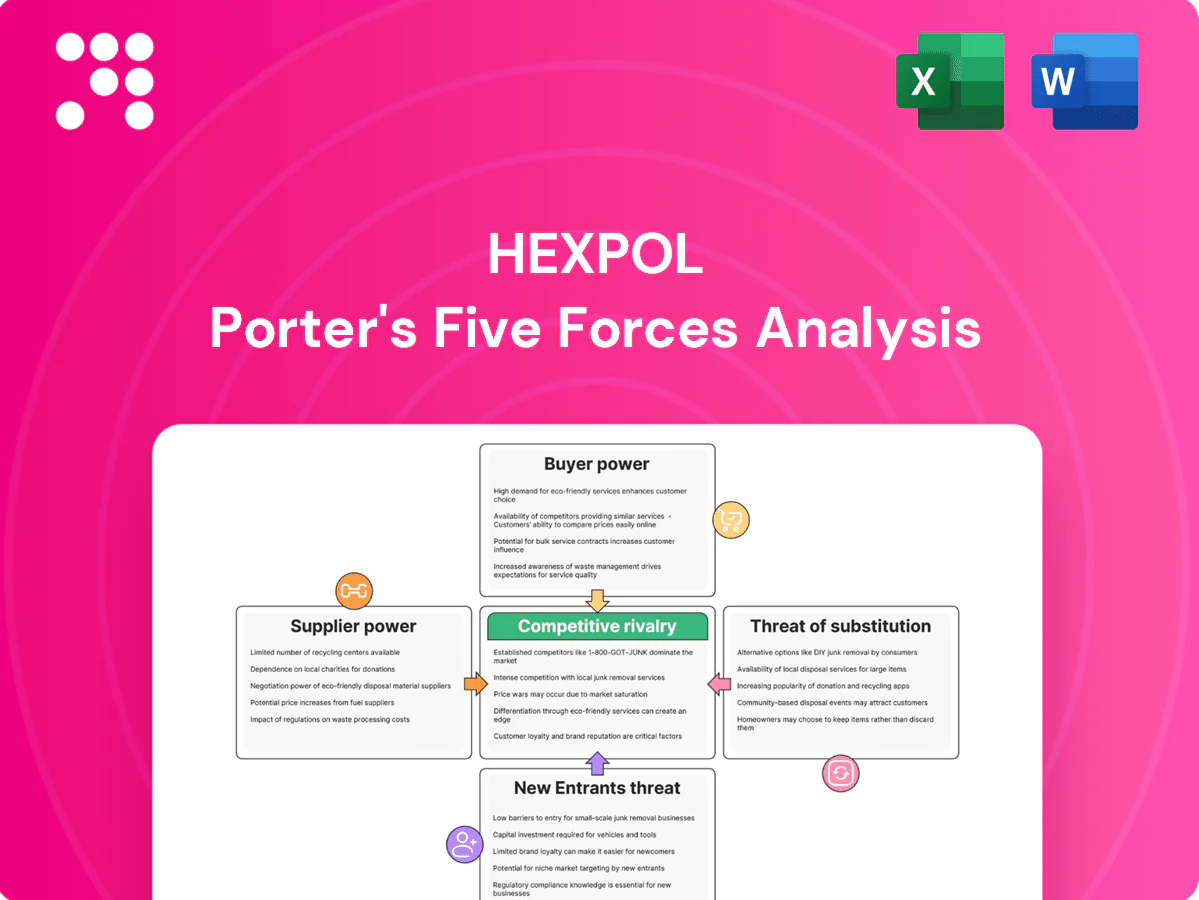
HEXPOL Porter's Five Forces Analysis

Elevate Your Analysis with the Complete Porter's Five Forces Analysis
HEXPOL’s Porter's Five Forces snapshot highlights moderate supplier power, intense industry rivalry, and evolving substitute threats driven by material innovation. Buyer leverage and barriers to entry shape margin pressure and strategic positioning. This brief only scratches the surface—unlock the full Porter's Five Forces Analysis for a force-by-force, data-driven breakdown to guide investment and strategy.
Suppliers Bargaining Power

Concentrated petrochemical feedstocks
HEXPOL depends on synthetic rubbers, polymers, plasticizers, carbon black and specialty additives largely produced by concentrated global players (BASF, SABIC, Sinopec, ExxonMobil, Reliance) in 2024; supplier consolidation and periodic capacity outages tightened availability and firmed pricing, increasing supplier power for constrained grades, while diversified sourcing and qualifying alternate suppliers remain key mitigants.
Oil and energy price volatility
Feedstock costs for HEXPOL closely track crude and natural gas—Brent averaged about $86/bbl in 2024 and Henry Hub roughly $2.9/MMBtu—so compound input prices move with energy markets. Rapid swings can compress margins when pass-through to customers lags, with 2024 volatility causing quarter-to-quarter raw material cost swings of 10–20% in the sector. Suppliers often enforce formula-based adjustments, strengthening leverage during spikes. Hedging programs and indexed contracts have reduced net exposure for many polymer processors.

Specialty additives scarcity
Certain performance additives, pigments and medical-grade ingredients come from a handful of high-spec vendors, giving them leverage as qualification and compliance typically take months and switching can push lead times past 20 weeks. Niche suppliers can dictate minimum order quantities and delivery terms, raising input cost risk for HEXPOL. Strategic partnerships and dual-qualification of alternative vendors reduce dependence and shorten response time.

Switching costs and qualification
Material requalification, tooling trials and regulatory documentation create 3–9 month switching frictions; for medical and automotive PPAP and biocompatibility testing commonly add 3–6 months, raising supplier stickiness and negotiation leverage for HEXPOL in critical segments.
Counterweights: scale and alt materials
HEXPOL’s global scale, aggregated volumes and technical know‑how strengthen negotiating power; 2024 net sales SEK 34.1bn and ~9,000 employees consolidate purchasing leverage. Reformulation to recycled, bio‑based or alternate polymers reduces single‑supplier influence. Multi‑sourcing, regional supply hubs and supplier scorecards/VMI further buffer disruptions and align cost/service incentives.
- Scale: SEK 34.1bn 2024
- Flexibility: recycled/bio alternatives
- Resilience: multi‑sourcing, regional hubs
- Governance: scorecards + VMI
Supplier power rises with feedstock shock — Brent $86/bbl
HEXPOL faces elevated supplier power in 2024 due to feedstock-linked pricing (Brent $86/bbl, Henry Hub $2.9/MMBtu) and concentrated polymer/additive suppliers, with switching frictions of 3–9 months raising negotiation leverage. Scale (net sales SEK 34.1bn) and multi‑sourcing limit exposure; hedging and long-term contracts partially mitigate spikes.
| Metric | 2024 |
|---|---|
| Brent | $86/bbl |
| Henry Hub | $2.9/MMBtu |
| Net sales | SEK 34.1bn |
| Switch delay | 3–9 months |
What is included in the product
 Detailed Word Document
Uncovers key drivers of competition, buyer and supplier power, entry barriers, substitutes and disruptive threats specific to HEXPOL’s market position, with strategic commentary and editable Word-ready insights for reports and decks.

 Customizable Excel Spreadsheet
A concise, one-sheet HEXPOL Porter's Five Forces summary that visualizes supplier, buyer, substitute, entrant and competitive pressures—perfect for quick strategic decisions and pinpointing where to reduce risk or seize advantage.
Customers Bargaining Power

Large OEMs and tier suppliers
Large automotive, medical and industrial OEMs and tier suppliers place high-volume contracts—global light-vehicle production was about 80 million units in 2024—allowing buyers to dictate terms and drive scale-based pricing. Their procurement sophistication, dual-sourcing and global bid processes intensify price pressure and compress margins. Complex specifications, multi-stage approvals and safety certifications limit easy switching, letting HEXPOL capture value through validated, performance-differentiated compounds that can command premiums.
Customization and stickiness
HEXPOL’s tailored compounds increase customer reliance on proprietary recipes and process know-how, creating program stickiness and high switching friction. Qualification times for high-spec elastomer programs commonly run 6–18 months, raising churn costs and lowering buyer power for those programs. This dynamic reduces negotiation leverage on price for core customers, although many still perform should-cost analyses to pressure margins.

Cyclical demand and pricing pressure
End markets such as automotive and construction are highly cyclical, so downturns intensify buyer pressure for discounts and volume concessions. Inventory destocking often forces renegotiation of volumes and margins, shifting short-term leverage to large OEMs and distributors. In upcycles capacity tightness can reverse leverage toward suppliers, and flexible pricing models and index-linked contracts help HEXPOL balance these swings.

Compliance and documentation demands
Medical and regulated sectors force HEXPOL to supply extensive REACH/RoHS, traceability and biocompatibility dossiers; meeting these raises service value but enables buyers to demand strict SLAs and failure penalties, increasing perceived customer leverage. In 2024 the global medical device market reached about 600 billion USD, heightening stakes for compliance-driven contracts. Superior QA and regulatory support can convert these demands into long-term loyalty.
- Higher service value vs greater buyer SLA leverage
- 2024 medical device market ~600 billion USD
- Strong QA/regulatory support reduces churn, builds loyalty
Switching options across compounders
Multiple global and regional compounders offer comparable base capabilities in 2024, and buyers frequently run RFQs to benchmark suppliers and compress margins; however nuanced performance, color matching and processing windows are difficult to replicate quickly, sustaining HEXPOLs technical premium. Technical support and speed-to-solution often neutralize pure price plays, keeping switching costs higher than spot pricing suggests.
- RFQs pressure margins
- Technical service raises switching costs
- Color/process differentiation = competitive moat
OEM buyer leverage from 80M vehicles; RFQs compress margins; $600B med device compliance
HEXPOL faces strong buyer leverage from large OEMs (global light-vehicle production ~80 million units in 2024) and frequent RFQs that compress margins. Long qualification cycles (6–18 months) and proprietary formulations raise switching costs and protect premiums. Cyclical end-markets and inventory destocking shift short-term power to buyers, while 2024 medical device market (~600 billion USD) increases compliance-driven demands.
Preview the Actual Deliverable
HEXPOL Porter's Five Forces Analysis
This preview shows the exact HEXPOL Porter’s Five Forces analysis you’ll receive—no placeholders or mockups. The document is the final, professionally formatted file, ready for immediate download and use upon purchase. What you see here is precisely what will be delivered to you.

Elevate Your Analysis with the Complete Porter's Five Forces Analysis
HEXPOL’s Porter's Five Forces snapshot highlights moderate supplier power, intense industry rivalry, and evolving substitute threats driven by material innovation. Buyer leverage and barriers to entry shape margin pressure and strategic positioning. This brief only scratches the surface—unlock the full Porter's Five Forces Analysis for a force-by-force, data-driven breakdown to guide investment and strategy.
Suppliers Bargaining Power
Concentrated petrochemical feedstocks
HEXPOL depends on synthetic rubbers, polymers, plasticizers, carbon black and specialty additives largely produced by concentrated global players (BASF, SABIC, Sinopec, ExxonMobil, Reliance) in 2024; supplier consolidation and periodic capacity outages tightened availability and firmed pricing, increasing supplier power for constrained grades, while diversified sourcing and qualifying alternate suppliers remain key mitigants.
Oil and energy price volatility
Feedstock costs for HEXPOL closely track crude and natural gas—Brent averaged about $86/bbl in 2024 and Henry Hub roughly $2.9/MMBtu—so compound input prices move with energy markets. Rapid swings can compress margins when pass-through to customers lags, with 2024 volatility causing quarter-to-quarter raw material cost swings of 10–20% in the sector. Suppliers often enforce formula-based adjustments, strengthening leverage during spikes. Hedging programs and indexed contracts have reduced net exposure for many polymer processors.
Specialty additives scarcity
Certain performance additives, pigments and medical-grade ingredients come from a handful of high-spec vendors, giving them leverage as qualification and compliance typically take months and switching can push lead times past 20 weeks. Niche suppliers can dictate minimum order quantities and delivery terms, raising input cost risk for HEXPOL. Strategic partnerships and dual-qualification of alternative vendors reduce dependence and shorten response time.
Switching costs and qualification
Material requalification, tooling trials and regulatory documentation create 3–9 month switching frictions; for medical and automotive PPAP and biocompatibility testing commonly add 3–6 months, raising supplier stickiness and negotiation leverage for HEXPOL in critical segments.
Counterweights: scale and alt materials
HEXPOL’s global scale, aggregated volumes and technical know‑how strengthen negotiating power; 2024 net sales SEK 34.1bn and ~9,000 employees consolidate purchasing leverage. Reformulation to recycled, bio‑based or alternate polymers reduces single‑supplier influence. Multi‑sourcing, regional supply hubs and supplier scorecards/VMI further buffer disruptions and align cost/service incentives.
- Scale: SEK 34.1bn 2024
- Flexibility: recycled/bio alternatives
- Resilience: multi‑sourcing, regional hubs
- Governance: scorecards + VMI
Supplier power rises with feedstock shock — Brent $86/bbl
HEXPOL faces elevated supplier power in 2024 due to feedstock-linked pricing (Brent $86/bbl, Henry Hub $2.9/MMBtu) and concentrated polymer/additive suppliers, with switching frictions of 3–9 months raising negotiation leverage. Scale (net sales SEK 34.1bn) and multi‑sourcing limit exposure; hedging and long-term contracts partially mitigate spikes.
| Metric | 2024 |
|---|---|
| Brent | $86/bbl |
| Henry Hub | $2.9/MMBtu |
| Net sales | SEK 34.1bn |
| Switch delay | 3–9 months |
What is included in the product
Detailed Word Document
Uncovers key drivers of competition, buyer and supplier power, entry barriers, substitutes and disruptive threats specific to HEXPOL’s market position, with strategic commentary and editable Word-ready insights for reports and decks.
Customizable Excel Spreadsheet
A concise, one-sheet HEXPOL Porter's Five Forces summary that visualizes supplier, buyer, substitute, entrant and competitive pressures—perfect for quick strategic decisions and pinpointing where to reduce risk or seize advantage.
Customers Bargaining Power
Large OEMs and tier suppliers
Large automotive, medical and industrial OEMs and tier suppliers place high-volume contracts—global light-vehicle production was about 80 million units in 2024—allowing buyers to dictate terms and drive scale-based pricing. Their procurement sophistication, dual-sourcing and global bid processes intensify price pressure and compress margins. Complex specifications, multi-stage approvals and safety certifications limit easy switching, letting HEXPOL capture value through validated, performance-differentiated compounds that can command premiums.
Customization and stickiness
HEXPOL’s tailored compounds increase customer reliance on proprietary recipes and process know-how, creating program stickiness and high switching friction. Qualification times for high-spec elastomer programs commonly run 6–18 months, raising churn costs and lowering buyer power for those programs. This dynamic reduces negotiation leverage on price for core customers, although many still perform should-cost analyses to pressure margins.
Cyclical demand and pricing pressure
End markets such as automotive and construction are highly cyclical, so downturns intensify buyer pressure for discounts and volume concessions. Inventory destocking often forces renegotiation of volumes and margins, shifting short-term leverage to large OEMs and distributors. In upcycles capacity tightness can reverse leverage toward suppliers, and flexible pricing models and index-linked contracts help HEXPOL balance these swings.
Compliance and documentation demands
Medical and regulated sectors force HEXPOL to supply extensive REACH/RoHS, traceability and biocompatibility dossiers; meeting these raises service value but enables buyers to demand strict SLAs and failure penalties, increasing perceived customer leverage. In 2024 the global medical device market reached about 600 billion USD, heightening stakes for compliance-driven contracts. Superior QA and regulatory support can convert these demands into long-term loyalty.
- Higher service value vs greater buyer SLA leverage
- 2024 medical device market ~600 billion USD
- Strong QA/regulatory support reduces churn, builds loyalty
Switching options across compounders
Multiple global and regional compounders offer comparable base capabilities in 2024, and buyers frequently run RFQs to benchmark suppliers and compress margins; however nuanced performance, color matching and processing windows are difficult to replicate quickly, sustaining HEXPOLs technical premium. Technical support and speed-to-solution often neutralize pure price plays, keeping switching costs higher than spot pricing suggests.
- RFQs pressure margins
- Technical service raises switching costs
- Color/process differentiation = competitive moat
OEM buyer leverage from 80M vehicles; RFQs compress margins; $600B med device compliance
HEXPOL faces strong buyer leverage from large OEMs (global light-vehicle production ~80 million units in 2024) and frequent RFQs that compress margins. Long qualification cycles (6–18 months) and proprietary formulations raise switching costs and protect premiums. Cyclical end-markets and inventory destocking shift short-term power to buyers, while 2024 medical device market (~600 billion USD) increases compliance-driven demands.
Preview the Actual Deliverable
HEXPOL Porter's Five Forces Analysis
This preview shows the exact HEXPOL Porter’s Five Forces analysis you’ll receive—no placeholders or mockups. The document is the final, professionally formatted file, ready for immediate download and use upon purchase. What you see here is precisely what will be delivered to you.
Original: $10.00
-65%$10.00
$3.50Description
Elevate Your Analysis with the Complete Porter's Five Forces Analysis
HEXPOL’s Porter's Five Forces snapshot highlights moderate supplier power, intense industry rivalry, and evolving substitute threats driven by material innovation. Buyer leverage and barriers to entry shape margin pressure and strategic positioning. This brief only scratches the surface—unlock the full Porter's Five Forces Analysis for a force-by-force, data-driven breakdown to guide investment and strategy.
Suppliers Bargaining Power
Concentrated petrochemical feedstocks
HEXPOL depends on synthetic rubbers, polymers, plasticizers, carbon black and specialty additives largely produced by concentrated global players (BASF, SABIC, Sinopec, ExxonMobil, Reliance) in 2024; supplier consolidation and periodic capacity outages tightened availability and firmed pricing, increasing supplier power for constrained grades, while diversified sourcing and qualifying alternate suppliers remain key mitigants.
Oil and energy price volatility
Feedstock costs for HEXPOL closely track crude and natural gas—Brent averaged about $86/bbl in 2024 and Henry Hub roughly $2.9/MMBtu—so compound input prices move with energy markets. Rapid swings can compress margins when pass-through to customers lags, with 2024 volatility causing quarter-to-quarter raw material cost swings of 10–20% in the sector. Suppliers often enforce formula-based adjustments, strengthening leverage during spikes. Hedging programs and indexed contracts have reduced net exposure for many polymer processors.
Specialty additives scarcity
Certain performance additives, pigments and medical-grade ingredients come from a handful of high-spec vendors, giving them leverage as qualification and compliance typically take months and switching can push lead times past 20 weeks. Niche suppliers can dictate minimum order quantities and delivery terms, raising input cost risk for HEXPOL. Strategic partnerships and dual-qualification of alternative vendors reduce dependence and shorten response time.
Switching costs and qualification
Material requalification, tooling trials and regulatory documentation create 3–9 month switching frictions; for medical and automotive PPAP and biocompatibility testing commonly add 3–6 months, raising supplier stickiness and negotiation leverage for HEXPOL in critical segments.
Counterweights: scale and alt materials
HEXPOL’s global scale, aggregated volumes and technical know‑how strengthen negotiating power; 2024 net sales SEK 34.1bn and ~9,000 employees consolidate purchasing leverage. Reformulation to recycled, bio‑based or alternate polymers reduces single‑supplier influence. Multi‑sourcing, regional supply hubs and supplier scorecards/VMI further buffer disruptions and align cost/service incentives.
- Scale: SEK 34.1bn 2024
- Flexibility: recycled/bio alternatives
- Resilience: multi‑sourcing, regional hubs
- Governance: scorecards + VMI
Supplier power rises with feedstock shock — Brent $86/bbl
HEXPOL faces elevated supplier power in 2024 due to feedstock-linked pricing (Brent $86/bbl, Henry Hub $2.9/MMBtu) and concentrated polymer/additive suppliers, with switching frictions of 3–9 months raising negotiation leverage. Scale (net sales SEK 34.1bn) and multi‑sourcing limit exposure; hedging and long-term contracts partially mitigate spikes.
| Metric | 2024 |
|---|---|
| Brent | $86/bbl |
| Henry Hub | $2.9/MMBtu |
| Net sales | SEK 34.1bn |
| Switch delay | 3–9 months |
What is included in the product
Detailed Word Document
Uncovers key drivers of competition, buyer and supplier power, entry barriers, substitutes and disruptive threats specific to HEXPOL’s market position, with strategic commentary and editable Word-ready insights for reports and decks.
Customizable Excel Spreadsheet
A concise, one-sheet HEXPOL Porter's Five Forces summary that visualizes supplier, buyer, substitute, entrant and competitive pressures—perfect for quick strategic decisions and pinpointing where to reduce risk or seize advantage.
Customers Bargaining Power
Large OEMs and tier suppliers
Large automotive, medical and industrial OEMs and tier suppliers place high-volume contracts—global light-vehicle production was about 80 million units in 2024—allowing buyers to dictate terms and drive scale-based pricing. Their procurement sophistication, dual-sourcing and global bid processes intensify price pressure and compress margins. Complex specifications, multi-stage approvals and safety certifications limit easy switching, letting HEXPOL capture value through validated, performance-differentiated compounds that can command premiums.
Customization and stickiness
HEXPOL’s tailored compounds increase customer reliance on proprietary recipes and process know-how, creating program stickiness and high switching friction. Qualification times for high-spec elastomer programs commonly run 6–18 months, raising churn costs and lowering buyer power for those programs. This dynamic reduces negotiation leverage on price for core customers, although many still perform should-cost analyses to pressure margins.
Cyclical demand and pricing pressure
End markets such as automotive and construction are highly cyclical, so downturns intensify buyer pressure for discounts and volume concessions. Inventory destocking often forces renegotiation of volumes and margins, shifting short-term leverage to large OEMs and distributors. In upcycles capacity tightness can reverse leverage toward suppliers, and flexible pricing models and index-linked contracts help HEXPOL balance these swings.
Compliance and documentation demands
Medical and regulated sectors force HEXPOL to supply extensive REACH/RoHS, traceability and biocompatibility dossiers; meeting these raises service value but enables buyers to demand strict SLAs and failure penalties, increasing perceived customer leverage. In 2024 the global medical device market reached about 600 billion USD, heightening stakes for compliance-driven contracts. Superior QA and regulatory support can convert these demands into long-term loyalty.
- Higher service value vs greater buyer SLA leverage
- 2024 medical device market ~600 billion USD
- Strong QA/regulatory support reduces churn, builds loyalty
Switching options across compounders
Multiple global and regional compounders offer comparable base capabilities in 2024, and buyers frequently run RFQs to benchmark suppliers and compress margins; however nuanced performance, color matching and processing windows are difficult to replicate quickly, sustaining HEXPOLs technical premium. Technical support and speed-to-solution often neutralize pure price plays, keeping switching costs higher than spot pricing suggests.
- RFQs pressure margins
- Technical service raises switching costs
- Color/process differentiation = competitive moat
OEM buyer leverage from 80M vehicles; RFQs compress margins; $600B med device compliance
HEXPOL faces strong buyer leverage from large OEMs (global light-vehicle production ~80 million units in 2024) and frequent RFQs that compress margins. Long qualification cycles (6–18 months) and proprietary formulations raise switching costs and protect premiums. Cyclical end-markets and inventory destocking shift short-term power to buyers, while 2024 medical device market (~600 billion USD) increases compliance-driven demands.
Preview the Actual Deliverable
HEXPOL Porter's Five Forces Analysis
This preview shows the exact HEXPOL Porter’s Five Forces analysis you’ll receive—no placeholders or mockups. The document is the final, professionally formatted file, ready for immediate download and use upon purchase. What you see here is precisely what will be delivered to you.











