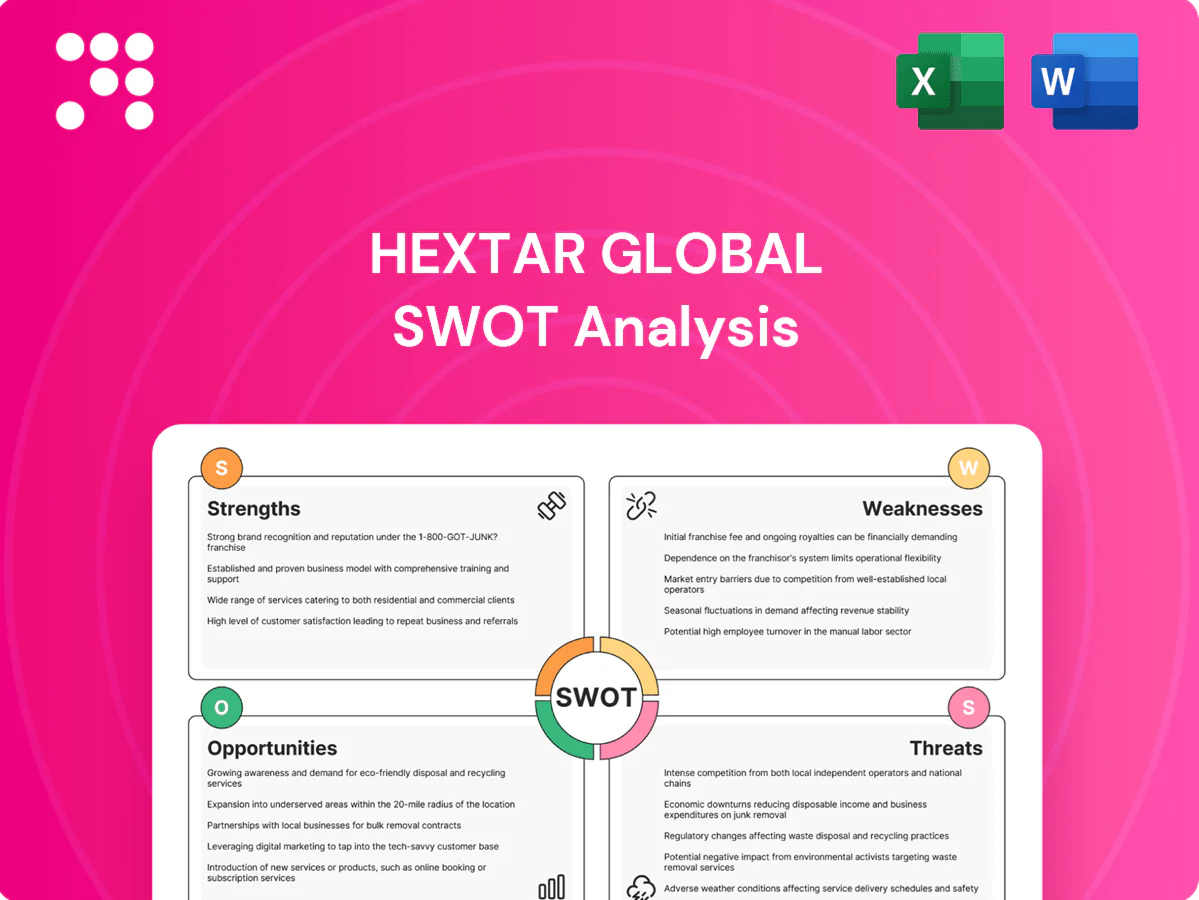
Hextar Global SWOT Analysis

Go Beyond the Preview—Access the Full Strategic Report
Hextar Global’s SWOT highlights robust product diversification and strong regional distribution but flags margin pressure and commodity exposure. Our full SWOT unpacks strategic implications, financial context, and competitive risks. Purchase the complete report for an editable, investor-ready analysis to inform strategy and investment decisions.
Strengths

Diversified chemical portfolio across agro, specialty, and fertilizers
Hextar Global’s diversified chemical portfolio across agro, specialty and fertilizers reduces dependence on any single revenue stream, smoothing cyclical demand across agriculture, industrial and consumer end-markets. The mix enables cross-selling between crop protection, specialty chemicals and fertilizer lines and allows shared manufacturing platforms to lower unit costs. This breadth enhances resilience to sector-specific downturns and supports more stable cash flows.
Established distribution and marketing network serving multiple regions
Bursa Malaysia-listed Hextar Global exports to over 20 countries, a wide geographic reach that supports scale, brand recognition and closer customer proximity. Strong regional channels improve inventory turns and responsiveness to seasonal agricultural cycles. Local presence across markets reduces logistics costs and lead times and strengthens after-sales service and technical support.

Manufacturing capabilities and process know-how in chemicals
Operational expertise in formulation, blending and regulatory compliance drives lower unit costs and reliable margins through efficient in-house production versus pure trading. Vertical manufacturing control enables tighter quality assurance and faster product iteration and localization for diverse crop and industrial needs. This process know-how underpins dependable supply to large farming and industrial clients.

Complementary industrial cleaning solutions and services
- Adjacency: specialty chemicals synergy
- Revenue: recurring service streams
- Risk: diversifies beyond crop seasonality
- Go-to-market: leverages B2B upsell
Investment holding flexibility for portfolio optimization
Hextar Global's holding structure, via its Bursa Malaysia-listed platform HEXTAR, enables bolt-on acquisitions and swift divestments, concentrating capital into higher-ROIC agrochemical and specialty-chem niches. Group-level treasury and retained earnings provide financial flexibility to accelerate entry into attractive chemical sub-segments. Holding-level governance streamlines strategic pivots and capital reallocation.
- Holding enables bolt-on M&A and divestments
- Focus capital on higher-ROIC niches
- Group treasury accelerates sub-segment entry
- Governance streamlines strategic pivots
Agro-specialty fertilizer group with >20-country exports & M&A growth
Hextar Global (Bursa: HEXTAR) combines diversified agro, specialty and fertilizer portfolios with in-house formulation and regional exports to over 20 countries, enabling stable cash flows, cross-selling and lower unit costs; holding company structure supports bolt-on M&A and capital redeployment to higher-ROIC niches.
| Metric | Fact |
|---|---|
| Listing | Bursa Malaysia (HEXTAR) |
| Export reach | >20 countries |
What is included in the product
 Detailed Word Document
Provides a concise SWOT analysis of Hextar Global, highlighting its operational and market strengths, internal weaknesses, strategic opportunities for expansion and diversification, and external threats such as regulatory shifts, commodity volatility, and competitive pressures.

 Customizable Excel Spreadsheet
Provides a focused Hextar Global SWOT matrix for rapid strategy alignment and stakeholder updates, enabling quick identification of risks, opportunities and tactical priorities.
Weaknesses

Exposure to commodity and raw material price volatility
Inputs such as solvents and intermediates track petrochemical cycles; with Brent averaging about 86 USD/bbl in 2024, feedstock-driven input swings (often ~30–40% of COGS in specialty chemicals) have compressed margins when passthrough lags. Hedging is constrained by limited liquidity and basis risk, making budgeting and working-capital planning more volatile.
Regulatory and compliance burden across chemical categories
Agrochemicals face stringent registration, safety and environmental standards, with single-product registration costs often exceeding $500,000 and approval timelines commonly stretching 12–36 months. Multiregional operations amplify compliance complexity and can raise annual regulatory costs by double-digit percentages for companies operating across ASEAN, APAC and MENA. Delays in approvals slow product launches and revenue recognition, while continuous documentation and audits strain technical and compliance teams’ capacity.

Seasonality and demand cyclicality in agriculture
Planting cycles drive uneven quarterly revenues and capacity utilization for Hextar Global, concentrating sales in pre-planting windows and leaving mid-year troughs. Weather variability — droughts or excessive rains — can abruptly shift demand for crop protection and fertilisers, complicating inventory planning and raising stockout or write-down risk. Cash flows tend to bunch around peak seasons, stressing working capital management.

Potential brand fragmentation across diverse offerings
Hextar Global’s broad portfolio risks diluting brand positioning across agrochemical, speciality chemicals and distribution lines; global crop protection market was about USD 67 billion in 2023, intensifying competition and reducing perceived specialization. Spreading marketing spend across disparate segments raises cost per acquisition and can weaken pricing power in crowded categories.
- Portfolio breadth vs focus
- Perceived limited niche expertise
- Higher marketing dilution
- Pressure on pricing power
Capital intensity and environmental footprint
Chemical manufacturing at Hextar Global requires continual capex for safety, process upgrades and regulatory compliance, driving high fixed costs and long payback periods. Waste management and emissions controls increase operating expenses and complexity, while any environmental incident could trigger fines, remediation costs and reputational damage. Rising decarbonization mandates and carbon pricing will likely compress future margins unless offset by efficiency gains or pricing power.
- High capex burden and long asset lives
- Elevated OPEX for waste and emissions control
- Regulatory fines and reputational risk from incidents
- Decarbonization pressure on margins
Feedstock volatility and >500k USD regs squeeze margins in 67bn USD crop-protection market
Feedstock volatility (Brent ~86 USD/bbl in 2024) and limited hedging compress margins and inflate working-capital swings. Registration costs >500,000 USD and 12–36 month approvals delay launches and raise compliance spend. Broad portfolio amid a USD 67bn global crop-protection market (2023) dilutes focus while high capex, waste controls and decarbonization demands pressure margins.
| Metric | Value |
|---|---|
| Brent (2024 avg) | 86 USD/bbl |
| Typical registration cost | >500,000 USD |
| Global crop-protection (2023) | 67,000,000,000 USD |
Full Version Awaits
Hextar Global SWOT Analysis
This is the actual SWOT analysis document you’ll receive upon purchase—no surprises, just professional quality. The preview below is taken directly from the full SWOT report you'll get; purchase unlocks the entire in-depth version. You’re viewing a live preview of the actual file—buy now to download the complete, editable report immediately after checkout.

Go Beyond the Preview—Access the Full Strategic Report
Hextar Global’s SWOT highlights robust product diversification and strong regional distribution but flags margin pressure and commodity exposure. Our full SWOT unpacks strategic implications, financial context, and competitive risks. Purchase the complete report for an editable, investor-ready analysis to inform strategy and investment decisions.
Strengths
Diversified chemical portfolio across agro, specialty, and fertilizers
Hextar Global’s diversified chemical portfolio across agro, specialty and fertilizers reduces dependence on any single revenue stream, smoothing cyclical demand across agriculture, industrial and consumer end-markets. The mix enables cross-selling between crop protection, specialty chemicals and fertilizer lines and allows shared manufacturing platforms to lower unit costs. This breadth enhances resilience to sector-specific downturns and supports more stable cash flows.
Established distribution and marketing network serving multiple regions
Bursa Malaysia-listed Hextar Global exports to over 20 countries, a wide geographic reach that supports scale, brand recognition and closer customer proximity. Strong regional channels improve inventory turns and responsiveness to seasonal agricultural cycles. Local presence across markets reduces logistics costs and lead times and strengthens after-sales service and technical support.
Manufacturing capabilities and process know-how in chemicals
Operational expertise in formulation, blending and regulatory compliance drives lower unit costs and reliable margins through efficient in-house production versus pure trading. Vertical manufacturing control enables tighter quality assurance and faster product iteration and localization for diverse crop and industrial needs. This process know-how underpins dependable supply to large farming and industrial clients.
Complementary industrial cleaning solutions and services
- Adjacency: specialty chemicals synergy
- Revenue: recurring service streams
- Risk: diversifies beyond crop seasonality
- Go-to-market: leverages B2B upsell
Investment holding flexibility for portfolio optimization
Hextar Global's holding structure, via its Bursa Malaysia-listed platform HEXTAR, enables bolt-on acquisitions and swift divestments, concentrating capital into higher-ROIC agrochemical and specialty-chem niches. Group-level treasury and retained earnings provide financial flexibility to accelerate entry into attractive chemical sub-segments. Holding-level governance streamlines strategic pivots and capital reallocation.
- Holding enables bolt-on M&A and divestments
- Focus capital on higher-ROIC niches
- Group treasury accelerates sub-segment entry
- Governance streamlines strategic pivots
Agro-specialty fertilizer group with >20-country exports & M&A growth
Hextar Global (Bursa: HEXTAR) combines diversified agro, specialty and fertilizer portfolios with in-house formulation and regional exports to over 20 countries, enabling stable cash flows, cross-selling and lower unit costs; holding company structure supports bolt-on M&A and capital redeployment to higher-ROIC niches.
| Metric | Fact |
|---|---|
| Listing | Bursa Malaysia (HEXTAR) |
| Export reach | >20 countries |
What is included in the product
Detailed Word Document
Provides a concise SWOT analysis of Hextar Global, highlighting its operational and market strengths, internal weaknesses, strategic opportunities for expansion and diversification, and external threats such as regulatory shifts, commodity volatility, and competitive pressures.
Customizable Excel Spreadsheet
Provides a focused Hextar Global SWOT matrix for rapid strategy alignment and stakeholder updates, enabling quick identification of risks, opportunities and tactical priorities.
Weaknesses
Exposure to commodity and raw material price volatility
Inputs such as solvents and intermediates track petrochemical cycles; with Brent averaging about 86 USD/bbl in 2024, feedstock-driven input swings (often ~30–40% of COGS in specialty chemicals) have compressed margins when passthrough lags. Hedging is constrained by limited liquidity and basis risk, making budgeting and working-capital planning more volatile.
Regulatory and compliance burden across chemical categories
Agrochemicals face stringent registration, safety and environmental standards, with single-product registration costs often exceeding $500,000 and approval timelines commonly stretching 12–36 months. Multiregional operations amplify compliance complexity and can raise annual regulatory costs by double-digit percentages for companies operating across ASEAN, APAC and MENA. Delays in approvals slow product launches and revenue recognition, while continuous documentation and audits strain technical and compliance teams’ capacity.
Seasonality and demand cyclicality in agriculture
Planting cycles drive uneven quarterly revenues and capacity utilization for Hextar Global, concentrating sales in pre-planting windows and leaving mid-year troughs. Weather variability — droughts or excessive rains — can abruptly shift demand for crop protection and fertilisers, complicating inventory planning and raising stockout or write-down risk. Cash flows tend to bunch around peak seasons, stressing working capital management.
Potential brand fragmentation across diverse offerings
Hextar Global’s broad portfolio risks diluting brand positioning across agrochemical, speciality chemicals and distribution lines; global crop protection market was about USD 67 billion in 2023, intensifying competition and reducing perceived specialization. Spreading marketing spend across disparate segments raises cost per acquisition and can weaken pricing power in crowded categories.
- Portfolio breadth vs focus
- Perceived limited niche expertise
- Higher marketing dilution
- Pressure on pricing power
Capital intensity and environmental footprint
Chemical manufacturing at Hextar Global requires continual capex for safety, process upgrades and regulatory compliance, driving high fixed costs and long payback periods. Waste management and emissions controls increase operating expenses and complexity, while any environmental incident could trigger fines, remediation costs and reputational damage. Rising decarbonization mandates and carbon pricing will likely compress future margins unless offset by efficiency gains or pricing power.
- High capex burden and long asset lives
- Elevated OPEX for waste and emissions control
- Regulatory fines and reputational risk from incidents
- Decarbonization pressure on margins
Feedstock volatility and >500k USD regs squeeze margins in 67bn USD crop-protection market
Feedstock volatility (Brent ~86 USD/bbl in 2024) and limited hedging compress margins and inflate working-capital swings. Registration costs >500,000 USD and 12–36 month approvals delay launches and raise compliance spend. Broad portfolio amid a USD 67bn global crop-protection market (2023) dilutes focus while high capex, waste controls and decarbonization demands pressure margins.
| Metric | Value |
|---|---|
| Brent (2024 avg) | 86 USD/bbl |
| Typical registration cost | >500,000 USD |
| Global crop-protection (2023) | 67,000,000,000 USD |
Full Version Awaits
Hextar Global SWOT Analysis
This is the actual SWOT analysis document you’ll receive upon purchase—no surprises, just professional quality. The preview below is taken directly from the full SWOT report you'll get; purchase unlocks the entire in-depth version. You’re viewing a live preview of the actual file—buy now to download the complete, editable report immediately after checkout.
Description
Go Beyond the Preview—Access the Full Strategic Report
Hextar Global’s SWOT highlights robust product diversification and strong regional distribution but flags margin pressure and commodity exposure. Our full SWOT unpacks strategic implications, financial context, and competitive risks. Purchase the complete report for an editable, investor-ready analysis to inform strategy and investment decisions.
Strengths
Diversified chemical portfolio across agro, specialty, and fertilizers
Hextar Global’s diversified chemical portfolio across agro, specialty and fertilizers reduces dependence on any single revenue stream, smoothing cyclical demand across agriculture, industrial and consumer end-markets. The mix enables cross-selling between crop protection, specialty chemicals and fertilizer lines and allows shared manufacturing platforms to lower unit costs. This breadth enhances resilience to sector-specific downturns and supports more stable cash flows.
Established distribution and marketing network serving multiple regions
Bursa Malaysia-listed Hextar Global exports to over 20 countries, a wide geographic reach that supports scale, brand recognition and closer customer proximity. Strong regional channels improve inventory turns and responsiveness to seasonal agricultural cycles. Local presence across markets reduces logistics costs and lead times and strengthens after-sales service and technical support.
Manufacturing capabilities and process know-how in chemicals
Operational expertise in formulation, blending and regulatory compliance drives lower unit costs and reliable margins through efficient in-house production versus pure trading. Vertical manufacturing control enables tighter quality assurance and faster product iteration and localization for diverse crop and industrial needs. This process know-how underpins dependable supply to large farming and industrial clients.
Complementary industrial cleaning solutions and services
- Adjacency: specialty chemicals synergy
- Revenue: recurring service streams
- Risk: diversifies beyond crop seasonality
- Go-to-market: leverages B2B upsell
Investment holding flexibility for portfolio optimization
Hextar Global's holding structure, via its Bursa Malaysia-listed platform HEXTAR, enables bolt-on acquisitions and swift divestments, concentrating capital into higher-ROIC agrochemical and specialty-chem niches. Group-level treasury and retained earnings provide financial flexibility to accelerate entry into attractive chemical sub-segments. Holding-level governance streamlines strategic pivots and capital reallocation.
- Holding enables bolt-on M&A and divestments
- Focus capital on higher-ROIC niches
- Group treasury accelerates sub-segment entry
- Governance streamlines strategic pivots
Agro-specialty fertilizer group with >20-country exports & M&A growth
Hextar Global (Bursa: HEXTAR) combines diversified agro, specialty and fertilizer portfolios with in-house formulation and regional exports to over 20 countries, enabling stable cash flows, cross-selling and lower unit costs; holding company structure supports bolt-on M&A and capital redeployment to higher-ROIC niches.
| Metric | Fact |
|---|---|
| Listing | Bursa Malaysia (HEXTAR) |
| Export reach | >20 countries |
What is included in the product
Detailed Word Document
Provides a concise SWOT analysis of Hextar Global, highlighting its operational and market strengths, internal weaknesses, strategic opportunities for expansion and diversification, and external threats such as regulatory shifts, commodity volatility, and competitive pressures.
Customizable Excel Spreadsheet
Provides a focused Hextar Global SWOT matrix for rapid strategy alignment and stakeholder updates, enabling quick identification of risks, opportunities and tactical priorities.
Weaknesses
Exposure to commodity and raw material price volatility
Inputs such as solvents and intermediates track petrochemical cycles; with Brent averaging about 86 USD/bbl in 2024, feedstock-driven input swings (often ~30–40% of COGS in specialty chemicals) have compressed margins when passthrough lags. Hedging is constrained by limited liquidity and basis risk, making budgeting and working-capital planning more volatile.
Regulatory and compliance burden across chemical categories
Agrochemicals face stringent registration, safety and environmental standards, with single-product registration costs often exceeding $500,000 and approval timelines commonly stretching 12–36 months. Multiregional operations amplify compliance complexity and can raise annual regulatory costs by double-digit percentages for companies operating across ASEAN, APAC and MENA. Delays in approvals slow product launches and revenue recognition, while continuous documentation and audits strain technical and compliance teams’ capacity.
Seasonality and demand cyclicality in agriculture
Planting cycles drive uneven quarterly revenues and capacity utilization for Hextar Global, concentrating sales in pre-planting windows and leaving mid-year troughs. Weather variability — droughts or excessive rains — can abruptly shift demand for crop protection and fertilisers, complicating inventory planning and raising stockout or write-down risk. Cash flows tend to bunch around peak seasons, stressing working capital management.
Potential brand fragmentation across diverse offerings
Hextar Global’s broad portfolio risks diluting brand positioning across agrochemical, speciality chemicals and distribution lines; global crop protection market was about USD 67 billion in 2023, intensifying competition and reducing perceived specialization. Spreading marketing spend across disparate segments raises cost per acquisition and can weaken pricing power in crowded categories.
- Portfolio breadth vs focus
- Perceived limited niche expertise
- Higher marketing dilution
- Pressure on pricing power
Capital intensity and environmental footprint
Chemical manufacturing at Hextar Global requires continual capex for safety, process upgrades and regulatory compliance, driving high fixed costs and long payback periods. Waste management and emissions controls increase operating expenses and complexity, while any environmental incident could trigger fines, remediation costs and reputational damage. Rising decarbonization mandates and carbon pricing will likely compress future margins unless offset by efficiency gains or pricing power.
- High capex burden and long asset lives
- Elevated OPEX for waste and emissions control
- Regulatory fines and reputational risk from incidents
- Decarbonization pressure on margins
Feedstock volatility and >500k USD regs squeeze margins in 67bn USD crop-protection market
Feedstock volatility (Brent ~86 USD/bbl in 2024) and limited hedging compress margins and inflate working-capital swings. Registration costs >500,000 USD and 12–36 month approvals delay launches and raise compliance spend. Broad portfolio amid a USD 67bn global crop-protection market (2023) dilutes focus while high capex, waste controls and decarbonization demands pressure margins.
| Metric | Value |
|---|---|
| Brent (2024 avg) | 86 USD/bbl |
| Typical registration cost | >500,000 USD |
| Global crop-protection (2023) | 67,000,000,000 USD |
Full Version Awaits
Hextar Global SWOT Analysis
This is the actual SWOT analysis document you’ll receive upon purchase—no surprises, just professional quality. The preview below is taken directly from the full SWOT report you'll get; purchase unlocks the entire in-depth version. You’re viewing a live preview of the actual file—buy now to download the complete, editable report immediately after checkout.











