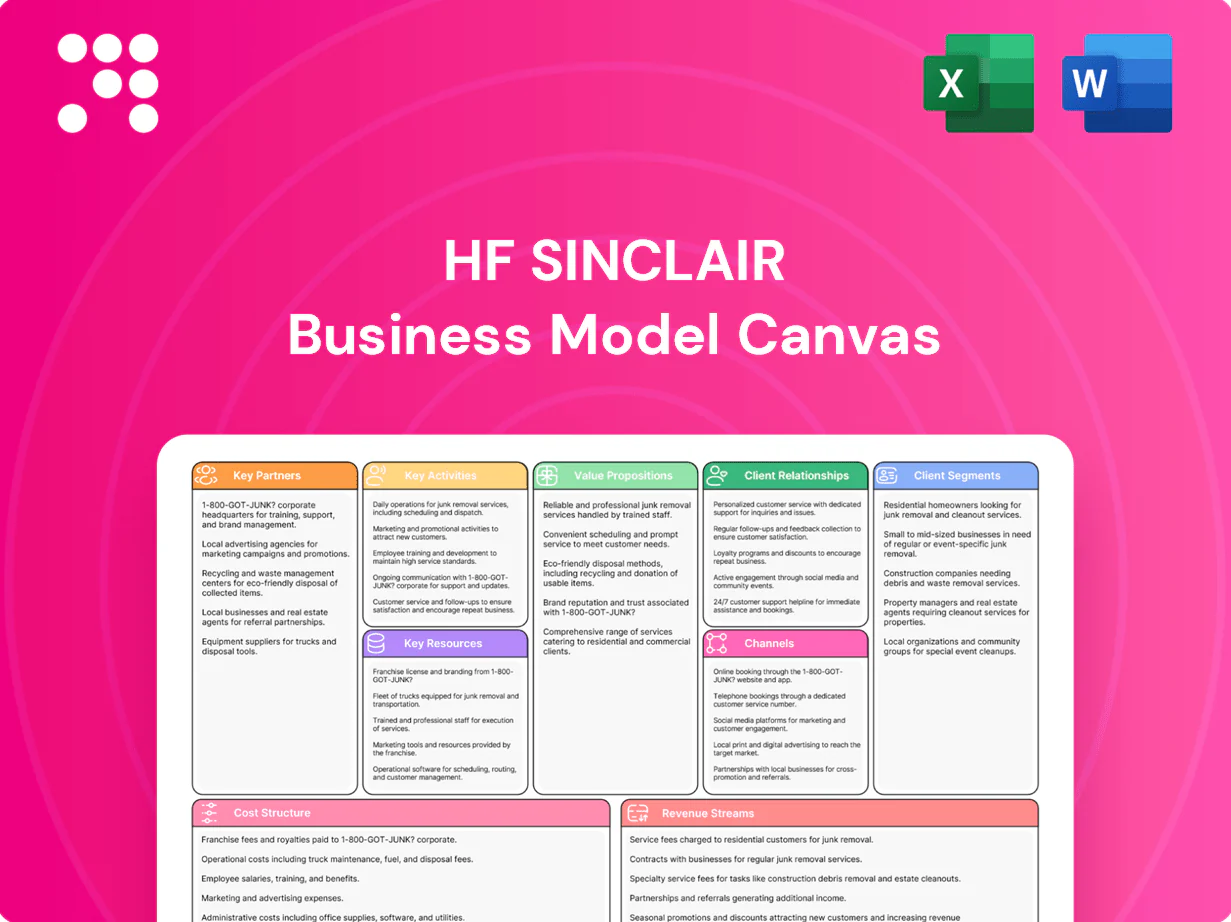
HF Sinclair Business Model Canvas

Unlock the strategic Business Model Canvas for energy-sector value drivers and revenue streams
Unlock the full strategic blueprint behind HF Sinclair’s business model with our detailed Business Model Canvas. This concise, actionable document maps value propositions, revenue streams, key partners, and cost drivers. Ideal for investors, consultants, and entrepreneurs seeking competitive insights. Purchase the complete Word and Excel files to apply these findings directly to your strategy.
Partnerships

Crude & feedstock suppliers
HF Sinclair secures long-term and spot agreements with domestic and international producers to ensure steady crude and renewable feedstock supply, aligning purchases with market windows while U.S. refineries processed about 16.7 million bpd on average in 2024 (EIA). Diversifying quality slates optimizes refinery yields and margins; maintaining supplier optionality mitigates price volatility and geopolitical risk. Strategic supplier relationships target advantaged barrels and scalable bio-feedstock access to support renewable diesel and refinery conversion economics.
Pipelines, rail, marine & trucking
Partner with midstream operators to secure inbound crude and outbound product flows, using pipeline nominations and capacity rights to stabilize feedstock for HF Sinclair refineries. Rail and marine charters are deployed to rebalance regional supply and manage seasonal demand swings, while coordinated trucking fleets handle last-mile deliveries to terminals and customers. Logistics contracts are aligned to reduce bottlenecks and demurrage exposure, improving turn times and margin protection.

Technology licensors & catalyst vendors
HF Sinclair partners with technology licensors such as UOP, Axens, Chevron Lummus and Haldor Topsoe for hydrocracking, FCC, hydrotreating and renewable diesel technologies, sourcing catalysts, additives and solvents to meet ultra-low sulfur diesel spec of ≤15 ppm. The company runs continuous improvement, revamp studies and unit debottlenecking and co-develops trials with vendors to lower energy and carbon intensity.

Retailers, jobbers & distributors
Partner with branded and unbranded fuel marketers to extend HF Sinclair retail footprint and capture share in a U.S. market where motor gasoline consumption averaged 8.9 million barrels per day in 2023 (EIA). Leverage lubricant and specialty distributors to penetrate industrial and automotive channels, structure supply contracts with incentives, co-branding and service support, and share rolling demand forecasts to align production and reduce inventory risk.
- Branded/unbranded expansion
- Lubricant & specialty distribution
- Incentive-based supply contracts
- Sharing demand forecasts
Regulators & compliance partners
Coordinate with federal and state agencies on fuels standards, RFS compliance and safety inspections; partner with credit traders and brokers to manage RINs (D6 ~ $0.75 average in 2024), LCFS credits (~$120/MT in California 2024) and carbon exposure (~$30/MT CA cap‑and‑trade 2024); engage third‑party auditors for ESG reporting and product certifications; maintain community and emergency response partnerships near assets.
- Regulatory coordination: RFS, LCFS, safety
- Markets: RINs, LCFS, carbon trading
- Verification: third‑party ESG auditors
- Local: community & emergency response
Refinery secures feedstock deals to stabilize margins as US throughput reaches 16.7M bpd
HF Sinclair secures long‑term and spot crude and bio‑feedstock deals to stabilize supply amid U.S. refinery throughput ~16.7M bpd in 2024 (EIA), diversifying slates to protect margins. Midstream, rail and marine partners lock inbound/outbound flows and reduce demurrage. Technology licensors and marketers enable renewable diesel scale‑up; RINs D6 ~$0.75, CA LCFS ~$120/MT, CA carbon ~$30/MT in 2024.
| Partnership | Metric (2024) |
|---|---|
| Refinery throughput | 16.7M bpd (US) |
| RINs D6 | $0.75 |
| CA LCFS | $120/MT |
| CA carbon | $30/MT |
What is included in the product
 Detailed Word Document
A concise, pre-written Business Model Canvas for HF Sinclair detailing its nine core blocks—customer segments, value propositions, channels, customer relationships, revenue streams, key resources, key activities, key partners, and cost structure—aligned with the company’s integrated refining, marketing, and midstream strategy; includes SWOT, competitive advantages, and polished narratives for investor presentations and strategic decision-making.

 Customizable Excel Spreadsheet
High-level view of HF Sinclair’s business model with editable cells to quickly identify core components and save hours of formatting, perfect for boardroom-ready summaries and team collaboration.
Activities

Refining & renewables operations
Run crude and renewable diesel units safely and efficiently to meet product specs, leveraging HF Sinclair’s operated refining capacity of ~525,000 barrels per day (2024) and expanded renewable diesel throughput. Optimize crude slate selection, cut-points and unit severity to maximize margins and yield. Execute turnaround planning, reliability and integrity programs with industry-standard KPIs (availability >90%). Ensure environmental compliance with continuous emissions monitoring and 2024-reporting protocols.
Supply, trading & risk management
In 2024 HF Sinclair (ticker DINO) sources crude, bio-feedstocks and blendstocks while marketing refined fuels, hedging exposures across crack spreads, basis and FX; inventory and storage are actively managed to smooth seasonality and working capital, and logistics routing is optimized to capture regional arbitrage and lower freight costs.

Marketing & key account sales
Negotiate term contracts with airlines, fleets, retailers, and industrials to secure stable volumes and margins, leveraging HF Sinclair’s network of over 2,300 Sinclair‑branded sites (2024). Set rack pricing, promotions, and co‑branding programs across Sinclair and third‑party brands to protect margin and drive retail margin per gallon. Provide technical assistance for lubricants and specialty products to reduce downtime and support fleet retention. Use data‑driven account planning and CRM analytics to grow share and wallet with top commercial accounts.

Quality, HSE & regulatory compliance
Maintain rigorous product testing, certifications, and lab controls to ensure fuel specs and product integrity across refineries; enforce process safety, worker safety, and environmental standards through ISOs and OSHA-aligned programs and incident-prevention systems. Track and retire compliance credits under RFS and LCFS regimes, integrating credit management into commercial optimization. Conduct regular audits and continuous improvement initiatives to reduce risk and drive operating efficiency.
- Product testing, certifications, lab controls
- Process, worker, and environmental safety enforcement
- RFS and LCFS credit tracking and retirement
- Audits and continuous improvement
R&D and product development
HF Sinclair R&D focuses on boosting renewable diesel, ultra-low-sulfur fuels and specialty lubes performance, running catalyst and co-processing trials and energy-efficiency pilots in 2024, supporting product formulations to meet OEM and industrial specs and lifecycle analyses for lower-carbon pathways.
- 2024 pilot units: 3 catalyst/co-processing trials
- Target: >30% lower carbon intensity in pathway studies
- Priority: differentiated OEM formulations and specialty lube specs
525,000 bpd refining, renewable diesel expansion, >90% availability, 3 CI-reduction pilots
Operate ~525,000 bpd refining (2024) incl. expanded renewable diesel; maintain >90% availability via turnarounds, reliability and safety programs. Source crude/bio feedstocks, manage inventory, hedges (crack/basis/FX) and logistics across 2,300+ Sinclair sites (2024). R&D runs 3 pilot trials targeting >30% CI reduction; track RFS/LCFS credits and certifications.
| Metric | 2024 |
|---|---|
| Operated capacity | 525,000 bpd |
| Retail sites | 2,300+ |
| Availability | >90% |
| Pilots | 3 |
Delivered as Displayed
Business Model Canvas
This HF Sinclair Business Model Canvas preview is the authentic, editable deliverable—not a mockup—and shows the same content and layout you will receive after purchase. When you buy, you’ll instantly get this exact file in Word and Excel formats, fully formatted and ready to edit, present, or share.

Unlock the strategic Business Model Canvas for energy-sector value drivers and revenue streams
Unlock the full strategic blueprint behind HF Sinclair’s business model with our detailed Business Model Canvas. This concise, actionable document maps value propositions, revenue streams, key partners, and cost drivers. Ideal for investors, consultants, and entrepreneurs seeking competitive insights. Purchase the complete Word and Excel files to apply these findings directly to your strategy.
Partnerships
Crude & feedstock suppliers
HF Sinclair secures long-term and spot agreements with domestic and international producers to ensure steady crude and renewable feedstock supply, aligning purchases with market windows while U.S. refineries processed about 16.7 million bpd on average in 2024 (EIA). Diversifying quality slates optimizes refinery yields and margins; maintaining supplier optionality mitigates price volatility and geopolitical risk. Strategic supplier relationships target advantaged barrels and scalable bio-feedstock access to support renewable diesel and refinery conversion economics.
Pipelines, rail, marine & trucking
Partner with midstream operators to secure inbound crude and outbound product flows, using pipeline nominations and capacity rights to stabilize feedstock for HF Sinclair refineries. Rail and marine charters are deployed to rebalance regional supply and manage seasonal demand swings, while coordinated trucking fleets handle last-mile deliveries to terminals and customers. Logistics contracts are aligned to reduce bottlenecks and demurrage exposure, improving turn times and margin protection.
Technology licensors & catalyst vendors
HF Sinclair partners with technology licensors such as UOP, Axens, Chevron Lummus and Haldor Topsoe for hydrocracking, FCC, hydrotreating and renewable diesel technologies, sourcing catalysts, additives and solvents to meet ultra-low sulfur diesel spec of ≤15 ppm. The company runs continuous improvement, revamp studies and unit debottlenecking and co-develops trials with vendors to lower energy and carbon intensity.
Retailers, jobbers & distributors
Partner with branded and unbranded fuel marketers to extend HF Sinclair retail footprint and capture share in a U.S. market where motor gasoline consumption averaged 8.9 million barrels per day in 2023 (EIA). Leverage lubricant and specialty distributors to penetrate industrial and automotive channels, structure supply contracts with incentives, co-branding and service support, and share rolling demand forecasts to align production and reduce inventory risk.
- Branded/unbranded expansion
- Lubricant & specialty distribution
- Incentive-based supply contracts
- Sharing demand forecasts
Regulators & compliance partners
Coordinate with federal and state agencies on fuels standards, RFS compliance and safety inspections; partner with credit traders and brokers to manage RINs (D6 ~ $0.75 average in 2024), LCFS credits (~$120/MT in California 2024) and carbon exposure (~$30/MT CA cap‑and‑trade 2024); engage third‑party auditors for ESG reporting and product certifications; maintain community and emergency response partnerships near assets.
- Regulatory coordination: RFS, LCFS, safety
- Markets: RINs, LCFS, carbon trading
- Verification: third‑party ESG auditors
- Local: community & emergency response
Refinery secures feedstock deals to stabilize margins as US throughput reaches 16.7M bpd
HF Sinclair secures long‑term and spot crude and bio‑feedstock deals to stabilize supply amid U.S. refinery throughput ~16.7M bpd in 2024 (EIA), diversifying slates to protect margins. Midstream, rail and marine partners lock inbound/outbound flows and reduce demurrage. Technology licensors and marketers enable renewable diesel scale‑up; RINs D6 ~$0.75, CA LCFS ~$120/MT, CA carbon ~$30/MT in 2024.
| Partnership | Metric (2024) |
|---|---|
| Refinery throughput | 16.7M bpd (US) |
| RINs D6 | $0.75 |
| CA LCFS | $120/MT |
| CA carbon | $30/MT |
What is included in the product
Detailed Word Document
A concise, pre-written Business Model Canvas for HF Sinclair detailing its nine core blocks—customer segments, value propositions, channels, customer relationships, revenue streams, key resources, key activities, key partners, and cost structure—aligned with the company’s integrated refining, marketing, and midstream strategy; includes SWOT, competitive advantages, and polished narratives for investor presentations and strategic decision-making.
Customizable Excel Spreadsheet
High-level view of HF Sinclair’s business model with editable cells to quickly identify core components and save hours of formatting, perfect for boardroom-ready summaries and team collaboration.
Activities
Refining & renewables operations
Run crude and renewable diesel units safely and efficiently to meet product specs, leveraging HF Sinclair’s operated refining capacity of ~525,000 barrels per day (2024) and expanded renewable diesel throughput. Optimize crude slate selection, cut-points and unit severity to maximize margins and yield. Execute turnaround planning, reliability and integrity programs with industry-standard KPIs (availability >90%). Ensure environmental compliance with continuous emissions monitoring and 2024-reporting protocols.
Supply, trading & risk management
In 2024 HF Sinclair (ticker DINO) sources crude, bio-feedstocks and blendstocks while marketing refined fuels, hedging exposures across crack spreads, basis and FX; inventory and storage are actively managed to smooth seasonality and working capital, and logistics routing is optimized to capture regional arbitrage and lower freight costs.
Marketing & key account sales
Negotiate term contracts with airlines, fleets, retailers, and industrials to secure stable volumes and margins, leveraging HF Sinclair’s network of over 2,300 Sinclair‑branded sites (2024). Set rack pricing, promotions, and co‑branding programs across Sinclair and third‑party brands to protect margin and drive retail margin per gallon. Provide technical assistance for lubricants and specialty products to reduce downtime and support fleet retention. Use data‑driven account planning and CRM analytics to grow share and wallet with top commercial accounts.
Quality, HSE & regulatory compliance
Maintain rigorous product testing, certifications, and lab controls to ensure fuel specs and product integrity across refineries; enforce process safety, worker safety, and environmental standards through ISOs and OSHA-aligned programs and incident-prevention systems. Track and retire compliance credits under RFS and LCFS regimes, integrating credit management into commercial optimization. Conduct regular audits and continuous improvement initiatives to reduce risk and drive operating efficiency.
- Product testing, certifications, lab controls
- Process, worker, and environmental safety enforcement
- RFS and LCFS credit tracking and retirement
- Audits and continuous improvement
R&D and product development
HF Sinclair R&D focuses on boosting renewable diesel, ultra-low-sulfur fuels and specialty lubes performance, running catalyst and co-processing trials and energy-efficiency pilots in 2024, supporting product formulations to meet OEM and industrial specs and lifecycle analyses for lower-carbon pathways.
- 2024 pilot units: 3 catalyst/co-processing trials
- Target: >30% lower carbon intensity in pathway studies
- Priority: differentiated OEM formulations and specialty lube specs
525,000 bpd refining, renewable diesel expansion, >90% availability, 3 CI-reduction pilots
Operate ~525,000 bpd refining (2024) incl. expanded renewable diesel; maintain >90% availability via turnarounds, reliability and safety programs. Source crude/bio feedstocks, manage inventory, hedges (crack/basis/FX) and logistics across 2,300+ Sinclair sites (2024). R&D runs 3 pilot trials targeting >30% CI reduction; track RFS/LCFS credits and certifications.
| Metric | 2024 |
|---|---|
| Operated capacity | 525,000 bpd |
| Retail sites | 2,300+ |
| Availability | >90% |
| Pilots | 3 |
Delivered as Displayed
Business Model Canvas
This HF Sinclair Business Model Canvas preview is the authentic, editable deliverable—not a mockup—and shows the same content and layout you will receive after purchase. When you buy, you’ll instantly get this exact file in Word and Excel formats, fully formatted and ready to edit, present, or share.
Original: $10.00
-65%$10.00
$3.50Description
Unlock the strategic Business Model Canvas for energy-sector value drivers and revenue streams
Unlock the full strategic blueprint behind HF Sinclair’s business model with our detailed Business Model Canvas. This concise, actionable document maps value propositions, revenue streams, key partners, and cost drivers. Ideal for investors, consultants, and entrepreneurs seeking competitive insights. Purchase the complete Word and Excel files to apply these findings directly to your strategy.
Partnerships
Crude & feedstock suppliers
HF Sinclair secures long-term and spot agreements with domestic and international producers to ensure steady crude and renewable feedstock supply, aligning purchases with market windows while U.S. refineries processed about 16.7 million bpd on average in 2024 (EIA). Diversifying quality slates optimizes refinery yields and margins; maintaining supplier optionality mitigates price volatility and geopolitical risk. Strategic supplier relationships target advantaged barrels and scalable bio-feedstock access to support renewable diesel and refinery conversion economics.
Pipelines, rail, marine & trucking
Partner with midstream operators to secure inbound crude and outbound product flows, using pipeline nominations and capacity rights to stabilize feedstock for HF Sinclair refineries. Rail and marine charters are deployed to rebalance regional supply and manage seasonal demand swings, while coordinated trucking fleets handle last-mile deliveries to terminals and customers. Logistics contracts are aligned to reduce bottlenecks and demurrage exposure, improving turn times and margin protection.
Technology licensors & catalyst vendors
HF Sinclair partners with technology licensors such as UOP, Axens, Chevron Lummus and Haldor Topsoe for hydrocracking, FCC, hydrotreating and renewable diesel technologies, sourcing catalysts, additives and solvents to meet ultra-low sulfur diesel spec of ≤15 ppm. The company runs continuous improvement, revamp studies and unit debottlenecking and co-develops trials with vendors to lower energy and carbon intensity.
Retailers, jobbers & distributors
Partner with branded and unbranded fuel marketers to extend HF Sinclair retail footprint and capture share in a U.S. market where motor gasoline consumption averaged 8.9 million barrels per day in 2023 (EIA). Leverage lubricant and specialty distributors to penetrate industrial and automotive channels, structure supply contracts with incentives, co-branding and service support, and share rolling demand forecasts to align production and reduce inventory risk.
- Branded/unbranded expansion
- Lubricant & specialty distribution
- Incentive-based supply contracts
- Sharing demand forecasts
Regulators & compliance partners
Coordinate with federal and state agencies on fuels standards, RFS compliance and safety inspections; partner with credit traders and brokers to manage RINs (D6 ~ $0.75 average in 2024), LCFS credits (~$120/MT in California 2024) and carbon exposure (~$30/MT CA cap‑and‑trade 2024); engage third‑party auditors for ESG reporting and product certifications; maintain community and emergency response partnerships near assets.
- Regulatory coordination: RFS, LCFS, safety
- Markets: RINs, LCFS, carbon trading
- Verification: third‑party ESG auditors
- Local: community & emergency response
Refinery secures feedstock deals to stabilize margins as US throughput reaches 16.7M bpd
HF Sinclair secures long‑term and spot crude and bio‑feedstock deals to stabilize supply amid U.S. refinery throughput ~16.7M bpd in 2024 (EIA), diversifying slates to protect margins. Midstream, rail and marine partners lock inbound/outbound flows and reduce demurrage. Technology licensors and marketers enable renewable diesel scale‑up; RINs D6 ~$0.75, CA LCFS ~$120/MT, CA carbon ~$30/MT in 2024.
| Partnership | Metric (2024) |
|---|---|
| Refinery throughput | 16.7M bpd (US) |
| RINs D6 | $0.75 |
| CA LCFS | $120/MT |
| CA carbon | $30/MT |
What is included in the product
Detailed Word Document
A concise, pre-written Business Model Canvas for HF Sinclair detailing its nine core blocks—customer segments, value propositions, channels, customer relationships, revenue streams, key resources, key activities, key partners, and cost structure—aligned with the company’s integrated refining, marketing, and midstream strategy; includes SWOT, competitive advantages, and polished narratives for investor presentations and strategic decision-making.
Customizable Excel Spreadsheet
High-level view of HF Sinclair’s business model with editable cells to quickly identify core components and save hours of formatting, perfect for boardroom-ready summaries and team collaboration.
Activities
Refining & renewables operations
Run crude and renewable diesel units safely and efficiently to meet product specs, leveraging HF Sinclair’s operated refining capacity of ~525,000 barrels per day (2024) and expanded renewable diesel throughput. Optimize crude slate selection, cut-points and unit severity to maximize margins and yield. Execute turnaround planning, reliability and integrity programs with industry-standard KPIs (availability >90%). Ensure environmental compliance with continuous emissions monitoring and 2024-reporting protocols.
Supply, trading & risk management
In 2024 HF Sinclair (ticker DINO) sources crude, bio-feedstocks and blendstocks while marketing refined fuels, hedging exposures across crack spreads, basis and FX; inventory and storage are actively managed to smooth seasonality and working capital, and logistics routing is optimized to capture regional arbitrage and lower freight costs.
Marketing & key account sales
Negotiate term contracts with airlines, fleets, retailers, and industrials to secure stable volumes and margins, leveraging HF Sinclair’s network of over 2,300 Sinclair‑branded sites (2024). Set rack pricing, promotions, and co‑branding programs across Sinclair and third‑party brands to protect margin and drive retail margin per gallon. Provide technical assistance for lubricants and specialty products to reduce downtime and support fleet retention. Use data‑driven account planning and CRM analytics to grow share and wallet with top commercial accounts.
Quality, HSE & regulatory compliance
Maintain rigorous product testing, certifications, and lab controls to ensure fuel specs and product integrity across refineries; enforce process safety, worker safety, and environmental standards through ISOs and OSHA-aligned programs and incident-prevention systems. Track and retire compliance credits under RFS and LCFS regimes, integrating credit management into commercial optimization. Conduct regular audits and continuous improvement initiatives to reduce risk and drive operating efficiency.
- Product testing, certifications, lab controls
- Process, worker, and environmental safety enforcement
- RFS and LCFS credit tracking and retirement
- Audits and continuous improvement
R&D and product development
HF Sinclair R&D focuses on boosting renewable diesel, ultra-low-sulfur fuels and specialty lubes performance, running catalyst and co-processing trials and energy-efficiency pilots in 2024, supporting product formulations to meet OEM and industrial specs and lifecycle analyses for lower-carbon pathways.
- 2024 pilot units: 3 catalyst/co-processing trials
- Target: >30% lower carbon intensity in pathway studies
- Priority: differentiated OEM formulations and specialty lube specs
525,000 bpd refining, renewable diesel expansion, >90% availability, 3 CI-reduction pilots
Operate ~525,000 bpd refining (2024) incl. expanded renewable diesel; maintain >90% availability via turnarounds, reliability and safety programs. Source crude/bio feedstocks, manage inventory, hedges (crack/basis/FX) and logistics across 2,300+ Sinclair sites (2024). R&D runs 3 pilot trials targeting >30% CI reduction; track RFS/LCFS credits and certifications.
| Metric | 2024 |
|---|---|
| Operated capacity | 525,000 bpd |
| Retail sites | 2,300+ |
| Availability | >90% |
| Pilots | 3 |
Delivered as Displayed
Business Model Canvas
This HF Sinclair Business Model Canvas preview is the authentic, editable deliverable—not a mockup—and shows the same content and layout you will receive after purchase. When you buy, you’ll instantly get this exact file in Word and Excel formats, fully formatted and ready to edit, present, or share.











