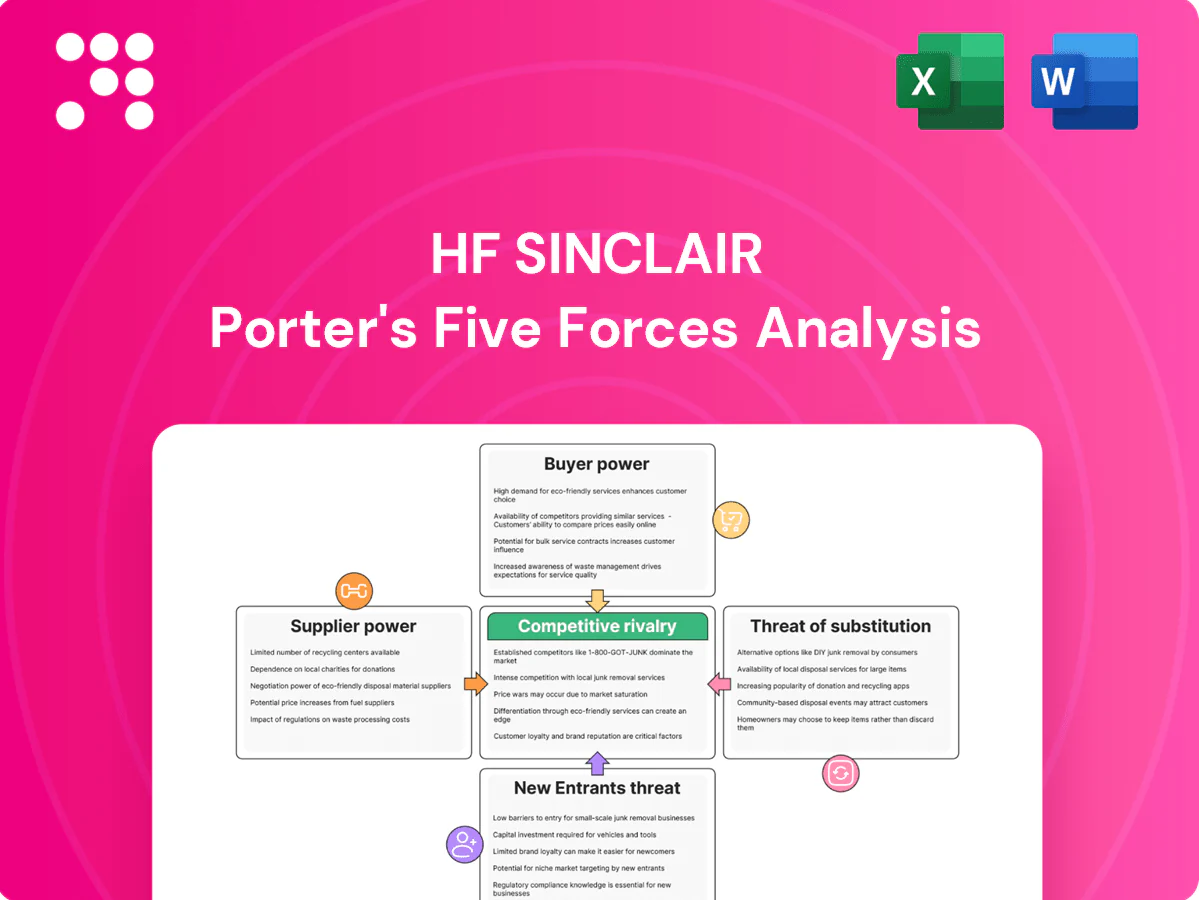
HF Sinclair Porter's Five Forces Analysis

Go Beyond the Preview—Access the Full Strategic Report
HF Sinclair faces intense supplier bargaining, moderate buyer pressure, high capital barriers to entry, shifting substitute risks, and rivalry driven by refining margins and feedstock volatility. This snapshot highlights key tensions and strategic levers. Unlock the full Porter's Five Forces Analysis for force-by-force ratings, visuals, and actionable insights to inform investment or strategy decisions.
Suppliers Bargaining Power

Diverse crude and feedstock sources
HF Sinclair sources crude, NGLs and bio-feedstocks from multiple domestic and global producers, reducing single-supplier leverage and allowing slate shifts based on price differentials. Global and U.S. sourcing flexibility helped manage margin volatility in 2024, but OPEC+ supply discipline (≈2.2 million b/d cuts since 2022) and geopolitical shocks pushed up feedstock costs. Long-haul logistics bottlenecks still raise delivered costs in specific regions.
Renewable diesel feedstock tightness
Used cooking oil, tallow and soybean oil markets are structurally tight in 2024, boosting supplier bargaining power as feedstock availability lags expanding demand for renewable diesel and SAF. LCFS and RIN dynamics have amplified feedstock price spikes and margin compression, with D4 RINs trading above $1/gal in 2023–24 and California LCFS credits near multi-hundred-dollar levels. Long-term offtakes and in-house pre-treatment capacity partially mitigate supply risk. Intensifying competition from other RD and SAF projects further tightens feedstock access.

Critical inputs and services
Critical inputs such as catalysts, specialty chemicals, hydrogen and turnaround services are supplied by a concentrated set of niche vendors, giving suppliers leverage through certification and high switching costs. HF Sinclair mitigates this via multi-year contracts and dual-sourcing where feasible, while on-site hydrogen production or long-term gas contracts reduce price volatility but do not remove supply risk entirely.

Midstream integration and logistics
Midstream integration and ownership of pipelines and terminals reduce HF Sinclair's reliance on third-party logistics, lowering take-or-pay exposure and intermediary fees and improving crude optionality and product offtake reliability in 2024.
Regulated tariff frameworks and necessary third-party interconnects still can affect delivered costs and timing despite owned logistics in 2024.
- Lower take-or-pay exposure
- Improved crude optionality
- Higher offtake reliability
- Regulated tariffs/third-party interconnect risk
Energy and utility exposure
- Natural gas price volatility: H1 2024 ~3.00 USD/MMBtu
- Industrial power rates: ~7–8 cents/kWh (2024)
- Hedging limits spillover risk but not supply interruption impact
Diversified sourcing limits supplier leverage amid OPEC+ cuts and tight RD feedstocks
HF Sinclair's diversified crude/NGL/bio-feedstock sourcing and midstream ownership limit supplier leverage, but OPEC+ cuts (≈2.2m b/d) and logistics bottlenecks raise feedstock costs. Renewable diesel feedstocks are tight in 2024, D4 RINs >1 USD/gal and CA LCFS credits in the low hundreds, increasing supplier power. Catalysts, hydrogen and turnaround services remain concentrated vendors, partially mitigated by contracts and hedges.
| Metric | 2024 |
|---|---|
| OPEC+ cuts | ≈2.2m b/d since 2022 |
| D4 RINs | >1 USD/gal |
| CA LCFS | ~100s USD/MT |
| HH gas H1 | ~3.00 USD/MMBtu |
| Industrial power | ~7–8¢/kWh |
What is included in the product
 Detailed Word Document
Tailored Porter's Five Forces analysis for HF Sinclair that uncovers key competitive drivers, evaluates supplier and buyer power and pricing influence, identifies disruptive threats and substitutes, and assesses barriers to entry and competitive intensity within its refining and midstream value chains.

 Customizable Excel Spreadsheet
A clear one-sheet summary of HF Sinclair's five competitive forces—ideal for quick strategic decisions; swap in current crude differentials, refining margins, feedstock risk, regulatory shifts and downstream/offtake dynamics to reflect evolving energy-market pressures.
Customers Bargaining Power

Commodity products and easy switching
Gasoline, diesel and jet are highly standardized, giving buyers many alternatives and strengthening buyer leverage; U.S. retail gasoline averaged about $3.50/gal in 2024 (EIA), underscoring tight price sensitivity. Price transparency via apps and exchanges reduces differentiation and raises switching incentives. Branded contracts provide volume but rarely fully lock demand. Buyers arbitrage regional spreads through logistics and rack purchases.
Concentrated large buyers
Airlines, large retailers and wholesalers leverage scale to extract volume discounts and favorable terms; major US carriers account for over two-thirds of domestic traffic (Bureau of Transportation Statistics 2023), enabling tough competitive bidding and multi-supplier portfolios. Supply reliability and tight quality specs limit product differentiation, keeping switching costs low. Contract lengths typically run 1–5 years and take-or-pay clauses temper but do not eliminate buyer power.

Export markets and optionality
Access to Latin American and global markets broadens HF Sinclair's buyer base and adds optionality, with U.S. refined product exports remaining near record highs in 2024 per the U.S. EIA. Exports can absorb domestic cracks but seaborne buyers compare global suppliers, keeping refinery margins compressed. Freight costs and voyage timing—which swung regional netbacks in 2024—can materially shift buyer leverage and netbacks.

ESG and low-carbon preferences
Buyers increasingly demand renewable diesel and low-carbon fuels to meet mandates, creating price premia—renewable diesel averaged a roughly $0.60/gal premium vs ULSD in 2024—while imposing strict specs that raise switching costs and drive supplier qualification.
Credits pass-through (D4 RINs ~ $1.30/gal and CA LCFS ~ $140/MTCO2e in 2024) complicate negotiations and can erode realized margins; intense buyer scrutiny on carbon intensity can reallocate contracts to lower-CI competitors.
Specialty lubes and chemicals
Specialty lubes and chemicals carry higher switching costs and strict performance specs, so technical service and formulation lock-in materially reduce buyer power while preserving premium pricing. Large OEMs and industrials still negotiate volume and contract terms, exerting pressure on margins. Niche substitutes limit pricing elasticity, capping upside for suppliers.
- High switching costs
- Formulation lock-in
- OEM volume leverage
- Substitute-driven price cap
Buyers' leverage compresses margins: commodity fuels, big carriers & price transparency
Buyers exert strong leverage: standardized fuels, price transparency and big buyers (major US carriers >66% domestic traffic 2023) depress margins; retail gasoline ~$3.50/gal (EIA 2024). Renewable diesel premium ~$0.60/gal; D4 RINs ~$1.30/gal; CA LCFS ~$140/MTCO2e (2024). Specialty lubes retain higher switching costs and premiums.
| Metric | 2024 |
|---|---|
| Gasoline | $3.50/gal |
| RD premium | $0.60/gal |
Preview Before You Purchase
HF Sinclair Porter's Five Forces Analysis
This preview shows the exact HF Sinclair Porter's Five Forces Analysis you'll receive immediately after purchase—no surprises or placeholders. It is the complete, professionally formatted file ready for download and use. You'll get instant access to this same document upon payment.

Go Beyond the Preview—Access the Full Strategic Report
HF Sinclair faces intense supplier bargaining, moderate buyer pressure, high capital barriers to entry, shifting substitute risks, and rivalry driven by refining margins and feedstock volatility. This snapshot highlights key tensions and strategic levers. Unlock the full Porter's Five Forces Analysis for force-by-force ratings, visuals, and actionable insights to inform investment or strategy decisions.
Suppliers Bargaining Power
Diverse crude and feedstock sources
HF Sinclair sources crude, NGLs and bio-feedstocks from multiple domestic and global producers, reducing single-supplier leverage and allowing slate shifts based on price differentials. Global and U.S. sourcing flexibility helped manage margin volatility in 2024, but OPEC+ supply discipline (≈2.2 million b/d cuts since 2022) and geopolitical shocks pushed up feedstock costs. Long-haul logistics bottlenecks still raise delivered costs in specific regions.
Renewable diesel feedstock tightness
Used cooking oil, tallow and soybean oil markets are structurally tight in 2024, boosting supplier bargaining power as feedstock availability lags expanding demand for renewable diesel and SAF. LCFS and RIN dynamics have amplified feedstock price spikes and margin compression, with D4 RINs trading above $1/gal in 2023–24 and California LCFS credits near multi-hundred-dollar levels. Long-term offtakes and in-house pre-treatment capacity partially mitigate supply risk. Intensifying competition from other RD and SAF projects further tightens feedstock access.
Critical inputs and services
Critical inputs such as catalysts, specialty chemicals, hydrogen and turnaround services are supplied by a concentrated set of niche vendors, giving suppliers leverage through certification and high switching costs. HF Sinclair mitigates this via multi-year contracts and dual-sourcing where feasible, while on-site hydrogen production or long-term gas contracts reduce price volatility but do not remove supply risk entirely.
Midstream integration and logistics
Midstream integration and ownership of pipelines and terminals reduce HF Sinclair's reliance on third-party logistics, lowering take-or-pay exposure and intermediary fees and improving crude optionality and product offtake reliability in 2024.
Regulated tariff frameworks and necessary third-party interconnects still can affect delivered costs and timing despite owned logistics in 2024.
- Lower take-or-pay exposure
- Improved crude optionality
- Higher offtake reliability
- Regulated tariffs/third-party interconnect risk
Energy and utility exposure
- Natural gas price volatility: H1 2024 ~3.00 USD/MMBtu
- Industrial power rates: ~7–8 cents/kWh (2024)
- Hedging limits spillover risk but not supply interruption impact
Diversified sourcing limits supplier leverage amid OPEC+ cuts and tight RD feedstocks
HF Sinclair's diversified crude/NGL/bio-feedstock sourcing and midstream ownership limit supplier leverage, but OPEC+ cuts (≈2.2m b/d) and logistics bottlenecks raise feedstock costs. Renewable diesel feedstocks are tight in 2024, D4 RINs >1 USD/gal and CA LCFS credits in the low hundreds, increasing supplier power. Catalysts, hydrogen and turnaround services remain concentrated vendors, partially mitigated by contracts and hedges.
| Metric | 2024 |
|---|---|
| OPEC+ cuts | ≈2.2m b/d since 2022 |
| D4 RINs | >1 USD/gal |
| CA LCFS | ~100s USD/MT |
| HH gas H1 | ~3.00 USD/MMBtu |
| Industrial power | ~7–8¢/kWh |
What is included in the product
Detailed Word Document
Tailored Porter's Five Forces analysis for HF Sinclair that uncovers key competitive drivers, evaluates supplier and buyer power and pricing influence, identifies disruptive threats and substitutes, and assesses barriers to entry and competitive intensity within its refining and midstream value chains.
Customizable Excel Spreadsheet
A clear one-sheet summary of HF Sinclair's five competitive forces—ideal for quick strategic decisions; swap in current crude differentials, refining margins, feedstock risk, regulatory shifts and downstream/offtake dynamics to reflect evolving energy-market pressures.
Customers Bargaining Power
Commodity products and easy switching
Gasoline, diesel and jet are highly standardized, giving buyers many alternatives and strengthening buyer leverage; U.S. retail gasoline averaged about $3.50/gal in 2024 (EIA), underscoring tight price sensitivity. Price transparency via apps and exchanges reduces differentiation and raises switching incentives. Branded contracts provide volume but rarely fully lock demand. Buyers arbitrage regional spreads through logistics and rack purchases.
Concentrated large buyers
Airlines, large retailers and wholesalers leverage scale to extract volume discounts and favorable terms; major US carriers account for over two-thirds of domestic traffic (Bureau of Transportation Statistics 2023), enabling tough competitive bidding and multi-supplier portfolios. Supply reliability and tight quality specs limit product differentiation, keeping switching costs low. Contract lengths typically run 1–5 years and take-or-pay clauses temper but do not eliminate buyer power.
Export markets and optionality
Access to Latin American and global markets broadens HF Sinclair's buyer base and adds optionality, with U.S. refined product exports remaining near record highs in 2024 per the U.S. EIA. Exports can absorb domestic cracks but seaborne buyers compare global suppliers, keeping refinery margins compressed. Freight costs and voyage timing—which swung regional netbacks in 2024—can materially shift buyer leverage and netbacks.
ESG and low-carbon preferences
Buyers increasingly demand renewable diesel and low-carbon fuels to meet mandates, creating price premia—renewable diesel averaged a roughly $0.60/gal premium vs ULSD in 2024—while imposing strict specs that raise switching costs and drive supplier qualification.
Credits pass-through (D4 RINs ~ $1.30/gal and CA LCFS ~ $140/MTCO2e in 2024) complicate negotiations and can erode realized margins; intense buyer scrutiny on carbon intensity can reallocate contracts to lower-CI competitors.
Specialty lubes and chemicals
Specialty lubes and chemicals carry higher switching costs and strict performance specs, so technical service and formulation lock-in materially reduce buyer power while preserving premium pricing. Large OEMs and industrials still negotiate volume and contract terms, exerting pressure on margins. Niche substitutes limit pricing elasticity, capping upside for suppliers.
- High switching costs
- Formulation lock-in
- OEM volume leverage
- Substitute-driven price cap
Buyers' leverage compresses margins: commodity fuels, big carriers & price transparency
Buyers exert strong leverage: standardized fuels, price transparency and big buyers (major US carriers >66% domestic traffic 2023) depress margins; retail gasoline ~$3.50/gal (EIA 2024). Renewable diesel premium ~$0.60/gal; D4 RINs ~$1.30/gal; CA LCFS ~$140/MTCO2e (2024). Specialty lubes retain higher switching costs and premiums.
| Metric | 2024 |
|---|---|
| Gasoline | $3.50/gal |
| RD premium | $0.60/gal |
Preview Before You Purchase
HF Sinclair Porter's Five Forces Analysis
This preview shows the exact HF Sinclair Porter's Five Forces Analysis you'll receive immediately after purchase—no surprises or placeholders. It is the complete, professionally formatted file ready for download and use. You'll get instant access to this same document upon payment.
Original: $10.00
-65%$10.00
$3.50Description
Go Beyond the Preview—Access the Full Strategic Report
HF Sinclair faces intense supplier bargaining, moderate buyer pressure, high capital barriers to entry, shifting substitute risks, and rivalry driven by refining margins and feedstock volatility. This snapshot highlights key tensions and strategic levers. Unlock the full Porter's Five Forces Analysis for force-by-force ratings, visuals, and actionable insights to inform investment or strategy decisions.
Suppliers Bargaining Power
Diverse crude and feedstock sources
HF Sinclair sources crude, NGLs and bio-feedstocks from multiple domestic and global producers, reducing single-supplier leverage and allowing slate shifts based on price differentials. Global and U.S. sourcing flexibility helped manage margin volatility in 2024, but OPEC+ supply discipline (≈2.2 million b/d cuts since 2022) and geopolitical shocks pushed up feedstock costs. Long-haul logistics bottlenecks still raise delivered costs in specific regions.
Renewable diesel feedstock tightness
Used cooking oil, tallow and soybean oil markets are structurally tight in 2024, boosting supplier bargaining power as feedstock availability lags expanding demand for renewable diesel and SAF. LCFS and RIN dynamics have amplified feedstock price spikes and margin compression, with D4 RINs trading above $1/gal in 2023–24 and California LCFS credits near multi-hundred-dollar levels. Long-term offtakes and in-house pre-treatment capacity partially mitigate supply risk. Intensifying competition from other RD and SAF projects further tightens feedstock access.
Critical inputs and services
Critical inputs such as catalysts, specialty chemicals, hydrogen and turnaround services are supplied by a concentrated set of niche vendors, giving suppliers leverage through certification and high switching costs. HF Sinclair mitigates this via multi-year contracts and dual-sourcing where feasible, while on-site hydrogen production or long-term gas contracts reduce price volatility but do not remove supply risk entirely.
Midstream integration and logistics
Midstream integration and ownership of pipelines and terminals reduce HF Sinclair's reliance on third-party logistics, lowering take-or-pay exposure and intermediary fees and improving crude optionality and product offtake reliability in 2024.
Regulated tariff frameworks and necessary third-party interconnects still can affect delivered costs and timing despite owned logistics in 2024.
- Lower take-or-pay exposure
- Improved crude optionality
- Higher offtake reliability
- Regulated tariffs/third-party interconnect risk
Energy and utility exposure
- Natural gas price volatility: H1 2024 ~3.00 USD/MMBtu
- Industrial power rates: ~7–8 cents/kWh (2024)
- Hedging limits spillover risk but not supply interruption impact
Diversified sourcing limits supplier leverage amid OPEC+ cuts and tight RD feedstocks
HF Sinclair's diversified crude/NGL/bio-feedstock sourcing and midstream ownership limit supplier leverage, but OPEC+ cuts (≈2.2m b/d) and logistics bottlenecks raise feedstock costs. Renewable diesel feedstocks are tight in 2024, D4 RINs >1 USD/gal and CA LCFS credits in the low hundreds, increasing supplier power. Catalysts, hydrogen and turnaround services remain concentrated vendors, partially mitigated by contracts and hedges.
| Metric | 2024 |
|---|---|
| OPEC+ cuts | ≈2.2m b/d since 2022 |
| D4 RINs | >1 USD/gal |
| CA LCFS | ~100s USD/MT |
| HH gas H1 | ~3.00 USD/MMBtu |
| Industrial power | ~7–8¢/kWh |
What is included in the product
Detailed Word Document
Tailored Porter's Five Forces analysis for HF Sinclair that uncovers key competitive drivers, evaluates supplier and buyer power and pricing influence, identifies disruptive threats and substitutes, and assesses barriers to entry and competitive intensity within its refining and midstream value chains.
Customizable Excel Spreadsheet
A clear one-sheet summary of HF Sinclair's five competitive forces—ideal for quick strategic decisions; swap in current crude differentials, refining margins, feedstock risk, regulatory shifts and downstream/offtake dynamics to reflect evolving energy-market pressures.
Customers Bargaining Power
Commodity products and easy switching
Gasoline, diesel and jet are highly standardized, giving buyers many alternatives and strengthening buyer leverage; U.S. retail gasoline averaged about $3.50/gal in 2024 (EIA), underscoring tight price sensitivity. Price transparency via apps and exchanges reduces differentiation and raises switching incentives. Branded contracts provide volume but rarely fully lock demand. Buyers arbitrage regional spreads through logistics and rack purchases.
Concentrated large buyers
Airlines, large retailers and wholesalers leverage scale to extract volume discounts and favorable terms; major US carriers account for over two-thirds of domestic traffic (Bureau of Transportation Statistics 2023), enabling tough competitive bidding and multi-supplier portfolios. Supply reliability and tight quality specs limit product differentiation, keeping switching costs low. Contract lengths typically run 1–5 years and take-or-pay clauses temper but do not eliminate buyer power.
Export markets and optionality
Access to Latin American and global markets broadens HF Sinclair's buyer base and adds optionality, with U.S. refined product exports remaining near record highs in 2024 per the U.S. EIA. Exports can absorb domestic cracks but seaborne buyers compare global suppliers, keeping refinery margins compressed. Freight costs and voyage timing—which swung regional netbacks in 2024—can materially shift buyer leverage and netbacks.
ESG and low-carbon preferences
Buyers increasingly demand renewable diesel and low-carbon fuels to meet mandates, creating price premia—renewable diesel averaged a roughly $0.60/gal premium vs ULSD in 2024—while imposing strict specs that raise switching costs and drive supplier qualification.
Credits pass-through (D4 RINs ~ $1.30/gal and CA LCFS ~ $140/MTCO2e in 2024) complicate negotiations and can erode realized margins; intense buyer scrutiny on carbon intensity can reallocate contracts to lower-CI competitors.
Specialty lubes and chemicals
Specialty lubes and chemicals carry higher switching costs and strict performance specs, so technical service and formulation lock-in materially reduce buyer power while preserving premium pricing. Large OEMs and industrials still negotiate volume and contract terms, exerting pressure on margins. Niche substitutes limit pricing elasticity, capping upside for suppliers.
- High switching costs
- Formulation lock-in
- OEM volume leverage
- Substitute-driven price cap
Buyers' leverage compresses margins: commodity fuels, big carriers & price transparency
Buyers exert strong leverage: standardized fuels, price transparency and big buyers (major US carriers >66% domestic traffic 2023) depress margins; retail gasoline ~$3.50/gal (EIA 2024). Renewable diesel premium ~$0.60/gal; D4 RINs ~$1.30/gal; CA LCFS ~$140/MTCO2e (2024). Specialty lubes retain higher switching costs and premiums.
| Metric | 2024 |
|---|---|
| Gasoline | $3.50/gal |
| RD premium | $0.60/gal |
Preview Before You Purchase
HF Sinclair Porter's Five Forces Analysis
This preview shows the exact HF Sinclair Porter's Five Forces Analysis you'll receive immediately after purchase—no surprises or placeholders. It is the complete, professionally formatted file ready for download and use. You'll get instant access to this same document upon payment.











