Hiramatsu PESTLE Analysis

Skip the Research. Get the Strategy.
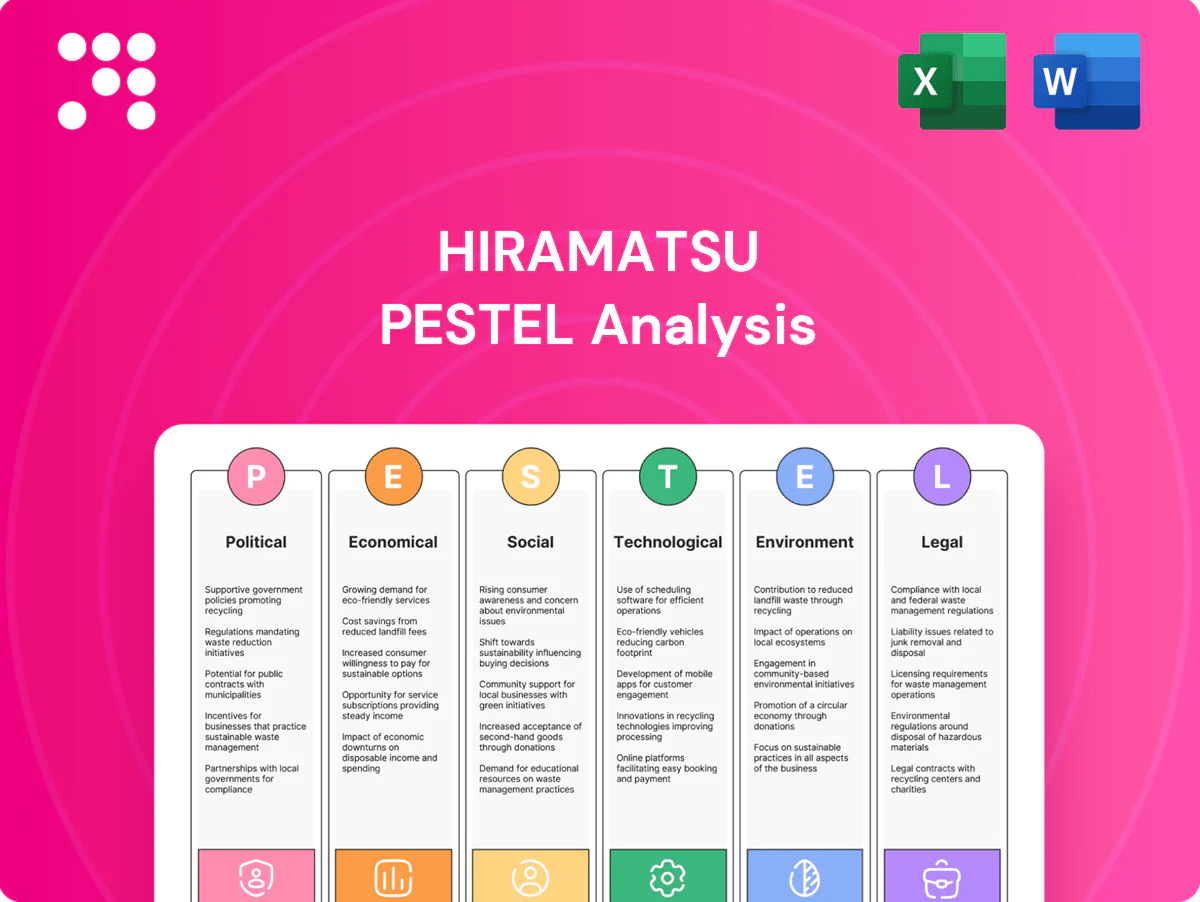
Discover how political shifts, economic trends, social dynamics, technological advances, legal changes, and environmental risks are shaping Hiramatsu’s future with our concise PESTLE overview. This snapshot highlights key external forces and strategic implications for investors and managers. Purchase the full PESTLE analysis to access detailed findings, scenarios, and actionable recommendations ready for immediate use.
Political factors

Government tourism policy and incentives
Inbound-promotion and event policies directly drive luxury hotel and restaurant occupancy; JNTO reported arrivals recovered to roughly 80% of 2019 levels by 2023, and central/local tourism budgets expanded in 2024 to accelerate demand. Subsidies and travel campaigns historically lift fine-dining and wedding bookings by double digits during campaign months, while municipal grants for cultural projects (multi‑billion yen programs) enhance destination appeal; Hiramatsu can time openings and marketing to these policy windows.
Food and wine import regulations
Tariffs, quotas and sanitary inspections shape menu authenticity and cost, especially for European wines, cheeses and specialty ingredients. The EU–Japan Economic Partnership Agreement, effective 1 February 2019, removed tariffs on most EU wines while some dairy tariff‑rate quotas remain. MAFF sanitary checks can add days to delivery timelines. Compliance planning, diversified import partners and strategic inventory buffers reduce disruption risk.

Urban planning and zoning approvals
Iconic architectural venues require permits, heritage approvals and neighborhood consultations; municipal planning approvals in Japan commonly span 2–6 months. Zoning limits on late-night operations, signage and event noise affect weddings and catering logistics, with national environmental noise standards often 45 dB at night in residential zones. Early engagement with municipalities shortens review cycles, and adaptive design aligns brand aesthetics with regulatory constraints.

Public health preparedness and guidelines
Policy responses to health crises can force seating caps and event-size limits that cut venue revenues; the global wedding market, estimated around $300 billion in 2023, saw sharp margin pressure during earlier COVID restrictions. Clear contingency plans and tiered pricing enabled many venues to sustain bookings under shifting rules. Investments in ventilation and certification (e.g., HVAC upgrades) create political-compliance advantages and preserve guest trust.
- capacity caps: e.g., 50% limits halve seating revenue risk
- contingency plans: rapid contract clauses reduce cancellations
- ventilation spend: upgrades often qualify for compliance grants
- transparent communication: maintains booking continuity and trust
Labor and immigration policy
Restrictions or facilitation of hospitality visas (eg H-2B cap 66,000 in the US) directly shape chef talent pipelines for French and Italian cuisine, tightening access to specialist hires when caps bind. Wage support programs and training subsidies reduce net staffing costs and speed up onboarding, while regional labor incentives spur hotel expansion into incentivized zones. Partnerships with culinary schools align recruitment to policy-driven talent flows.
- visa-impact: H-2B cap 66,000 (US)
- wage-support: reduces employer payroll burden
- regional-incentives: drive hotel CAPEX
- culinary-partnerships: secure specialized chefs
Japan tourism rebound lifts luxury bookings; EPA, sanitary rules, permits and H-2B caps bite
Inbound-promotion and expanded 2024 tourism budgets lifted occupancy; JNTO reported ~28.7M arrivals in 2023 (~80% of 2019), aiding luxury bookings. Trade rules (EU–Japan EPA since 2019) and MAFF sanitary checks affect import timing and costs. Permits/zoning review 2–6 months and 45 dB night noise limits constrain venue design; visa caps (H‑2B 66,000) tighten specialist hiring.
| Metric | Value |
|---|---|
| JNTO arrivals 2023 | 28.7M (~80% of 2019) |
| EU–Japan EPA | Effective 1 Feb 2019 |
| Permit review | 2–6 months |
| Night noise | ~45 dB |
| H‑2B cap (US) | 66,000 |
What is included in the product
 Detailed Word Document
Explores how Political, Economic, Social, Technological, Environmental, and Legal forces uniquely impact Hiramatsu, combining data-driven trends and regional regulatory context to highlight risks and opportunities; designed for executives and investors to inform strategy and scenario planning.

 Customizable Excel Spreadsheet
A concise, visually segmented Hiramatsu PESTLE summary that’s easy to drop into presentations, editable for local context, and written in plain language to speed team alignment and risk discussions.
Economic factors

Disposable income and luxury demand cycles
High-end dining and boutique stays are highly sensitive to income growth and consumer confidence; the global personal luxury goods market reached about €353 billion in 2023 (Bain 2024), reflecting strong discretionary spending tails. Economic slowdowns typically shift guests toward affordable options and smaller weddings, compressing average spend per booking. Counter-cyclical tasting menus, tiered packages and dynamic pricing — revenue management tests report yield gains of roughly 8–12% — smooth revenue across seasons.
Exchange rates and import costs
Yen swings—USD/JPY trading roughly 145–155 and EUR/JPY 160–175 in 2024—raise costs for imported wines and premium ingredients; 2024 volatility moved JPY ~12% vs USD, often compressing margins 2–5% or forcing 3–8% menu price adjustments. Hedging and multi-sourcing (regional suppliers, bulk forwards) stabilize COGS, while targeted menu engineering preserves margins without diluting Hiramatsu’s premium positioning.

Inflation and operating cost pressures
Rising utilities, food and linen costs squeeze fine-dining margins as Japan's CPI averaged about 3.2% in 2024 and food prices rose roughly 4.5% YoY; hotel housekeeping and amenity expenses rose with wages up ~3.3% in 2024. Productivity tools and supplier renegotiations have cut unit costs, while curated value-added experiences support a 5–10% price premium to protect profitability.

Interest rates and capex for venues
Architecturally distinctive Hiramatsu venues require high upfront capex, increasing sensitivity to financing costs as global policy rates rose (US Fed funds ~5.25–5.50% in 2024–25) while 10y JGBs traded near 0.6–0.9% in mid‑2025, raising hurdle rates for new sites; phased development and asset‑light partner models cut capital intensity, and sale‑leasebacks/long leases preserve balance sheet flexibility.
- Higher rates: raises financing cost and required returns
- Phased dev: reduces peak capex
- Asset‑light: JV/management contracts lower balance sheet exposure
- Lease/sale‑leaseback: improves liquidity and gearing
Tourism flows and seasonality
Inbound travel recovery (UNWTO: international arrivals ~95% of 2019 levels in 2024) drives Hiramatsu occupancy and banquet bookings, while event calendars and peak seasons (cherry blossom, year-end, wedding season) create staffing and supply cost spikes; packaging dining with stays and weddings smooths seasonality and cultivating local demand lowers reliance on travel shocks.
- Inbound rebound: ~95% of 2019 (UNWTO 2024)
- Packages: higher weekday banquet yield
- Local demand: reduces travel-sensitivity
Japan tourism rebound lifts luxury bookings; EPA, sanitary rules, permits and H-2B caps bite
High-end demand ties to disposable income; global personal luxury goods €353bn (2023) supports premium pricing but downturns compress spend. USD/JPY 145–155 (2024) and JPY ~12% 2024 volatility raise COGS; CPI 3.2% and wages +3.3% (2024) squeeze margins. Higher rates lift capex hurdle; inbound arrivals ~95% of 2019 boost occupancy.
| Metric | Value | Impact |
|---|---|---|
| Luxury market | €353bn (2023) | Supports pricing |
| USD/JPY | 145–155 (2024) | Higher import cost |
| CPI/Wages | 3.2% / 3.3% (2024) | Margin pressure |
| Inbound | ~95% of 2019 (2024) | Demand recovery |
What You See Is What You Get
Hiramatsu PESTLE Analysis
The Hiramatsu PESTLE Analysis preview shown here is the exact document you’ll receive after purchase—fully formatted and ready to use. This real file contains the complete political, economic, social, technological, legal, and environmental assessment as displayed. No placeholders or surprises; download the same finished report immediately after checkout.

Skip the Research. Get the Strategy.
Discover how political shifts, economic trends, social dynamics, technological advances, legal changes, and environmental risks are shaping Hiramatsu’s future with our concise PESTLE overview. This snapshot highlights key external forces and strategic implications for investors and managers. Purchase the full PESTLE analysis to access detailed findings, scenarios, and actionable recommendations ready for immediate use.
Political factors
Government tourism policy and incentives
Inbound-promotion and event policies directly drive luxury hotel and restaurant occupancy; JNTO reported arrivals recovered to roughly 80% of 2019 levels by 2023, and central/local tourism budgets expanded in 2024 to accelerate demand. Subsidies and travel campaigns historically lift fine-dining and wedding bookings by double digits during campaign months, while municipal grants for cultural projects (multi‑billion yen programs) enhance destination appeal; Hiramatsu can time openings and marketing to these policy windows.
Food and wine import regulations
Tariffs, quotas and sanitary inspections shape menu authenticity and cost, especially for European wines, cheeses and specialty ingredients. The EU–Japan Economic Partnership Agreement, effective 1 February 2019, removed tariffs on most EU wines while some dairy tariff‑rate quotas remain. MAFF sanitary checks can add days to delivery timelines. Compliance planning, diversified import partners and strategic inventory buffers reduce disruption risk.
Urban planning and zoning approvals
Iconic architectural venues require permits, heritage approvals and neighborhood consultations; municipal planning approvals in Japan commonly span 2–6 months. Zoning limits on late-night operations, signage and event noise affect weddings and catering logistics, with national environmental noise standards often 45 dB at night in residential zones. Early engagement with municipalities shortens review cycles, and adaptive design aligns brand aesthetics with regulatory constraints.
Public health preparedness and guidelines
Policy responses to health crises can force seating caps and event-size limits that cut venue revenues; the global wedding market, estimated around $300 billion in 2023, saw sharp margin pressure during earlier COVID restrictions. Clear contingency plans and tiered pricing enabled many venues to sustain bookings under shifting rules. Investments in ventilation and certification (e.g., HVAC upgrades) create political-compliance advantages and preserve guest trust.
- capacity caps: e.g., 50% limits halve seating revenue risk
- contingency plans: rapid contract clauses reduce cancellations
- ventilation spend: upgrades often qualify for compliance grants
- transparent communication: maintains booking continuity and trust
Labor and immigration policy
Restrictions or facilitation of hospitality visas (eg H-2B cap 66,000 in the US) directly shape chef talent pipelines for French and Italian cuisine, tightening access to specialist hires when caps bind. Wage support programs and training subsidies reduce net staffing costs and speed up onboarding, while regional labor incentives spur hotel expansion into incentivized zones. Partnerships with culinary schools align recruitment to policy-driven talent flows.
- visa-impact: H-2B cap 66,000 (US)
- wage-support: reduces employer payroll burden
- regional-incentives: drive hotel CAPEX
- culinary-partnerships: secure specialized chefs
Japan tourism rebound lifts luxury bookings; EPA, sanitary rules, permits and H-2B caps bite
Inbound-promotion and expanded 2024 tourism budgets lifted occupancy; JNTO reported ~28.7M arrivals in 2023 (~80% of 2019), aiding luxury bookings. Trade rules (EU–Japan EPA since 2019) and MAFF sanitary checks affect import timing and costs. Permits/zoning review 2–6 months and 45 dB night noise limits constrain venue design; visa caps (H‑2B 66,000) tighten specialist hiring.
| Metric | Value |
|---|---|
| JNTO arrivals 2023 | 28.7M (~80% of 2019) |
| EU–Japan EPA | Effective 1 Feb 2019 |
| Permit review | 2–6 months |
| Night noise | ~45 dB |
| H‑2B cap (US) | 66,000 |
What is included in the product
Detailed Word Document
Explores how Political, Economic, Social, Technological, Environmental, and Legal forces uniquely impact Hiramatsu, combining data-driven trends and regional regulatory context to highlight risks and opportunities; designed for executives and investors to inform strategy and scenario planning.
Customizable Excel Spreadsheet
A concise, visually segmented Hiramatsu PESTLE summary that’s easy to drop into presentations, editable for local context, and written in plain language to speed team alignment and risk discussions.
Economic factors
Disposable income and luxury demand cycles
High-end dining and boutique stays are highly sensitive to income growth and consumer confidence; the global personal luxury goods market reached about €353 billion in 2023 (Bain 2024), reflecting strong discretionary spending tails. Economic slowdowns typically shift guests toward affordable options and smaller weddings, compressing average spend per booking. Counter-cyclical tasting menus, tiered packages and dynamic pricing — revenue management tests report yield gains of roughly 8–12% — smooth revenue across seasons.
Exchange rates and import costs
Yen swings—USD/JPY trading roughly 145–155 and EUR/JPY 160–175 in 2024—raise costs for imported wines and premium ingredients; 2024 volatility moved JPY ~12% vs USD, often compressing margins 2–5% or forcing 3–8% menu price adjustments. Hedging and multi-sourcing (regional suppliers, bulk forwards) stabilize COGS, while targeted menu engineering preserves margins without diluting Hiramatsu’s premium positioning.
Inflation and operating cost pressures
Rising utilities, food and linen costs squeeze fine-dining margins as Japan's CPI averaged about 3.2% in 2024 and food prices rose roughly 4.5% YoY; hotel housekeeping and amenity expenses rose with wages up ~3.3% in 2024. Productivity tools and supplier renegotiations have cut unit costs, while curated value-added experiences support a 5–10% price premium to protect profitability.
Interest rates and capex for venues
Architecturally distinctive Hiramatsu venues require high upfront capex, increasing sensitivity to financing costs as global policy rates rose (US Fed funds ~5.25–5.50% in 2024–25) while 10y JGBs traded near 0.6–0.9% in mid‑2025, raising hurdle rates for new sites; phased development and asset‑light partner models cut capital intensity, and sale‑leasebacks/long leases preserve balance sheet flexibility.
- Higher rates: raises financing cost and required returns
- Phased dev: reduces peak capex
- Asset‑light: JV/management contracts lower balance sheet exposure
- Lease/sale‑leaseback: improves liquidity and gearing
Tourism flows and seasonality
Inbound travel recovery (UNWTO: international arrivals ~95% of 2019 levels in 2024) drives Hiramatsu occupancy and banquet bookings, while event calendars and peak seasons (cherry blossom, year-end, wedding season) create staffing and supply cost spikes; packaging dining with stays and weddings smooths seasonality and cultivating local demand lowers reliance on travel shocks.
- Inbound rebound: ~95% of 2019 (UNWTO 2024)
- Packages: higher weekday banquet yield
- Local demand: reduces travel-sensitivity
Japan tourism rebound lifts luxury bookings; EPA, sanitary rules, permits and H-2B caps bite
High-end demand ties to disposable income; global personal luxury goods €353bn (2023) supports premium pricing but downturns compress spend. USD/JPY 145–155 (2024) and JPY ~12% 2024 volatility raise COGS; CPI 3.2% and wages +3.3% (2024) squeeze margins. Higher rates lift capex hurdle; inbound arrivals ~95% of 2019 boost occupancy.
| Metric | Value | Impact |
|---|---|---|
| Luxury market | €353bn (2023) | Supports pricing |
| USD/JPY | 145–155 (2024) | Higher import cost |
| CPI/Wages | 3.2% / 3.3% (2024) | Margin pressure |
| Inbound | ~95% of 2019 (2024) | Demand recovery |
What You See Is What You Get
Hiramatsu PESTLE Analysis
The Hiramatsu PESTLE Analysis preview shown here is the exact document you’ll receive after purchase—fully formatted and ready to use. This real file contains the complete political, economic, social, technological, legal, and environmental assessment as displayed. No placeholders or surprises; download the same finished report immediately after checkout.
Description
Skip the Research. Get the Strategy.
Discover how political shifts, economic trends, social dynamics, technological advances, legal changes, and environmental risks are shaping Hiramatsu’s future with our concise PESTLE overview. This snapshot highlights key external forces and strategic implications for investors and managers. Purchase the full PESTLE analysis to access detailed findings, scenarios, and actionable recommendations ready for immediate use.
Political factors
Government tourism policy and incentives
Inbound-promotion and event policies directly drive luxury hotel and restaurant occupancy; JNTO reported arrivals recovered to roughly 80% of 2019 levels by 2023, and central/local tourism budgets expanded in 2024 to accelerate demand. Subsidies and travel campaigns historically lift fine-dining and wedding bookings by double digits during campaign months, while municipal grants for cultural projects (multi‑billion yen programs) enhance destination appeal; Hiramatsu can time openings and marketing to these policy windows.
Food and wine import regulations
Tariffs, quotas and sanitary inspections shape menu authenticity and cost, especially for European wines, cheeses and specialty ingredients. The EU–Japan Economic Partnership Agreement, effective 1 February 2019, removed tariffs on most EU wines while some dairy tariff‑rate quotas remain. MAFF sanitary checks can add days to delivery timelines. Compliance planning, diversified import partners and strategic inventory buffers reduce disruption risk.
Urban planning and zoning approvals
Iconic architectural venues require permits, heritage approvals and neighborhood consultations; municipal planning approvals in Japan commonly span 2–6 months. Zoning limits on late-night operations, signage and event noise affect weddings and catering logistics, with national environmental noise standards often 45 dB at night in residential zones. Early engagement with municipalities shortens review cycles, and adaptive design aligns brand aesthetics with regulatory constraints.
Public health preparedness and guidelines
Policy responses to health crises can force seating caps and event-size limits that cut venue revenues; the global wedding market, estimated around $300 billion in 2023, saw sharp margin pressure during earlier COVID restrictions. Clear contingency plans and tiered pricing enabled many venues to sustain bookings under shifting rules. Investments in ventilation and certification (e.g., HVAC upgrades) create political-compliance advantages and preserve guest trust.
- capacity caps: e.g., 50% limits halve seating revenue risk
- contingency plans: rapid contract clauses reduce cancellations
- ventilation spend: upgrades often qualify for compliance grants
- transparent communication: maintains booking continuity and trust
Labor and immigration policy
Restrictions or facilitation of hospitality visas (eg H-2B cap 66,000 in the US) directly shape chef talent pipelines for French and Italian cuisine, tightening access to specialist hires when caps bind. Wage support programs and training subsidies reduce net staffing costs and speed up onboarding, while regional labor incentives spur hotel expansion into incentivized zones. Partnerships with culinary schools align recruitment to policy-driven talent flows.
- visa-impact: H-2B cap 66,000 (US)
- wage-support: reduces employer payroll burden
- regional-incentives: drive hotel CAPEX
- culinary-partnerships: secure specialized chefs
Japan tourism rebound lifts luxury bookings; EPA, sanitary rules, permits and H-2B caps bite
Inbound-promotion and expanded 2024 tourism budgets lifted occupancy; JNTO reported ~28.7M arrivals in 2023 (~80% of 2019), aiding luxury bookings. Trade rules (EU–Japan EPA since 2019) and MAFF sanitary checks affect import timing and costs. Permits/zoning review 2–6 months and 45 dB night noise limits constrain venue design; visa caps (H‑2B 66,000) tighten specialist hiring.
| Metric | Value |
|---|---|
| JNTO arrivals 2023 | 28.7M (~80% of 2019) |
| EU–Japan EPA | Effective 1 Feb 2019 |
| Permit review | 2–6 months |
| Night noise | ~45 dB |
| H‑2B cap (US) | 66,000 |
What is included in the product
Detailed Word Document
Explores how Political, Economic, Social, Technological, Environmental, and Legal forces uniquely impact Hiramatsu, combining data-driven trends and regional regulatory context to highlight risks and opportunities; designed for executives and investors to inform strategy and scenario planning.
Customizable Excel Spreadsheet
A concise, visually segmented Hiramatsu PESTLE summary that’s easy to drop into presentations, editable for local context, and written in plain language to speed team alignment and risk discussions.
Economic factors
Disposable income and luxury demand cycles
High-end dining and boutique stays are highly sensitive to income growth and consumer confidence; the global personal luxury goods market reached about €353 billion in 2023 (Bain 2024), reflecting strong discretionary spending tails. Economic slowdowns typically shift guests toward affordable options and smaller weddings, compressing average spend per booking. Counter-cyclical tasting menus, tiered packages and dynamic pricing — revenue management tests report yield gains of roughly 8–12% — smooth revenue across seasons.
Exchange rates and import costs
Yen swings—USD/JPY trading roughly 145–155 and EUR/JPY 160–175 in 2024—raise costs for imported wines and premium ingredients; 2024 volatility moved JPY ~12% vs USD, often compressing margins 2–5% or forcing 3–8% menu price adjustments. Hedging and multi-sourcing (regional suppliers, bulk forwards) stabilize COGS, while targeted menu engineering preserves margins without diluting Hiramatsu’s premium positioning.
Inflation and operating cost pressures
Rising utilities, food and linen costs squeeze fine-dining margins as Japan's CPI averaged about 3.2% in 2024 and food prices rose roughly 4.5% YoY; hotel housekeeping and amenity expenses rose with wages up ~3.3% in 2024. Productivity tools and supplier renegotiations have cut unit costs, while curated value-added experiences support a 5–10% price premium to protect profitability.
Interest rates and capex for venues
Architecturally distinctive Hiramatsu venues require high upfront capex, increasing sensitivity to financing costs as global policy rates rose (US Fed funds ~5.25–5.50% in 2024–25) while 10y JGBs traded near 0.6–0.9% in mid‑2025, raising hurdle rates for new sites; phased development and asset‑light partner models cut capital intensity, and sale‑leasebacks/long leases preserve balance sheet flexibility.
- Higher rates: raises financing cost and required returns
- Phased dev: reduces peak capex
- Asset‑light: JV/management contracts lower balance sheet exposure
- Lease/sale‑leaseback: improves liquidity and gearing
Tourism flows and seasonality
Inbound travel recovery (UNWTO: international arrivals ~95% of 2019 levels in 2024) drives Hiramatsu occupancy and banquet bookings, while event calendars and peak seasons (cherry blossom, year-end, wedding season) create staffing and supply cost spikes; packaging dining with stays and weddings smooths seasonality and cultivating local demand lowers reliance on travel shocks.
- Inbound rebound: ~95% of 2019 (UNWTO 2024)
- Packages: higher weekday banquet yield
- Local demand: reduces travel-sensitivity
Japan tourism rebound lifts luxury bookings; EPA, sanitary rules, permits and H-2B caps bite
High-end demand ties to disposable income; global personal luxury goods €353bn (2023) supports premium pricing but downturns compress spend. USD/JPY 145–155 (2024) and JPY ~12% 2024 volatility raise COGS; CPI 3.2% and wages +3.3% (2024) squeeze margins. Higher rates lift capex hurdle; inbound arrivals ~95% of 2019 boost occupancy.
| Metric | Value | Impact |
|---|---|---|
| Luxury market | €353bn (2023) | Supports pricing |
| USD/JPY | 145–155 (2024) | Higher import cost |
| CPI/Wages | 3.2% / 3.3% (2024) | Margin pressure |
| Inbound | ~95% of 2019 (2024) | Demand recovery |
What You See Is What You Get
Hiramatsu PESTLE Analysis
The Hiramatsu PESTLE Analysis preview shown here is the exact document you’ll receive after purchase—fully formatted and ready to use. This real file contains the complete political, economic, social, technological, legal, and environmental assessment as displayed. No placeholders or surprises; download the same finished report immediately after checkout.











