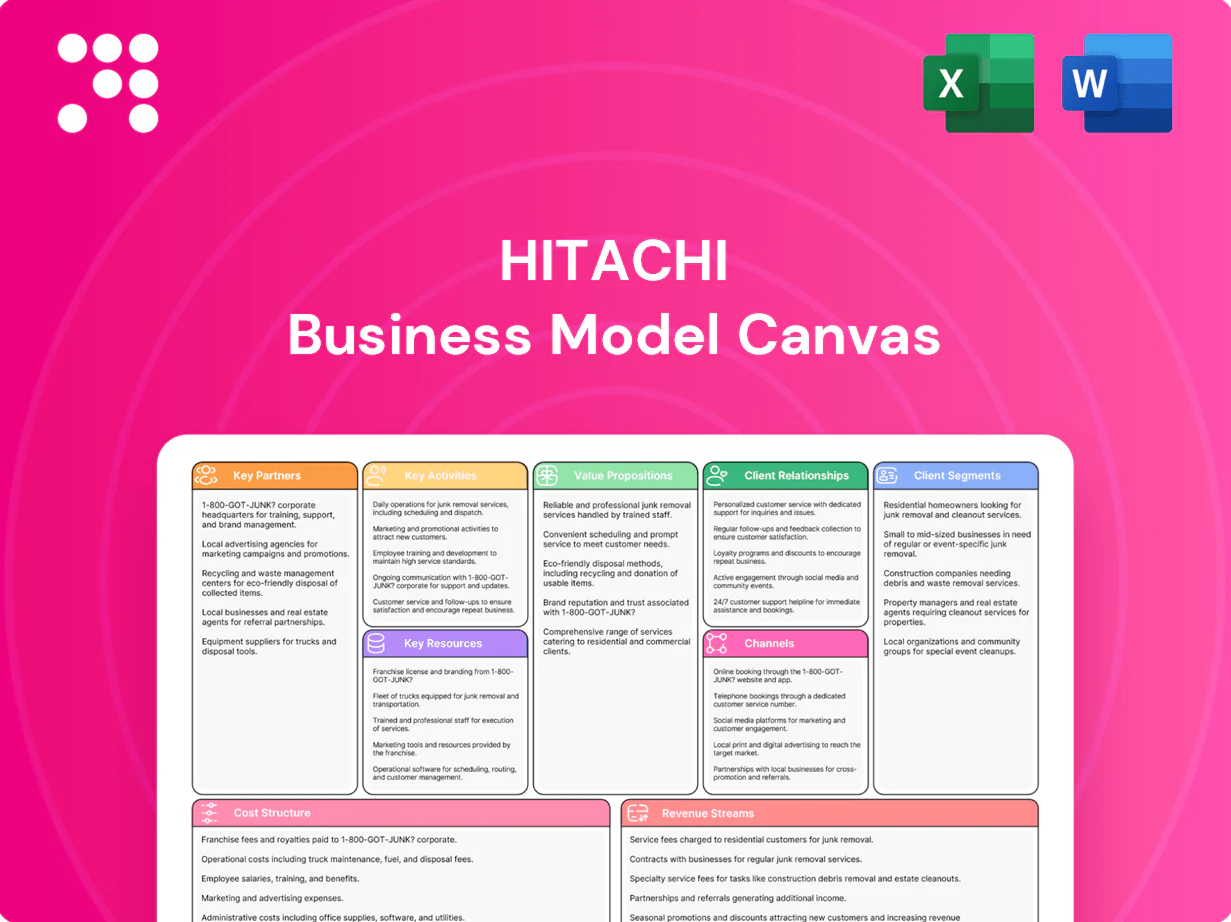
Hitachi Business Model Canvas

Unlock a strategic Business Model Canvas mapping value, partners and revenue streams
Discover Hitachi’s strategic engine with a concise Business Model Canvas that maps its value propositions, key partners, and revenue streams in one view; this snapshot uncovers how Hitachi scales innovation across sectors. Get the full, editable canvas to access detailed, company-specific insights and a ready-to-use template for benchmarking, strategy, or investor decks—purchase now to unlock the complete strategic blueprint.
Partnerships

Cloud & AI hyperscalers
Partnerships with AWS, Microsoft Azure and Google Cloud—which together held roughly 65% of the global cloud market in 2024—enable scalable data, AI and edge services that power Lumada and Hitachi industry platforms. Joint go-to-market and co-innovation shorten time-to-value, enhance interoperability and security, expand global reach, and ease migration of OT workloads into secure hybrid architectures.
Industrial & energy ecosystem
Alliances with utilities, OEMs, grid operators and standards bodies accelerate Hitachi’s energy-transition solutions, leveraging 2024 industry investment topping $1 trillion to scale deployments. Co-development with partners strengthens grid automation, storage and renewable integration, driving faster tech maturation. Shared pilots de-risk large capex programs and speed regulatory approvals, while interoperability frameworks ensure lifecycle support across brownfield assets.

System integrators & channel partners
Global SIs and regional VARs expand Hitachi delivery capacity and local compliance coverage, with Hitachi Vantara reporting over 2,000 channel partners in 2024 to broaden reach. They tailor sector-specific solutions and integrate with client legacy systems, enabling joint bids that materially boost success in large multi-year tenders. Partner enablement programs standardize skills and post-deployment support to protect service quality and renewal revenues.

Research institutions & startups
University labs and startups supply advanced analytics, robotics and materials innovations that feed Hitachi’s OT-IT convergence; open innovation hubs accelerate prototyping and market validation of integrated solutions. Equity investments and pilot programs secure access to cutting-edge IP and commercialization routes, while collaborations compress R&D cycles and broaden patent portfolios.
- Research partnerships: technology transfer
- Open hubs: faster prototyping
- Equity/pilots: access to IP
- Collaboration: shorter R&D, more patents
Public sector & mobility authorities
Partnerships with governments, rail operators and city agencies underpin multi-decade infrastructure programs; World Bank estimated global infrastructure needs at about 94 trillion USD for 2015–2030, underscoring scale for public-private collaboration. Public-private models align funding with societal outcomes while data-sharing agreements improve safety and operational efficiency; compliance alignment streamlines procurement and long-term service arrangements.
- Partners: governments, rail operators, city agencies
- Model: public-private funding tied to outcomes
- Data: shared for safer, more efficient mobility
- Compliance: streamlines procurement and long-term contracts
Cloud partners scale edge AI and OT-to-cloud amid $1T+ energy buildout, 2,000+ channels
Hitachi partners with AWS, Azure, Google Cloud (≈65% global cloud share in 2024) to scale Lumada and edge AI, accelerating OT-to-cloud migration. Utilities, OEMs and public agencies leverage $1T+ energy transition investment in 2024 for grid, storage and rail projects. 2,000+ channel partners (Hitachi Vantara 2024) expand delivery, while universities/startups supply IP via equity pilots.
| Partner Type | Role | 2024 Metric |
|---|---|---|
| Cloud | Scalability, security | ≈65% market share |
| Energy/Public | Infrastructure, funding | $1T+ investment |
| Channels | Delivery/localization | 2,000+ partners |
| R&D | IP, prototyping | Equity pilots |
What is included in the product
 Detailed Word Document
A comprehensive, pre-written Business Model Canvas for Hitachi that maps customer segments, value propositions, channels, revenue streams and key resources across the 9 classic BMC blocks. Tailored to real-world operations, it includes competitive-advantage analysis, SWOT-linked insights and a polished format for presentations, investor discussions and strategic decision-making.

 Customizable Excel Spreadsheet
High-level view of Hitachi’s business model with editable cells to quickly pinpoint operational bottlenecks and streamline strategic alignment for faster decision-making.
Activities

OT-IT integration & platforming
Designing and integrating control systems, edge devices and cloud analytics across industrial sites via Lumada ensures unified data flows and standardized APIs and data models. Lumada implementations align with cybersecurity and safety certifications such as ISO/IEC 27001 and IEC 62443 in regulated sectors. Architectures target resilient, scalable deployments with typical operational availability goals up to 99.999% for mission-critical operations.
Solution engineering & EPC delivery
End-to-end engineering, procurement and construction for energy, rail and industrial systems delivers turnkey projects often spanning >36 months and coordinating dozens of vendors and public stakeholders. Program management oversees multi-year deployments with phased milestones and strict uptime SLAs targeting 99.9% availability. Commissioning, testing and handover follow industrial protocols with performance guarantees; digital twins and analytics drive continuous improvement, cutting unplanned downtime by up to 30% in comparable deployments.

Software development & AI services
Building enterprise software, IoT applications and AI/ML models for predictive and prescriptive insights, delivered via Agile teams with DevSecOps and MLOps pipelines to shorten time-to-value and continuous releases. Model governance enforces transparency and compliance with evolving rules (eg EU AI Act), while managed services sustain feature rollout and ROI; IDC projected global AI systems spending at about $209.8B in 2024.

Lifecycle maintenance & managed services
Hitachi delivers lifecycle maintenance and managed services via remote monitoring, field service, spares and upgrades across asset lifecycles; remote diagnostics and CBM reduce maintenance costs by ~25% and downtime by up to 40% (2024 industry averages). 24x7 support centers enforce SLAs and contractual KPIs; modernization services typically extend asset life 10–30% while improving sustainability metrics.
- Remote monitoring: -25% maintenance cost
- CBM: -40% downtime
- 24x7 support: SLA-driven performance
- Modernization: +10–30% asset life
Co-creation & consulting
Co-creation & consulting with clients identifies high-value use cases, quantifies ROI and designs roadmaps; domain experts convert operational challenges into Lumada-enabled digital solutions. Pilot-to-scale frameworks cut deployment risk and speed adoption, while governance and change management ensure measurable outcomes; IDC estimates global DX spend around $2.3T in 2024.
- Use-case discovery
- Value quantification
- Pilot→scale frameworks
- Governance & change mgmt
Secure control systems — 99.999% availability, ~30% less unplanned downtime
Designing Lumada control systems and cloud analytics with ISO/IEC 27001 & IEC 62443 compliance, targeting up to 99.999% availability. EPC program delivery (>36 months) and commissioning cut unplanned downtime ~30% while CBM reduces maintenance ~25%. Software, AI and managed services support continuous ops (AI spend $209.8B; DX $2.3T in 2024).
| Activity | KPI | 2024 |
|---|---|---|
| Availability | Target | 99.999% |
| Downtime | Reduction | ~30% |
| AI/DX spend | Market | $209.8B/$2.3T |
Preview Before You Purchase
Business Model Canvas
The document you're previewing is the actual Hitachi Business Model Canvas—not a mockup or sample—and shows the same content and layout you'll receive after purchase. When you complete your order, you'll get this exact file in editable Word and Excel formats. No placeholders, no surprises—ready to present, edit, and implement.

Unlock a strategic Business Model Canvas mapping value, partners and revenue streams
Discover Hitachi’s strategic engine with a concise Business Model Canvas that maps its value propositions, key partners, and revenue streams in one view; this snapshot uncovers how Hitachi scales innovation across sectors. Get the full, editable canvas to access detailed, company-specific insights and a ready-to-use template for benchmarking, strategy, or investor decks—purchase now to unlock the complete strategic blueprint.
Partnerships
Cloud & AI hyperscalers
Partnerships with AWS, Microsoft Azure and Google Cloud—which together held roughly 65% of the global cloud market in 2024—enable scalable data, AI and edge services that power Lumada and Hitachi industry platforms. Joint go-to-market and co-innovation shorten time-to-value, enhance interoperability and security, expand global reach, and ease migration of OT workloads into secure hybrid architectures.
Industrial & energy ecosystem
Alliances with utilities, OEMs, grid operators and standards bodies accelerate Hitachi’s energy-transition solutions, leveraging 2024 industry investment topping $1 trillion to scale deployments. Co-development with partners strengthens grid automation, storage and renewable integration, driving faster tech maturation. Shared pilots de-risk large capex programs and speed regulatory approvals, while interoperability frameworks ensure lifecycle support across brownfield assets.
System integrators & channel partners
Global SIs and regional VARs expand Hitachi delivery capacity and local compliance coverage, with Hitachi Vantara reporting over 2,000 channel partners in 2024 to broaden reach. They tailor sector-specific solutions and integrate with client legacy systems, enabling joint bids that materially boost success in large multi-year tenders. Partner enablement programs standardize skills and post-deployment support to protect service quality and renewal revenues.
Research institutions & startups
University labs and startups supply advanced analytics, robotics and materials innovations that feed Hitachi’s OT-IT convergence; open innovation hubs accelerate prototyping and market validation of integrated solutions. Equity investments and pilot programs secure access to cutting-edge IP and commercialization routes, while collaborations compress R&D cycles and broaden patent portfolios.
- Research partnerships: technology transfer
- Open hubs: faster prototyping
- Equity/pilots: access to IP
- Collaboration: shorter R&D, more patents
Public sector & mobility authorities
Partnerships with governments, rail operators and city agencies underpin multi-decade infrastructure programs; World Bank estimated global infrastructure needs at about 94 trillion USD for 2015–2030, underscoring scale for public-private collaboration. Public-private models align funding with societal outcomes while data-sharing agreements improve safety and operational efficiency; compliance alignment streamlines procurement and long-term service arrangements.
- Partners: governments, rail operators, city agencies
- Model: public-private funding tied to outcomes
- Data: shared for safer, more efficient mobility
- Compliance: streamlines procurement and long-term contracts
Cloud partners scale edge AI and OT-to-cloud amid $1T+ energy buildout, 2,000+ channels
Hitachi partners with AWS, Azure, Google Cloud (≈65% global cloud share in 2024) to scale Lumada and edge AI, accelerating OT-to-cloud migration. Utilities, OEMs and public agencies leverage $1T+ energy transition investment in 2024 for grid, storage and rail projects. 2,000+ channel partners (Hitachi Vantara 2024) expand delivery, while universities/startups supply IP via equity pilots.
| Partner Type | Role | 2024 Metric |
|---|---|---|
| Cloud | Scalability, security | ≈65% market share |
| Energy/Public | Infrastructure, funding | $1T+ investment |
| Channels | Delivery/localization | 2,000+ partners |
| R&D | IP, prototyping | Equity pilots |
What is included in the product
Detailed Word Document
A comprehensive, pre-written Business Model Canvas for Hitachi that maps customer segments, value propositions, channels, revenue streams and key resources across the 9 classic BMC blocks. Tailored to real-world operations, it includes competitive-advantage analysis, SWOT-linked insights and a polished format for presentations, investor discussions and strategic decision-making.
Customizable Excel Spreadsheet
High-level view of Hitachi’s business model with editable cells to quickly pinpoint operational bottlenecks and streamline strategic alignment for faster decision-making.
Activities
OT-IT integration & platforming
Designing and integrating control systems, edge devices and cloud analytics across industrial sites via Lumada ensures unified data flows and standardized APIs and data models. Lumada implementations align with cybersecurity and safety certifications such as ISO/IEC 27001 and IEC 62443 in regulated sectors. Architectures target resilient, scalable deployments with typical operational availability goals up to 99.999% for mission-critical operations.
Solution engineering & EPC delivery
End-to-end engineering, procurement and construction for energy, rail and industrial systems delivers turnkey projects often spanning >36 months and coordinating dozens of vendors and public stakeholders. Program management oversees multi-year deployments with phased milestones and strict uptime SLAs targeting 99.9% availability. Commissioning, testing and handover follow industrial protocols with performance guarantees; digital twins and analytics drive continuous improvement, cutting unplanned downtime by up to 30% in comparable deployments.
Software development & AI services
Building enterprise software, IoT applications and AI/ML models for predictive and prescriptive insights, delivered via Agile teams with DevSecOps and MLOps pipelines to shorten time-to-value and continuous releases. Model governance enforces transparency and compliance with evolving rules (eg EU AI Act), while managed services sustain feature rollout and ROI; IDC projected global AI systems spending at about $209.8B in 2024.
Lifecycle maintenance & managed services
Hitachi delivers lifecycle maintenance and managed services via remote monitoring, field service, spares and upgrades across asset lifecycles; remote diagnostics and CBM reduce maintenance costs by ~25% and downtime by up to 40% (2024 industry averages). 24x7 support centers enforce SLAs and contractual KPIs; modernization services typically extend asset life 10–30% while improving sustainability metrics.
- Remote monitoring: -25% maintenance cost
- CBM: -40% downtime
- 24x7 support: SLA-driven performance
- Modernization: +10–30% asset life
Co-creation & consulting
Co-creation & consulting with clients identifies high-value use cases, quantifies ROI and designs roadmaps; domain experts convert operational challenges into Lumada-enabled digital solutions. Pilot-to-scale frameworks cut deployment risk and speed adoption, while governance and change management ensure measurable outcomes; IDC estimates global DX spend around $2.3T in 2024.
- Use-case discovery
- Value quantification
- Pilot→scale frameworks
- Governance & change mgmt
Secure control systems — 99.999% availability, ~30% less unplanned downtime
Designing Lumada control systems and cloud analytics with ISO/IEC 27001 & IEC 62443 compliance, targeting up to 99.999% availability. EPC program delivery (>36 months) and commissioning cut unplanned downtime ~30% while CBM reduces maintenance ~25%. Software, AI and managed services support continuous ops (AI spend $209.8B; DX $2.3T in 2024).
| Activity | KPI | 2024 |
|---|---|---|
| Availability | Target | 99.999% |
| Downtime | Reduction | ~30% |
| AI/DX spend | Market | $209.8B/$2.3T |
Preview Before You Purchase
Business Model Canvas
The document you're previewing is the actual Hitachi Business Model Canvas—not a mockup or sample—and shows the same content and layout you'll receive after purchase. When you complete your order, you'll get this exact file in editable Word and Excel formats. No placeholders, no surprises—ready to present, edit, and implement.
Original: $10.00
-65%$10.00
$3.50Description
Unlock a strategic Business Model Canvas mapping value, partners and revenue streams
Discover Hitachi’s strategic engine with a concise Business Model Canvas that maps its value propositions, key partners, and revenue streams in one view; this snapshot uncovers how Hitachi scales innovation across sectors. Get the full, editable canvas to access detailed, company-specific insights and a ready-to-use template for benchmarking, strategy, or investor decks—purchase now to unlock the complete strategic blueprint.
Partnerships
Cloud & AI hyperscalers
Partnerships with AWS, Microsoft Azure and Google Cloud—which together held roughly 65% of the global cloud market in 2024—enable scalable data, AI and edge services that power Lumada and Hitachi industry platforms. Joint go-to-market and co-innovation shorten time-to-value, enhance interoperability and security, expand global reach, and ease migration of OT workloads into secure hybrid architectures.
Industrial & energy ecosystem
Alliances with utilities, OEMs, grid operators and standards bodies accelerate Hitachi’s energy-transition solutions, leveraging 2024 industry investment topping $1 trillion to scale deployments. Co-development with partners strengthens grid automation, storage and renewable integration, driving faster tech maturation. Shared pilots de-risk large capex programs and speed regulatory approvals, while interoperability frameworks ensure lifecycle support across brownfield assets.
System integrators & channel partners
Global SIs and regional VARs expand Hitachi delivery capacity and local compliance coverage, with Hitachi Vantara reporting over 2,000 channel partners in 2024 to broaden reach. They tailor sector-specific solutions and integrate with client legacy systems, enabling joint bids that materially boost success in large multi-year tenders. Partner enablement programs standardize skills and post-deployment support to protect service quality and renewal revenues.
Research institutions & startups
University labs and startups supply advanced analytics, robotics and materials innovations that feed Hitachi’s OT-IT convergence; open innovation hubs accelerate prototyping and market validation of integrated solutions. Equity investments and pilot programs secure access to cutting-edge IP and commercialization routes, while collaborations compress R&D cycles and broaden patent portfolios.
- Research partnerships: technology transfer
- Open hubs: faster prototyping
- Equity/pilots: access to IP
- Collaboration: shorter R&D, more patents
Public sector & mobility authorities
Partnerships with governments, rail operators and city agencies underpin multi-decade infrastructure programs; World Bank estimated global infrastructure needs at about 94 trillion USD for 2015–2030, underscoring scale for public-private collaboration. Public-private models align funding with societal outcomes while data-sharing agreements improve safety and operational efficiency; compliance alignment streamlines procurement and long-term service arrangements.
- Partners: governments, rail operators, city agencies
- Model: public-private funding tied to outcomes
- Data: shared for safer, more efficient mobility
- Compliance: streamlines procurement and long-term contracts
Cloud partners scale edge AI and OT-to-cloud amid $1T+ energy buildout, 2,000+ channels
Hitachi partners with AWS, Azure, Google Cloud (≈65% global cloud share in 2024) to scale Lumada and edge AI, accelerating OT-to-cloud migration. Utilities, OEMs and public agencies leverage $1T+ energy transition investment in 2024 for grid, storage and rail projects. 2,000+ channel partners (Hitachi Vantara 2024) expand delivery, while universities/startups supply IP via equity pilots.
| Partner Type | Role | 2024 Metric |
|---|---|---|
| Cloud | Scalability, security | ≈65% market share |
| Energy/Public | Infrastructure, funding | $1T+ investment |
| Channels | Delivery/localization | 2,000+ partners |
| R&D | IP, prototyping | Equity pilots |
What is included in the product
Detailed Word Document
A comprehensive, pre-written Business Model Canvas for Hitachi that maps customer segments, value propositions, channels, revenue streams and key resources across the 9 classic BMC blocks. Tailored to real-world operations, it includes competitive-advantage analysis, SWOT-linked insights and a polished format for presentations, investor discussions and strategic decision-making.
Customizable Excel Spreadsheet
High-level view of Hitachi’s business model with editable cells to quickly pinpoint operational bottlenecks and streamline strategic alignment for faster decision-making.
Activities
OT-IT integration & platforming
Designing and integrating control systems, edge devices and cloud analytics across industrial sites via Lumada ensures unified data flows and standardized APIs and data models. Lumada implementations align with cybersecurity and safety certifications such as ISO/IEC 27001 and IEC 62443 in regulated sectors. Architectures target resilient, scalable deployments with typical operational availability goals up to 99.999% for mission-critical operations.
Solution engineering & EPC delivery
End-to-end engineering, procurement and construction for energy, rail and industrial systems delivers turnkey projects often spanning >36 months and coordinating dozens of vendors and public stakeholders. Program management oversees multi-year deployments with phased milestones and strict uptime SLAs targeting 99.9% availability. Commissioning, testing and handover follow industrial protocols with performance guarantees; digital twins and analytics drive continuous improvement, cutting unplanned downtime by up to 30% in comparable deployments.
Software development & AI services
Building enterprise software, IoT applications and AI/ML models for predictive and prescriptive insights, delivered via Agile teams with DevSecOps and MLOps pipelines to shorten time-to-value and continuous releases. Model governance enforces transparency and compliance with evolving rules (eg EU AI Act), while managed services sustain feature rollout and ROI; IDC projected global AI systems spending at about $209.8B in 2024.
Lifecycle maintenance & managed services
Hitachi delivers lifecycle maintenance and managed services via remote monitoring, field service, spares and upgrades across asset lifecycles; remote diagnostics and CBM reduce maintenance costs by ~25% and downtime by up to 40% (2024 industry averages). 24x7 support centers enforce SLAs and contractual KPIs; modernization services typically extend asset life 10–30% while improving sustainability metrics.
- Remote monitoring: -25% maintenance cost
- CBM: -40% downtime
- 24x7 support: SLA-driven performance
- Modernization: +10–30% asset life
Co-creation & consulting
Co-creation & consulting with clients identifies high-value use cases, quantifies ROI and designs roadmaps; domain experts convert operational challenges into Lumada-enabled digital solutions. Pilot-to-scale frameworks cut deployment risk and speed adoption, while governance and change management ensure measurable outcomes; IDC estimates global DX spend around $2.3T in 2024.
- Use-case discovery
- Value quantification
- Pilot→scale frameworks
- Governance & change mgmt
Secure control systems — 99.999% availability, ~30% less unplanned downtime
Designing Lumada control systems and cloud analytics with ISO/IEC 27001 & IEC 62443 compliance, targeting up to 99.999% availability. EPC program delivery (>36 months) and commissioning cut unplanned downtime ~30% while CBM reduces maintenance ~25%. Software, AI and managed services support continuous ops (AI spend $209.8B; DX $2.3T in 2024).
| Activity | KPI | 2024 |
|---|---|---|
| Availability | Target | 99.999% |
| Downtime | Reduction | ~30% |
| AI/DX spend | Market | $209.8B/$2.3T |
Preview Before You Purchase
Business Model Canvas
The document you're previewing is the actual Hitachi Business Model Canvas—not a mockup or sample—and shows the same content and layout you'll receive after purchase. When you complete your order, you'll get this exact file in editable Word and Excel formats. No placeholders, no surprises—ready to present, edit, and implement.











