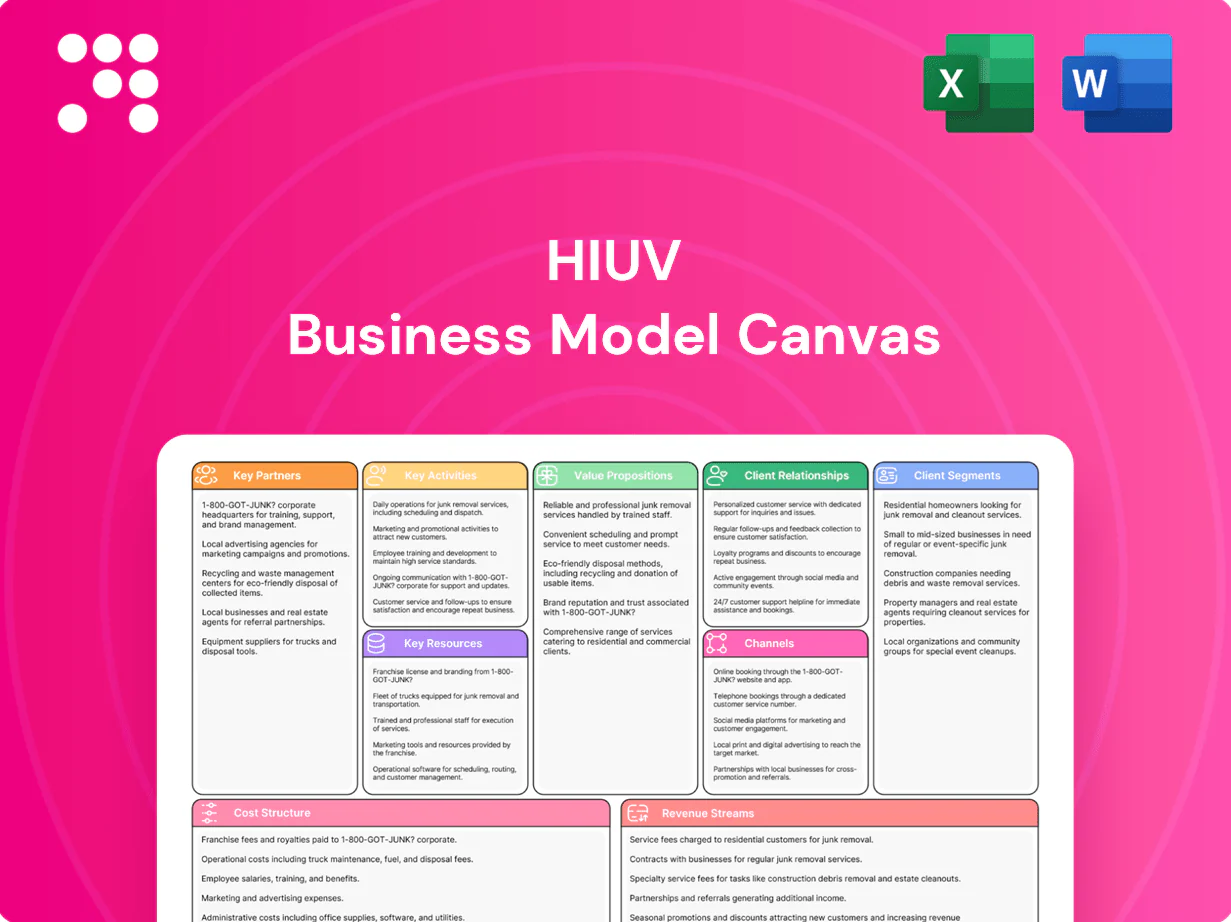
HIUV Business Model Canvas

Business Model Canvas snapshot: value propositions, revenue streams, growth levers
Dive into HIUV's Business Model Canvas to see how its value propositions, revenue streams, and partnerships create scalable advantage. This concise snapshot reveals strategic priorities and growth levers for investors and founders. Purchase the full, editable Canvas for detailed, section-by-section insights and ready-to-use templates.
Partnerships

Upstream polymer and additive suppliers
Secure partnerships with EVA, POE and specialty additive producers ensure consistent resin quality and price stability; the global EVA market reached about 1.1 million tonnes in 2024, underpinning supply scale for HIUV encapsulants. Co-developing resins for high-transparency and anti-PID performance accelerates innovation and reduced field failure rates. Multi-sourcing plus long-term contracts mitigate supply risks amid petrochemical price swings that saw up to ~35% volatility across 2022–24.
Tier-1 photovoltaic module manufacturers
Strategic partnerships with Tier-1 PV OEMs secure multi-gigawatt qualification pipelines and give HIUV forward volume visibility tied to GW-scale module lines. Joint testing on HJT, TOPCon and N-type cells—now achieving 26%+ lab efficiencies—ensures encapsulant specs track rapid cell-architecture gains. Key accounts deliver continuous feedback loops that sharpen product roadmaps and support yield and durability improvements.

Equipment and automation vendors
Alliances with film extrusion, calendering and inline inspection OEMs optimize throughput and uniformity, with 2024 industry surveys reporting 10–30% throughput gains and 15–40% scrap reduction. Early access to new die designs and process controls reduced defects by up to 25% in partner pilots, lowering cost per kg. Co-validation with OEMs shortened scale-up cycles for new grades from 12–18 months to 4–8 months in multiple implementations.

Certification and testing institutions
Partnerships with TUV, UL and CNAS labs accelerate certification for UV, damp-heat, PID and yellowing resistance, aligning tests to IEC 61215 damp-heat at 85°C/85% RH for 1,000 hours and relevant IEC/ISO protocols; third-party validation enhances bankability with project financiers by providing independent IEC/UL reports; continuous test programs benchmark durability versus global standards.
- Third-party labs: TUV, UL, CNAS
- Key tests: UV, damp-heat (85°C/85% RH, 1,000h), PID, yellowing
- Value: independent reports improve project finance acceptance
Logistics providers and regional distributors
Cold-chain and moisture-controlled logistics preserve thin-film PV properties in transit, with SLAs typically targeting 95–99% on-time delivery to protect yield.
Regional distributors extend reach, handle customs (average 2–4 day clearance for prioritized shipments in 2024) and provide last-mile inventory buffers of 1–2 weeks to module lines.
Just-in-time deliveries supported by SLAs enable module lines to run at >95% uptime and reduce working capital.
- Tag: cold-chain
- Tag: SLAs 95–99%
- Tag: customs 2–4 days
- Tag: inventory 1–2 weeks
Secure resin deals: 1.1M t EVA, cut petro volatility 35%
Secure resin partnerships (EVA/POE/additives) ensure supply scale; global EVA ~1.1M t in 2024 and long-term contracts mitigate ~35% petrochemical volatility (2022–24). Tier-1 PV OEM alliances provide multi-GW qualification pipelines and forward volumes. OEM machinery, labs and logistics partnerships cut defects ~25% and shorten scale-up from 12–18 to 4–8 months.
| Partner | Benefit | 2024 metric |
|---|---|---|
| Resin suppliers | Supply stability | 1.1M t EVA |
| PV OEMs | GW pipelines | Multi-GW qual. |
| Labs/OEMs | Faster scale-up | -25% defects; 4–8m |
What is included in the product
 Detailed Word Document
A concise, pre-written HIUV Business Model Canvas organized into the 9 classic BMC blocks, detailing customer segments, channels, value propositions, revenue streams and operations while highlighting competitive advantages and linked SWOT insights—ideal for investor presentations, strategic planning, and validating business ideas with real-world data.

 Customizable Excel Spreadsheet
Streamlines strategy by condensing the HIUV business model into an editable, one-page canvas that eliminates formatting friction and accelerates decision-making. Shareable and team-ready, it aligns stakeholders quickly for brainstorming, board reviews, or comparative analysis.
Activities

Advanced materials R&D and formulation
Design and test of EVA/POE blends targets optical transmittance above 90%, controlled crosslinking for gel content and long-term durability, and thermal/UV stability validated through accelerated aging. Pilot runs (≈500 modules) confirm adhesion to glass, backsheet, and bifacial cells with peel strength targets >1 N/mm. Iterative compounding and active IP filing underpin technical differentiation and commercialization readiness.
High-throughput film manufacturing
Operate extrusion and casting lines at industry 2024 benchmarks of 100–300 m/min with thickness control to ±2–5 µm, gel management, and uniform additive dosing to meet battery and laminate specs. Inline metrology with 100% surface/thickness inspection and SPC maintain tight tolerances critical to lamination yield, with SPC shown to cut scrap 20–30% in 2024 case studies. Continuous improvement focuses on raising OEE toward >92% to lower scrap and boost uptime.

Quality assurance and certification management
Conduct accelerated aging, PID, UV and thermal-cycle testing to IEC 61215, IEC 61730 and IEC 62804 standards to validate performance and safety across product grades. Certification management covers multi-grade approvals and regional market entries, aligning documents and test reports for CE, UL and TÜV pathways. Lot-level traceability using serialized batch IDs and QA databases ensures accountable provenance and rapid containment for any nonconformance.

Technical application engineering
Technical application engineering delivers on-site lamination trials and line-parameter tuning for new-customer qualifications, cutting qualification time by up to 30% and lifting first-pass yield to 92% in 2024. Teams diagnose defects such as bubbles, delamination, and shrinkage, applying corrective recipes that reduce reject rates by ~40%. Best-practice transfer increases customer throughput and OEE across lines.
- on-site trials
- line tuning
- defect diagnosis
- countermeasures
- best-practice transfer
Global sales and key account management
Global sales and key account management forecast demand with tight cadence planning, negotiate and execute price-indexed contracts to hedge volatility, and coordinate supply allocations during peak periods to protect strategic customers and retention. The team systematically captures voice-of-customer (VOC) to drive product and service enhancements and adjust commercial terms.
- WTO 2024 goods trade volume growth forecast: 1.4%
- Target forecast accuracy: 95% for key accounts
- Priority: protect top strategic customers during supply peaks
Scale pilot EVA/POE: ≈500 modules, transmittance >90%, peel >1 N/mm
Design/test EVA/POE blends: transmittance >90%, pilot ≈500 modules, peel >1 N/mm, accelerated aging validated.
Manufacturing: extrusion 100–300 m/min, ±2–5 µm thickness, SPC reduced scrap 20–30% (2024), target OEE >92%.
Quality/commercial: IEC testing, lot traceability, first-pass yield 92% (2024), VOC-driven sales with 95% forecast accuracy for key accounts.
| Metric | Value |
|---|---|
| Pilot modules | ≈500 |
| Transmittance | >90% |
| SPC scrap reduction | 20–30% |
| First-pass yield | 92% |
Delivered as Displayed
Business Model Canvas
The HIUV Business Model Canvas previewed here is the exact document you'll receive—no mockups or samples. When you purchase, you’ll get this same ready-to-edit file with all content and pages included. Instant download in editable formats; no surprises.

Business Model Canvas snapshot: value propositions, revenue streams, growth levers
Dive into HIUV's Business Model Canvas to see how its value propositions, revenue streams, and partnerships create scalable advantage. This concise snapshot reveals strategic priorities and growth levers for investors and founders. Purchase the full, editable Canvas for detailed, section-by-section insights and ready-to-use templates.
Partnerships
Upstream polymer and additive suppliers
Secure partnerships with EVA, POE and specialty additive producers ensure consistent resin quality and price stability; the global EVA market reached about 1.1 million tonnes in 2024, underpinning supply scale for HIUV encapsulants. Co-developing resins for high-transparency and anti-PID performance accelerates innovation and reduced field failure rates. Multi-sourcing plus long-term contracts mitigate supply risks amid petrochemical price swings that saw up to ~35% volatility across 2022–24.
Tier-1 photovoltaic module manufacturers
Strategic partnerships with Tier-1 PV OEMs secure multi-gigawatt qualification pipelines and give HIUV forward volume visibility tied to GW-scale module lines. Joint testing on HJT, TOPCon and N-type cells—now achieving 26%+ lab efficiencies—ensures encapsulant specs track rapid cell-architecture gains. Key accounts deliver continuous feedback loops that sharpen product roadmaps and support yield and durability improvements.
Equipment and automation vendors
Alliances with film extrusion, calendering and inline inspection OEMs optimize throughput and uniformity, with 2024 industry surveys reporting 10–30% throughput gains and 15–40% scrap reduction. Early access to new die designs and process controls reduced defects by up to 25% in partner pilots, lowering cost per kg. Co-validation with OEMs shortened scale-up cycles for new grades from 12–18 months to 4–8 months in multiple implementations.
Certification and testing institutions
Partnerships with TUV, UL and CNAS labs accelerate certification for UV, damp-heat, PID and yellowing resistance, aligning tests to IEC 61215 damp-heat at 85°C/85% RH for 1,000 hours and relevant IEC/ISO protocols; third-party validation enhances bankability with project financiers by providing independent IEC/UL reports; continuous test programs benchmark durability versus global standards.
- Third-party labs: TUV, UL, CNAS
- Key tests: UV, damp-heat (85°C/85% RH, 1,000h), PID, yellowing
- Value: independent reports improve project finance acceptance
Logistics providers and regional distributors
Cold-chain and moisture-controlled logistics preserve thin-film PV properties in transit, with SLAs typically targeting 95–99% on-time delivery to protect yield.
Regional distributors extend reach, handle customs (average 2–4 day clearance for prioritized shipments in 2024) and provide last-mile inventory buffers of 1–2 weeks to module lines.
Just-in-time deliveries supported by SLAs enable module lines to run at >95% uptime and reduce working capital.
- Tag: cold-chain
- Tag: SLAs 95–99%
- Tag: customs 2–4 days
- Tag: inventory 1–2 weeks
Secure resin deals: 1.1M t EVA, cut petro volatility 35%
Secure resin partnerships (EVA/POE/additives) ensure supply scale; global EVA ~1.1M t in 2024 and long-term contracts mitigate ~35% petrochemical volatility (2022–24). Tier-1 PV OEM alliances provide multi-GW qualification pipelines and forward volumes. OEM machinery, labs and logistics partnerships cut defects ~25% and shorten scale-up from 12–18 to 4–8 months.
| Partner | Benefit | 2024 metric |
|---|---|---|
| Resin suppliers | Supply stability | 1.1M t EVA |
| PV OEMs | GW pipelines | Multi-GW qual. |
| Labs/OEMs | Faster scale-up | -25% defects; 4–8m |
What is included in the product
Detailed Word Document
A concise, pre-written HIUV Business Model Canvas organized into the 9 classic BMC blocks, detailing customer segments, channels, value propositions, revenue streams and operations while highlighting competitive advantages and linked SWOT insights—ideal for investor presentations, strategic planning, and validating business ideas with real-world data.
Customizable Excel Spreadsheet
Streamlines strategy by condensing the HIUV business model into an editable, one-page canvas that eliminates formatting friction and accelerates decision-making. Shareable and team-ready, it aligns stakeholders quickly for brainstorming, board reviews, or comparative analysis.
Activities
Advanced materials R&D and formulation
Design and test of EVA/POE blends targets optical transmittance above 90%, controlled crosslinking for gel content and long-term durability, and thermal/UV stability validated through accelerated aging. Pilot runs (≈500 modules) confirm adhesion to glass, backsheet, and bifacial cells with peel strength targets >1 N/mm. Iterative compounding and active IP filing underpin technical differentiation and commercialization readiness.
High-throughput film manufacturing
Operate extrusion and casting lines at industry 2024 benchmarks of 100–300 m/min with thickness control to ±2–5 µm, gel management, and uniform additive dosing to meet battery and laminate specs. Inline metrology with 100% surface/thickness inspection and SPC maintain tight tolerances critical to lamination yield, with SPC shown to cut scrap 20–30% in 2024 case studies. Continuous improvement focuses on raising OEE toward >92% to lower scrap and boost uptime.
Quality assurance and certification management
Conduct accelerated aging, PID, UV and thermal-cycle testing to IEC 61215, IEC 61730 and IEC 62804 standards to validate performance and safety across product grades. Certification management covers multi-grade approvals and regional market entries, aligning documents and test reports for CE, UL and TÜV pathways. Lot-level traceability using serialized batch IDs and QA databases ensures accountable provenance and rapid containment for any nonconformance.
Technical application engineering
Technical application engineering delivers on-site lamination trials and line-parameter tuning for new-customer qualifications, cutting qualification time by up to 30% and lifting first-pass yield to 92% in 2024. Teams diagnose defects such as bubbles, delamination, and shrinkage, applying corrective recipes that reduce reject rates by ~40%. Best-practice transfer increases customer throughput and OEE across lines.
- on-site trials
- line tuning
- defect diagnosis
- countermeasures
- best-practice transfer
Global sales and key account management
Global sales and key account management forecast demand with tight cadence planning, negotiate and execute price-indexed contracts to hedge volatility, and coordinate supply allocations during peak periods to protect strategic customers and retention. The team systematically captures voice-of-customer (VOC) to drive product and service enhancements and adjust commercial terms.
- WTO 2024 goods trade volume growth forecast: 1.4%
- Target forecast accuracy: 95% for key accounts
- Priority: protect top strategic customers during supply peaks
Scale pilot EVA/POE: ≈500 modules, transmittance >90%, peel >1 N/mm
Design/test EVA/POE blends: transmittance >90%, pilot ≈500 modules, peel >1 N/mm, accelerated aging validated.
Manufacturing: extrusion 100–300 m/min, ±2–5 µm thickness, SPC reduced scrap 20–30% (2024), target OEE >92%.
Quality/commercial: IEC testing, lot traceability, first-pass yield 92% (2024), VOC-driven sales with 95% forecast accuracy for key accounts.
| Metric | Value |
|---|---|
| Pilot modules | ≈500 |
| Transmittance | >90% |
| SPC scrap reduction | 20–30% |
| First-pass yield | 92% |
Delivered as Displayed
Business Model Canvas
The HIUV Business Model Canvas previewed here is the exact document you'll receive—no mockups or samples. When you purchase, you’ll get this same ready-to-edit file with all content and pages included. Instant download in editable formats; no surprises.
Original: $10.00
-65%$10.00
$3.50Description
Business Model Canvas snapshot: value propositions, revenue streams, growth levers
Dive into HIUV's Business Model Canvas to see how its value propositions, revenue streams, and partnerships create scalable advantage. This concise snapshot reveals strategic priorities and growth levers for investors and founders. Purchase the full, editable Canvas for detailed, section-by-section insights and ready-to-use templates.
Partnerships
Upstream polymer and additive suppliers
Secure partnerships with EVA, POE and specialty additive producers ensure consistent resin quality and price stability; the global EVA market reached about 1.1 million tonnes in 2024, underpinning supply scale for HIUV encapsulants. Co-developing resins for high-transparency and anti-PID performance accelerates innovation and reduced field failure rates. Multi-sourcing plus long-term contracts mitigate supply risks amid petrochemical price swings that saw up to ~35% volatility across 2022–24.
Tier-1 photovoltaic module manufacturers
Strategic partnerships with Tier-1 PV OEMs secure multi-gigawatt qualification pipelines and give HIUV forward volume visibility tied to GW-scale module lines. Joint testing on HJT, TOPCon and N-type cells—now achieving 26%+ lab efficiencies—ensures encapsulant specs track rapid cell-architecture gains. Key accounts deliver continuous feedback loops that sharpen product roadmaps and support yield and durability improvements.
Equipment and automation vendors
Alliances with film extrusion, calendering and inline inspection OEMs optimize throughput and uniformity, with 2024 industry surveys reporting 10–30% throughput gains and 15–40% scrap reduction. Early access to new die designs and process controls reduced defects by up to 25% in partner pilots, lowering cost per kg. Co-validation with OEMs shortened scale-up cycles for new grades from 12–18 months to 4–8 months in multiple implementations.
Certification and testing institutions
Partnerships with TUV, UL and CNAS labs accelerate certification for UV, damp-heat, PID and yellowing resistance, aligning tests to IEC 61215 damp-heat at 85°C/85% RH for 1,000 hours and relevant IEC/ISO protocols; third-party validation enhances bankability with project financiers by providing independent IEC/UL reports; continuous test programs benchmark durability versus global standards.
- Third-party labs: TUV, UL, CNAS
- Key tests: UV, damp-heat (85°C/85% RH, 1,000h), PID, yellowing
- Value: independent reports improve project finance acceptance
Logistics providers and regional distributors
Cold-chain and moisture-controlled logistics preserve thin-film PV properties in transit, with SLAs typically targeting 95–99% on-time delivery to protect yield.
Regional distributors extend reach, handle customs (average 2–4 day clearance for prioritized shipments in 2024) and provide last-mile inventory buffers of 1–2 weeks to module lines.
Just-in-time deliveries supported by SLAs enable module lines to run at >95% uptime and reduce working capital.
- Tag: cold-chain
- Tag: SLAs 95–99%
- Tag: customs 2–4 days
- Tag: inventory 1–2 weeks
Secure resin deals: 1.1M t EVA, cut petro volatility 35%
Secure resin partnerships (EVA/POE/additives) ensure supply scale; global EVA ~1.1M t in 2024 and long-term contracts mitigate ~35% petrochemical volatility (2022–24). Tier-1 PV OEM alliances provide multi-GW qualification pipelines and forward volumes. OEM machinery, labs and logistics partnerships cut defects ~25% and shorten scale-up from 12–18 to 4–8 months.
| Partner | Benefit | 2024 metric |
|---|---|---|
| Resin suppliers | Supply stability | 1.1M t EVA |
| PV OEMs | GW pipelines | Multi-GW qual. |
| Labs/OEMs | Faster scale-up | -25% defects; 4–8m |
What is included in the product
Detailed Word Document
A concise, pre-written HIUV Business Model Canvas organized into the 9 classic BMC blocks, detailing customer segments, channels, value propositions, revenue streams and operations while highlighting competitive advantages and linked SWOT insights—ideal for investor presentations, strategic planning, and validating business ideas with real-world data.
Customizable Excel Spreadsheet
Streamlines strategy by condensing the HIUV business model into an editable, one-page canvas that eliminates formatting friction and accelerates decision-making. Shareable and team-ready, it aligns stakeholders quickly for brainstorming, board reviews, or comparative analysis.
Activities
Advanced materials R&D and formulation
Design and test of EVA/POE blends targets optical transmittance above 90%, controlled crosslinking for gel content and long-term durability, and thermal/UV stability validated through accelerated aging. Pilot runs (≈500 modules) confirm adhesion to glass, backsheet, and bifacial cells with peel strength targets >1 N/mm. Iterative compounding and active IP filing underpin technical differentiation and commercialization readiness.
High-throughput film manufacturing
Operate extrusion and casting lines at industry 2024 benchmarks of 100–300 m/min with thickness control to ±2–5 µm, gel management, and uniform additive dosing to meet battery and laminate specs. Inline metrology with 100% surface/thickness inspection and SPC maintain tight tolerances critical to lamination yield, with SPC shown to cut scrap 20–30% in 2024 case studies. Continuous improvement focuses on raising OEE toward >92% to lower scrap and boost uptime.
Quality assurance and certification management
Conduct accelerated aging, PID, UV and thermal-cycle testing to IEC 61215, IEC 61730 and IEC 62804 standards to validate performance and safety across product grades. Certification management covers multi-grade approvals and regional market entries, aligning documents and test reports for CE, UL and TÜV pathways. Lot-level traceability using serialized batch IDs and QA databases ensures accountable provenance and rapid containment for any nonconformance.
Technical application engineering
Technical application engineering delivers on-site lamination trials and line-parameter tuning for new-customer qualifications, cutting qualification time by up to 30% and lifting first-pass yield to 92% in 2024. Teams diagnose defects such as bubbles, delamination, and shrinkage, applying corrective recipes that reduce reject rates by ~40%. Best-practice transfer increases customer throughput and OEE across lines.
- on-site trials
- line tuning
- defect diagnosis
- countermeasures
- best-practice transfer
Global sales and key account management
Global sales and key account management forecast demand with tight cadence planning, negotiate and execute price-indexed contracts to hedge volatility, and coordinate supply allocations during peak periods to protect strategic customers and retention. The team systematically captures voice-of-customer (VOC) to drive product and service enhancements and adjust commercial terms.
- WTO 2024 goods trade volume growth forecast: 1.4%
- Target forecast accuracy: 95% for key accounts
- Priority: protect top strategic customers during supply peaks
Scale pilot EVA/POE: ≈500 modules, transmittance >90%, peel >1 N/mm
Design/test EVA/POE blends: transmittance >90%, pilot ≈500 modules, peel >1 N/mm, accelerated aging validated.
Manufacturing: extrusion 100–300 m/min, ±2–5 µm thickness, SPC reduced scrap 20–30% (2024), target OEE >92%.
Quality/commercial: IEC testing, lot traceability, first-pass yield 92% (2024), VOC-driven sales with 95% forecast accuracy for key accounts.
| Metric | Value |
|---|---|
| Pilot modules | ≈500 |
| Transmittance | >90% |
| SPC scrap reduction | 20–30% |
| First-pass yield | 92% |
Delivered as Displayed
Business Model Canvas
The HIUV Business Model Canvas previewed here is the exact document you'll receive—no mockups or samples. When you purchase, you’ll get this same ready-to-edit file with all content and pages included. Instant download in editable formats; no surprises.











