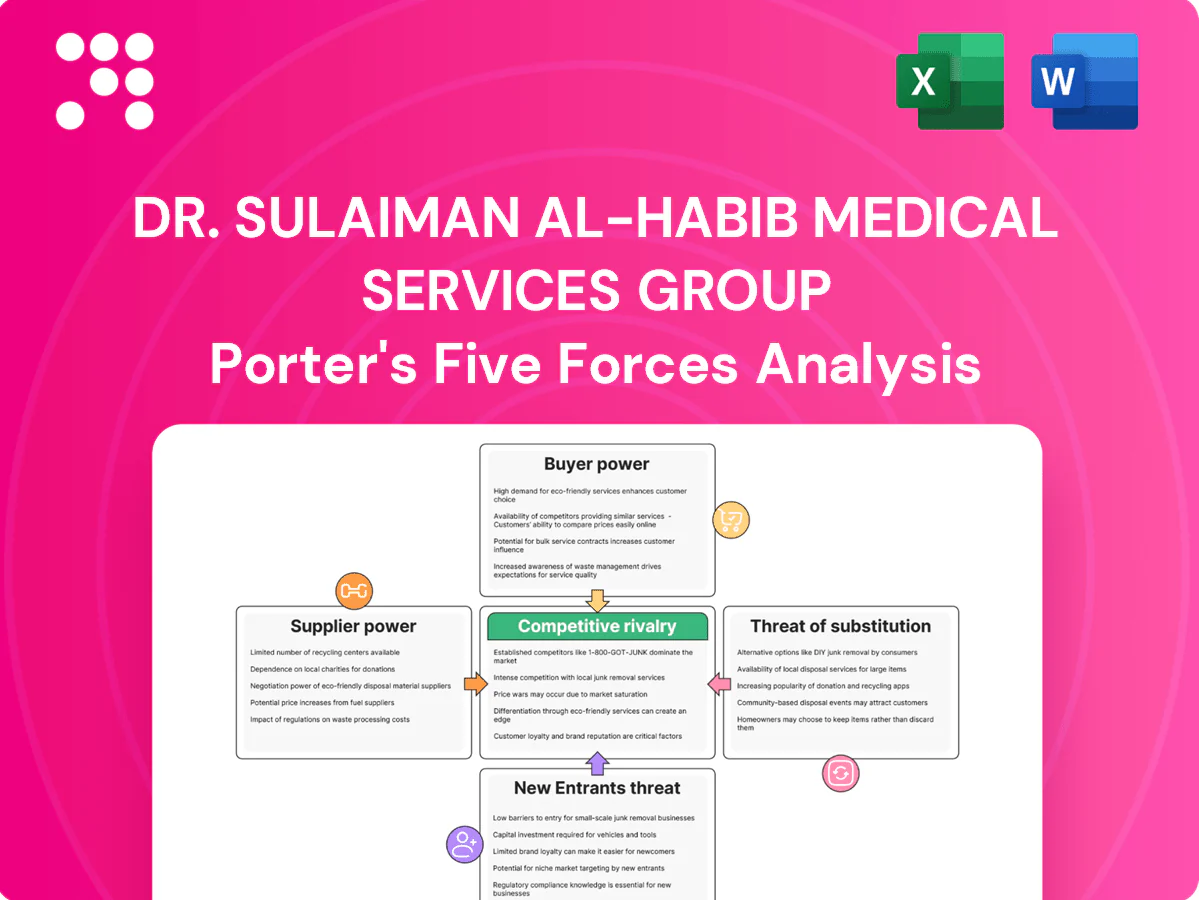
Dr. Sulaiman Al-Habib Medical Services Group Porter's Five Forces Analysis

Elevate Your Analysis with the Complete Porter's Five Forces Analysis
This snapshot highlights key competitive pressures facing Dr. Sulaiman Al‑Habib Medical Services Group—intense rivalry, rising buyer expectations, and evolving supplier dynamics—impacting margins and growth potential. The full Porter's Five Forces Analysis reveals force-by-force ratings, visuals, and tailored implications. Unlock deep, data-driven insights and ready-to-use Excel and Word deliverables to inform strategy or investment decisions. Purchase the complete report to act with confidence.
Suppliers Bargaining Power

Concentrated medical device OEMs
High-end imaging and robotics are dominated by a few global OEMs (top 3 vendors ~60% of imaging; Intuitive Surgical ~70% of surgical-robot installed base in 2024), while top 5 IVD suppliers account for ~75% of lab systems, constraining switching and boosting supplier pricing/service leverage. Long equipment lifecycles and interoperability create further lock-in. HMG counters with scale procurement and multi-year framework agreements.
Specialist talent scarcity
Board-certified physicians, nurses, and allied specialists are scarce regionally, reinforcing supplier power and contributing to a WHO-estimated global shortfall of 10 million health workers by 2030. Staffing agencies and clinicians command higher compensation, with Gulf locum premiums reported up to 30% in 2024. Visa, licensing, and credentialing timelines add switching friction. HMG mitigates risk via in-house training, physician networks, and targeted retention programs.

Pharmaceutical and consumables dependence
Essential drugs and disposables for HMG depend on approved originators and distributors, and with the global pharmaceutical market at about $1.6 trillion in 2024 biologics—roughly 30% of top-seller value—limit substitution flexibility for critical therapies. Supply-chain shocks have driven episodic spot-price spikes, stressing margins. HMG mitigates risk via diversified sourcing, inventory buffers and active formulary management to reduce stockout exposure.

Regulatory and accreditation requirements
Regulatory and accreditation requirements from MOH, SFDA/DHA and international bodies embed specific supplier standards, making approved-vendor lists and documented quality protocols compulsory and narrowing the supplier pool. Approved-vendor lists increase supplier stickiness and documentation plus periodic audits raise switching costs materially. HMG’s scale in compliance enables stronger pricing leverage but does not allow full substitution of accredited suppliers.
- Regulatory standards: MOH, SFDA/DHA enforce supplier criteria
- Approved-vendor effect: narrows choices, raises stickiness
- Audit burden: documented QA increases switching costs
- HMG scale: improves negotiation, limits total substitution
IT platforms and interoperability
Core HIS/EMR, PACS, and cybersecurity vendors create strong data and workflow lock-in that raised vendor leverage in 2024; integration and training costs make switching operationally risky and expensive, while vendors exert power through upgrade and licensing terms. HMG offsets this by adopting modular architectures and negotiating enterprise licensing and managed-service terms to contain vendor influence.
- 2024: vendor lock-in heightens switching risk
- Integration/training drive high switching costs
- Upgrades/licensing are leverage points
- HMG: modular design + enterprise licenses
Supply conc 60–75%; workforce -10m; pharma $1.6T
Supplier power is high: top 3 imaging vendors ~60% share and Intuitive Surgical ~70% of surgical robots (2024) restrict equipment substitution; top 5 IVD suppliers ~75% share. Workforce scarcity (WHO 10m shortfall by 2030) and Gulf locum premiums up to 30% (2024) raise labor costs. Pharma market ~$1.6T (2024) with biologics ~30% value limits drug substitution; HMG uses scale, frameworks, training.
| Factor | Metric (2024/2030) |
|---|---|
| Imaging/Robotics | Top3 ~60% / Intuitive ~70% |
| IVD | Top5 ~75% |
| Workforce | WHO -10m by 2030; Gulf locum +30% |
| Pharma | $1.6T; biologics ~30% |
What is included in the product
 Detailed Word Document
Tailored Porter's Five Forces analysis for Dr. Sulaiman Al-Habib Medical Services Group uncovering competitive intensity, buyer and supplier power, threats from new entrants and substitutes, and strategic barriers that protect incumbent profitability, with actionable insights for investors and management.

 Customizable Excel Spreadsheet
Clear one-sheet Porter's Five Forces for Dr. Sulaiman Al‑Habib Medical Services Group—instantly identify competitive pressures and pain points for strategic decisions, with editable inputs to reflect new regulations or market shifts.
Customers Bargaining Power

Insurers and corporate payers
Insurers and corporate payers steer large patient volumes to HMG, enforcing negotiated tariffs and preauthorization rules that compress margins. Their scale gives them strong leverage on pricing, payment timelines and contract terms. Network inclusion is critical for HMG to maintain patient access and case mix. HMG offsets payer pressure with brand-driven demand and outcome data to support premium rates.
Price-sensitive self-pay patients
Price-sensitive self-pay patients in 2024 routinely compare hospitals on out-of-pocket cost and convenience, using online price lists and review platforms. Transparent procedure packages and timed promotions often sway choice, especially for elective surgeries and diagnostics where sensitivity is highest. HMG counters with bundled pricing, promotional packages and marketing of perceived clinical quality to retain self-pay demand.

Government programs and regulations
Public payers account for over 70% of healthcare utilization in Saudi Arabia, so policy shifts and reimbursement cuts directly hit HMG’s volumes and margins; 2024 tariff standardization compressed negotiation room by aligning public/private rates. Lengthy compliance and pre-authorization rules often delay approvals and payments, increasing working capital needs. HMG mitigates impact through scale, improved coding accuracy and active participation in national strategic initiatives.

Quality and experience expectations
Customers increasingly demand short wait times, rapid specialist access and seamless digital journeys; negative reviews or adverse outcomes quickly redirect patient flows, making experience scores critical bargaining chips for Dr. Sulaiman Al-Habib Medical Services Group.
To retain leverage HMG has invested in streamlined patient pathways, telehealth platforms and concierge services to protect revenue and referral relationships.
- Shorter waits
- Specialist access
- Digital journeys
- Experience scores = bargaining power
- Investments: pathways, telehealth, concierge
Medical tourism alternatives
- Market size 2024 ~90B USD
- Airfare volatility 2024 ~15%
- HMG focus: top-tier specialties + advanced tech
Payers (70%+) and insurers squeeze margins; self-pay, medical tourism rise
Payers (public 70%+ of utilization) and large insurers exert strong price and contract leverage, compressing margins; self-pay price sensitivity rose in 2024 with online comparisons and bundled offers; medical tourism market ~90B USD (2024) increases choice for affluent patients; HMG offsets pressure via brand, outcome data, telehealth and concierge services.
| Metric | 2024 |
|---|---|
| Public payer share | 70%+ |
| Medical tourism market | ~90B USD |
| Airfare volatility | ~15% |
Full Version Awaits
Dr. Sulaiman Al-Habib Medical Services Group Porter's Five Forces Analysis
This preview shows the exact Porter's Five Forces analysis for Dr. Sulaiman Al-Habib Medical Services Group you'll receive immediately after purchase—no placeholders or samples. The file is fully formatted, complete, and ready for download and use the moment you buy.

Elevate Your Analysis with the Complete Porter's Five Forces Analysis
This snapshot highlights key competitive pressures facing Dr. Sulaiman Al‑Habib Medical Services Group—intense rivalry, rising buyer expectations, and evolving supplier dynamics—impacting margins and growth potential. The full Porter's Five Forces Analysis reveals force-by-force ratings, visuals, and tailored implications. Unlock deep, data-driven insights and ready-to-use Excel and Word deliverables to inform strategy or investment decisions. Purchase the complete report to act with confidence.
Suppliers Bargaining Power
Concentrated medical device OEMs
High-end imaging and robotics are dominated by a few global OEMs (top 3 vendors ~60% of imaging; Intuitive Surgical ~70% of surgical-robot installed base in 2024), while top 5 IVD suppliers account for ~75% of lab systems, constraining switching and boosting supplier pricing/service leverage. Long equipment lifecycles and interoperability create further lock-in. HMG counters with scale procurement and multi-year framework agreements.
Specialist talent scarcity
Board-certified physicians, nurses, and allied specialists are scarce regionally, reinforcing supplier power and contributing to a WHO-estimated global shortfall of 10 million health workers by 2030. Staffing agencies and clinicians command higher compensation, with Gulf locum premiums reported up to 30% in 2024. Visa, licensing, and credentialing timelines add switching friction. HMG mitigates risk via in-house training, physician networks, and targeted retention programs.
Pharmaceutical and consumables dependence
Essential drugs and disposables for HMG depend on approved originators and distributors, and with the global pharmaceutical market at about $1.6 trillion in 2024 biologics—roughly 30% of top-seller value—limit substitution flexibility for critical therapies. Supply-chain shocks have driven episodic spot-price spikes, stressing margins. HMG mitigates risk via diversified sourcing, inventory buffers and active formulary management to reduce stockout exposure.
Regulatory and accreditation requirements
Regulatory and accreditation requirements from MOH, SFDA/DHA and international bodies embed specific supplier standards, making approved-vendor lists and documented quality protocols compulsory and narrowing the supplier pool. Approved-vendor lists increase supplier stickiness and documentation plus periodic audits raise switching costs materially. HMG’s scale in compliance enables stronger pricing leverage but does not allow full substitution of accredited suppliers.
- Regulatory standards: MOH, SFDA/DHA enforce supplier criteria
- Approved-vendor effect: narrows choices, raises stickiness
- Audit burden: documented QA increases switching costs
- HMG scale: improves negotiation, limits total substitution
IT platforms and interoperability
Core HIS/EMR, PACS, and cybersecurity vendors create strong data and workflow lock-in that raised vendor leverage in 2024; integration and training costs make switching operationally risky and expensive, while vendors exert power through upgrade and licensing terms. HMG offsets this by adopting modular architectures and negotiating enterprise licensing and managed-service terms to contain vendor influence.
- 2024: vendor lock-in heightens switching risk
- Integration/training drive high switching costs
- Upgrades/licensing are leverage points
- HMG: modular design + enterprise licenses
Supply conc 60–75%; workforce -10m; pharma $1.6T
Supplier power is high: top 3 imaging vendors ~60% share and Intuitive Surgical ~70% of surgical robots (2024) restrict equipment substitution; top 5 IVD suppliers ~75% share. Workforce scarcity (WHO 10m shortfall by 2030) and Gulf locum premiums up to 30% (2024) raise labor costs. Pharma market ~$1.6T (2024) with biologics ~30% value limits drug substitution; HMG uses scale, frameworks, training.
| Factor | Metric (2024/2030) |
|---|---|
| Imaging/Robotics | Top3 ~60% / Intuitive ~70% |
| IVD | Top5 ~75% |
| Workforce | WHO -10m by 2030; Gulf locum +30% |
| Pharma | $1.6T; biologics ~30% |
What is included in the product
Detailed Word Document
Tailored Porter's Five Forces analysis for Dr. Sulaiman Al-Habib Medical Services Group uncovering competitive intensity, buyer and supplier power, threats from new entrants and substitutes, and strategic barriers that protect incumbent profitability, with actionable insights for investors and management.
Customizable Excel Spreadsheet
Clear one-sheet Porter's Five Forces for Dr. Sulaiman Al‑Habib Medical Services Group—instantly identify competitive pressures and pain points for strategic decisions, with editable inputs to reflect new regulations or market shifts.
Customers Bargaining Power
Insurers and corporate payers
Insurers and corporate payers steer large patient volumes to HMG, enforcing negotiated tariffs and preauthorization rules that compress margins. Their scale gives them strong leverage on pricing, payment timelines and contract terms. Network inclusion is critical for HMG to maintain patient access and case mix. HMG offsets payer pressure with brand-driven demand and outcome data to support premium rates.
Price-sensitive self-pay patients
Price-sensitive self-pay patients in 2024 routinely compare hospitals on out-of-pocket cost and convenience, using online price lists and review platforms. Transparent procedure packages and timed promotions often sway choice, especially for elective surgeries and diagnostics where sensitivity is highest. HMG counters with bundled pricing, promotional packages and marketing of perceived clinical quality to retain self-pay demand.
Government programs and regulations
Public payers account for over 70% of healthcare utilization in Saudi Arabia, so policy shifts and reimbursement cuts directly hit HMG’s volumes and margins; 2024 tariff standardization compressed negotiation room by aligning public/private rates. Lengthy compliance and pre-authorization rules often delay approvals and payments, increasing working capital needs. HMG mitigates impact through scale, improved coding accuracy and active participation in national strategic initiatives.
Quality and experience expectations
Customers increasingly demand short wait times, rapid specialist access and seamless digital journeys; negative reviews or adverse outcomes quickly redirect patient flows, making experience scores critical bargaining chips for Dr. Sulaiman Al-Habib Medical Services Group.
To retain leverage HMG has invested in streamlined patient pathways, telehealth platforms and concierge services to protect revenue and referral relationships.
- Shorter waits
- Specialist access
- Digital journeys
- Experience scores = bargaining power
- Investments: pathways, telehealth, concierge
Medical tourism alternatives
- Market size 2024 ~90B USD
- Airfare volatility 2024 ~15%
- HMG focus: top-tier specialties + advanced tech
Payers (70%+) and insurers squeeze margins; self-pay, medical tourism rise
Payers (public 70%+ of utilization) and large insurers exert strong price and contract leverage, compressing margins; self-pay price sensitivity rose in 2024 with online comparisons and bundled offers; medical tourism market ~90B USD (2024) increases choice for affluent patients; HMG offsets pressure via brand, outcome data, telehealth and concierge services.
| Metric | 2024 |
|---|---|
| Public payer share | 70%+ |
| Medical tourism market | ~90B USD |
| Airfare volatility | ~15% |
Full Version Awaits
Dr. Sulaiman Al-Habib Medical Services Group Porter's Five Forces Analysis
This preview shows the exact Porter's Five Forces analysis for Dr. Sulaiman Al-Habib Medical Services Group you'll receive immediately after purchase—no placeholders or samples. The file is fully formatted, complete, and ready for download and use the moment you buy.
Original: $10.00
-65%$10.00
$3.50Description
Elevate Your Analysis with the Complete Porter's Five Forces Analysis
This snapshot highlights key competitive pressures facing Dr. Sulaiman Al‑Habib Medical Services Group—intense rivalry, rising buyer expectations, and evolving supplier dynamics—impacting margins and growth potential. The full Porter's Five Forces Analysis reveals force-by-force ratings, visuals, and tailored implications. Unlock deep, data-driven insights and ready-to-use Excel and Word deliverables to inform strategy or investment decisions. Purchase the complete report to act with confidence.
Suppliers Bargaining Power
Concentrated medical device OEMs
High-end imaging and robotics are dominated by a few global OEMs (top 3 vendors ~60% of imaging; Intuitive Surgical ~70% of surgical-robot installed base in 2024), while top 5 IVD suppliers account for ~75% of lab systems, constraining switching and boosting supplier pricing/service leverage. Long equipment lifecycles and interoperability create further lock-in. HMG counters with scale procurement and multi-year framework agreements.
Specialist talent scarcity
Board-certified physicians, nurses, and allied specialists are scarce regionally, reinforcing supplier power and contributing to a WHO-estimated global shortfall of 10 million health workers by 2030. Staffing agencies and clinicians command higher compensation, with Gulf locum premiums reported up to 30% in 2024. Visa, licensing, and credentialing timelines add switching friction. HMG mitigates risk via in-house training, physician networks, and targeted retention programs.
Pharmaceutical and consumables dependence
Essential drugs and disposables for HMG depend on approved originators and distributors, and with the global pharmaceutical market at about $1.6 trillion in 2024 biologics—roughly 30% of top-seller value—limit substitution flexibility for critical therapies. Supply-chain shocks have driven episodic spot-price spikes, stressing margins. HMG mitigates risk via diversified sourcing, inventory buffers and active formulary management to reduce stockout exposure.
Regulatory and accreditation requirements
Regulatory and accreditation requirements from MOH, SFDA/DHA and international bodies embed specific supplier standards, making approved-vendor lists and documented quality protocols compulsory and narrowing the supplier pool. Approved-vendor lists increase supplier stickiness and documentation plus periodic audits raise switching costs materially. HMG’s scale in compliance enables stronger pricing leverage but does not allow full substitution of accredited suppliers.
- Regulatory standards: MOH, SFDA/DHA enforce supplier criteria
- Approved-vendor effect: narrows choices, raises stickiness
- Audit burden: documented QA increases switching costs
- HMG scale: improves negotiation, limits total substitution
IT platforms and interoperability
Core HIS/EMR, PACS, and cybersecurity vendors create strong data and workflow lock-in that raised vendor leverage in 2024; integration and training costs make switching operationally risky and expensive, while vendors exert power through upgrade and licensing terms. HMG offsets this by adopting modular architectures and negotiating enterprise licensing and managed-service terms to contain vendor influence.
- 2024: vendor lock-in heightens switching risk
- Integration/training drive high switching costs
- Upgrades/licensing are leverage points
- HMG: modular design + enterprise licenses
Supply conc 60–75%; workforce -10m; pharma $1.6T
Supplier power is high: top 3 imaging vendors ~60% share and Intuitive Surgical ~70% of surgical robots (2024) restrict equipment substitution; top 5 IVD suppliers ~75% share. Workforce scarcity (WHO 10m shortfall by 2030) and Gulf locum premiums up to 30% (2024) raise labor costs. Pharma market ~$1.6T (2024) with biologics ~30% value limits drug substitution; HMG uses scale, frameworks, training.
| Factor | Metric (2024/2030) |
|---|---|
| Imaging/Robotics | Top3 ~60% / Intuitive ~70% |
| IVD | Top5 ~75% |
| Workforce | WHO -10m by 2030; Gulf locum +30% |
| Pharma | $1.6T; biologics ~30% |
What is included in the product
Detailed Word Document
Tailored Porter's Five Forces analysis for Dr. Sulaiman Al-Habib Medical Services Group uncovering competitive intensity, buyer and supplier power, threats from new entrants and substitutes, and strategic barriers that protect incumbent profitability, with actionable insights for investors and management.
Customizable Excel Spreadsheet
Clear one-sheet Porter's Five Forces for Dr. Sulaiman Al‑Habib Medical Services Group—instantly identify competitive pressures and pain points for strategic decisions, with editable inputs to reflect new regulations or market shifts.
Customers Bargaining Power
Insurers and corporate payers
Insurers and corporate payers steer large patient volumes to HMG, enforcing negotiated tariffs and preauthorization rules that compress margins. Their scale gives them strong leverage on pricing, payment timelines and contract terms. Network inclusion is critical for HMG to maintain patient access and case mix. HMG offsets payer pressure with brand-driven demand and outcome data to support premium rates.
Price-sensitive self-pay patients
Price-sensitive self-pay patients in 2024 routinely compare hospitals on out-of-pocket cost and convenience, using online price lists and review platforms. Transparent procedure packages and timed promotions often sway choice, especially for elective surgeries and diagnostics where sensitivity is highest. HMG counters with bundled pricing, promotional packages and marketing of perceived clinical quality to retain self-pay demand.
Government programs and regulations
Public payers account for over 70% of healthcare utilization in Saudi Arabia, so policy shifts and reimbursement cuts directly hit HMG’s volumes and margins; 2024 tariff standardization compressed negotiation room by aligning public/private rates. Lengthy compliance and pre-authorization rules often delay approvals and payments, increasing working capital needs. HMG mitigates impact through scale, improved coding accuracy and active participation in national strategic initiatives.
Quality and experience expectations
Customers increasingly demand short wait times, rapid specialist access and seamless digital journeys; negative reviews or adverse outcomes quickly redirect patient flows, making experience scores critical bargaining chips for Dr. Sulaiman Al-Habib Medical Services Group.
To retain leverage HMG has invested in streamlined patient pathways, telehealth platforms and concierge services to protect revenue and referral relationships.
- Shorter waits
- Specialist access
- Digital journeys
- Experience scores = bargaining power
- Investments: pathways, telehealth, concierge
Medical tourism alternatives
- Market size 2024 ~90B USD
- Airfare volatility 2024 ~15%
- HMG focus: top-tier specialties + advanced tech
Payers (70%+) and insurers squeeze margins; self-pay, medical tourism rise
Payers (public 70%+ of utilization) and large insurers exert strong price and contract leverage, compressing margins; self-pay price sensitivity rose in 2024 with online comparisons and bundled offers; medical tourism market ~90B USD (2024) increases choice for affluent patients; HMG offsets pressure via brand, outcome data, telehealth and concierge services.
| Metric | 2024 |
|---|---|
| Public payer share | 70%+ |
| Medical tourism market | ~90B USD |
| Airfare volatility | ~15% |
Full Version Awaits
Dr. Sulaiman Al-Habib Medical Services Group Porter's Five Forces Analysis
This preview shows the exact Porter's Five Forces analysis for Dr. Sulaiman Al-Habib Medical Services Group you'll receive immediately after purchase—no placeholders or samples. The file is fully formatted, complete, and ready for download and use the moment you buy.











