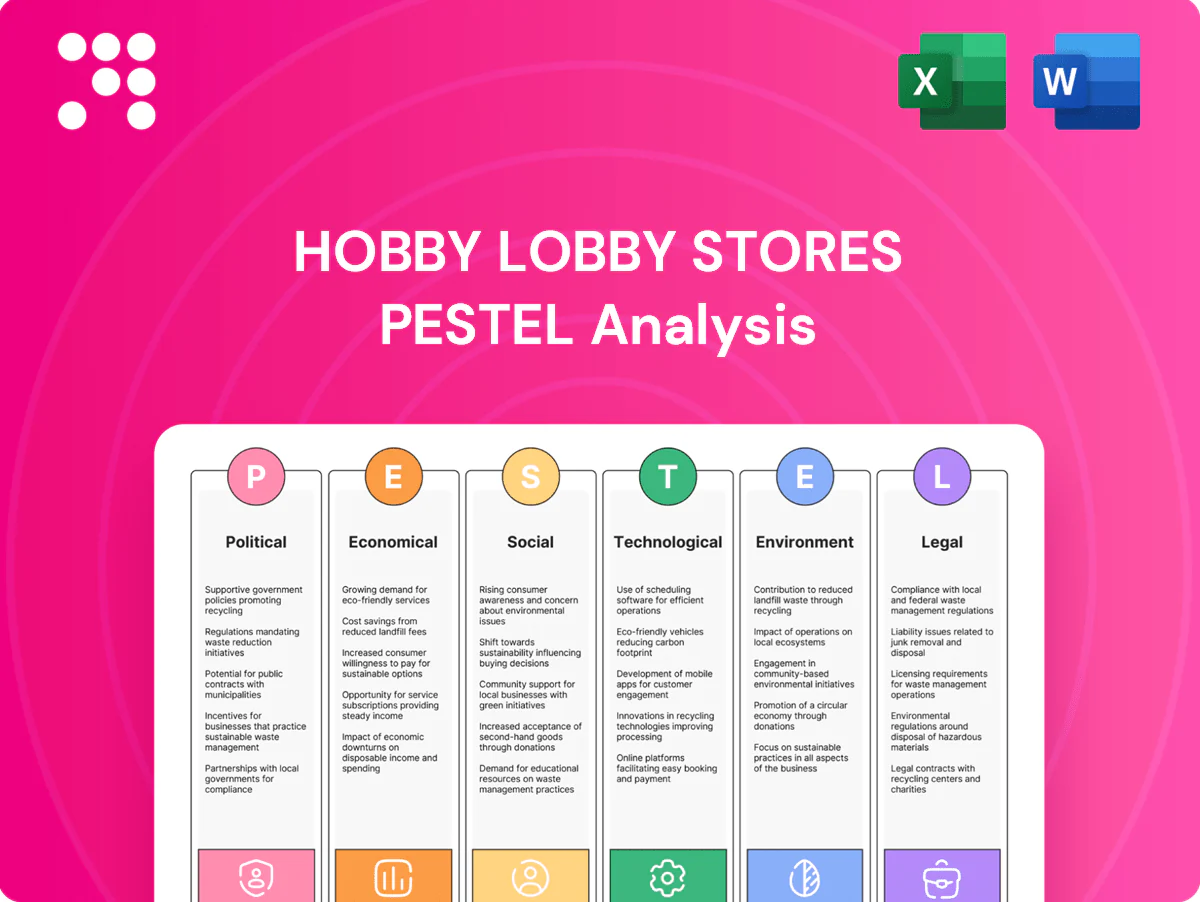
Hobby Lobby Stores PESTLE Analysis

Skip the Research. Get the Strategy.
Gain strategic insight with our PESTLE Analysis of Hobby Lobby Stores. Unpack the political, economic, social, technological, legal and environmental forces shaping its retail strategy and risk profile. Ideal for investors, consultants, and executives—buy the full report to download actionable, editable findings now.
Political factors

Trade policy and tariffs
Import duties such as Section 301 tariffs (implemented since 2018 at 7.5–25%) can materially shift landed costs for craft materials, textiles and seasonal goods and squeeze Hobby Lobby’s pricing power. Shifts in U.S.–Asia trade relations, with Asia supplying roughly two thirds of U.S. consumer goods, force changes to sourcing footprints and vendor viability. Proactive tariff engineering, diversified supplier bases and advocacy via retail groups like NRF (over 16,000 members) mitigate shocks.
State-local incentives and zoning
Hobby Lobby, headquartered in Oklahoma City, relies on favorable zoning and infrastructure; U.S. permitting timelines commonly span 6–12 months, affecting roll-out speed. State and municipal incentives, including tax abatements and infrastructure grants, materially influence site selection and pacing. Local politics over traffic and land use can slow or block projects, so early engagement and rigorous impact studies are standard practice to reduce friction.

Minimum wage and labor policy
Political momentum for higher wages alters store-level P&L: federal minimum remains $7.25 while state and city rates reach roughly $16–19 in places like California and Seattle, lifting hourly payroll. Predictive scheduling laws in California, New York and several cities reduce shift flexibility and raise administrative costs. Regional benefits mandates add compliance complexity and cost. Workforce planning and productivity tech can offset an estimated 5–12% of rising labor expenses.

Cultural-policy dynamics
Hobby Lobby’s explicit Christian values intersect with policy debates on religious expression in commerce, exemplified by the 2014 Supreme Court ruling in Burwell v. Hobby Lobby; the chain operates over 900 stores in 47 states, so regional political polarization can trigger localized boycotts or loyalty surges. Messaging must reflect core values while retaining broad consumer appeal, and scenario planning reduces reputational and operational risk.
- legal: 2014 SCOTUS precedent
- scale: 900+ stores, 47 states
- risk: region-specific boycotts/loyalty swings
- mitigation: targeted messaging + scenario planning
Tax and fiscal environment
State sales-tax rules, exemptions and holidays shape Hobby Lobby footfall and category mix as shoppers chase tax-free events; 45 states and DC impose sales tax while 5 states have none. The 21% federal corporate rate and state add-ons influence reinvestment and store growth. Post-Wayfair nexus rules force multi-state compliance; proactive tax planning protects margin.
- 45 states+DC collect sales tax; 5 states no sales tax
- Federal corp tax 21% (plus state rates)
- Wayfair (2018) led to widespread economic nexus enforcement
- Tax holidays shift SKU sales and traffic
Tariffs, multi-state tax nexus, wage gaps & permitting risks for 900+ store crafts retailer
Political risks for Hobby Lobby include Section 301 tariffs (7.5–25%) raising landed costs, Wayfair (2018) nexus expanding multi-state tax compliance, and federal corporate tax at 21% plus state add-ons. Labor policy variance (federal $7.25 vs state highs ~$16–19) and zoning/permitting (6–12 months) affect roll-out; 900+ stores in 47 states amplify regional political exposure.
| Factor | Key data |
|---|---|
| Tariffs | 7.5–25% |
| Stores/States | 900+, 47 |
| Corp tax | 21% + state |
| Sales tax | 45 states+DC |
| Min wage range | $7.25 federal; ~$16–19 state highs |
What is included in the product
 Detailed Word Document
Explores how external macro-environmental factors uniquely affect Hobby Lobby Stores across Political, Economic, Social, Technological, Environmental, and Legal dimensions, with data-driven trends and region-specific examples. Designed to help executives, consultants, and investors identify threats, opportunities, and strategic actions.

 Customizable Excel Spreadsheet
Visually segmented PESTLE summary for Hobby Lobby that distills external risks and opportunities into a clean, shareable slide-ready format—easy to annotate for region- or business-line specifics and ideal for quick alignment during planning sessions.
Economic factors

Consumer spending cycles
Discretionary crafts and decor sales for Hobby Lobby closely track employment, wages and consumer confidence: US unemployment averaged about 3.6% in 2024 (BLS) and real wage growth weakened, constraining spend on nonessentials. During downturns DIY often substitutes professional services, partially cushioning demand as seen in elevated craft-store traffic during 2023–24. Premium seasonal items are more price elastic and need sharper promotions; inventory depth should flex with macro signals and weekly retail-sales and confidence trends.
Inflation and input costs
Material, freight and wage inflation — with US CPI at 3.4% in 2023 — have compressed gross margins for Hobby Lobby, pressuring retail math. A heavier private-label mix and tighter vendor negotiations have helped defend price points. Dynamic pricing, pack-size strategies and SKU-level cost visibility enable targeted markdowns to preserve value perception and protect margins.

Supply chain and logistics
Ocean spot rates fell roughly 80% from 2021 peaks (~$10,000 per FEU) to about $1,800 per FEU in 2024, while U.S. West Coast vessel wait times eased from ~20 days to under 2 days, making seasonal availability risk still material for Hobby Lobby. Nearshoring and multi-port sourcing improve resilience, and targeted safety-stock rises of 15–25% for holiday peaks must be weighed against working-capital limits. Diversified transportation contracts and multiple 3PL partners reduce freight volatility and mitigate stockouts.

Competitive landscape
Competition from Amazon, Michaels, Joann and niche specialty rivals pressures price and convenience; assortment breadth, in-store experience and DIY classes/events differentiate Hobby Lobby, which operates over 900 stores nationwide. Omnichannel services such as BOPIS and curbside pickup counter last-mile competition, while localized merchandising lifts average basket size.
- Rivals: Amazon, Michaels, Joann, niche boutiques
- Hobby Lobby scale: over 900 stores
- Differentiators: classes/events, experiential stores
- Omnichannel: BOPIS/curbside reduces last-mile risk
FX and sourcing diversification
Currency swings materially affect costs for Hobby Lobby’s imported goods and components; the US dollar (DXY) averaged about 103 in 2024, pressuring supplier prices and margins. Multi-country sourcing spreads geopolitical and FX risk across suppliers in Asia, Latin America and Europe; Hobby Lobby operated roughly 936 stores in 2024, driving scale in procurement. Hedging programs and dollar‑denominated contracts are used to stabilize margins while vendor scorecards guide spend allocation and reallocation.
- FX backdrop: DXY ~103 (2024)
- Scale: ~936 US stores (2024)
- Risk tools: hedging + USD contracts
- Allocation: vendor scorecards
Tariffs, multi-state tax nexus, wage gaps & permitting risks for 900+ store crafts retailer
US unemployment ~3.6% (2024) and softer real wages curbed discretionary spend, though DIY demand rose in 2023–24; CPI 2023 ~3.4% pressured margins. Freight eased to ~$1,800/FEU (2024) and DXY ~103 (2024) raised import costs; Hobby Lobby scale (~936 stores) supports procurement leverage and targeted safety-stock (15–25%).
| Metric | Value |
|---|---|
| Unemployment (US) | 3.6% (2024) |
| CPI | 3.4% (2023) |
| Ocean spot | $1,800/FEU (2024) |
| DXY | ~103 (2024) |
| Stores | ~936 (2024) |
Same Document Delivered
Hobby Lobby Stores PESTLE Analysis
This Hobby Lobby Stores PESTLE Analysis preview is the exact document you’ll receive after purchase—fully formatted and ready to use. The layout, content, and structure shown are identical to the downloadable file. No placeholders, no surprises; it’s the final, professional report you’ll own after checkout.

Skip the Research. Get the Strategy.
Gain strategic insight with our PESTLE Analysis of Hobby Lobby Stores. Unpack the political, economic, social, technological, legal and environmental forces shaping its retail strategy and risk profile. Ideal for investors, consultants, and executives—buy the full report to download actionable, editable findings now.
Political factors
Trade policy and tariffs
Import duties such as Section 301 tariffs (implemented since 2018 at 7.5–25%) can materially shift landed costs for craft materials, textiles and seasonal goods and squeeze Hobby Lobby’s pricing power. Shifts in U.S.–Asia trade relations, with Asia supplying roughly two thirds of U.S. consumer goods, force changes to sourcing footprints and vendor viability. Proactive tariff engineering, diversified supplier bases and advocacy via retail groups like NRF (over 16,000 members) mitigate shocks.
State-local incentives and zoning
Hobby Lobby, headquartered in Oklahoma City, relies on favorable zoning and infrastructure; U.S. permitting timelines commonly span 6–12 months, affecting roll-out speed. State and municipal incentives, including tax abatements and infrastructure grants, materially influence site selection and pacing. Local politics over traffic and land use can slow or block projects, so early engagement and rigorous impact studies are standard practice to reduce friction.
Minimum wage and labor policy
Political momentum for higher wages alters store-level P&L: federal minimum remains $7.25 while state and city rates reach roughly $16–19 in places like California and Seattle, lifting hourly payroll. Predictive scheduling laws in California, New York and several cities reduce shift flexibility and raise administrative costs. Regional benefits mandates add compliance complexity and cost. Workforce planning and productivity tech can offset an estimated 5–12% of rising labor expenses.
Cultural-policy dynamics
Hobby Lobby’s explicit Christian values intersect with policy debates on religious expression in commerce, exemplified by the 2014 Supreme Court ruling in Burwell v. Hobby Lobby; the chain operates over 900 stores in 47 states, so regional political polarization can trigger localized boycotts or loyalty surges. Messaging must reflect core values while retaining broad consumer appeal, and scenario planning reduces reputational and operational risk.
- legal: 2014 SCOTUS precedent
- scale: 900+ stores, 47 states
- risk: region-specific boycotts/loyalty swings
- mitigation: targeted messaging + scenario planning
Tax and fiscal environment
State sales-tax rules, exemptions and holidays shape Hobby Lobby footfall and category mix as shoppers chase tax-free events; 45 states and DC impose sales tax while 5 states have none. The 21% federal corporate rate and state add-ons influence reinvestment and store growth. Post-Wayfair nexus rules force multi-state compliance; proactive tax planning protects margin.
- 45 states+DC collect sales tax; 5 states no sales tax
- Federal corp tax 21% (plus state rates)
- Wayfair (2018) led to widespread economic nexus enforcement
- Tax holidays shift SKU sales and traffic
Tariffs, multi-state tax nexus, wage gaps & permitting risks for 900+ store crafts retailer
Political risks for Hobby Lobby include Section 301 tariffs (7.5–25%) raising landed costs, Wayfair (2018) nexus expanding multi-state tax compliance, and federal corporate tax at 21% plus state add-ons. Labor policy variance (federal $7.25 vs state highs ~$16–19) and zoning/permitting (6–12 months) affect roll-out; 900+ stores in 47 states amplify regional political exposure.
| Factor | Key data |
|---|---|
| Tariffs | 7.5–25% |
| Stores/States | 900+, 47 |
| Corp tax | 21% + state |
| Sales tax | 45 states+DC |
| Min wage range | $7.25 federal; ~$16–19 state highs |
What is included in the product
Detailed Word Document
Explores how external macro-environmental factors uniquely affect Hobby Lobby Stores across Political, Economic, Social, Technological, Environmental, and Legal dimensions, with data-driven trends and region-specific examples. Designed to help executives, consultants, and investors identify threats, opportunities, and strategic actions.
Customizable Excel Spreadsheet
Visually segmented PESTLE summary for Hobby Lobby that distills external risks and opportunities into a clean, shareable slide-ready format—easy to annotate for region- or business-line specifics and ideal for quick alignment during planning sessions.
Economic factors
Consumer spending cycles
Discretionary crafts and decor sales for Hobby Lobby closely track employment, wages and consumer confidence: US unemployment averaged about 3.6% in 2024 (BLS) and real wage growth weakened, constraining spend on nonessentials. During downturns DIY often substitutes professional services, partially cushioning demand as seen in elevated craft-store traffic during 2023–24. Premium seasonal items are more price elastic and need sharper promotions; inventory depth should flex with macro signals and weekly retail-sales and confidence trends.
Inflation and input costs
Material, freight and wage inflation — with US CPI at 3.4% in 2023 — have compressed gross margins for Hobby Lobby, pressuring retail math. A heavier private-label mix and tighter vendor negotiations have helped defend price points. Dynamic pricing, pack-size strategies and SKU-level cost visibility enable targeted markdowns to preserve value perception and protect margins.
Supply chain and logistics
Ocean spot rates fell roughly 80% from 2021 peaks (~$10,000 per FEU) to about $1,800 per FEU in 2024, while U.S. West Coast vessel wait times eased from ~20 days to under 2 days, making seasonal availability risk still material for Hobby Lobby. Nearshoring and multi-port sourcing improve resilience, and targeted safety-stock rises of 15–25% for holiday peaks must be weighed against working-capital limits. Diversified transportation contracts and multiple 3PL partners reduce freight volatility and mitigate stockouts.
Competitive landscape
Competition from Amazon, Michaels, Joann and niche specialty rivals pressures price and convenience; assortment breadth, in-store experience and DIY classes/events differentiate Hobby Lobby, which operates over 900 stores nationwide. Omnichannel services such as BOPIS and curbside pickup counter last-mile competition, while localized merchandising lifts average basket size.
- Rivals: Amazon, Michaels, Joann, niche boutiques
- Hobby Lobby scale: over 900 stores
- Differentiators: classes/events, experiential stores
- Omnichannel: BOPIS/curbside reduces last-mile risk
FX and sourcing diversification
Currency swings materially affect costs for Hobby Lobby’s imported goods and components; the US dollar (DXY) averaged about 103 in 2024, pressuring supplier prices and margins. Multi-country sourcing spreads geopolitical and FX risk across suppliers in Asia, Latin America and Europe; Hobby Lobby operated roughly 936 stores in 2024, driving scale in procurement. Hedging programs and dollar‑denominated contracts are used to stabilize margins while vendor scorecards guide spend allocation and reallocation.
- FX backdrop: DXY ~103 (2024)
- Scale: ~936 US stores (2024)
- Risk tools: hedging + USD contracts
- Allocation: vendor scorecards
Tariffs, multi-state tax nexus, wage gaps & permitting risks for 900+ store crafts retailer
US unemployment ~3.6% (2024) and softer real wages curbed discretionary spend, though DIY demand rose in 2023–24; CPI 2023 ~3.4% pressured margins. Freight eased to ~$1,800/FEU (2024) and DXY ~103 (2024) raised import costs; Hobby Lobby scale (~936 stores) supports procurement leverage and targeted safety-stock (15–25%).
| Metric | Value |
|---|---|
| Unemployment (US) | 3.6% (2024) |
| CPI | 3.4% (2023) |
| Ocean spot | $1,800/FEU (2024) |
| DXY | ~103 (2024) |
| Stores | ~936 (2024) |
Same Document Delivered
Hobby Lobby Stores PESTLE Analysis
This Hobby Lobby Stores PESTLE Analysis preview is the exact document you’ll receive after purchase—fully formatted and ready to use. The layout, content, and structure shown are identical to the downloadable file. No placeholders, no surprises; it’s the final, professional report you’ll own after checkout.
Description
Skip the Research. Get the Strategy.
Gain strategic insight with our PESTLE Analysis of Hobby Lobby Stores. Unpack the political, economic, social, technological, legal and environmental forces shaping its retail strategy and risk profile. Ideal for investors, consultants, and executives—buy the full report to download actionable, editable findings now.
Political factors
Trade policy and tariffs
Import duties such as Section 301 tariffs (implemented since 2018 at 7.5–25%) can materially shift landed costs for craft materials, textiles and seasonal goods and squeeze Hobby Lobby’s pricing power. Shifts in U.S.–Asia trade relations, with Asia supplying roughly two thirds of U.S. consumer goods, force changes to sourcing footprints and vendor viability. Proactive tariff engineering, diversified supplier bases and advocacy via retail groups like NRF (over 16,000 members) mitigate shocks.
State-local incentives and zoning
Hobby Lobby, headquartered in Oklahoma City, relies on favorable zoning and infrastructure; U.S. permitting timelines commonly span 6–12 months, affecting roll-out speed. State and municipal incentives, including tax abatements and infrastructure grants, materially influence site selection and pacing. Local politics over traffic and land use can slow or block projects, so early engagement and rigorous impact studies are standard practice to reduce friction.
Minimum wage and labor policy
Political momentum for higher wages alters store-level P&L: federal minimum remains $7.25 while state and city rates reach roughly $16–19 in places like California and Seattle, lifting hourly payroll. Predictive scheduling laws in California, New York and several cities reduce shift flexibility and raise administrative costs. Regional benefits mandates add compliance complexity and cost. Workforce planning and productivity tech can offset an estimated 5–12% of rising labor expenses.
Cultural-policy dynamics
Hobby Lobby’s explicit Christian values intersect with policy debates on religious expression in commerce, exemplified by the 2014 Supreme Court ruling in Burwell v. Hobby Lobby; the chain operates over 900 stores in 47 states, so regional political polarization can trigger localized boycotts or loyalty surges. Messaging must reflect core values while retaining broad consumer appeal, and scenario planning reduces reputational and operational risk.
- legal: 2014 SCOTUS precedent
- scale: 900+ stores, 47 states
- risk: region-specific boycotts/loyalty swings
- mitigation: targeted messaging + scenario planning
Tax and fiscal environment
State sales-tax rules, exemptions and holidays shape Hobby Lobby footfall and category mix as shoppers chase tax-free events; 45 states and DC impose sales tax while 5 states have none. The 21% federal corporate rate and state add-ons influence reinvestment and store growth. Post-Wayfair nexus rules force multi-state compliance; proactive tax planning protects margin.
- 45 states+DC collect sales tax; 5 states no sales tax
- Federal corp tax 21% (plus state rates)
- Wayfair (2018) led to widespread economic nexus enforcement
- Tax holidays shift SKU sales and traffic
Tariffs, multi-state tax nexus, wage gaps & permitting risks for 900+ store crafts retailer
Political risks for Hobby Lobby include Section 301 tariffs (7.5–25%) raising landed costs, Wayfair (2018) nexus expanding multi-state tax compliance, and federal corporate tax at 21% plus state add-ons. Labor policy variance (federal $7.25 vs state highs ~$16–19) and zoning/permitting (6–12 months) affect roll-out; 900+ stores in 47 states amplify regional political exposure.
| Factor | Key data |
|---|---|
| Tariffs | 7.5–25% |
| Stores/States | 900+, 47 |
| Corp tax | 21% + state |
| Sales tax | 45 states+DC |
| Min wage range | $7.25 federal; ~$16–19 state highs |
What is included in the product
Detailed Word Document
Explores how external macro-environmental factors uniquely affect Hobby Lobby Stores across Political, Economic, Social, Technological, Environmental, and Legal dimensions, with data-driven trends and region-specific examples. Designed to help executives, consultants, and investors identify threats, opportunities, and strategic actions.
Customizable Excel Spreadsheet
Visually segmented PESTLE summary for Hobby Lobby that distills external risks and opportunities into a clean, shareable slide-ready format—easy to annotate for region- or business-line specifics and ideal for quick alignment during planning sessions.
Economic factors
Consumer spending cycles
Discretionary crafts and decor sales for Hobby Lobby closely track employment, wages and consumer confidence: US unemployment averaged about 3.6% in 2024 (BLS) and real wage growth weakened, constraining spend on nonessentials. During downturns DIY often substitutes professional services, partially cushioning demand as seen in elevated craft-store traffic during 2023–24. Premium seasonal items are more price elastic and need sharper promotions; inventory depth should flex with macro signals and weekly retail-sales and confidence trends.
Inflation and input costs
Material, freight and wage inflation — with US CPI at 3.4% in 2023 — have compressed gross margins for Hobby Lobby, pressuring retail math. A heavier private-label mix and tighter vendor negotiations have helped defend price points. Dynamic pricing, pack-size strategies and SKU-level cost visibility enable targeted markdowns to preserve value perception and protect margins.
Supply chain and logistics
Ocean spot rates fell roughly 80% from 2021 peaks (~$10,000 per FEU) to about $1,800 per FEU in 2024, while U.S. West Coast vessel wait times eased from ~20 days to under 2 days, making seasonal availability risk still material for Hobby Lobby. Nearshoring and multi-port sourcing improve resilience, and targeted safety-stock rises of 15–25% for holiday peaks must be weighed against working-capital limits. Diversified transportation contracts and multiple 3PL partners reduce freight volatility and mitigate stockouts.
Competitive landscape
Competition from Amazon, Michaels, Joann and niche specialty rivals pressures price and convenience; assortment breadth, in-store experience and DIY classes/events differentiate Hobby Lobby, which operates over 900 stores nationwide. Omnichannel services such as BOPIS and curbside pickup counter last-mile competition, while localized merchandising lifts average basket size.
- Rivals: Amazon, Michaels, Joann, niche boutiques
- Hobby Lobby scale: over 900 stores
- Differentiators: classes/events, experiential stores
- Omnichannel: BOPIS/curbside reduces last-mile risk
FX and sourcing diversification
Currency swings materially affect costs for Hobby Lobby’s imported goods and components; the US dollar (DXY) averaged about 103 in 2024, pressuring supplier prices and margins. Multi-country sourcing spreads geopolitical and FX risk across suppliers in Asia, Latin America and Europe; Hobby Lobby operated roughly 936 stores in 2024, driving scale in procurement. Hedging programs and dollar‑denominated contracts are used to stabilize margins while vendor scorecards guide spend allocation and reallocation.
- FX backdrop: DXY ~103 (2024)
- Scale: ~936 US stores (2024)
- Risk tools: hedging + USD contracts
- Allocation: vendor scorecards
Tariffs, multi-state tax nexus, wage gaps & permitting risks for 900+ store crafts retailer
US unemployment ~3.6% (2024) and softer real wages curbed discretionary spend, though DIY demand rose in 2023–24; CPI 2023 ~3.4% pressured margins. Freight eased to ~$1,800/FEU (2024) and DXY ~103 (2024) raised import costs; Hobby Lobby scale (~936 stores) supports procurement leverage and targeted safety-stock (15–25%).
| Metric | Value |
|---|---|
| Unemployment (US) | 3.6% (2024) |
| CPI | 3.4% (2023) |
| Ocean spot | $1,800/FEU (2024) |
| DXY | ~103 (2024) |
| Stores | ~936 (2024) |
Same Document Delivered
Hobby Lobby Stores PESTLE Analysis
This Hobby Lobby Stores PESTLE Analysis preview is the exact document you’ll receive after purchase—fully formatted and ready to use. The layout, content, and structure shown are identical to the downloadable file. No placeholders, no surprises; it’s the final, professional report you’ll own after checkout.











