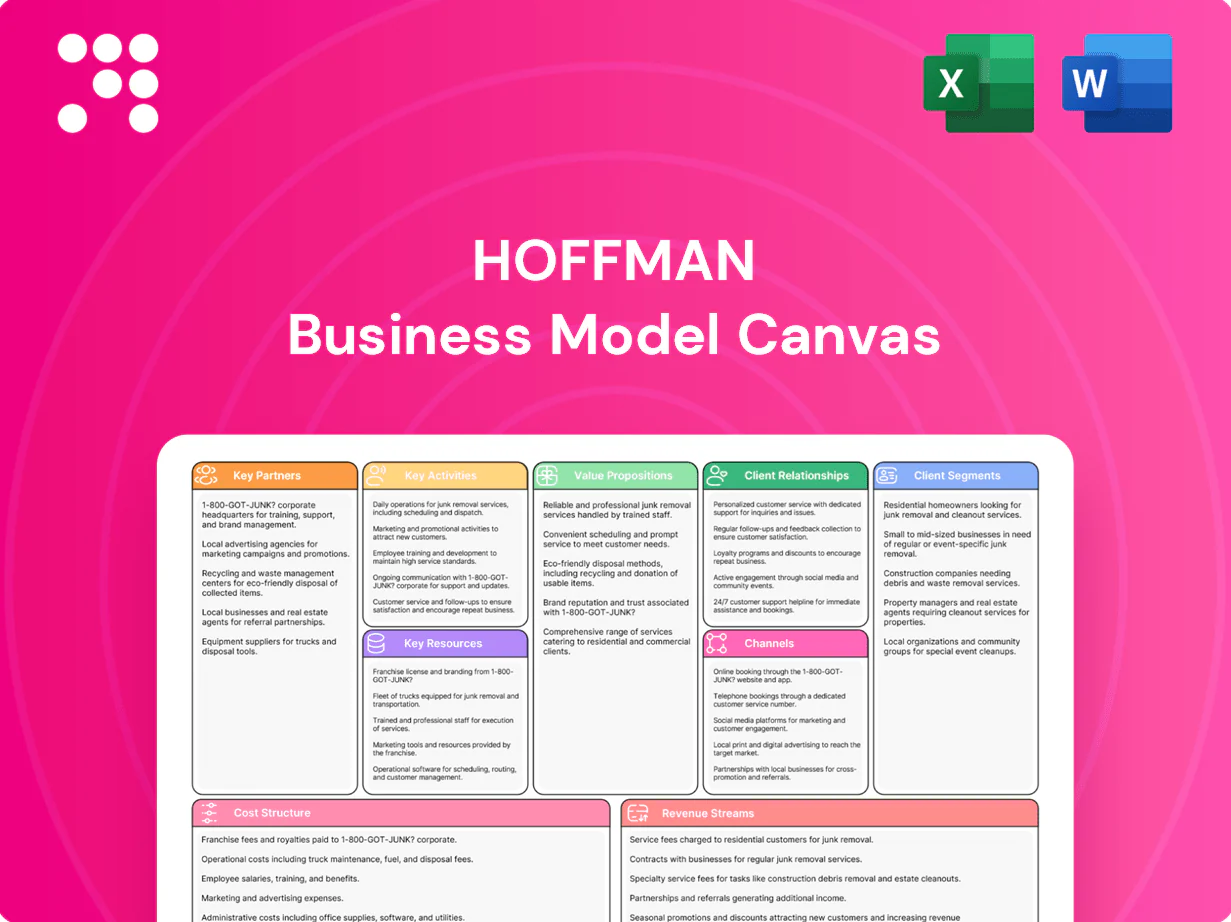
Hoffman Business Model Canvas

Unlock a complete Business Model Canvas: actionable templates for entrepreneurs and investors
Unlock Hoffman’s strategic playbook with the complete Business Model Canvas—concise, company-specific insights into customers, value propositions, channels, and revenue streams. Ideal for entrepreneurs, analysts, and investors seeking actionable strategies and ready-to-use Word/Excel templates. Purchase the full canvas to benchmark, plan, and scale with confidence.
Partnerships

Specialty trade subcontractors
Strategic alliances with MEP, structural, façade and interior specialty subcontractors secure capacity for complex scopes, where specialty trades typically execute about 70% of on-site labor and materials on large commercial builds; prequalification raises quality, safety and predictability, long-term partners drive 5–10% better pricing and schedule reliability, and joint planning cuts rework and change-order risk substantially.
Architects & engineering firms
Architects and engineering firms as design partners enable integrated delivery, value engineering, and improved constructability, with shared BIM standards—adopted by 78% of firms in 2024 (Autodesk industry survey)—streamlining coordination across trades. Early collaboration reduces design conflicts and can shorten permitting cycles, while joint pursuit teams measurably strengthen bids on complex projects, boosting competitive win rates in large-build sectors.

Technology & BIM providers
Partners for BIM, VDC, reality capture and project-management platforms drive onsite efficiency and ISO 19650–aligned workflows. Integrated tools improve clash detection and can cut rework by up to 30%, while schedule optimization shortens critical-path durations. Data-sharing platforms increase transparency with clients and subs through centralized models and dashboards. Continuous software upgrades support innovation and sustainability goals in 2024.

Suppliers & manufacturers
Direct supplier and manufacturer relationships secure material availability and shorten lead times, with many industrial contracts in 2024 tracking lead-time reductions of 15–25% versus spot-buying models. Preferred pricing and manufacturer warranties (commonly 5–10 years in 2024 equipment contracts) lower lifecycle costs for owners. Early procurement and manufacturer support aid commissioning and performance validation, mitigating market volatility.
- Lead-time certainty: contracts cut delays 15–25%
- Preferred pricing: lowers capex and O&M
- Warranties: 5–10 years standard (2024)
- Manufacturer support: speeds commissioning, validates performance
Financial, legal & insurance partners
Bonding, surety, and legal advisors enable large-scale project capacity and compliance, and in 2024 firms continued using these partners to qualify for public and private megaproject bids. Robust risk-management frameworks preserve margin and schedule through contingency and claims playbooks. Expert structuring of alternative delivery contracts (PPP, design-build) improves financing and outcomes. Comprehensive insurance programs support safety, claims resolution, and continuity.
- Bonding & surety: project eligibility
- Legal advisors: compliance & dispute avoidance
- Risk frameworks: margin & schedule protection
- Alt-delivery structuring: financing & performance
- Insurance: safety, claims, continuity
Subcontractor, BIM & supplier alliances cut costs 5–10%, cut rework 30% and speed delivery
Strategic subcontractor alliances (specialty trades ~70% of on-site labor) secure capacity, cutting costs 5–10% and improving schedule reliability; design partners with BIM (78% adoption in 2024) reduce conflicts and speed permits; tech and supplier partners cut rework up to 30% and lead times 15–25%, with warranties commonly 5–10 years.
| Partner | Benefit | 2024 Metric |
|---|---|---|
| Specialty subs | Capacity, pricing | 70% labor; 5–10% cost |
| Design/BIM | Constructability | 78% BIM adoption |
| Tech/suppliers | Less rework, faster delivery | Rework −30%; lead time −15–25% |
| Manufacturers | Warranties/support | 5–10 yr warranties |
What is included in the product
 Detailed Word Document
The Hoffman Business Model Canvas is a comprehensive, pre-written BMC tailored to a company’s strategy, covering customer segments, channels, value propositions, and operations with narrative and insights for presentations and investor discussions.

 Customizable Excel Spreadsheet
Hoffman Business Model Canvas quickly surfaces strategic gaps and pain points by condensing complex business elements into a single editable page, enabling rapid diagnosis and prioritization of fixes. Ideal for fast alignment, collaborative problem-solving, and turning insights into action without lengthy reports.
Activities

Preconstruction & estimating
Detailed takeoffs, rigorous budgeting and value engineering establish cost certainty; McKinsey found large construction projects often run 20% longer and 80% over budget, so early accuracy matters. Phased estimating ties estimates to design evolution, while constructability reviews cut change orders (commonly 5–10% of contract value). Early procurement strategy secures long‑lead items and schedule assurance.
Construction management
Site logistics, schedule control, and subcontractor coordination—with subcontractors delivering about 60% of project value—drive execution; weekly progress tracking and formal reporting keep stakeholders aligned. Rigorous QA and safety programs are enforced—construction accounts for roughly 20% of workplace fatalities, so safety reduces risk and insurance exposure. Rapid issue resolution preserves momentum and enforces budget discipline.

Design-build integration
Single-point accountability in design-build streamlines decisions and has been shown to cut delay-related claims and change orders, supporting faster delivery; collaborative design workshops align scope, cost and schedule, with DB projects delivering roughly 20–30% faster on average. BIM-led coordination reduces documentation errors and rework by about 20–40% (2024 industry studies). Rapid iteration accelerates permitting and long-lead procurement, often trimming approvals by ~25–30%.

Sustainability & commissioning
Sustainability and commissioning embed LEED, WELL and prevailing energy standards in delivery; LEED projects typically use about 25% less energy and emit 34% less CO2 (USGBC). Rigorous envelope testing and MEP commissioning ensure systems meet specs; measurement and verification (IPMVP-aligned) validate savings often within ±5–10% post-occupancy. Lifecycle cost analysis captures owner value, frequently offsetting 3–7% upfront premiums with multi-decade O&M savings.
- LEED/WELL/energy codes: 25% energy savings; 34% CO2 reduction
- Envelope testing + MEP commissioning: performance assurance
- M&V (IPMVP): validation within ±5–10%
- Lifecycle cost analysis: offsets 3–7% capex with long-term O&M savings
Safety & risk management
Comprehensive safety planning cuts incidents and insurance costs; US Census of Fatal Occupational Injuries recorded 5,190 workplace fatalities in 2022, highlighting risk exposure.
Risk registers and mitigation plans are maintained proactively; regular compliance audits under OSHA/ISO frameworks reduce regulatory penalties.
Training and culture programs elevate site behaviors, lowering claims and improving retention.
- Safety planning: incident reduction
- Risk registers: proactive mitigation
- Audits: regulatory adherence
- Training: behavioral change
BIM+design-build cuts rework 20–40%, speeds 20–30%
Detailed takeoffs, phased estimating and value engineering secure cost certainty—large projects run ~20% longer and ~80% over budget (McKinsey); subcontractors deliver ~60% of value. BIM coordination and single‑point design-build cut rework ~20–40% and speed delivery ~20–30%. LEED/commissioning yield ~25% energy savings, 34% lower CO2; M&V ±5–10%.
| Metric | Value |
|---|---|
| Schedule overrun | ~20% |
| Cost overrun | ~80% |
| Subcontractor share | ~60% |
| BIM rework reduction | 20–40% |
| LEED energy | ~25% |
| CO2 reduction | 34% |
Delivered as Displayed
Business Model Canvas
The Hoffman Business Model Canvas preview shown here is the actual deliverable, not a mockup—what you see is a direct snapshot of the file you’ll receive after purchase. Once you complete your order, you’ll get this same professionally formatted document, ready to edit and present. No placeholders, no surprises—exactly as previewed.

Unlock a complete Business Model Canvas: actionable templates for entrepreneurs and investors
Unlock Hoffman’s strategic playbook with the complete Business Model Canvas—concise, company-specific insights into customers, value propositions, channels, and revenue streams. Ideal for entrepreneurs, analysts, and investors seeking actionable strategies and ready-to-use Word/Excel templates. Purchase the full canvas to benchmark, plan, and scale with confidence.
Partnerships
Specialty trade subcontractors
Strategic alliances with MEP, structural, façade and interior specialty subcontractors secure capacity for complex scopes, where specialty trades typically execute about 70% of on-site labor and materials on large commercial builds; prequalification raises quality, safety and predictability, long-term partners drive 5–10% better pricing and schedule reliability, and joint planning cuts rework and change-order risk substantially.
Architects & engineering firms
Architects and engineering firms as design partners enable integrated delivery, value engineering, and improved constructability, with shared BIM standards—adopted by 78% of firms in 2024 (Autodesk industry survey)—streamlining coordination across trades. Early collaboration reduces design conflicts and can shorten permitting cycles, while joint pursuit teams measurably strengthen bids on complex projects, boosting competitive win rates in large-build sectors.
Technology & BIM providers
Partners for BIM, VDC, reality capture and project-management platforms drive onsite efficiency and ISO 19650–aligned workflows. Integrated tools improve clash detection and can cut rework by up to 30%, while schedule optimization shortens critical-path durations. Data-sharing platforms increase transparency with clients and subs through centralized models and dashboards. Continuous software upgrades support innovation and sustainability goals in 2024.
Suppliers & manufacturers
Direct supplier and manufacturer relationships secure material availability and shorten lead times, with many industrial contracts in 2024 tracking lead-time reductions of 15–25% versus spot-buying models. Preferred pricing and manufacturer warranties (commonly 5–10 years in 2024 equipment contracts) lower lifecycle costs for owners. Early procurement and manufacturer support aid commissioning and performance validation, mitigating market volatility.
- Lead-time certainty: contracts cut delays 15–25%
- Preferred pricing: lowers capex and O&M
- Warranties: 5–10 years standard (2024)
- Manufacturer support: speeds commissioning, validates performance
Financial, legal & insurance partners
Bonding, surety, and legal advisors enable large-scale project capacity and compliance, and in 2024 firms continued using these partners to qualify for public and private megaproject bids. Robust risk-management frameworks preserve margin and schedule through contingency and claims playbooks. Expert structuring of alternative delivery contracts (PPP, design-build) improves financing and outcomes. Comprehensive insurance programs support safety, claims resolution, and continuity.
- Bonding & surety: project eligibility
- Legal advisors: compliance & dispute avoidance
- Risk frameworks: margin & schedule protection
- Alt-delivery structuring: financing & performance
- Insurance: safety, claims, continuity
Subcontractor, BIM & supplier alliances cut costs 5–10%, cut rework 30% and speed delivery
Strategic subcontractor alliances (specialty trades ~70% of on-site labor) secure capacity, cutting costs 5–10% and improving schedule reliability; design partners with BIM (78% adoption in 2024) reduce conflicts and speed permits; tech and supplier partners cut rework up to 30% and lead times 15–25%, with warranties commonly 5–10 years.
| Partner | Benefit | 2024 Metric |
|---|---|---|
| Specialty subs | Capacity, pricing | 70% labor; 5–10% cost |
| Design/BIM | Constructability | 78% BIM adoption |
| Tech/suppliers | Less rework, faster delivery | Rework −30%; lead time −15–25% |
| Manufacturers | Warranties/support | 5–10 yr warranties |
What is included in the product
Detailed Word Document
The Hoffman Business Model Canvas is a comprehensive, pre-written BMC tailored to a company’s strategy, covering customer segments, channels, value propositions, and operations with narrative and insights for presentations and investor discussions.
Customizable Excel Spreadsheet
Hoffman Business Model Canvas quickly surfaces strategic gaps and pain points by condensing complex business elements into a single editable page, enabling rapid diagnosis and prioritization of fixes. Ideal for fast alignment, collaborative problem-solving, and turning insights into action without lengthy reports.
Activities
Preconstruction & estimating
Detailed takeoffs, rigorous budgeting and value engineering establish cost certainty; McKinsey found large construction projects often run 20% longer and 80% over budget, so early accuracy matters. Phased estimating ties estimates to design evolution, while constructability reviews cut change orders (commonly 5–10% of contract value). Early procurement strategy secures long‑lead items and schedule assurance.
Construction management
Site logistics, schedule control, and subcontractor coordination—with subcontractors delivering about 60% of project value—drive execution; weekly progress tracking and formal reporting keep stakeholders aligned. Rigorous QA and safety programs are enforced—construction accounts for roughly 20% of workplace fatalities, so safety reduces risk and insurance exposure. Rapid issue resolution preserves momentum and enforces budget discipline.
Design-build integration
Single-point accountability in design-build streamlines decisions and has been shown to cut delay-related claims and change orders, supporting faster delivery; collaborative design workshops align scope, cost and schedule, with DB projects delivering roughly 20–30% faster on average. BIM-led coordination reduces documentation errors and rework by about 20–40% (2024 industry studies). Rapid iteration accelerates permitting and long-lead procurement, often trimming approvals by ~25–30%.
Sustainability & commissioning
Sustainability and commissioning embed LEED, WELL and prevailing energy standards in delivery; LEED projects typically use about 25% less energy and emit 34% less CO2 (USGBC). Rigorous envelope testing and MEP commissioning ensure systems meet specs; measurement and verification (IPMVP-aligned) validate savings often within ±5–10% post-occupancy. Lifecycle cost analysis captures owner value, frequently offsetting 3–7% upfront premiums with multi-decade O&M savings.
- LEED/WELL/energy codes: 25% energy savings; 34% CO2 reduction
- Envelope testing + MEP commissioning: performance assurance
- M&V (IPMVP): validation within ±5–10%
- Lifecycle cost analysis: offsets 3–7% capex with long-term O&M savings
Safety & risk management
Comprehensive safety planning cuts incidents and insurance costs; US Census of Fatal Occupational Injuries recorded 5,190 workplace fatalities in 2022, highlighting risk exposure.
Risk registers and mitigation plans are maintained proactively; regular compliance audits under OSHA/ISO frameworks reduce regulatory penalties.
Training and culture programs elevate site behaviors, lowering claims and improving retention.
- Safety planning: incident reduction
- Risk registers: proactive mitigation
- Audits: regulatory adherence
- Training: behavioral change
BIM+design-build cuts rework 20–40%, speeds 20–30%
Detailed takeoffs, phased estimating and value engineering secure cost certainty—large projects run ~20% longer and ~80% over budget (McKinsey); subcontractors deliver ~60% of value. BIM coordination and single‑point design-build cut rework ~20–40% and speed delivery ~20–30%. LEED/commissioning yield ~25% energy savings, 34% lower CO2; M&V ±5–10%.
| Metric | Value |
|---|---|
| Schedule overrun | ~20% |
| Cost overrun | ~80% |
| Subcontractor share | ~60% |
| BIM rework reduction | 20–40% |
| LEED energy | ~25% |
| CO2 reduction | 34% |
Delivered as Displayed
Business Model Canvas
The Hoffman Business Model Canvas preview shown here is the actual deliverable, not a mockup—what you see is a direct snapshot of the file you’ll receive after purchase. Once you complete your order, you’ll get this same professionally formatted document, ready to edit and present. No placeholders, no surprises—exactly as previewed.
Original: $10.00
-65%$10.00
$3.50Description
Unlock a complete Business Model Canvas: actionable templates for entrepreneurs and investors
Unlock Hoffman’s strategic playbook with the complete Business Model Canvas—concise, company-specific insights into customers, value propositions, channels, and revenue streams. Ideal for entrepreneurs, analysts, and investors seeking actionable strategies and ready-to-use Word/Excel templates. Purchase the full canvas to benchmark, plan, and scale with confidence.
Partnerships
Specialty trade subcontractors
Strategic alliances with MEP, structural, façade and interior specialty subcontractors secure capacity for complex scopes, where specialty trades typically execute about 70% of on-site labor and materials on large commercial builds; prequalification raises quality, safety and predictability, long-term partners drive 5–10% better pricing and schedule reliability, and joint planning cuts rework and change-order risk substantially.
Architects & engineering firms
Architects and engineering firms as design partners enable integrated delivery, value engineering, and improved constructability, with shared BIM standards—adopted by 78% of firms in 2024 (Autodesk industry survey)—streamlining coordination across trades. Early collaboration reduces design conflicts and can shorten permitting cycles, while joint pursuit teams measurably strengthen bids on complex projects, boosting competitive win rates in large-build sectors.
Technology & BIM providers
Partners for BIM, VDC, reality capture and project-management platforms drive onsite efficiency and ISO 19650–aligned workflows. Integrated tools improve clash detection and can cut rework by up to 30%, while schedule optimization shortens critical-path durations. Data-sharing platforms increase transparency with clients and subs through centralized models and dashboards. Continuous software upgrades support innovation and sustainability goals in 2024.
Suppliers & manufacturers
Direct supplier and manufacturer relationships secure material availability and shorten lead times, with many industrial contracts in 2024 tracking lead-time reductions of 15–25% versus spot-buying models. Preferred pricing and manufacturer warranties (commonly 5–10 years in 2024 equipment contracts) lower lifecycle costs for owners. Early procurement and manufacturer support aid commissioning and performance validation, mitigating market volatility.
- Lead-time certainty: contracts cut delays 15–25%
- Preferred pricing: lowers capex and O&M
- Warranties: 5–10 years standard (2024)
- Manufacturer support: speeds commissioning, validates performance
Financial, legal & insurance partners
Bonding, surety, and legal advisors enable large-scale project capacity and compliance, and in 2024 firms continued using these partners to qualify for public and private megaproject bids. Robust risk-management frameworks preserve margin and schedule through contingency and claims playbooks. Expert structuring of alternative delivery contracts (PPP, design-build) improves financing and outcomes. Comprehensive insurance programs support safety, claims resolution, and continuity.
- Bonding & surety: project eligibility
- Legal advisors: compliance & dispute avoidance
- Risk frameworks: margin & schedule protection
- Alt-delivery structuring: financing & performance
- Insurance: safety, claims, continuity
Subcontractor, BIM & supplier alliances cut costs 5–10%, cut rework 30% and speed delivery
Strategic subcontractor alliances (specialty trades ~70% of on-site labor) secure capacity, cutting costs 5–10% and improving schedule reliability; design partners with BIM (78% adoption in 2024) reduce conflicts and speed permits; tech and supplier partners cut rework up to 30% and lead times 15–25%, with warranties commonly 5–10 years.
| Partner | Benefit | 2024 Metric |
|---|---|---|
| Specialty subs | Capacity, pricing | 70% labor; 5–10% cost |
| Design/BIM | Constructability | 78% BIM adoption |
| Tech/suppliers | Less rework, faster delivery | Rework −30%; lead time −15–25% |
| Manufacturers | Warranties/support | 5–10 yr warranties |
What is included in the product
Detailed Word Document
The Hoffman Business Model Canvas is a comprehensive, pre-written BMC tailored to a company’s strategy, covering customer segments, channels, value propositions, and operations with narrative and insights for presentations and investor discussions.
Customizable Excel Spreadsheet
Hoffman Business Model Canvas quickly surfaces strategic gaps and pain points by condensing complex business elements into a single editable page, enabling rapid diagnosis and prioritization of fixes. Ideal for fast alignment, collaborative problem-solving, and turning insights into action without lengthy reports.
Activities
Preconstruction & estimating
Detailed takeoffs, rigorous budgeting and value engineering establish cost certainty; McKinsey found large construction projects often run 20% longer and 80% over budget, so early accuracy matters. Phased estimating ties estimates to design evolution, while constructability reviews cut change orders (commonly 5–10% of contract value). Early procurement strategy secures long‑lead items and schedule assurance.
Construction management
Site logistics, schedule control, and subcontractor coordination—with subcontractors delivering about 60% of project value—drive execution; weekly progress tracking and formal reporting keep stakeholders aligned. Rigorous QA and safety programs are enforced—construction accounts for roughly 20% of workplace fatalities, so safety reduces risk and insurance exposure. Rapid issue resolution preserves momentum and enforces budget discipline.
Design-build integration
Single-point accountability in design-build streamlines decisions and has been shown to cut delay-related claims and change orders, supporting faster delivery; collaborative design workshops align scope, cost and schedule, with DB projects delivering roughly 20–30% faster on average. BIM-led coordination reduces documentation errors and rework by about 20–40% (2024 industry studies). Rapid iteration accelerates permitting and long-lead procurement, often trimming approvals by ~25–30%.
Sustainability & commissioning
Sustainability and commissioning embed LEED, WELL and prevailing energy standards in delivery; LEED projects typically use about 25% less energy and emit 34% less CO2 (USGBC). Rigorous envelope testing and MEP commissioning ensure systems meet specs; measurement and verification (IPMVP-aligned) validate savings often within ±5–10% post-occupancy. Lifecycle cost analysis captures owner value, frequently offsetting 3–7% upfront premiums with multi-decade O&M savings.
- LEED/WELL/energy codes: 25% energy savings; 34% CO2 reduction
- Envelope testing + MEP commissioning: performance assurance
- M&V (IPMVP): validation within ±5–10%
- Lifecycle cost analysis: offsets 3–7% capex with long-term O&M savings
Safety & risk management
Comprehensive safety planning cuts incidents and insurance costs; US Census of Fatal Occupational Injuries recorded 5,190 workplace fatalities in 2022, highlighting risk exposure.
Risk registers and mitigation plans are maintained proactively; regular compliance audits under OSHA/ISO frameworks reduce regulatory penalties.
Training and culture programs elevate site behaviors, lowering claims and improving retention.
- Safety planning: incident reduction
- Risk registers: proactive mitigation
- Audits: regulatory adherence
- Training: behavioral change
BIM+design-build cuts rework 20–40%, speeds 20–30%
Detailed takeoffs, phased estimating and value engineering secure cost certainty—large projects run ~20% longer and ~80% over budget (McKinsey); subcontractors deliver ~60% of value. BIM coordination and single‑point design-build cut rework ~20–40% and speed delivery ~20–30%. LEED/commissioning yield ~25% energy savings, 34% lower CO2; M&V ±5–10%.
| Metric | Value |
|---|---|
| Schedule overrun | ~20% |
| Cost overrun | ~80% |
| Subcontractor share | ~60% |
| BIM rework reduction | 20–40% |
| LEED energy | ~25% |
| CO2 reduction | 34% |
Delivered as Displayed
Business Model Canvas
The Hoffman Business Model Canvas preview shown here is the actual deliverable, not a mockup—what you see is a direct snapshot of the file you’ll receive after purchase. Once you complete your order, you’ll get this same professionally formatted document, ready to edit and present. No placeholders, no surprises—exactly as previewed.











