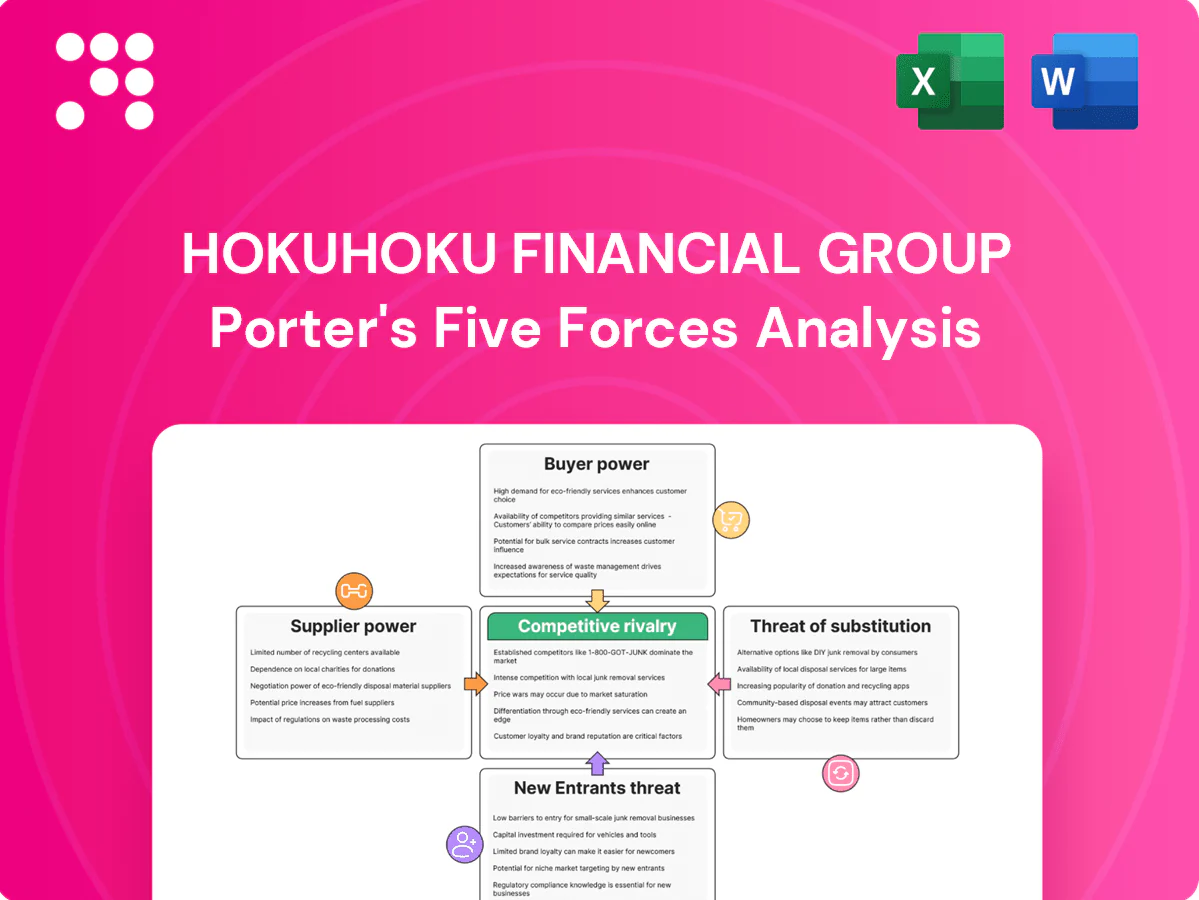
Hokuhoku Financial Group Porter's Five Forces Analysis

Go Beyond the Preview—Access the Full Strategic Report
Hokuhoku Financial Group faces moderate competitive intensity from regional peers, strong regulatory oversight, and modest threat of new entrants due to capital and relationship barriers; customer bargaining power is balanced while technology and fintech pose an emerging substitute risk. This brief snapshot only scratches the surface. Unlock the full Porter's Five Forces Analysis to explore strategic implications in detail.
Suppliers Bargaining Power

Concentrated core IT vendors
Hokuhoku relies on a small set of core-banking and payments vendors, giving suppliers leverage over pricing and upgrade timing; the global core-banking market was about USD 10 billion in 2024, concentrating bargaining power. Switching platforms typically spans multiple years and high migration costs, raising dependence and making renegotiations favor incumbents. Vendor product roadmaps therefore materially shape Hokuhoku’s digital pace and cost trajectory.
Funding from depositors
Household and SME depositors in Hokuhoku FG are highly fragmented, limiting individual bargaining power despite Japan holding about ¥1,960 trillion in household deposits (end-2023); banks rely on this retail base for stable funding. Prolonged near-zero policy rates compressed deposit pricing, but 10-year JGB yields rising to ~0.6–0.8% in 2024 show sudden rate shifts can lift funding costs. Demographic aging—Hokkaido ~5.1m population with over-65s near 29%—reduces deposit growth and shifts mix toward smaller, older accounts. Competition for large corporate deposits forces pricing concessions and higher promotional rates.

Capital market and BOJ access
Wholesale funding, bond markets and BOJ facilities give Hokuhoku Financial Group liquidity but at market-determined terms; in 2024 Japan's 10-year JGB averaged about 0.7%, tightening term costs for issuers. Stress episodes or narrowing credit spreads can spike funding costs and impose tighter covenants. Credit ratings directly affect access and pricing, indirectly strengthening capital providers' bargaining power. Regulatory shifts can change eligibility and collateral haircuts, altering funding availability.

Skilled labor and compliance talent
Skilled risk, IT and compliance talent is scarce outside major urban centers, giving employees stronger bargaining power; Japan’s unemployment hovered near 2.5% in 2024, tightening labor supply. Wage pressure is highest for cybersecurity, data and model-validation roles, with Tokyo base pay roughly 20% above regional averages, while remote work enables poaching by Tokyo firms and fintechs, lifting retention costs and operating expenses.
- Scarcity: regional talent tight — 2.5% unemployment (2024)
- Wage gap: Tokyo ~20% higher
- Cost impact: higher retention/poaching raises OPEX
Data, networks, and credit bureaus
Reliance on payment networks, three major credit bureaus, and data providers creates meaningful switching costs for Hokuhoku Financial Group; global card networks (Visa/Mastercard) still account for over 80% of cross-border transaction rails, concentrating pricing power. API and open‑banking integration deepens technical coupling, while outages or policy changes can quickly disrupt product delivery and credit-risk models.
- Concentration: pricing power with few large data suppliers
- Switching cost: integration, contracts, certification
- Dependency: APIs/open banking deepen coupling
- Operational risk: outages/policy shifts disrupt risk models
High supplier power, aging Hokkaido and funding squeeze — 10y JGB 0.7%
Supplier power is high: core‑banking vendors (global market ~USD 10bn in 2024) and major card/data networks (>80% rails) set pricing and upgrade timing. Retail funding is fragmented (¥1,960tn household deposits end‑2023) but aging Hokkaido (pop ~5.1m; 65+ ~29%) reduces growth. Wholesale funding costs rose with 10y JGB ~0.7% (2024). Talent scarce — Japan unemployment ~2.5% (2024); Tokyo pay ~20% premium.
| Factor | 2024/2023 metric |
|---|---|
| Core vendors | USD 10bn market (2024) |
| Household deposits | ¥1,960tn (end‑2023) |
| 10y JGB | ~0.7% (2024) |
| Labor | Unemp 2.5% (2024); Tokyo +20% pay |
What is included in the product
 Detailed Word Document
Tailored exclusively for Hokuhoku Financial Group, this Porter's Five Forces overview uncovers key drivers of competition, buyer/supplier influence, entry barriers, substitutes and disruptive threats to its market position.

 Customizable Excel Spreadsheet
One-sheet Porter's Five Forces for Hokuhoku Financial Group—clear radar visualization and customizable pressure levels to instantly identify competitive pain points; clean, no-macros layout ready for decks, easy data swaps, and seamless integration into Excel dashboards or the companion Word report.
Customers Bargaining Power

SMEs with multi-banking
Regional SMEs commonly maintain multiple banking relationships, giving them strong leverage to negotiate fees and loan pricing. They can credibly threaten to reallocate transaction volumes, pressuring Hokuhoku Financial Group to match terms. Competitive tendering of credit among regional banks compresses margins. Even where relationship depth exists, SMEs remain highly price-sensitive and likely to switch for better rates.
Retail customers’ low switching costs
Digital onboarding and instant transfers have lowered switching friction, with over 80% of Japanese retail customers using online banking channels in 2024, enabling faster account or loan moves.
Comparison sites and fintech aggregators have raised pricing transparency, while targeted incentives from competitors frequently trigger churn among price-sensitive segments.
Brand trust and branch proximity still retain customers, particularly older demographics and corporate clients, partially offsetting digital mobility.

Large corporates’ scale
Bigger corporates in Hokkaido and Hokuriku routinely secure bespoke loan terms and narrower spreads by auctioning mandates among megabanks and regionals; they also leverage ancillary wallet services such as FX and cash management for pricing concessions. With Hokkaido population about 5.1 million and Hokuriku roughly 3 million in 2024, client concentration amplifies Hokuhoku Financial Group’s sensitivity to a few large borrowers’ demands.

Price transparency in low-rate Japan
Compressed yields in low-rate Japan make customers extremely price-aware across deposits, mortgages and SME loans; retail deposit rates remain effectively near 0% while the 10-year JGB averaged about 0.9% in 2024, so small pricing gaps drive switching and negotiation.
- Price sensitivity: high
- Digital fee-free: baseline expectation
- Small spread moves retention
- Cross-sell must justify premium
Wealth clients’ platform choice
- Client comparison set: securities firms, robo-advisors, online brokers
- Fee pressure: robo ~0.25% vs bank ~0.8–1.0% (2024)
- Portability: higher switching increases bargaining power
- Retention lever: differentiated advisory and research
Regional banks squeezed by ≈80% online adoption and robo advisors
Regional SMEs and corporates wield strong price leverage via multi-bank relationships and tendering, forcing fee and spread competition. Digital adoption (≈80% online banking in Japan, 2024) and fintech comparators lower switching costs; concentrated regional client bases (Hokkaido 5.1M, Hokuriku 3M, 2024) amplify sensitivity. Robo-advisor disruption (global AUM ≈1.4T USD, robo fees ≈0.25% vs bank 0.8–1.0%, 2024) intensifies fee pressure.
| Metric | Value (2024) |
|---|---|
| Online banking adoption | ≈80% |
| 10y JGB | ≈0.9% |
| Hokkaido population | 5.1M |
| Robo-advisor global AUM | ≈1.4T USD |
Full Version Awaits
Hokuhoku Financial Group Porter's Five Forces Analysis
This preview shows the exact Hokuhoku Financial Group Porter’s Five Forces analysis you'll receive after purchase—no placeholders. It is the full, professionally formatted document, ready for download and use immediately. The content covers competitive rivalry, buyer and supplier power, and threats of substitutes and entrants with actionable insights. No mockups; this is the deliverable.

Go Beyond the Preview—Access the Full Strategic Report
Hokuhoku Financial Group faces moderate competitive intensity from regional peers, strong regulatory oversight, and modest threat of new entrants due to capital and relationship barriers; customer bargaining power is balanced while technology and fintech pose an emerging substitute risk. This brief snapshot only scratches the surface. Unlock the full Porter's Five Forces Analysis to explore strategic implications in detail.
Suppliers Bargaining Power
Concentrated core IT vendors
Hokuhoku relies on a small set of core-banking and payments vendors, giving suppliers leverage over pricing and upgrade timing; the global core-banking market was about USD 10 billion in 2024, concentrating bargaining power. Switching platforms typically spans multiple years and high migration costs, raising dependence and making renegotiations favor incumbents. Vendor product roadmaps therefore materially shape Hokuhoku’s digital pace and cost trajectory.
Funding from depositors
Household and SME depositors in Hokuhoku FG are highly fragmented, limiting individual bargaining power despite Japan holding about ¥1,960 trillion in household deposits (end-2023); banks rely on this retail base for stable funding. Prolonged near-zero policy rates compressed deposit pricing, but 10-year JGB yields rising to ~0.6–0.8% in 2024 show sudden rate shifts can lift funding costs. Demographic aging—Hokkaido ~5.1m population with over-65s near 29%—reduces deposit growth and shifts mix toward smaller, older accounts. Competition for large corporate deposits forces pricing concessions and higher promotional rates.
Capital market and BOJ access
Wholesale funding, bond markets and BOJ facilities give Hokuhoku Financial Group liquidity but at market-determined terms; in 2024 Japan's 10-year JGB averaged about 0.7%, tightening term costs for issuers. Stress episodes or narrowing credit spreads can spike funding costs and impose tighter covenants. Credit ratings directly affect access and pricing, indirectly strengthening capital providers' bargaining power. Regulatory shifts can change eligibility and collateral haircuts, altering funding availability.
Skilled labor and compliance talent
Skilled risk, IT and compliance talent is scarce outside major urban centers, giving employees stronger bargaining power; Japan’s unemployment hovered near 2.5% in 2024, tightening labor supply. Wage pressure is highest for cybersecurity, data and model-validation roles, with Tokyo base pay roughly 20% above regional averages, while remote work enables poaching by Tokyo firms and fintechs, lifting retention costs and operating expenses.
- Scarcity: regional talent tight — 2.5% unemployment (2024)
- Wage gap: Tokyo ~20% higher
- Cost impact: higher retention/poaching raises OPEX
Data, networks, and credit bureaus
Reliance on payment networks, three major credit bureaus, and data providers creates meaningful switching costs for Hokuhoku Financial Group; global card networks (Visa/Mastercard) still account for over 80% of cross-border transaction rails, concentrating pricing power. API and open‑banking integration deepens technical coupling, while outages or policy changes can quickly disrupt product delivery and credit-risk models.
- Concentration: pricing power with few large data suppliers
- Switching cost: integration, contracts, certification
- Dependency: APIs/open banking deepen coupling
- Operational risk: outages/policy shifts disrupt risk models
High supplier power, aging Hokkaido and funding squeeze — 10y JGB 0.7%
Supplier power is high: core‑banking vendors (global market ~USD 10bn in 2024) and major card/data networks (>80% rails) set pricing and upgrade timing. Retail funding is fragmented (¥1,960tn household deposits end‑2023) but aging Hokkaido (pop ~5.1m; 65+ ~29%) reduces growth. Wholesale funding costs rose with 10y JGB ~0.7% (2024). Talent scarce — Japan unemployment ~2.5% (2024); Tokyo pay ~20% premium.
| Factor | 2024/2023 metric |
|---|---|
| Core vendors | USD 10bn market (2024) |
| Household deposits | ¥1,960tn (end‑2023) |
| 10y JGB | ~0.7% (2024) |
| Labor | Unemp 2.5% (2024); Tokyo +20% pay |
What is included in the product
Detailed Word Document
Tailored exclusively for Hokuhoku Financial Group, this Porter's Five Forces overview uncovers key drivers of competition, buyer/supplier influence, entry barriers, substitutes and disruptive threats to its market position.
Customizable Excel Spreadsheet
One-sheet Porter's Five Forces for Hokuhoku Financial Group—clear radar visualization and customizable pressure levels to instantly identify competitive pain points; clean, no-macros layout ready for decks, easy data swaps, and seamless integration into Excel dashboards or the companion Word report.
Customers Bargaining Power
SMEs with multi-banking
Regional SMEs commonly maintain multiple banking relationships, giving them strong leverage to negotiate fees and loan pricing. They can credibly threaten to reallocate transaction volumes, pressuring Hokuhoku Financial Group to match terms. Competitive tendering of credit among regional banks compresses margins. Even where relationship depth exists, SMEs remain highly price-sensitive and likely to switch for better rates.
Retail customers’ low switching costs
Digital onboarding and instant transfers have lowered switching friction, with over 80% of Japanese retail customers using online banking channels in 2024, enabling faster account or loan moves.
Comparison sites and fintech aggregators have raised pricing transparency, while targeted incentives from competitors frequently trigger churn among price-sensitive segments.
Brand trust and branch proximity still retain customers, particularly older demographics and corporate clients, partially offsetting digital mobility.
Large corporates’ scale
Bigger corporates in Hokkaido and Hokuriku routinely secure bespoke loan terms and narrower spreads by auctioning mandates among megabanks and regionals; they also leverage ancillary wallet services such as FX and cash management for pricing concessions. With Hokkaido population about 5.1 million and Hokuriku roughly 3 million in 2024, client concentration amplifies Hokuhoku Financial Group’s sensitivity to a few large borrowers’ demands.
Price transparency in low-rate Japan
Compressed yields in low-rate Japan make customers extremely price-aware across deposits, mortgages and SME loans; retail deposit rates remain effectively near 0% while the 10-year JGB averaged about 0.9% in 2024, so small pricing gaps drive switching and negotiation.
- Price sensitivity: high
- Digital fee-free: baseline expectation
- Small spread moves retention
- Cross-sell must justify premium
Wealth clients’ platform choice
- Client comparison set: securities firms, robo-advisors, online brokers
- Fee pressure: robo ~0.25% vs bank ~0.8–1.0% (2024)
- Portability: higher switching increases bargaining power
- Retention lever: differentiated advisory and research
Regional banks squeezed by ≈80% online adoption and robo advisors
Regional SMEs and corporates wield strong price leverage via multi-bank relationships and tendering, forcing fee and spread competition. Digital adoption (≈80% online banking in Japan, 2024) and fintech comparators lower switching costs; concentrated regional client bases (Hokkaido 5.1M, Hokuriku 3M, 2024) amplify sensitivity. Robo-advisor disruption (global AUM ≈1.4T USD, robo fees ≈0.25% vs bank 0.8–1.0%, 2024) intensifies fee pressure.
| Metric | Value (2024) |
|---|---|
| Online banking adoption | ≈80% |
| 10y JGB | ≈0.9% |
| Hokkaido population | 5.1M |
| Robo-advisor global AUM | ≈1.4T USD |
Full Version Awaits
Hokuhoku Financial Group Porter's Five Forces Analysis
This preview shows the exact Hokuhoku Financial Group Porter’s Five Forces analysis you'll receive after purchase—no placeholders. It is the full, professionally formatted document, ready for download and use immediately. The content covers competitive rivalry, buyer and supplier power, and threats of substitutes and entrants with actionable insights. No mockups; this is the deliverable.
Original: $10.00
-65%$10.00
$3.50Description
Go Beyond the Preview—Access the Full Strategic Report
Hokuhoku Financial Group faces moderate competitive intensity from regional peers, strong regulatory oversight, and modest threat of new entrants due to capital and relationship barriers; customer bargaining power is balanced while technology and fintech pose an emerging substitute risk. This brief snapshot only scratches the surface. Unlock the full Porter's Five Forces Analysis to explore strategic implications in detail.
Suppliers Bargaining Power
Concentrated core IT vendors
Hokuhoku relies on a small set of core-banking and payments vendors, giving suppliers leverage over pricing and upgrade timing; the global core-banking market was about USD 10 billion in 2024, concentrating bargaining power. Switching platforms typically spans multiple years and high migration costs, raising dependence and making renegotiations favor incumbents. Vendor product roadmaps therefore materially shape Hokuhoku’s digital pace and cost trajectory.
Funding from depositors
Household and SME depositors in Hokuhoku FG are highly fragmented, limiting individual bargaining power despite Japan holding about ¥1,960 trillion in household deposits (end-2023); banks rely on this retail base for stable funding. Prolonged near-zero policy rates compressed deposit pricing, but 10-year JGB yields rising to ~0.6–0.8% in 2024 show sudden rate shifts can lift funding costs. Demographic aging—Hokkaido ~5.1m population with over-65s near 29%—reduces deposit growth and shifts mix toward smaller, older accounts. Competition for large corporate deposits forces pricing concessions and higher promotional rates.
Capital market and BOJ access
Wholesale funding, bond markets and BOJ facilities give Hokuhoku Financial Group liquidity but at market-determined terms; in 2024 Japan's 10-year JGB averaged about 0.7%, tightening term costs for issuers. Stress episodes or narrowing credit spreads can spike funding costs and impose tighter covenants. Credit ratings directly affect access and pricing, indirectly strengthening capital providers' bargaining power. Regulatory shifts can change eligibility and collateral haircuts, altering funding availability.
Skilled labor and compliance talent
Skilled risk, IT and compliance talent is scarce outside major urban centers, giving employees stronger bargaining power; Japan’s unemployment hovered near 2.5% in 2024, tightening labor supply. Wage pressure is highest for cybersecurity, data and model-validation roles, with Tokyo base pay roughly 20% above regional averages, while remote work enables poaching by Tokyo firms and fintechs, lifting retention costs and operating expenses.
- Scarcity: regional talent tight — 2.5% unemployment (2024)
- Wage gap: Tokyo ~20% higher
- Cost impact: higher retention/poaching raises OPEX
Data, networks, and credit bureaus
Reliance on payment networks, three major credit bureaus, and data providers creates meaningful switching costs for Hokuhoku Financial Group; global card networks (Visa/Mastercard) still account for over 80% of cross-border transaction rails, concentrating pricing power. API and open‑banking integration deepens technical coupling, while outages or policy changes can quickly disrupt product delivery and credit-risk models.
- Concentration: pricing power with few large data suppliers
- Switching cost: integration, contracts, certification
- Dependency: APIs/open banking deepen coupling
- Operational risk: outages/policy shifts disrupt risk models
High supplier power, aging Hokkaido and funding squeeze — 10y JGB 0.7%
Supplier power is high: core‑banking vendors (global market ~USD 10bn in 2024) and major card/data networks (>80% rails) set pricing and upgrade timing. Retail funding is fragmented (¥1,960tn household deposits end‑2023) but aging Hokkaido (pop ~5.1m; 65+ ~29%) reduces growth. Wholesale funding costs rose with 10y JGB ~0.7% (2024). Talent scarce — Japan unemployment ~2.5% (2024); Tokyo pay ~20% premium.
| Factor | 2024/2023 metric |
|---|---|
| Core vendors | USD 10bn market (2024) |
| Household deposits | ¥1,960tn (end‑2023) |
| 10y JGB | ~0.7% (2024) |
| Labor | Unemp 2.5% (2024); Tokyo +20% pay |
What is included in the product
Detailed Word Document
Tailored exclusively for Hokuhoku Financial Group, this Porter's Five Forces overview uncovers key drivers of competition, buyer/supplier influence, entry barriers, substitutes and disruptive threats to its market position.
Customizable Excel Spreadsheet
One-sheet Porter's Five Forces for Hokuhoku Financial Group—clear radar visualization and customizable pressure levels to instantly identify competitive pain points; clean, no-macros layout ready for decks, easy data swaps, and seamless integration into Excel dashboards or the companion Word report.
Customers Bargaining Power
SMEs with multi-banking
Regional SMEs commonly maintain multiple banking relationships, giving them strong leverage to negotiate fees and loan pricing. They can credibly threaten to reallocate transaction volumes, pressuring Hokuhoku Financial Group to match terms. Competitive tendering of credit among regional banks compresses margins. Even where relationship depth exists, SMEs remain highly price-sensitive and likely to switch for better rates.
Retail customers’ low switching costs
Digital onboarding and instant transfers have lowered switching friction, with over 80% of Japanese retail customers using online banking channels in 2024, enabling faster account or loan moves.
Comparison sites and fintech aggregators have raised pricing transparency, while targeted incentives from competitors frequently trigger churn among price-sensitive segments.
Brand trust and branch proximity still retain customers, particularly older demographics and corporate clients, partially offsetting digital mobility.
Large corporates’ scale
Bigger corporates in Hokkaido and Hokuriku routinely secure bespoke loan terms and narrower spreads by auctioning mandates among megabanks and regionals; they also leverage ancillary wallet services such as FX and cash management for pricing concessions. With Hokkaido population about 5.1 million and Hokuriku roughly 3 million in 2024, client concentration amplifies Hokuhoku Financial Group’s sensitivity to a few large borrowers’ demands.
Price transparency in low-rate Japan
Compressed yields in low-rate Japan make customers extremely price-aware across deposits, mortgages and SME loans; retail deposit rates remain effectively near 0% while the 10-year JGB averaged about 0.9% in 2024, so small pricing gaps drive switching and negotiation.
- Price sensitivity: high
- Digital fee-free: baseline expectation
- Small spread moves retention
- Cross-sell must justify premium
Wealth clients’ platform choice
- Client comparison set: securities firms, robo-advisors, online brokers
- Fee pressure: robo ~0.25% vs bank ~0.8–1.0% (2024)
- Portability: higher switching increases bargaining power
- Retention lever: differentiated advisory and research
Regional banks squeezed by ≈80% online adoption and robo advisors
Regional SMEs and corporates wield strong price leverage via multi-bank relationships and tendering, forcing fee and spread competition. Digital adoption (≈80% online banking in Japan, 2024) and fintech comparators lower switching costs; concentrated regional client bases (Hokkaido 5.1M, Hokuriku 3M, 2024) amplify sensitivity. Robo-advisor disruption (global AUM ≈1.4T USD, robo fees ≈0.25% vs bank 0.8–1.0%, 2024) intensifies fee pressure.
| Metric | Value (2024) |
|---|---|
| Online banking adoption | ≈80% |
| 10y JGB | ≈0.9% |
| Hokkaido population | 5.1M |
| Robo-advisor global AUM | ≈1.4T USD |
Full Version Awaits
Hokuhoku Financial Group Porter's Five Forces Analysis
This preview shows the exact Hokuhoku Financial Group Porter’s Five Forces analysis you'll receive after purchase—no placeholders. It is the full, professionally formatted document, ready for download and use immediately. The content covers competitive rivalry, buyer and supplier power, and threats of substitutes and entrants with actionable insights. No mockups; this is the deliverable.











