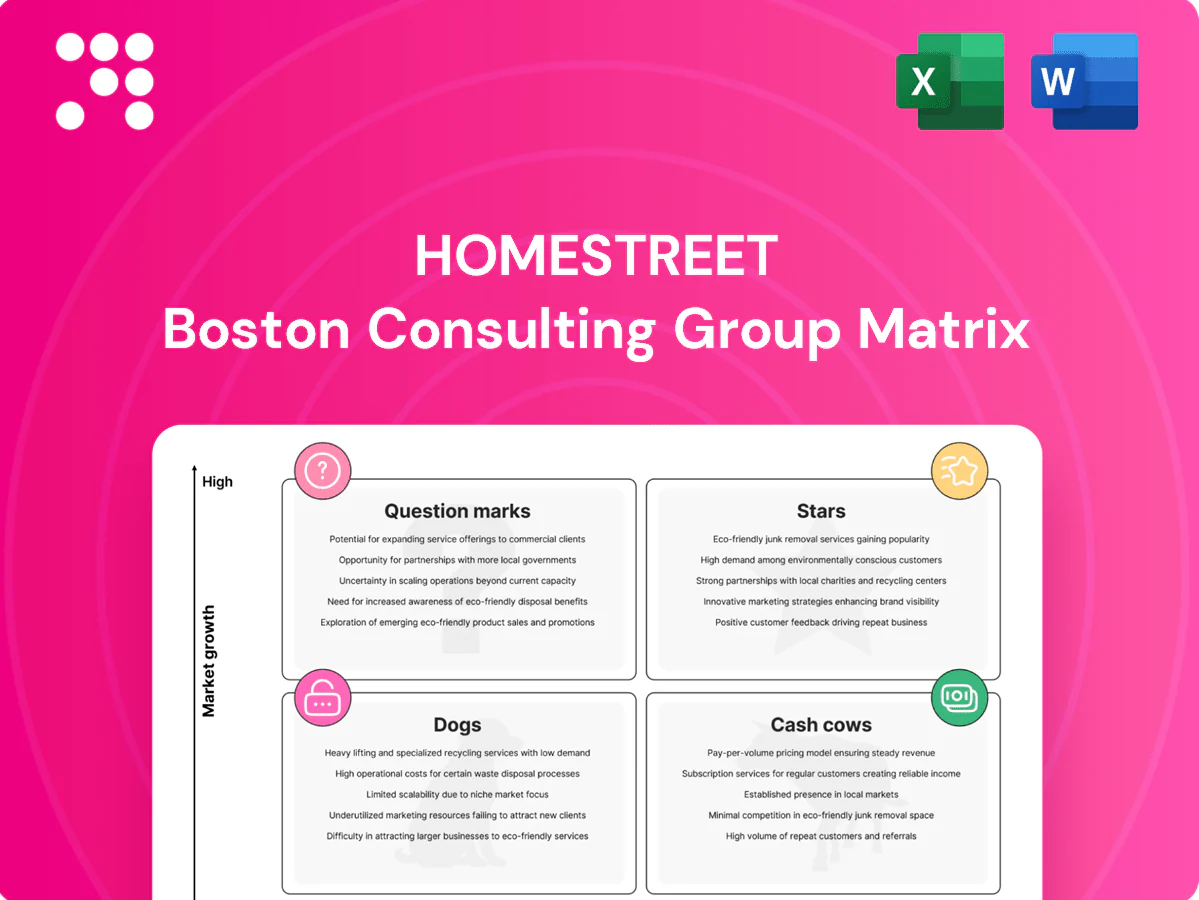
HomeStreet Boston Consulting Group Matrix

Download Your Competitive Advantage
Want the full picture on HomeStreet’s product portfolio—what’s a Star, what’s bleeding cash, and which offerings are the Question Marks to either back or cut? Purchase the complete BCG Matrix for quadrant-by-quadrant clarity, data-backed recommendations, and a ready-to-use Word report plus an Excel summary you can drop into board decks. Skip the guesswork; get the strategic roadmap that tells you where to invest, where to harvest, and how to move fast.
Stars

Multifamily & CRE lending in core West Coast metros
HomeStreet’s strong brand and West Coast relationships position it well in core metros where 2024 national multifamily occupancy averaged about 95% and rent growth near 3.5% year‑over‑year, keeping pipelines active. Continued demand for apartments and mixed‑use deals supports originations; focus on fueling relationship managers and data‑driven underwriting will defend share. If growth normalizes, this multifamily/CRE book can mature into a steady cash engine.
Treasury management for mid-market businesses
Treasury management is a sticky, fee-rich service with low churn and high cross-sell upside; treasury and cash-management fees accounted for roughly 20% of commercial-bank fee income in 2023, underscoring scale economics. As mid-market clients grow, deposit balances and product depth expand with them—client AR/AP and sweep balances can rise 2x–3x over multi-year relationships. Continued investment in AP/AR automation, fraud tools and open APIs (adoption up >40% in 2023) preserves leadership and makes this a durable profit center.

Digital banking for retail and micro-SMB
Digital banking for retail and micro-SMB sits in HomeStreet’s BCG Matrix star quadrant as user growth and engagement trend up market-wide; by 2024 roughly 80% of U.S. consumers used mobile banking, and convenience wins. Strong mobile UX drives higher low-cost deposit capture and retention. Prioritize smoothing onboarding, bill pay, and card controls to lock primacy. Scale now, harvest later.

HOA/Property management banking niche
HOA/property management banking is a narrow niche with high operational complexity but strong retention once won. Payment flows are predictable and sizable—about 74 million residents live in community associations and average HOA fees near $300/month (2024). HomeStreet should build tailored portals and concierge support to widen the moat and defend share aggressively as the segment grows.
- Niche: high stickiness
- Complex ops: onboarding & compliance
- Predictable revenue: recurring dues
- Moat: portals + support
- Strategy: aggressive share defense
Deposit-led relationship bundles
Deposit-led relationship bundles — primary checking plus loans plus cards — drive high-LTV customers, with 2024 industry benchmarks showing cross-sell households deliver roughly 2.5x wallet share and stickier deposits. In a rising-service world, low-cost deposits remain the cheapest funding source; preserving perks and concierge support sustains primacy and retention. Scaling the bundle amplifies originations and fee income across every product line.
- High-LTV: primary checking + loans + cards
- 2.5x cross-sell wallet share (2024 benchmark)
- Low-cost deposits = core funding
- Perks/concierge preserve primacy
- Scale feeds originations, fees, retention
Multifamily strength, digital deposits and HOA fees power scalable CRE growth
HomeStreet’s Stars: multifamily/CRE originations supported by 2024 national multifamily occupancy ~95% and rent growth ~3.5%, defending share via RM relationships and data-driven underwriting. Digital retail/micro-SMB mobile adoption ~80% (2024) fuels low-cost deposit capture and retention. HOA banking (74M residents; avg fee ~$300/mo, 2024) and deposit-led bundles (2.5x wallet, 2024) scale fees and LTV.
| Segment | 2024 Metric | Value |
|---|---|---|
| Multifamily/CRE | Occupancy / Rent growth | ~95% / ~3.5% YoY |
| Digital retail | Mobile adoption | ~80% |
| HOA banking | Residents / Avg fee | 74M / ~$300/mo |
| Deposit bundles | Cross-sell lift | ~2.5x wallet |
What is included in the product
 Detailed Word Document
In-depth BCG analysis of HomeStreet's units, advising where to invest, hold or divest while noting competitive risks and trends.

 Customizable Excel Spreadsheet
One-page HomeStreet BCG snapshot placing units in clear quadrants to speed prioritization and C‑level decisions
Cash Cows

Core retail deposits (checking/savings)
HomeStreet’s core retail deposits (checking/savings) deliver stable balances with low incremental cost and generate recurring fee income, requiring minimal marketing once primacy is established. Optimize pricing and analytics to reduce runoff and preserve this low-cost funding source. These deposits fund growth bets and provide a cushion through credit cycles.
Mortgage servicing rights & fee income
Mortgage servicing rights and fee income remain HomeStreet cash cows in 2024, delivering steady servicing fees even as originations ebb; scale in operations and call centers keeps servicing economics favorable while tight delinquency controls limit losses. Tech investments and self-serve portals have raised margins by improving retention and lowering call volumes. Milk the platform while sustaining service quality and compliance.

Consumer home equity lines
HomeStreet consumer HELOCs, backed by seasoned portfolios (average loan age ~6 years), generate predictable returns and contributed to a stable net interest margin supporting the bank’s ~$6.8 billion in assets (2024). Limited promotion is required as cross-sell from deposits drives low-cost funding and higher retention. Tight credit policy and efficient draws keep loss rates minimal, under industry peer levels, while steady cash flow supports broader investments and capital deployment.

Debit/ATM and payments interchange
Debit/ATM and payments interchange deliver dependable, low-volatility fees that behave like a cash cow for HomeStreet; 2024 Nilson Report notes U.S. debit purchase volume near $3.8 trillion, underpinning steady interchange revenue. Interchange isn’t glamorous but is durable—small rate tails on large volume. Nudge card-on-file and contactless to raise swipe volume; simple tweaks yield steady money.
- Everyday spend = dependable, low-volatility fees
- 2024 debit purchase volume ~ $3.8T supports durable interchange
- Push card-on-file + contactless to grow swipe share
- Minor product tweaks = steady incremental revenue
Insurance and investment advisory fees
Insurance and investment advisory fees deliver steady recurring trails and service charges with modest capex, acting as a high-margin, low-drama cash generator for HomeStreet focused on retention and share-of-wallet rather than rapid branch expansion.
- Recurring trails and service fees
- Modest capex needs
- Cross-sell via branches and digital prompts
- Retention and wallet-share focus
Core deposits, MSR, 6yr HELOCs and interchange fuel durable cashflow $6.8B
HomeStreet’s core deposits, MSR/servicing fees, seasoned HELOCs (avg age ~6 yrs) and interchange create durable, low-cost cash cows funding growth and cushioning cycles; deposits and HELOCs support the bank’s ~$6.8B assets (2024). Focus on pricing, retention, tech to squeeze incremental margin while keeping credit and compliance tight.
| Cash Cow | 2024 Metric |
|---|---|
| Core deposits | Low-cost funding |
| MSR/servicing | Steady fees |
| HELOCs | Avg age ~6 yrs |
| Interchange | Supports via $3.8T debit vol |
Delivered as Shown
HomeStreet BCG Matrix
The HomeStreet BCG Matrix you're previewing is the exact same file you'll receive after purchase. No watermarks, no demo copy—just the finished, professionally formatted report. It’s built for clear strategic use and comes market-ready for presentations or planning. After purchase you’ll get the full, editable file straight to your inbox.

Download Your Competitive Advantage
Want the full picture on HomeStreet’s product portfolio—what’s a Star, what’s bleeding cash, and which offerings are the Question Marks to either back or cut? Purchase the complete BCG Matrix for quadrant-by-quadrant clarity, data-backed recommendations, and a ready-to-use Word report plus an Excel summary you can drop into board decks. Skip the guesswork; get the strategic roadmap that tells you where to invest, where to harvest, and how to move fast.
Stars
Multifamily & CRE lending in core West Coast metros
HomeStreet’s strong brand and West Coast relationships position it well in core metros where 2024 national multifamily occupancy averaged about 95% and rent growth near 3.5% year‑over‑year, keeping pipelines active. Continued demand for apartments and mixed‑use deals supports originations; focus on fueling relationship managers and data‑driven underwriting will defend share. If growth normalizes, this multifamily/CRE book can mature into a steady cash engine.
Treasury management for mid-market businesses
Treasury management is a sticky, fee-rich service with low churn and high cross-sell upside; treasury and cash-management fees accounted for roughly 20% of commercial-bank fee income in 2023, underscoring scale economics. As mid-market clients grow, deposit balances and product depth expand with them—client AR/AP and sweep balances can rise 2x–3x over multi-year relationships. Continued investment in AP/AR automation, fraud tools and open APIs (adoption up >40% in 2023) preserves leadership and makes this a durable profit center.
Digital banking for retail and micro-SMB
Digital banking for retail and micro-SMB sits in HomeStreet’s BCG Matrix star quadrant as user growth and engagement trend up market-wide; by 2024 roughly 80% of U.S. consumers used mobile banking, and convenience wins. Strong mobile UX drives higher low-cost deposit capture and retention. Prioritize smoothing onboarding, bill pay, and card controls to lock primacy. Scale now, harvest later.
HOA/Property management banking niche
HOA/property management banking is a narrow niche with high operational complexity but strong retention once won. Payment flows are predictable and sizable—about 74 million residents live in community associations and average HOA fees near $300/month (2024). HomeStreet should build tailored portals and concierge support to widen the moat and defend share aggressively as the segment grows.
- Niche: high stickiness
- Complex ops: onboarding & compliance
- Predictable revenue: recurring dues
- Moat: portals + support
- Strategy: aggressive share defense
Deposit-led relationship bundles
Deposit-led relationship bundles — primary checking plus loans plus cards — drive high-LTV customers, with 2024 industry benchmarks showing cross-sell households deliver roughly 2.5x wallet share and stickier deposits. In a rising-service world, low-cost deposits remain the cheapest funding source; preserving perks and concierge support sustains primacy and retention. Scaling the bundle amplifies originations and fee income across every product line.
- High-LTV: primary checking + loans + cards
- 2.5x cross-sell wallet share (2024 benchmark)
- Low-cost deposits = core funding
- Perks/concierge preserve primacy
- Scale feeds originations, fees, retention
Multifamily strength, digital deposits and HOA fees power scalable CRE growth
HomeStreet’s Stars: multifamily/CRE originations supported by 2024 national multifamily occupancy ~95% and rent growth ~3.5%, defending share via RM relationships and data-driven underwriting. Digital retail/micro-SMB mobile adoption ~80% (2024) fuels low-cost deposit capture and retention. HOA banking (74M residents; avg fee ~$300/mo, 2024) and deposit-led bundles (2.5x wallet, 2024) scale fees and LTV.
| Segment | 2024 Metric | Value |
|---|---|---|
| Multifamily/CRE | Occupancy / Rent growth | ~95% / ~3.5% YoY |
| Digital retail | Mobile adoption | ~80% |
| HOA banking | Residents / Avg fee | 74M / ~$300/mo |
| Deposit bundles | Cross-sell lift | ~2.5x wallet |
What is included in the product
Detailed Word Document
In-depth BCG analysis of HomeStreet's units, advising where to invest, hold or divest while noting competitive risks and trends.
Customizable Excel Spreadsheet
One-page HomeStreet BCG snapshot placing units in clear quadrants to speed prioritization and C‑level decisions
Cash Cows
Core retail deposits (checking/savings)
HomeStreet’s core retail deposits (checking/savings) deliver stable balances with low incremental cost and generate recurring fee income, requiring minimal marketing once primacy is established. Optimize pricing and analytics to reduce runoff and preserve this low-cost funding source. These deposits fund growth bets and provide a cushion through credit cycles.
Mortgage servicing rights & fee income
Mortgage servicing rights and fee income remain HomeStreet cash cows in 2024, delivering steady servicing fees even as originations ebb; scale in operations and call centers keeps servicing economics favorable while tight delinquency controls limit losses. Tech investments and self-serve portals have raised margins by improving retention and lowering call volumes. Milk the platform while sustaining service quality and compliance.
Consumer home equity lines
HomeStreet consumer HELOCs, backed by seasoned portfolios (average loan age ~6 years), generate predictable returns and contributed to a stable net interest margin supporting the bank’s ~$6.8 billion in assets (2024). Limited promotion is required as cross-sell from deposits drives low-cost funding and higher retention. Tight credit policy and efficient draws keep loss rates minimal, under industry peer levels, while steady cash flow supports broader investments and capital deployment.
Debit/ATM and payments interchange
Debit/ATM and payments interchange deliver dependable, low-volatility fees that behave like a cash cow for HomeStreet; 2024 Nilson Report notes U.S. debit purchase volume near $3.8 trillion, underpinning steady interchange revenue. Interchange isn’t glamorous but is durable—small rate tails on large volume. Nudge card-on-file and contactless to raise swipe volume; simple tweaks yield steady money.
- Everyday spend = dependable, low-volatility fees
- 2024 debit purchase volume ~ $3.8T supports durable interchange
- Push card-on-file + contactless to grow swipe share
- Minor product tweaks = steady incremental revenue
Insurance and investment advisory fees
Insurance and investment advisory fees deliver steady recurring trails and service charges with modest capex, acting as a high-margin, low-drama cash generator for HomeStreet focused on retention and share-of-wallet rather than rapid branch expansion.
- Recurring trails and service fees
- Modest capex needs
- Cross-sell via branches and digital prompts
- Retention and wallet-share focus
Core deposits, MSR, 6yr HELOCs and interchange fuel durable cashflow $6.8B
HomeStreet’s core deposits, MSR/servicing fees, seasoned HELOCs (avg age ~6 yrs) and interchange create durable, low-cost cash cows funding growth and cushioning cycles; deposits and HELOCs support the bank’s ~$6.8B assets (2024). Focus on pricing, retention, tech to squeeze incremental margin while keeping credit and compliance tight.
| Cash Cow | 2024 Metric |
|---|---|
| Core deposits | Low-cost funding |
| MSR/servicing | Steady fees |
| HELOCs | Avg age ~6 yrs |
| Interchange | Supports via $3.8T debit vol |
Delivered as Shown
HomeStreet BCG Matrix
The HomeStreet BCG Matrix you're previewing is the exact same file you'll receive after purchase. No watermarks, no demo copy—just the finished, professionally formatted report. It’s built for clear strategic use and comes market-ready for presentations or planning. After purchase you’ll get the full, editable file straight to your inbox.
Original: $10.00
-65%$10.00
$3.50Description
Download Your Competitive Advantage
Want the full picture on HomeStreet’s product portfolio—what’s a Star, what’s bleeding cash, and which offerings are the Question Marks to either back or cut? Purchase the complete BCG Matrix for quadrant-by-quadrant clarity, data-backed recommendations, and a ready-to-use Word report plus an Excel summary you can drop into board decks. Skip the guesswork; get the strategic roadmap that tells you where to invest, where to harvest, and how to move fast.
Stars
Multifamily & CRE lending in core West Coast metros
HomeStreet’s strong brand and West Coast relationships position it well in core metros where 2024 national multifamily occupancy averaged about 95% and rent growth near 3.5% year‑over‑year, keeping pipelines active. Continued demand for apartments and mixed‑use deals supports originations; focus on fueling relationship managers and data‑driven underwriting will defend share. If growth normalizes, this multifamily/CRE book can mature into a steady cash engine.
Treasury management for mid-market businesses
Treasury management is a sticky, fee-rich service with low churn and high cross-sell upside; treasury and cash-management fees accounted for roughly 20% of commercial-bank fee income in 2023, underscoring scale economics. As mid-market clients grow, deposit balances and product depth expand with them—client AR/AP and sweep balances can rise 2x–3x over multi-year relationships. Continued investment in AP/AR automation, fraud tools and open APIs (adoption up >40% in 2023) preserves leadership and makes this a durable profit center.
Digital banking for retail and micro-SMB
Digital banking for retail and micro-SMB sits in HomeStreet’s BCG Matrix star quadrant as user growth and engagement trend up market-wide; by 2024 roughly 80% of U.S. consumers used mobile banking, and convenience wins. Strong mobile UX drives higher low-cost deposit capture and retention. Prioritize smoothing onboarding, bill pay, and card controls to lock primacy. Scale now, harvest later.
HOA/Property management banking niche
HOA/property management banking is a narrow niche with high operational complexity but strong retention once won. Payment flows are predictable and sizable—about 74 million residents live in community associations and average HOA fees near $300/month (2024). HomeStreet should build tailored portals and concierge support to widen the moat and defend share aggressively as the segment grows.
- Niche: high stickiness
- Complex ops: onboarding & compliance
- Predictable revenue: recurring dues
- Moat: portals + support
- Strategy: aggressive share defense
Deposit-led relationship bundles
Deposit-led relationship bundles — primary checking plus loans plus cards — drive high-LTV customers, with 2024 industry benchmarks showing cross-sell households deliver roughly 2.5x wallet share and stickier deposits. In a rising-service world, low-cost deposits remain the cheapest funding source; preserving perks and concierge support sustains primacy and retention. Scaling the bundle amplifies originations and fee income across every product line.
- High-LTV: primary checking + loans + cards
- 2.5x cross-sell wallet share (2024 benchmark)
- Low-cost deposits = core funding
- Perks/concierge preserve primacy
- Scale feeds originations, fees, retention
Multifamily strength, digital deposits and HOA fees power scalable CRE growth
HomeStreet’s Stars: multifamily/CRE originations supported by 2024 national multifamily occupancy ~95% and rent growth ~3.5%, defending share via RM relationships and data-driven underwriting. Digital retail/micro-SMB mobile adoption ~80% (2024) fuels low-cost deposit capture and retention. HOA banking (74M residents; avg fee ~$300/mo, 2024) and deposit-led bundles (2.5x wallet, 2024) scale fees and LTV.
| Segment | 2024 Metric | Value |
|---|---|---|
| Multifamily/CRE | Occupancy / Rent growth | ~95% / ~3.5% YoY |
| Digital retail | Mobile adoption | ~80% |
| HOA banking | Residents / Avg fee | 74M / ~$300/mo |
| Deposit bundles | Cross-sell lift | ~2.5x wallet |
What is included in the product
Detailed Word Document
In-depth BCG analysis of HomeStreet's units, advising where to invest, hold or divest while noting competitive risks and trends.
Customizable Excel Spreadsheet
One-page HomeStreet BCG snapshot placing units in clear quadrants to speed prioritization and C‑level decisions
Cash Cows
Core retail deposits (checking/savings)
HomeStreet’s core retail deposits (checking/savings) deliver stable balances with low incremental cost and generate recurring fee income, requiring minimal marketing once primacy is established. Optimize pricing and analytics to reduce runoff and preserve this low-cost funding source. These deposits fund growth bets and provide a cushion through credit cycles.
Mortgage servicing rights & fee income
Mortgage servicing rights and fee income remain HomeStreet cash cows in 2024, delivering steady servicing fees even as originations ebb; scale in operations and call centers keeps servicing economics favorable while tight delinquency controls limit losses. Tech investments and self-serve portals have raised margins by improving retention and lowering call volumes. Milk the platform while sustaining service quality and compliance.
Consumer home equity lines
HomeStreet consumer HELOCs, backed by seasoned portfolios (average loan age ~6 years), generate predictable returns and contributed to a stable net interest margin supporting the bank’s ~$6.8 billion in assets (2024). Limited promotion is required as cross-sell from deposits drives low-cost funding and higher retention. Tight credit policy and efficient draws keep loss rates minimal, under industry peer levels, while steady cash flow supports broader investments and capital deployment.
Debit/ATM and payments interchange
Debit/ATM and payments interchange deliver dependable, low-volatility fees that behave like a cash cow for HomeStreet; 2024 Nilson Report notes U.S. debit purchase volume near $3.8 trillion, underpinning steady interchange revenue. Interchange isn’t glamorous but is durable—small rate tails on large volume. Nudge card-on-file and contactless to raise swipe volume; simple tweaks yield steady money.
- Everyday spend = dependable, low-volatility fees
- 2024 debit purchase volume ~ $3.8T supports durable interchange
- Push card-on-file + contactless to grow swipe share
- Minor product tweaks = steady incremental revenue
Insurance and investment advisory fees
Insurance and investment advisory fees deliver steady recurring trails and service charges with modest capex, acting as a high-margin, low-drama cash generator for HomeStreet focused on retention and share-of-wallet rather than rapid branch expansion.
- Recurring trails and service fees
- Modest capex needs
- Cross-sell via branches and digital prompts
- Retention and wallet-share focus
Core deposits, MSR, 6yr HELOCs and interchange fuel durable cashflow $6.8B
HomeStreet’s core deposits, MSR/servicing fees, seasoned HELOCs (avg age ~6 yrs) and interchange create durable, low-cost cash cows funding growth and cushioning cycles; deposits and HELOCs support the bank’s ~$6.8B assets (2024). Focus on pricing, retention, tech to squeeze incremental margin while keeping credit and compliance tight.
| Cash Cow | 2024 Metric |
|---|---|
| Core deposits | Low-cost funding |
| MSR/servicing | Steady fees |
| HELOCs | Avg age ~6 yrs |
| Interchange | Supports via $3.8T debit vol |
Delivered as Shown
HomeStreet BCG Matrix
The HomeStreet BCG Matrix you're previewing is the exact same file you'll receive after purchase. No watermarks, no demo copy—just the finished, professionally formatted report. It’s built for clear strategic use and comes market-ready for presentations or planning. After purchase you’ll get the full, editable file straight to your inbox.











