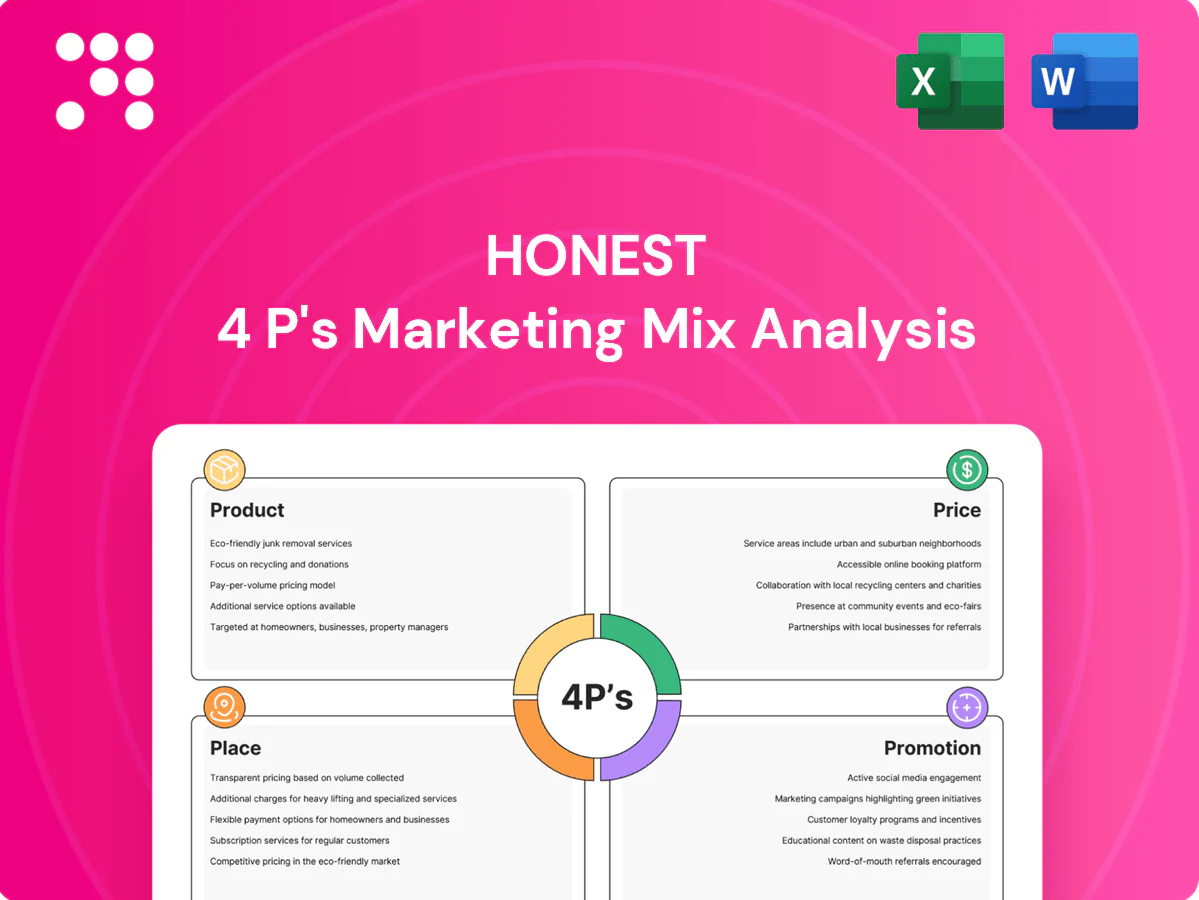
Honest Marketing Mix

Built for Strategy. Ready in Minutes.
Discover how Honest’s product design, pricing architecture, distribution channels, and promotion tactics combine to create market advantage; this preview teases the insights, the full 4Ps Marketing Mix Analysis delivers an editable, presentation-ready deep dive with real data, strategic recommendations, and ready-to-use slides—buy now to save research time and apply proven tactics to your strategy.
Product

Clean, conscious essentials
Offer baby, personal care, and household essentials formulated without harsh chemicals and with responsibly sourced ingredients, addressing a clean-beauty segment growing at about 7% CAGR through 2028. Emphasize safety testing, transparent labeling, and certifications (e.g., EWG, USDA Organic) to build trust and capture the 2024 consumer shift toward cleaner options. Position the portfolio as everyday essentials that reduce toxic load while maintaining performance, and continuously update formulas to meet evolving clean standards and rising consumer expectations.
Derm-tested baby care
Derm-tested baby care emphasizes hypoallergenic diapers, wipes, lotions and washes formulated for sensitive skin, all pediatrician- and dermatologist-tested with transparent ingredient lists and batch traceability. Products span newborn to toddler sizes and single-use to bulk formats to match growth stages and use cases. Honest integrates eco-conscious materials like FSC pulp and plant-based cores where feasible without compromising absorbency. The global baby care market is projected near $85B by 2027, underscoring scale.

Personal care and beauty
Honest positions personal care and beauty as clean, effective lines—skincare, bath, cosmetics with minimal irritants and plant-derived actives—addressing a clean-beauty market growing at ~8.6% CAGR (2024–2030, Grand View Research). Ingredient transparency influences ~70% of buyers, so avoiding controversial inputs differentiates the brand. Inclusive shade ranges and skin-type SKUs broaden appeal, while simplified packaging and clear instructions streamline routines and reduce churn.

Household and hygiene
Deliver non-toxic cleaners, sanitizers, and detergents that balance safety with efficacy; green household-cleaning market is growing at ~6.5% CAGR (2024–2030), supporting premium positioning.
Ensure compatibility with common surfaces and fabrics to reduce liability; offer low-fragrance or fragrance-free lines—62% of consumers (2024) prioritize low-irritant formulations.
Use recyclable or concentrated formats to cut waste and cost-in-use; concentrated refills can reduce packaging volume by up to 70% and improve margins.
- Non-toxic formulations
- Surface/fabric compatibility
- Low-fragrance variants
- Recyclable/concentrated packaging
Sustainable packaging
Honest’s sustainable packaging strategy prioritizes recyclable and post-consumer recycled materials, plus refill solutions to lower material use and costs; packaging represents about 40% of global plastic use and refill pouches can cut plastic per use by up to 80% in real-world pilots (2024). On-pack and online disposal guidance improves recycling rates; optimizing weight lowers shipping emissions and freight costs.
- Adopt R-PET and curbside recyclable formats
- Clear on-pack recycling + QR-guides
- Lightweighting to cut transport emissions
- Pilot refill pouches/bulk to raise LTV, reduce plastic
Safe, transparent baby & home care - clean-beauty growth, 80% less plastic via refills
Portfolio: non-toxic baby, personal care and household essentials positioned on safety, transparency and performance; target clean-beauty CAGR ~8.6% (2024–2030) and baby care market ≈$85B by 2027. Packaging: recyclable/R-PET, lightweighting and refills — refills can cut plastic per use up to 80% and reduce packaging volume ~70%. Product breadth spans hypoallergenic baby, inclusive personal care, and effective green cleaners.
| Metric | Value |
|---|---|
| Baby care market | $85B by 2027 |
| Clean-beauty CAGR | ~8.6% (2024–2030) |
| Green cleaning CAGR | ~6.5% (2024–2030) |
| Refill impact | Plastic/use ↓ up to 80% (2024) |
What is included in the product
 Detailed Word Document
Delivers a concise, company-specific deep dive into Honest’s Product, Price, Place, and Promotion strategies, using real brand practices and competitor context to ground recommendations; ideal for managers, consultants, and marketers needing a ready-to-use, professionally structured analysis to benchmark positioning, inform strategy, or adapt for reports and presentations.

 Customizable Excel Spreadsheet
Condenses the Honest 4P's into a clean, one-page summary that quickly aligns leadership, fuels rapid decision-making, and relieves stakeholder confusion by translating marketing complexity into actionable talking points.
Place

Owned e-commerce
Sell through the brand website to control experience, storytelling and subscriptions, capitalizing on e-commerce accounting for 22.3% of global retail sales in 2024; direct control improves conversion (global avg ~2.6% in 2024). Use first-party data for personalization and replenishment prompts—McKinsey found personalization can lift revenue up to 15%—offer exclusive bundles and early access, and provide responsive support and easy returns to boost loyalty.
Major retail partners
Distribute through national mass, drug and specialty beauty retailers to access roughly 95% of US households, tailoring assortments to channel and retailer planograms to maximize shelf share. Focus on demand planning and rapid replenishment to target >95% on-shelf availability and minimize lost-sales. Leverage retail media networks, projected to reach about $76 billion in US ad spend by 2025, to drive discovery and in-aisle/online conversion.

Online marketplaces
List curated assortments on leading marketplaces—Amazon held about 40% of US e-commerce in 2024—so capture intent-driven search traffic. Maintain authorized-seller controls and branded stores for consistent presentation and MAP enforcement. Leverage fast-shipping badges, which industry studies show can lift conversion roughly 10–15%. Sync inventory and pricing in real time to prevent channel conflict and costly stockouts.

Subscription and bundles
Enable subscribe-and-save for high-frequency items like diapers and wipes to lock recurring revenue and match shopper habit; Recurly 2024 benchmarks show subscriptions can improve retention ~20% versus one-off buyers.
Offer cross-category bundles (baby care + skincare) to raise AOV and drive trial; bundles in FMCG lifted basket size 10–18% in recent retailer pilots (2023–24).
Provide flexible cadence and easy edits via account self-service to reduce churn and calls; seamless edits cut cancellation intent in trials by double digits.
Use predictive reminders and delivery forecasts to preempt lapses and failed shipments, improving on-time delivery and reducing churn from missed orders.
Omnichannel fulfillment
Integrate DTC warehouses with 3PLs and retailer distribution centers to maximize coverage and speed, supporting BOPIS, curbside and same-day fulfillment via retail partners. Monitor OTIF (target 95%+ to avoid shelf penalties) and use demand forecasting to stage inventory near key markets; same-day reached ~10% online share in the US (2024).
- Integrate DTC+3PL+retailer DCs
- Support BOPIS/curbside/same-day
- OTIF benchmark 95%+
- Forecast to stage inventory near key markets
Omnichannel: DTC subscriptions + retail reach 95%+ US households; Amazon drives e‑commerce intent
Omnichannel distribution: DTC site (22.3% e‑commerce share 2024) for control and subscriptions, national retailers for reach to ~95% US households, and marketplaces (Amazon ~40% US e‑commerce 2024) for intent traffic. Prioritize >95% on‑shelf/OTIF, fast‑ship badges (+10–15% conv.), and subscribe-and-save (+20% retention). Integrate DTC, 3PL and retailer DCs to enable BOPIS/curbside/same‑day.
| Metric | 2023–2025 |
|---|---|
| E‑commerce share | 22.3% (2024) |
| Amazon share | ~40% US (2024) |
| OTIF target | 95%+ |
Same Document Delivered
Honest 4P's Marketing Mix Analysis
You're viewing the exact Honest 4P's Marketing Mix Analysis you'll receive instantly after purchase—fully complete and ready to use. This is not a sample or mockup; the preview is the real, editable document included with your download. Buy with confidence knowing the file shown is the final version delivered immediately at checkout.

Built for Strategy. Ready in Minutes.
Discover how Honest’s product design, pricing architecture, distribution channels, and promotion tactics combine to create market advantage; this preview teases the insights, the full 4Ps Marketing Mix Analysis delivers an editable, presentation-ready deep dive with real data, strategic recommendations, and ready-to-use slides—buy now to save research time and apply proven tactics to your strategy.
Product
Clean, conscious essentials
Offer baby, personal care, and household essentials formulated without harsh chemicals and with responsibly sourced ingredients, addressing a clean-beauty segment growing at about 7% CAGR through 2028. Emphasize safety testing, transparent labeling, and certifications (e.g., EWG, USDA Organic) to build trust and capture the 2024 consumer shift toward cleaner options. Position the portfolio as everyday essentials that reduce toxic load while maintaining performance, and continuously update formulas to meet evolving clean standards and rising consumer expectations.
Derm-tested baby care
Derm-tested baby care emphasizes hypoallergenic diapers, wipes, lotions and washes formulated for sensitive skin, all pediatrician- and dermatologist-tested with transparent ingredient lists and batch traceability. Products span newborn to toddler sizes and single-use to bulk formats to match growth stages and use cases. Honest integrates eco-conscious materials like FSC pulp and plant-based cores where feasible without compromising absorbency. The global baby care market is projected near $85B by 2027, underscoring scale.
Personal care and beauty
Honest positions personal care and beauty as clean, effective lines—skincare, bath, cosmetics with minimal irritants and plant-derived actives—addressing a clean-beauty market growing at ~8.6% CAGR (2024–2030, Grand View Research). Ingredient transparency influences ~70% of buyers, so avoiding controversial inputs differentiates the brand. Inclusive shade ranges and skin-type SKUs broaden appeal, while simplified packaging and clear instructions streamline routines and reduce churn.
Household and hygiene
Deliver non-toxic cleaners, sanitizers, and detergents that balance safety with efficacy; green household-cleaning market is growing at ~6.5% CAGR (2024–2030), supporting premium positioning.
Ensure compatibility with common surfaces and fabrics to reduce liability; offer low-fragrance or fragrance-free lines—62% of consumers (2024) prioritize low-irritant formulations.
Use recyclable or concentrated formats to cut waste and cost-in-use; concentrated refills can reduce packaging volume by up to 70% and improve margins.
- Non-toxic formulations
- Surface/fabric compatibility
- Low-fragrance variants
- Recyclable/concentrated packaging
Sustainable packaging
Honest’s sustainable packaging strategy prioritizes recyclable and post-consumer recycled materials, plus refill solutions to lower material use and costs; packaging represents about 40% of global plastic use and refill pouches can cut plastic per use by up to 80% in real-world pilots (2024). On-pack and online disposal guidance improves recycling rates; optimizing weight lowers shipping emissions and freight costs.
- Adopt R-PET and curbside recyclable formats
- Clear on-pack recycling + QR-guides
- Lightweighting to cut transport emissions
- Pilot refill pouches/bulk to raise LTV, reduce plastic
Safe, transparent baby & home care - clean-beauty growth, 80% less plastic via refills
Portfolio: non-toxic baby, personal care and household essentials positioned on safety, transparency and performance; target clean-beauty CAGR ~8.6% (2024–2030) and baby care market ≈$85B by 2027. Packaging: recyclable/R-PET, lightweighting and refills — refills can cut plastic per use up to 80% and reduce packaging volume ~70%. Product breadth spans hypoallergenic baby, inclusive personal care, and effective green cleaners.
| Metric | Value |
|---|---|
| Baby care market | $85B by 2027 |
| Clean-beauty CAGR | ~8.6% (2024–2030) |
| Green cleaning CAGR | ~6.5% (2024–2030) |
| Refill impact | Plastic/use ↓ up to 80% (2024) |
What is included in the product
Detailed Word Document
Delivers a concise, company-specific deep dive into Honest’s Product, Price, Place, and Promotion strategies, using real brand practices and competitor context to ground recommendations; ideal for managers, consultants, and marketers needing a ready-to-use, professionally structured analysis to benchmark positioning, inform strategy, or adapt for reports and presentations.
Customizable Excel Spreadsheet
Condenses the Honest 4P's into a clean, one-page summary that quickly aligns leadership, fuels rapid decision-making, and relieves stakeholder confusion by translating marketing complexity into actionable talking points.
Place
Owned e-commerce
Sell through the brand website to control experience, storytelling and subscriptions, capitalizing on e-commerce accounting for 22.3% of global retail sales in 2024; direct control improves conversion (global avg ~2.6% in 2024). Use first-party data for personalization and replenishment prompts—McKinsey found personalization can lift revenue up to 15%—offer exclusive bundles and early access, and provide responsive support and easy returns to boost loyalty.
Major retail partners
Distribute through national mass, drug and specialty beauty retailers to access roughly 95% of US households, tailoring assortments to channel and retailer planograms to maximize shelf share. Focus on demand planning and rapid replenishment to target >95% on-shelf availability and minimize lost-sales. Leverage retail media networks, projected to reach about $76 billion in US ad spend by 2025, to drive discovery and in-aisle/online conversion.
Online marketplaces
List curated assortments on leading marketplaces—Amazon held about 40% of US e-commerce in 2024—so capture intent-driven search traffic. Maintain authorized-seller controls and branded stores for consistent presentation and MAP enforcement. Leverage fast-shipping badges, which industry studies show can lift conversion roughly 10–15%. Sync inventory and pricing in real time to prevent channel conflict and costly stockouts.
Subscription and bundles
Enable subscribe-and-save for high-frequency items like diapers and wipes to lock recurring revenue and match shopper habit; Recurly 2024 benchmarks show subscriptions can improve retention ~20% versus one-off buyers.
Offer cross-category bundles (baby care + skincare) to raise AOV and drive trial; bundles in FMCG lifted basket size 10–18% in recent retailer pilots (2023–24).
Provide flexible cadence and easy edits via account self-service to reduce churn and calls; seamless edits cut cancellation intent in trials by double digits.
Use predictive reminders and delivery forecasts to preempt lapses and failed shipments, improving on-time delivery and reducing churn from missed orders.
Omnichannel fulfillment
Integrate DTC warehouses with 3PLs and retailer distribution centers to maximize coverage and speed, supporting BOPIS, curbside and same-day fulfillment via retail partners. Monitor OTIF (target 95%+ to avoid shelf penalties) and use demand forecasting to stage inventory near key markets; same-day reached ~10% online share in the US (2024).
- Integrate DTC+3PL+retailer DCs
- Support BOPIS/curbside/same-day
- OTIF benchmark 95%+
- Forecast to stage inventory near key markets
Omnichannel: DTC subscriptions + retail reach 95%+ US households; Amazon drives e‑commerce intent
Omnichannel distribution: DTC site (22.3% e‑commerce share 2024) for control and subscriptions, national retailers for reach to ~95% US households, and marketplaces (Amazon ~40% US e‑commerce 2024) for intent traffic. Prioritize >95% on‑shelf/OTIF, fast‑ship badges (+10–15% conv.), and subscribe-and-save (+20% retention). Integrate DTC, 3PL and retailer DCs to enable BOPIS/curbside/same‑day.
| Metric | 2023–2025 |
|---|---|
| E‑commerce share | 22.3% (2024) |
| Amazon share | ~40% US (2024) |
| OTIF target | 95%+ |
Same Document Delivered
Honest 4P's Marketing Mix Analysis
You're viewing the exact Honest 4P's Marketing Mix Analysis you'll receive instantly after purchase—fully complete and ready to use. This is not a sample or mockup; the preview is the real, editable document included with your download. Buy with confidence knowing the file shown is the final version delivered immediately at checkout.
Description
Built for Strategy. Ready in Minutes.
Discover how Honest’s product design, pricing architecture, distribution channels, and promotion tactics combine to create market advantage; this preview teases the insights, the full 4Ps Marketing Mix Analysis delivers an editable, presentation-ready deep dive with real data, strategic recommendations, and ready-to-use slides—buy now to save research time and apply proven tactics to your strategy.
Product
Clean, conscious essentials
Offer baby, personal care, and household essentials formulated without harsh chemicals and with responsibly sourced ingredients, addressing a clean-beauty segment growing at about 7% CAGR through 2028. Emphasize safety testing, transparent labeling, and certifications (e.g., EWG, USDA Organic) to build trust and capture the 2024 consumer shift toward cleaner options. Position the portfolio as everyday essentials that reduce toxic load while maintaining performance, and continuously update formulas to meet evolving clean standards and rising consumer expectations.
Derm-tested baby care
Derm-tested baby care emphasizes hypoallergenic diapers, wipes, lotions and washes formulated for sensitive skin, all pediatrician- and dermatologist-tested with transparent ingredient lists and batch traceability. Products span newborn to toddler sizes and single-use to bulk formats to match growth stages and use cases. Honest integrates eco-conscious materials like FSC pulp and plant-based cores where feasible without compromising absorbency. The global baby care market is projected near $85B by 2027, underscoring scale.
Personal care and beauty
Honest positions personal care and beauty as clean, effective lines—skincare, bath, cosmetics with minimal irritants and plant-derived actives—addressing a clean-beauty market growing at ~8.6% CAGR (2024–2030, Grand View Research). Ingredient transparency influences ~70% of buyers, so avoiding controversial inputs differentiates the brand. Inclusive shade ranges and skin-type SKUs broaden appeal, while simplified packaging and clear instructions streamline routines and reduce churn.
Household and hygiene
Deliver non-toxic cleaners, sanitizers, and detergents that balance safety with efficacy; green household-cleaning market is growing at ~6.5% CAGR (2024–2030), supporting premium positioning.
Ensure compatibility with common surfaces and fabrics to reduce liability; offer low-fragrance or fragrance-free lines—62% of consumers (2024) prioritize low-irritant formulations.
Use recyclable or concentrated formats to cut waste and cost-in-use; concentrated refills can reduce packaging volume by up to 70% and improve margins.
- Non-toxic formulations
- Surface/fabric compatibility
- Low-fragrance variants
- Recyclable/concentrated packaging
Sustainable packaging
Honest’s sustainable packaging strategy prioritizes recyclable and post-consumer recycled materials, plus refill solutions to lower material use and costs; packaging represents about 40% of global plastic use and refill pouches can cut plastic per use by up to 80% in real-world pilots (2024). On-pack and online disposal guidance improves recycling rates; optimizing weight lowers shipping emissions and freight costs.
- Adopt R-PET and curbside recyclable formats
- Clear on-pack recycling + QR-guides
- Lightweighting to cut transport emissions
- Pilot refill pouches/bulk to raise LTV, reduce plastic
Safe, transparent baby & home care - clean-beauty growth, 80% less plastic via refills
Portfolio: non-toxic baby, personal care and household essentials positioned on safety, transparency and performance; target clean-beauty CAGR ~8.6% (2024–2030) and baby care market ≈$85B by 2027. Packaging: recyclable/R-PET, lightweighting and refills — refills can cut plastic per use up to 80% and reduce packaging volume ~70%. Product breadth spans hypoallergenic baby, inclusive personal care, and effective green cleaners.
| Metric | Value |
|---|---|
| Baby care market | $85B by 2027 |
| Clean-beauty CAGR | ~8.6% (2024–2030) |
| Green cleaning CAGR | ~6.5% (2024–2030) |
| Refill impact | Plastic/use ↓ up to 80% (2024) |
What is included in the product
Detailed Word Document
Delivers a concise, company-specific deep dive into Honest’s Product, Price, Place, and Promotion strategies, using real brand practices and competitor context to ground recommendations; ideal for managers, consultants, and marketers needing a ready-to-use, professionally structured analysis to benchmark positioning, inform strategy, or adapt for reports and presentations.
Customizable Excel Spreadsheet
Condenses the Honest 4P's into a clean, one-page summary that quickly aligns leadership, fuels rapid decision-making, and relieves stakeholder confusion by translating marketing complexity into actionable talking points.
Place
Owned e-commerce
Sell through the brand website to control experience, storytelling and subscriptions, capitalizing on e-commerce accounting for 22.3% of global retail sales in 2024; direct control improves conversion (global avg ~2.6% in 2024). Use first-party data for personalization and replenishment prompts—McKinsey found personalization can lift revenue up to 15%—offer exclusive bundles and early access, and provide responsive support and easy returns to boost loyalty.
Major retail partners
Distribute through national mass, drug and specialty beauty retailers to access roughly 95% of US households, tailoring assortments to channel and retailer planograms to maximize shelf share. Focus on demand planning and rapid replenishment to target >95% on-shelf availability and minimize lost-sales. Leverage retail media networks, projected to reach about $76 billion in US ad spend by 2025, to drive discovery and in-aisle/online conversion.
Online marketplaces
List curated assortments on leading marketplaces—Amazon held about 40% of US e-commerce in 2024—so capture intent-driven search traffic. Maintain authorized-seller controls and branded stores for consistent presentation and MAP enforcement. Leverage fast-shipping badges, which industry studies show can lift conversion roughly 10–15%. Sync inventory and pricing in real time to prevent channel conflict and costly stockouts.
Subscription and bundles
Enable subscribe-and-save for high-frequency items like diapers and wipes to lock recurring revenue and match shopper habit; Recurly 2024 benchmarks show subscriptions can improve retention ~20% versus one-off buyers.
Offer cross-category bundles (baby care + skincare) to raise AOV and drive trial; bundles in FMCG lifted basket size 10–18% in recent retailer pilots (2023–24).
Provide flexible cadence and easy edits via account self-service to reduce churn and calls; seamless edits cut cancellation intent in trials by double digits.
Use predictive reminders and delivery forecasts to preempt lapses and failed shipments, improving on-time delivery and reducing churn from missed orders.
Omnichannel fulfillment
Integrate DTC warehouses with 3PLs and retailer distribution centers to maximize coverage and speed, supporting BOPIS, curbside and same-day fulfillment via retail partners. Monitor OTIF (target 95%+ to avoid shelf penalties) and use demand forecasting to stage inventory near key markets; same-day reached ~10% online share in the US (2024).
- Integrate DTC+3PL+retailer DCs
- Support BOPIS/curbside/same-day
- OTIF benchmark 95%+
- Forecast to stage inventory near key markets
Omnichannel: DTC subscriptions + retail reach 95%+ US households; Amazon drives e‑commerce intent
Omnichannel distribution: DTC site (22.3% e‑commerce share 2024) for control and subscriptions, national retailers for reach to ~95% US households, and marketplaces (Amazon ~40% US e‑commerce 2024) for intent traffic. Prioritize >95% on‑shelf/OTIF, fast‑ship badges (+10–15% conv.), and subscribe-and-save (+20% retention). Integrate DTC, 3PL and retailer DCs to enable BOPIS/curbside/same‑day.
| Metric | 2023–2025 |
|---|---|
| E‑commerce share | 22.3% (2024) |
| Amazon share | ~40% US (2024) |
| OTIF target | 95%+ |
Same Document Delivered
Honest 4P's Marketing Mix Analysis
You're viewing the exact Honest 4P's Marketing Mix Analysis you'll receive instantly after purchase—fully complete and ready to use. This is not a sample or mockup; the preview is the real, editable document included with your download. Buy with confidence knowing the file shown is the final version delivered immediately at checkout.











