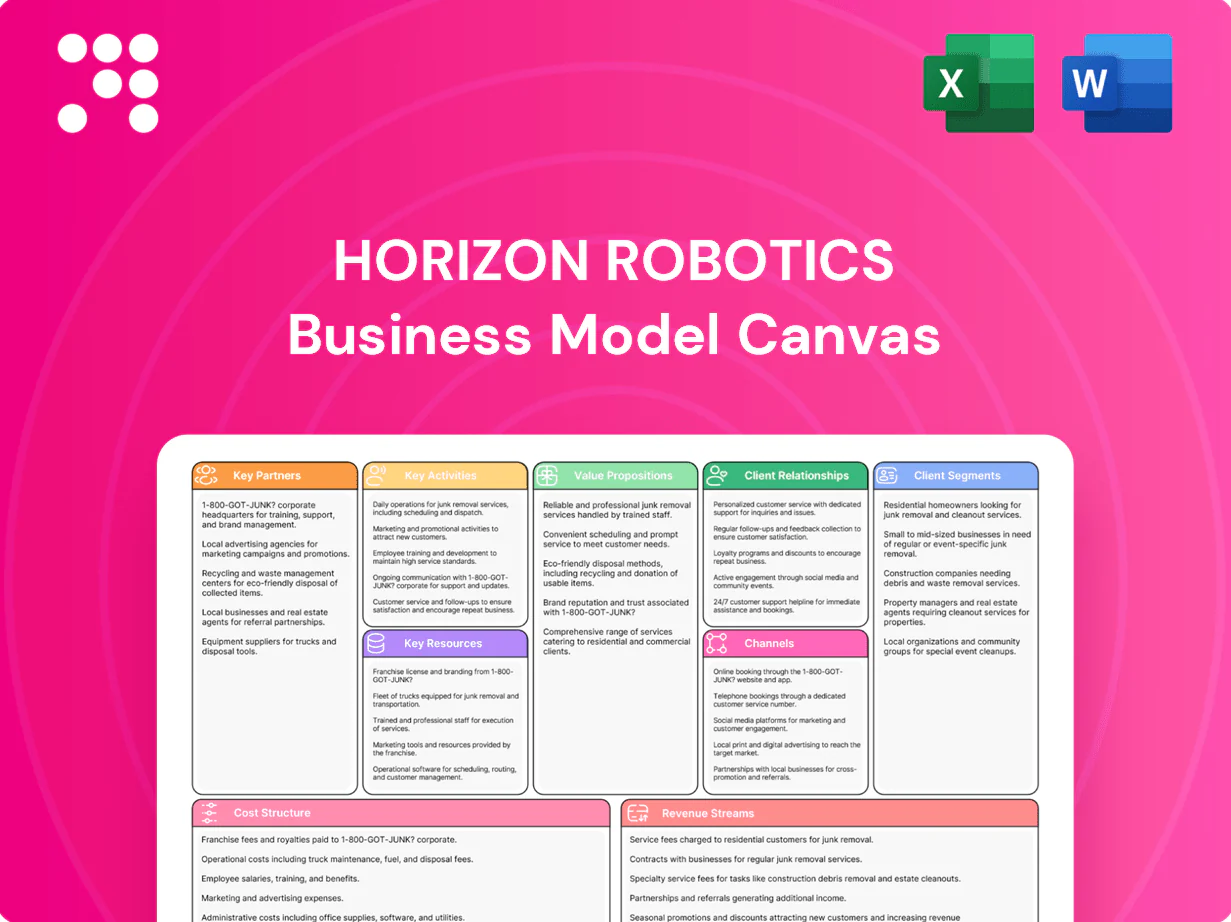
Horizon Robotics Business Model Canvas

AI edge computing: Business Model Canvas revealing value props, partners and revenue levers
Unlock Horizon Robotics' strategic blueprint with our Business Model Canvas. This concise, actionable snapshot reveals value propositions, key partners, revenue streams and scaling levers in AI edge computing. Purchase the full Canvas for editable Word/Excel files and investor-ready, section-by-section insights.
Partnerships

Automaker alliances
Partner with OEMs to embed AI compute into next-generation vehicles, targeting L2+ and L4 ADAS functions; ADAS-equipped vehicles exceeded 100 million globally by 2024. Jointly define requirements for sensors, software stacks and validation to meet OEM timelines and regulations. Secure design wins across 3–5 model cycles and platforms to lock multi-year revenue streams. Co-market measured safety improvements and performance benchmarks to drive adoption.
Tier-1 suppliers
Collaborate with Tier-1 suppliers for ECU integration, system validation, and production scaling to ensure Horizon Robotics' SoCs fit OEM ECU architectures and thermal/functional constraints.
Ensure compatibility with vehicle networks and sensor suites through joint engineering, CAN/FlexRay/Automotive Ethernet validation, and co-developed sensor fusion stacks.
Leverage Tier-1 manufacturing and service footprints to accelerate OEM program onboarding and shorten time-to-market for series production.

Foundry and OSAT
Work with leading foundries and OSATs to access advanced nodes and improve yield, co-optimizing PPA targets and thermal envelopes across process and packaging. Secure capacity via long-term supply agreements and demand forecasting to mitigate wafer and assembly bottlenecks. Maintain ISO 26262-aligned quality, full traceability and automotive-grade test flows to meet OEM reliability requirements.

Sensor and middleware
- Partners: LiDAR, radar, camera, middleware vendors
- Focus: drivers, time sync, data fusion
- Goal: end-to-end validation, -30% deployment time
- Benefit: reduced integration risk for customers
Cloud and standards
Partner with cloud platforms for training, simulation, and OTA updates, leveraging the 2024 cloud infrastructure leaders (AWS, Azure, Google Cloud) which together held about 64% market share to scale compute and delivery. Engage safety bodies and standards groups (ISO 26262, SOTIF) to influence regulations and map compliance paths, using certifications and shared testbeds to build credibility.
- Cloud partners: scale training/OTA
- Standards: ISO 26262, SOTIF
- Regulatory influence & compliance mapping
- Certs & shared testbeds for credibility
Secure 3-5 ADAS wins with OEMs/Tier-1s; 100M ADAS by 2024
Partner OEMs and Tier‑1s to secure 3–5 model‑cycle design wins for L2+ to L4 ADAS; ADAS vehicles exceeded 100M globally by 2024. Lock foundry/OSAT capacity, ISO 26262 compliance and sensor vendors to cut integration risk and time‑to‑market. Use AWS/Azure/GCP (64% cloud share in 2024) for training, simulation and OTA.
| Partner | Metric/2024 | Target |
|---|---|---|
| OEMs | 100M ADAS cars | 3–5 cycle wins |
| Cloud | 64% market share | Scale training/OTA |
| Foundry/OSAT | Advanced nodes | Capacity agreements |
What is included in the product
 Detailed Word Document
A comprehensive, pre-written Business Model Canvas tailored to Horizon Robotics’ AI chip and autonomous driving platform strategy, covering customer segments, channels, value propositions and revenue streams. Includes SWOT-linked insights across all 9 BMC blocks and polished narrative for investor presentations and strategic decision-making.

 Customizable Excel Spreadsheet
High-level view of Horizon Robotics' business model with editable cells—streamlines AI chip strategy, partnerships, and revenue streams into a single one-page snapshot to relieve planning and communication bottlenecks.
Activities

ASIC design
As of 2024 Horizon Robotics architects and tapes out low-power, high-throughput AI processors for edge autonomy, iterates IP for inference acceleration and memory efficiency, validates silicon with rigorous test suites, and continuously improves PPA across process nodes.
Software stack
Develop and maintain SDKs, compilers, runtime and model-optimization tools to enable low-latency inference for perception and planning networks; port and optimize networks across chip families while providing robust APIs for developers and integrators. Ensure cross-version compatibility and security updates; China accounted for over 50% of global EV sales in 2024, driving demand.

System integration
Builds reference designs for domain and central compute, delivering Journey-class platform compatibility and validated sensor fusion/AV pipelines across camera, radar and lidar stacks.
Conducts HIL/SIL testing and benchmarking to accelerate verification, typically shortening integration cycles by 30–50% and validating across dozens of sensor configurations.
Supports customers through pilots to SOP with hands-on integration, deploying multi‑vehicle pilots and managing pilot‑to‑production timelines commonly in the 12–24 month range.

Safety and compliance
Pursue ISO 26262 (including ASIL D for safety-critical stacks), ASPICE (targeting levels 3–5) and recognized cybersecurity certifications; document safety cases and tool qualification to meet OEM expectations. Run robustness and reliability programs (industry MTBF targets and fault-injection validation) and interface continuously with auditors and OEM assessments.
- ISO 26262: ASIL D
- ASPICE: level 3–5
- Tool qualification: documented evidence
- Continuous OEM audits & assessments
Ecosystem enablement
Ecosystem enablement runs developer programs and training, hosts sample code, models and datasets, and co-runs partner demos to accelerate adoption; in 2024 many AI chip ecosystems reported 10k+ active developers and double-digit YoY community growth. Support for hackathons and PoCs converts pilots into production, shortening time-to-integration.
- developer-programs
- sample-code-models-datasets
- partner-demos
- hackathons-PoCs
Edge AI SoCs - 30-50% faster integration; pilot->SOP 12-24m
Design and tape-out of low-power AI SoCs; SDKs, compilers and model tools for edge inference; HIL/SIL verification shortening integration 30–50%; pilot-to-SOP support (12–24 months) and ecosystem growth (10k+ active developers in 2024); pursue ISO 26262 ASIL D and ASPICE 3–5.
| Activity | KPI | 2024 |
|---|---|---|
| Integration cycles | Shortening | 30–50% |
| Pilot→SOP | Time | 12–24 months |
| Dev community | Active devs | 10k+ |
| Market driver | China EV share | >50% |
Delivered as Displayed
Business Model Canvas
The document you're previewing is the exact Horizon Robotics Business Model Canvas you will receive after purchase, not a mockup. When you complete your order you’ll get the full, editable file—structured and formatted exactly as shown. The deliverable comes ready for editing, presenting, or sharing in Word and Excel formats.

AI edge computing: Business Model Canvas revealing value props, partners and revenue levers
Unlock Horizon Robotics' strategic blueprint with our Business Model Canvas. This concise, actionable snapshot reveals value propositions, key partners, revenue streams and scaling levers in AI edge computing. Purchase the full Canvas for editable Word/Excel files and investor-ready, section-by-section insights.
Partnerships
Automaker alliances
Partner with OEMs to embed AI compute into next-generation vehicles, targeting L2+ and L4 ADAS functions; ADAS-equipped vehicles exceeded 100 million globally by 2024. Jointly define requirements for sensors, software stacks and validation to meet OEM timelines and regulations. Secure design wins across 3–5 model cycles and platforms to lock multi-year revenue streams. Co-market measured safety improvements and performance benchmarks to drive adoption.
Tier-1 suppliers
Collaborate with Tier-1 suppliers for ECU integration, system validation, and production scaling to ensure Horizon Robotics' SoCs fit OEM ECU architectures and thermal/functional constraints.
Ensure compatibility with vehicle networks and sensor suites through joint engineering, CAN/FlexRay/Automotive Ethernet validation, and co-developed sensor fusion stacks.
Leverage Tier-1 manufacturing and service footprints to accelerate OEM program onboarding and shorten time-to-market for series production.
Foundry and OSAT
Work with leading foundries and OSATs to access advanced nodes and improve yield, co-optimizing PPA targets and thermal envelopes across process and packaging. Secure capacity via long-term supply agreements and demand forecasting to mitigate wafer and assembly bottlenecks. Maintain ISO 26262-aligned quality, full traceability and automotive-grade test flows to meet OEM reliability requirements.
Sensor and middleware
- Partners: LiDAR, radar, camera, middleware vendors
- Focus: drivers, time sync, data fusion
- Goal: end-to-end validation, -30% deployment time
- Benefit: reduced integration risk for customers
Cloud and standards
Partner with cloud platforms for training, simulation, and OTA updates, leveraging the 2024 cloud infrastructure leaders (AWS, Azure, Google Cloud) which together held about 64% market share to scale compute and delivery. Engage safety bodies and standards groups (ISO 26262, SOTIF) to influence regulations and map compliance paths, using certifications and shared testbeds to build credibility.
- Cloud partners: scale training/OTA
- Standards: ISO 26262, SOTIF
- Regulatory influence & compliance mapping
- Certs & shared testbeds for credibility
Secure 3-5 ADAS wins with OEMs/Tier-1s; 100M ADAS by 2024
Partner OEMs and Tier‑1s to secure 3–5 model‑cycle design wins for L2+ to L4 ADAS; ADAS vehicles exceeded 100M globally by 2024. Lock foundry/OSAT capacity, ISO 26262 compliance and sensor vendors to cut integration risk and time‑to‑market. Use AWS/Azure/GCP (64% cloud share in 2024) for training, simulation and OTA.
| Partner | Metric/2024 | Target |
|---|---|---|
| OEMs | 100M ADAS cars | 3–5 cycle wins |
| Cloud | 64% market share | Scale training/OTA |
| Foundry/OSAT | Advanced nodes | Capacity agreements |
What is included in the product
Detailed Word Document
A comprehensive, pre-written Business Model Canvas tailored to Horizon Robotics’ AI chip and autonomous driving platform strategy, covering customer segments, channels, value propositions and revenue streams. Includes SWOT-linked insights across all 9 BMC blocks and polished narrative for investor presentations and strategic decision-making.
Customizable Excel Spreadsheet
High-level view of Horizon Robotics' business model with editable cells—streamlines AI chip strategy, partnerships, and revenue streams into a single one-page snapshot to relieve planning and communication bottlenecks.
Activities
ASIC design
As of 2024 Horizon Robotics architects and tapes out low-power, high-throughput AI processors for edge autonomy, iterates IP for inference acceleration and memory efficiency, validates silicon with rigorous test suites, and continuously improves PPA across process nodes.
Software stack
Develop and maintain SDKs, compilers, runtime and model-optimization tools to enable low-latency inference for perception and planning networks; port and optimize networks across chip families while providing robust APIs for developers and integrators. Ensure cross-version compatibility and security updates; China accounted for over 50% of global EV sales in 2024, driving demand.
System integration
Builds reference designs for domain and central compute, delivering Journey-class platform compatibility and validated sensor fusion/AV pipelines across camera, radar and lidar stacks.
Conducts HIL/SIL testing and benchmarking to accelerate verification, typically shortening integration cycles by 30–50% and validating across dozens of sensor configurations.
Supports customers through pilots to SOP with hands-on integration, deploying multi‑vehicle pilots and managing pilot‑to‑production timelines commonly in the 12–24 month range.
Safety and compliance
Pursue ISO 26262 (including ASIL D for safety-critical stacks), ASPICE (targeting levels 3–5) and recognized cybersecurity certifications; document safety cases and tool qualification to meet OEM expectations. Run robustness and reliability programs (industry MTBF targets and fault-injection validation) and interface continuously with auditors and OEM assessments.
- ISO 26262: ASIL D
- ASPICE: level 3–5
- Tool qualification: documented evidence
- Continuous OEM audits & assessments
Ecosystem enablement
Ecosystem enablement runs developer programs and training, hosts sample code, models and datasets, and co-runs partner demos to accelerate adoption; in 2024 many AI chip ecosystems reported 10k+ active developers and double-digit YoY community growth. Support for hackathons and PoCs converts pilots into production, shortening time-to-integration.
- developer-programs
- sample-code-models-datasets
- partner-demos
- hackathons-PoCs
Edge AI SoCs - 30-50% faster integration; pilot->SOP 12-24m
Design and tape-out of low-power AI SoCs; SDKs, compilers and model tools for edge inference; HIL/SIL verification shortening integration 30–50%; pilot-to-SOP support (12–24 months) and ecosystem growth (10k+ active developers in 2024); pursue ISO 26262 ASIL D and ASPICE 3–5.
| Activity | KPI | 2024 |
|---|---|---|
| Integration cycles | Shortening | 30–50% |
| Pilot→SOP | Time | 12–24 months |
| Dev community | Active devs | 10k+ |
| Market driver | China EV share | >50% |
Delivered as Displayed
Business Model Canvas
The document you're previewing is the exact Horizon Robotics Business Model Canvas you will receive after purchase, not a mockup. When you complete your order you’ll get the full, editable file—structured and formatted exactly as shown. The deliverable comes ready for editing, presenting, or sharing in Word and Excel formats.
Original: $10.00
-65%$10.00
$3.50Description
AI edge computing: Business Model Canvas revealing value props, partners and revenue levers
Unlock Horizon Robotics' strategic blueprint with our Business Model Canvas. This concise, actionable snapshot reveals value propositions, key partners, revenue streams and scaling levers in AI edge computing. Purchase the full Canvas for editable Word/Excel files and investor-ready, section-by-section insights.
Partnerships
Automaker alliances
Partner with OEMs to embed AI compute into next-generation vehicles, targeting L2+ and L4 ADAS functions; ADAS-equipped vehicles exceeded 100 million globally by 2024. Jointly define requirements for sensors, software stacks and validation to meet OEM timelines and regulations. Secure design wins across 3–5 model cycles and platforms to lock multi-year revenue streams. Co-market measured safety improvements and performance benchmarks to drive adoption.
Tier-1 suppliers
Collaborate with Tier-1 suppliers for ECU integration, system validation, and production scaling to ensure Horizon Robotics' SoCs fit OEM ECU architectures and thermal/functional constraints.
Ensure compatibility with vehicle networks and sensor suites through joint engineering, CAN/FlexRay/Automotive Ethernet validation, and co-developed sensor fusion stacks.
Leverage Tier-1 manufacturing and service footprints to accelerate OEM program onboarding and shorten time-to-market for series production.
Foundry and OSAT
Work with leading foundries and OSATs to access advanced nodes and improve yield, co-optimizing PPA targets and thermal envelopes across process and packaging. Secure capacity via long-term supply agreements and demand forecasting to mitigate wafer and assembly bottlenecks. Maintain ISO 26262-aligned quality, full traceability and automotive-grade test flows to meet OEM reliability requirements.
Sensor and middleware
- Partners: LiDAR, radar, camera, middleware vendors
- Focus: drivers, time sync, data fusion
- Goal: end-to-end validation, -30% deployment time
- Benefit: reduced integration risk for customers
Cloud and standards
Partner with cloud platforms for training, simulation, and OTA updates, leveraging the 2024 cloud infrastructure leaders (AWS, Azure, Google Cloud) which together held about 64% market share to scale compute and delivery. Engage safety bodies and standards groups (ISO 26262, SOTIF) to influence regulations and map compliance paths, using certifications and shared testbeds to build credibility.
- Cloud partners: scale training/OTA
- Standards: ISO 26262, SOTIF
- Regulatory influence & compliance mapping
- Certs & shared testbeds for credibility
Secure 3-5 ADAS wins with OEMs/Tier-1s; 100M ADAS by 2024
Partner OEMs and Tier‑1s to secure 3–5 model‑cycle design wins for L2+ to L4 ADAS; ADAS vehicles exceeded 100M globally by 2024. Lock foundry/OSAT capacity, ISO 26262 compliance and sensor vendors to cut integration risk and time‑to‑market. Use AWS/Azure/GCP (64% cloud share in 2024) for training, simulation and OTA.
| Partner | Metric/2024 | Target |
|---|---|---|
| OEMs | 100M ADAS cars | 3–5 cycle wins |
| Cloud | 64% market share | Scale training/OTA |
| Foundry/OSAT | Advanced nodes | Capacity agreements |
What is included in the product
Detailed Word Document
A comprehensive, pre-written Business Model Canvas tailored to Horizon Robotics’ AI chip and autonomous driving platform strategy, covering customer segments, channels, value propositions and revenue streams. Includes SWOT-linked insights across all 9 BMC blocks and polished narrative for investor presentations and strategic decision-making.
Customizable Excel Spreadsheet
High-level view of Horizon Robotics' business model with editable cells—streamlines AI chip strategy, partnerships, and revenue streams into a single one-page snapshot to relieve planning and communication bottlenecks.
Activities
ASIC design
As of 2024 Horizon Robotics architects and tapes out low-power, high-throughput AI processors for edge autonomy, iterates IP for inference acceleration and memory efficiency, validates silicon with rigorous test suites, and continuously improves PPA across process nodes.
Software stack
Develop and maintain SDKs, compilers, runtime and model-optimization tools to enable low-latency inference for perception and planning networks; port and optimize networks across chip families while providing robust APIs for developers and integrators. Ensure cross-version compatibility and security updates; China accounted for over 50% of global EV sales in 2024, driving demand.
System integration
Builds reference designs for domain and central compute, delivering Journey-class platform compatibility and validated sensor fusion/AV pipelines across camera, radar and lidar stacks.
Conducts HIL/SIL testing and benchmarking to accelerate verification, typically shortening integration cycles by 30–50% and validating across dozens of sensor configurations.
Supports customers through pilots to SOP with hands-on integration, deploying multi‑vehicle pilots and managing pilot‑to‑production timelines commonly in the 12–24 month range.
Safety and compliance
Pursue ISO 26262 (including ASIL D for safety-critical stacks), ASPICE (targeting levels 3–5) and recognized cybersecurity certifications; document safety cases and tool qualification to meet OEM expectations. Run robustness and reliability programs (industry MTBF targets and fault-injection validation) and interface continuously with auditors and OEM assessments.
- ISO 26262: ASIL D
- ASPICE: level 3–5
- Tool qualification: documented evidence
- Continuous OEM audits & assessments
Ecosystem enablement
Ecosystem enablement runs developer programs and training, hosts sample code, models and datasets, and co-runs partner demos to accelerate adoption; in 2024 many AI chip ecosystems reported 10k+ active developers and double-digit YoY community growth. Support for hackathons and PoCs converts pilots into production, shortening time-to-integration.
- developer-programs
- sample-code-models-datasets
- partner-demos
- hackathons-PoCs
Edge AI SoCs - 30-50% faster integration; pilot->SOP 12-24m
Design and tape-out of low-power AI SoCs; SDKs, compilers and model tools for edge inference; HIL/SIL verification shortening integration 30–50%; pilot-to-SOP support (12–24 months) and ecosystem growth (10k+ active developers in 2024); pursue ISO 26262 ASIL D and ASPICE 3–5.
| Activity | KPI | 2024 |
|---|---|---|
| Integration cycles | Shortening | 30–50% |
| Pilot→SOP | Time | 12–24 months |
| Dev community | Active devs | 10k+ |
| Market driver | China EV share | >50% |
Delivered as Displayed
Business Model Canvas
The document you're previewing is the exact Horizon Robotics Business Model Canvas you will receive after purchase, not a mockup. When you complete your order you’ll get the full, editable file—structured and formatted exactly as shown. The deliverable comes ready for editing, presenting, or sharing in Word and Excel formats.











