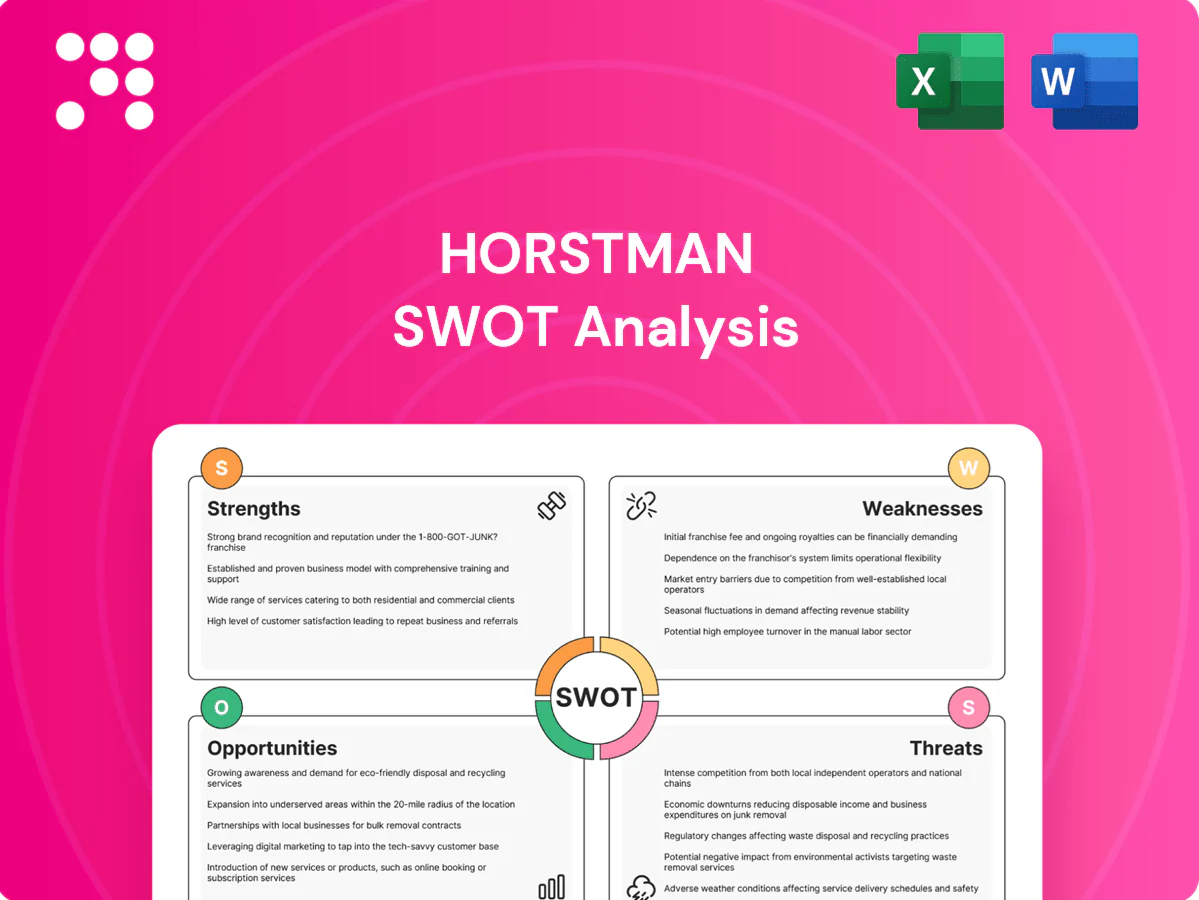
Horstman SWOT Analysis

Go Beyond the Preview—Access the Full Strategic Report
Horstman’s SWOT analysis highlights core engineering strengths, niche market positioning, and key operational risks while flagging growth opportunities in defence and electrification. Want deeper financial context, competitor mapping, and strategic recommendations? Purchase the full SWOT analysis to access a professionally written, editable report and Excel matrix—ready for planning, pitching, or investing.
Strengths

Specialized market leadership
Horstman is a recognized leader in hydro-pneumatic and rotary damper suspensions for armored platforms, a niche that supports meaningful pricing power and preferred-vendor status with prime integrators. Long-standing reference programs bolster credibility in new procurements and reduce time-to-contract. This leadership attracts specialized engineering talent and strategic partners, strengthening R&D throughput and aftermarket capture.
Proven combat reliability
Horstman systems are fielded on main battle tanks and APCs worldwide, including Challenger 2, and proven in harsh environments across desert and arctic operations. Battle-proven reliability lowers adoption risk for primes and defense ministries by minimizing integration uncertainty. Consistently lower lifecycle failures improve mission readiness and reduce TCO, differentiating Horstman from newer entrants.

Deep engineering and IP moat
Decades of domain know-how, patents and extensive test data create high replication barriers. Precision damping and vehicle integration expertise is hard to commoditize. Proprietary designs enable platform-specific optimization, lowering total cost of ownership and improving survivability. Continuous R&D sustains iterative performance gains across program cycles.

Global OEM and defense ties
Established relationships with vehicle OEMs and Tier-1 defense primes streamline integration and accelerate program entry, while a multi-country footprint supports offset commitments, localization and in-theater support, and approved supplier status reduces qualification lead-times; network access enhances pipeline visibility for sustained order flow.
- OEM/Tier-1 integration
- Global footprint: offsets & in-theater support
- Approved supplier: faster qualification
- Network-driven pipeline visibility
Customization and lifecycle support
Modular architectures let Horstman tune suspension and turret systems for specific weight, terrain and survivability targets, while through-life support, spares and upgrades increase revenue per platform and customer lifetime value. Service data drives iterative design improvements and close customer collaboration reduces integration risk and field rework.
- Modularity: configurable for weight/terrain/survivability
- Through-life revenue: spares, upgrades, support
- Data-driven design: service feedback loops
- Customer collaboration: lower integration risk
Combat-proven hydro-pneumatic suspensions for MBTs and APCs, reducing lifecycle failures
Horstman is a recognized leader in hydro-pneumatic and rotary damper suspensions for armored platforms, fielded on main battle tanks and APCs including Challenger 2, delivering proven reliability and lower lifecycle failures. Decades of domain know-how, patents and long-standing OEM/Tier-1 relationships shorten qualification times and drive through-life revenue via spares and upgrades.
| Strength | Evidence | Metric |
|---|---|---|
| Combat-proven | Fielded on MBTs/APCs | Includes Challenger 2 |
| Domain expertise | Patents & test data | Decades |
| OEM access | Approved supplier status | Faster qualification |
| Through-life sales | Spares & upgrades | Ongoing revenue |
What is included in the product
 Detailed Word Document
Delivers a strategic overview of Horstman’s internal and external business factors, outlining strengths, weaknesses, opportunities and threats to assess its competitive position, key growth drivers, operational gaps and risks shaping the company’s future.

 Customizable Excel Spreadsheet
Horstman SWOT Analysis condenses strategic risks and advantages into a clear, visual matrix for rapid alignment and decision-making, enabling executives to spot priority issues and update plans quickly.
Weaknesses

Customer and program concentration
Revenue is concentrated in a limited set of military platforms and government programmes, making Horstman vulnerable to programme cancellations or schedule delays that can materially affect quarterly and annual results. Contract negotiation power typically lies with large primes and Ministries of Defence, compressing margins and limiting upside. Structural barriers—tight export controls, long lead times and prime-centric supply chains—make diversifying end-customers difficult.
Long sales and qualification cycles
Defense procurement requires lengthy testing, certification and multi-year budget approvals within a sector governed by large programs (US DoD FY2024 budget ~858 billion USD), stretching sales cycles to multiple years. Cash conversion lags as R&D and bid costs tie up capital, while milestone-based revenue and missed gate reviews can defer awards for years, complicating forecasting.

Capital- and capability-intensive operations
Precision machining, bespoke test rigs and strict QA systems force continuous capital investment and upgrades, increasing fixed cost burden. Retaining specialized engineers and maintaining aerospace/defence certifications drives high ongoing personnel and compliance costs. Small-volume, high-mix production compresses margins and raises unit costs. Capacity planning is highly sensitive to program phasing and creates cashflow volatility.

Limited diversification outside defense
Horstman’s focus on armored mobility concentrates exposure to defense cycles, leaving revenue tied to fluctuating procurement budgets and program timings; pivoting into commercial heavy vehicles or industrial damping requires significant engineering, supply-chain and certification investment and faces entrenched OEM suppliers. The brand and certifications remain defense-centric, so civil demand shocks provide limited hedging.
- Defense concentration
- High entry barriers to commercial markets
- Defense-focused certifications
- Poor hedging vs civil shocks
Supply chain sensitivity
Specialty materials, seals and precision components are often single- or dual-sourced for Horstman, creating concentrated supplier risk and lead-time volatility that disrupts delivery schedules and customer commitments. Upstream quality escapes force rework and warranty exposure, while inventory buffers built to mitigate disruption tie up working capital and compress margins.
- single/dual sourcing risk
- lead-time volatility → delivery disruption
- quality escapes → rework/warranty
- inventory buffers → working capital strain
Concentrated defense revenue: ~858 billion USD programmes drive 2–5 year sales cycles, tight margins
Revenue concentrated in military platforms and gov't programmes (US DoD FY2024 budget ~858 billion USD) creates high programme risk and long 2–5 year sales cycles that pressure cash conversion and forecasting. High fixed costs for precision capital, certifications and specialist staff compress margins, while single/dual sourcing adds supply and working-capital strain.
| Metric | Value |
|---|---|
| US DoD FY2024 | ~858 billion USD |
| Typical sales cycle | 2–5 years |
What You See Is What You Get
Horstman SWOT Analysis
This is the actual Horstman SWOT analysis document you’ll receive upon purchase—no surprises, just professional quality. The preview below is taken directly from the full report and reflects the complete structure and key findings. Buy now to unlock the editable, full-length version for immediate download.

Go Beyond the Preview—Access the Full Strategic Report
Horstman’s SWOT analysis highlights core engineering strengths, niche market positioning, and key operational risks while flagging growth opportunities in defence and electrification. Want deeper financial context, competitor mapping, and strategic recommendations? Purchase the full SWOT analysis to access a professionally written, editable report and Excel matrix—ready for planning, pitching, or investing.
Strengths
Specialized market leadership
Horstman is a recognized leader in hydro-pneumatic and rotary damper suspensions for armored platforms, a niche that supports meaningful pricing power and preferred-vendor status with prime integrators. Long-standing reference programs bolster credibility in new procurements and reduce time-to-contract. This leadership attracts specialized engineering talent and strategic partners, strengthening R&D throughput and aftermarket capture.
Proven combat reliability
Horstman systems are fielded on main battle tanks and APCs worldwide, including Challenger 2, and proven in harsh environments across desert and arctic operations. Battle-proven reliability lowers adoption risk for primes and defense ministries by minimizing integration uncertainty. Consistently lower lifecycle failures improve mission readiness and reduce TCO, differentiating Horstman from newer entrants.
Deep engineering and IP moat
Decades of domain know-how, patents and extensive test data create high replication barriers. Precision damping and vehicle integration expertise is hard to commoditize. Proprietary designs enable platform-specific optimization, lowering total cost of ownership and improving survivability. Continuous R&D sustains iterative performance gains across program cycles.
Global OEM and defense ties
Established relationships with vehicle OEMs and Tier-1 defense primes streamline integration and accelerate program entry, while a multi-country footprint supports offset commitments, localization and in-theater support, and approved supplier status reduces qualification lead-times; network access enhances pipeline visibility for sustained order flow.
- OEM/Tier-1 integration
- Global footprint: offsets & in-theater support
- Approved supplier: faster qualification
- Network-driven pipeline visibility
Customization and lifecycle support
Modular architectures let Horstman tune suspension and turret systems for specific weight, terrain and survivability targets, while through-life support, spares and upgrades increase revenue per platform and customer lifetime value. Service data drives iterative design improvements and close customer collaboration reduces integration risk and field rework.
- Modularity: configurable for weight/terrain/survivability
- Through-life revenue: spares, upgrades, support
- Data-driven design: service feedback loops
- Customer collaboration: lower integration risk
Combat-proven hydro-pneumatic suspensions for MBTs and APCs, reducing lifecycle failures
Horstman is a recognized leader in hydro-pneumatic and rotary damper suspensions for armored platforms, fielded on main battle tanks and APCs including Challenger 2, delivering proven reliability and lower lifecycle failures. Decades of domain know-how, patents and long-standing OEM/Tier-1 relationships shorten qualification times and drive through-life revenue via spares and upgrades.
| Strength | Evidence | Metric |
|---|---|---|
| Combat-proven | Fielded on MBTs/APCs | Includes Challenger 2 |
| Domain expertise | Patents & test data | Decades |
| OEM access | Approved supplier status | Faster qualification |
| Through-life sales | Spares & upgrades | Ongoing revenue |
What is included in the product
Detailed Word Document
Delivers a strategic overview of Horstman’s internal and external business factors, outlining strengths, weaknesses, opportunities and threats to assess its competitive position, key growth drivers, operational gaps and risks shaping the company’s future.
Customizable Excel Spreadsheet
Horstman SWOT Analysis condenses strategic risks and advantages into a clear, visual matrix for rapid alignment and decision-making, enabling executives to spot priority issues and update plans quickly.
Weaknesses
Customer and program concentration
Revenue is concentrated in a limited set of military platforms and government programmes, making Horstman vulnerable to programme cancellations or schedule delays that can materially affect quarterly and annual results. Contract negotiation power typically lies with large primes and Ministries of Defence, compressing margins and limiting upside. Structural barriers—tight export controls, long lead times and prime-centric supply chains—make diversifying end-customers difficult.
Long sales and qualification cycles
Defense procurement requires lengthy testing, certification and multi-year budget approvals within a sector governed by large programs (US DoD FY2024 budget ~858 billion USD), stretching sales cycles to multiple years. Cash conversion lags as R&D and bid costs tie up capital, while milestone-based revenue and missed gate reviews can defer awards for years, complicating forecasting.
Capital- and capability-intensive operations
Precision machining, bespoke test rigs and strict QA systems force continuous capital investment and upgrades, increasing fixed cost burden. Retaining specialized engineers and maintaining aerospace/defence certifications drives high ongoing personnel and compliance costs. Small-volume, high-mix production compresses margins and raises unit costs. Capacity planning is highly sensitive to program phasing and creates cashflow volatility.
Limited diversification outside defense
Horstman’s focus on armored mobility concentrates exposure to defense cycles, leaving revenue tied to fluctuating procurement budgets and program timings; pivoting into commercial heavy vehicles or industrial damping requires significant engineering, supply-chain and certification investment and faces entrenched OEM suppliers. The brand and certifications remain defense-centric, so civil demand shocks provide limited hedging.
- Defense concentration
- High entry barriers to commercial markets
- Defense-focused certifications
- Poor hedging vs civil shocks
Supply chain sensitivity
Specialty materials, seals and precision components are often single- or dual-sourced for Horstman, creating concentrated supplier risk and lead-time volatility that disrupts delivery schedules and customer commitments. Upstream quality escapes force rework and warranty exposure, while inventory buffers built to mitigate disruption tie up working capital and compress margins.
- single/dual sourcing risk
- lead-time volatility → delivery disruption
- quality escapes → rework/warranty
- inventory buffers → working capital strain
Concentrated defense revenue: ~858 billion USD programmes drive 2–5 year sales cycles, tight margins
Revenue concentrated in military platforms and gov't programmes (US DoD FY2024 budget ~858 billion USD) creates high programme risk and long 2–5 year sales cycles that pressure cash conversion and forecasting. High fixed costs for precision capital, certifications and specialist staff compress margins, while single/dual sourcing adds supply and working-capital strain.
| Metric | Value |
|---|---|
| US DoD FY2024 | ~858 billion USD |
| Typical sales cycle | 2–5 years |
What You See Is What You Get
Horstman SWOT Analysis
This is the actual Horstman SWOT analysis document you’ll receive upon purchase—no surprises, just professional quality. The preview below is taken directly from the full report and reflects the complete structure and key findings. Buy now to unlock the editable, full-length version for immediate download.
Original: $10.00
-65%$10.00
$3.50Description
Go Beyond the Preview—Access the Full Strategic Report
Horstman’s SWOT analysis highlights core engineering strengths, niche market positioning, and key operational risks while flagging growth opportunities in defence and electrification. Want deeper financial context, competitor mapping, and strategic recommendations? Purchase the full SWOT analysis to access a professionally written, editable report and Excel matrix—ready for planning, pitching, or investing.
Strengths
Specialized market leadership
Horstman is a recognized leader in hydro-pneumatic and rotary damper suspensions for armored platforms, a niche that supports meaningful pricing power and preferred-vendor status with prime integrators. Long-standing reference programs bolster credibility in new procurements and reduce time-to-contract. This leadership attracts specialized engineering talent and strategic partners, strengthening R&D throughput and aftermarket capture.
Proven combat reliability
Horstman systems are fielded on main battle tanks and APCs worldwide, including Challenger 2, and proven in harsh environments across desert and arctic operations. Battle-proven reliability lowers adoption risk for primes and defense ministries by minimizing integration uncertainty. Consistently lower lifecycle failures improve mission readiness and reduce TCO, differentiating Horstman from newer entrants.
Deep engineering and IP moat
Decades of domain know-how, patents and extensive test data create high replication barriers. Precision damping and vehicle integration expertise is hard to commoditize. Proprietary designs enable platform-specific optimization, lowering total cost of ownership and improving survivability. Continuous R&D sustains iterative performance gains across program cycles.
Global OEM and defense ties
Established relationships with vehicle OEMs and Tier-1 defense primes streamline integration and accelerate program entry, while a multi-country footprint supports offset commitments, localization and in-theater support, and approved supplier status reduces qualification lead-times; network access enhances pipeline visibility for sustained order flow.
- OEM/Tier-1 integration
- Global footprint: offsets & in-theater support
- Approved supplier: faster qualification
- Network-driven pipeline visibility
Customization and lifecycle support
Modular architectures let Horstman tune suspension and turret systems for specific weight, terrain and survivability targets, while through-life support, spares and upgrades increase revenue per platform and customer lifetime value. Service data drives iterative design improvements and close customer collaboration reduces integration risk and field rework.
- Modularity: configurable for weight/terrain/survivability
- Through-life revenue: spares, upgrades, support
- Data-driven design: service feedback loops
- Customer collaboration: lower integration risk
Combat-proven hydro-pneumatic suspensions for MBTs and APCs, reducing lifecycle failures
Horstman is a recognized leader in hydro-pneumatic and rotary damper suspensions for armored platforms, fielded on main battle tanks and APCs including Challenger 2, delivering proven reliability and lower lifecycle failures. Decades of domain know-how, patents and long-standing OEM/Tier-1 relationships shorten qualification times and drive through-life revenue via spares and upgrades.
| Strength | Evidence | Metric |
|---|---|---|
| Combat-proven | Fielded on MBTs/APCs | Includes Challenger 2 |
| Domain expertise | Patents & test data | Decades |
| OEM access | Approved supplier status | Faster qualification |
| Through-life sales | Spares & upgrades | Ongoing revenue |
What is included in the product
Detailed Word Document
Delivers a strategic overview of Horstman’s internal and external business factors, outlining strengths, weaknesses, opportunities and threats to assess its competitive position, key growth drivers, operational gaps and risks shaping the company’s future.
Customizable Excel Spreadsheet
Horstman SWOT Analysis condenses strategic risks and advantages into a clear, visual matrix for rapid alignment and decision-making, enabling executives to spot priority issues and update plans quickly.
Weaknesses
Customer and program concentration
Revenue is concentrated in a limited set of military platforms and government programmes, making Horstman vulnerable to programme cancellations or schedule delays that can materially affect quarterly and annual results. Contract negotiation power typically lies with large primes and Ministries of Defence, compressing margins and limiting upside. Structural barriers—tight export controls, long lead times and prime-centric supply chains—make diversifying end-customers difficult.
Long sales and qualification cycles
Defense procurement requires lengthy testing, certification and multi-year budget approvals within a sector governed by large programs (US DoD FY2024 budget ~858 billion USD), stretching sales cycles to multiple years. Cash conversion lags as R&D and bid costs tie up capital, while milestone-based revenue and missed gate reviews can defer awards for years, complicating forecasting.
Capital- and capability-intensive operations
Precision machining, bespoke test rigs and strict QA systems force continuous capital investment and upgrades, increasing fixed cost burden. Retaining specialized engineers and maintaining aerospace/defence certifications drives high ongoing personnel and compliance costs. Small-volume, high-mix production compresses margins and raises unit costs. Capacity planning is highly sensitive to program phasing and creates cashflow volatility.
Limited diversification outside defense
Horstman’s focus on armored mobility concentrates exposure to defense cycles, leaving revenue tied to fluctuating procurement budgets and program timings; pivoting into commercial heavy vehicles or industrial damping requires significant engineering, supply-chain and certification investment and faces entrenched OEM suppliers. The brand and certifications remain defense-centric, so civil demand shocks provide limited hedging.
- Defense concentration
- High entry barriers to commercial markets
- Defense-focused certifications
- Poor hedging vs civil shocks
Supply chain sensitivity
Specialty materials, seals and precision components are often single- or dual-sourced for Horstman, creating concentrated supplier risk and lead-time volatility that disrupts delivery schedules and customer commitments. Upstream quality escapes force rework and warranty exposure, while inventory buffers built to mitigate disruption tie up working capital and compress margins.
- single/dual sourcing risk
- lead-time volatility → delivery disruption
- quality escapes → rework/warranty
- inventory buffers → working capital strain
Concentrated defense revenue: ~858 billion USD programmes drive 2–5 year sales cycles, tight margins
Revenue concentrated in military platforms and gov't programmes (US DoD FY2024 budget ~858 billion USD) creates high programme risk and long 2–5 year sales cycles that pressure cash conversion and forecasting. High fixed costs for precision capital, certifications and specialist staff compress margins, while single/dual sourcing adds supply and working-capital strain.
| Metric | Value |
|---|---|
| US DoD FY2024 | ~858 billion USD |
| Typical sales cycle | 2–5 years |
What You See Is What You Get
Horstman SWOT Analysis
This is the actual Horstman SWOT analysis document you’ll receive upon purchase—no surprises, just professional quality. The preview below is taken directly from the full report and reflects the complete structure and key findings. Buy now to unlock the editable, full-length version for immediate download.











