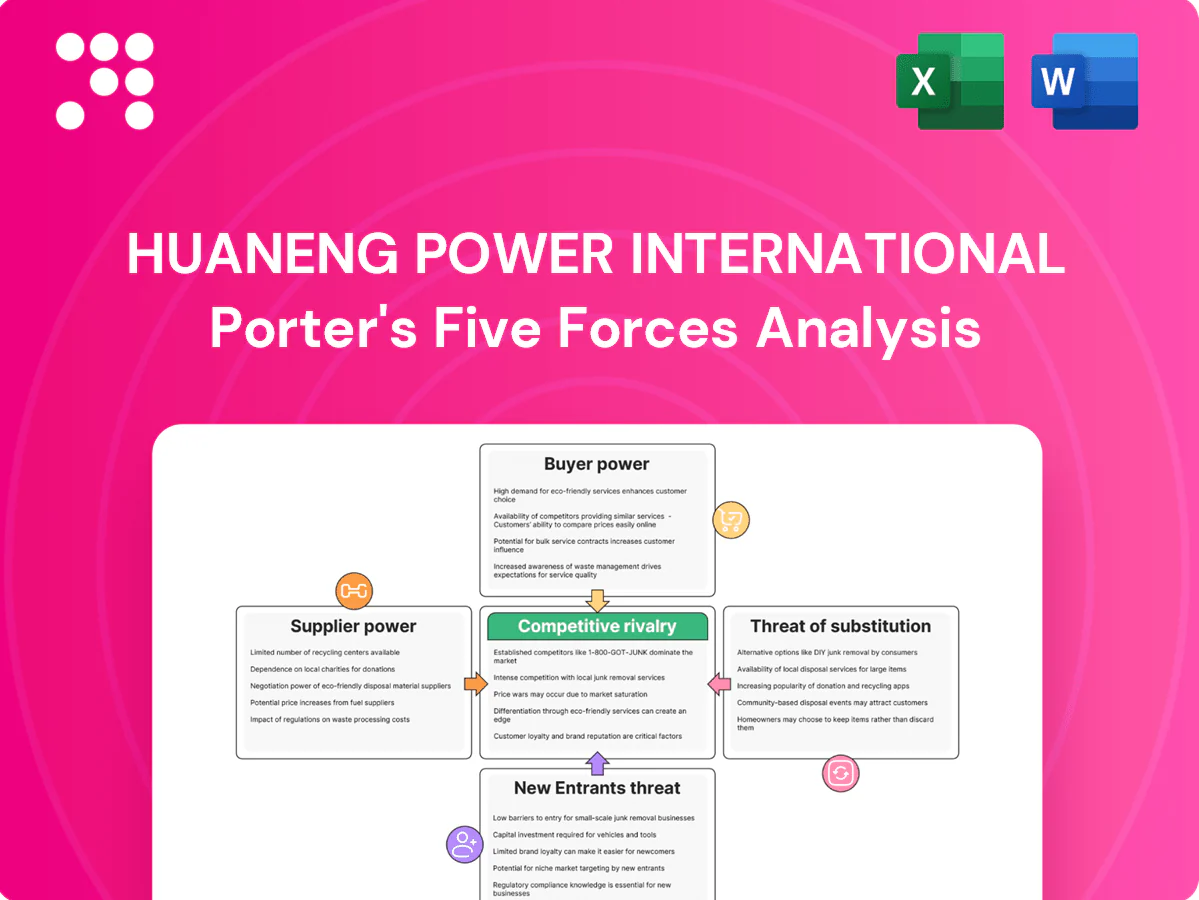
Huaneng Power International Porter's Five Forces Analysis

A Must-Have Tool for Decision-Makers
Huaneng Power International faces moderate buyer power, high regulatory and capital-intensity barriers, and increasing pressure from renewables and grid reforms that reshape profitability. This brief snapshot highlights key competitive tensions and strategic levers. Unlock the full Porter's Five Forces Analysis to explore detailed force ratings, visuals, and actionable insights for investment or strategy.
Suppliers Bargaining Power

Fuel Supply Concentration
Coal dominated Huaneng’s 2024 fuel mix, accounting for about 68% of generation, largely sourced from a concentrated set of state-backed miners and rail logistics providers, which raises price pass-through pressure and supply-security risk during market tightness. Long-term contracts and captive mines partly mitigate exposure, but coal quality variance and transport bottlenecks sustain supplier leverage. Ongoing diversification into hydro, wind and solar (now ~22% capacity) reduces but does not immediately eliminate dependency.
Equipment OEM Dependence
Huaneng faces concentrated OEM supply for large thermal units, gas turbines and grid-scale inverters, with a handful of global and domestic suppliers dominating market share in 2024, driving bargaining leverage. Switching costs remain high because performance guarantees, OEM spare parts and O&M know-how tie plants to original suppliers. OEM backlog cycles and technology lock-in — lead times often stretching to ~24 months in 2024 — push pricing and service terms upward, while localization reduces exposure but cutting-edge efficiency and emissions tech still trade at a premium.

Transmission and Ancillary Inputs
Rail, port and trucking for coal and water rights are regionally concentrated in China, so 2024 logistics congestion and episodic droughts (which cut hydropower output) shifted bargaining leverage to transport and water suppliers and raised short-term spot freight and coal premia. Environmental reagents (urea, ammonia) and SCR vendors remain specialized, sustaining above-industry margins. Multi-channel contracting cushions supply shocks but increases coordination and working-capital costs for Huaneng.

Carbon and Compliance Costs
China’s national ETS covers the power sector and traded at around 60 CNY/tCO2 in 2024, making allowances and stricter emissions controls quasi-suppliers of compliance; tighter caps or allowance scarcity raise Huaneng’s effective input cost. Limited accredited monitoring and waste-remediation providers concentrate pricing power, while forward allowance procurement and efficiency upgrades blunt but do not remove that leverage.
- ETS price ~60 CNY/tCO2 (2024)
- Power sector covered → direct compliance exposure
- Few accredited monitoring/remediation providers → price-taking
- Forward procurement and efficiency cap but don’t eliminate supplier leverage
Renewables Component Supply
Renewables component supply for Huaneng—wind turbines, blades, towers, PV modules and batteries—is competitive but cyclical; 2024 saw tighter lead times during demand surges, lifting supplier pricing power and EPC slot premiums. Technology upgrades (large-rotor wind, N-type PV, LFP cells) generated temporary scarcity pockets in 2024, pressuring costs and delivery. Framework agreements and vertical partnerships have been used to stabilize pricing and secure capacity.
- 2024 LFP share ~60% in China EV/storage shipments
- Module and turbine lead-time spikes drove short-term price uplifts in 2024
- Frameworks/partnerships reduced procurement volatility for Huaneng
Coal 68% dependence, OEM 24-month lead times, ETS 60 CNY/tCO2
Suppliers hold moderate-to-high leverage: coal (68% of generation in 2024) and concentrated state miners/rail raise price and security risk; OEMs face ~24-month lead times, locking Huaneng into higher service/spare costs; logistics, water and specialized SCR vendors exert regional power; ETS at ~60 CNY/tCO2 and few remediation providers add compliance cost pressure.
| Item | 2024 metric | Impact |
|---|---|---|
| Coal share | 68% | High dependency |
| ETS price | 60 CNY/tCO2 | Compliance cost |
| OEM lead time | ~24 months | Switching cost |
| LFP share | ~60% | renewables supply risk |
What is included in the product
 Detailed Word Document
Tailored exclusively for Huaneng Power International, this Porter’s Five Forces overview uncovers key drivers of competition, supplier and buyer power, entry barriers, substitutes, and emerging threats shaping its profitability and strategic positioning.

 Customizable Excel Spreadsheet
One-sheet Porter's Five Forces for Huaneng Power International simplifies competitive dynamics into a clear, slide-ready summary so executives and investors can act fast. Customize force levels, swap in your own data, and visualize strategic pressure with an instant spider chart—no complex tools required.
Customers Bargaining Power

Grid Single-Buyer Dynamics
In 2024 State Grid and China Southern Grid aggregated roughly 95% of national transmission and offtake, concentrating purchaser power against generators. Centralized dispatch and settlement compress pricing flexibility, with on‑grid tariffs (coal units ~0.45 RMB/kWh in 2024) quickly cascading to merchant prices. Long‑term contracts give volume certainty, but balancing market negotiation leverage tilts decisively toward grid companies.
Marketization and Direct Trading
Marketization and direct trading accelerated in 2024 as China expanded spot and bilateral power trading pilots, enabling large industrial buyers to secure discounts and push volumes toward market-based contracts. As load shifts from regulated tariffs to market pricing, buyers gain greater price influence, forcing Huaneng to offer competitive rates or contract flexibility to retain customers. Hedging strategies and an optimized generation mix became critical in 2024 to protect margins amid volatile spot prices.

Heat Customers in CHP
Urban heating customers for CHP are typically municipal or institutional and highly price-sensitive, with tariffs regulated by local governments and the National Development and Reform Commission limiting unilateral price hikes. Mid-season switching is operationally difficult due to network lock-in and continuity requirements, while service reliability and environmental compliance (China carbon neutrality by 2060) shape strict contract terms and give buyers policy leverage in negotiations.

Quality and Flexibility Demands
Buyers in 2024 increasingly demand ancillary services, fast ramping and green attributes, shifting bargaining power toward the side that controls flexibility. Huaneng’s diversified thermal, gas, hydro and renewables fleet can match varied load profiles but requires accelerated investment in digital dispatch and asset optimisation to capture premiums. Performance SLAs and penalties in contracts further strengthen buyer leverage.
- Fleet diversity: enables flexibility
- Digital dispatch: critical gap
- SLAs/penalties: increase buyer leverage
Green Certificates and Attributes
Global corporate PPA volume reached about 30 GW in 2024, boosting demand for RECs and PPAs while buyers increasingly scrutinize price and additionality. Sophisticated customers can shop among many renewable projects, raising buyer bargaining power in renewables contracting. Bundling grid services and certificates can partially offset price pressure and protect margins.
- 2024 PPA market ~30 GW — higher buyer leverage
- Additionality demands raise contract hurdles
- Bundling services + certificates = partial countermeasure
Buyer leverage rises with 95% grid concentration and 30 GW PPAs
Buyer power is high: State Grid/China Southern Grid control ~95% of offtake, central dispatch caps generator pricing (coal on‑grid ~0.45 RMB/kWh in 2024). Market trading and 30 GW corporate PPA growth in 2024 increased large buyer leverage; urban heating and CHP customers face regulated tariffs and switching friction, but demand for fast ramping, ancillary services and green attributes shifts negotiating power to sophisticated buyers.
| Metric | 2024 value |
|---|---|
| Grid concentration | ~95% |
| Coal on‑grid tariff | ~0.45 RMB/kWh |
| Corporate PPA market | ~30 GW |
Preview Before You Purchase
Huaneng Power International Porter's Five Forces Analysis
This Porter's Five Forces analysis of Huaneng Power International assesses competitive rivalry, supplier and buyer power, threat of substitutes, and barriers to entry to inform strategic and investment decisions. This preview is the exact, fully formatted document you will receive immediately after purchase. No placeholders or samples—ready to download and use.

A Must-Have Tool for Decision-Makers
Huaneng Power International faces moderate buyer power, high regulatory and capital-intensity barriers, and increasing pressure from renewables and grid reforms that reshape profitability. This brief snapshot highlights key competitive tensions and strategic levers. Unlock the full Porter's Five Forces Analysis to explore detailed force ratings, visuals, and actionable insights for investment or strategy.
Suppliers Bargaining Power
Fuel Supply Concentration
Coal dominated Huaneng’s 2024 fuel mix, accounting for about 68% of generation, largely sourced from a concentrated set of state-backed miners and rail logistics providers, which raises price pass-through pressure and supply-security risk during market tightness. Long-term contracts and captive mines partly mitigate exposure, but coal quality variance and transport bottlenecks sustain supplier leverage. Ongoing diversification into hydro, wind and solar (now ~22% capacity) reduces but does not immediately eliminate dependency.
Equipment OEM Dependence
Huaneng faces concentrated OEM supply for large thermal units, gas turbines and grid-scale inverters, with a handful of global and domestic suppliers dominating market share in 2024, driving bargaining leverage. Switching costs remain high because performance guarantees, OEM spare parts and O&M know-how tie plants to original suppliers. OEM backlog cycles and technology lock-in — lead times often stretching to ~24 months in 2024 — push pricing and service terms upward, while localization reduces exposure but cutting-edge efficiency and emissions tech still trade at a premium.
Transmission and Ancillary Inputs
Rail, port and trucking for coal and water rights are regionally concentrated in China, so 2024 logistics congestion and episodic droughts (which cut hydropower output) shifted bargaining leverage to transport and water suppliers and raised short-term spot freight and coal premia. Environmental reagents (urea, ammonia) and SCR vendors remain specialized, sustaining above-industry margins. Multi-channel contracting cushions supply shocks but increases coordination and working-capital costs for Huaneng.
Carbon and Compliance Costs
China’s national ETS covers the power sector and traded at around 60 CNY/tCO2 in 2024, making allowances and stricter emissions controls quasi-suppliers of compliance; tighter caps or allowance scarcity raise Huaneng’s effective input cost. Limited accredited monitoring and waste-remediation providers concentrate pricing power, while forward allowance procurement and efficiency upgrades blunt but do not remove that leverage.
- ETS price ~60 CNY/tCO2 (2024)
- Power sector covered → direct compliance exposure
- Few accredited monitoring/remediation providers → price-taking
- Forward procurement and efficiency cap but don’t eliminate supplier leverage
Renewables Component Supply
Renewables component supply for Huaneng—wind turbines, blades, towers, PV modules and batteries—is competitive but cyclical; 2024 saw tighter lead times during demand surges, lifting supplier pricing power and EPC slot premiums. Technology upgrades (large-rotor wind, N-type PV, LFP cells) generated temporary scarcity pockets in 2024, pressuring costs and delivery. Framework agreements and vertical partnerships have been used to stabilize pricing and secure capacity.
- 2024 LFP share ~60% in China EV/storage shipments
- Module and turbine lead-time spikes drove short-term price uplifts in 2024
- Frameworks/partnerships reduced procurement volatility for Huaneng
Coal 68% dependence, OEM 24-month lead times, ETS 60 CNY/tCO2
Suppliers hold moderate-to-high leverage: coal (68% of generation in 2024) and concentrated state miners/rail raise price and security risk; OEMs face ~24-month lead times, locking Huaneng into higher service/spare costs; logistics, water and specialized SCR vendors exert regional power; ETS at ~60 CNY/tCO2 and few remediation providers add compliance cost pressure.
| Item | 2024 metric | Impact |
|---|---|---|
| Coal share | 68% | High dependency |
| ETS price | 60 CNY/tCO2 | Compliance cost |
| OEM lead time | ~24 months | Switching cost |
| LFP share | ~60% | renewables supply risk |
What is included in the product
Detailed Word Document
Tailored exclusively for Huaneng Power International, this Porter’s Five Forces overview uncovers key drivers of competition, supplier and buyer power, entry barriers, substitutes, and emerging threats shaping its profitability and strategic positioning.
Customizable Excel Spreadsheet
One-sheet Porter's Five Forces for Huaneng Power International simplifies competitive dynamics into a clear, slide-ready summary so executives and investors can act fast. Customize force levels, swap in your own data, and visualize strategic pressure with an instant spider chart—no complex tools required.
Customers Bargaining Power
Grid Single-Buyer Dynamics
In 2024 State Grid and China Southern Grid aggregated roughly 95% of national transmission and offtake, concentrating purchaser power against generators. Centralized dispatch and settlement compress pricing flexibility, with on‑grid tariffs (coal units ~0.45 RMB/kWh in 2024) quickly cascading to merchant prices. Long‑term contracts give volume certainty, but balancing market negotiation leverage tilts decisively toward grid companies.
Marketization and Direct Trading
Marketization and direct trading accelerated in 2024 as China expanded spot and bilateral power trading pilots, enabling large industrial buyers to secure discounts and push volumes toward market-based contracts. As load shifts from regulated tariffs to market pricing, buyers gain greater price influence, forcing Huaneng to offer competitive rates or contract flexibility to retain customers. Hedging strategies and an optimized generation mix became critical in 2024 to protect margins amid volatile spot prices.
Heat Customers in CHP
Urban heating customers for CHP are typically municipal or institutional and highly price-sensitive, with tariffs regulated by local governments and the National Development and Reform Commission limiting unilateral price hikes. Mid-season switching is operationally difficult due to network lock-in and continuity requirements, while service reliability and environmental compliance (China carbon neutrality by 2060) shape strict contract terms and give buyers policy leverage in negotiations.
Quality and Flexibility Demands
Buyers in 2024 increasingly demand ancillary services, fast ramping and green attributes, shifting bargaining power toward the side that controls flexibility. Huaneng’s diversified thermal, gas, hydro and renewables fleet can match varied load profiles but requires accelerated investment in digital dispatch and asset optimisation to capture premiums. Performance SLAs and penalties in contracts further strengthen buyer leverage.
- Fleet diversity: enables flexibility
- Digital dispatch: critical gap
- SLAs/penalties: increase buyer leverage
Green Certificates and Attributes
Global corporate PPA volume reached about 30 GW in 2024, boosting demand for RECs and PPAs while buyers increasingly scrutinize price and additionality. Sophisticated customers can shop among many renewable projects, raising buyer bargaining power in renewables contracting. Bundling grid services and certificates can partially offset price pressure and protect margins.
- 2024 PPA market ~30 GW — higher buyer leverage
- Additionality demands raise contract hurdles
- Bundling services + certificates = partial countermeasure
Buyer leverage rises with 95% grid concentration and 30 GW PPAs
Buyer power is high: State Grid/China Southern Grid control ~95% of offtake, central dispatch caps generator pricing (coal on‑grid ~0.45 RMB/kWh in 2024). Market trading and 30 GW corporate PPA growth in 2024 increased large buyer leverage; urban heating and CHP customers face regulated tariffs and switching friction, but demand for fast ramping, ancillary services and green attributes shifts negotiating power to sophisticated buyers.
| Metric | 2024 value |
|---|---|
| Grid concentration | ~95% |
| Coal on‑grid tariff | ~0.45 RMB/kWh |
| Corporate PPA market | ~30 GW |
Preview Before You Purchase
Huaneng Power International Porter's Five Forces Analysis
This Porter's Five Forces analysis of Huaneng Power International assesses competitive rivalry, supplier and buyer power, threat of substitutes, and barriers to entry to inform strategic and investment decisions. This preview is the exact, fully formatted document you will receive immediately after purchase. No placeholders or samples—ready to download and use.
Description
A Must-Have Tool for Decision-Makers
Huaneng Power International faces moderate buyer power, high regulatory and capital-intensity barriers, and increasing pressure from renewables and grid reforms that reshape profitability. This brief snapshot highlights key competitive tensions and strategic levers. Unlock the full Porter's Five Forces Analysis to explore detailed force ratings, visuals, and actionable insights for investment or strategy.
Suppliers Bargaining Power
Fuel Supply Concentration
Coal dominated Huaneng’s 2024 fuel mix, accounting for about 68% of generation, largely sourced from a concentrated set of state-backed miners and rail logistics providers, which raises price pass-through pressure and supply-security risk during market tightness. Long-term contracts and captive mines partly mitigate exposure, but coal quality variance and transport bottlenecks sustain supplier leverage. Ongoing diversification into hydro, wind and solar (now ~22% capacity) reduces but does not immediately eliminate dependency.
Equipment OEM Dependence
Huaneng faces concentrated OEM supply for large thermal units, gas turbines and grid-scale inverters, with a handful of global and domestic suppliers dominating market share in 2024, driving bargaining leverage. Switching costs remain high because performance guarantees, OEM spare parts and O&M know-how tie plants to original suppliers. OEM backlog cycles and technology lock-in — lead times often stretching to ~24 months in 2024 — push pricing and service terms upward, while localization reduces exposure but cutting-edge efficiency and emissions tech still trade at a premium.
Transmission and Ancillary Inputs
Rail, port and trucking for coal and water rights are regionally concentrated in China, so 2024 logistics congestion and episodic droughts (which cut hydropower output) shifted bargaining leverage to transport and water suppliers and raised short-term spot freight and coal premia. Environmental reagents (urea, ammonia) and SCR vendors remain specialized, sustaining above-industry margins. Multi-channel contracting cushions supply shocks but increases coordination and working-capital costs for Huaneng.
Carbon and Compliance Costs
China’s national ETS covers the power sector and traded at around 60 CNY/tCO2 in 2024, making allowances and stricter emissions controls quasi-suppliers of compliance; tighter caps or allowance scarcity raise Huaneng’s effective input cost. Limited accredited monitoring and waste-remediation providers concentrate pricing power, while forward allowance procurement and efficiency upgrades blunt but do not remove that leverage.
- ETS price ~60 CNY/tCO2 (2024)
- Power sector covered → direct compliance exposure
- Few accredited monitoring/remediation providers → price-taking
- Forward procurement and efficiency cap but don’t eliminate supplier leverage
Renewables Component Supply
Renewables component supply for Huaneng—wind turbines, blades, towers, PV modules and batteries—is competitive but cyclical; 2024 saw tighter lead times during demand surges, lifting supplier pricing power and EPC slot premiums. Technology upgrades (large-rotor wind, N-type PV, LFP cells) generated temporary scarcity pockets in 2024, pressuring costs and delivery. Framework agreements and vertical partnerships have been used to stabilize pricing and secure capacity.
- 2024 LFP share ~60% in China EV/storage shipments
- Module and turbine lead-time spikes drove short-term price uplifts in 2024
- Frameworks/partnerships reduced procurement volatility for Huaneng
Coal 68% dependence, OEM 24-month lead times, ETS 60 CNY/tCO2
Suppliers hold moderate-to-high leverage: coal (68% of generation in 2024) and concentrated state miners/rail raise price and security risk; OEMs face ~24-month lead times, locking Huaneng into higher service/spare costs; logistics, water and specialized SCR vendors exert regional power; ETS at ~60 CNY/tCO2 and few remediation providers add compliance cost pressure.
| Item | 2024 metric | Impact |
|---|---|---|
| Coal share | 68% | High dependency |
| ETS price | 60 CNY/tCO2 | Compliance cost |
| OEM lead time | ~24 months | Switching cost |
| LFP share | ~60% | renewables supply risk |
What is included in the product
Detailed Word Document
Tailored exclusively for Huaneng Power International, this Porter’s Five Forces overview uncovers key drivers of competition, supplier and buyer power, entry barriers, substitutes, and emerging threats shaping its profitability and strategic positioning.
Customizable Excel Spreadsheet
One-sheet Porter's Five Forces for Huaneng Power International simplifies competitive dynamics into a clear, slide-ready summary so executives and investors can act fast. Customize force levels, swap in your own data, and visualize strategic pressure with an instant spider chart—no complex tools required.
Customers Bargaining Power
Grid Single-Buyer Dynamics
In 2024 State Grid and China Southern Grid aggregated roughly 95% of national transmission and offtake, concentrating purchaser power against generators. Centralized dispatch and settlement compress pricing flexibility, with on‑grid tariffs (coal units ~0.45 RMB/kWh in 2024) quickly cascading to merchant prices. Long‑term contracts give volume certainty, but balancing market negotiation leverage tilts decisively toward grid companies.
Marketization and Direct Trading
Marketization and direct trading accelerated in 2024 as China expanded spot and bilateral power trading pilots, enabling large industrial buyers to secure discounts and push volumes toward market-based contracts. As load shifts from regulated tariffs to market pricing, buyers gain greater price influence, forcing Huaneng to offer competitive rates or contract flexibility to retain customers. Hedging strategies and an optimized generation mix became critical in 2024 to protect margins amid volatile spot prices.
Heat Customers in CHP
Urban heating customers for CHP are typically municipal or institutional and highly price-sensitive, with tariffs regulated by local governments and the National Development and Reform Commission limiting unilateral price hikes. Mid-season switching is operationally difficult due to network lock-in and continuity requirements, while service reliability and environmental compliance (China carbon neutrality by 2060) shape strict contract terms and give buyers policy leverage in negotiations.
Quality and Flexibility Demands
Buyers in 2024 increasingly demand ancillary services, fast ramping and green attributes, shifting bargaining power toward the side that controls flexibility. Huaneng’s diversified thermal, gas, hydro and renewables fleet can match varied load profiles but requires accelerated investment in digital dispatch and asset optimisation to capture premiums. Performance SLAs and penalties in contracts further strengthen buyer leverage.
- Fleet diversity: enables flexibility
- Digital dispatch: critical gap
- SLAs/penalties: increase buyer leverage
Green Certificates and Attributes
Global corporate PPA volume reached about 30 GW in 2024, boosting demand for RECs and PPAs while buyers increasingly scrutinize price and additionality. Sophisticated customers can shop among many renewable projects, raising buyer bargaining power in renewables contracting. Bundling grid services and certificates can partially offset price pressure and protect margins.
- 2024 PPA market ~30 GW — higher buyer leverage
- Additionality demands raise contract hurdles
- Bundling services + certificates = partial countermeasure
Buyer leverage rises with 95% grid concentration and 30 GW PPAs
Buyer power is high: State Grid/China Southern Grid control ~95% of offtake, central dispatch caps generator pricing (coal on‑grid ~0.45 RMB/kWh in 2024). Market trading and 30 GW corporate PPA growth in 2024 increased large buyer leverage; urban heating and CHP customers face regulated tariffs and switching friction, but demand for fast ramping, ancillary services and green attributes shifts negotiating power to sophisticated buyers.
| Metric | 2024 value |
|---|---|
| Grid concentration | ~95% |
| Coal on‑grid tariff | ~0.45 RMB/kWh |
| Corporate PPA market | ~30 GW |
Preview Before You Purchase
Huaneng Power International Porter's Five Forces Analysis
This Porter's Five Forces analysis of Huaneng Power International assesses competitive rivalry, supplier and buyer power, threat of substitutes, and barriers to entry to inform strategic and investment decisions. This preview is the exact, fully formatted document you will receive immediately after purchase. No placeholders or samples—ready to download and use.











