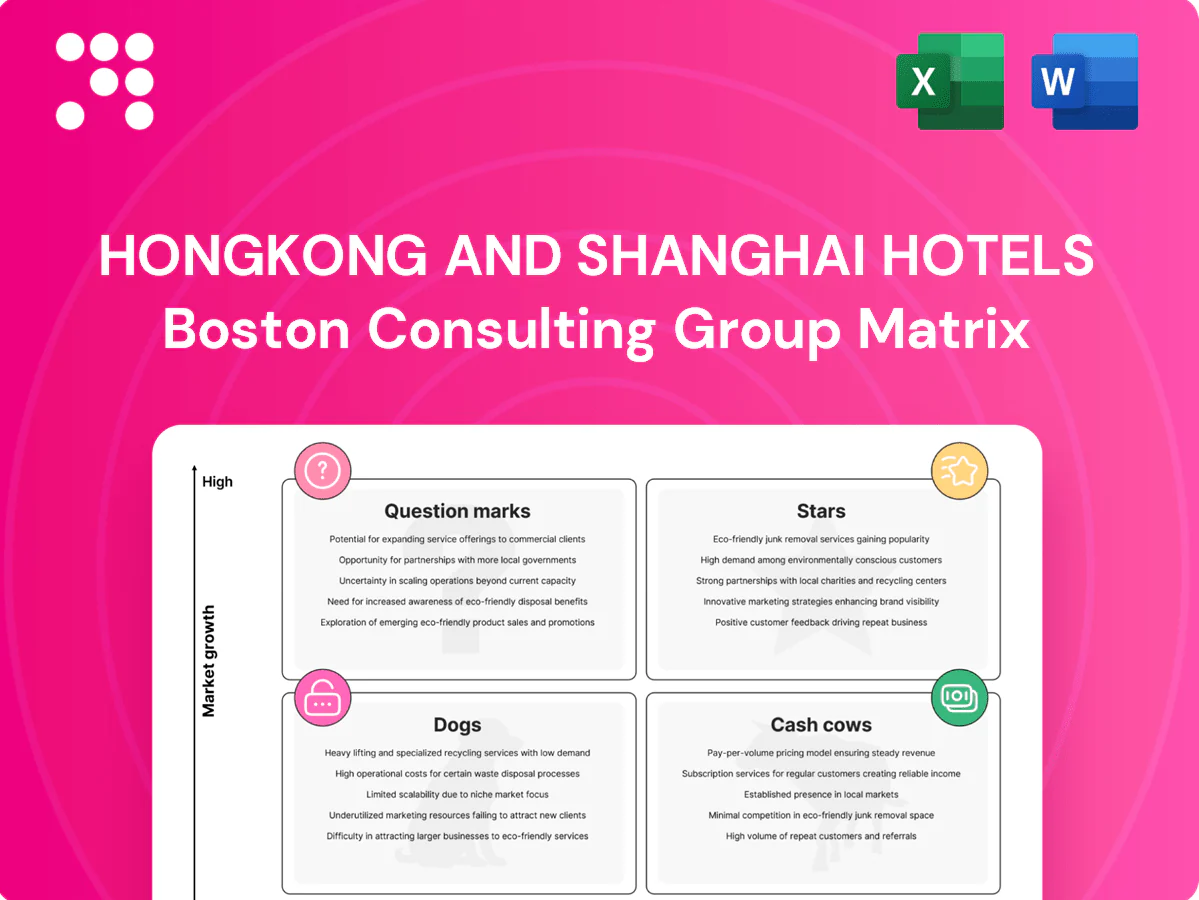
Hongkong and Shanghai Hotels Boston Consulting Group Matrix

Download Your Competitive Advantage
Hongkong and Shanghai Hotels sits at an interesting crossroads — some assets are steady cash cows, while newer ventures look like question marks with upside if management doubles down. Our quick look teases where market share and growth potential collide, but the full picture shows which properties to invest in, divest, or defend. This preview is just the beginning. Get the full BCG Matrix report to uncover detailed quadrant placements, data-backed recommendations, and a roadmap to smart investment and product decisions.
Stars

Peninsula flagship growth engines
Iconic Peninsula hotels in fast-growing gateway cities are driving elevated ADR and rising demand, with strong brand heat and new-to-market buzz keeping occupancy trending upward despite premium pricing.
Continued investment in service, visibility and key partnerships is essential to lock leadership and capture higher yield per room.
Sustained momentum here can convert these flagship assets from growth-stage stars into long-run cash cows for Hongkong and Shanghai Hotels.
Integrated luxury mixed-use hubs
Hotels anchored by high-end retail and offices create flywheel economics in growth corridors, where cross-traffic boosts spend, length of stay, and tenant pull. As districts scale these integrated luxury mixed-use hubs gain share quickly, driven by synergies between lodging, branded retail, and premium workplace demand. Double down on placemaking and curated brands to sustain premium pricing and capture accelerating district-level capture.

Experiential travel and ultra-luxury positioning
Global HNWIs are trading up for rare, culturally rich stays—Capgemini reported ~23.3 million HNWIs in 2024, underpinning rising demand for ultra-luxury experiences. Peninsula’s craftsmanship and heritage map directly to that growth corridor, enabling premium rate power and higher repeat stays. Ongoing refreshed programming and city-exclusive offerings are essential to defend and extend the brand’s market crown.

Direct premium channels and curated partnerships
Owner-managed control of the Peninsula brand enables sharper yield management and consistent brand stewardship, driving higher ADR and guest loyalty through high-touch direct bookings and selective advisor networks that lift mix and margins.
In growth markets this model accelerates share capture; invest in CRM and guest-journey tech where tracking shows measurable RevPAR uplifts and improved repeat-booking rates.
- Owner-managed control: sharper yield, stronger brand stewardship
- Direct bookings + advisors: higher mix and margin
- Growth markets: faster share capture
- Priority investment: CRM and guest journey tech to move RevPAR
Reopened tourism icons with renewed demand
Reopened marquee attractions are capturing renewed travel demand and lifting Peninsula brand awareness, with higher footfall directly boosting hotel occupancy and F&B covers. Early growth phases remain cash‑hungry due to marketing and staffing ramp-up but accelerate long‑term brand gravity. Maintain targeted promotions and deliberate guest‑flow design to convert visibility into repeat revenue.
- Revitalized attractions
- Footfall→occupancy/F&B
- Short‑term cash burn
- Promotions + guest‑flow
Iconic flagship hotels in gateway cities push premium ADR, occupancy and direct-booking yield
Iconic Peninsula flagships in gateway cities drive premium ADR and rising occupancy, supported by heritage-led demand and refreshed city-exclusive programming. Owner-managed brand control and direct-booking focus push higher yields and loyalty. Global HNWI base reached ~23.3 million in 2024, underpinning luxury stay growth.
| Metric | 2024 |
|---|---|
| Global HNWIs | ~23.3 million (Capgemini 2024) |
| Flagship markets | HK, Shanghai, Tokyo, New York, Beverly Hills, Bangkok, Manila |
What is included in the product
 Detailed Word Document
BCG Matrix analysis of Hongkong and Shanghai Hotels: identifies Stars, Cash Cows, Question Marks and Dogs with clear invest, hold, divest guidance.

 Customizable Excel Spreadsheet
One-page BCG Matrix for Hongkong and Shanghai Hotels — clarifies portfolio decisions, export-ready for PowerPoint and C-suite use.
Cash Cows

Legacy Peninsula icons in mature markets
Established Peninsula flagships in mature markets sustain high occupancy and pricing discipline, supported by a loyal luxury clientele and repeat corporate accounts. Capex is surgical—focused on room refurbishments and service training rather than large-scale repositioning—so free cash flow remains reliable and funds the pipeline. Protecting service consistency and keeping rooms fresh are central to defending margins and brand value.
High-stability residential leasing portfolios
Prime residential assets in core Hong Kong districts deliver predictable rental streams, with Hong Kong private home rents up about 7% in 2024 per market reports, underpinning stable cash flows. These portfolios are low growth, high retention with limited marketing spend, while targeted asset enhancement and smart amenities typically nudge NOI up by low single digits. Quiet workhorses bankroll the brand’s broader ambitions.

Commercial offices and retail in core footprints
Well-located Peninsula commercial offices and luxury retail in core footprints sustain durable demand; lean operations, long leases and disciplined renewals produce stable cashflow. Incremental asset upgrades lift efficiency with limited marketing spend, allowing steady NOI growth while pruning underperforming tenancies. Milk these cash cows prudently to fund higher-growth hospitality initiatives.

Clubs and recurring membership revenues
Clubs and recurring membership revenues at Hongkong and Shanghai Hotels provided a dependable cash stream in 2024, with mid-single-digit revenue growth and steady F&B pull-through from loyal local bases; disciplined staffing kept operating margins around 25% while occasional refurbishments contained churn.
- Loyal locals: stable dues
- 2024: mid-single-digit growth
- Margins: ~25%
- Low churn via refurbishments
- Dependable, low-capex cash cow
Proven F&B concepts attached to anchor hotels
Signature dining and lounges at anchor hotels capture captive guests and neighborhood regulars, generating predictable daytime and evening covers; optimized menus and seat turns push F&B EBITDA into double-digit ranges (typically 10–20%), while marketing spend falls materially once the concept is established. Steady cash flows fund broader brand theater and cross-subsidize experiential investments.
- captive demand
- menu engineering
- seat optimization
- low marketing
- steady cash
78% occ · ADR HKD4,200 · rents +7%
Established Peninsula hotels sustain high occupancy and pricing discipline in 2024 (occ ~78%, ADR HKD4,200), generating reliable free cash flow. Prime HK residences delivered predictable rents (rents +7% y/y) with low capex. Clubs and signature F&B grew mid-single-digits with EBITDA 10–20% and operating margins ~25%.
| Asset | Key 2024 metric |
|---|---|
| Hotels | Occ 78% · ADR HKD4,200 |
| Residences | Rents +7% y/y |
| Clubs/F&B | Rev gr mid-single-digit · EBITDA 10–20% · OM ~25% |
What You’re Viewing Is Included
Hongkong and Shanghai Hotels BCG Matrix
The file you're previewing is the final Hongkong and Shanghai Hotels BCG Matrix you’ll receive after purchase. No watermarks, no demo slides—just a fully formatted, analysis-ready report. It’s crafted for immediate editing, printing, or pitching to stakeholders. Buy once and download the exact document shown here, ready for strategic use.

Download Your Competitive Advantage
Hongkong and Shanghai Hotels sits at an interesting crossroads — some assets are steady cash cows, while newer ventures look like question marks with upside if management doubles down. Our quick look teases where market share and growth potential collide, but the full picture shows which properties to invest in, divest, or defend. This preview is just the beginning. Get the full BCG Matrix report to uncover detailed quadrant placements, data-backed recommendations, and a roadmap to smart investment and product decisions.
Stars
Peninsula flagship growth engines
Iconic Peninsula hotels in fast-growing gateway cities are driving elevated ADR and rising demand, with strong brand heat and new-to-market buzz keeping occupancy trending upward despite premium pricing.
Continued investment in service, visibility and key partnerships is essential to lock leadership and capture higher yield per room.
Sustained momentum here can convert these flagship assets from growth-stage stars into long-run cash cows for Hongkong and Shanghai Hotels.
Integrated luxury mixed-use hubs
Hotels anchored by high-end retail and offices create flywheel economics in growth corridors, where cross-traffic boosts spend, length of stay, and tenant pull. As districts scale these integrated luxury mixed-use hubs gain share quickly, driven by synergies between lodging, branded retail, and premium workplace demand. Double down on placemaking and curated brands to sustain premium pricing and capture accelerating district-level capture.
Experiential travel and ultra-luxury positioning
Global HNWIs are trading up for rare, culturally rich stays—Capgemini reported ~23.3 million HNWIs in 2024, underpinning rising demand for ultra-luxury experiences. Peninsula’s craftsmanship and heritage map directly to that growth corridor, enabling premium rate power and higher repeat stays. Ongoing refreshed programming and city-exclusive offerings are essential to defend and extend the brand’s market crown.
Direct premium channels and curated partnerships
Owner-managed control of the Peninsula brand enables sharper yield management and consistent brand stewardship, driving higher ADR and guest loyalty through high-touch direct bookings and selective advisor networks that lift mix and margins.
In growth markets this model accelerates share capture; invest in CRM and guest-journey tech where tracking shows measurable RevPAR uplifts and improved repeat-booking rates.
- Owner-managed control: sharper yield, stronger brand stewardship
- Direct bookings + advisors: higher mix and margin
- Growth markets: faster share capture
- Priority investment: CRM and guest journey tech to move RevPAR
Reopened tourism icons with renewed demand
Reopened marquee attractions are capturing renewed travel demand and lifting Peninsula brand awareness, with higher footfall directly boosting hotel occupancy and F&B covers. Early growth phases remain cash‑hungry due to marketing and staffing ramp-up but accelerate long‑term brand gravity. Maintain targeted promotions and deliberate guest‑flow design to convert visibility into repeat revenue.
- Revitalized attractions
- Footfall→occupancy/F&B
- Short‑term cash burn
- Promotions + guest‑flow
Iconic flagship hotels in gateway cities push premium ADR, occupancy and direct-booking yield
Iconic Peninsula flagships in gateway cities drive premium ADR and rising occupancy, supported by heritage-led demand and refreshed city-exclusive programming. Owner-managed brand control and direct-booking focus push higher yields and loyalty. Global HNWI base reached ~23.3 million in 2024, underpinning luxury stay growth.
| Metric | 2024 |
|---|---|
| Global HNWIs | ~23.3 million (Capgemini 2024) |
| Flagship markets | HK, Shanghai, Tokyo, New York, Beverly Hills, Bangkok, Manila |
What is included in the product
Detailed Word Document
BCG Matrix analysis of Hongkong and Shanghai Hotels: identifies Stars, Cash Cows, Question Marks and Dogs with clear invest, hold, divest guidance.
Customizable Excel Spreadsheet
One-page BCG Matrix for Hongkong and Shanghai Hotels — clarifies portfolio decisions, export-ready for PowerPoint and C-suite use.
Cash Cows
Legacy Peninsula icons in mature markets
Established Peninsula flagships in mature markets sustain high occupancy and pricing discipline, supported by a loyal luxury clientele and repeat corporate accounts. Capex is surgical—focused on room refurbishments and service training rather than large-scale repositioning—so free cash flow remains reliable and funds the pipeline. Protecting service consistency and keeping rooms fresh are central to defending margins and brand value.
High-stability residential leasing portfolios
Prime residential assets in core Hong Kong districts deliver predictable rental streams, with Hong Kong private home rents up about 7% in 2024 per market reports, underpinning stable cash flows. These portfolios are low growth, high retention with limited marketing spend, while targeted asset enhancement and smart amenities typically nudge NOI up by low single digits. Quiet workhorses bankroll the brand’s broader ambitions.
Commercial offices and retail in core footprints
Well-located Peninsula commercial offices and luxury retail in core footprints sustain durable demand; lean operations, long leases and disciplined renewals produce stable cashflow. Incremental asset upgrades lift efficiency with limited marketing spend, allowing steady NOI growth while pruning underperforming tenancies. Milk these cash cows prudently to fund higher-growth hospitality initiatives.
Clubs and recurring membership revenues
Clubs and recurring membership revenues at Hongkong and Shanghai Hotels provided a dependable cash stream in 2024, with mid-single-digit revenue growth and steady F&B pull-through from loyal local bases; disciplined staffing kept operating margins around 25% while occasional refurbishments contained churn.
- Loyal locals: stable dues
- 2024: mid-single-digit growth
- Margins: ~25%
- Low churn via refurbishments
- Dependable, low-capex cash cow
Proven F&B concepts attached to anchor hotels
Signature dining and lounges at anchor hotels capture captive guests and neighborhood regulars, generating predictable daytime and evening covers; optimized menus and seat turns push F&B EBITDA into double-digit ranges (typically 10–20%), while marketing spend falls materially once the concept is established. Steady cash flows fund broader brand theater and cross-subsidize experiential investments.
- captive demand
- menu engineering
- seat optimization
- low marketing
- steady cash
78% occ · ADR HKD4,200 · rents +7%
Established Peninsula hotels sustain high occupancy and pricing discipline in 2024 (occ ~78%, ADR HKD4,200), generating reliable free cash flow. Prime HK residences delivered predictable rents (rents +7% y/y) with low capex. Clubs and signature F&B grew mid-single-digits with EBITDA 10–20% and operating margins ~25%.
| Asset | Key 2024 metric |
|---|---|
| Hotels | Occ 78% · ADR HKD4,200 |
| Residences | Rents +7% y/y |
| Clubs/F&B | Rev gr mid-single-digit · EBITDA 10–20% · OM ~25% |
What You’re Viewing Is Included
Hongkong and Shanghai Hotels BCG Matrix
The file you're previewing is the final Hongkong and Shanghai Hotels BCG Matrix you’ll receive after purchase. No watermarks, no demo slides—just a fully formatted, analysis-ready report. It’s crafted for immediate editing, printing, or pitching to stakeholders. Buy once and download the exact document shown here, ready for strategic use.
Description
Download Your Competitive Advantage
Hongkong and Shanghai Hotels sits at an interesting crossroads — some assets are steady cash cows, while newer ventures look like question marks with upside if management doubles down. Our quick look teases where market share and growth potential collide, but the full picture shows which properties to invest in, divest, or defend. This preview is just the beginning. Get the full BCG Matrix report to uncover detailed quadrant placements, data-backed recommendations, and a roadmap to smart investment and product decisions.
Stars
Peninsula flagship growth engines
Iconic Peninsula hotels in fast-growing gateway cities are driving elevated ADR and rising demand, with strong brand heat and new-to-market buzz keeping occupancy trending upward despite premium pricing.
Continued investment in service, visibility and key partnerships is essential to lock leadership and capture higher yield per room.
Sustained momentum here can convert these flagship assets from growth-stage stars into long-run cash cows for Hongkong and Shanghai Hotels.
Integrated luxury mixed-use hubs
Hotels anchored by high-end retail and offices create flywheel economics in growth corridors, where cross-traffic boosts spend, length of stay, and tenant pull. As districts scale these integrated luxury mixed-use hubs gain share quickly, driven by synergies between lodging, branded retail, and premium workplace demand. Double down on placemaking and curated brands to sustain premium pricing and capture accelerating district-level capture.
Experiential travel and ultra-luxury positioning
Global HNWIs are trading up for rare, culturally rich stays—Capgemini reported ~23.3 million HNWIs in 2024, underpinning rising demand for ultra-luxury experiences. Peninsula’s craftsmanship and heritage map directly to that growth corridor, enabling premium rate power and higher repeat stays. Ongoing refreshed programming and city-exclusive offerings are essential to defend and extend the brand’s market crown.
Direct premium channels and curated partnerships
Owner-managed control of the Peninsula brand enables sharper yield management and consistent brand stewardship, driving higher ADR and guest loyalty through high-touch direct bookings and selective advisor networks that lift mix and margins.
In growth markets this model accelerates share capture; invest in CRM and guest-journey tech where tracking shows measurable RevPAR uplifts and improved repeat-booking rates.
- Owner-managed control: sharper yield, stronger brand stewardship
- Direct bookings + advisors: higher mix and margin
- Growth markets: faster share capture
- Priority investment: CRM and guest journey tech to move RevPAR
Reopened tourism icons with renewed demand
Reopened marquee attractions are capturing renewed travel demand and lifting Peninsula brand awareness, with higher footfall directly boosting hotel occupancy and F&B covers. Early growth phases remain cash‑hungry due to marketing and staffing ramp-up but accelerate long‑term brand gravity. Maintain targeted promotions and deliberate guest‑flow design to convert visibility into repeat revenue.
- Revitalized attractions
- Footfall→occupancy/F&B
- Short‑term cash burn
- Promotions + guest‑flow
Iconic flagship hotels in gateway cities push premium ADR, occupancy and direct-booking yield
Iconic Peninsula flagships in gateway cities drive premium ADR and rising occupancy, supported by heritage-led demand and refreshed city-exclusive programming. Owner-managed brand control and direct-booking focus push higher yields and loyalty. Global HNWI base reached ~23.3 million in 2024, underpinning luxury stay growth.
| Metric | 2024 |
|---|---|
| Global HNWIs | ~23.3 million (Capgemini 2024) |
| Flagship markets | HK, Shanghai, Tokyo, New York, Beverly Hills, Bangkok, Manila |
What is included in the product
Detailed Word Document
BCG Matrix analysis of Hongkong and Shanghai Hotels: identifies Stars, Cash Cows, Question Marks and Dogs with clear invest, hold, divest guidance.
Customizable Excel Spreadsheet
One-page BCG Matrix for Hongkong and Shanghai Hotels — clarifies portfolio decisions, export-ready for PowerPoint and C-suite use.
Cash Cows
Legacy Peninsula icons in mature markets
Established Peninsula flagships in mature markets sustain high occupancy and pricing discipline, supported by a loyal luxury clientele and repeat corporate accounts. Capex is surgical—focused on room refurbishments and service training rather than large-scale repositioning—so free cash flow remains reliable and funds the pipeline. Protecting service consistency and keeping rooms fresh are central to defending margins and brand value.
High-stability residential leasing portfolios
Prime residential assets in core Hong Kong districts deliver predictable rental streams, with Hong Kong private home rents up about 7% in 2024 per market reports, underpinning stable cash flows. These portfolios are low growth, high retention with limited marketing spend, while targeted asset enhancement and smart amenities typically nudge NOI up by low single digits. Quiet workhorses bankroll the brand’s broader ambitions.
Commercial offices and retail in core footprints
Well-located Peninsula commercial offices and luxury retail in core footprints sustain durable demand; lean operations, long leases and disciplined renewals produce stable cashflow. Incremental asset upgrades lift efficiency with limited marketing spend, allowing steady NOI growth while pruning underperforming tenancies. Milk these cash cows prudently to fund higher-growth hospitality initiatives.
Clubs and recurring membership revenues
Clubs and recurring membership revenues at Hongkong and Shanghai Hotels provided a dependable cash stream in 2024, with mid-single-digit revenue growth and steady F&B pull-through from loyal local bases; disciplined staffing kept operating margins around 25% while occasional refurbishments contained churn.
- Loyal locals: stable dues
- 2024: mid-single-digit growth
- Margins: ~25%
- Low churn via refurbishments
- Dependable, low-capex cash cow
Proven F&B concepts attached to anchor hotels
Signature dining and lounges at anchor hotels capture captive guests and neighborhood regulars, generating predictable daytime and evening covers; optimized menus and seat turns push F&B EBITDA into double-digit ranges (typically 10–20%), while marketing spend falls materially once the concept is established. Steady cash flows fund broader brand theater and cross-subsidize experiential investments.
- captive demand
- menu engineering
- seat optimization
- low marketing
- steady cash
78% occ · ADR HKD4,200 · rents +7%
Established Peninsula hotels sustain high occupancy and pricing discipline in 2024 (occ ~78%, ADR HKD4,200), generating reliable free cash flow. Prime HK residences delivered predictable rents (rents +7% y/y) with low capex. Clubs and signature F&B grew mid-single-digits with EBITDA 10–20% and operating margins ~25%.
| Asset | Key 2024 metric |
|---|---|
| Hotels | Occ 78% · ADR HKD4,200 |
| Residences | Rents +7% y/y |
| Clubs/F&B | Rev gr mid-single-digit · EBITDA 10–20% · OM ~25% |
What You’re Viewing Is Included
Hongkong and Shanghai Hotels BCG Matrix
The file you're previewing is the final Hongkong and Shanghai Hotels BCG Matrix you’ll receive after purchase. No watermarks, no demo slides—just a fully formatted, analysis-ready report. It’s crafted for immediate editing, printing, or pitching to stakeholders. Buy once and download the exact document shown here, ready for strategic use.











