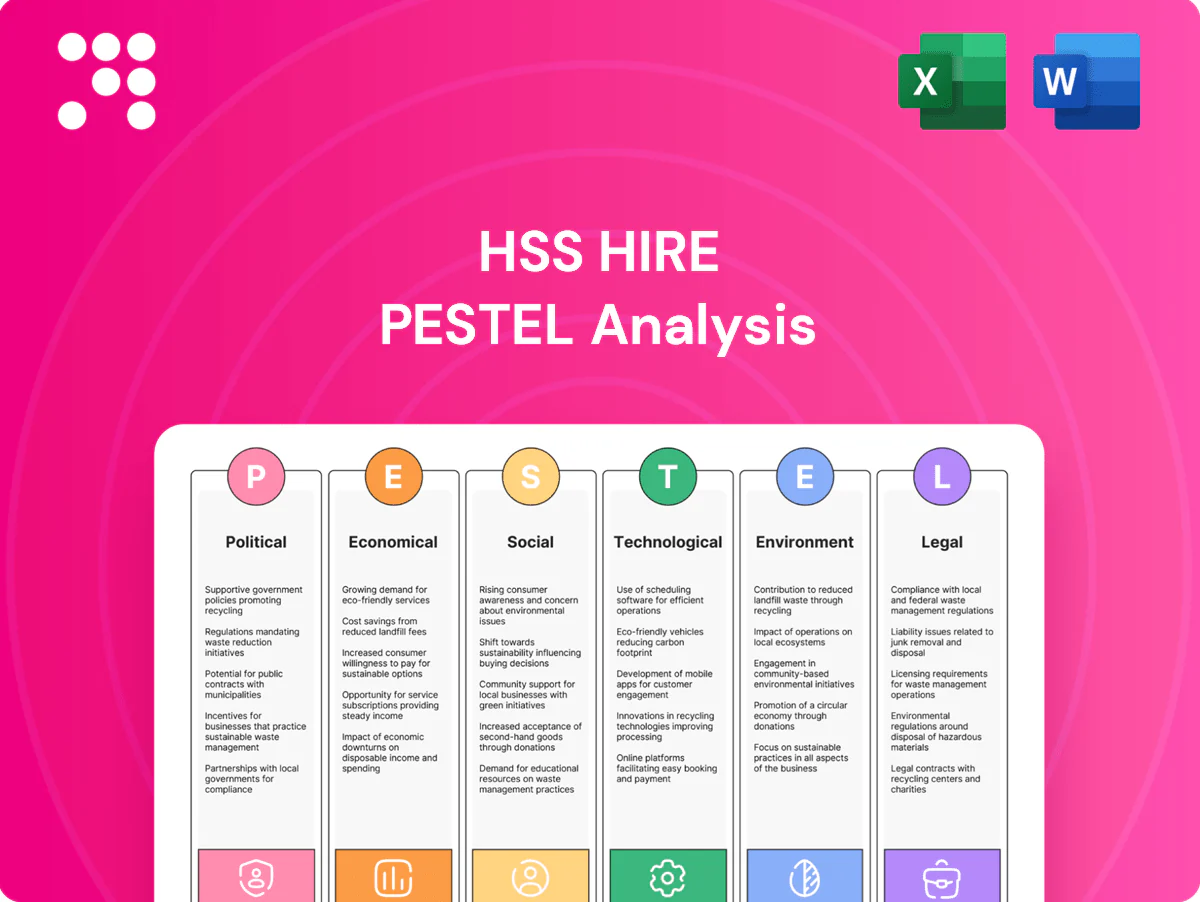
HSS Hire PESTLE Analysis

Your Shortcut to Market Insight Starts Here
Unlock how political shifts, economic cycles, and tech trends are reshaping HSS Hire’s market position in our concise PESTLE snapshot. Designed for investors and strategists, it highlights risks and growth levers you can act on immediately. Purchase the full PESTLE for the complete, editable analysis and turn insight into advantage.
Political factors

UK infrastructure and public spending
Government budgets for infrastructure, housing and public works directly drive equipment hire demand, with UK public sector capital spending rising towards c.£100bn in 2024–25, supporting large civil and housing programmes. Policy shifts after elections can accelerate or pause pipelines, so post‑election reprioritisations materially affect utilisation rates and fleet turnover. Monitoring UK and Irish capital plans and engaging in public procurement frameworks can secure multi‑year volumes and inform depot capacity and fleet mix.
Post‑Brexit trade and cross‑border frictions
Post‑Brexit customs controls and the 2021 Northern Ireland Protocol mean GB, NI and ROI movements face additional paperwork, cabotage restrictions and standards divergence that can delay equipment transfers and trigger tariff exposure under non‑preferential rules. Increased documentation since the end of the 2020 transition has raised logistical lead times and costs, prompting suppliers to adopt dual certification and localized stockholding. Stable cross‑border operations remain critical to HSS Hire service reliability.

Devolved and local authority regulations
Devolved and local rules across Scotland (32 councils), Wales (22 unitary authorities), Northern Ireland (11 districts) and Republic of Ireland (26 counties) create differing site requirements for HSS Hire. Planning conditions, permitted operating hours and safety enforcement vary by authority, affecting project timelines. Tailored compliance and local stakeholder relations cut disruption and planning refusals. Regional policy incentives and funds (UK Levelling Up allocations ~4.8bn) influence depot siting and capex decisions.

Public procurement and social value criteria
Winning council and central contracts increasingly requires demonstrable social value as UK public procurement exceeds £300bn annually (2023–24); tenders commonly allocate 10–20% weighting to social value. Commitments on local jobs, apprenticeships and community benefits directly affect bid scoring, while clear sustainability and safety leadership differentiates HSS Hire. Robust, auditable reporting systems measurably strengthen tender scores and ongoing contract retention.
- tag:public_procurement_£300bn
- tag:social_value_weighting_10-20%
- tag:local_jobs_apprenticeships
- tag:sustainability_safety_leadership
- tag:robust_reporting
Energy and industrial policy
Policies promoting renewables, grid upgrades and retrofit programmes create strong hire demand for temporary plant and specialist crews; UK offshore wind target of 50 GW by 2030 signals large-scale project pipelines. Incentives for low-emission equipment speed fleet transition, while sudden cuts to green schemes can sharply reduce short-term hire volumes. Advocacy helps align standards with operational realities.
- Opportunity: large renewables projects (UK 50 GW by 2030)
- Incentive: accelerates low‑emission fleet uptake
- Risk: policy cuts dampen demand
- Action: active industry advocacy
UK capital spending near £100bn (2024–25) boosts equipment hire and local procurement premiums
UK public capital spending near £100bn in 2024–25 drives equipment hire for infrastructure and housing, affecting utilisation and fleet turnover. Post‑Brexit/NI Protocol adds paperwork and cross‑border delays, increasing logistical costs and local stockholding. Public procurement ~£300bn (2023–24) with 10–20% social value weighting raises bid premium for local jobs, apprenticeships and sustainability.
| tag | value |
|---|---|
| tag:public_capital | £100bn (2024–25) |
| tag:procurement | £300bn (2023–24) |
| tag:social_value | 10–20% |
What is included in the product
 Detailed Word Document
Explores how external macro-environmental factors uniquely affect the HSS Hire across six dimensions—Political, Economic, Social, Technological, Environmental, and Legal—backed by current data and trends for reliable insight. Designed to help executives, consultants, and entrepreneurs identify threats, opportunities, and forward-looking scenarios.

 Customizable Excel Spreadsheet
A concise, visually segmented PESTLE summary for HSS Hire that’s easily dropped into presentations, editable for regional/context notes, and shareable across teams to streamline planning, risk discussions and client reports.
Economic factors

Construction cycle sensitivity
New build, infrastructure and FM budgets — with construction accounting for about 6% of UK GDP (ONS) — directly drive HSS Hire utilization and pricing as project-led demand lifts rates and utilisation. Slowdowns shift rental mix toward maintenance and repair, reducing average ticket sizes while booms strain availability and raise replacement capex. Scenario planning to balance fleet age/capex, plus flexible pricing and cross‑hire, mitigates cycle volatility.
Inflation, interest rates, and capex
Higher Bank Rate at 5.25% (mid-2025) raises financing costs for fleet purchases and working capital, squeezing cashflow for HSS Hire. Inflation at around 2.0% in mid-2025 still pressures wages, parts and transport, challenging margins. Index-linked pricing, ongoing efficiency gains and fleet utilisation improvements help protect profitability. Lease versus buy decisions become more critical for capex optimisation.

Labour availability and wage dynamics
Skilled technicians and drivers remain scarce in the UK hire sector, raising costs and extending turnaround times as sector vacancies stayed above pre-pandemic levels; HSS faces higher fulfilment costs and delayed asset redeployment. Training pipelines and retention programmes (apprenticeships, targeted pay bands) reduce downtime by improving first-time fix rates. Wage inflation—regular pay growth ~6% in 2024 (ONS)—forces productivity offsets to protect margins. Service quality hinges on stable staffing and low turnover to maintain uptime and safety.

GBP/EUR and Ireland exposure
GBP/EUR ~1.17 (Jul 2025) means currency moves materially affect Irish revenue translation and the cost of EU‑sourced parts. Active hedging programs and greater local procurement have reduced reported volatility. Price lists and contracts need FX clauses, while harmonized SKUs simplify inventory and parts exposure across borders.
- GBP/EUR 1.17 (Jul 2025)
- Hedging reduces P&L swings
- FX clauses required in contracts
- Harmonized SKUs cut inventory FX risk
Client outsourcing and hire substitution
Clients increasingly prefer hiring over owning to preserve cash and flexibility; the UK equipment hire market was estimated at about £5.0bn in 2024, reinforcing demand for hire models.
Economic uncertainty in 2024–25 strengthened the hire value proposition, with businesses postponing capex and shifting to variable OPEX solutions.
Expanded managed services have deepened share of wallet for HSS, while data‑backed TCO analyses have improved conversion rates and contract lengths.
- Market size: ≈£5.0bn (2024)
- Trend: capex→opex shift
- Strategy: managed services ↑ wallet share
- Sales driver: TCO proofs boost conversion
UK capital spending near £100bn (2024–25) boosts equipment hire and local procurement premiums
Project-led construction demand (construction ≈6% of UK GDP) and a ≈£5.0bn UK hire market (2024) drive HSS utilisation and pricing; booms raise capex, slowdowns shift mix to maintenance. Bank Rate 5.25% (mid-2025) and CPI ≈2.0% squeeze financing and wage costs; GBP/EUR ≈1.17 affects parts and Irish revenue. Managed services and TCO selling increase contract length and wallet share.
| Metric | Value |
|---|---|
| Bank Rate | 5.25% (mid-2025) |
| CPI | ≈2.0% (mid-2025) |
| GBP/EUR | ≈1.17 (Jul 2025) |
| UK hire market | ≈£5.0bn (2024) |
| Construction share GDP | ≈6% (ONS) |
What You See Is What You Get
HSS Hire PESTLE Analysis
The preview shown here is the exact document you’ll receive after purchase—fully formatted and ready to use. This HSS Hire PESTLE Analysis outlines political, economic, social, technological, legal and environmental factors affecting the business and is presented in the same structure and detail as the downloadable file. No placeholders or teasers—what you see is the final, ready-to-download report.

Your Shortcut to Market Insight Starts Here
Unlock how political shifts, economic cycles, and tech trends are reshaping HSS Hire’s market position in our concise PESTLE snapshot. Designed for investors and strategists, it highlights risks and growth levers you can act on immediately. Purchase the full PESTLE for the complete, editable analysis and turn insight into advantage.
Political factors
UK infrastructure and public spending
Government budgets for infrastructure, housing and public works directly drive equipment hire demand, with UK public sector capital spending rising towards c.£100bn in 2024–25, supporting large civil and housing programmes. Policy shifts after elections can accelerate or pause pipelines, so post‑election reprioritisations materially affect utilisation rates and fleet turnover. Monitoring UK and Irish capital plans and engaging in public procurement frameworks can secure multi‑year volumes and inform depot capacity and fleet mix.
Post‑Brexit trade and cross‑border frictions
Post‑Brexit customs controls and the 2021 Northern Ireland Protocol mean GB, NI and ROI movements face additional paperwork, cabotage restrictions and standards divergence that can delay equipment transfers and trigger tariff exposure under non‑preferential rules. Increased documentation since the end of the 2020 transition has raised logistical lead times and costs, prompting suppliers to adopt dual certification and localized stockholding. Stable cross‑border operations remain critical to HSS Hire service reliability.
Devolved and local authority regulations
Devolved and local rules across Scotland (32 councils), Wales (22 unitary authorities), Northern Ireland (11 districts) and Republic of Ireland (26 counties) create differing site requirements for HSS Hire. Planning conditions, permitted operating hours and safety enforcement vary by authority, affecting project timelines. Tailored compliance and local stakeholder relations cut disruption and planning refusals. Regional policy incentives and funds (UK Levelling Up allocations ~4.8bn) influence depot siting and capex decisions.
Public procurement and social value criteria
Winning council and central contracts increasingly requires demonstrable social value as UK public procurement exceeds £300bn annually (2023–24); tenders commonly allocate 10–20% weighting to social value. Commitments on local jobs, apprenticeships and community benefits directly affect bid scoring, while clear sustainability and safety leadership differentiates HSS Hire. Robust, auditable reporting systems measurably strengthen tender scores and ongoing contract retention.
- tag:public_procurement_£300bn
- tag:social_value_weighting_10-20%
- tag:local_jobs_apprenticeships
- tag:sustainability_safety_leadership
- tag:robust_reporting
Energy and industrial policy
Policies promoting renewables, grid upgrades and retrofit programmes create strong hire demand for temporary plant and specialist crews; UK offshore wind target of 50 GW by 2030 signals large-scale project pipelines. Incentives for low-emission equipment speed fleet transition, while sudden cuts to green schemes can sharply reduce short-term hire volumes. Advocacy helps align standards with operational realities.
- Opportunity: large renewables projects (UK 50 GW by 2030)
- Incentive: accelerates low‑emission fleet uptake
- Risk: policy cuts dampen demand
- Action: active industry advocacy
UK capital spending near £100bn (2024–25) boosts equipment hire and local procurement premiums
UK public capital spending near £100bn in 2024–25 drives equipment hire for infrastructure and housing, affecting utilisation and fleet turnover. Post‑Brexit/NI Protocol adds paperwork and cross‑border delays, increasing logistical costs and local stockholding. Public procurement ~£300bn (2023–24) with 10–20% social value weighting raises bid premium for local jobs, apprenticeships and sustainability.
| tag | value |
|---|---|
| tag:public_capital | £100bn (2024–25) |
| tag:procurement | £300bn (2023–24) |
| tag:social_value | 10–20% |
What is included in the product
Detailed Word Document
Explores how external macro-environmental factors uniquely affect the HSS Hire across six dimensions—Political, Economic, Social, Technological, Environmental, and Legal—backed by current data and trends for reliable insight. Designed to help executives, consultants, and entrepreneurs identify threats, opportunities, and forward-looking scenarios.
Customizable Excel Spreadsheet
A concise, visually segmented PESTLE summary for HSS Hire that’s easily dropped into presentations, editable for regional/context notes, and shareable across teams to streamline planning, risk discussions and client reports.
Economic factors
Construction cycle sensitivity
New build, infrastructure and FM budgets — with construction accounting for about 6% of UK GDP (ONS) — directly drive HSS Hire utilization and pricing as project-led demand lifts rates and utilisation. Slowdowns shift rental mix toward maintenance and repair, reducing average ticket sizes while booms strain availability and raise replacement capex. Scenario planning to balance fleet age/capex, plus flexible pricing and cross‑hire, mitigates cycle volatility.
Inflation, interest rates, and capex
Higher Bank Rate at 5.25% (mid-2025) raises financing costs for fleet purchases and working capital, squeezing cashflow for HSS Hire. Inflation at around 2.0% in mid-2025 still pressures wages, parts and transport, challenging margins. Index-linked pricing, ongoing efficiency gains and fleet utilisation improvements help protect profitability. Lease versus buy decisions become more critical for capex optimisation.
Labour availability and wage dynamics
Skilled technicians and drivers remain scarce in the UK hire sector, raising costs and extending turnaround times as sector vacancies stayed above pre-pandemic levels; HSS faces higher fulfilment costs and delayed asset redeployment. Training pipelines and retention programmes (apprenticeships, targeted pay bands) reduce downtime by improving first-time fix rates. Wage inflation—regular pay growth ~6% in 2024 (ONS)—forces productivity offsets to protect margins. Service quality hinges on stable staffing and low turnover to maintain uptime and safety.
GBP/EUR and Ireland exposure
GBP/EUR ~1.17 (Jul 2025) means currency moves materially affect Irish revenue translation and the cost of EU‑sourced parts. Active hedging programs and greater local procurement have reduced reported volatility. Price lists and contracts need FX clauses, while harmonized SKUs simplify inventory and parts exposure across borders.
- GBP/EUR 1.17 (Jul 2025)
- Hedging reduces P&L swings
- FX clauses required in contracts
- Harmonized SKUs cut inventory FX risk
Client outsourcing and hire substitution
Clients increasingly prefer hiring over owning to preserve cash and flexibility; the UK equipment hire market was estimated at about £5.0bn in 2024, reinforcing demand for hire models.
Economic uncertainty in 2024–25 strengthened the hire value proposition, with businesses postponing capex and shifting to variable OPEX solutions.
Expanded managed services have deepened share of wallet for HSS, while data‑backed TCO analyses have improved conversion rates and contract lengths.
- Market size: ≈£5.0bn (2024)
- Trend: capex→opex shift
- Strategy: managed services ↑ wallet share
- Sales driver: TCO proofs boost conversion
UK capital spending near £100bn (2024–25) boosts equipment hire and local procurement premiums
Project-led construction demand (construction ≈6% of UK GDP) and a ≈£5.0bn UK hire market (2024) drive HSS utilisation and pricing; booms raise capex, slowdowns shift mix to maintenance. Bank Rate 5.25% (mid-2025) and CPI ≈2.0% squeeze financing and wage costs; GBP/EUR ≈1.17 affects parts and Irish revenue. Managed services and TCO selling increase contract length and wallet share.
| Metric | Value |
|---|---|
| Bank Rate | 5.25% (mid-2025) |
| CPI | ≈2.0% (mid-2025) |
| GBP/EUR | ≈1.17 (Jul 2025) |
| UK hire market | ≈£5.0bn (2024) |
| Construction share GDP | ≈6% (ONS) |
What You See Is What You Get
HSS Hire PESTLE Analysis
The preview shown here is the exact document you’ll receive after purchase—fully formatted and ready to use. This HSS Hire PESTLE Analysis outlines political, economic, social, technological, legal and environmental factors affecting the business and is presented in the same structure and detail as the downloadable file. No placeholders or teasers—what you see is the final, ready-to-download report.
Original: $10.00
-65%$10.00
$3.50Description
Your Shortcut to Market Insight Starts Here
Unlock how political shifts, economic cycles, and tech trends are reshaping HSS Hire’s market position in our concise PESTLE snapshot. Designed for investors and strategists, it highlights risks and growth levers you can act on immediately. Purchase the full PESTLE for the complete, editable analysis and turn insight into advantage.
Political factors
UK infrastructure and public spending
Government budgets for infrastructure, housing and public works directly drive equipment hire demand, with UK public sector capital spending rising towards c.£100bn in 2024–25, supporting large civil and housing programmes. Policy shifts after elections can accelerate or pause pipelines, so post‑election reprioritisations materially affect utilisation rates and fleet turnover. Monitoring UK and Irish capital plans and engaging in public procurement frameworks can secure multi‑year volumes and inform depot capacity and fleet mix.
Post‑Brexit trade and cross‑border frictions
Post‑Brexit customs controls and the 2021 Northern Ireland Protocol mean GB, NI and ROI movements face additional paperwork, cabotage restrictions and standards divergence that can delay equipment transfers and trigger tariff exposure under non‑preferential rules. Increased documentation since the end of the 2020 transition has raised logistical lead times and costs, prompting suppliers to adopt dual certification and localized stockholding. Stable cross‑border operations remain critical to HSS Hire service reliability.
Devolved and local authority regulations
Devolved and local rules across Scotland (32 councils), Wales (22 unitary authorities), Northern Ireland (11 districts) and Republic of Ireland (26 counties) create differing site requirements for HSS Hire. Planning conditions, permitted operating hours and safety enforcement vary by authority, affecting project timelines. Tailored compliance and local stakeholder relations cut disruption and planning refusals. Regional policy incentives and funds (UK Levelling Up allocations ~4.8bn) influence depot siting and capex decisions.
Public procurement and social value criteria
Winning council and central contracts increasingly requires demonstrable social value as UK public procurement exceeds £300bn annually (2023–24); tenders commonly allocate 10–20% weighting to social value. Commitments on local jobs, apprenticeships and community benefits directly affect bid scoring, while clear sustainability and safety leadership differentiates HSS Hire. Robust, auditable reporting systems measurably strengthen tender scores and ongoing contract retention.
- tag:public_procurement_£300bn
- tag:social_value_weighting_10-20%
- tag:local_jobs_apprenticeships
- tag:sustainability_safety_leadership
- tag:robust_reporting
Energy and industrial policy
Policies promoting renewables, grid upgrades and retrofit programmes create strong hire demand for temporary plant and specialist crews; UK offshore wind target of 50 GW by 2030 signals large-scale project pipelines. Incentives for low-emission equipment speed fleet transition, while sudden cuts to green schemes can sharply reduce short-term hire volumes. Advocacy helps align standards with operational realities.
- Opportunity: large renewables projects (UK 50 GW by 2030)
- Incentive: accelerates low‑emission fleet uptake
- Risk: policy cuts dampen demand
- Action: active industry advocacy
UK capital spending near £100bn (2024–25) boosts equipment hire and local procurement premiums
UK public capital spending near £100bn in 2024–25 drives equipment hire for infrastructure and housing, affecting utilisation and fleet turnover. Post‑Brexit/NI Protocol adds paperwork and cross‑border delays, increasing logistical costs and local stockholding. Public procurement ~£300bn (2023–24) with 10–20% social value weighting raises bid premium for local jobs, apprenticeships and sustainability.
| tag | value |
|---|---|
| tag:public_capital | £100bn (2024–25) |
| tag:procurement | £300bn (2023–24) |
| tag:social_value | 10–20% |
What is included in the product
Detailed Word Document
Explores how external macro-environmental factors uniquely affect the HSS Hire across six dimensions—Political, Economic, Social, Technological, Environmental, and Legal—backed by current data and trends for reliable insight. Designed to help executives, consultants, and entrepreneurs identify threats, opportunities, and forward-looking scenarios.
Customizable Excel Spreadsheet
A concise, visually segmented PESTLE summary for HSS Hire that’s easily dropped into presentations, editable for regional/context notes, and shareable across teams to streamline planning, risk discussions and client reports.
Economic factors
Construction cycle sensitivity
New build, infrastructure and FM budgets — with construction accounting for about 6% of UK GDP (ONS) — directly drive HSS Hire utilization and pricing as project-led demand lifts rates and utilisation. Slowdowns shift rental mix toward maintenance and repair, reducing average ticket sizes while booms strain availability and raise replacement capex. Scenario planning to balance fleet age/capex, plus flexible pricing and cross‑hire, mitigates cycle volatility.
Inflation, interest rates, and capex
Higher Bank Rate at 5.25% (mid-2025) raises financing costs for fleet purchases and working capital, squeezing cashflow for HSS Hire. Inflation at around 2.0% in mid-2025 still pressures wages, parts and transport, challenging margins. Index-linked pricing, ongoing efficiency gains and fleet utilisation improvements help protect profitability. Lease versus buy decisions become more critical for capex optimisation.
Labour availability and wage dynamics
Skilled technicians and drivers remain scarce in the UK hire sector, raising costs and extending turnaround times as sector vacancies stayed above pre-pandemic levels; HSS faces higher fulfilment costs and delayed asset redeployment. Training pipelines and retention programmes (apprenticeships, targeted pay bands) reduce downtime by improving first-time fix rates. Wage inflation—regular pay growth ~6% in 2024 (ONS)—forces productivity offsets to protect margins. Service quality hinges on stable staffing and low turnover to maintain uptime and safety.
GBP/EUR and Ireland exposure
GBP/EUR ~1.17 (Jul 2025) means currency moves materially affect Irish revenue translation and the cost of EU‑sourced parts. Active hedging programs and greater local procurement have reduced reported volatility. Price lists and contracts need FX clauses, while harmonized SKUs simplify inventory and parts exposure across borders.
- GBP/EUR 1.17 (Jul 2025)
- Hedging reduces P&L swings
- FX clauses required in contracts
- Harmonized SKUs cut inventory FX risk
Client outsourcing and hire substitution
Clients increasingly prefer hiring over owning to preserve cash and flexibility; the UK equipment hire market was estimated at about £5.0bn in 2024, reinforcing demand for hire models.
Economic uncertainty in 2024–25 strengthened the hire value proposition, with businesses postponing capex and shifting to variable OPEX solutions.
Expanded managed services have deepened share of wallet for HSS, while data‑backed TCO analyses have improved conversion rates and contract lengths.
- Market size: ≈£5.0bn (2024)
- Trend: capex→opex shift
- Strategy: managed services ↑ wallet share
- Sales driver: TCO proofs boost conversion
UK capital spending near £100bn (2024–25) boosts equipment hire and local procurement premiums
Project-led construction demand (construction ≈6% of UK GDP) and a ≈£5.0bn UK hire market (2024) drive HSS utilisation and pricing; booms raise capex, slowdowns shift mix to maintenance. Bank Rate 5.25% (mid-2025) and CPI ≈2.0% squeeze financing and wage costs; GBP/EUR ≈1.17 affects parts and Irish revenue. Managed services and TCO selling increase contract length and wallet share.
| Metric | Value |
|---|---|
| Bank Rate | 5.25% (mid-2025) |
| CPI | ≈2.0% (mid-2025) |
| GBP/EUR | ≈1.17 (Jul 2025) |
| UK hire market | ≈£5.0bn (2024) |
| Construction share GDP | ≈6% (ONS) |
What You See Is What You Get
HSS Hire PESTLE Analysis
The preview shown here is the exact document you’ll receive after purchase—fully formatted and ready to use. This HSS Hire PESTLE Analysis outlines political, economic, social, technological, legal and environmental factors affecting the business and is presented in the same structure and detail as the downloadable file. No placeholders or teasers—what you see is the final, ready-to-download report.











