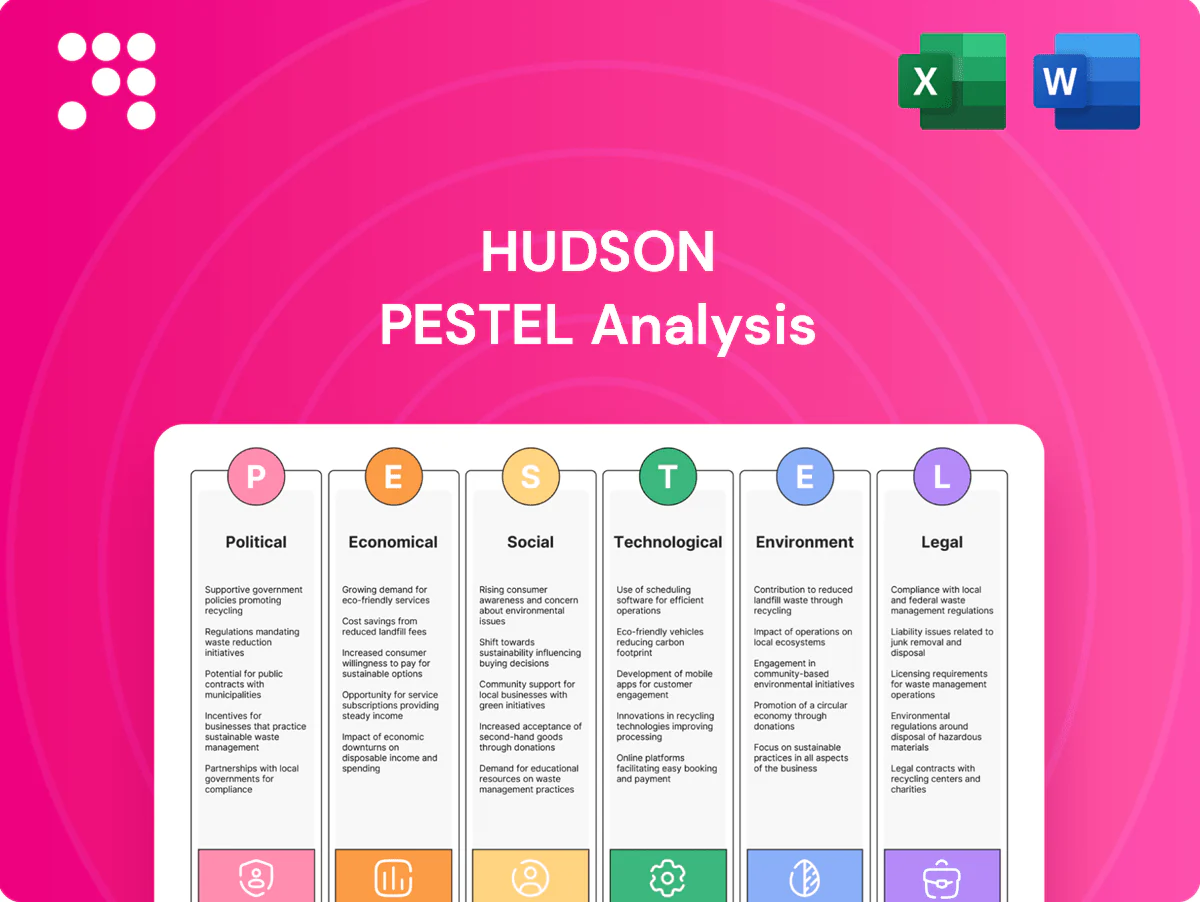
Hudson PESTLE Analysis

Your Shortcut to Market Insight Starts Here
Unlock strategic clarity with our PESTLE Analysis of Hudson—three to five tangibly scoped insights into how political, economic, social, technological, legal, and environmental forces will shape its next moves. Ideal for investors and strategists, the full report delivers actionable, sourced intelligence to inform decisions. Purchase the complete analysis for instant, editable access.
Political factors

Labor and immigration policy
Changes in work visa regimes—eg the US H-1B cap of 85,000 and a projected global talent shortfall of 85 million by 2030 (Korn Ferry)—alter candidate pools for Hudson clients and delivery centers.
Tightened rules raise time-to-hire and sourcing costs; liberalization expands supply, so Hudson must diversify sourcing across jurisdictions to hedge policy shifts and recalibrate pipelines via proactive policy monitoring.
Public sector outsourcing stance
Government attitudes toward outsourcing directly affect RPO demand in health, education and agencies: pro-outsourcing regimes drive multi-year contracts while protectionist shifts narrow scope. Public procurement accounts for about 12% of GDP per OECD, underscoring material opportunity. Hudson Global should tailor bids to compliance-heavy frameworks and local content rules and use stakeholder engagement to mitigate political turnover risk.

Geopolitical instability
Geopolitical instability—conflicts, sanctions and unrest—disrupt client hiring and delivery hubs, prompting hiring freezes, relocations or contingency sourcing; UNHCR counted ~110 million forcibly displaced at end‑2023, and expanded sanctions since 2022 have strained energy and finance corridors. Hudson Global needs cross‑border redundancy, supplier alternatives and scenario planning to preserve service levels under sudden shocks.

Trade and data localization
Data residency mandates (eg GDPR fines up to €20m or 4% of global turnover) and localization pushes in markets like India (1.4 billion people) and China force where candidate data can be stored, complicating global RPO standardization. Hudson Global likely needs regional data stacks and in-country partners; early alignment cuts regulatory friction and delays.
- Regulatory risk: GDPR €20m/4% turnover
- Markets: India, China require localization
- Action: regional stacks + local partners
Fiscal and industrial policy
Subsidies and sector incentives—e.g., the US Inflation Reduction Act's ~369 billion in clean-energy tax incentives and the EU's NextGenerationEU ~800 billion fund—shift hiring toward priority industries; austerity or stimulus alters client recruitment velocity, with stimulus accelerating placements. Hudson Global can pivot vertical focus to capture policy-backed growth, using policy tracking to inform capacity allocation and sales targeting.
- Subsidy-driven hiring: clean energy, tech
- Stimulus vs austerity: recruitment velocity swings
- Hudson pivot: target policy-backed verticals
- Policy tracking: guides capacity & sales
Talent crunch and policy cash: 85m gap; visa caps tighten US hiring
Visa shifts (H-1B 85,000) and a projected 85m global talent gap by 2030 (Korn Ferry) tighten pools; geopolitical shocks (~110m displaced end‑2023) raise contingency costs. Data residency/GDPR (€20m/4%) plus India/China localization force regional stacks. Subsidies (IRA $369bn; NextGenerationEU €800bn) and public procurement (~12% GDP OECD) redirect hiring to policy-backed sectors.
| Tag | Metric | Impact |
|---|---|---|
| Visa | H‑1B 85,000 | Smaller US talent pool |
| Talent gap | 85m by 2030 | Higher sourcing demand |
| Data | GDPR €20m/4% | Regional infra |
| Policy | IRA $369bn / NextGenEU €800bn | Sector hiring shifts |
What is included in the product
 Detailed Word Document
Explores how macro-environmental factors uniquely affect the Hudson across Political, Economic, Social, Technological, Environmental and Legal dimensions, with each section backed by data and current trends to reflect regional market and regulatory dynamics. Designed for executives and advisors, it delivers clean, actionable, forward-looking insights ready for plans, decks, or scenario planning.

 Customizable Excel Spreadsheet
Summarizes Hudson’s external risks into clear PESTLE segments for quick meeting reference, editable for local context and ideal for slides or rapid team alignment.
Economic factors

Labor market tightness
Labor market tightness—with US job vacancies around 8.5 million and unemployment near 3.7% in 2024—raises sourcing difficulty and strengthens Hudsons RPO value proposition by driving clients to outsource to speed fills and boost quality of hire. Clients increasingly buy managed hiring to reduce time-to-fill as tech and cloud skill vacancies rose double-digit in 2024. Hudson Global can command outcome-based pricing when scarcity is acute, but must align capacity planning to requisition surges in hot skills.
Interest rates and budgets
With global policy rates elevated in 2024 (US federal funds ~5.25–5.50%, UK Bank Rate ~5.25%), high financing costs compressed client hiring budgets and lengthened sales cycles. When rates ease, expansionary hiring and program rollouts revive. Hudson should push modular RPO to match constrained budgets, with pricing flexibility and clear ROI proof points becoming critical to win mandates.

Unemployment cycles
Downturns shift client demand toward replacement hiring and critical roles while recoveries trigger volume ramps and project RPO; with U.S. unemployment about 3.7% (May 2025, BLS) Hudson must maintain scalable delivery to flex with cycles. Robust forecasting of demand and supply helps balance bench strength and utilization, reducing margin erosion when volumes swing.

Currency fluctuations
Multi-country delivery exposes Hudson margins to FX volatility; global FX daily turnover reached about 7.5 trillion USD in the BIS 2022 survey, underscoring market moves that can swing staffing margins. Cost arbitrage can erode or improve with currency moves; Hudson can use natural hedges and price contracts in stable currencies while regular FX reviews protect contract profitability.
- FX exposure: multi-country revenue vs costs
- Cost arbitrage: can widen or compress margins
- Mitigants: natural hedges, pricing in USD/EUR
- Governance: regular FX reviews to protect contracts
Wage inflation
Rising wage inflation raises Hudsons recruiter costs and candidate expectations; US average hourly earnings rose about 4.2% YoY in 2024, pressuring margins and benefits packages. Bid assumptions risk slippage on multi-year contracts, so Hudson should insert indexation and formal rate-review clauses and maintain continuous market mapping to keep offers competitive.
- Impact: higher recruiter COGS
- Risk: long-term bid slippage
- Mitigation: indexation/rate reviews
- Action: continuous market mapping
Talent crunch and policy cash: 85m gap; visa caps tighten US hiring
Labor tightness (US vacancies ~8.5M; unemployment ~3.7% in 2024–May 2025) boosts RPO demand; elevated policy rates (US fed ~5.25–5.50%) compress budgets; FX turnover ~$7.5T (BIS 2022) and wage inflation (+4.2% YoY 2024) pressure margins and pricing.
| Metric | Value | Implication |
|---|---|---|
| Vacancies | ~8.5M | Higher RPO demand |
| Fed rate | 5.25–5.50% | Budget pressure |
| Wage inf. | +4.2% YoY | Cost pressure |
What You See Is What You Get
Hudson PESTLE Analysis
The preview shown here is the exact Hudson PESTLE Analysis you’ll receive after purchase—fully formatted and ready to use. The content, layout and insights in this preview match the downloadable file with no placeholders or surprises. After payment you’ll instantly get this exact, final document to download and use.

Your Shortcut to Market Insight Starts Here
Unlock strategic clarity with our PESTLE Analysis of Hudson—three to five tangibly scoped insights into how political, economic, social, technological, legal, and environmental forces will shape its next moves. Ideal for investors and strategists, the full report delivers actionable, sourced intelligence to inform decisions. Purchase the complete analysis for instant, editable access.
Political factors
Labor and immigration policy
Changes in work visa regimes—eg the US H-1B cap of 85,000 and a projected global talent shortfall of 85 million by 2030 (Korn Ferry)—alter candidate pools for Hudson clients and delivery centers.
Tightened rules raise time-to-hire and sourcing costs; liberalization expands supply, so Hudson must diversify sourcing across jurisdictions to hedge policy shifts and recalibrate pipelines via proactive policy monitoring.
Public sector outsourcing stance
Government attitudes toward outsourcing directly affect RPO demand in health, education and agencies: pro-outsourcing regimes drive multi-year contracts while protectionist shifts narrow scope. Public procurement accounts for about 12% of GDP per OECD, underscoring material opportunity. Hudson Global should tailor bids to compliance-heavy frameworks and local content rules and use stakeholder engagement to mitigate political turnover risk.
Geopolitical instability
Geopolitical instability—conflicts, sanctions and unrest—disrupt client hiring and delivery hubs, prompting hiring freezes, relocations or contingency sourcing; UNHCR counted ~110 million forcibly displaced at end‑2023, and expanded sanctions since 2022 have strained energy and finance corridors. Hudson Global needs cross‑border redundancy, supplier alternatives and scenario planning to preserve service levels under sudden shocks.
Trade and data localization
Data residency mandates (eg GDPR fines up to €20m or 4% of global turnover) and localization pushes in markets like India (1.4 billion people) and China force where candidate data can be stored, complicating global RPO standardization. Hudson Global likely needs regional data stacks and in-country partners; early alignment cuts regulatory friction and delays.
- Regulatory risk: GDPR €20m/4% turnover
- Markets: India, China require localization
- Action: regional stacks + local partners
Fiscal and industrial policy
Subsidies and sector incentives—e.g., the US Inflation Reduction Act's ~369 billion in clean-energy tax incentives and the EU's NextGenerationEU ~800 billion fund—shift hiring toward priority industries; austerity or stimulus alters client recruitment velocity, with stimulus accelerating placements. Hudson Global can pivot vertical focus to capture policy-backed growth, using policy tracking to inform capacity allocation and sales targeting.
- Subsidy-driven hiring: clean energy, tech
- Stimulus vs austerity: recruitment velocity swings
- Hudson pivot: target policy-backed verticals
- Policy tracking: guides capacity & sales
Talent crunch and policy cash: 85m gap; visa caps tighten US hiring
Visa shifts (H-1B 85,000) and a projected 85m global talent gap by 2030 (Korn Ferry) tighten pools; geopolitical shocks (~110m displaced end‑2023) raise contingency costs. Data residency/GDPR (€20m/4%) plus India/China localization force regional stacks. Subsidies (IRA $369bn; NextGenerationEU €800bn) and public procurement (~12% GDP OECD) redirect hiring to policy-backed sectors.
| Tag | Metric | Impact |
|---|---|---|
| Visa | H‑1B 85,000 | Smaller US talent pool |
| Talent gap | 85m by 2030 | Higher sourcing demand |
| Data | GDPR €20m/4% | Regional infra |
| Policy | IRA $369bn / NextGenEU €800bn | Sector hiring shifts |
What is included in the product
Detailed Word Document
Explores how macro-environmental factors uniquely affect the Hudson across Political, Economic, Social, Technological, Environmental and Legal dimensions, with each section backed by data and current trends to reflect regional market and regulatory dynamics. Designed for executives and advisors, it delivers clean, actionable, forward-looking insights ready for plans, decks, or scenario planning.
Customizable Excel Spreadsheet
Summarizes Hudson’s external risks into clear PESTLE segments for quick meeting reference, editable for local context and ideal for slides or rapid team alignment.
Economic factors
Labor market tightness
Labor market tightness—with US job vacancies around 8.5 million and unemployment near 3.7% in 2024—raises sourcing difficulty and strengthens Hudsons RPO value proposition by driving clients to outsource to speed fills and boost quality of hire. Clients increasingly buy managed hiring to reduce time-to-fill as tech and cloud skill vacancies rose double-digit in 2024. Hudson Global can command outcome-based pricing when scarcity is acute, but must align capacity planning to requisition surges in hot skills.
Interest rates and budgets
With global policy rates elevated in 2024 (US federal funds ~5.25–5.50%, UK Bank Rate ~5.25%), high financing costs compressed client hiring budgets and lengthened sales cycles. When rates ease, expansionary hiring and program rollouts revive. Hudson should push modular RPO to match constrained budgets, with pricing flexibility and clear ROI proof points becoming critical to win mandates.
Unemployment cycles
Downturns shift client demand toward replacement hiring and critical roles while recoveries trigger volume ramps and project RPO; with U.S. unemployment about 3.7% (May 2025, BLS) Hudson must maintain scalable delivery to flex with cycles. Robust forecasting of demand and supply helps balance bench strength and utilization, reducing margin erosion when volumes swing.
Currency fluctuations
Multi-country delivery exposes Hudson margins to FX volatility; global FX daily turnover reached about 7.5 trillion USD in the BIS 2022 survey, underscoring market moves that can swing staffing margins. Cost arbitrage can erode or improve with currency moves; Hudson can use natural hedges and price contracts in stable currencies while regular FX reviews protect contract profitability.
- FX exposure: multi-country revenue vs costs
- Cost arbitrage: can widen or compress margins
- Mitigants: natural hedges, pricing in USD/EUR
- Governance: regular FX reviews to protect contracts
Wage inflation
Rising wage inflation raises Hudsons recruiter costs and candidate expectations; US average hourly earnings rose about 4.2% YoY in 2024, pressuring margins and benefits packages. Bid assumptions risk slippage on multi-year contracts, so Hudson should insert indexation and formal rate-review clauses and maintain continuous market mapping to keep offers competitive.
- Impact: higher recruiter COGS
- Risk: long-term bid slippage
- Mitigation: indexation/rate reviews
- Action: continuous market mapping
Talent crunch and policy cash: 85m gap; visa caps tighten US hiring
Labor tightness (US vacancies ~8.5M; unemployment ~3.7% in 2024–May 2025) boosts RPO demand; elevated policy rates (US fed ~5.25–5.50%) compress budgets; FX turnover ~$7.5T (BIS 2022) and wage inflation (+4.2% YoY 2024) pressure margins and pricing.
| Metric | Value | Implication |
|---|---|---|
| Vacancies | ~8.5M | Higher RPO demand |
| Fed rate | 5.25–5.50% | Budget pressure |
| Wage inf. | +4.2% YoY | Cost pressure |
What You See Is What You Get
Hudson PESTLE Analysis
The preview shown here is the exact Hudson PESTLE Analysis you’ll receive after purchase—fully formatted and ready to use. The content, layout and insights in this preview match the downloadable file with no placeholders or surprises. After payment you’ll instantly get this exact, final document to download and use.
Original: $10.00
-65%$10.00
$3.50Description
Your Shortcut to Market Insight Starts Here
Unlock strategic clarity with our PESTLE Analysis of Hudson—three to five tangibly scoped insights into how political, economic, social, technological, legal, and environmental forces will shape its next moves. Ideal for investors and strategists, the full report delivers actionable, sourced intelligence to inform decisions. Purchase the complete analysis for instant, editable access.
Political factors
Labor and immigration policy
Changes in work visa regimes—eg the US H-1B cap of 85,000 and a projected global talent shortfall of 85 million by 2030 (Korn Ferry)—alter candidate pools for Hudson clients and delivery centers.
Tightened rules raise time-to-hire and sourcing costs; liberalization expands supply, so Hudson must diversify sourcing across jurisdictions to hedge policy shifts and recalibrate pipelines via proactive policy monitoring.
Public sector outsourcing stance
Government attitudes toward outsourcing directly affect RPO demand in health, education and agencies: pro-outsourcing regimes drive multi-year contracts while protectionist shifts narrow scope. Public procurement accounts for about 12% of GDP per OECD, underscoring material opportunity. Hudson Global should tailor bids to compliance-heavy frameworks and local content rules and use stakeholder engagement to mitigate political turnover risk.
Geopolitical instability
Geopolitical instability—conflicts, sanctions and unrest—disrupt client hiring and delivery hubs, prompting hiring freezes, relocations or contingency sourcing; UNHCR counted ~110 million forcibly displaced at end‑2023, and expanded sanctions since 2022 have strained energy and finance corridors. Hudson Global needs cross‑border redundancy, supplier alternatives and scenario planning to preserve service levels under sudden shocks.
Trade and data localization
Data residency mandates (eg GDPR fines up to €20m or 4% of global turnover) and localization pushes in markets like India (1.4 billion people) and China force where candidate data can be stored, complicating global RPO standardization. Hudson Global likely needs regional data stacks and in-country partners; early alignment cuts regulatory friction and delays.
- Regulatory risk: GDPR €20m/4% turnover
- Markets: India, China require localization
- Action: regional stacks + local partners
Fiscal and industrial policy
Subsidies and sector incentives—e.g., the US Inflation Reduction Act's ~369 billion in clean-energy tax incentives and the EU's NextGenerationEU ~800 billion fund—shift hiring toward priority industries; austerity or stimulus alters client recruitment velocity, with stimulus accelerating placements. Hudson Global can pivot vertical focus to capture policy-backed growth, using policy tracking to inform capacity allocation and sales targeting.
- Subsidy-driven hiring: clean energy, tech
- Stimulus vs austerity: recruitment velocity swings
- Hudson pivot: target policy-backed verticals
- Policy tracking: guides capacity & sales
Talent crunch and policy cash: 85m gap; visa caps tighten US hiring
Visa shifts (H-1B 85,000) and a projected 85m global talent gap by 2030 (Korn Ferry) tighten pools; geopolitical shocks (~110m displaced end‑2023) raise contingency costs. Data residency/GDPR (€20m/4%) plus India/China localization force regional stacks. Subsidies (IRA $369bn; NextGenerationEU €800bn) and public procurement (~12% GDP OECD) redirect hiring to policy-backed sectors.
| Tag | Metric | Impact |
|---|---|---|
| Visa | H‑1B 85,000 | Smaller US talent pool |
| Talent gap | 85m by 2030 | Higher sourcing demand |
| Data | GDPR €20m/4% | Regional infra |
| Policy | IRA $369bn / NextGenEU €800bn | Sector hiring shifts |
What is included in the product
Detailed Word Document
Explores how macro-environmental factors uniquely affect the Hudson across Political, Economic, Social, Technological, Environmental and Legal dimensions, with each section backed by data and current trends to reflect regional market and regulatory dynamics. Designed for executives and advisors, it delivers clean, actionable, forward-looking insights ready for plans, decks, or scenario planning.
Customizable Excel Spreadsheet
Summarizes Hudson’s external risks into clear PESTLE segments for quick meeting reference, editable for local context and ideal for slides or rapid team alignment.
Economic factors
Labor market tightness
Labor market tightness—with US job vacancies around 8.5 million and unemployment near 3.7% in 2024—raises sourcing difficulty and strengthens Hudsons RPO value proposition by driving clients to outsource to speed fills and boost quality of hire. Clients increasingly buy managed hiring to reduce time-to-fill as tech and cloud skill vacancies rose double-digit in 2024. Hudson Global can command outcome-based pricing when scarcity is acute, but must align capacity planning to requisition surges in hot skills.
Interest rates and budgets
With global policy rates elevated in 2024 (US federal funds ~5.25–5.50%, UK Bank Rate ~5.25%), high financing costs compressed client hiring budgets and lengthened sales cycles. When rates ease, expansionary hiring and program rollouts revive. Hudson should push modular RPO to match constrained budgets, with pricing flexibility and clear ROI proof points becoming critical to win mandates.
Unemployment cycles
Downturns shift client demand toward replacement hiring and critical roles while recoveries trigger volume ramps and project RPO; with U.S. unemployment about 3.7% (May 2025, BLS) Hudson must maintain scalable delivery to flex with cycles. Robust forecasting of demand and supply helps balance bench strength and utilization, reducing margin erosion when volumes swing.
Currency fluctuations
Multi-country delivery exposes Hudson margins to FX volatility; global FX daily turnover reached about 7.5 trillion USD in the BIS 2022 survey, underscoring market moves that can swing staffing margins. Cost arbitrage can erode or improve with currency moves; Hudson can use natural hedges and price contracts in stable currencies while regular FX reviews protect contract profitability.
- FX exposure: multi-country revenue vs costs
- Cost arbitrage: can widen or compress margins
- Mitigants: natural hedges, pricing in USD/EUR
- Governance: regular FX reviews to protect contracts
Wage inflation
Rising wage inflation raises Hudsons recruiter costs and candidate expectations; US average hourly earnings rose about 4.2% YoY in 2024, pressuring margins and benefits packages. Bid assumptions risk slippage on multi-year contracts, so Hudson should insert indexation and formal rate-review clauses and maintain continuous market mapping to keep offers competitive.
- Impact: higher recruiter COGS
- Risk: long-term bid slippage
- Mitigation: indexation/rate reviews
- Action: continuous market mapping
Talent crunch and policy cash: 85m gap; visa caps tighten US hiring
Labor tightness (US vacancies ~8.5M; unemployment ~3.7% in 2024–May 2025) boosts RPO demand; elevated policy rates (US fed ~5.25–5.50%) compress budgets; FX turnover ~$7.5T (BIS 2022) and wage inflation (+4.2% YoY 2024) pressure margins and pricing.
| Metric | Value | Implication |
|---|---|---|
| Vacancies | ~8.5M | Higher RPO demand |
| Fed rate | 5.25–5.50% | Budget pressure |
| Wage inf. | +4.2% YoY | Cost pressure |
What You See Is What You Get
Hudson PESTLE Analysis
The preview shown here is the exact Hudson PESTLE Analysis you’ll receive after purchase—fully formatted and ready to use. The content, layout and insights in this preview match the downloadable file with no placeholders or surprises. After payment you’ll instantly get this exact, final document to download and use.











