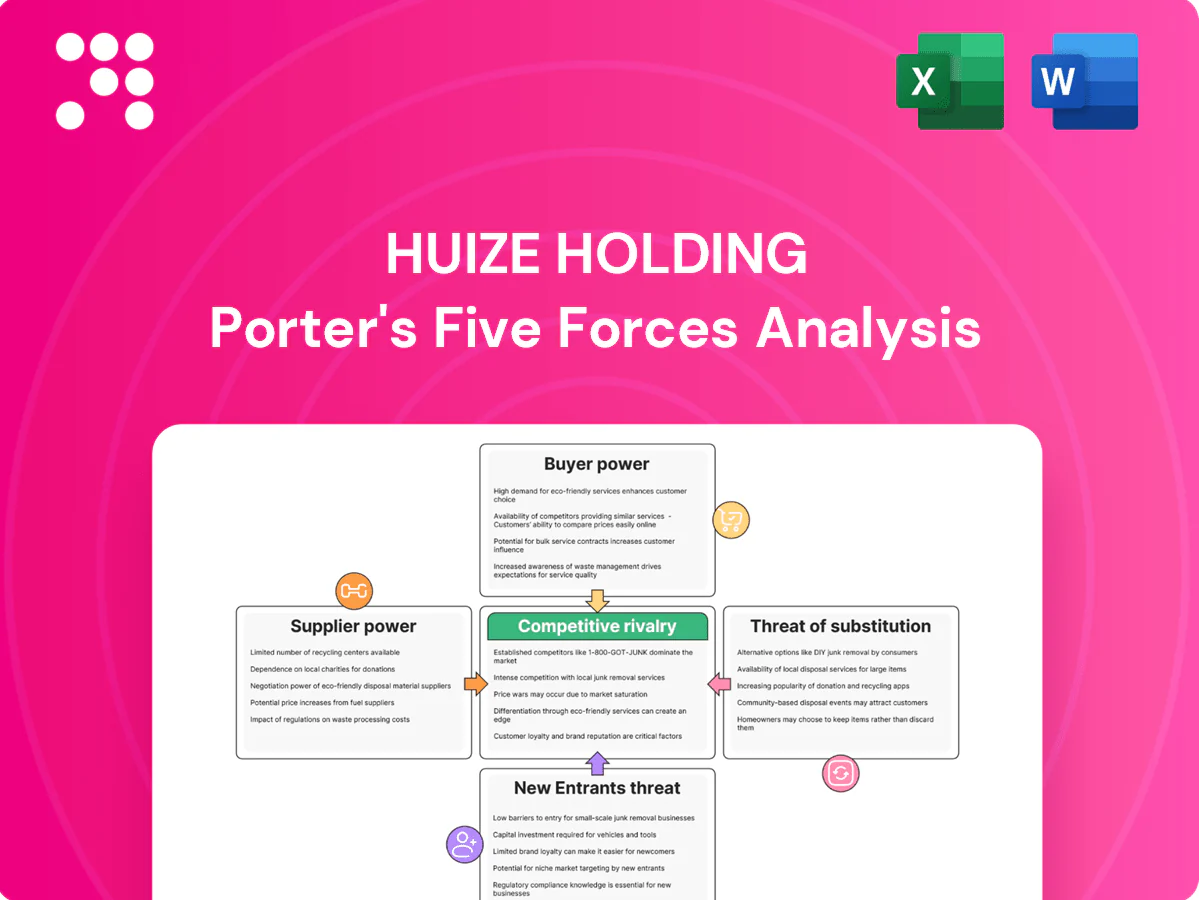
Huize Holding Porter's Five Forces Analysis

Go Beyond the Preview—Access the Full Strategic Report
Huize Holding faces moderate–high competitive rivalry with digital challengers and price-sensitive buyers, while supplier power remains limited and new entrants pose a moderate threat; substitutes and regulatory shifts add tactical risk. This snapshot highlights key pressures on margins and growth. The full Porter's Five Forces breaks down each force, ratings, and strategic implications. Unlock the complete analysis to inform investment or strategy decisions.
Suppliers Bargaining Power

Carrier concentration
Huize depends on a finite set of large life and P&C carriers for capacity and product shelves, allowing leading insurers with strong brands to negotiate placement priority, privileged data access, and margin concessions.
Nonetheless, Huize’s broad insurer panel reduces single-supplier dependence, and its across-life, health, and P&C product mix limits any single carrier’s bargaining leverage.
Product exclusivity
Exclusive or co-developed products give select insurers leverage over pricing and feature sets, while Huize’s customization embeds platform-driven features that are harder for competitors to replicate in 2024. If exclusivity is time-limited, that leverage drops after launch; conversely, multi-year exclusivity raises supplier power and increases client reliance on Huize’s platform. Long exclusivity can push pricing power toward insurers and lock in distribution dynamics.

Integration and data dependencies
Deep API integrations for underwriting, KYC and claims tie Huize to over 200 insurer partners as of 2024, raising switching costs and increasing supplier bargaining power when carriers are heavily embedded. Standardized interfaces and middleware adoption across the industry mitigate lock-in by enabling multi-carrier routing and faster partner replacement. Data‑sharing agreements give carriers leverage to negotiate commission economics and visibility into Huize’s customer flows.

Capacity and risk appetite
Insurers control underwriting capacity and pricing, directly shaping Huize Holding’s product availability; in tight risk cycles carriers often tighten capacity, raising supplier bargaining power, while expanded risk appetite lets Huize re-balance placement across partners and restore margins.
- Supplier control: underwriting/pricing
- Risk cycles: pullback increases power
- Expanded appetite: enables re-balancing
- Portfolio breadth: eases capacity substitution
Compliance and service SLAs
Suppliers set issuance and claims SLAs that directly shape Huize user experience, with tight SLAs and co‑managed operations reducing friction and limiting supplier leverage. Regulatory oversight has trended toward greater standardization of carrier processes, further constraining supplier variability. Where SLAs are weak, suppliers gain power by controlling critical post‑sale touchpoints and recovery timelines.
- Suppliers set SLAs for issuance and claims
- Strong SLAs + co‑management reduce supplier leverage
- Regulatory pressure drives process standardization
- Weak SLAs increase supplier control of post‑sale touchpoints
Partners exceed 200 as APIs and exclusivity magnify insurer leverage
Huize relies on a finite set of large carriers but maintained over 200 insurer partners as of 2024, reducing single‑supplier dependence.
Deep API integrations and time‑limited exclusives raise switching costs and short‑term supplier leverage; multi‑year exclusivity magnifies carrier power.
Insurer control of underwriting capacity and SLAs drives pricing and customer experience, with risk‑cycle tightening increasing supplier bargaining power.
| Metric | 2024 |
|---|---|
| Insurer partners | >200 |
| Key leverage points | APIs, exclusivity, underwriting capacity |
What is included in the product
 Detailed Word Document
Tailored Porter's Five Forces analysis for Huize Holding that uncovers key drivers of competition, buyer and supplier power, substitutes and entry barriers, identifies disruptive threats and market dynamics affecting pricing and profitability, and delivers strategic commentary for investors and management.

 Customizable Excel Spreadsheet
Clear one-sheet Porter's Five Forces for Huize Holding—instantly highlights insurer-specific competitive pressures and regulatory risks for rapid decision-making.
Customers Bargaining Power

Price transparency
Online comparison lets customers benchmark premiums and benefits instantly, increasing buyer power and compressing margins for Huize. High transparency forces commoditization; Huize can defend by bundling services and offering tailored recommendations to raise switching costs. Emphasizing claims support and clear value communication reduces pure price shopping and preserves margin.
Low switching costs
Users can multi-home across Huize, other platforms and direct channels, keeping switching costs minimal and increasing buyer leverage on price and features; digital channels accounted for roughly 30% of China life & health new-business premium in 2024, reinforcing platform competition. Loyalty programs and renewal-management tools can raise frictions, while superior onboarding and claims assistance materially anchor retention.

Sensitivity to claims experience
Insurance buyers heavily weight claims speed and fairness; a 2024 McKinsey analysis found stronger claims performance can lower churn by up to 20% and reduce costs 10–20%. Poor claim experiences drive churn and fuel negative reviews, magnifying buyer bargaining power via social proof. Huize’s lifecycle support and transparent claim tracking can differentiate service, rebuild trust and blunt price-driven adversarial dynamics.

Segment heterogeneity
Mass-market buyers on Huize remain price-driven, while affluent and SME clients prioritize customization and advisory, allowing the firm to segment journeys and convert bargaining power into value-based upsell in 2024. Advisory content and self-serve tools lower perceived purchase risk and increase conversion rates. Tailored products reduce cross-platform comparability and blunt buyer leverage.
- Segmented journeys → higher ARPU for non-mass segments
- Advisory tools → lower perceived risk, higher conversion
- Tailoring → less price-based churn
Data-driven personalization
Data-driven personalization raises relevance and perceived value, tempering buyer power; 2024 McKinsey estimates personalization can deliver a 5–15% revenue uplift, and predictive nudges at renewal reduce churn by pre-empting shopping around. Ethical data use preserves trust and improves conversion, while over-targeting risks backlash and re-empowers buyers to opt out.
- Relevance:+5–15% revenue uplift (McKinsey 2024)
- Renewals: predictive nudges lower churn
- Trust: ethical data use boosts conversion
- Risk: over-targeting → opt-outs
30% digital share raises buyer leverage; claims reduce churn, personalization lifts ARPU
High transparency and 30% digital-channel share in 2024 raise buyer leverage, compressing margins. Strong claims performance (up to 20% lower churn) and personalization (5–15% revenue uplift) are key defenses. Segmenting affluent/SME clients and raising switching frictions via onboarding and advisory convert buyer power into higher ARPU.
| Metric | 2024 | Impact |
|---|---|---|
| Digital share | 30% | ↑ buyer leverage |
| Claims effect | −20% churn | retention |
| Personalization | +5–15% rev | higher ARPU |
What You See Is What You Get
Huize Holding Porter's Five Forces Analysis
This preview shows the exact Huize Holding Porter’s Five Forces Analysis document you’ll receive after purchase—no placeholders or mockups. It is fully formatted, professionally written and ready for immediate download. Instant access is granted upon payment.

Go Beyond the Preview—Access the Full Strategic Report
Huize Holding faces moderate–high competitive rivalry with digital challengers and price-sensitive buyers, while supplier power remains limited and new entrants pose a moderate threat; substitutes and regulatory shifts add tactical risk. This snapshot highlights key pressures on margins and growth. The full Porter's Five Forces breaks down each force, ratings, and strategic implications. Unlock the complete analysis to inform investment or strategy decisions.
Suppliers Bargaining Power
Carrier concentration
Huize depends on a finite set of large life and P&C carriers for capacity and product shelves, allowing leading insurers with strong brands to negotiate placement priority, privileged data access, and margin concessions.
Nonetheless, Huize’s broad insurer panel reduces single-supplier dependence, and its across-life, health, and P&C product mix limits any single carrier’s bargaining leverage.
Product exclusivity
Exclusive or co-developed products give select insurers leverage over pricing and feature sets, while Huize’s customization embeds platform-driven features that are harder for competitors to replicate in 2024. If exclusivity is time-limited, that leverage drops after launch; conversely, multi-year exclusivity raises supplier power and increases client reliance on Huize’s platform. Long exclusivity can push pricing power toward insurers and lock in distribution dynamics.
Integration and data dependencies
Deep API integrations for underwriting, KYC and claims tie Huize to over 200 insurer partners as of 2024, raising switching costs and increasing supplier bargaining power when carriers are heavily embedded. Standardized interfaces and middleware adoption across the industry mitigate lock-in by enabling multi-carrier routing and faster partner replacement. Data‑sharing agreements give carriers leverage to negotiate commission economics and visibility into Huize’s customer flows.
Capacity and risk appetite
Insurers control underwriting capacity and pricing, directly shaping Huize Holding’s product availability; in tight risk cycles carriers often tighten capacity, raising supplier bargaining power, while expanded risk appetite lets Huize re-balance placement across partners and restore margins.
- Supplier control: underwriting/pricing
- Risk cycles: pullback increases power
- Expanded appetite: enables re-balancing
- Portfolio breadth: eases capacity substitution
Compliance and service SLAs
Suppliers set issuance and claims SLAs that directly shape Huize user experience, with tight SLAs and co‑managed operations reducing friction and limiting supplier leverage. Regulatory oversight has trended toward greater standardization of carrier processes, further constraining supplier variability. Where SLAs are weak, suppliers gain power by controlling critical post‑sale touchpoints and recovery timelines.
- Suppliers set SLAs for issuance and claims
- Strong SLAs + co‑management reduce supplier leverage
- Regulatory pressure drives process standardization
- Weak SLAs increase supplier control of post‑sale touchpoints
Partners exceed 200 as APIs and exclusivity magnify insurer leverage
Huize relies on a finite set of large carriers but maintained over 200 insurer partners as of 2024, reducing single‑supplier dependence.
Deep API integrations and time‑limited exclusives raise switching costs and short‑term supplier leverage; multi‑year exclusivity magnifies carrier power.
Insurer control of underwriting capacity and SLAs drives pricing and customer experience, with risk‑cycle tightening increasing supplier bargaining power.
| Metric | 2024 |
|---|---|
| Insurer partners | >200 |
| Key leverage points | APIs, exclusivity, underwriting capacity |
What is included in the product
Detailed Word Document
Tailored Porter's Five Forces analysis for Huize Holding that uncovers key drivers of competition, buyer and supplier power, substitutes and entry barriers, identifies disruptive threats and market dynamics affecting pricing and profitability, and delivers strategic commentary for investors and management.
Customizable Excel Spreadsheet
Clear one-sheet Porter's Five Forces for Huize Holding—instantly highlights insurer-specific competitive pressures and regulatory risks for rapid decision-making.
Customers Bargaining Power
Price transparency
Online comparison lets customers benchmark premiums and benefits instantly, increasing buyer power and compressing margins for Huize. High transparency forces commoditization; Huize can defend by bundling services and offering tailored recommendations to raise switching costs. Emphasizing claims support and clear value communication reduces pure price shopping and preserves margin.
Low switching costs
Users can multi-home across Huize, other platforms and direct channels, keeping switching costs minimal and increasing buyer leverage on price and features; digital channels accounted for roughly 30% of China life & health new-business premium in 2024, reinforcing platform competition. Loyalty programs and renewal-management tools can raise frictions, while superior onboarding and claims assistance materially anchor retention.
Sensitivity to claims experience
Insurance buyers heavily weight claims speed and fairness; a 2024 McKinsey analysis found stronger claims performance can lower churn by up to 20% and reduce costs 10–20%. Poor claim experiences drive churn and fuel negative reviews, magnifying buyer bargaining power via social proof. Huize’s lifecycle support and transparent claim tracking can differentiate service, rebuild trust and blunt price-driven adversarial dynamics.
Segment heterogeneity
Mass-market buyers on Huize remain price-driven, while affluent and SME clients prioritize customization and advisory, allowing the firm to segment journeys and convert bargaining power into value-based upsell in 2024. Advisory content and self-serve tools lower perceived purchase risk and increase conversion rates. Tailored products reduce cross-platform comparability and blunt buyer leverage.
- Segmented journeys → higher ARPU for non-mass segments
- Advisory tools → lower perceived risk, higher conversion
- Tailoring → less price-based churn
Data-driven personalization
Data-driven personalization raises relevance and perceived value, tempering buyer power; 2024 McKinsey estimates personalization can deliver a 5–15% revenue uplift, and predictive nudges at renewal reduce churn by pre-empting shopping around. Ethical data use preserves trust and improves conversion, while over-targeting risks backlash and re-empowers buyers to opt out.
- Relevance:+5–15% revenue uplift (McKinsey 2024)
- Renewals: predictive nudges lower churn
- Trust: ethical data use boosts conversion
- Risk: over-targeting → opt-outs
30% digital share raises buyer leverage; claims reduce churn, personalization lifts ARPU
High transparency and 30% digital-channel share in 2024 raise buyer leverage, compressing margins. Strong claims performance (up to 20% lower churn) and personalization (5–15% revenue uplift) are key defenses. Segmenting affluent/SME clients and raising switching frictions via onboarding and advisory convert buyer power into higher ARPU.
| Metric | 2024 | Impact |
|---|---|---|
| Digital share | 30% | ↑ buyer leverage |
| Claims effect | −20% churn | retention |
| Personalization | +5–15% rev | higher ARPU |
What You See Is What You Get
Huize Holding Porter's Five Forces Analysis
This preview shows the exact Huize Holding Porter’s Five Forces Analysis document you’ll receive after purchase—no placeholders or mockups. It is fully formatted, professionally written and ready for immediate download. Instant access is granted upon payment.
Original: $10.00
-65%$10.00
$3.50Description
Go Beyond the Preview—Access the Full Strategic Report
Huize Holding faces moderate–high competitive rivalry with digital challengers and price-sensitive buyers, while supplier power remains limited and new entrants pose a moderate threat; substitutes and regulatory shifts add tactical risk. This snapshot highlights key pressures on margins and growth. The full Porter's Five Forces breaks down each force, ratings, and strategic implications. Unlock the complete analysis to inform investment or strategy decisions.
Suppliers Bargaining Power
Carrier concentration
Huize depends on a finite set of large life and P&C carriers for capacity and product shelves, allowing leading insurers with strong brands to negotiate placement priority, privileged data access, and margin concessions.
Nonetheless, Huize’s broad insurer panel reduces single-supplier dependence, and its across-life, health, and P&C product mix limits any single carrier’s bargaining leverage.
Product exclusivity
Exclusive or co-developed products give select insurers leverage over pricing and feature sets, while Huize’s customization embeds platform-driven features that are harder for competitors to replicate in 2024. If exclusivity is time-limited, that leverage drops after launch; conversely, multi-year exclusivity raises supplier power and increases client reliance on Huize’s platform. Long exclusivity can push pricing power toward insurers and lock in distribution dynamics.
Integration and data dependencies
Deep API integrations for underwriting, KYC and claims tie Huize to over 200 insurer partners as of 2024, raising switching costs and increasing supplier bargaining power when carriers are heavily embedded. Standardized interfaces and middleware adoption across the industry mitigate lock-in by enabling multi-carrier routing and faster partner replacement. Data‑sharing agreements give carriers leverage to negotiate commission economics and visibility into Huize’s customer flows.
Capacity and risk appetite
Insurers control underwriting capacity and pricing, directly shaping Huize Holding’s product availability; in tight risk cycles carriers often tighten capacity, raising supplier bargaining power, while expanded risk appetite lets Huize re-balance placement across partners and restore margins.
- Supplier control: underwriting/pricing
- Risk cycles: pullback increases power
- Expanded appetite: enables re-balancing
- Portfolio breadth: eases capacity substitution
Compliance and service SLAs
Suppliers set issuance and claims SLAs that directly shape Huize user experience, with tight SLAs and co‑managed operations reducing friction and limiting supplier leverage. Regulatory oversight has trended toward greater standardization of carrier processes, further constraining supplier variability. Where SLAs are weak, suppliers gain power by controlling critical post‑sale touchpoints and recovery timelines.
- Suppliers set SLAs for issuance and claims
- Strong SLAs + co‑management reduce supplier leverage
- Regulatory pressure drives process standardization
- Weak SLAs increase supplier control of post‑sale touchpoints
Partners exceed 200 as APIs and exclusivity magnify insurer leverage
Huize relies on a finite set of large carriers but maintained over 200 insurer partners as of 2024, reducing single‑supplier dependence.
Deep API integrations and time‑limited exclusives raise switching costs and short‑term supplier leverage; multi‑year exclusivity magnifies carrier power.
Insurer control of underwriting capacity and SLAs drives pricing and customer experience, with risk‑cycle tightening increasing supplier bargaining power.
| Metric | 2024 |
|---|---|
| Insurer partners | >200 |
| Key leverage points | APIs, exclusivity, underwriting capacity |
What is included in the product
Detailed Word Document
Tailored Porter's Five Forces analysis for Huize Holding that uncovers key drivers of competition, buyer and supplier power, substitutes and entry barriers, identifies disruptive threats and market dynamics affecting pricing and profitability, and delivers strategic commentary for investors and management.
Customizable Excel Spreadsheet
Clear one-sheet Porter's Five Forces for Huize Holding—instantly highlights insurer-specific competitive pressures and regulatory risks for rapid decision-making.
Customers Bargaining Power
Price transparency
Online comparison lets customers benchmark premiums and benefits instantly, increasing buyer power and compressing margins for Huize. High transparency forces commoditization; Huize can defend by bundling services and offering tailored recommendations to raise switching costs. Emphasizing claims support and clear value communication reduces pure price shopping and preserves margin.
Low switching costs
Users can multi-home across Huize, other platforms and direct channels, keeping switching costs minimal and increasing buyer leverage on price and features; digital channels accounted for roughly 30% of China life & health new-business premium in 2024, reinforcing platform competition. Loyalty programs and renewal-management tools can raise frictions, while superior onboarding and claims assistance materially anchor retention.
Sensitivity to claims experience
Insurance buyers heavily weight claims speed and fairness; a 2024 McKinsey analysis found stronger claims performance can lower churn by up to 20% and reduce costs 10–20%. Poor claim experiences drive churn and fuel negative reviews, magnifying buyer bargaining power via social proof. Huize’s lifecycle support and transparent claim tracking can differentiate service, rebuild trust and blunt price-driven adversarial dynamics.
Segment heterogeneity
Mass-market buyers on Huize remain price-driven, while affluent and SME clients prioritize customization and advisory, allowing the firm to segment journeys and convert bargaining power into value-based upsell in 2024. Advisory content and self-serve tools lower perceived purchase risk and increase conversion rates. Tailored products reduce cross-platform comparability and blunt buyer leverage.
- Segmented journeys → higher ARPU for non-mass segments
- Advisory tools → lower perceived risk, higher conversion
- Tailoring → less price-based churn
Data-driven personalization
Data-driven personalization raises relevance and perceived value, tempering buyer power; 2024 McKinsey estimates personalization can deliver a 5–15% revenue uplift, and predictive nudges at renewal reduce churn by pre-empting shopping around. Ethical data use preserves trust and improves conversion, while over-targeting risks backlash and re-empowers buyers to opt out.
- Relevance:+5–15% revenue uplift (McKinsey 2024)
- Renewals: predictive nudges lower churn
- Trust: ethical data use boosts conversion
- Risk: over-targeting → opt-outs
30% digital share raises buyer leverage; claims reduce churn, personalization lifts ARPU
High transparency and 30% digital-channel share in 2024 raise buyer leverage, compressing margins. Strong claims performance (up to 20% lower churn) and personalization (5–15% revenue uplift) are key defenses. Segmenting affluent/SME clients and raising switching frictions via onboarding and advisory convert buyer power into higher ARPU.
| Metric | 2024 | Impact |
|---|---|---|
| Digital share | 30% | ↑ buyer leverage |
| Claims effect | −20% churn | retention |
| Personalization | +5–15% rev | higher ARPU |
What You See Is What You Get
Huize Holding Porter's Five Forces Analysis
This preview shows the exact Huize Holding Porter’s Five Forces Analysis document you’ll receive after purchase—no placeholders or mockups. It is fully formatted, professionally written and ready for immediate download. Instant access is granted upon payment.











