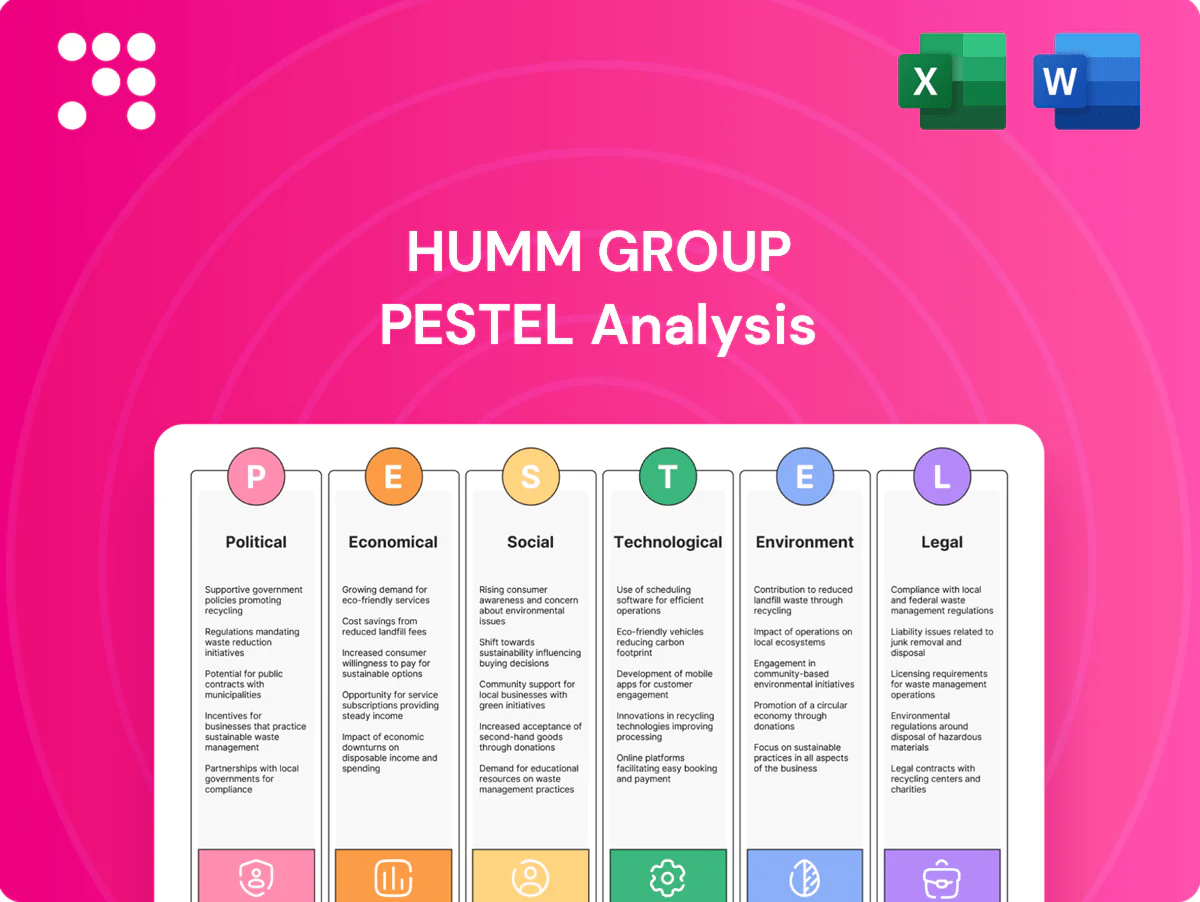
Humm Group PESTLE Analysis

Plan Smarter. Present Sharper. Compete Stronger.
Unlock how political shifts, economic cycles, and emerging technologies are reshaping Humm Group’s competitive landscape with our targeted PESTLE snapshot. This concise analysis highlights regulatory risks, consumer trends, and tech disruptors that matter to investors and strategists. Purchase the full PESTLE to get in-depth, actionable intelligence you can apply instantly.
Political factors

BNPL policy direction
Policy debates in Australia (Treasury consultation since 2023) and New Zealand (MBIE reviews in 2023–24) could reclassify BNPL under credit laws, shifting oversight and compliance burdens; regulators estimate BNPL annual transaction volumes at roughly A$20–30bn in 2023–24. A tougher stance may mandate affordability checks and fee caps, increasing operating costs and capital requirements for Humm. Humm must monitor consultation timelines and adapt product design rapidly, and early engagement with policymakers can reduce adverse impacts.
Cost-of-living agendas
Governments prioritizing cost-of-living relief increase scrutiny of consumer finance fees and practices, driven by consumer inflation pressures (Australian CPI ~4.1% in 2024). Populist measures in several markets have targeted late fees and aggressive collections, raising regulatory risk for BNPL lenders. Humm’s hardship support policies and transparent pricing align with these political goals. Strategic partnerships demonstrating clear consumer benefit strengthen Humm’s licence to operate.

Trans-Tasman coordination
Australia and New Zealand together represent roughly 31.1 million consumers (Australia ~26.0m, New Zealand ~5.1m), so Trans-Tasman policy harmonization materially affects Humm Group’s cross-border operations and compliance frameworks. Divergent regulatory timelines between the RBA and RBNZ create execution complexity for product launches and disclosures. Coordinated lobbying through industry bodies (payments associations, banks) can push for consistent standards. Operational playbooks should include market-specific tweaks and rollout checkpoints.

Digital economy initiatives
Government pushes for cashless systems and national digital IDs are accelerating BNPL uptake; global BNPL GMV reached about 166 billion USD in 2024, strengthening Humm Group’s addressable market. Grants and payment security standards (e.g., PSD2-style rules and national guidelines) can raise initial integration costs but reduce long-term fraud losses. Humm can use e-invoicing and digital ID to cut onboarding time and KYC friction, while alignment with public cybersecurity frameworks boosts institutional credibility and merchant trust.
- Regulatory tailwind: +166bn USD BNPL GMV (2024)
- Integration impact: grants reduce upfront costs; standards lower fraud risk
- Operational gains: faster onboarding via e-invoicing + digital ID; stronger trust from public cybersecurity alignment
Election-driven uncertainty
Election-driven uncertainty in Australia has repeatedly affected BNPL policy timing: Treasury and ASIC have been conducting BNPL and consumer credit reviews since 2021 and intensified reforms through 2023–24, so election cycles can delay or accelerate rule‑making and enforcement impacting Humm Group (ASX: HUM). Shifts in ministerial priorities often redirect enforcement intensity; scenario planning adjusts risk appetite and marketing cadence, while stakeholder mapping reduces surprise from policy pivots.
- tags: regulatory-timing
- tags: enforcement-shifts
- tags: scenario-planning
- tags: stakeholder-mapping
Policy risk imperils BNPL; AU/NZ A$25bn, global US$166bn
Policy reforms in AU/NZ (Treasury/MBIE reviews 2023–24) threaten BNPL reclassification, adding compliance costs; AU/NZ BNPL ~A$25bn (2023–24) within global GMV US$166bn (2024). Cost-of-living politics (AU CPI ~4.1% 2024) raises fee scrutiny; election cycles drive timing risk and enforcement shifts.
| Metric | Value |
|---|---|
| Global BNPL GMV (2024) | US$166bn |
| AU/NZ BNPL volume (2023–24) | A$25bn |
| AU CPI (2024) | 4.1% |
What is included in the product
 Detailed Word Document
Explores how Political, Economic, Social, Technological, Environmental and Legal forces uniquely affect Humm Group, with each section backed by relevant data and market/regulatory dynamics. Designed to support executives and investors with forward-looking insights ready for reports and planning.

 Customizable Excel Spreadsheet
Condensed PESTLE summary for Humm Group that distills regulatory, economic, social, technological, environmental and legal risks into a one-page reference for faster meetings and clearer strategic decisions.
Economic factors

Interest rate sensitivity
Higher RBA (4.35%) and RBNZ (5.50%) policy rates in mid-2024 elevated Humm Group funding costs and squeezed consumer affordability, reducing loan originations and spending. Net margins risk compression if merchant fees or customer charges cannot be raised to offset higher wholesale funding. Conversely, lower rates revive demand and credit performance; dynamic pricing and diversified funding sources are critical levers to protect margins.
Consumer spending cycles
Discretionary retail volatility directly affects BNPL volumes; Reserve Bank of Australia data showed BNPL around 3% of card purchases by value in 2023, exposing Humm to cyclical swings. Humm benefits from seasonal spikes (eg. holiday sales) but faces downturn risk during consumer contractions. Diversifying into essentials and using real-time merchant mix management helps smooth throughput and limit cyclicality.

Unemployment and delinquencies
Rising joblessness (Australia unemployment ~3.7% in 2024 per OECD) elevates arrears and portfolio loss rates, pressuring Humm Group’s consumer BNPL exposures. Tighter underwriting and proactive collections materially reduce charge-offs and stabilize recoveries. Macroeconomic dashboards should trigger policy overrides when leading indicators breach thresholds. Provisioning must remain forward-looking to protect capital and regulatory ratios.

Inflation and basket size
Rising inflation (Australia CPI 4.1% YoY in 2024, ABS) has pushed average ticket sizes higher, straining household affordability and existing credit limits; merchants increasingly offer BNPL to protect conversion rates. Humm must recalibrate per-customer limits and extend flexible tenures to sustain volume while managing default risk. Ongoing fee-elasticity analysis will guide pricing updates to balance take-up and margin.
- Inflation: Australia CPI 4.1% (2024, ABS)
- Effect: larger ticket sizes → affordability pressure
- Merchant response: more BNPL to defend conversion
- Humm actions: adjust limits, tenure, price via fee-elasticity
SME health and merchant churn
SME stress raises merchant attrition and lowers POS finance demand; ABS 2024 notes SMEs form ~98% of Australian businesses, amplifying systemic effects. Stronger value propositions — conversion analytics and faster settlements — improve partner retention. Humm’s business finance lines require sectoral exposure caps; coordinated merchant marketing can stabilise throughput.
- SME exposure:ABS 2024 ~98% of businesses
- Retention:conversion analytics,faster settlements
- Risk control:sectoral caps on business finance
- Throughput:joint marketing stabilises volumes
Policy risk imperils BNPL; AU/NZ A$25bn, global US$166bn
Higher policy rates (RBA 4.35%, RBNZ 5.50% mid-2024) and CPI 4.1% (2024, ABS) compressed margins and affordability, lowering loan originations and raising arrears risk as unemployment ~3.7% (2024, OECD) and BNPL ≈3% of card purchases (2023) amplified cyclical swings. Diversifying funding, dynamic pricing, tighter underwriting and merchant mix management are essential to stabilise volumes and protect capital.
| Metric | Value |
|---|---|
| RBA policy rate | 4.35% |
| RBNZ policy rate | 5.50% |
| Australia CPI (2024) | 4.1% |
| Unemployment (2024) | 3.7% |
| BNPL share (2023) | ~3% |
Same Document Delivered
Humm Group PESTLE Analysis
The preview shown here is the exact Humm Group PESTLE Analysis you’ll receive after purchase — fully formatted, professionally structured, and ready to use. This screenshot reflects the final document with no placeholders or edits pending. Immediately after checkout you’ll download the same file as displayed.

Plan Smarter. Present Sharper. Compete Stronger.
Unlock how political shifts, economic cycles, and emerging technologies are reshaping Humm Group’s competitive landscape with our targeted PESTLE snapshot. This concise analysis highlights regulatory risks, consumer trends, and tech disruptors that matter to investors and strategists. Purchase the full PESTLE to get in-depth, actionable intelligence you can apply instantly.
Political factors
BNPL policy direction
Policy debates in Australia (Treasury consultation since 2023) and New Zealand (MBIE reviews in 2023–24) could reclassify BNPL under credit laws, shifting oversight and compliance burdens; regulators estimate BNPL annual transaction volumes at roughly A$20–30bn in 2023–24. A tougher stance may mandate affordability checks and fee caps, increasing operating costs and capital requirements for Humm. Humm must monitor consultation timelines and adapt product design rapidly, and early engagement with policymakers can reduce adverse impacts.
Cost-of-living agendas
Governments prioritizing cost-of-living relief increase scrutiny of consumer finance fees and practices, driven by consumer inflation pressures (Australian CPI ~4.1% in 2024). Populist measures in several markets have targeted late fees and aggressive collections, raising regulatory risk for BNPL lenders. Humm’s hardship support policies and transparent pricing align with these political goals. Strategic partnerships demonstrating clear consumer benefit strengthen Humm’s licence to operate.
Trans-Tasman coordination
Australia and New Zealand together represent roughly 31.1 million consumers (Australia ~26.0m, New Zealand ~5.1m), so Trans-Tasman policy harmonization materially affects Humm Group’s cross-border operations and compliance frameworks. Divergent regulatory timelines between the RBA and RBNZ create execution complexity for product launches and disclosures. Coordinated lobbying through industry bodies (payments associations, banks) can push for consistent standards. Operational playbooks should include market-specific tweaks and rollout checkpoints.
Digital economy initiatives
Government pushes for cashless systems and national digital IDs are accelerating BNPL uptake; global BNPL GMV reached about 166 billion USD in 2024, strengthening Humm Group’s addressable market. Grants and payment security standards (e.g., PSD2-style rules and national guidelines) can raise initial integration costs but reduce long-term fraud losses. Humm can use e-invoicing and digital ID to cut onboarding time and KYC friction, while alignment with public cybersecurity frameworks boosts institutional credibility and merchant trust.
- Regulatory tailwind: +166bn USD BNPL GMV (2024)
- Integration impact: grants reduce upfront costs; standards lower fraud risk
- Operational gains: faster onboarding via e-invoicing + digital ID; stronger trust from public cybersecurity alignment
Election-driven uncertainty
Election-driven uncertainty in Australia has repeatedly affected BNPL policy timing: Treasury and ASIC have been conducting BNPL and consumer credit reviews since 2021 and intensified reforms through 2023–24, so election cycles can delay or accelerate rule‑making and enforcement impacting Humm Group (ASX: HUM). Shifts in ministerial priorities often redirect enforcement intensity; scenario planning adjusts risk appetite and marketing cadence, while stakeholder mapping reduces surprise from policy pivots.
- tags: regulatory-timing
- tags: enforcement-shifts
- tags: scenario-planning
- tags: stakeholder-mapping
Policy risk imperils BNPL; AU/NZ A$25bn, global US$166bn
Policy reforms in AU/NZ (Treasury/MBIE reviews 2023–24) threaten BNPL reclassification, adding compliance costs; AU/NZ BNPL ~A$25bn (2023–24) within global GMV US$166bn (2024). Cost-of-living politics (AU CPI ~4.1% 2024) raises fee scrutiny; election cycles drive timing risk and enforcement shifts.
| Metric | Value |
|---|---|
| Global BNPL GMV (2024) | US$166bn |
| AU/NZ BNPL volume (2023–24) | A$25bn |
| AU CPI (2024) | 4.1% |
What is included in the product
Detailed Word Document
Explores how Political, Economic, Social, Technological, Environmental and Legal forces uniquely affect Humm Group, with each section backed by relevant data and market/regulatory dynamics. Designed to support executives and investors with forward-looking insights ready for reports and planning.
Customizable Excel Spreadsheet
Condensed PESTLE summary for Humm Group that distills regulatory, economic, social, technological, environmental and legal risks into a one-page reference for faster meetings and clearer strategic decisions.
Economic factors
Interest rate sensitivity
Higher RBA (4.35%) and RBNZ (5.50%) policy rates in mid-2024 elevated Humm Group funding costs and squeezed consumer affordability, reducing loan originations and spending. Net margins risk compression if merchant fees or customer charges cannot be raised to offset higher wholesale funding. Conversely, lower rates revive demand and credit performance; dynamic pricing and diversified funding sources are critical levers to protect margins.
Consumer spending cycles
Discretionary retail volatility directly affects BNPL volumes; Reserve Bank of Australia data showed BNPL around 3% of card purchases by value in 2023, exposing Humm to cyclical swings. Humm benefits from seasonal spikes (eg. holiday sales) but faces downturn risk during consumer contractions. Diversifying into essentials and using real-time merchant mix management helps smooth throughput and limit cyclicality.
Unemployment and delinquencies
Rising joblessness (Australia unemployment ~3.7% in 2024 per OECD) elevates arrears and portfolio loss rates, pressuring Humm Group’s consumer BNPL exposures. Tighter underwriting and proactive collections materially reduce charge-offs and stabilize recoveries. Macroeconomic dashboards should trigger policy overrides when leading indicators breach thresholds. Provisioning must remain forward-looking to protect capital and regulatory ratios.
Inflation and basket size
Rising inflation (Australia CPI 4.1% YoY in 2024, ABS) has pushed average ticket sizes higher, straining household affordability and existing credit limits; merchants increasingly offer BNPL to protect conversion rates. Humm must recalibrate per-customer limits and extend flexible tenures to sustain volume while managing default risk. Ongoing fee-elasticity analysis will guide pricing updates to balance take-up and margin.
- Inflation: Australia CPI 4.1% (2024, ABS)
- Effect: larger ticket sizes → affordability pressure
- Merchant response: more BNPL to defend conversion
- Humm actions: adjust limits, tenure, price via fee-elasticity
SME health and merchant churn
SME stress raises merchant attrition and lowers POS finance demand; ABS 2024 notes SMEs form ~98% of Australian businesses, amplifying systemic effects. Stronger value propositions — conversion analytics and faster settlements — improve partner retention. Humm’s business finance lines require sectoral exposure caps; coordinated merchant marketing can stabilise throughput.
- SME exposure:ABS 2024 ~98% of businesses
- Retention:conversion analytics,faster settlements
- Risk control:sectoral caps on business finance
- Throughput:joint marketing stabilises volumes
Policy risk imperils BNPL; AU/NZ A$25bn, global US$166bn
Higher policy rates (RBA 4.35%, RBNZ 5.50% mid-2024) and CPI 4.1% (2024, ABS) compressed margins and affordability, lowering loan originations and raising arrears risk as unemployment ~3.7% (2024, OECD) and BNPL ≈3% of card purchases (2023) amplified cyclical swings. Diversifying funding, dynamic pricing, tighter underwriting and merchant mix management are essential to stabilise volumes and protect capital.
| Metric | Value |
|---|---|
| RBA policy rate | 4.35% |
| RBNZ policy rate | 5.50% |
| Australia CPI (2024) | 4.1% |
| Unemployment (2024) | 3.7% |
| BNPL share (2023) | ~3% |
Same Document Delivered
Humm Group PESTLE Analysis
The preview shown here is the exact Humm Group PESTLE Analysis you’ll receive after purchase — fully formatted, professionally structured, and ready to use. This screenshot reflects the final document with no placeholders or edits pending. Immediately after checkout you’ll download the same file as displayed.
Original: $10.00
-65%$10.00
$3.50Description
Plan Smarter. Present Sharper. Compete Stronger.
Unlock how political shifts, economic cycles, and emerging technologies are reshaping Humm Group’s competitive landscape with our targeted PESTLE snapshot. This concise analysis highlights regulatory risks, consumer trends, and tech disruptors that matter to investors and strategists. Purchase the full PESTLE to get in-depth, actionable intelligence you can apply instantly.
Political factors
BNPL policy direction
Policy debates in Australia (Treasury consultation since 2023) and New Zealand (MBIE reviews in 2023–24) could reclassify BNPL under credit laws, shifting oversight and compliance burdens; regulators estimate BNPL annual transaction volumes at roughly A$20–30bn in 2023–24. A tougher stance may mandate affordability checks and fee caps, increasing operating costs and capital requirements for Humm. Humm must monitor consultation timelines and adapt product design rapidly, and early engagement with policymakers can reduce adverse impacts.
Cost-of-living agendas
Governments prioritizing cost-of-living relief increase scrutiny of consumer finance fees and practices, driven by consumer inflation pressures (Australian CPI ~4.1% in 2024). Populist measures in several markets have targeted late fees and aggressive collections, raising regulatory risk for BNPL lenders. Humm’s hardship support policies and transparent pricing align with these political goals. Strategic partnerships demonstrating clear consumer benefit strengthen Humm’s licence to operate.
Trans-Tasman coordination
Australia and New Zealand together represent roughly 31.1 million consumers (Australia ~26.0m, New Zealand ~5.1m), so Trans-Tasman policy harmonization materially affects Humm Group’s cross-border operations and compliance frameworks. Divergent regulatory timelines between the RBA and RBNZ create execution complexity for product launches and disclosures. Coordinated lobbying through industry bodies (payments associations, banks) can push for consistent standards. Operational playbooks should include market-specific tweaks and rollout checkpoints.
Digital economy initiatives
Government pushes for cashless systems and national digital IDs are accelerating BNPL uptake; global BNPL GMV reached about 166 billion USD in 2024, strengthening Humm Group’s addressable market. Grants and payment security standards (e.g., PSD2-style rules and national guidelines) can raise initial integration costs but reduce long-term fraud losses. Humm can use e-invoicing and digital ID to cut onboarding time and KYC friction, while alignment with public cybersecurity frameworks boosts institutional credibility and merchant trust.
- Regulatory tailwind: +166bn USD BNPL GMV (2024)
- Integration impact: grants reduce upfront costs; standards lower fraud risk
- Operational gains: faster onboarding via e-invoicing + digital ID; stronger trust from public cybersecurity alignment
Election-driven uncertainty
Election-driven uncertainty in Australia has repeatedly affected BNPL policy timing: Treasury and ASIC have been conducting BNPL and consumer credit reviews since 2021 and intensified reforms through 2023–24, so election cycles can delay or accelerate rule‑making and enforcement impacting Humm Group (ASX: HUM). Shifts in ministerial priorities often redirect enforcement intensity; scenario planning adjusts risk appetite and marketing cadence, while stakeholder mapping reduces surprise from policy pivots.
- tags: regulatory-timing
- tags: enforcement-shifts
- tags: scenario-planning
- tags: stakeholder-mapping
Policy risk imperils BNPL; AU/NZ A$25bn, global US$166bn
Policy reforms in AU/NZ (Treasury/MBIE reviews 2023–24) threaten BNPL reclassification, adding compliance costs; AU/NZ BNPL ~A$25bn (2023–24) within global GMV US$166bn (2024). Cost-of-living politics (AU CPI ~4.1% 2024) raises fee scrutiny; election cycles drive timing risk and enforcement shifts.
| Metric | Value |
|---|---|
| Global BNPL GMV (2024) | US$166bn |
| AU/NZ BNPL volume (2023–24) | A$25bn |
| AU CPI (2024) | 4.1% |
What is included in the product
Detailed Word Document
Explores how Political, Economic, Social, Technological, Environmental and Legal forces uniquely affect Humm Group, with each section backed by relevant data and market/regulatory dynamics. Designed to support executives and investors with forward-looking insights ready for reports and planning.
Customizable Excel Spreadsheet
Condensed PESTLE summary for Humm Group that distills regulatory, economic, social, technological, environmental and legal risks into a one-page reference for faster meetings and clearer strategic decisions.
Economic factors
Interest rate sensitivity
Higher RBA (4.35%) and RBNZ (5.50%) policy rates in mid-2024 elevated Humm Group funding costs and squeezed consumer affordability, reducing loan originations and spending. Net margins risk compression if merchant fees or customer charges cannot be raised to offset higher wholesale funding. Conversely, lower rates revive demand and credit performance; dynamic pricing and diversified funding sources are critical levers to protect margins.
Consumer spending cycles
Discretionary retail volatility directly affects BNPL volumes; Reserve Bank of Australia data showed BNPL around 3% of card purchases by value in 2023, exposing Humm to cyclical swings. Humm benefits from seasonal spikes (eg. holiday sales) but faces downturn risk during consumer contractions. Diversifying into essentials and using real-time merchant mix management helps smooth throughput and limit cyclicality.
Unemployment and delinquencies
Rising joblessness (Australia unemployment ~3.7% in 2024 per OECD) elevates arrears and portfolio loss rates, pressuring Humm Group’s consumer BNPL exposures. Tighter underwriting and proactive collections materially reduce charge-offs and stabilize recoveries. Macroeconomic dashboards should trigger policy overrides when leading indicators breach thresholds. Provisioning must remain forward-looking to protect capital and regulatory ratios.
Inflation and basket size
Rising inflation (Australia CPI 4.1% YoY in 2024, ABS) has pushed average ticket sizes higher, straining household affordability and existing credit limits; merchants increasingly offer BNPL to protect conversion rates. Humm must recalibrate per-customer limits and extend flexible tenures to sustain volume while managing default risk. Ongoing fee-elasticity analysis will guide pricing updates to balance take-up and margin.
- Inflation: Australia CPI 4.1% (2024, ABS)
- Effect: larger ticket sizes → affordability pressure
- Merchant response: more BNPL to defend conversion
- Humm actions: adjust limits, tenure, price via fee-elasticity
SME health and merchant churn
SME stress raises merchant attrition and lowers POS finance demand; ABS 2024 notes SMEs form ~98% of Australian businesses, amplifying systemic effects. Stronger value propositions — conversion analytics and faster settlements — improve partner retention. Humm’s business finance lines require sectoral exposure caps; coordinated merchant marketing can stabilise throughput.
- SME exposure:ABS 2024 ~98% of businesses
- Retention:conversion analytics,faster settlements
- Risk control:sectoral caps on business finance
- Throughput:joint marketing stabilises volumes
Policy risk imperils BNPL; AU/NZ A$25bn, global US$166bn
Higher policy rates (RBA 4.35%, RBNZ 5.50% mid-2024) and CPI 4.1% (2024, ABS) compressed margins and affordability, lowering loan originations and raising arrears risk as unemployment ~3.7% (2024, OECD) and BNPL ≈3% of card purchases (2023) amplified cyclical swings. Diversifying funding, dynamic pricing, tighter underwriting and merchant mix management are essential to stabilise volumes and protect capital.
| Metric | Value |
|---|---|
| RBA policy rate | 4.35% |
| RBNZ policy rate | 5.50% |
| Australia CPI (2024) | 4.1% |
| Unemployment (2024) | 3.7% |
| BNPL share (2023) | ~3% |
Same Document Delivered
Humm Group PESTLE Analysis
The preview shown here is the exact Humm Group PESTLE Analysis you’ll receive after purchase — fully formatted, professionally structured, and ready to use. This screenshot reflects the final document with no placeholders or edits pending. Immediately after checkout you’ll download the same file as displayed.











