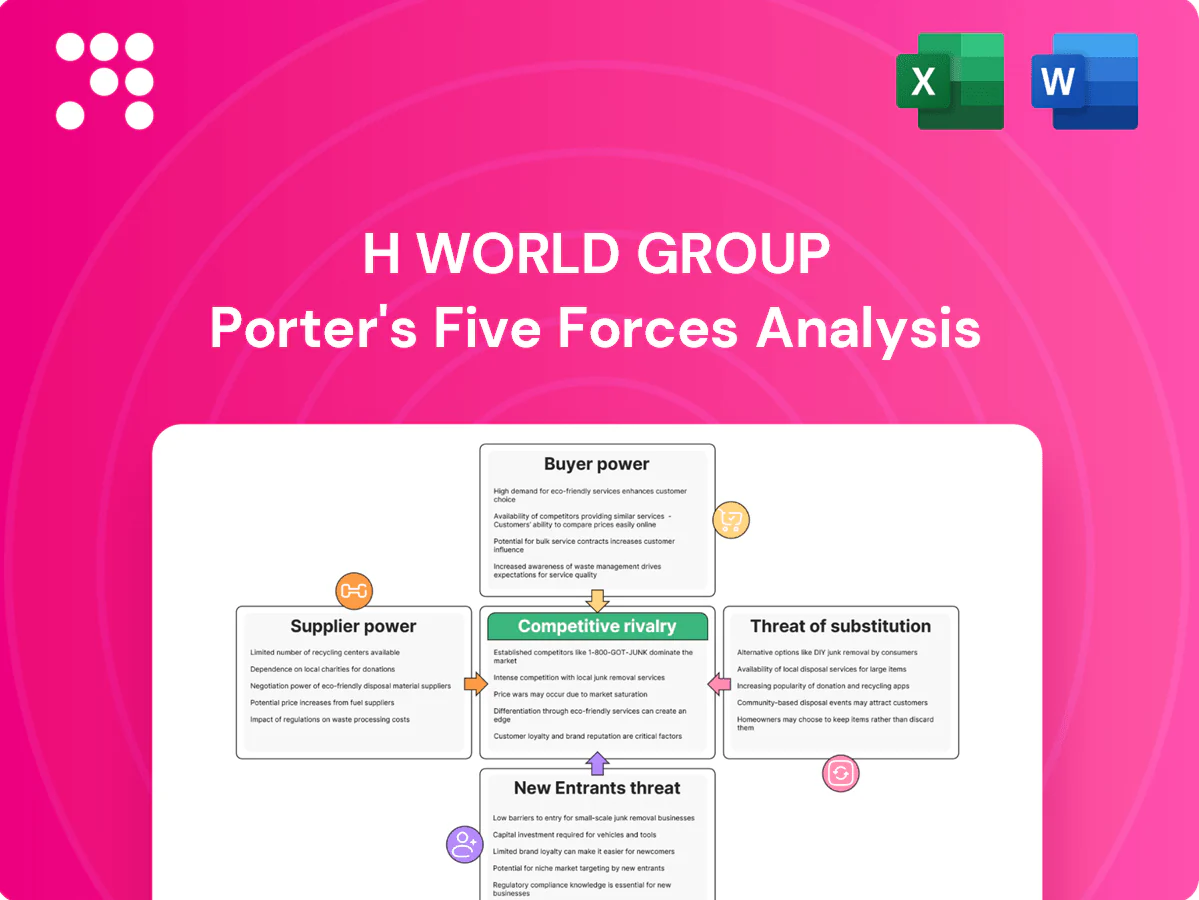
H World Group Porter's Five Forces Analysis

A Must-Have Tool for Decision-Makers
H World Group faces intense competitive dynamics driven by large hotel chains, rising OTAs, and shifting traveler preferences; supplier and buyer power vary across segments. Threat of new entrants is moderate due to brand scale and capital, while substitutes and rivalry pressure margins. This brief snapshot only scratches the surface—unlock the full Porter's Five Forces Analysis to explore force-by-force ratings, visuals, and strategic implications tailored to H World Group.
Suppliers Bargaining Power

Fragmented operating inputs
Linens, FF&E and F&B vendors are highly fragmented, keeping switching costs moderate and price competition healthy; supplier concentration is low and limits pricing power. H World’s scale—over 7,000 hotels and roughly 1 million rooms in 2024—enables bulk buying and standardized specs, compressing unit costs. Robust local supply chains in China reduce import dependency and further dilute supplier leverage.
Real estate owners and lessors
Landlords in prime Chinese cities retain strong leverage where land supply is scarce, pushing rents and renewal premiums that can lift occupancy costs through embedded escalation clauses. Long-term leases with CPI-linked or stepped rent increases have raised operating leverage for chains. H World’s multi-brand footprint and site flexibility broaden location choices and limit single-owner exposure. By mid-2024 H World operated over 8,500 hotels, with a growing franchise conversion pipeline reducing lease reliance.

Labor and staffing constraints
Housekeeping and front-office labor availability for H World varies by city tier and season, with urban cores seeing tighter pools and higher turnover; labor typically accounts for 25-35% of hotel operating costs. Rising minimum wages and compliance in major cities compressed margins in 2024, while standardized SOPs and automation (kiosks, mobile check-in) can cut check-in staffing needs by up to 30%. Training academies and career ladders strengthen retention and reduce the supplier-like power of talent pools.

Technology and systems vendors
PMS, CRS, payment and cybersecurity vendors for H World are specialized with limited substitutability; integration costs and data-migration risks create meaningful switching frictions, though H World’s proprietary CRS and loyalty stack reduce vendor lock-in on distribution-critical layers. Niche modules such as revenue-management systems retain bargaining leverage.
- Vendors: specialized, low substitutability
- Frictions: integration and data-migration costs
- Defensive asset: proprietary CRS/loyalty
- Leverage: niche modules (revenue management)
Renovation and construction contractors
Renovation and construction contractors drive H World fit-out cycles, with typical regional lead times of 8–12 weeks in 2024; local material shortages or permit delays commonly push openings and raise costs by double-digit percentages when persistent. Competitive bidding across provinces compresses supplier margins, while standardized brand prototypes cut bespoke work and limit idiosyncratic supplier power.
- 2024 lead times: 8–12 weeks
- Local regulatory delays: double-digit cost impact
- Competitive bidding reduces margins
- Standard prototypes lower supplier leverage
Suppliers have limited leverage, boosting scale-driven cost advantage amid rent and labor pressure
Suppliers overall have limited bargaining power: fragmented linen/F&B vendors and robust local chains keep prices competitive while H World scale (≈8,500 hotels, ~1.0M rooms in 2024) secures bulk discounts. Landlords and niche tech/RMS vendors exert pockets of leverage; labor (25–35% of costs) and lease escalations can pressure margins. Standardized prototypes, proprietary CRS/loyalty and competitive bidding reduce supplier hold.
| Supplier | Leverage | 2024 metric |
|---|---|---|
| Vendors (linen/F&B) | Low | Fragmented |
| Landlords | Medium–High | Urban rent pressure |
| Labor | Medium | 25–35% of Opex |
| Tech/RMS | Medium | High switching frictions |
What is included in the product
 Detailed Word Document
Comprehensive Porter's Five Forces review tailored to H World Group, uncovering key competitive drivers, buyer and supplier power, threat of entrants and substitutes, and emerging disruptive risks to market share and profitability.

 Customizable Excel Spreadsheet
Concise Porter's Five Forces snapshot tailored for H World Group—perfect for quick strategic decisions and investor briefs. Customize pressure levels and swap in your own data to reflect changing travel trends, regulatory shifts, or new entrants, then drop the clean chart straight into pitch decks or boardroom slides.
Customers Bargaining Power

Price-sensitive leisure guests
Price-sensitive leisure guests dominate China's large economy and midscale segments, which show high price elasticity; OTAs drive transparent price comparisons and account for over 50% of online hotel bookings, intensifying deal-seeking. H World mitigates this with tiered brands and dynamic pricing to segment demand, while its loyalty program—over 100 million members by 2024—offers perks that nudge direct bookings and soften buyer power.
Corporate and group accounts
Corporate travel managers negotiate volume rates and amenity bundles, leveraging concentrated demand to secure multi-city discounts; H World’s nationwide network of over 7,000 hotels in 2024 strengthens buyers’ leverage. Consistent service, broad coverage and consolidated reporting tools help H World defend rate integrity and transparency. Long-term agreements reduce churn but typically compress yields, pressuring average daily rate growth.

OTAs and metasearch as demand aggregators
OTAs and metasearch funnel substantial demand—over 50% of online bookings—and extract 15–25% commissions, creating clear leverage over net ADR. Visibility algorithms and preferred listings further pressure pricing and distribution economics. H World’s direct app, WeChat mini-programs and 39‑million‑member loyalty program recaptured material share in 2024, boosting direct digital bookings and lowering reliance on high‑cost channels. Channel mix optimization limits dependence on intermediaries.

Franchisees as internal customers
Franchisees act as internal customers who select brand flags and can switch to rivals at contract expiry, forcing H World to negotiate key money, fees and renovation scopes; performance guarantees and operational support raise franchisee stickiness. By 2024 the group reported a multi-thousand property pipeline, reducing owner concentration risk and limiting bargaining leverage of any single owner.
- Owner switching risk: contract expiry leverage
- Commercial bargaining: key money, fees, renovation scope
- Lock-in: performance guarantees and support services
- Risk dilution: multi-thousand 2024 pipeline
Experience-focused upscale travelers
Experience-focused upscale travelers prioritize design, F&B, and location over pure price, and their reviews and social media posts disproportionately shape H World Group’s brand equity; maintaining distinct upscale positioning is essential for commanding premiums. Service lapses rapidly drive switching and rate pushback, forcing rapid operational fixes to protect RevPAR and margin.
- Customer focus: design, F&B, location
- Influence: reviews & social media
- Need: clear upscale differentiation
- Risk: service lapses → switching & rate pressure
OTAs dominate >50% bookings; 15–25% commissions meet 100M loyalty push to direct
Price-sensitive leisure guests and OTAs (>50% online bookings) raise buyer power; OTAs take 15–25% commissions. H World’s tiered brands, dynamic pricing and 100M loyalty members (2024) push direct bookings. Corporate volume deals and franchisee switching risk compress ADR but nationwide 7,000+ hotels (2024) and multi-thousand pipeline dilute single-owner leverage.
| Metric | 2024 |
|---|---|
| OTA share | >50% |
| OTA commission | 15–25% |
| Loyalty members | 100M |
| Hotels | 7,000+ |
Same Document Delivered
H World Group Porter's Five Forces Analysis
This preview shows the exact H World Group Porter’s Five Forces analysis you’ll receive—fully formatted and ready for immediate use. It is the same complete document available for instant download after purchase, with no placeholders or mockups. Use it as-is for strategy, valuation, or presentation needs.

A Must-Have Tool for Decision-Makers
H World Group faces intense competitive dynamics driven by large hotel chains, rising OTAs, and shifting traveler preferences; supplier and buyer power vary across segments. Threat of new entrants is moderate due to brand scale and capital, while substitutes and rivalry pressure margins. This brief snapshot only scratches the surface—unlock the full Porter's Five Forces Analysis to explore force-by-force ratings, visuals, and strategic implications tailored to H World Group.
Suppliers Bargaining Power
Fragmented operating inputs
Linens, FF&E and F&B vendors are highly fragmented, keeping switching costs moderate and price competition healthy; supplier concentration is low and limits pricing power. H World’s scale—over 7,000 hotels and roughly 1 million rooms in 2024—enables bulk buying and standardized specs, compressing unit costs. Robust local supply chains in China reduce import dependency and further dilute supplier leverage.
Real estate owners and lessors
Landlords in prime Chinese cities retain strong leverage where land supply is scarce, pushing rents and renewal premiums that can lift occupancy costs through embedded escalation clauses. Long-term leases with CPI-linked or stepped rent increases have raised operating leverage for chains. H World’s multi-brand footprint and site flexibility broaden location choices and limit single-owner exposure. By mid-2024 H World operated over 8,500 hotels, with a growing franchise conversion pipeline reducing lease reliance.
Labor and staffing constraints
Housekeeping and front-office labor availability for H World varies by city tier and season, with urban cores seeing tighter pools and higher turnover; labor typically accounts for 25-35% of hotel operating costs. Rising minimum wages and compliance in major cities compressed margins in 2024, while standardized SOPs and automation (kiosks, mobile check-in) can cut check-in staffing needs by up to 30%. Training academies and career ladders strengthen retention and reduce the supplier-like power of talent pools.
Technology and systems vendors
PMS, CRS, payment and cybersecurity vendors for H World are specialized with limited substitutability; integration costs and data-migration risks create meaningful switching frictions, though H World’s proprietary CRS and loyalty stack reduce vendor lock-in on distribution-critical layers. Niche modules such as revenue-management systems retain bargaining leverage.
- Vendors: specialized, low substitutability
- Frictions: integration and data-migration costs
- Defensive asset: proprietary CRS/loyalty
- Leverage: niche modules (revenue management)
Renovation and construction contractors
Renovation and construction contractors drive H World fit-out cycles, with typical regional lead times of 8–12 weeks in 2024; local material shortages or permit delays commonly push openings and raise costs by double-digit percentages when persistent. Competitive bidding across provinces compresses supplier margins, while standardized brand prototypes cut bespoke work and limit idiosyncratic supplier power.
- 2024 lead times: 8–12 weeks
- Local regulatory delays: double-digit cost impact
- Competitive bidding reduces margins
- Standard prototypes lower supplier leverage
Suppliers have limited leverage, boosting scale-driven cost advantage amid rent and labor pressure
Suppliers overall have limited bargaining power: fragmented linen/F&B vendors and robust local chains keep prices competitive while H World scale (≈8,500 hotels, ~1.0M rooms in 2024) secures bulk discounts. Landlords and niche tech/RMS vendors exert pockets of leverage; labor (25–35% of costs) and lease escalations can pressure margins. Standardized prototypes, proprietary CRS/loyalty and competitive bidding reduce supplier hold.
| Supplier | Leverage | 2024 metric |
|---|---|---|
| Vendors (linen/F&B) | Low | Fragmented |
| Landlords | Medium–High | Urban rent pressure |
| Labor | Medium | 25–35% of Opex |
| Tech/RMS | Medium | High switching frictions |
What is included in the product
Detailed Word Document
Comprehensive Porter's Five Forces review tailored to H World Group, uncovering key competitive drivers, buyer and supplier power, threat of entrants and substitutes, and emerging disruptive risks to market share and profitability.
Customizable Excel Spreadsheet
Concise Porter's Five Forces snapshot tailored for H World Group—perfect for quick strategic decisions and investor briefs. Customize pressure levels and swap in your own data to reflect changing travel trends, regulatory shifts, or new entrants, then drop the clean chart straight into pitch decks or boardroom slides.
Customers Bargaining Power
Price-sensitive leisure guests
Price-sensitive leisure guests dominate China's large economy and midscale segments, which show high price elasticity; OTAs drive transparent price comparisons and account for over 50% of online hotel bookings, intensifying deal-seeking. H World mitigates this with tiered brands and dynamic pricing to segment demand, while its loyalty program—over 100 million members by 2024—offers perks that nudge direct bookings and soften buyer power.
Corporate and group accounts
Corporate travel managers negotiate volume rates and amenity bundles, leveraging concentrated demand to secure multi-city discounts; H World’s nationwide network of over 7,000 hotels in 2024 strengthens buyers’ leverage. Consistent service, broad coverage and consolidated reporting tools help H World defend rate integrity and transparency. Long-term agreements reduce churn but typically compress yields, pressuring average daily rate growth.
OTAs and metasearch as demand aggregators
OTAs and metasearch funnel substantial demand—over 50% of online bookings—and extract 15–25% commissions, creating clear leverage over net ADR. Visibility algorithms and preferred listings further pressure pricing and distribution economics. H World’s direct app, WeChat mini-programs and 39‑million‑member loyalty program recaptured material share in 2024, boosting direct digital bookings and lowering reliance on high‑cost channels. Channel mix optimization limits dependence on intermediaries.
Franchisees as internal customers
Franchisees act as internal customers who select brand flags and can switch to rivals at contract expiry, forcing H World to negotiate key money, fees and renovation scopes; performance guarantees and operational support raise franchisee stickiness. By 2024 the group reported a multi-thousand property pipeline, reducing owner concentration risk and limiting bargaining leverage of any single owner.
- Owner switching risk: contract expiry leverage
- Commercial bargaining: key money, fees, renovation scope
- Lock-in: performance guarantees and support services
- Risk dilution: multi-thousand 2024 pipeline
Experience-focused upscale travelers
Experience-focused upscale travelers prioritize design, F&B, and location over pure price, and their reviews and social media posts disproportionately shape H World Group’s brand equity; maintaining distinct upscale positioning is essential for commanding premiums. Service lapses rapidly drive switching and rate pushback, forcing rapid operational fixes to protect RevPAR and margin.
- Customer focus: design, F&B, location
- Influence: reviews & social media
- Need: clear upscale differentiation
- Risk: service lapses → switching & rate pressure
OTAs dominate >50% bookings; 15–25% commissions meet 100M loyalty push to direct
Price-sensitive leisure guests and OTAs (>50% online bookings) raise buyer power; OTAs take 15–25% commissions. H World’s tiered brands, dynamic pricing and 100M loyalty members (2024) push direct bookings. Corporate volume deals and franchisee switching risk compress ADR but nationwide 7,000+ hotels (2024) and multi-thousand pipeline dilute single-owner leverage.
| Metric | 2024 |
|---|---|
| OTA share | >50% |
| OTA commission | 15–25% |
| Loyalty members | 100M |
| Hotels | 7,000+ |
Same Document Delivered
H World Group Porter's Five Forces Analysis
This preview shows the exact H World Group Porter’s Five Forces analysis you’ll receive—fully formatted and ready for immediate use. It is the same complete document available for instant download after purchase, with no placeholders or mockups. Use it as-is for strategy, valuation, or presentation needs.
Original: $10.00
-65%$10.00
$3.50Description
A Must-Have Tool for Decision-Makers
H World Group faces intense competitive dynamics driven by large hotel chains, rising OTAs, and shifting traveler preferences; supplier and buyer power vary across segments. Threat of new entrants is moderate due to brand scale and capital, while substitutes and rivalry pressure margins. This brief snapshot only scratches the surface—unlock the full Porter's Five Forces Analysis to explore force-by-force ratings, visuals, and strategic implications tailored to H World Group.
Suppliers Bargaining Power
Fragmented operating inputs
Linens, FF&E and F&B vendors are highly fragmented, keeping switching costs moderate and price competition healthy; supplier concentration is low and limits pricing power. H World’s scale—over 7,000 hotels and roughly 1 million rooms in 2024—enables bulk buying and standardized specs, compressing unit costs. Robust local supply chains in China reduce import dependency and further dilute supplier leverage.
Real estate owners and lessors
Landlords in prime Chinese cities retain strong leverage where land supply is scarce, pushing rents and renewal premiums that can lift occupancy costs through embedded escalation clauses. Long-term leases with CPI-linked or stepped rent increases have raised operating leverage for chains. H World’s multi-brand footprint and site flexibility broaden location choices and limit single-owner exposure. By mid-2024 H World operated over 8,500 hotels, with a growing franchise conversion pipeline reducing lease reliance.
Labor and staffing constraints
Housekeeping and front-office labor availability for H World varies by city tier and season, with urban cores seeing tighter pools and higher turnover; labor typically accounts for 25-35% of hotel operating costs. Rising minimum wages and compliance in major cities compressed margins in 2024, while standardized SOPs and automation (kiosks, mobile check-in) can cut check-in staffing needs by up to 30%. Training academies and career ladders strengthen retention and reduce the supplier-like power of talent pools.
Technology and systems vendors
PMS, CRS, payment and cybersecurity vendors for H World are specialized with limited substitutability; integration costs and data-migration risks create meaningful switching frictions, though H World’s proprietary CRS and loyalty stack reduce vendor lock-in on distribution-critical layers. Niche modules such as revenue-management systems retain bargaining leverage.
- Vendors: specialized, low substitutability
- Frictions: integration and data-migration costs
- Defensive asset: proprietary CRS/loyalty
- Leverage: niche modules (revenue management)
Renovation and construction contractors
Renovation and construction contractors drive H World fit-out cycles, with typical regional lead times of 8–12 weeks in 2024; local material shortages or permit delays commonly push openings and raise costs by double-digit percentages when persistent. Competitive bidding across provinces compresses supplier margins, while standardized brand prototypes cut bespoke work and limit idiosyncratic supplier power.
- 2024 lead times: 8–12 weeks
- Local regulatory delays: double-digit cost impact
- Competitive bidding reduces margins
- Standard prototypes lower supplier leverage
Suppliers have limited leverage, boosting scale-driven cost advantage amid rent and labor pressure
Suppliers overall have limited bargaining power: fragmented linen/F&B vendors and robust local chains keep prices competitive while H World scale (≈8,500 hotels, ~1.0M rooms in 2024) secures bulk discounts. Landlords and niche tech/RMS vendors exert pockets of leverage; labor (25–35% of costs) and lease escalations can pressure margins. Standardized prototypes, proprietary CRS/loyalty and competitive bidding reduce supplier hold.
| Supplier | Leverage | 2024 metric |
|---|---|---|
| Vendors (linen/F&B) | Low | Fragmented |
| Landlords | Medium–High | Urban rent pressure |
| Labor | Medium | 25–35% of Opex |
| Tech/RMS | Medium | High switching frictions |
What is included in the product
Detailed Word Document
Comprehensive Porter's Five Forces review tailored to H World Group, uncovering key competitive drivers, buyer and supplier power, threat of entrants and substitutes, and emerging disruptive risks to market share and profitability.
Customizable Excel Spreadsheet
Concise Porter's Five Forces snapshot tailored for H World Group—perfect for quick strategic decisions and investor briefs. Customize pressure levels and swap in your own data to reflect changing travel trends, regulatory shifts, or new entrants, then drop the clean chart straight into pitch decks or boardroom slides.
Customers Bargaining Power
Price-sensitive leisure guests
Price-sensitive leisure guests dominate China's large economy and midscale segments, which show high price elasticity; OTAs drive transparent price comparisons and account for over 50% of online hotel bookings, intensifying deal-seeking. H World mitigates this with tiered brands and dynamic pricing to segment demand, while its loyalty program—over 100 million members by 2024—offers perks that nudge direct bookings and soften buyer power.
Corporate and group accounts
Corporate travel managers negotiate volume rates and amenity bundles, leveraging concentrated demand to secure multi-city discounts; H World’s nationwide network of over 7,000 hotels in 2024 strengthens buyers’ leverage. Consistent service, broad coverage and consolidated reporting tools help H World defend rate integrity and transparency. Long-term agreements reduce churn but typically compress yields, pressuring average daily rate growth.
OTAs and metasearch as demand aggregators
OTAs and metasearch funnel substantial demand—over 50% of online bookings—and extract 15–25% commissions, creating clear leverage over net ADR. Visibility algorithms and preferred listings further pressure pricing and distribution economics. H World’s direct app, WeChat mini-programs and 39‑million‑member loyalty program recaptured material share in 2024, boosting direct digital bookings and lowering reliance on high‑cost channels. Channel mix optimization limits dependence on intermediaries.
Franchisees as internal customers
Franchisees act as internal customers who select brand flags and can switch to rivals at contract expiry, forcing H World to negotiate key money, fees and renovation scopes; performance guarantees and operational support raise franchisee stickiness. By 2024 the group reported a multi-thousand property pipeline, reducing owner concentration risk and limiting bargaining leverage of any single owner.
- Owner switching risk: contract expiry leverage
- Commercial bargaining: key money, fees, renovation scope
- Lock-in: performance guarantees and support services
- Risk dilution: multi-thousand 2024 pipeline
Experience-focused upscale travelers
Experience-focused upscale travelers prioritize design, F&B, and location over pure price, and their reviews and social media posts disproportionately shape H World Group’s brand equity; maintaining distinct upscale positioning is essential for commanding premiums. Service lapses rapidly drive switching and rate pushback, forcing rapid operational fixes to protect RevPAR and margin.
- Customer focus: design, F&B, location
- Influence: reviews & social media
- Need: clear upscale differentiation
- Risk: service lapses → switching & rate pressure
OTAs dominate >50% bookings; 15–25% commissions meet 100M loyalty push to direct
Price-sensitive leisure guests and OTAs (>50% online bookings) raise buyer power; OTAs take 15–25% commissions. H World’s tiered brands, dynamic pricing and 100M loyalty members (2024) push direct bookings. Corporate volume deals and franchisee switching risk compress ADR but nationwide 7,000+ hotels (2024) and multi-thousand pipeline dilute single-owner leverage.
| Metric | 2024 |
|---|---|
| OTA share | >50% |
| OTA commission | 15–25% |
| Loyalty members | 100M |
| Hotels | 7,000+ |
Same Document Delivered
H World Group Porter's Five Forces Analysis
This preview shows the exact H World Group Porter’s Five Forces analysis you’ll receive—fully formatted and ready for immediate use. It is the same complete document available for instant download after purchase, with no placeholders or mockups. Use it as-is for strategy, valuation, or presentation needs.











