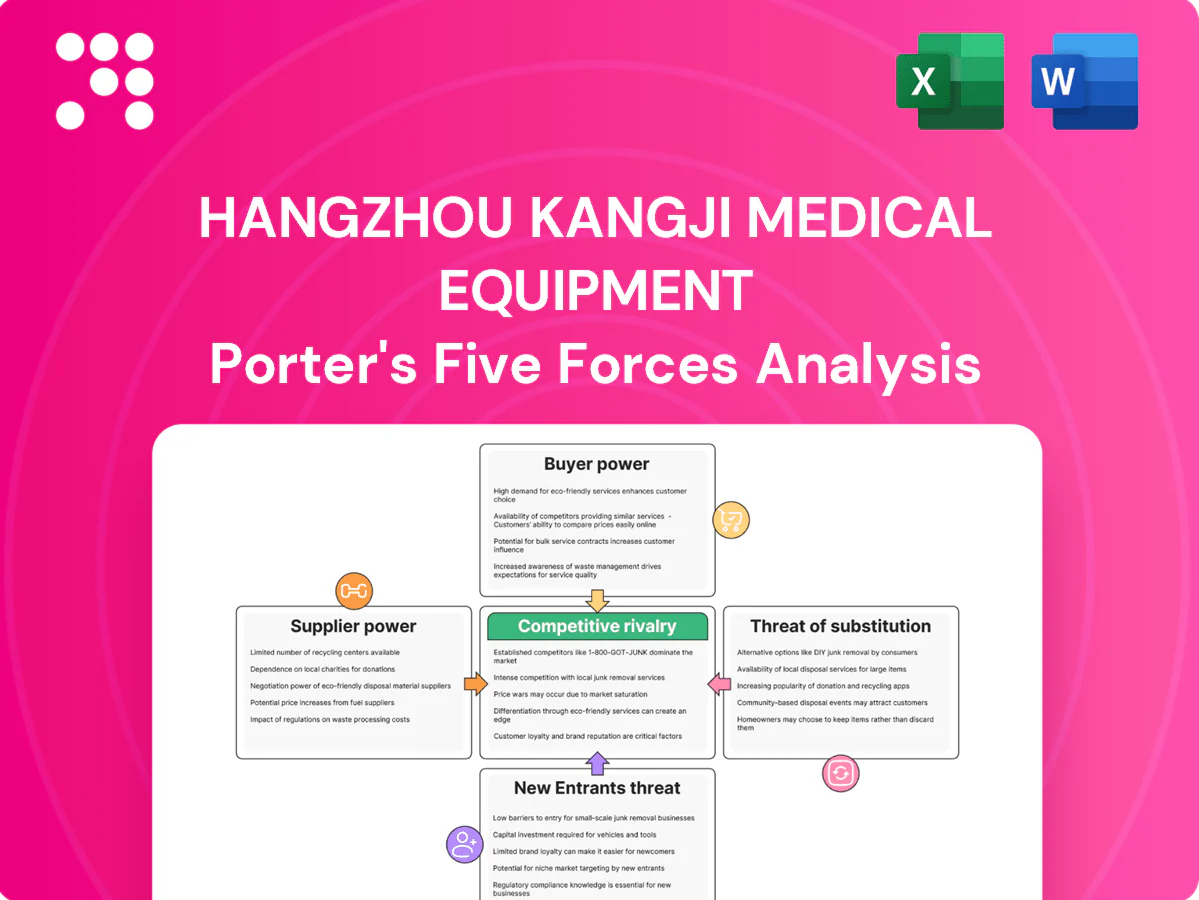
Hangzhou Kangji Medical Equipment Porter's Five Forces Analysis

A Must-Have Tool for Decision-Makers
Hangzhou Kangji faces moderate supplier power from specialized components, while buyer power is tempered by hospital procurement processes. Competitive rivalry is high due to domestic peers and tender-driven pricing, and entry barriers are medium—regulation matters but scale is attainable. Substitute threats are limited now, though tech disruption could raise risk. This preview is just the beginning. The full analysis provides a complete strategic snapshot with force-by-force ratings, visuals, and business implications tailored to Hangzhou Kangji Medical Equipment.
Suppliers Bargaining Power

Specialized component reliance
High-precision actuators, control electronics and medical-grade materials are sourced from a narrow supplier base, elevating switching costs and driving lead times commonly to 9–24 weeks. Dual-sourcing and in-house engineering reduce single-supplier exposure but rarely eliminate dependency on specialized tech. Long qualification cycles, often 6–12 months, further amplify supplier leverage over pricing and delivery.
Quality and compliance thresholds
For Hangzhou Kangji Medical Equipment, ISO 13485, IEC 60601 electrical-safety requirements and ISO 10993 biocompatibility standards sharply constrain supplier substitution, since any material or component change mandates design and process revalidation and often regulatory notification. Validation and requalification timelines create supplier stickiness and raise switching costs. Compliance failures can halt production lines or trigger recalls, increasing supplier leverage. Preferred-supplier programs and dual-sourcing partially mitigate this imbalance.

Custom OEM modules
Customized control boards, hydraulic systems and pendant joints create high specificity, with tooling and NRE often running USD 50,000–300,000 per module in 2024, locking customer-supplier ties. Suppliers of low-volume bespoke parts can command 15–30% price premiums and stronger payment terms. Prioritizing design-for-manufacture to standardize interfaces can reduce uniqueness and regain roughly 5–10% bargaining room.

Logistics and lead-time exposure
Long-lead components (motors, linear actuators, semiconductors) remain supply-shock sensitive; semiconductors normalized to ~12–16 week lead times in 2024 while motors/actuators often see 12–28 week waits. Buffer stocks and VMI cut stockouts but tie up working capital (roughly 2–6% of revenue for comparable med‑device firms). Delays can derail hospital project timelines and suppliers gain pricing/leverage power during upcycles.
- Lead times: semis ~12–16 wks (2024), motors/actuators 12–28 wks
- Working capital hit: ~2–6% of revenue
- Project risk: hospital timelines sensitive to single‑source delays
- Upcycle leverage: supplier pricing power rises with order books
Material price volatility
Stainless steel, aluminum and electronic components showed marked cyclical pricing in 2024, with aluminum LME averaging about $2,300/ton and spot swings near 15%, tightening margins for Hangzhou Kangji when hospital tenders lock prices for 6–12 months and cost pass-through is limited; hedging and frame contracts can stabilize input costs, while suppliers gain leverage when buyers cannot reprice mid-cycle.
- Input volatility: aluminum ±15% (2024)
- Tender lock: typical hospital bids 6–12 months
- Mitigation: hedging/frame contracts reduce cost swings
- Supplier power: rises when repricing is not permitted
Narrow suppliers raise switching costs: 12–28 wks LTs, 15–30% premium, 2–6% cash drag
Narrow, specialized suppliers grant high leverage via long lead times (semis 12–16 wks; motors/actuators 12–28 wks) and lengthy qualification (6–12 months), raising switching costs. NRE/tooling USD 50,000–300,000 and 15–30% price premiums for bespoke parts increase dependency. Buffer stock/VMI mitigates stockouts but ties 2–6% of revenue; aluminum averaged ~$2,300/ton (±15%) in 2024.
| Metric | 2024 Value |
|---|---|
| Semiconductors LT | 12–16 wks |
| Motors/Actuators LT | 12–28 wks |
| NRE/tooling | USD 50k–300k |
| Price premium | 15–30% |
| Working capital hit | 2–6% rev |
| Aluminum | ~$2,300/ton (±15%) |
What is included in the product
 Detailed Word Document
Tailored Porter's Five Forces analysis for Hangzhou Kangji Medical Equipment uncovers competitive drivers, supplier and buyer power, substitution threats, and entry barriers, identifying disruptive forces and strategic levers to protect market share and inform investor or internal strategy materials.

 Customizable Excel Spreadsheet
A one-sheet Porter's Five Forces summary for Hangzhou Kangji Medical Equipment that quickly relieves strategic pain points—visual spider chart, customizable pressure levels, and clean layout for instant boardroom or investor-ready slides. No macros or complex code; swap in your data, duplicate scenarios, and integrate seamlessly into reports for faster, confident decisions.
Customers Bargaining Power

Concentrated hospital buyers
Public hospitals dominate China’s tertiary care (over 90% public in 2024), while large private chains and GPOs aggregate demand into national/provincial tenders often exceeding RMB billions, enabling aggressive price cuts. Standardized technical specs for devices reduce product differentiation, increasing buyer leverage. Multi-year procurement cycles shift competition to total cost of ownership, pressuring margins and driving consolidation among suppliers.
Project-based bidding
Project-based bidding for integrated OR solutions awards turnkey contracts where buyers evaluate bundled offerings of surgical tables, pendants, and integration software; transparent scoring frameworks prioritize price, service uptime, and regulatory compliance. This procurement format makes comparisons straightforward and shifts negotiating power to purchasers, increasing their leverage across vendors and driving tighter margins for suppliers.

High switching and lifecycle focus
Once installed switching is costly because ceiling rails, utilities and workflow integration create retrofit bills often in the tens to hundreds of thousands of USD and typical device replacement cycles run 7–10 years. Buyers exploit competition at refresh cycles and expansions, leveraging service contracts, uptime SLAs (commonly 99.5–99.9% in 2024) and training as key decision levers. Buyers routinely demand bundled discounts and extended warranties during negotiations.

Clinical KOL and engineer influence
Surgeons and biomedical engineers at Hangzhou Kangji drive specs and vendor lists; demonstrated ergonomics, safety, and OR efficiency in 2024 site trials and references materially reduce price pressure. Site trials and peer hospital references are pivotal; without strong clinical advocacy, procurement teams press harder on price and margins.
- Clinical influence: surgeons/biomed lead specs
- Value drivers: ergonomics, safety, OR efficiency
- Proof: site trials & references decisive
- Risk: lack of KOL support → stronger price push
Compliance and documentation demands
Buyers demand rigorous certifications, full traceability and device cybersecurity for systems integration, shifting documentation and validation costs to vendors; failure to meet hospital IT and facility protocols commonly disqualifies bids, giving purchasers strong leverage in contract terms by 2024.
- Buyers: pass/fail cybersecurity & traceability
- Vendors: bear documentation/validation costs
- Noncompliance: bid disqualification
Public hospitals >90%, RMB1bn tenders, 7-10yr refreshes force steep price concessions
Public hospitals account for over 90% of tertiary care in 2024, and national/provincial tenders often exceed RMB1bn, concentrating buyer power and forcing aggressive price concessions. Standardized specs and transparent scoring (price, uptime 99.5–99.9% in 2024, compliance) increase leverage; long 7–10 year cycles make refresh bidding the main pressure point. Strong surgeon/biomed advocacy can offset price erosion.
| Metric | 2024 Value |
|---|---|
| Public tertiary share | >90% |
| Typical tender size | >RMB1bn |
| Uptime SLAs | 99.5–99.9% |
| Device refresh cycle | 7–10 years |
What You See Is What You Get
Hangzhou Kangji Medical Equipment Porter's Five Forces Analysis
This preview shows the exact Porter's Five Forces analysis for Hangzhou Kangji Medical Equipment that you'll receive. The document is fully formatted, professional, and ready for immediate download upon purchase. No placeholders or mockups—what you see is the complete, final deliverable.

A Must-Have Tool for Decision-Makers
Hangzhou Kangji faces moderate supplier power from specialized components, while buyer power is tempered by hospital procurement processes. Competitive rivalry is high due to domestic peers and tender-driven pricing, and entry barriers are medium—regulation matters but scale is attainable. Substitute threats are limited now, though tech disruption could raise risk. This preview is just the beginning. The full analysis provides a complete strategic snapshot with force-by-force ratings, visuals, and business implications tailored to Hangzhou Kangji Medical Equipment.
Suppliers Bargaining Power
Specialized component reliance
High-precision actuators, control electronics and medical-grade materials are sourced from a narrow supplier base, elevating switching costs and driving lead times commonly to 9–24 weeks. Dual-sourcing and in-house engineering reduce single-supplier exposure but rarely eliminate dependency on specialized tech. Long qualification cycles, often 6–12 months, further amplify supplier leverage over pricing and delivery.
Quality and compliance thresholds
For Hangzhou Kangji Medical Equipment, ISO 13485, IEC 60601 electrical-safety requirements and ISO 10993 biocompatibility standards sharply constrain supplier substitution, since any material or component change mandates design and process revalidation and often regulatory notification. Validation and requalification timelines create supplier stickiness and raise switching costs. Compliance failures can halt production lines or trigger recalls, increasing supplier leverage. Preferred-supplier programs and dual-sourcing partially mitigate this imbalance.
Custom OEM modules
Customized control boards, hydraulic systems and pendant joints create high specificity, with tooling and NRE often running USD 50,000–300,000 per module in 2024, locking customer-supplier ties. Suppliers of low-volume bespoke parts can command 15–30% price premiums and stronger payment terms. Prioritizing design-for-manufacture to standardize interfaces can reduce uniqueness and regain roughly 5–10% bargaining room.
Logistics and lead-time exposure
Long-lead components (motors, linear actuators, semiconductors) remain supply-shock sensitive; semiconductors normalized to ~12–16 week lead times in 2024 while motors/actuators often see 12–28 week waits. Buffer stocks and VMI cut stockouts but tie up working capital (roughly 2–6% of revenue for comparable med‑device firms). Delays can derail hospital project timelines and suppliers gain pricing/leverage power during upcycles.
- Lead times: semis ~12–16 wks (2024), motors/actuators 12–28 wks
- Working capital hit: ~2–6% of revenue
- Project risk: hospital timelines sensitive to single‑source delays
- Upcycle leverage: supplier pricing power rises with order books
Material price volatility
Stainless steel, aluminum and electronic components showed marked cyclical pricing in 2024, with aluminum LME averaging about $2,300/ton and spot swings near 15%, tightening margins for Hangzhou Kangji when hospital tenders lock prices for 6–12 months and cost pass-through is limited; hedging and frame contracts can stabilize input costs, while suppliers gain leverage when buyers cannot reprice mid-cycle.
- Input volatility: aluminum ±15% (2024)
- Tender lock: typical hospital bids 6–12 months
- Mitigation: hedging/frame contracts reduce cost swings
- Supplier power: rises when repricing is not permitted
Narrow suppliers raise switching costs: 12–28 wks LTs, 15–30% premium, 2–6% cash drag
Narrow, specialized suppliers grant high leverage via long lead times (semis 12–16 wks; motors/actuators 12–28 wks) and lengthy qualification (6–12 months), raising switching costs. NRE/tooling USD 50,000–300,000 and 15–30% price premiums for bespoke parts increase dependency. Buffer stock/VMI mitigates stockouts but ties 2–6% of revenue; aluminum averaged ~$2,300/ton (±15%) in 2024.
| Metric | 2024 Value |
|---|---|
| Semiconductors LT | 12–16 wks |
| Motors/Actuators LT | 12–28 wks |
| NRE/tooling | USD 50k–300k |
| Price premium | 15–30% |
| Working capital hit | 2–6% rev |
| Aluminum | ~$2,300/ton (±15%) |
What is included in the product
Detailed Word Document
Tailored Porter's Five Forces analysis for Hangzhou Kangji Medical Equipment uncovers competitive drivers, supplier and buyer power, substitution threats, and entry barriers, identifying disruptive forces and strategic levers to protect market share and inform investor or internal strategy materials.
Customizable Excel Spreadsheet
A one-sheet Porter's Five Forces summary for Hangzhou Kangji Medical Equipment that quickly relieves strategic pain points—visual spider chart, customizable pressure levels, and clean layout for instant boardroom or investor-ready slides. No macros or complex code; swap in your data, duplicate scenarios, and integrate seamlessly into reports for faster, confident decisions.
Customers Bargaining Power
Concentrated hospital buyers
Public hospitals dominate China’s tertiary care (over 90% public in 2024), while large private chains and GPOs aggregate demand into national/provincial tenders often exceeding RMB billions, enabling aggressive price cuts. Standardized technical specs for devices reduce product differentiation, increasing buyer leverage. Multi-year procurement cycles shift competition to total cost of ownership, pressuring margins and driving consolidation among suppliers.
Project-based bidding
Project-based bidding for integrated OR solutions awards turnkey contracts where buyers evaluate bundled offerings of surgical tables, pendants, and integration software; transparent scoring frameworks prioritize price, service uptime, and regulatory compliance. This procurement format makes comparisons straightforward and shifts negotiating power to purchasers, increasing their leverage across vendors and driving tighter margins for suppliers.
High switching and lifecycle focus
Once installed switching is costly because ceiling rails, utilities and workflow integration create retrofit bills often in the tens to hundreds of thousands of USD and typical device replacement cycles run 7–10 years. Buyers exploit competition at refresh cycles and expansions, leveraging service contracts, uptime SLAs (commonly 99.5–99.9% in 2024) and training as key decision levers. Buyers routinely demand bundled discounts and extended warranties during negotiations.
Clinical KOL and engineer influence
Surgeons and biomedical engineers at Hangzhou Kangji drive specs and vendor lists; demonstrated ergonomics, safety, and OR efficiency in 2024 site trials and references materially reduce price pressure. Site trials and peer hospital references are pivotal; without strong clinical advocacy, procurement teams press harder on price and margins.
- Clinical influence: surgeons/biomed lead specs
- Value drivers: ergonomics, safety, OR efficiency
- Proof: site trials & references decisive
- Risk: lack of KOL support → stronger price push
Compliance and documentation demands
Buyers demand rigorous certifications, full traceability and device cybersecurity for systems integration, shifting documentation and validation costs to vendors; failure to meet hospital IT and facility protocols commonly disqualifies bids, giving purchasers strong leverage in contract terms by 2024.
- Buyers: pass/fail cybersecurity & traceability
- Vendors: bear documentation/validation costs
- Noncompliance: bid disqualification
Public hospitals >90%, RMB1bn tenders, 7-10yr refreshes force steep price concessions
Public hospitals account for over 90% of tertiary care in 2024, and national/provincial tenders often exceed RMB1bn, concentrating buyer power and forcing aggressive price concessions. Standardized specs and transparent scoring (price, uptime 99.5–99.9% in 2024, compliance) increase leverage; long 7–10 year cycles make refresh bidding the main pressure point. Strong surgeon/biomed advocacy can offset price erosion.
| Metric | 2024 Value |
|---|---|
| Public tertiary share | >90% |
| Typical tender size | >RMB1bn |
| Uptime SLAs | 99.5–99.9% |
| Device refresh cycle | 7–10 years |
What You See Is What You Get
Hangzhou Kangji Medical Equipment Porter's Five Forces Analysis
This preview shows the exact Porter's Five Forces analysis for Hangzhou Kangji Medical Equipment that you'll receive. The document is fully formatted, professional, and ready for immediate download upon purchase. No placeholders or mockups—what you see is the complete, final deliverable.
Original: $10.00
-65%$10.00
$3.50Description
A Must-Have Tool for Decision-Makers
Hangzhou Kangji faces moderate supplier power from specialized components, while buyer power is tempered by hospital procurement processes. Competitive rivalry is high due to domestic peers and tender-driven pricing, and entry barriers are medium—regulation matters but scale is attainable. Substitute threats are limited now, though tech disruption could raise risk. This preview is just the beginning. The full analysis provides a complete strategic snapshot with force-by-force ratings, visuals, and business implications tailored to Hangzhou Kangji Medical Equipment.
Suppliers Bargaining Power
Specialized component reliance
High-precision actuators, control electronics and medical-grade materials are sourced from a narrow supplier base, elevating switching costs and driving lead times commonly to 9–24 weeks. Dual-sourcing and in-house engineering reduce single-supplier exposure but rarely eliminate dependency on specialized tech. Long qualification cycles, often 6–12 months, further amplify supplier leverage over pricing and delivery.
Quality and compliance thresholds
For Hangzhou Kangji Medical Equipment, ISO 13485, IEC 60601 electrical-safety requirements and ISO 10993 biocompatibility standards sharply constrain supplier substitution, since any material or component change mandates design and process revalidation and often regulatory notification. Validation and requalification timelines create supplier stickiness and raise switching costs. Compliance failures can halt production lines or trigger recalls, increasing supplier leverage. Preferred-supplier programs and dual-sourcing partially mitigate this imbalance.
Custom OEM modules
Customized control boards, hydraulic systems and pendant joints create high specificity, with tooling and NRE often running USD 50,000–300,000 per module in 2024, locking customer-supplier ties. Suppliers of low-volume bespoke parts can command 15–30% price premiums and stronger payment terms. Prioritizing design-for-manufacture to standardize interfaces can reduce uniqueness and regain roughly 5–10% bargaining room.
Logistics and lead-time exposure
Long-lead components (motors, linear actuators, semiconductors) remain supply-shock sensitive; semiconductors normalized to ~12–16 week lead times in 2024 while motors/actuators often see 12–28 week waits. Buffer stocks and VMI cut stockouts but tie up working capital (roughly 2–6% of revenue for comparable med‑device firms). Delays can derail hospital project timelines and suppliers gain pricing/leverage power during upcycles.
- Lead times: semis ~12–16 wks (2024), motors/actuators 12–28 wks
- Working capital hit: ~2–6% of revenue
- Project risk: hospital timelines sensitive to single‑source delays
- Upcycle leverage: supplier pricing power rises with order books
Material price volatility
Stainless steel, aluminum and electronic components showed marked cyclical pricing in 2024, with aluminum LME averaging about $2,300/ton and spot swings near 15%, tightening margins for Hangzhou Kangji when hospital tenders lock prices for 6–12 months and cost pass-through is limited; hedging and frame contracts can stabilize input costs, while suppliers gain leverage when buyers cannot reprice mid-cycle.
- Input volatility: aluminum ±15% (2024)
- Tender lock: typical hospital bids 6–12 months
- Mitigation: hedging/frame contracts reduce cost swings
- Supplier power: rises when repricing is not permitted
Narrow suppliers raise switching costs: 12–28 wks LTs, 15–30% premium, 2–6% cash drag
Narrow, specialized suppliers grant high leverage via long lead times (semis 12–16 wks; motors/actuators 12–28 wks) and lengthy qualification (6–12 months), raising switching costs. NRE/tooling USD 50,000–300,000 and 15–30% price premiums for bespoke parts increase dependency. Buffer stock/VMI mitigates stockouts but ties 2–6% of revenue; aluminum averaged ~$2,300/ton (±15%) in 2024.
| Metric | 2024 Value |
|---|---|
| Semiconductors LT | 12–16 wks |
| Motors/Actuators LT | 12–28 wks |
| NRE/tooling | USD 50k–300k |
| Price premium | 15–30% |
| Working capital hit | 2–6% rev |
| Aluminum | ~$2,300/ton (±15%) |
What is included in the product
Detailed Word Document
Tailored Porter's Five Forces analysis for Hangzhou Kangji Medical Equipment uncovers competitive drivers, supplier and buyer power, substitution threats, and entry barriers, identifying disruptive forces and strategic levers to protect market share and inform investor or internal strategy materials.
Customizable Excel Spreadsheet
A one-sheet Porter's Five Forces summary for Hangzhou Kangji Medical Equipment that quickly relieves strategic pain points—visual spider chart, customizable pressure levels, and clean layout for instant boardroom or investor-ready slides. No macros or complex code; swap in your data, duplicate scenarios, and integrate seamlessly into reports for faster, confident decisions.
Customers Bargaining Power
Concentrated hospital buyers
Public hospitals dominate China’s tertiary care (over 90% public in 2024), while large private chains and GPOs aggregate demand into national/provincial tenders often exceeding RMB billions, enabling aggressive price cuts. Standardized technical specs for devices reduce product differentiation, increasing buyer leverage. Multi-year procurement cycles shift competition to total cost of ownership, pressuring margins and driving consolidation among suppliers.
Project-based bidding
Project-based bidding for integrated OR solutions awards turnkey contracts where buyers evaluate bundled offerings of surgical tables, pendants, and integration software; transparent scoring frameworks prioritize price, service uptime, and regulatory compliance. This procurement format makes comparisons straightforward and shifts negotiating power to purchasers, increasing their leverage across vendors and driving tighter margins for suppliers.
High switching and lifecycle focus
Once installed switching is costly because ceiling rails, utilities and workflow integration create retrofit bills often in the tens to hundreds of thousands of USD and typical device replacement cycles run 7–10 years. Buyers exploit competition at refresh cycles and expansions, leveraging service contracts, uptime SLAs (commonly 99.5–99.9% in 2024) and training as key decision levers. Buyers routinely demand bundled discounts and extended warranties during negotiations.
Clinical KOL and engineer influence
Surgeons and biomedical engineers at Hangzhou Kangji drive specs and vendor lists; demonstrated ergonomics, safety, and OR efficiency in 2024 site trials and references materially reduce price pressure. Site trials and peer hospital references are pivotal; without strong clinical advocacy, procurement teams press harder on price and margins.
- Clinical influence: surgeons/biomed lead specs
- Value drivers: ergonomics, safety, OR efficiency
- Proof: site trials & references decisive
- Risk: lack of KOL support → stronger price push
Compliance and documentation demands
Buyers demand rigorous certifications, full traceability and device cybersecurity for systems integration, shifting documentation and validation costs to vendors; failure to meet hospital IT and facility protocols commonly disqualifies bids, giving purchasers strong leverage in contract terms by 2024.
- Buyers: pass/fail cybersecurity & traceability
- Vendors: bear documentation/validation costs
- Noncompliance: bid disqualification
Public hospitals >90%, RMB1bn tenders, 7-10yr refreshes force steep price concessions
Public hospitals account for over 90% of tertiary care in 2024, and national/provincial tenders often exceed RMB1bn, concentrating buyer power and forcing aggressive price concessions. Standardized specs and transparent scoring (price, uptime 99.5–99.9% in 2024, compliance) increase leverage; long 7–10 year cycles make refresh bidding the main pressure point. Strong surgeon/biomed advocacy can offset price erosion.
| Metric | 2024 Value |
|---|---|
| Public tertiary share | >90% |
| Typical tender size | >RMB1bn |
| Uptime SLAs | 99.5–99.9% |
| Device refresh cycle | 7–10 years |
What You See Is What You Get
Hangzhou Kangji Medical Equipment Porter's Five Forces Analysis
This preview shows the exact Porter's Five Forces analysis for Hangzhou Kangji Medical Equipment that you'll receive. The document is fully formatted, professional, and ready for immediate download upon purchase. No placeholders or mockups—what you see is the complete, final deliverable.











