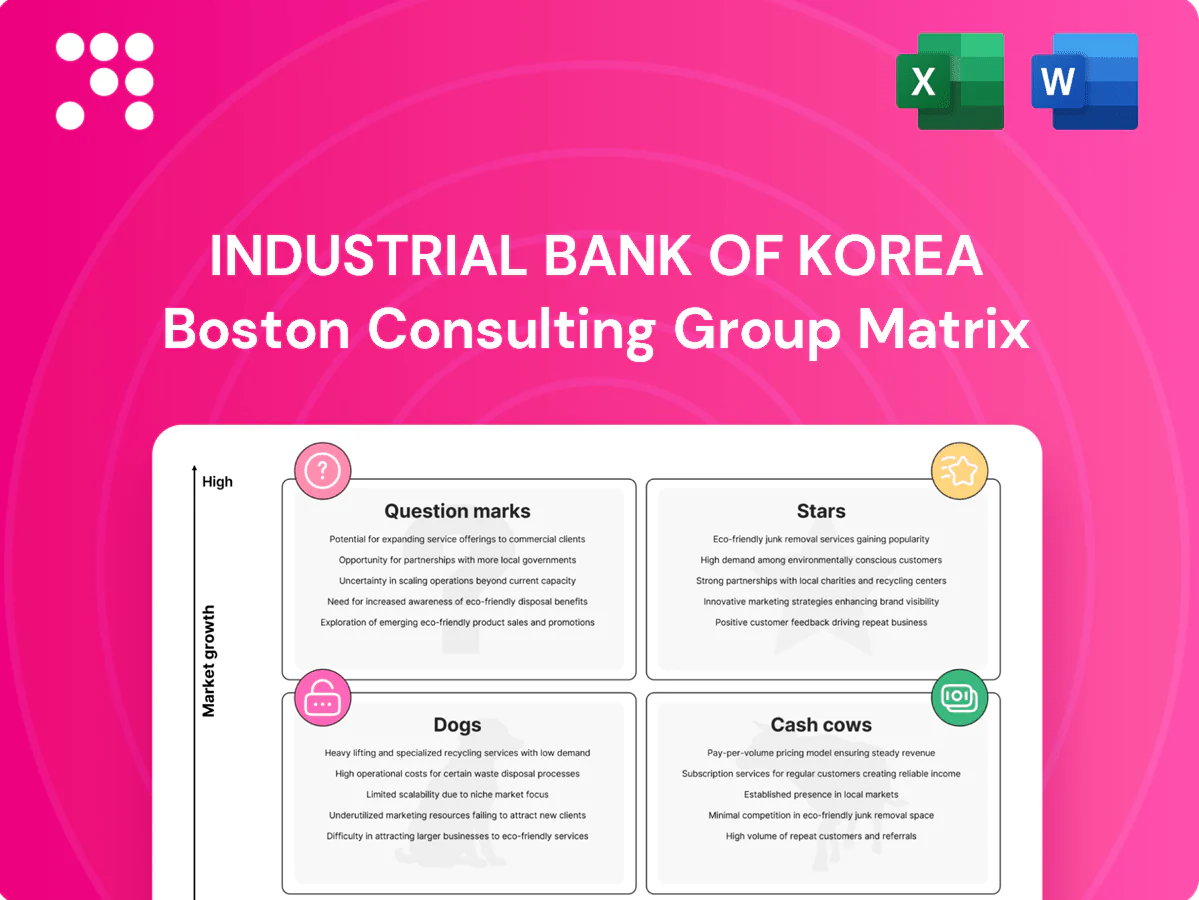
Industrial Bank of Korea Boston Consulting Group Matrix

Unlock Strategic Clarity
The Industrial Bank of Korea’s BCG Matrix preview shows where key loan products and services land — which are scaling fast, which fund the business, and which may be lagging. Want the quadrant-by-quadrant map, data-backed recommendations, and a clear spend/scale roadmap? Purchase the full BCG Matrix for a detailed Word report plus an Excel summary you can present and act on immediately. It’s the fastest way to turn market position into confident strategy.
Stars

Core SME lending leadership
Core SME lending leadership: IBK dominates Korea’s SME financing with roughly 30% market share and a SME loan book that grew about 5% y/y in 2024, driven by new ventures and supplier financing. High share and utilization plus constant policy tailwinds let IBK pull volume and set pricing. Keep feeding this franchise and it compounds into tomorrow’s cash cow.
Policy-backed growth programs
Government-supported credit lines and guarantees flow through IBK at scale, with the bank channeling over KRW 100 trillion in policy lending annually as of 2024; demand spikes in cycles but IBK’s share remains high due to its statutory SME mandate. Cash-in, cash-out dynamics are heavy but justified by social objectives and credit absorption. Invest to keep the pipeline and approval speed world-class to sustain that role.

Digital SME banking platform
Onboarding, cash management and loan origination have rapidly moved online, and as South Korea’s largest SME-focused lender, Industrial Bank of Korea (IBK) holds a clear usage edge as SMEs digitize operations.
Growth is brisk and leadership is within reach given IBK’s policy-backed SME mandate and branch scale; prioritize UX, open APIs and data-driven risk scoring to lock share.

Trade finance for exporting SMEs
Korean SME exporters heavily use letters of credit, bank guarantees and FX hedges, and IBK is the go-to provider, supporting a market where SMEs make up roughly 99% of firms and national goods exports were about $700 billion in 2023, underscoring long-term export growth and a high-growth pocket for trade finance.
Deepen corridors into Southeast Asia and Latin America and accelerate trade-automation and e-documents to cement IBK’s relationship advantage and capture rising SME export volumes.
- focus: Trade finance for SME exporters
- strength: Strong IBK client relationships
- opportunity: ~$700B Korea exports (2023)
- action: expand corridors + automate
Supply chain and vendor financing
Anchor-led payables programs scaled through 2024 with major manufacturers, and IBK sits in the flow leveraging enterprise transaction data to price counterparty and supply-chain risk accurately. Usage expands as more supplier tiers connect, increasing fee and float capture while lowering working capital need for buyers. Prioritize platform connectivity and analytics to widen spreads and deepen client stickiness.
SME scale: 30%, +5% loans, $700B exports
IBK Stars: ~30% SME market share; SME loan book +5% y/y in 2024, policy lending ~KRW 100 trillion (2024) underpin growth and pricing power.
Trade finance exposure taps $700B Korean exports (2023); anchor-led payables scaled in 2024, boosting fees and float capture.
Priorities: UX, APIs, analytics to convert volume into sustained profitability.
| Metric | Value |
|---|---|
| SME share | ~30% |
| SME loan growth | +5% y/y (2024) |
| Policy lending | KRW 100T (2024) |
| Exports | $700B (2023) |
What is included in the product
 Detailed Word Document
BCG review of Industrial Bank of Korea: maps Stars, Cash Cows, Question Marks and Dogs, with clear recommendations to invest, hold, or divest.

 Customizable Excel Spreadsheet
One-page BCG matrix for Industrial Bank of Korea — quadrant view to pinpoint underperformers and focus capital fast.
Cash Cows

Low-cost retail and SME deposits
Low-cost retail and SME deposits provide IBK with stable funding at scale, comprising roughly 70% of core funding and supporting about KRW 270 trillion in deposits in 2024; growth is low while share remains high. These cheap deposits power margins across the loan book, reducing funding cost by several hundred basis points versus wholesale. Minimal marketing is needed to sustain balances; focus on optimizing pricing and targeted cross-sell preserves yield without overpaying for balances.
Transactional banking and cash management
Transactional banking and cash management at Industrial Bank of Korea, founded 1961 as Korea’s policy bank for SMEs, shows entrenched account services, payroll, collections and payments with mature-market penetration. Steady fee income and low churn stem from material switching costs; uptime targets exceed industry norms to retain clients. Keep fees rational and operational availability high to continue milking this cash cow.

Conventional working-capital loans
Conventional working-capital loans are IBK’s cash cow: core revolving credit to established SMEs grows slowly but steadily, with IBK holding roughly 20% of Korea’s SME lending market in 2024. Underwriting is repeatable and renewal rates exceed 80%, delivering solid margins. Incremental automation has raised net interest spread by ~30–50bps without major capex, keeping yield resilient.

FX and remittance services
Daily hedges and transfers for SMEs and affiliates deliver reliable fee income; volumes cycle but show flat-to-low growth, keeping overall contribution steady. IBK’s market share remains sticky given branch and corporate network convenience. Priority actions: maintain spreads, sharpen digital rails, and contain operational costs.
- Fee stability
- Flat-to-low volume growth
- Sticky share
- Keep spreads
- Enhance digital rails
- Cost containment
Conservative mortgages for customers
Conservative mortgages at Industrial Bank of Korea are plain-vanilla home loans: scale products with modest growth that fund cheaply off deposits and generate steady net interest income; in 2024 South Korea household debt stayed near 1,930 trillion won, underscoring demand stability. Not a battleground but a dependable cash cow—maintain risk discipline and retention to keep cash flowing.
- Scale product: high volume, low growth
- Cheap funding: deposit mix supports NII
- Stable demand: household debt ~1,930 trillion won (2024)
- Focus: risk discipline and borrower retention
Low-cost retail/SME deposits and SME cash mgmt anchor NII — priorities: spreads, digital, cost
IBK cash cows: low-cost retail/SME deposits (~KRW 270tn, ~70% core funding in 2024) and entrenched SME cash management drive stable NII and fees; SME lending ~20% market share with >80% renewal rates and mortgages anchored by Korea household debt ~KRW 1,930tn in 2024. Priorities: preserve spreads, digital rails, cost control.
| Metric | 2024 |
|---|---|
| Deposits | KRW 270tn |
| Core funding share | ~70% |
| SME lending share | ~20% |
| Household debt | KRW 1,930tn |
What You See Is What You Get
Industrial Bank of Korea BCG Matrix
The file you’re previewing here is the exact Industrial Bank of Korea BCG Matrix report you’ll receive after purchase. No watermarks, no placeholder slides—just the fully formatted, analysis-ready document. It’s crafted for clarity and quick presentation to stakeholders. After buying, the same file is instantly downloadable for editing, printing, or sharing. No surprises—what you see is what you get.

Unlock Strategic Clarity
The Industrial Bank of Korea’s BCG Matrix preview shows where key loan products and services land — which are scaling fast, which fund the business, and which may be lagging. Want the quadrant-by-quadrant map, data-backed recommendations, and a clear spend/scale roadmap? Purchase the full BCG Matrix for a detailed Word report plus an Excel summary you can present and act on immediately. It’s the fastest way to turn market position into confident strategy.
Stars
Core SME lending leadership
Core SME lending leadership: IBK dominates Korea’s SME financing with roughly 30% market share and a SME loan book that grew about 5% y/y in 2024, driven by new ventures and supplier financing. High share and utilization plus constant policy tailwinds let IBK pull volume and set pricing. Keep feeding this franchise and it compounds into tomorrow’s cash cow.
Policy-backed growth programs
Government-supported credit lines and guarantees flow through IBK at scale, with the bank channeling over KRW 100 trillion in policy lending annually as of 2024; demand spikes in cycles but IBK’s share remains high due to its statutory SME mandate. Cash-in, cash-out dynamics are heavy but justified by social objectives and credit absorption. Invest to keep the pipeline and approval speed world-class to sustain that role.
Digital SME banking platform
Onboarding, cash management and loan origination have rapidly moved online, and as South Korea’s largest SME-focused lender, Industrial Bank of Korea (IBK) holds a clear usage edge as SMEs digitize operations.
Growth is brisk and leadership is within reach given IBK’s policy-backed SME mandate and branch scale; prioritize UX, open APIs and data-driven risk scoring to lock share.
Trade finance for exporting SMEs
Korean SME exporters heavily use letters of credit, bank guarantees and FX hedges, and IBK is the go-to provider, supporting a market where SMEs make up roughly 99% of firms and national goods exports were about $700 billion in 2023, underscoring long-term export growth and a high-growth pocket for trade finance.
Deepen corridors into Southeast Asia and Latin America and accelerate trade-automation and e-documents to cement IBK’s relationship advantage and capture rising SME export volumes.
- focus: Trade finance for SME exporters
- strength: Strong IBK client relationships
- opportunity: ~$700B Korea exports (2023)
- action: expand corridors + automate
Supply chain and vendor financing
Anchor-led payables programs scaled through 2024 with major manufacturers, and IBK sits in the flow leveraging enterprise transaction data to price counterparty and supply-chain risk accurately. Usage expands as more supplier tiers connect, increasing fee and float capture while lowering working capital need for buyers. Prioritize platform connectivity and analytics to widen spreads and deepen client stickiness.
SME scale: 30%, +5% loans, $700B exports
IBK Stars: ~30% SME market share; SME loan book +5% y/y in 2024, policy lending ~KRW 100 trillion (2024) underpin growth and pricing power.
Trade finance exposure taps $700B Korean exports (2023); anchor-led payables scaled in 2024, boosting fees and float capture.
Priorities: UX, APIs, analytics to convert volume into sustained profitability.
| Metric | Value |
|---|---|
| SME share | ~30% |
| SME loan growth | +5% y/y (2024) |
| Policy lending | KRW 100T (2024) |
| Exports | $700B (2023) |
What is included in the product
Detailed Word Document
BCG review of Industrial Bank of Korea: maps Stars, Cash Cows, Question Marks and Dogs, with clear recommendations to invest, hold, or divest.
Customizable Excel Spreadsheet
One-page BCG matrix for Industrial Bank of Korea — quadrant view to pinpoint underperformers and focus capital fast.
Cash Cows
Low-cost retail and SME deposits
Low-cost retail and SME deposits provide IBK with stable funding at scale, comprising roughly 70% of core funding and supporting about KRW 270 trillion in deposits in 2024; growth is low while share remains high. These cheap deposits power margins across the loan book, reducing funding cost by several hundred basis points versus wholesale. Minimal marketing is needed to sustain balances; focus on optimizing pricing and targeted cross-sell preserves yield without overpaying for balances.
Transactional banking and cash management
Transactional banking and cash management at Industrial Bank of Korea, founded 1961 as Korea’s policy bank for SMEs, shows entrenched account services, payroll, collections and payments with mature-market penetration. Steady fee income and low churn stem from material switching costs; uptime targets exceed industry norms to retain clients. Keep fees rational and operational availability high to continue milking this cash cow.
Conventional working-capital loans
Conventional working-capital loans are IBK’s cash cow: core revolving credit to established SMEs grows slowly but steadily, with IBK holding roughly 20% of Korea’s SME lending market in 2024. Underwriting is repeatable and renewal rates exceed 80%, delivering solid margins. Incremental automation has raised net interest spread by ~30–50bps without major capex, keeping yield resilient.
FX and remittance services
Daily hedges and transfers for SMEs and affiliates deliver reliable fee income; volumes cycle but show flat-to-low growth, keeping overall contribution steady. IBK’s market share remains sticky given branch and corporate network convenience. Priority actions: maintain spreads, sharpen digital rails, and contain operational costs.
- Fee stability
- Flat-to-low volume growth
- Sticky share
- Keep spreads
- Enhance digital rails
- Cost containment
Conservative mortgages for customers
Conservative mortgages at Industrial Bank of Korea are plain-vanilla home loans: scale products with modest growth that fund cheaply off deposits and generate steady net interest income; in 2024 South Korea household debt stayed near 1,930 trillion won, underscoring demand stability. Not a battleground but a dependable cash cow—maintain risk discipline and retention to keep cash flowing.
- Scale product: high volume, low growth
- Cheap funding: deposit mix supports NII
- Stable demand: household debt ~1,930 trillion won (2024)
- Focus: risk discipline and borrower retention
Low-cost retail/SME deposits and SME cash mgmt anchor NII — priorities: spreads, digital, cost
IBK cash cows: low-cost retail/SME deposits (~KRW 270tn, ~70% core funding in 2024) and entrenched SME cash management drive stable NII and fees; SME lending ~20% market share with >80% renewal rates and mortgages anchored by Korea household debt ~KRW 1,930tn in 2024. Priorities: preserve spreads, digital rails, cost control.
| Metric | 2024 |
|---|---|
| Deposits | KRW 270tn |
| Core funding share | ~70% |
| SME lending share | ~20% |
| Household debt | KRW 1,930tn |
What You See Is What You Get
Industrial Bank of Korea BCG Matrix
The file you’re previewing here is the exact Industrial Bank of Korea BCG Matrix report you’ll receive after purchase. No watermarks, no placeholder slides—just the fully formatted, analysis-ready document. It’s crafted for clarity and quick presentation to stakeholders. After buying, the same file is instantly downloadable for editing, printing, or sharing. No surprises—what you see is what you get.
Description
Unlock Strategic Clarity
The Industrial Bank of Korea’s BCG Matrix preview shows where key loan products and services land — which are scaling fast, which fund the business, and which may be lagging. Want the quadrant-by-quadrant map, data-backed recommendations, and a clear spend/scale roadmap? Purchase the full BCG Matrix for a detailed Word report plus an Excel summary you can present and act on immediately. It’s the fastest way to turn market position into confident strategy.
Stars
Core SME lending leadership
Core SME lending leadership: IBK dominates Korea’s SME financing with roughly 30% market share and a SME loan book that grew about 5% y/y in 2024, driven by new ventures and supplier financing. High share and utilization plus constant policy tailwinds let IBK pull volume and set pricing. Keep feeding this franchise and it compounds into tomorrow’s cash cow.
Policy-backed growth programs
Government-supported credit lines and guarantees flow through IBK at scale, with the bank channeling over KRW 100 trillion in policy lending annually as of 2024; demand spikes in cycles but IBK’s share remains high due to its statutory SME mandate. Cash-in, cash-out dynamics are heavy but justified by social objectives and credit absorption. Invest to keep the pipeline and approval speed world-class to sustain that role.
Digital SME banking platform
Onboarding, cash management and loan origination have rapidly moved online, and as South Korea’s largest SME-focused lender, Industrial Bank of Korea (IBK) holds a clear usage edge as SMEs digitize operations.
Growth is brisk and leadership is within reach given IBK’s policy-backed SME mandate and branch scale; prioritize UX, open APIs and data-driven risk scoring to lock share.
Trade finance for exporting SMEs
Korean SME exporters heavily use letters of credit, bank guarantees and FX hedges, and IBK is the go-to provider, supporting a market where SMEs make up roughly 99% of firms and national goods exports were about $700 billion in 2023, underscoring long-term export growth and a high-growth pocket for trade finance.
Deepen corridors into Southeast Asia and Latin America and accelerate trade-automation and e-documents to cement IBK’s relationship advantage and capture rising SME export volumes.
- focus: Trade finance for SME exporters
- strength: Strong IBK client relationships
- opportunity: ~$700B Korea exports (2023)
- action: expand corridors + automate
Supply chain and vendor financing
Anchor-led payables programs scaled through 2024 with major manufacturers, and IBK sits in the flow leveraging enterprise transaction data to price counterparty and supply-chain risk accurately. Usage expands as more supplier tiers connect, increasing fee and float capture while lowering working capital need for buyers. Prioritize platform connectivity and analytics to widen spreads and deepen client stickiness.
SME scale: 30%, +5% loans, $700B exports
IBK Stars: ~30% SME market share; SME loan book +5% y/y in 2024, policy lending ~KRW 100 trillion (2024) underpin growth and pricing power.
Trade finance exposure taps $700B Korean exports (2023); anchor-led payables scaled in 2024, boosting fees and float capture.
Priorities: UX, APIs, analytics to convert volume into sustained profitability.
| Metric | Value |
|---|---|
| SME share | ~30% |
| SME loan growth | +5% y/y (2024) |
| Policy lending | KRW 100T (2024) |
| Exports | $700B (2023) |
What is included in the product
Detailed Word Document
BCG review of Industrial Bank of Korea: maps Stars, Cash Cows, Question Marks and Dogs, with clear recommendations to invest, hold, or divest.
Customizable Excel Spreadsheet
One-page BCG matrix for Industrial Bank of Korea — quadrant view to pinpoint underperformers and focus capital fast.
Cash Cows
Low-cost retail and SME deposits
Low-cost retail and SME deposits provide IBK with stable funding at scale, comprising roughly 70% of core funding and supporting about KRW 270 trillion in deposits in 2024; growth is low while share remains high. These cheap deposits power margins across the loan book, reducing funding cost by several hundred basis points versus wholesale. Minimal marketing is needed to sustain balances; focus on optimizing pricing and targeted cross-sell preserves yield without overpaying for balances.
Transactional banking and cash management
Transactional banking and cash management at Industrial Bank of Korea, founded 1961 as Korea’s policy bank for SMEs, shows entrenched account services, payroll, collections and payments with mature-market penetration. Steady fee income and low churn stem from material switching costs; uptime targets exceed industry norms to retain clients. Keep fees rational and operational availability high to continue milking this cash cow.
Conventional working-capital loans
Conventional working-capital loans are IBK’s cash cow: core revolving credit to established SMEs grows slowly but steadily, with IBK holding roughly 20% of Korea’s SME lending market in 2024. Underwriting is repeatable and renewal rates exceed 80%, delivering solid margins. Incremental automation has raised net interest spread by ~30–50bps without major capex, keeping yield resilient.
FX and remittance services
Daily hedges and transfers for SMEs and affiliates deliver reliable fee income; volumes cycle but show flat-to-low growth, keeping overall contribution steady. IBK’s market share remains sticky given branch and corporate network convenience. Priority actions: maintain spreads, sharpen digital rails, and contain operational costs.
- Fee stability
- Flat-to-low volume growth
- Sticky share
- Keep spreads
- Enhance digital rails
- Cost containment
Conservative mortgages for customers
Conservative mortgages at Industrial Bank of Korea are plain-vanilla home loans: scale products with modest growth that fund cheaply off deposits and generate steady net interest income; in 2024 South Korea household debt stayed near 1,930 trillion won, underscoring demand stability. Not a battleground but a dependable cash cow—maintain risk discipline and retention to keep cash flowing.
- Scale product: high volume, low growth
- Cheap funding: deposit mix supports NII
- Stable demand: household debt ~1,930 trillion won (2024)
- Focus: risk discipline and borrower retention
Low-cost retail/SME deposits and SME cash mgmt anchor NII — priorities: spreads, digital, cost
IBK cash cows: low-cost retail/SME deposits (~KRW 270tn, ~70% core funding in 2024) and entrenched SME cash management drive stable NII and fees; SME lending ~20% market share with >80% renewal rates and mortgages anchored by Korea household debt ~KRW 1,930tn in 2024. Priorities: preserve spreads, digital rails, cost control.
| Metric | 2024 |
|---|---|
| Deposits | KRW 270tn |
| Core funding share | ~70% |
| SME lending share | ~20% |
| Household debt | KRW 1,930tn |
What You See Is What You Get
Industrial Bank of Korea BCG Matrix
The file you’re previewing here is the exact Industrial Bank of Korea BCG Matrix report you’ll receive after purchase. No watermarks, no placeholder slides—just the fully formatted, analysis-ready document. It’s crafted for clarity and quick presentation to stakeholders. After buying, the same file is instantly downloadable for editing, printing, or sharing. No surprises—what you see is what you get.











