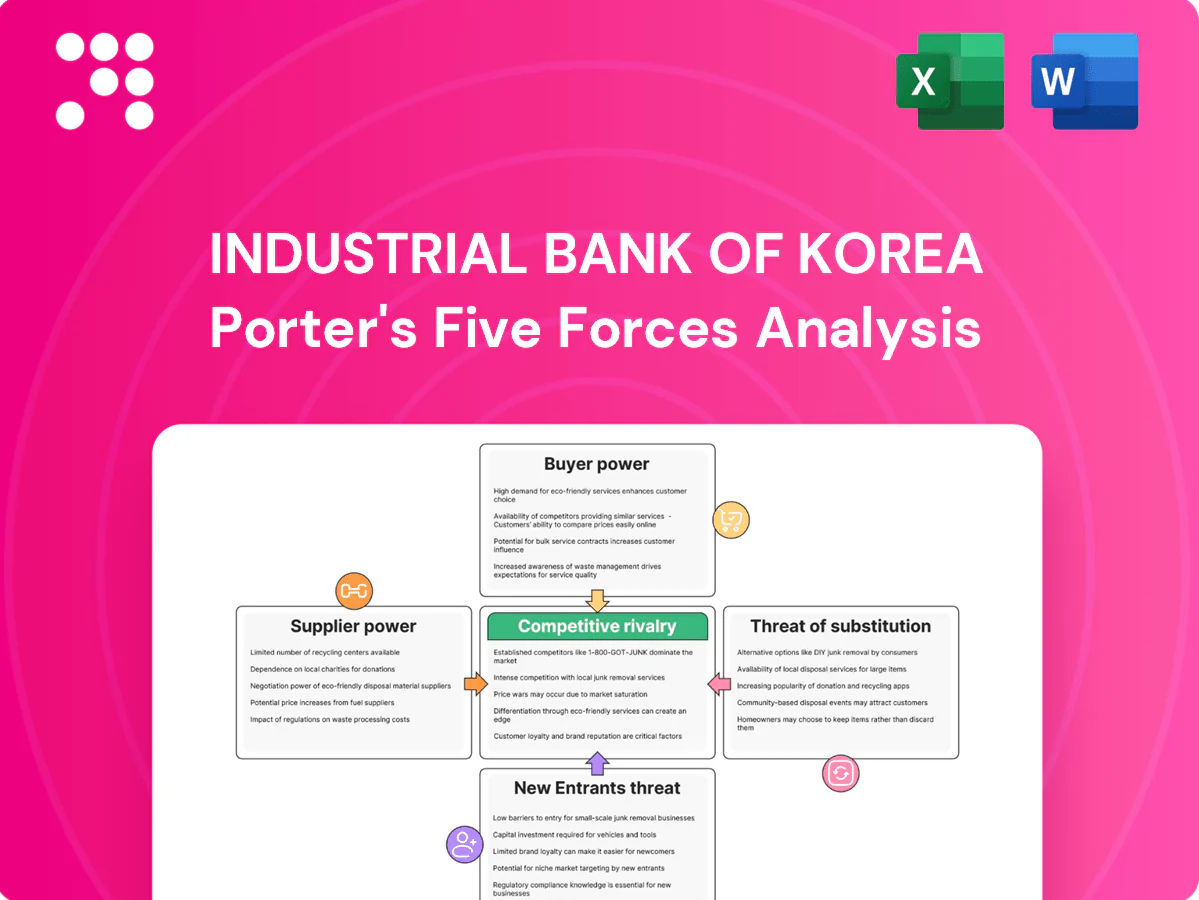
Industrial Bank of Korea Porter's Five Forces Analysis

Go Beyond the Preview—Access the Full Strategic Report
Industrial Bank of Korea faces moderate rivalry from domestic banks, strong regulatory barriers, and rising fintech substitutes that pressure margins. Corporate and SME buyer power is significant, while supplier power (capital markets) is moderate. New entrants are limited but digital challengers raise long-term risk. This snapshot only scratches the surface—unlock the full Porter's Five Forces Analysis for actionable strategy and valuation insights.
Suppliers Bargaining Power

Stable low-cost deposits
IBK funds a large share of lending through retail and SME deposits, keeping funding costs relatively low and predictable. State-linked ownership and perceived government support stabilize depositor behavior in downturns, reducing suppliers’ leverage on pricing. Nonetheless, flight-to-safety dynamics can force upward pressure on deposit rates during market stress, tightening margins.
Government as key stakeholder
As a state-owned bank, IBK depends on government policy guidance, capital injections and credit guarantees—with total assets of about KRW 305 trillion in 2024—making the state a dominant supplier that can both enable growth and constrain strategy.
Policy priorities frequently shape pricing, risk appetite and credit allocation, for example steering preferential SME lending quotas and subsidized rates that alter margins.
The government’s influence is high but largely aligned with IBK’s SME mission, ensuring mandate consistency even when commercial flexibility is limited.

Wholesale and capital markets
Market funding for IBK becomes costlier and more volatile in liquidity squeezes; 2024 saw Korean bank bond spreads swing roughly 30–50 basis points during stress episodes, with ratings and macro shifts directly widening spreads and raising supplier power cyclically.
Diversified maturities and covered bonds—issuances surpassed KRW 10 trillion cumulative by 2024—partially mitigate rollover and spread risk but do not eliminate counterparty concentration pressure.

Technology and data vendors
Core banking, cloud, cybersecurity and data analytics vendors are highly specialized and concentrated, with the top three cloud providers holding roughly 66% of market share in 2024, giving suppliers leverage. High switching costs and integration risks increase vendor bargaining power, and prevalent long-term contracts lock in pricing and SLAs. IBK's scale and state ownership improve negotiating position, but dependency on specialized vendors remains material.
- Top‑3 cloud ≈66% share (2024)
- Long‑term contracts common
- High switching & integration costs
- IBK scale helps, dependence persists
Skilled labor and unions
Skilled risk officers, SME relationship managers and IT specialists are scarce in Korea, elevating internal supplier power for Industrial Bank of Korea; labor unions and sector norms (union density ≈11% in Korea) constrain compensation flexibility and work practices, while training pipelines and employer brand reduce but do not remove retention risk.
- Scarce specialized staff raises hiring costs
- Union influence limits flexibility
- Training/brand mitigate turnover but gap remains
State backing steadies funding; vendor concentration and staff scarcity increase supplier leverage
IBK's supplier power is moderated by retail/SME deposits and state backing (assets ≈KRW 305trn in 2024) which keep funding stable, but market stress raised Korean bank bond spreads ~30–50bps in 2024 increasing supplier leverage. Government policy steers pricing and capital support, constraining commercial flexibility. Vendor concentration (top‑3 cloud ≈66%) and scarce skilled staff (union density ≈11%) raise bargaining costs.
| Item | 2024 Metric |
|---|---|
| Total assets | KRW 305 trillion |
| Bank spread moves | ~30–50 bps |
| Top‑3 cloud share | ≈66% |
| Covered bonds issued | >KRW 10 trillion |
| Union density | ≈11% |
What is included in the product
 Detailed Word Document
Tailored Porter's Five Forces analysis for Industrial Bank of Korea, uncovering competitive pressures, buyer/supplier power, threats from new entrants and substitutes, and strategic levers to protect margin and market share.

 Customizable Excel Spreadsheet
One-sheet Porter’s Five Forces for Industrial Bank of Korea distills competitive pressures into a single view to speed strategic decisions. Customizable force levels and a clean layout make it easy to update with new data, drop into decks, and relieve analysis bottlenecks for non-finance teams.
Customers Bargaining Power

SME borrowers’ price sensitivity
SMEs, which account for roughly 99.9% of Korean firms and about 87% of employment (2023), are highly rate- and collateral-sensitive as tight margins make borrowing costs material to viability.
Ability to compare offers across major banks and government policy programs intensifies pressure on loan pricing and fees, forcing competitive rate tightening.
IBK’s advisory services and credit guarantees—including government-backed schemes—help it capture SME business by delivering value beyond price, easing collateral constraints and preserving margins.
Large depositors’ leverage
In 2024 corporates and public entities can redeploy sizable balances quickly, enabling negotiation of preferential rates and bundled services. Concentration of large depositors raises buyer power and pricing pressure on IBK. IBK offsets this through deep SME relationships, integrated cash-management platforms and state-backed credibility that increase account stickiness.

Digital comparison and transparency
Online platforms make loan and deposit rates highly visible, driven by South Korea’s internet penetration of over 95% in 2024 (ITU), exposing Industrial Bank of Korea to direct rate comparisons across more than 20 retail banks. Switching and pre-qualification tools cut onboarding frictions, shortening decision time and increasing price sensitivity. Greater transparency strengthens customers’ negotiating position, so IBK must bundle value-added services to protect margins.

Multi-banking behavior
SMEs and consumers increasingly spread relationships across banks and fintechs, lowering switching costs and intensifying price competition; bundling and loyalty programs show diminishing returns in 2024. Multi-banking elevates bargaining power as customers demand fee cuts and better digital services. IBK’s mission-driven SME focus and tailored lending can retain core clients despite these pressures.
- Multi-banking: higher customer leverage
- Pricing pressure: increased
- Bundling: lower effectiveness
- IBK edge: mission-led client retention
Service quality and speed
Buyers demand rapid credit decisions and seamless digital journeys; with 96% smartphone penetration in South Korea in 2024, slow turnaround invites churn and shifts bargaining power toward customers expecting consumer-grade UX. Industrial Bank of Korea must accelerate process automation and data-driven underwriting to retain deposits and loan volumes, cutting decision times to hours or minutes to avoid attrition.
- Customer expectations: instant digital UX
- Risk: churn from slow approvals
- Response: automation + data underwriting
SME price sensitivity meets digital switching; banks counter with SME guarantees and cash management
SMEs (99.9% of firms; 87% of employment, 2023) drive price sensitivity and collateral constraints. 95% internet and 96% smartphone penetration in 2024 amplify rate transparency and switching. 20+ retail banks and fintechs raise multi-banking and pricing pressure; IBK offsets via SME-focused guarantees, advisory and integrated cash management.
| Metric | Value |
|---|---|
| SME share (firms) | 99.9% (2023) |
| Employment from SMEs | ~87% (2023) |
| Internet / Smartphone | 95% / 96% (2024) |
| Retail banks | 20+ |
Same Document Delivered
Industrial Bank of Korea Porter's Five Forces Analysis
This preview shows the exact Industrial Bank of Korea Porter's Five Forces Analysis you'll receive immediately after purchase—no surprises, no placeholders. The document is fully formatted, professionally written, and ready for download and use the moment you buy. You're looking at the actual deliverable.

Go Beyond the Preview—Access the Full Strategic Report
Industrial Bank of Korea faces moderate rivalry from domestic banks, strong regulatory barriers, and rising fintech substitutes that pressure margins. Corporate and SME buyer power is significant, while supplier power (capital markets) is moderate. New entrants are limited but digital challengers raise long-term risk. This snapshot only scratches the surface—unlock the full Porter's Five Forces Analysis for actionable strategy and valuation insights.
Suppliers Bargaining Power
Stable low-cost deposits
IBK funds a large share of lending through retail and SME deposits, keeping funding costs relatively low and predictable. State-linked ownership and perceived government support stabilize depositor behavior in downturns, reducing suppliers’ leverage on pricing. Nonetheless, flight-to-safety dynamics can force upward pressure on deposit rates during market stress, tightening margins.
Government as key stakeholder
As a state-owned bank, IBK depends on government policy guidance, capital injections and credit guarantees—with total assets of about KRW 305 trillion in 2024—making the state a dominant supplier that can both enable growth and constrain strategy.
Policy priorities frequently shape pricing, risk appetite and credit allocation, for example steering preferential SME lending quotas and subsidized rates that alter margins.
The government’s influence is high but largely aligned with IBK’s SME mission, ensuring mandate consistency even when commercial flexibility is limited.
Wholesale and capital markets
Market funding for IBK becomes costlier and more volatile in liquidity squeezes; 2024 saw Korean bank bond spreads swing roughly 30–50 basis points during stress episodes, with ratings and macro shifts directly widening spreads and raising supplier power cyclically.
Diversified maturities and covered bonds—issuances surpassed KRW 10 trillion cumulative by 2024—partially mitigate rollover and spread risk but do not eliminate counterparty concentration pressure.
Technology and data vendors
Core banking, cloud, cybersecurity and data analytics vendors are highly specialized and concentrated, with the top three cloud providers holding roughly 66% of market share in 2024, giving suppliers leverage. High switching costs and integration risks increase vendor bargaining power, and prevalent long-term contracts lock in pricing and SLAs. IBK's scale and state ownership improve negotiating position, but dependency on specialized vendors remains material.
- Top‑3 cloud ≈66% share (2024)
- Long‑term contracts common
- High switching & integration costs
- IBK scale helps, dependence persists
Skilled labor and unions
Skilled risk officers, SME relationship managers and IT specialists are scarce in Korea, elevating internal supplier power for Industrial Bank of Korea; labor unions and sector norms (union density ≈11% in Korea) constrain compensation flexibility and work practices, while training pipelines and employer brand reduce but do not remove retention risk.
- Scarce specialized staff raises hiring costs
- Union influence limits flexibility
- Training/brand mitigate turnover but gap remains
State backing steadies funding; vendor concentration and staff scarcity increase supplier leverage
IBK's supplier power is moderated by retail/SME deposits and state backing (assets ≈KRW 305trn in 2024) which keep funding stable, but market stress raised Korean bank bond spreads ~30–50bps in 2024 increasing supplier leverage. Government policy steers pricing and capital support, constraining commercial flexibility. Vendor concentration (top‑3 cloud ≈66%) and scarce skilled staff (union density ≈11%) raise bargaining costs.
| Item | 2024 Metric |
|---|---|
| Total assets | KRW 305 trillion |
| Bank spread moves | ~30–50 bps |
| Top‑3 cloud share | ≈66% |
| Covered bonds issued | >KRW 10 trillion |
| Union density | ≈11% |
What is included in the product
Detailed Word Document
Tailored Porter's Five Forces analysis for Industrial Bank of Korea, uncovering competitive pressures, buyer/supplier power, threats from new entrants and substitutes, and strategic levers to protect margin and market share.
Customizable Excel Spreadsheet
One-sheet Porter’s Five Forces for Industrial Bank of Korea distills competitive pressures into a single view to speed strategic decisions. Customizable force levels and a clean layout make it easy to update with new data, drop into decks, and relieve analysis bottlenecks for non-finance teams.
Customers Bargaining Power
SME borrowers’ price sensitivity
SMEs, which account for roughly 99.9% of Korean firms and about 87% of employment (2023), are highly rate- and collateral-sensitive as tight margins make borrowing costs material to viability.
Ability to compare offers across major banks and government policy programs intensifies pressure on loan pricing and fees, forcing competitive rate tightening.
IBK’s advisory services and credit guarantees—including government-backed schemes—help it capture SME business by delivering value beyond price, easing collateral constraints and preserving margins.
Large depositors’ leverage
In 2024 corporates and public entities can redeploy sizable balances quickly, enabling negotiation of preferential rates and bundled services. Concentration of large depositors raises buyer power and pricing pressure on IBK. IBK offsets this through deep SME relationships, integrated cash-management platforms and state-backed credibility that increase account stickiness.
Digital comparison and transparency
Online platforms make loan and deposit rates highly visible, driven by South Korea’s internet penetration of over 95% in 2024 (ITU), exposing Industrial Bank of Korea to direct rate comparisons across more than 20 retail banks. Switching and pre-qualification tools cut onboarding frictions, shortening decision time and increasing price sensitivity. Greater transparency strengthens customers’ negotiating position, so IBK must bundle value-added services to protect margins.
Multi-banking behavior
SMEs and consumers increasingly spread relationships across banks and fintechs, lowering switching costs and intensifying price competition; bundling and loyalty programs show diminishing returns in 2024. Multi-banking elevates bargaining power as customers demand fee cuts and better digital services. IBK’s mission-driven SME focus and tailored lending can retain core clients despite these pressures.
- Multi-banking: higher customer leverage
- Pricing pressure: increased
- Bundling: lower effectiveness
- IBK edge: mission-led client retention
Service quality and speed
Buyers demand rapid credit decisions and seamless digital journeys; with 96% smartphone penetration in South Korea in 2024, slow turnaround invites churn and shifts bargaining power toward customers expecting consumer-grade UX. Industrial Bank of Korea must accelerate process automation and data-driven underwriting to retain deposits and loan volumes, cutting decision times to hours or minutes to avoid attrition.
- Customer expectations: instant digital UX
- Risk: churn from slow approvals
- Response: automation + data underwriting
SME price sensitivity meets digital switching; banks counter with SME guarantees and cash management
SMEs (99.9% of firms; 87% of employment, 2023) drive price sensitivity and collateral constraints. 95% internet and 96% smartphone penetration in 2024 amplify rate transparency and switching. 20+ retail banks and fintechs raise multi-banking and pricing pressure; IBK offsets via SME-focused guarantees, advisory and integrated cash management.
| Metric | Value |
|---|---|
| SME share (firms) | 99.9% (2023) |
| Employment from SMEs | ~87% (2023) |
| Internet / Smartphone | 95% / 96% (2024) |
| Retail banks | 20+ |
Same Document Delivered
Industrial Bank of Korea Porter's Five Forces Analysis
This preview shows the exact Industrial Bank of Korea Porter's Five Forces Analysis you'll receive immediately after purchase—no surprises, no placeholders. The document is fully formatted, professionally written, and ready for download and use the moment you buy. You're looking at the actual deliverable.
Original: $10.00
-65%$10.00
$3.50Description
Go Beyond the Preview—Access the Full Strategic Report
Industrial Bank of Korea faces moderate rivalry from domestic banks, strong regulatory barriers, and rising fintech substitutes that pressure margins. Corporate and SME buyer power is significant, while supplier power (capital markets) is moderate. New entrants are limited but digital challengers raise long-term risk. This snapshot only scratches the surface—unlock the full Porter's Five Forces Analysis for actionable strategy and valuation insights.
Suppliers Bargaining Power
Stable low-cost deposits
IBK funds a large share of lending through retail and SME deposits, keeping funding costs relatively low and predictable. State-linked ownership and perceived government support stabilize depositor behavior in downturns, reducing suppliers’ leverage on pricing. Nonetheless, flight-to-safety dynamics can force upward pressure on deposit rates during market stress, tightening margins.
Government as key stakeholder
As a state-owned bank, IBK depends on government policy guidance, capital injections and credit guarantees—with total assets of about KRW 305 trillion in 2024—making the state a dominant supplier that can both enable growth and constrain strategy.
Policy priorities frequently shape pricing, risk appetite and credit allocation, for example steering preferential SME lending quotas and subsidized rates that alter margins.
The government’s influence is high but largely aligned with IBK’s SME mission, ensuring mandate consistency even when commercial flexibility is limited.
Wholesale and capital markets
Market funding for IBK becomes costlier and more volatile in liquidity squeezes; 2024 saw Korean bank bond spreads swing roughly 30–50 basis points during stress episodes, with ratings and macro shifts directly widening spreads and raising supplier power cyclically.
Diversified maturities and covered bonds—issuances surpassed KRW 10 trillion cumulative by 2024—partially mitigate rollover and spread risk but do not eliminate counterparty concentration pressure.
Technology and data vendors
Core banking, cloud, cybersecurity and data analytics vendors are highly specialized and concentrated, with the top three cloud providers holding roughly 66% of market share in 2024, giving suppliers leverage. High switching costs and integration risks increase vendor bargaining power, and prevalent long-term contracts lock in pricing and SLAs. IBK's scale and state ownership improve negotiating position, but dependency on specialized vendors remains material.
- Top‑3 cloud ≈66% share (2024)
- Long‑term contracts common
- High switching & integration costs
- IBK scale helps, dependence persists
Skilled labor and unions
Skilled risk officers, SME relationship managers and IT specialists are scarce in Korea, elevating internal supplier power for Industrial Bank of Korea; labor unions and sector norms (union density ≈11% in Korea) constrain compensation flexibility and work practices, while training pipelines and employer brand reduce but do not remove retention risk.
- Scarce specialized staff raises hiring costs
- Union influence limits flexibility
- Training/brand mitigate turnover but gap remains
State backing steadies funding; vendor concentration and staff scarcity increase supplier leverage
IBK's supplier power is moderated by retail/SME deposits and state backing (assets ≈KRW 305trn in 2024) which keep funding stable, but market stress raised Korean bank bond spreads ~30–50bps in 2024 increasing supplier leverage. Government policy steers pricing and capital support, constraining commercial flexibility. Vendor concentration (top‑3 cloud ≈66%) and scarce skilled staff (union density ≈11%) raise bargaining costs.
| Item | 2024 Metric |
|---|---|
| Total assets | KRW 305 trillion |
| Bank spread moves | ~30–50 bps |
| Top‑3 cloud share | ≈66% |
| Covered bonds issued | >KRW 10 trillion |
| Union density | ≈11% |
What is included in the product
Detailed Word Document
Tailored Porter's Five Forces analysis for Industrial Bank of Korea, uncovering competitive pressures, buyer/supplier power, threats from new entrants and substitutes, and strategic levers to protect margin and market share.
Customizable Excel Spreadsheet
One-sheet Porter’s Five Forces for Industrial Bank of Korea distills competitive pressures into a single view to speed strategic decisions. Customizable force levels and a clean layout make it easy to update with new data, drop into decks, and relieve analysis bottlenecks for non-finance teams.
Customers Bargaining Power
SME borrowers’ price sensitivity
SMEs, which account for roughly 99.9% of Korean firms and about 87% of employment (2023), are highly rate- and collateral-sensitive as tight margins make borrowing costs material to viability.
Ability to compare offers across major banks and government policy programs intensifies pressure on loan pricing and fees, forcing competitive rate tightening.
IBK’s advisory services and credit guarantees—including government-backed schemes—help it capture SME business by delivering value beyond price, easing collateral constraints and preserving margins.
Large depositors’ leverage
In 2024 corporates and public entities can redeploy sizable balances quickly, enabling negotiation of preferential rates and bundled services. Concentration of large depositors raises buyer power and pricing pressure on IBK. IBK offsets this through deep SME relationships, integrated cash-management platforms and state-backed credibility that increase account stickiness.
Digital comparison and transparency
Online platforms make loan and deposit rates highly visible, driven by South Korea’s internet penetration of over 95% in 2024 (ITU), exposing Industrial Bank of Korea to direct rate comparisons across more than 20 retail banks. Switching and pre-qualification tools cut onboarding frictions, shortening decision time and increasing price sensitivity. Greater transparency strengthens customers’ negotiating position, so IBK must bundle value-added services to protect margins.
Multi-banking behavior
SMEs and consumers increasingly spread relationships across banks and fintechs, lowering switching costs and intensifying price competition; bundling and loyalty programs show diminishing returns in 2024. Multi-banking elevates bargaining power as customers demand fee cuts and better digital services. IBK’s mission-driven SME focus and tailored lending can retain core clients despite these pressures.
- Multi-banking: higher customer leverage
- Pricing pressure: increased
- Bundling: lower effectiveness
- IBK edge: mission-led client retention
Service quality and speed
Buyers demand rapid credit decisions and seamless digital journeys; with 96% smartphone penetration in South Korea in 2024, slow turnaround invites churn and shifts bargaining power toward customers expecting consumer-grade UX. Industrial Bank of Korea must accelerate process automation and data-driven underwriting to retain deposits and loan volumes, cutting decision times to hours or minutes to avoid attrition.
- Customer expectations: instant digital UX
- Risk: churn from slow approvals
- Response: automation + data underwriting
SME price sensitivity meets digital switching; banks counter with SME guarantees and cash management
SMEs (99.9% of firms; 87% of employment, 2023) drive price sensitivity and collateral constraints. 95% internet and 96% smartphone penetration in 2024 amplify rate transparency and switching. 20+ retail banks and fintechs raise multi-banking and pricing pressure; IBK offsets via SME-focused guarantees, advisory and integrated cash management.
| Metric | Value |
|---|---|
| SME share (firms) | 99.9% (2023) |
| Employment from SMEs | ~87% (2023) |
| Internet / Smartphone | 95% / 96% (2024) |
| Retail banks | 20+ |
Same Document Delivered
Industrial Bank of Korea Porter's Five Forces Analysis
This preview shows the exact Industrial Bank of Korea Porter's Five Forces Analysis you'll receive immediately after purchase—no surprises, no placeholders. The document is fully formatted, professionally written, and ready for download and use the moment you buy. You're looking at the actual deliverable.











