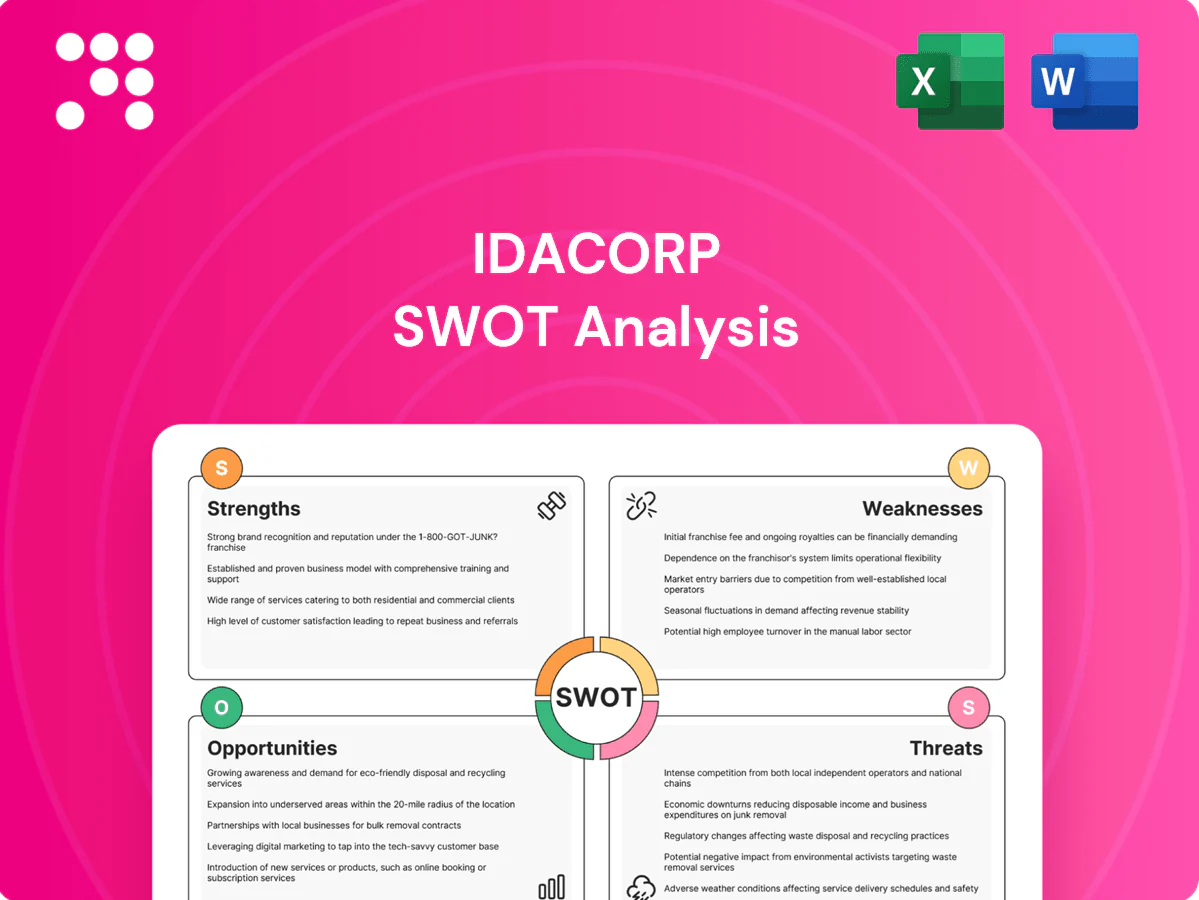
IdaCorp SWOT Analysis

Make Insightful Decisions Backed by Expert Research
IdaCorp shows resilient local market strength and regulated utility cash flows, but faces regulatory and weather-related risks that could pressure margins. Our full SWOT unpacks growth levers, capital needs, and competitive threats with data-driven insight. Purchase the complete report for an editable, investor-ready analysis to inform strategy and decisions.
Strengths

Regulated revenue stability
As a regulated electric utility, Idaho Power generates nearly 100% of its revenues from rate-regulated operations, providing predictable cash flows and enabling cost recovery through approved tariff mechanisms. This regulatory framework reduces earnings volatility, supports multi-year capital plans and sustained capital investment, and underpins investment-grade credit metrics and access to long-term financing.
Monopoly service territory
Serving southern Idaho and eastern Oregon, Idaho Power—IdaCorp’s primary utility—serves about 600,000 customers, facing limited direct competition in its footprint. Geographic exclusivity helps sustain steady demand and predictable regulated revenues. Strong local presence bolsters customer relationships and regulatory engagement with state commissions. Focused operations enable efficiency and reliability across a defined region.

Integrated generation-to-distribution
IdaCorp's integrated generation-to-distribution model—through Idaho Power serving roughly 600,000 customers and owning about 2.7 GW of generation—supports high system reliability. Vertical integration enables optimized dispatch and lowers procurement risk, reducing exposure to market volatility. Integrated operations create operating efficiencies across the value chain and align supply with regional load patterns.

Reliability and affordability focus
IdaCorp s core mission to deliver reliable, affordable energy aligns closely with regulator and community expectations, reinforcing customer trust and its social license to operate. Emphasis on disciplined cost control helps keep retail rates competitive while maintaining capital discipline. Strong reliability metrics translate into higher customer satisfaction and stronger regulatory standing.
- Alignment with stakeholder expectations
- Cost control supports competitive rates
- High reliability boosts customer satisfaction
- Supports brand trust and social license
Environmental stewardship commitment
Active environmental stewardship strengthens Idacorp's long-term viability by reducing exposure to tightening regulations and aligning with shifting customer preferences; improving performance lowers compliance risk and operational disruption. It also positions the utility to access federal clean-energy incentives under the Inflation Reduction Act, which provides baseline ITC/PTC support of roughly 30% for eligible projects.
- Reduces regulatory risk
- Aligns with customer demand for clean energy
- Improves operational resilience
- Enables access to ~30% IRA tax incentives
Rate-regulated utility: predictable cash flows, ~600,000 customers, ~30% IRA access
IdaCorp benefits from nearly 100% rate-regulated revenues, providing predictable cash flows and supporting investment-grade financing. Idaho Power serves ~600,000 customers with ~2.7 GW owned generation, enabling high reliability and low procurement risk. Strong local monopoly position and disciplined cost control keep retail rates competitive. Active environmental programs enable access to ~30% IRA incentives for eligible projects.
| Metric | Value |
|---|---|
| Customers | ~600,000 |
| Owned Gen | ~2.7 GW |
| Regulated Rev | ~100% |
| IRA Incentive | ~30% |
What is included in the product
 Detailed Word Document
Provides a concise SWOT overview of IdaCorp, highlighting its core strengths and weaknesses while outlining key market opportunities and external threats shaping its strategic trajectory.

 Customizable Excel Spreadsheet
Provides a concise, visual SWOT matrix tailored to IdaCorp for rapid strategic alignment and quick stakeholder-ready summaries, enabling fast decision-making and easy integration into reports or presentations.
Weaknesses

Geographic concentration
Operations are concentrated in Idaho and eastern Oregon—IdaCorp’s regulated utility serves about 632,000 customers, concentrating operational and regulatory risk. Regional slowdowns or extreme weather can disproportionately impact revenue and reliability. Load growth is closely tied to local demographics and industry mix; Idaho led U.S. population growth at roughly 2.6% in 2023, amplifying sensitivity to local trends. Limited geographic diversification reduces resilience to local shocks.
Regulatory dependence
IdaCorp’s earnings hinge on Idaho Public Utilities Commission rate cases and regulator decisions, so adverse rulings can delay cost recovery or cap allowed returns and cash flow. Regulatory timelines often lag inflation—US CPI rose about 3.4% in 2024—eroding timely cost pass-through. This dependence constrains strategic flexibility and investment pacing, with recovery often taking months to years.

Capital intensity
Generation and grid assets require continuous, sizable investments, and IDACORP faces heavy capital intensity that can strain free cash flow. Large capex needs often necessitate external financing, raising leverage and interest exposure. Project delays or cost overruns can erode allowed returns under rate-making, while aging infrastructure increases near-term replacement requirements and maintenance spend.

Exposure to load seasonality
IdaCorp faces meaningful exposure to load seasonality: Idaho Power serves about 630,000 customers (2024) and weather-driven peaks strain capacity and increase short-term wholesale procurement costs during extreme cold or heat.
Mild shoulder seasons can compress billed volumes under volumetric rates, reducing revenue, while forecasting errors have led to costly market purchases and operational adjustments in recent years.
- Peak stress on capacity and margins
- Higher procurement costs during extremes
- Revenue sensitivity in mild seasons
- Forecasting risk → operational/market exposure
Limited scale vs. majors
Compared with national majors, IDACORP's smaller scale (serving roughly 620,000 customers as of 2024) limits economies of scale, often leading to less favorable vendor pricing and slower technology adoption. Smaller size concentrates single-project risk and constrains diversification across resource types, which can amplify earnings volatility versus larger diversified utilities.
- Fewer economies of scale
- Weaker vendor pricing power
- Slower tech adoption
- Single-project concentration risk
- Limited resource diversification
Idaho utility with ~630,000 customers: regulatory, weather and capital risk
Operations are concentrated in Idaho/eastern Oregon, serving ~630,000 customers (2024), concentrating regulatory and weather risk. Earnings depend on Idaho PUC decisions and lagging rate relief versus inflation (US CPI ~3.4% in 2024). Heavy, ongoing capital intensity raises financing and project‑risk exposure, while limited scale reduces vendor leverage and resource diversification.
| Metric | Value |
|---|---|
| Customers (2024) | ~630,000 |
| Idaho population growth (2023) | ~2.6% |
| US CPI (2024) | ~3.4% |
| Geographic footprint | Idaho & eastern Oregon |
Same Document Delivered
IdaCorp SWOT Analysis
This is the actual IdaCorp SWOT analysis document you’ll receive upon purchase—no surprises, just professional quality. The preview below is taken directly from the full report and reflects the real, structured content you can use immediately. Buy now to unlock the complete, editable version for download.

Make Insightful Decisions Backed by Expert Research
IdaCorp shows resilient local market strength and regulated utility cash flows, but faces regulatory and weather-related risks that could pressure margins. Our full SWOT unpacks growth levers, capital needs, and competitive threats with data-driven insight. Purchase the complete report for an editable, investor-ready analysis to inform strategy and decisions.
Strengths
Regulated revenue stability
As a regulated electric utility, Idaho Power generates nearly 100% of its revenues from rate-regulated operations, providing predictable cash flows and enabling cost recovery through approved tariff mechanisms. This regulatory framework reduces earnings volatility, supports multi-year capital plans and sustained capital investment, and underpins investment-grade credit metrics and access to long-term financing.
Monopoly service territory
Serving southern Idaho and eastern Oregon, Idaho Power—IdaCorp’s primary utility—serves about 600,000 customers, facing limited direct competition in its footprint. Geographic exclusivity helps sustain steady demand and predictable regulated revenues. Strong local presence bolsters customer relationships and regulatory engagement with state commissions. Focused operations enable efficiency and reliability across a defined region.
Integrated generation-to-distribution
IdaCorp's integrated generation-to-distribution model—through Idaho Power serving roughly 600,000 customers and owning about 2.7 GW of generation—supports high system reliability. Vertical integration enables optimized dispatch and lowers procurement risk, reducing exposure to market volatility. Integrated operations create operating efficiencies across the value chain and align supply with regional load patterns.
Reliability and affordability focus
IdaCorp s core mission to deliver reliable, affordable energy aligns closely with regulator and community expectations, reinforcing customer trust and its social license to operate. Emphasis on disciplined cost control helps keep retail rates competitive while maintaining capital discipline. Strong reliability metrics translate into higher customer satisfaction and stronger regulatory standing.
- Alignment with stakeholder expectations
- Cost control supports competitive rates
- High reliability boosts customer satisfaction
- Supports brand trust and social license
Environmental stewardship commitment
Active environmental stewardship strengthens Idacorp's long-term viability by reducing exposure to tightening regulations and aligning with shifting customer preferences; improving performance lowers compliance risk and operational disruption. It also positions the utility to access federal clean-energy incentives under the Inflation Reduction Act, which provides baseline ITC/PTC support of roughly 30% for eligible projects.
- Reduces regulatory risk
- Aligns with customer demand for clean energy
- Improves operational resilience
- Enables access to ~30% IRA tax incentives
Rate-regulated utility: predictable cash flows, ~600,000 customers, ~30% IRA access
IdaCorp benefits from nearly 100% rate-regulated revenues, providing predictable cash flows and supporting investment-grade financing. Idaho Power serves ~600,000 customers with ~2.7 GW owned generation, enabling high reliability and low procurement risk. Strong local monopoly position and disciplined cost control keep retail rates competitive. Active environmental programs enable access to ~30% IRA incentives for eligible projects.
| Metric | Value |
|---|---|
| Customers | ~600,000 |
| Owned Gen | ~2.7 GW |
| Regulated Rev | ~100% |
| IRA Incentive | ~30% |
What is included in the product
Detailed Word Document
Provides a concise SWOT overview of IdaCorp, highlighting its core strengths and weaknesses while outlining key market opportunities and external threats shaping its strategic trajectory.
Customizable Excel Spreadsheet
Provides a concise, visual SWOT matrix tailored to IdaCorp for rapid strategic alignment and quick stakeholder-ready summaries, enabling fast decision-making and easy integration into reports or presentations.
Weaknesses
Geographic concentration
Operations are concentrated in Idaho and eastern Oregon—IdaCorp’s regulated utility serves about 632,000 customers, concentrating operational and regulatory risk. Regional slowdowns or extreme weather can disproportionately impact revenue and reliability. Load growth is closely tied to local demographics and industry mix; Idaho led U.S. population growth at roughly 2.6% in 2023, amplifying sensitivity to local trends. Limited geographic diversification reduces resilience to local shocks.
Regulatory dependence
IdaCorp’s earnings hinge on Idaho Public Utilities Commission rate cases and regulator decisions, so adverse rulings can delay cost recovery or cap allowed returns and cash flow. Regulatory timelines often lag inflation—US CPI rose about 3.4% in 2024—eroding timely cost pass-through. This dependence constrains strategic flexibility and investment pacing, with recovery often taking months to years.
Capital intensity
Generation and grid assets require continuous, sizable investments, and IDACORP faces heavy capital intensity that can strain free cash flow. Large capex needs often necessitate external financing, raising leverage and interest exposure. Project delays or cost overruns can erode allowed returns under rate-making, while aging infrastructure increases near-term replacement requirements and maintenance spend.
Exposure to load seasonality
IdaCorp faces meaningful exposure to load seasonality: Idaho Power serves about 630,000 customers (2024) and weather-driven peaks strain capacity and increase short-term wholesale procurement costs during extreme cold or heat.
Mild shoulder seasons can compress billed volumes under volumetric rates, reducing revenue, while forecasting errors have led to costly market purchases and operational adjustments in recent years.
- Peak stress on capacity and margins
- Higher procurement costs during extremes
- Revenue sensitivity in mild seasons
- Forecasting risk → operational/market exposure
Limited scale vs. majors
Compared with national majors, IDACORP's smaller scale (serving roughly 620,000 customers as of 2024) limits economies of scale, often leading to less favorable vendor pricing and slower technology adoption. Smaller size concentrates single-project risk and constrains diversification across resource types, which can amplify earnings volatility versus larger diversified utilities.
- Fewer economies of scale
- Weaker vendor pricing power
- Slower tech adoption
- Single-project concentration risk
- Limited resource diversification
Idaho utility with ~630,000 customers: regulatory, weather and capital risk
Operations are concentrated in Idaho/eastern Oregon, serving ~630,000 customers (2024), concentrating regulatory and weather risk. Earnings depend on Idaho PUC decisions and lagging rate relief versus inflation (US CPI ~3.4% in 2024). Heavy, ongoing capital intensity raises financing and project‑risk exposure, while limited scale reduces vendor leverage and resource diversification.
| Metric | Value |
|---|---|
| Customers (2024) | ~630,000 |
| Idaho population growth (2023) | ~2.6% |
| US CPI (2024) | ~3.4% |
| Geographic footprint | Idaho & eastern Oregon |
Same Document Delivered
IdaCorp SWOT Analysis
This is the actual IdaCorp SWOT analysis document you’ll receive upon purchase—no surprises, just professional quality. The preview below is taken directly from the full report and reflects the real, structured content you can use immediately. Buy now to unlock the complete, editable version for download.
Original: $10.00
-65%$10.00
$3.50Description
Make Insightful Decisions Backed by Expert Research
IdaCorp shows resilient local market strength and regulated utility cash flows, but faces regulatory and weather-related risks that could pressure margins. Our full SWOT unpacks growth levers, capital needs, and competitive threats with data-driven insight. Purchase the complete report for an editable, investor-ready analysis to inform strategy and decisions.
Strengths
Regulated revenue stability
As a regulated electric utility, Idaho Power generates nearly 100% of its revenues from rate-regulated operations, providing predictable cash flows and enabling cost recovery through approved tariff mechanisms. This regulatory framework reduces earnings volatility, supports multi-year capital plans and sustained capital investment, and underpins investment-grade credit metrics and access to long-term financing.
Monopoly service territory
Serving southern Idaho and eastern Oregon, Idaho Power—IdaCorp’s primary utility—serves about 600,000 customers, facing limited direct competition in its footprint. Geographic exclusivity helps sustain steady demand and predictable regulated revenues. Strong local presence bolsters customer relationships and regulatory engagement with state commissions. Focused operations enable efficiency and reliability across a defined region.
Integrated generation-to-distribution
IdaCorp's integrated generation-to-distribution model—through Idaho Power serving roughly 600,000 customers and owning about 2.7 GW of generation—supports high system reliability. Vertical integration enables optimized dispatch and lowers procurement risk, reducing exposure to market volatility. Integrated operations create operating efficiencies across the value chain and align supply with regional load patterns.
Reliability and affordability focus
IdaCorp s core mission to deliver reliable, affordable energy aligns closely with regulator and community expectations, reinforcing customer trust and its social license to operate. Emphasis on disciplined cost control helps keep retail rates competitive while maintaining capital discipline. Strong reliability metrics translate into higher customer satisfaction and stronger regulatory standing.
- Alignment with stakeholder expectations
- Cost control supports competitive rates
- High reliability boosts customer satisfaction
- Supports brand trust and social license
Environmental stewardship commitment
Active environmental stewardship strengthens Idacorp's long-term viability by reducing exposure to tightening regulations and aligning with shifting customer preferences; improving performance lowers compliance risk and operational disruption. It also positions the utility to access federal clean-energy incentives under the Inflation Reduction Act, which provides baseline ITC/PTC support of roughly 30% for eligible projects.
- Reduces regulatory risk
- Aligns with customer demand for clean energy
- Improves operational resilience
- Enables access to ~30% IRA tax incentives
Rate-regulated utility: predictable cash flows, ~600,000 customers, ~30% IRA access
IdaCorp benefits from nearly 100% rate-regulated revenues, providing predictable cash flows and supporting investment-grade financing. Idaho Power serves ~600,000 customers with ~2.7 GW owned generation, enabling high reliability and low procurement risk. Strong local monopoly position and disciplined cost control keep retail rates competitive. Active environmental programs enable access to ~30% IRA incentives for eligible projects.
| Metric | Value |
|---|---|
| Customers | ~600,000 |
| Owned Gen | ~2.7 GW |
| Regulated Rev | ~100% |
| IRA Incentive | ~30% |
What is included in the product
Detailed Word Document
Provides a concise SWOT overview of IdaCorp, highlighting its core strengths and weaknesses while outlining key market opportunities and external threats shaping its strategic trajectory.
Customizable Excel Spreadsheet
Provides a concise, visual SWOT matrix tailored to IdaCorp for rapid strategic alignment and quick stakeholder-ready summaries, enabling fast decision-making and easy integration into reports or presentations.
Weaknesses
Geographic concentration
Operations are concentrated in Idaho and eastern Oregon—IdaCorp’s regulated utility serves about 632,000 customers, concentrating operational and regulatory risk. Regional slowdowns or extreme weather can disproportionately impact revenue and reliability. Load growth is closely tied to local demographics and industry mix; Idaho led U.S. population growth at roughly 2.6% in 2023, amplifying sensitivity to local trends. Limited geographic diversification reduces resilience to local shocks.
Regulatory dependence
IdaCorp’s earnings hinge on Idaho Public Utilities Commission rate cases and regulator decisions, so adverse rulings can delay cost recovery or cap allowed returns and cash flow. Regulatory timelines often lag inflation—US CPI rose about 3.4% in 2024—eroding timely cost pass-through. This dependence constrains strategic flexibility and investment pacing, with recovery often taking months to years.
Capital intensity
Generation and grid assets require continuous, sizable investments, and IDACORP faces heavy capital intensity that can strain free cash flow. Large capex needs often necessitate external financing, raising leverage and interest exposure. Project delays or cost overruns can erode allowed returns under rate-making, while aging infrastructure increases near-term replacement requirements and maintenance spend.
Exposure to load seasonality
IdaCorp faces meaningful exposure to load seasonality: Idaho Power serves about 630,000 customers (2024) and weather-driven peaks strain capacity and increase short-term wholesale procurement costs during extreme cold or heat.
Mild shoulder seasons can compress billed volumes under volumetric rates, reducing revenue, while forecasting errors have led to costly market purchases and operational adjustments in recent years.
- Peak stress on capacity and margins
- Higher procurement costs during extremes
- Revenue sensitivity in mild seasons
- Forecasting risk → operational/market exposure
Limited scale vs. majors
Compared with national majors, IDACORP's smaller scale (serving roughly 620,000 customers as of 2024) limits economies of scale, often leading to less favorable vendor pricing and slower technology adoption. Smaller size concentrates single-project risk and constrains diversification across resource types, which can amplify earnings volatility versus larger diversified utilities.
- Fewer economies of scale
- Weaker vendor pricing power
- Slower tech adoption
- Single-project concentration risk
- Limited resource diversification
Idaho utility with ~630,000 customers: regulatory, weather and capital risk
Operations are concentrated in Idaho/eastern Oregon, serving ~630,000 customers (2024), concentrating regulatory and weather risk. Earnings depend on Idaho PUC decisions and lagging rate relief versus inflation (US CPI ~3.4% in 2024). Heavy, ongoing capital intensity raises financing and project‑risk exposure, while limited scale reduces vendor leverage and resource diversification.
| Metric | Value |
|---|---|
| Customers (2024) | ~630,000 |
| Idaho population growth (2023) | ~2.6% |
| US CPI (2024) | ~3.4% |
| Geographic footprint | Idaho & eastern Oregon |
Same Document Delivered
IdaCorp SWOT Analysis
This is the actual IdaCorp SWOT analysis document you’ll receive upon purchase—no surprises, just professional quality. The preview below is taken directly from the full report and reflects the real, structured content you can use immediately. Buy now to unlock the complete, editable version for download.











