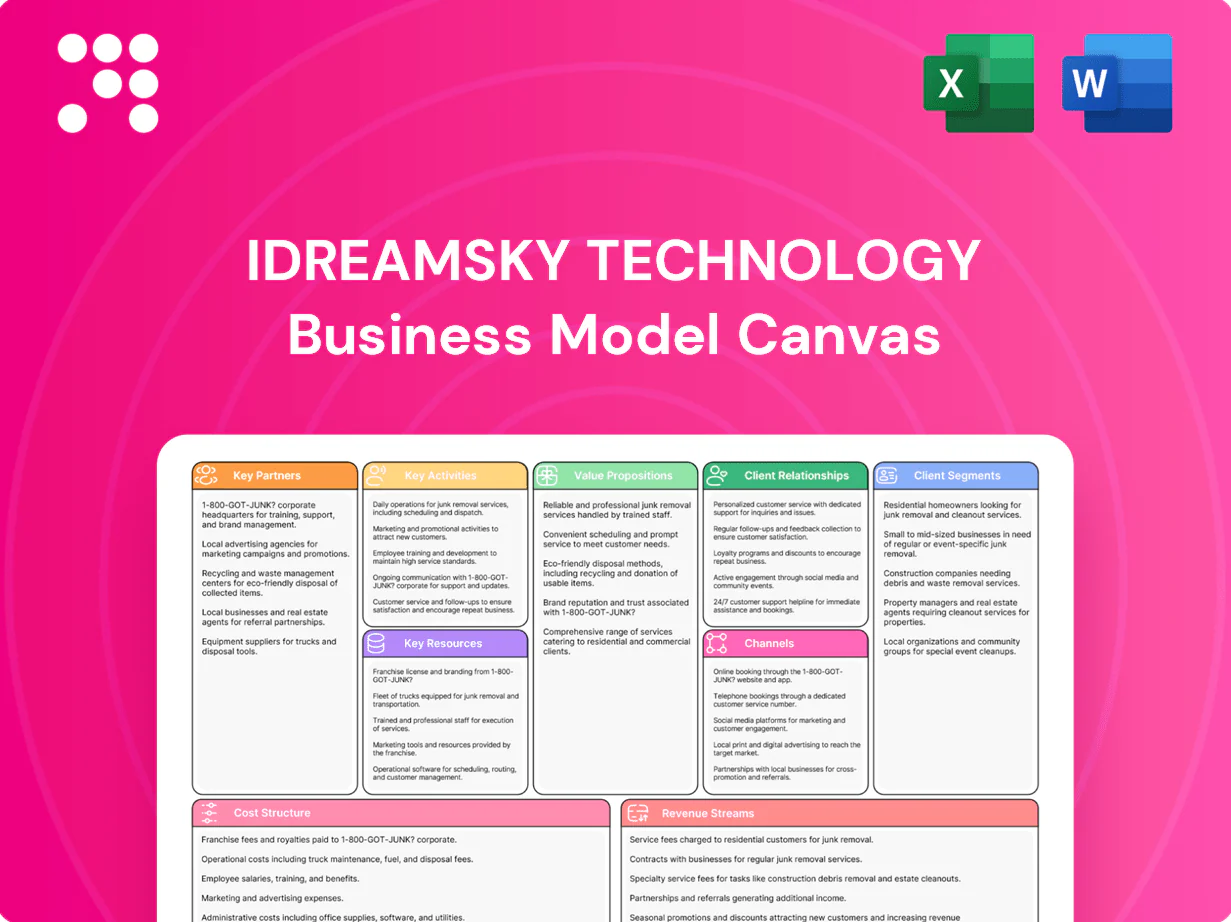
iDreamSky Technology Business Model Canvas

Unlock the strategic Business Model Canvas: value propositions, partners, revenues, costs
Unlock the full strategic blueprint behind iDreamSky Technology’s business model with our detailed Business Model Canvas. This concise, section-by-section analysis reveals value propositions, customer segments, key partners, revenue streams and cost drivers to help investors and strategists make better decisions. Download the editable Word & Excel pack to benchmark, adapt, and scale proven strategies.
Partnerships

Mobile app stores and platforms
Partnerships with major Chinese Android stores (Huawei, Tencent, Oppo, Vivo, Xiaomi collectively covering over 90% of Android distribution in China) and the Apple App Store (Apple captured roughly 64% of global app-store consumer spending in 2023) secure iDreamSky visibility, feature placements, payment rails and SDK integrations. Close collaboration ensures compliance, faster updates and coordinated promotions, lowering user acquisition costs and accelerating launch cycles.
IP owners and licensors
Licensing deals with global and domestic IP holders enable iDreamSky to publish hit titles and extend into merchandise, tapping a mobile games market that surpassed $100 billion in 2024. Strong, long-term IP relationships secure favorable royalty terms and co-marketing support, lowering average user acquisition costs. Access to well-known IP reduces onboarding friction and boosts retention, while enabling cross-sell into derivatives and retail products.

Third-party game developers
External third-party studios supply a steady pipeline of titles while iDreamSky provides funding, China-focused localization and live-ops to scale launches; structured revenue shares—commonly around 70/30 publisher/developer—align incentives across acquisition, retention and monetization. Long-term partnerships build portfolio diversification and operational continuity, crucial in China’s ~CNY 260 billion mobile games market in 2024.

Payment processors and ad-tech networks
Payment gateways ensure smooth IAP settlement across wallets and cards while meeting KYC/PCI rules; ad-tech partners supply mediation, demand sources and optimization tools that boost ARPU and fill rates and enable user acquisition at target CPIs. Global mobile ad spend exceeded 300 billion USD in 2024, reinforcing scale and UA efficiency.
- Payment gateways: settlement, wallets, PCI/KYC
- Ad networks: mediation, demand, optimization
- Outcomes: higher ARPU, improved fill rates, compliant UA at target CPI
Retail, e-commerce, and logistics partners
Retail, e-commerce marketplaces and 3PLs enable iDreamSky to sell IP merchandise and fulfill orders across channels, while manufacturing partners secure quality and speed-to-market for trend-driven products; apparel return rates average about 20% (2023), so logistics efficiency directly cuts reverse-flow costs. Store-in-store and pop-up collaborations boost foot traffic and brand exposure, increasing omnichannel sales conversion.
- Retail partners: offline reach
- Marketplaces: online scale
- 3PLs: fulfillment efficiency
- Manufacturers: quality & speed
- Pop-ups: brand exposure
- Logistics: lower returns & inventory risk
Mobile games publisher: app-store reach ~90%, Apple 64% global spend
iDreamSky’s key partnerships with Chinese app stores and Apple secure distribution, placements and payment rails (stores cover ~90% China; Apple 64% of global app-store spend 2023). IP licensors and third-party studios supply hit content and pipeline (China mobile games ~CNY 260bn/2024; market >$100bn/2024). Ad-tech, payment and logistics partners improve ARPU, UA efficiency and fulfillment.
| Partner type | Role | 2024 metric |
|---|---|---|
| App stores | Distribution & placements | ~90% China reach |
| Apple | Global spend share | 64% (2023) |
| IP licensors | Content & co-marketing | China games CNY 260bn |
| Studios | Development pipeline | 70/30 rev share |
| Ad/payments | Monetization & UA | Mobile ad spend $300bn |
| Retail/3PL | Merch & fulfillment | Apparel return ~20% (2023) |
What is included in the product
 Detailed Word Document
A comprehensive, pre-written Business Model Canvas tailored to iDreamSky Technology, covering customer segments, channels, value propositions and revenue/cost structures across the 9 classic BMC blocks; it reflects real-world operations, highlights competitive advantages and linked SWOT analysis, and is ideal for presentations, investor due diligence and strategic decision-making.

 Customizable Excel Spreadsheet
Condenses iDreamSky's mobile gaming business into a clean one‑page model that relieves the pain of scattered strategy—quickly surfacing revenue streams, key partners, user acquisition bottlenecks and cost drivers for fast decision-making and team alignment.
Activities

Game sourcing, licensing, and portfolio management
Identifying promising titles and negotiating rights is core to sustaining growth, with the team prioritizing fit, monetization potential, and regulatory compliance across regions. The evaluation framework assesses user acquisition cost versus lifetime value and selects models from IAP, ads, and subscriptions. Ongoing portfolio pruning and rotation preserve engagement by retiring underperformers and refreshing live-ops. Strategic timing aligns major launches and events to seasonal demand and key market windows.
Development, localization, and live-ops
Internal development and localization teams adapt content for Chinese audiences and regulatory approval cycles, aligning IP, payment flows, and age-gating to local requirements. Live events, timed content drops, and balance updates drive retention and can boost DAU during events by up to 20–30%. Technical operations prioritize 99.9%+ uptime, anti-cheat measures, and performance optimizations to protect revenue. Continuous A/B testing yields incremental KPI lifts typically in the 5–15% range over rolling releases.

User acquisition and brand marketing
Performance marketing scales installs efficiently across channels, feeding a portfolio that sits within a mobile games market that exceeded $90 billion in revenue in 2023. Influencer and social strategies lift organic discovery, supported by global influencer marketing spend of about $21 billion in 2023. Cross-promotion inside the portfolio cuts CAC materially, while brand campaigns enable higher-conversion launches and IP merchandise tie-ins.

Monetization design and data analytics
Monetization design and analytics run cohort-aware pipelines tracking spend and LTV, with experimentation labs optimizing pricing, bundles and ad placements; segmentation enables personalized offers and live events while insights loop into product roadmaps and creative. As of 2024 global mobile game revenue was ~US$95B, underscoring monetization leverage.
- cohort LTV
- pricing A/B
- segmentation→personalization
- insights→roadmap
Merchandise design, sourcing, and retail operations
Design teams translate iDreamSky IP into trend-led consumer products, creating seasonal lines and limited drops to boost engagement and LTV; sourcing manages supplier networks, QA protocols and lead-time optimization to contain COGS and shrinkage; retail operations run stores, inventory and visual merchandising while omni-channel integration enables buy-online-pickup and streamlined returns, supporting e-commerce which reached about 22% of global retail sales in 2024.
- Design: IP-to-product pipelines, seasonal drops
- Sourcing: supplier management, QA, lead-time control
- Retail ops: stores, inventory, merchandising
- Omni-channel: BOPIS, unified returns (supports 2024 e-commerce ~22%)
Monetize titles: live-ops +20-30% DAU, 99.9%+ uptime, ads IAP subs
Core activities: title selection and rights negotiation drive portfolio monetization (IAP, ads, subs) guided by cohort LTV vs CAC. Ops focus on localization/regulatory, live-ops and events (DAU +20–30%), 99.9%+ uptime and A/B testing (KPIs +5–15%). Marketing and commerce scale installs, leverage influencer spend ($21B 2023) and tap a mobile games market ≈US$95B (2024); e-commerce share ~22% (2024).
| Activity | KPI | 2024 |
|---|---|---|
| Live-ops | DAU uplift | 20–30% |
| Reliability | Uptime | 99.9%+ |
| Market | Mobile game revenue | ≈US$95B |
Full Document Unlocks After Purchase
Business Model Canvas
The document you're previewing is the exact iDreamSky Technology Business Model Canvas you'll receive after purchase; it’s not a mockup or sample. On completion, you’ll get the full, editable file structured and formatted identically to this preview in Word and Excel. No hidden pages or placeholders—what you see is the complete deliverable, ready to edit, present, and apply.

Unlock the strategic Business Model Canvas: value propositions, partners, revenues, costs
Unlock the full strategic blueprint behind iDreamSky Technology’s business model with our detailed Business Model Canvas. This concise, section-by-section analysis reveals value propositions, customer segments, key partners, revenue streams and cost drivers to help investors and strategists make better decisions. Download the editable Word & Excel pack to benchmark, adapt, and scale proven strategies.
Partnerships
Mobile app stores and platforms
Partnerships with major Chinese Android stores (Huawei, Tencent, Oppo, Vivo, Xiaomi collectively covering over 90% of Android distribution in China) and the Apple App Store (Apple captured roughly 64% of global app-store consumer spending in 2023) secure iDreamSky visibility, feature placements, payment rails and SDK integrations. Close collaboration ensures compliance, faster updates and coordinated promotions, lowering user acquisition costs and accelerating launch cycles.
IP owners and licensors
Licensing deals with global and domestic IP holders enable iDreamSky to publish hit titles and extend into merchandise, tapping a mobile games market that surpassed $100 billion in 2024. Strong, long-term IP relationships secure favorable royalty terms and co-marketing support, lowering average user acquisition costs. Access to well-known IP reduces onboarding friction and boosts retention, while enabling cross-sell into derivatives and retail products.
Third-party game developers
External third-party studios supply a steady pipeline of titles while iDreamSky provides funding, China-focused localization and live-ops to scale launches; structured revenue shares—commonly around 70/30 publisher/developer—align incentives across acquisition, retention and monetization. Long-term partnerships build portfolio diversification and operational continuity, crucial in China’s ~CNY 260 billion mobile games market in 2024.
Payment processors and ad-tech networks
Payment gateways ensure smooth IAP settlement across wallets and cards while meeting KYC/PCI rules; ad-tech partners supply mediation, demand sources and optimization tools that boost ARPU and fill rates and enable user acquisition at target CPIs. Global mobile ad spend exceeded 300 billion USD in 2024, reinforcing scale and UA efficiency.
- Payment gateways: settlement, wallets, PCI/KYC
- Ad networks: mediation, demand, optimization
- Outcomes: higher ARPU, improved fill rates, compliant UA at target CPI
Retail, e-commerce, and logistics partners
Retail, e-commerce marketplaces and 3PLs enable iDreamSky to sell IP merchandise and fulfill orders across channels, while manufacturing partners secure quality and speed-to-market for trend-driven products; apparel return rates average about 20% (2023), so logistics efficiency directly cuts reverse-flow costs. Store-in-store and pop-up collaborations boost foot traffic and brand exposure, increasing omnichannel sales conversion.
- Retail partners: offline reach
- Marketplaces: online scale
- 3PLs: fulfillment efficiency
- Manufacturers: quality & speed
- Pop-ups: brand exposure
- Logistics: lower returns & inventory risk
Mobile games publisher: app-store reach ~90%, Apple 64% global spend
iDreamSky’s key partnerships with Chinese app stores and Apple secure distribution, placements and payment rails (stores cover ~90% China; Apple 64% of global app-store spend 2023). IP licensors and third-party studios supply hit content and pipeline (China mobile games ~CNY 260bn/2024; market >$100bn/2024). Ad-tech, payment and logistics partners improve ARPU, UA efficiency and fulfillment.
| Partner type | Role | 2024 metric |
|---|---|---|
| App stores | Distribution & placements | ~90% China reach |
| Apple | Global spend share | 64% (2023) |
| IP licensors | Content & co-marketing | China games CNY 260bn |
| Studios | Development pipeline | 70/30 rev share |
| Ad/payments | Monetization & UA | Mobile ad spend $300bn |
| Retail/3PL | Merch & fulfillment | Apparel return ~20% (2023) |
What is included in the product
Detailed Word Document
A comprehensive, pre-written Business Model Canvas tailored to iDreamSky Technology, covering customer segments, channels, value propositions and revenue/cost structures across the 9 classic BMC blocks; it reflects real-world operations, highlights competitive advantages and linked SWOT analysis, and is ideal for presentations, investor due diligence and strategic decision-making.
Customizable Excel Spreadsheet
Condenses iDreamSky's mobile gaming business into a clean one‑page model that relieves the pain of scattered strategy—quickly surfacing revenue streams, key partners, user acquisition bottlenecks and cost drivers for fast decision-making and team alignment.
Activities
Game sourcing, licensing, and portfolio management
Identifying promising titles and negotiating rights is core to sustaining growth, with the team prioritizing fit, monetization potential, and regulatory compliance across regions. The evaluation framework assesses user acquisition cost versus lifetime value and selects models from IAP, ads, and subscriptions. Ongoing portfolio pruning and rotation preserve engagement by retiring underperformers and refreshing live-ops. Strategic timing aligns major launches and events to seasonal demand and key market windows.
Development, localization, and live-ops
Internal development and localization teams adapt content for Chinese audiences and regulatory approval cycles, aligning IP, payment flows, and age-gating to local requirements. Live events, timed content drops, and balance updates drive retention and can boost DAU during events by up to 20–30%. Technical operations prioritize 99.9%+ uptime, anti-cheat measures, and performance optimizations to protect revenue. Continuous A/B testing yields incremental KPI lifts typically in the 5–15% range over rolling releases.
User acquisition and brand marketing
Performance marketing scales installs efficiently across channels, feeding a portfolio that sits within a mobile games market that exceeded $90 billion in revenue in 2023. Influencer and social strategies lift organic discovery, supported by global influencer marketing spend of about $21 billion in 2023. Cross-promotion inside the portfolio cuts CAC materially, while brand campaigns enable higher-conversion launches and IP merchandise tie-ins.
Monetization design and data analytics
Monetization design and analytics run cohort-aware pipelines tracking spend and LTV, with experimentation labs optimizing pricing, bundles and ad placements; segmentation enables personalized offers and live events while insights loop into product roadmaps and creative. As of 2024 global mobile game revenue was ~US$95B, underscoring monetization leverage.
- cohort LTV
- pricing A/B
- segmentation→personalization
- insights→roadmap
Merchandise design, sourcing, and retail operations
Design teams translate iDreamSky IP into trend-led consumer products, creating seasonal lines and limited drops to boost engagement and LTV; sourcing manages supplier networks, QA protocols and lead-time optimization to contain COGS and shrinkage; retail operations run stores, inventory and visual merchandising while omni-channel integration enables buy-online-pickup and streamlined returns, supporting e-commerce which reached about 22% of global retail sales in 2024.
- Design: IP-to-product pipelines, seasonal drops
- Sourcing: supplier management, QA, lead-time control
- Retail ops: stores, inventory, merchandising
- Omni-channel: BOPIS, unified returns (supports 2024 e-commerce ~22%)
Monetize titles: live-ops +20-30% DAU, 99.9%+ uptime, ads IAP subs
Core activities: title selection and rights negotiation drive portfolio monetization (IAP, ads, subs) guided by cohort LTV vs CAC. Ops focus on localization/regulatory, live-ops and events (DAU +20–30%), 99.9%+ uptime and A/B testing (KPIs +5–15%). Marketing and commerce scale installs, leverage influencer spend ($21B 2023) and tap a mobile games market ≈US$95B (2024); e-commerce share ~22% (2024).
| Activity | KPI | 2024 |
|---|---|---|
| Live-ops | DAU uplift | 20–30% |
| Reliability | Uptime | 99.9%+ |
| Market | Mobile game revenue | ≈US$95B |
Full Document Unlocks After Purchase
Business Model Canvas
The document you're previewing is the exact iDreamSky Technology Business Model Canvas you'll receive after purchase; it’s not a mockup or sample. On completion, you’ll get the full, editable file structured and formatted identically to this preview in Word and Excel. No hidden pages or placeholders—what you see is the complete deliverable, ready to edit, present, and apply.
Original: $10.00
-65%$10.00
$3.50Description
Unlock the strategic Business Model Canvas: value propositions, partners, revenues, costs
Unlock the full strategic blueprint behind iDreamSky Technology’s business model with our detailed Business Model Canvas. This concise, section-by-section analysis reveals value propositions, customer segments, key partners, revenue streams and cost drivers to help investors and strategists make better decisions. Download the editable Word & Excel pack to benchmark, adapt, and scale proven strategies.
Partnerships
Mobile app stores and platforms
Partnerships with major Chinese Android stores (Huawei, Tencent, Oppo, Vivo, Xiaomi collectively covering over 90% of Android distribution in China) and the Apple App Store (Apple captured roughly 64% of global app-store consumer spending in 2023) secure iDreamSky visibility, feature placements, payment rails and SDK integrations. Close collaboration ensures compliance, faster updates and coordinated promotions, lowering user acquisition costs and accelerating launch cycles.
IP owners and licensors
Licensing deals with global and domestic IP holders enable iDreamSky to publish hit titles and extend into merchandise, tapping a mobile games market that surpassed $100 billion in 2024. Strong, long-term IP relationships secure favorable royalty terms and co-marketing support, lowering average user acquisition costs. Access to well-known IP reduces onboarding friction and boosts retention, while enabling cross-sell into derivatives and retail products.
Third-party game developers
External third-party studios supply a steady pipeline of titles while iDreamSky provides funding, China-focused localization and live-ops to scale launches; structured revenue shares—commonly around 70/30 publisher/developer—align incentives across acquisition, retention and monetization. Long-term partnerships build portfolio diversification and operational continuity, crucial in China’s ~CNY 260 billion mobile games market in 2024.
Payment processors and ad-tech networks
Payment gateways ensure smooth IAP settlement across wallets and cards while meeting KYC/PCI rules; ad-tech partners supply mediation, demand sources and optimization tools that boost ARPU and fill rates and enable user acquisition at target CPIs. Global mobile ad spend exceeded 300 billion USD in 2024, reinforcing scale and UA efficiency.
- Payment gateways: settlement, wallets, PCI/KYC
- Ad networks: mediation, demand, optimization
- Outcomes: higher ARPU, improved fill rates, compliant UA at target CPI
Retail, e-commerce, and logistics partners
Retail, e-commerce marketplaces and 3PLs enable iDreamSky to sell IP merchandise and fulfill orders across channels, while manufacturing partners secure quality and speed-to-market for trend-driven products; apparel return rates average about 20% (2023), so logistics efficiency directly cuts reverse-flow costs. Store-in-store and pop-up collaborations boost foot traffic and brand exposure, increasing omnichannel sales conversion.
- Retail partners: offline reach
- Marketplaces: online scale
- 3PLs: fulfillment efficiency
- Manufacturers: quality & speed
- Pop-ups: brand exposure
- Logistics: lower returns & inventory risk
Mobile games publisher: app-store reach ~90%, Apple 64% global spend
iDreamSky’s key partnerships with Chinese app stores and Apple secure distribution, placements and payment rails (stores cover ~90% China; Apple 64% of global app-store spend 2023). IP licensors and third-party studios supply hit content and pipeline (China mobile games ~CNY 260bn/2024; market >$100bn/2024). Ad-tech, payment and logistics partners improve ARPU, UA efficiency and fulfillment.
| Partner type | Role | 2024 metric |
|---|---|---|
| App stores | Distribution & placements | ~90% China reach |
| Apple | Global spend share | 64% (2023) |
| IP licensors | Content & co-marketing | China games CNY 260bn |
| Studios | Development pipeline | 70/30 rev share |
| Ad/payments | Monetization & UA | Mobile ad spend $300bn |
| Retail/3PL | Merch & fulfillment | Apparel return ~20% (2023) |
What is included in the product
Detailed Word Document
A comprehensive, pre-written Business Model Canvas tailored to iDreamSky Technology, covering customer segments, channels, value propositions and revenue/cost structures across the 9 classic BMC blocks; it reflects real-world operations, highlights competitive advantages and linked SWOT analysis, and is ideal for presentations, investor due diligence and strategic decision-making.
Customizable Excel Spreadsheet
Condenses iDreamSky's mobile gaming business into a clean one‑page model that relieves the pain of scattered strategy—quickly surfacing revenue streams, key partners, user acquisition bottlenecks and cost drivers for fast decision-making and team alignment.
Activities
Game sourcing, licensing, and portfolio management
Identifying promising titles and negotiating rights is core to sustaining growth, with the team prioritizing fit, monetization potential, and regulatory compliance across regions. The evaluation framework assesses user acquisition cost versus lifetime value and selects models from IAP, ads, and subscriptions. Ongoing portfolio pruning and rotation preserve engagement by retiring underperformers and refreshing live-ops. Strategic timing aligns major launches and events to seasonal demand and key market windows.
Development, localization, and live-ops
Internal development and localization teams adapt content for Chinese audiences and regulatory approval cycles, aligning IP, payment flows, and age-gating to local requirements. Live events, timed content drops, and balance updates drive retention and can boost DAU during events by up to 20–30%. Technical operations prioritize 99.9%+ uptime, anti-cheat measures, and performance optimizations to protect revenue. Continuous A/B testing yields incremental KPI lifts typically in the 5–15% range over rolling releases.
User acquisition and brand marketing
Performance marketing scales installs efficiently across channels, feeding a portfolio that sits within a mobile games market that exceeded $90 billion in revenue in 2023. Influencer and social strategies lift organic discovery, supported by global influencer marketing spend of about $21 billion in 2023. Cross-promotion inside the portfolio cuts CAC materially, while brand campaigns enable higher-conversion launches and IP merchandise tie-ins.
Monetization design and data analytics
Monetization design and analytics run cohort-aware pipelines tracking spend and LTV, with experimentation labs optimizing pricing, bundles and ad placements; segmentation enables personalized offers and live events while insights loop into product roadmaps and creative. As of 2024 global mobile game revenue was ~US$95B, underscoring monetization leverage.
- cohort LTV
- pricing A/B
- segmentation→personalization
- insights→roadmap
Merchandise design, sourcing, and retail operations
Design teams translate iDreamSky IP into trend-led consumer products, creating seasonal lines and limited drops to boost engagement and LTV; sourcing manages supplier networks, QA protocols and lead-time optimization to contain COGS and shrinkage; retail operations run stores, inventory and visual merchandising while omni-channel integration enables buy-online-pickup and streamlined returns, supporting e-commerce which reached about 22% of global retail sales in 2024.
- Design: IP-to-product pipelines, seasonal drops
- Sourcing: supplier management, QA, lead-time control
- Retail ops: stores, inventory, merchandising
- Omni-channel: BOPIS, unified returns (supports 2024 e-commerce ~22%)
Monetize titles: live-ops +20-30% DAU, 99.9%+ uptime, ads IAP subs
Core activities: title selection and rights negotiation drive portfolio monetization (IAP, ads, subs) guided by cohort LTV vs CAC. Ops focus on localization/regulatory, live-ops and events (DAU +20–30%), 99.9%+ uptime and A/B testing (KPIs +5–15%). Marketing and commerce scale installs, leverage influencer spend ($21B 2023) and tap a mobile games market ≈US$95B (2024); e-commerce share ~22% (2024).
| Activity | KPI | 2024 |
|---|---|---|
| Live-ops | DAU uplift | 20–30% |
| Reliability | Uptime | 99.9%+ |
| Market | Mobile game revenue | ≈US$95B |
Full Document Unlocks After Purchase
Business Model Canvas
The document you're previewing is the exact iDreamSky Technology Business Model Canvas you'll receive after purchase; it’s not a mockup or sample. On completion, you’ll get the full, editable file structured and formatted identically to this preview in Word and Excel. No hidden pages or placeholders—what you see is the complete deliverable, ready to edit, present, and apply.











