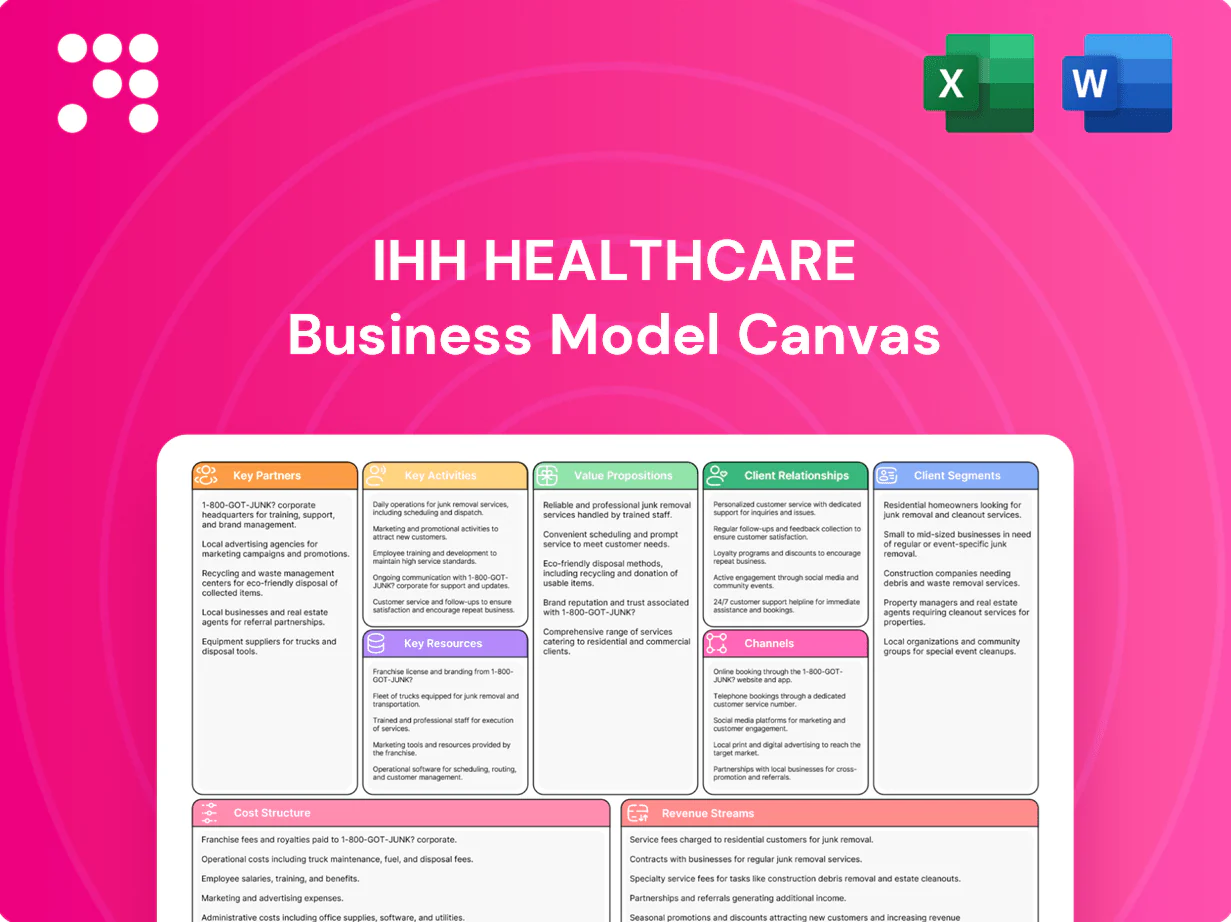
IHH Healthcare Business Model Canvas

Discover a leading healthcare group's Business Model Canvas: hospitals, clinics, insurers, services
Discover IHH Healthcare's Business Model Canvas — a concise breakdown of how the group creates value across hospitals, clinics, insurance partnerships and patient services. This snapshot highlights customer segments, key partners, revenue streams and cost drivers. Purchase the full, editable Canvas in Word/Excel for detailed insights, benchmarking and strategic use.
Partnerships

Insurers & TPAs
Partnerships with private insurers and TPAs expand covered patient access and stabilize demand, leveraging IHH’s presence in 10 countries and over 80 hospitals as of 2024. Contracting drives predictable volumes and negotiated tariffs across markets. Collaboration on care pathways and claims accelerates reimbursement and lowers friction. Joint wellness programs reduce claim ratios and improve outcomes.
Medtech & Pharma
Alliances with device makers and pharmaceutical firms give IHH access to cutting-edge therapies and equipment, supporting its network of over 80 hospitals across 10 countries. Co-development and on-site training drive safe adoption of new modalities, while value-based procurement and service contracts reduce downtime and capex variability. Clinical-trial partnerships expand treatment options for complex cases and strengthen referral pipelines.

Universities & R&D
Ties with medical schools support residency pipelines and clinician upskilling across IHH’s network of over 80 hospitals in 10 countries. Research collaborations enhance evidence-based practice and brand credibility through joint clinical studies. Shared labs and targeted grants accelerate innovation in oncology, cardiology and neurology via translational projects. Talent exchange programs strengthen subspecialty depth across the network.

Govt & Regulators
Engagement with health ministries ensures compliance, licensing and accreditation for IHH, which as of 2024 operates over 80 hospitals in 10 countries; regular regulatory alignment reduces shutdown and penalty risks. Public-private partnerships enable managed services and capacity expansion, supporting rapid bed and specialist growth in high-demand markets. Data-sharing on public health boosts preparedness and quality standards, while policy dialogue influences reimbursement rates and cross-border care frameworks.
- Regulatory alignment: reduces operational risk
- PPPs: scalable capacity and managed services
- Data-sharing: improved preparedness and outcomes
- Policy dialogue: shapes reimbursement and cross-border care
IT & Diagnostics Vendors
Strategic vendors deliver EHR, PACS, cybersecurity and interoperability solutions that underpin IHH's clinical platforms across 80+ hospitals in 10 countries (2024), while diagnostic partners scale lab capacity and standardize quality through centralized protocols. Managed services cut downtime and capex shocks via OPEX models and SLAs. Joint vendor-IHH roadmaps accelerate digital front door and telehealth rollouts.
- Networks: 80+ hospitals, 10 countries (2024)
- Tech: EHR, PACS, cybersecurity, interoperability
- Ops: managed services = OPEX smoothing, SLA-driven uptime
- Strategy: joint roadmaps for digital front door & telehealth
Partnerships secure 80+ hospitals in 10 countries, stabilizing volumes and enabling advanced care
Partnerships with insurers, device/pharma, academia, governments and tech vendors underpin IHH’s 80+ hospitals in 10 countries (2024), securing demand, advanced therapies, talent pipelines, regulatory access and digital continuity. Contracting stabilizes volumes; co-development cuts capex variability; academic ties feed specialists; PPPs enable rapid bed growth.
| Partner | Role | Impact (2024) |
|---|---|---|
| Insurers/TPAs | Coverage contracts | Stabilized volumes |
| Device/Pharma | Therapies/equipment | Faster adoption |
| Academia | Training/research | Pipeline hires |
What is included in the product
 Detailed Word Document
A comprehensive Business Model Canvas for IHH Healthcare detailing customer segments, channels, value propositions and the 9 BMC blocks with operational insights, competitive advantages, linked SWOT, and investor-ready narratives for strategic decisions.

 Customizable Excel Spreadsheet
High-level view of IHH Healthcare’s business model with editable cells to quickly identify and address pain points across patient care, operations, and partnerships.
Activities

Clinical Care
Providing end-to-end care from primary to tertiary services is core to IHH Healthcare, which operates in 10 countries with over 60 hospitals and tertiary centres worldwide.
Multidisciplinary teams deliver complex procedures and chronic disease management across specialties, supported by centralized training and credentialing.
Standardized clinical protocols and care pathways harmonize outcomes across sites, while continuous quality-improvement programs target reductions in variability and complications.
Specialty Programs
Centres of excellence in oncology, cardiology and neurology concentrate specialist manpower and advanced technology to standardise complex care. Multidisciplinary tumor boards and heart teams coordinate surgical, interventional and systemic therapies across sites. Outcome tracking and value reporting are integrated into electronic dashboards; IHH operates over 80 hospitals in 10 countries supporting consolidated specialty metrics. Subspecialty outreach strengthens referral pathways.

Quality & Safety
Accreditation, audits and clinical governance sustain standards across IHH’s network of over 80 hospitals in 10 countries, with many facilities holding international credentials such as JCI. Robust infection control, medication safety programs and incident-learning systems reduce clinical risk and drive downward trends in avoidable harm. Routine patient-reported outcomes feed service improvements while cross-region benchmarking accelerates best-practice adoption.

Digital Health
Operating telemedicine, remote monitoring and patient portals expanded access—telehealth stabilized near 15% of outpatient visits in 2024—while EHR integration ensures continuity and enables data-driven care. AI triage and imaging support can cut triage/imaging times by up to 30%. Cybersecurity and privacy management remain critical as healthcare breaches rose about 5% in 2024 to protect patient trust.
- Access: telehealth ~15% (2024)
- EHR: continuity + analytics
- AI: ≤30% faster triage/imaging
- Security: breaches +5% (2024)
Network Expansion
Integrated care across 80+ hospitals in 10 countries; telehealth ~15%, AI ≤30% faster
Providing end-to-end care across specialties through over 80 hospitals in 10 countries (2024) remains core, with centres of excellence concentrating complex procedures. Standardized protocols, accreditation and outcome dashboards drive quality improvement and cross-site benchmarking. Telehealth (~15% of outpatient visits, 2024), AI triage (≤30% faster) and cybersecurity (breaches +5% in 2024) enable scalable, data-driven care.
| Metric | 2024 |
|---|---|
| Hospitals | over 80 |
| Countries | 10 |
| Telehealth share | ~15% |
| AI triage/imaging | ≤30% faster |
| Cybersecurity trend | breaches +5% |
Preview Before You Purchase
Business Model Canvas
The document you're previewing is the actual IHH Healthcare Business Model Canvas, not a mockup or sample. After purchase you'll receive this identical, fully editable file with all sections included. It is delivered ready to download in Word and Excel formats for immediate use.

Discover a leading healthcare group's Business Model Canvas: hospitals, clinics, insurers, services
Discover IHH Healthcare's Business Model Canvas — a concise breakdown of how the group creates value across hospitals, clinics, insurance partnerships and patient services. This snapshot highlights customer segments, key partners, revenue streams and cost drivers. Purchase the full, editable Canvas in Word/Excel for detailed insights, benchmarking and strategic use.
Partnerships
Insurers & TPAs
Partnerships with private insurers and TPAs expand covered patient access and stabilize demand, leveraging IHH’s presence in 10 countries and over 80 hospitals as of 2024. Contracting drives predictable volumes and negotiated tariffs across markets. Collaboration on care pathways and claims accelerates reimbursement and lowers friction. Joint wellness programs reduce claim ratios and improve outcomes.
Medtech & Pharma
Alliances with device makers and pharmaceutical firms give IHH access to cutting-edge therapies and equipment, supporting its network of over 80 hospitals across 10 countries. Co-development and on-site training drive safe adoption of new modalities, while value-based procurement and service contracts reduce downtime and capex variability. Clinical-trial partnerships expand treatment options for complex cases and strengthen referral pipelines.
Universities & R&D
Ties with medical schools support residency pipelines and clinician upskilling across IHH’s network of over 80 hospitals in 10 countries. Research collaborations enhance evidence-based practice and brand credibility through joint clinical studies. Shared labs and targeted grants accelerate innovation in oncology, cardiology and neurology via translational projects. Talent exchange programs strengthen subspecialty depth across the network.
Govt & Regulators
Engagement with health ministries ensures compliance, licensing and accreditation for IHH, which as of 2024 operates over 80 hospitals in 10 countries; regular regulatory alignment reduces shutdown and penalty risks. Public-private partnerships enable managed services and capacity expansion, supporting rapid bed and specialist growth in high-demand markets. Data-sharing on public health boosts preparedness and quality standards, while policy dialogue influences reimbursement rates and cross-border care frameworks.
- Regulatory alignment: reduces operational risk
- PPPs: scalable capacity and managed services
- Data-sharing: improved preparedness and outcomes
- Policy dialogue: shapes reimbursement and cross-border care
IT & Diagnostics Vendors
Strategic vendors deliver EHR, PACS, cybersecurity and interoperability solutions that underpin IHH's clinical platforms across 80+ hospitals in 10 countries (2024), while diagnostic partners scale lab capacity and standardize quality through centralized protocols. Managed services cut downtime and capex shocks via OPEX models and SLAs. Joint vendor-IHH roadmaps accelerate digital front door and telehealth rollouts.
- Networks: 80+ hospitals, 10 countries (2024)
- Tech: EHR, PACS, cybersecurity, interoperability
- Ops: managed services = OPEX smoothing, SLA-driven uptime
- Strategy: joint roadmaps for digital front door & telehealth
Partnerships secure 80+ hospitals in 10 countries, stabilizing volumes and enabling advanced care
Partnerships with insurers, device/pharma, academia, governments and tech vendors underpin IHH’s 80+ hospitals in 10 countries (2024), securing demand, advanced therapies, talent pipelines, regulatory access and digital continuity. Contracting stabilizes volumes; co-development cuts capex variability; academic ties feed specialists; PPPs enable rapid bed growth.
| Partner | Role | Impact (2024) |
|---|---|---|
| Insurers/TPAs | Coverage contracts | Stabilized volumes |
| Device/Pharma | Therapies/equipment | Faster adoption |
| Academia | Training/research | Pipeline hires |
What is included in the product
Detailed Word Document
A comprehensive Business Model Canvas for IHH Healthcare detailing customer segments, channels, value propositions and the 9 BMC blocks with operational insights, competitive advantages, linked SWOT, and investor-ready narratives for strategic decisions.
Customizable Excel Spreadsheet
High-level view of IHH Healthcare’s business model with editable cells to quickly identify and address pain points across patient care, operations, and partnerships.
Activities
Clinical Care
Providing end-to-end care from primary to tertiary services is core to IHH Healthcare, which operates in 10 countries with over 60 hospitals and tertiary centres worldwide.
Multidisciplinary teams deliver complex procedures and chronic disease management across specialties, supported by centralized training and credentialing.
Standardized clinical protocols and care pathways harmonize outcomes across sites, while continuous quality-improvement programs target reductions in variability and complications.
Specialty Programs
Centres of excellence in oncology, cardiology and neurology concentrate specialist manpower and advanced technology to standardise complex care. Multidisciplinary tumor boards and heart teams coordinate surgical, interventional and systemic therapies across sites. Outcome tracking and value reporting are integrated into electronic dashboards; IHH operates over 80 hospitals in 10 countries supporting consolidated specialty metrics. Subspecialty outreach strengthens referral pathways.
Quality & Safety
Accreditation, audits and clinical governance sustain standards across IHH’s network of over 80 hospitals in 10 countries, with many facilities holding international credentials such as JCI. Robust infection control, medication safety programs and incident-learning systems reduce clinical risk and drive downward trends in avoidable harm. Routine patient-reported outcomes feed service improvements while cross-region benchmarking accelerates best-practice adoption.
Digital Health
Operating telemedicine, remote monitoring and patient portals expanded access—telehealth stabilized near 15% of outpatient visits in 2024—while EHR integration ensures continuity and enables data-driven care. AI triage and imaging support can cut triage/imaging times by up to 30%. Cybersecurity and privacy management remain critical as healthcare breaches rose about 5% in 2024 to protect patient trust.
- Access: telehealth ~15% (2024)
- EHR: continuity + analytics
- AI: ≤30% faster triage/imaging
- Security: breaches +5% (2024)
Network Expansion
Integrated care across 80+ hospitals in 10 countries; telehealth ~15%, AI ≤30% faster
Providing end-to-end care across specialties through over 80 hospitals in 10 countries (2024) remains core, with centres of excellence concentrating complex procedures. Standardized protocols, accreditation and outcome dashboards drive quality improvement and cross-site benchmarking. Telehealth (~15% of outpatient visits, 2024), AI triage (≤30% faster) and cybersecurity (breaches +5% in 2024) enable scalable, data-driven care.
| Metric | 2024 |
|---|---|
| Hospitals | over 80 |
| Countries | 10 |
| Telehealth share | ~15% |
| AI triage/imaging | ≤30% faster |
| Cybersecurity trend | breaches +5% |
Preview Before You Purchase
Business Model Canvas
The document you're previewing is the actual IHH Healthcare Business Model Canvas, not a mockup or sample. After purchase you'll receive this identical, fully editable file with all sections included. It is delivered ready to download in Word and Excel formats for immediate use.
Description
Discover a leading healthcare group's Business Model Canvas: hospitals, clinics, insurers, services
Discover IHH Healthcare's Business Model Canvas — a concise breakdown of how the group creates value across hospitals, clinics, insurance partnerships and patient services. This snapshot highlights customer segments, key partners, revenue streams and cost drivers. Purchase the full, editable Canvas in Word/Excel for detailed insights, benchmarking and strategic use.
Partnerships
Insurers & TPAs
Partnerships with private insurers and TPAs expand covered patient access and stabilize demand, leveraging IHH’s presence in 10 countries and over 80 hospitals as of 2024. Contracting drives predictable volumes and negotiated tariffs across markets. Collaboration on care pathways and claims accelerates reimbursement and lowers friction. Joint wellness programs reduce claim ratios and improve outcomes.
Medtech & Pharma
Alliances with device makers and pharmaceutical firms give IHH access to cutting-edge therapies and equipment, supporting its network of over 80 hospitals across 10 countries. Co-development and on-site training drive safe adoption of new modalities, while value-based procurement and service contracts reduce downtime and capex variability. Clinical-trial partnerships expand treatment options for complex cases and strengthen referral pipelines.
Universities & R&D
Ties with medical schools support residency pipelines and clinician upskilling across IHH’s network of over 80 hospitals in 10 countries. Research collaborations enhance evidence-based practice and brand credibility through joint clinical studies. Shared labs and targeted grants accelerate innovation in oncology, cardiology and neurology via translational projects. Talent exchange programs strengthen subspecialty depth across the network.
Govt & Regulators
Engagement with health ministries ensures compliance, licensing and accreditation for IHH, which as of 2024 operates over 80 hospitals in 10 countries; regular regulatory alignment reduces shutdown and penalty risks. Public-private partnerships enable managed services and capacity expansion, supporting rapid bed and specialist growth in high-demand markets. Data-sharing on public health boosts preparedness and quality standards, while policy dialogue influences reimbursement rates and cross-border care frameworks.
- Regulatory alignment: reduces operational risk
- PPPs: scalable capacity and managed services
- Data-sharing: improved preparedness and outcomes
- Policy dialogue: shapes reimbursement and cross-border care
IT & Diagnostics Vendors
Strategic vendors deliver EHR, PACS, cybersecurity and interoperability solutions that underpin IHH's clinical platforms across 80+ hospitals in 10 countries (2024), while diagnostic partners scale lab capacity and standardize quality through centralized protocols. Managed services cut downtime and capex shocks via OPEX models and SLAs. Joint vendor-IHH roadmaps accelerate digital front door and telehealth rollouts.
- Networks: 80+ hospitals, 10 countries (2024)
- Tech: EHR, PACS, cybersecurity, interoperability
- Ops: managed services = OPEX smoothing, SLA-driven uptime
- Strategy: joint roadmaps for digital front door & telehealth
Partnerships secure 80+ hospitals in 10 countries, stabilizing volumes and enabling advanced care
Partnerships with insurers, device/pharma, academia, governments and tech vendors underpin IHH’s 80+ hospitals in 10 countries (2024), securing demand, advanced therapies, talent pipelines, regulatory access and digital continuity. Contracting stabilizes volumes; co-development cuts capex variability; academic ties feed specialists; PPPs enable rapid bed growth.
| Partner | Role | Impact (2024) |
|---|---|---|
| Insurers/TPAs | Coverage contracts | Stabilized volumes |
| Device/Pharma | Therapies/equipment | Faster adoption |
| Academia | Training/research | Pipeline hires |
What is included in the product
Detailed Word Document
A comprehensive Business Model Canvas for IHH Healthcare detailing customer segments, channels, value propositions and the 9 BMC blocks with operational insights, competitive advantages, linked SWOT, and investor-ready narratives for strategic decisions.
Customizable Excel Spreadsheet
High-level view of IHH Healthcare’s business model with editable cells to quickly identify and address pain points across patient care, operations, and partnerships.
Activities
Clinical Care
Providing end-to-end care from primary to tertiary services is core to IHH Healthcare, which operates in 10 countries with over 60 hospitals and tertiary centres worldwide.
Multidisciplinary teams deliver complex procedures and chronic disease management across specialties, supported by centralized training and credentialing.
Standardized clinical protocols and care pathways harmonize outcomes across sites, while continuous quality-improvement programs target reductions in variability and complications.
Specialty Programs
Centres of excellence in oncology, cardiology and neurology concentrate specialist manpower and advanced technology to standardise complex care. Multidisciplinary tumor boards and heart teams coordinate surgical, interventional and systemic therapies across sites. Outcome tracking and value reporting are integrated into electronic dashboards; IHH operates over 80 hospitals in 10 countries supporting consolidated specialty metrics. Subspecialty outreach strengthens referral pathways.
Quality & Safety
Accreditation, audits and clinical governance sustain standards across IHH’s network of over 80 hospitals in 10 countries, with many facilities holding international credentials such as JCI. Robust infection control, medication safety programs and incident-learning systems reduce clinical risk and drive downward trends in avoidable harm. Routine patient-reported outcomes feed service improvements while cross-region benchmarking accelerates best-practice adoption.
Digital Health
Operating telemedicine, remote monitoring and patient portals expanded access—telehealth stabilized near 15% of outpatient visits in 2024—while EHR integration ensures continuity and enables data-driven care. AI triage and imaging support can cut triage/imaging times by up to 30%. Cybersecurity and privacy management remain critical as healthcare breaches rose about 5% in 2024 to protect patient trust.
- Access: telehealth ~15% (2024)
- EHR: continuity + analytics
- AI: ≤30% faster triage/imaging
- Security: breaches +5% (2024)
Network Expansion
Integrated care across 80+ hospitals in 10 countries; telehealth ~15%, AI ≤30% faster
Providing end-to-end care across specialties through over 80 hospitals in 10 countries (2024) remains core, with centres of excellence concentrating complex procedures. Standardized protocols, accreditation and outcome dashboards drive quality improvement and cross-site benchmarking. Telehealth (~15% of outpatient visits, 2024), AI triage (≤30% faster) and cybersecurity (breaches +5% in 2024) enable scalable, data-driven care.
| Metric | 2024 |
|---|---|
| Hospitals | over 80 |
| Countries | 10 |
| Telehealth share | ~15% |
| AI triage/imaging | ≤30% faster |
| Cybersecurity trend | breaches +5% |
Preview Before You Purchase
Business Model Canvas
The document you're previewing is the actual IHH Healthcare Business Model Canvas, not a mockup or sample. After purchase you'll receive this identical, fully editable file with all sections included. It is delivered ready to download in Word and Excel formats for immediate use.











