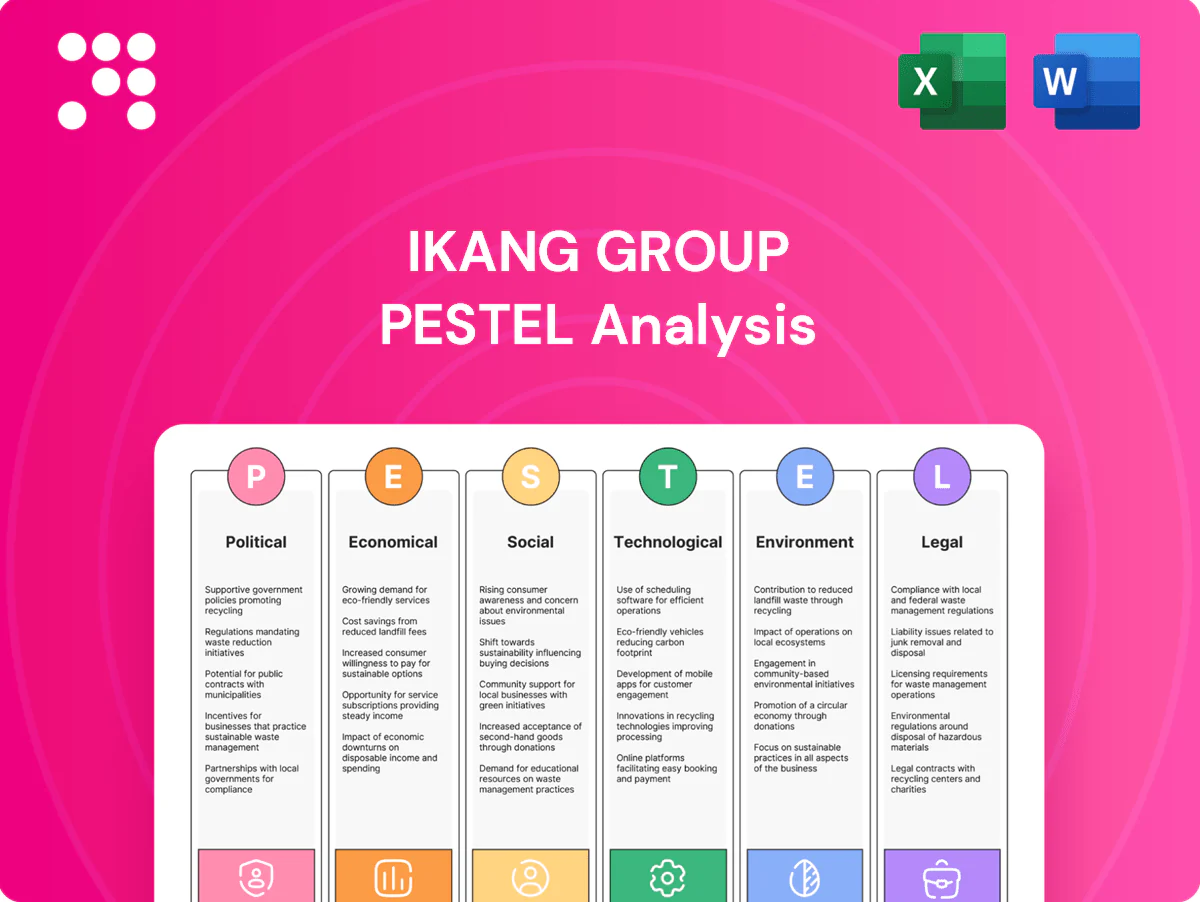
iKang Group PESTLE Analysis

Skip the Research. Get the Strategy.
Discover how political shifts, economic trends, social behavior, technological advances, legal changes and environmental risks are shaping iKang Group’s future in our concise PESTLE snapshot. Ideal for investors and strategists, this analysis reveals actionable risks and opportunities. Purchase the full report to access detailed insights and ready-to-use recommendations.
Political factors

Healthcare reform and NHC directives
China’s National Health Commission (NHC) sets preventive care and screening norms that directly shape iKang’s service menu across a population of about 1.41 billion, with basic medical insurance covering over 95% of residents. Periodic NHC reforms can reallocate emphasis between public and private provision, altering referral flows and revenue mix. Compliance with national screening guidelines is essential for legitimacy and government contracts, while policy shifts may force rapid protocol updates and staff retraining.
Public–private partnerships and local approvals
City-level health bureaus in China’s 333 prefecture-level cities control licensing, expansion permits and PPP opportunities for corporate checkups. Relationships with municipal authorities directly influence center siting and capacity quotas. Regional disparities in policy enforcement create uneven growth. Proactive government engagement mitigates approval delays and political risk.

Industrial policy and “Healthy China 2030”
Healthy China 2030, issued by the State Council in 2016, prioritizes early detection and chronic disease management, structurally favoring preventive firms such as iKang.
Central and local pilot programs have expanded subsidies and pilots for cancer screening and digital health, typically requiring demonstrable population health outcomes to qualify.
Policy alignment can unlock public procurement and employer-backed programs across China’s ~1.41 billion population, where noncommunicable diseases account for roughly 88% of deaths.

Geopolitical climate and supply chain security
Geopolitical frictions since 2022 have raised import risks for imaging equipment and reagents, with China still sourcing a majority of high-end imaging devices from foreign firms (roughly 60–70% market share for high-end MRI/CT as of 2024), prompting iKang to face sourcing delays and cost pressure. Policies encouraging domestic substitutes — bolstered by 2024 procurement guidelines — may shift vendor mixes and unit costs. Contingency stockpiles and multi-vendor strategies (already used by leading chains) lower disruption risk, while transparent customs and certification timelines are now a political necessity for capital planning.
- Import exposure: ~60–70% high-end imaging foreign-sourced
- Policy shift: 2024 procurement favoring domestic alternatives
- Mitigation: contingency stock + multi-vendor sourcing
- Priority: visibility into customs/certification timelines
Regional health spending priorities
Provincial budgets and cadre targets in 2024 continue to steer funding toward prioritized diseases and cohorts, channeling capital and patient referrals to designated screening and chronic-care programs and making tier-2/3 expansion attractive where rural screening incentives exist. Shifting local priorities can reallocate corporate wellness budgets away from third-party providers, so active participation in provincial pilots secures early-mover placement and higher reimbursement corridors.
- Provincial targets: focus funds on prioritized disease cohorts
- Rural incentives: drive tier-2/3 screening expansion
- Corporate wellness: vulnerable to local reallocation
- Provincial pilots: early participation = reimbursement advantage
Healthy China 2030 drives preventive care, domestic imaging uptake and subsidies
China’s NHC policies and Healthy China 2030 prioritize preventive care and chronic disease screening, shaping iKang’s service mix across ~1.41bn people with >95% basic insurance coverage. Local health bureaus and provincial targets drive licensing, funding and referrals, while 2024 procurement favors domestic imaging amid 60–70% foreign share of high-end MRI/CT. Active participation in pilots secures subsidies and reimbursement advantages.
| Metric | Value |
|---|---|
| Population | 1.41bn |
| Insurance coverage | >95% |
| NCD death share | ~88% |
| High-end imaging foreign share (2024) | 60–70% |
What is included in the product
 Detailed Word Document
Explores how Political, Economic, Social, Technological, Environmental and Legal forces uniquely affect iKang Group, with data-backed trends and sector-specific examples to identify risks and opportunities; designed for executives and investors seeking forward-looking, insert-ready insights for strategy and funding decisions.

 Customizable Excel Spreadsheet
Visually segmented by PESTEL categories, the iKang Group PESTLE summary delivers a concise, shareable snapshot to speed risk discussions and align teams during planning sessions.
Economic factors

Corporate wellness demand cycles
Employer-paid checkups remain the primary volume driver for iKang, tracking closely with hiring cycles and HR budgets; in 2024–25 peak recruitment periods produced notable upticks in bookings while slowdowns saw package downgrades and fewer add‑ons that compressed margins. In expansions, upselling advanced imaging and genetic screens raised ARPU materially. Diversifying client mix across SMEs, SOEs and insurers stabilizes revenue through cycles.
Disposable income and consumer upgrades
Rising middle-class incomes (per capita disposable income up about 5.2% in 2024 per NBS) support uptake of premium preventive packages, while price sensitivity in lower-tier cities keeps demand concentrated in basic bundles and exam packages with penetration under 20%. Tiered pricing, point-of-care financing and installment plans (consumer credit up ~18% YoY in 2024) can unlock latent demand. With GDP growth easing to ~4.5% in 2024, tactical promotions and timed subsidies are needed to sustain throughput.

Insurance penetration and reimbursement
Commercial health insurance premiums in China topped RMB 1 trillion in 2023, and riders increasingly reimburse screenings, lifting demand for preventive services. Inclusion on insurer networks materially boosts footfall and cash conversion, with the physical exam market already exceeding RMB 300 billion in 2023. Negotiated rates can compress yields unless packages are carefully designed, while partnerships with insuretechs enable scalable bundled preventive plans and faster claims settlement.

Cost inflation in labor and equipment
Cost inflation in clinician wages and scarce radiology talent have raised iKang's operating costs, with 2024 industry reports citing tightening clinical labor markets and upward pressure on specialist pay. Imaging equipment depreciation and rising maintenance contracts compress unit economics as capital intensity remains high. Centralized procurement, utilization optimization, lean scheduling and throughput analytics improved per-room ROI in 2024 implementations.
- Clinician wage pressure: 2024 industry tightening
- Equipment costs: higher depreciation & maintenance burden
- Mitigants: centralized purchasing, utilization optimization
- Efficiency: lean scheduling + throughput analytics lift ROI
Competitive intensity and consolidation
Private chains, hospitals and boutique clinics compete on convenience and brand, driving intense rivalry in metros where price wars have compressed margins by an estimated 5–10 percentage points; consolidation via M&A is used to secure location density and employer contracts. iKang counters commoditization by differentiating with specialty screening programs and higher service quality, improving retention and ASPs.
- Competition: convenience + brand
- Margin pressure: -5–10 pp in saturated metros
- M&A: secures sites & corporate contracts
- Differentiation: specialty screening & service quality
Healthy China 2030 drives preventive care, domestic imaging uptake and subsidies
Employer-paid checkups drive volume and seasonality; upsells raise ARPU but package downgrades occur in hiring slowdowns. Per capita disposable income rose ~5.2% in 2024 supporting premium uptake while GDP growth eased to ~4.5% in 2024. Commercial health premiums exceeded RMB1.0tn in 2023 and the physical exam market topped RMB300bn, but clinician wage and equipment cost inflation compress margins.
| Metric | Value |
|---|---|
| GDP growth (2024) | ~4.5% |
| Disposable income (2024) | +5.2% |
| Commercial premiums (2023) | RMB1.0tn+ |
| Exam market (2023) | RMB300bn |
| Consumer credit (2024) | +18% YoY |
Same Document Delivered
iKang Group PESTLE Analysis
The iKang Group PESTLE Analysis provides a concise review of political, economic, social, technological, legal, and environmental factors affecting the company, and the preview shown here is the exact document you’ll receive after purchase—fully formatted and ready to use. No placeholders, no teasers; this is the final, downloadable file.

Skip the Research. Get the Strategy.
Discover how political shifts, economic trends, social behavior, technological advances, legal changes and environmental risks are shaping iKang Group’s future in our concise PESTLE snapshot. Ideal for investors and strategists, this analysis reveals actionable risks and opportunities. Purchase the full report to access detailed insights and ready-to-use recommendations.
Political factors
Healthcare reform and NHC directives
China’s National Health Commission (NHC) sets preventive care and screening norms that directly shape iKang’s service menu across a population of about 1.41 billion, with basic medical insurance covering over 95% of residents. Periodic NHC reforms can reallocate emphasis between public and private provision, altering referral flows and revenue mix. Compliance with national screening guidelines is essential for legitimacy and government contracts, while policy shifts may force rapid protocol updates and staff retraining.
Public–private partnerships and local approvals
City-level health bureaus in China’s 333 prefecture-level cities control licensing, expansion permits and PPP opportunities for corporate checkups. Relationships with municipal authorities directly influence center siting and capacity quotas. Regional disparities in policy enforcement create uneven growth. Proactive government engagement mitigates approval delays and political risk.
Industrial policy and “Healthy China 2030”
Healthy China 2030, issued by the State Council in 2016, prioritizes early detection and chronic disease management, structurally favoring preventive firms such as iKang.
Central and local pilot programs have expanded subsidies and pilots for cancer screening and digital health, typically requiring demonstrable population health outcomes to qualify.
Policy alignment can unlock public procurement and employer-backed programs across China’s ~1.41 billion population, where noncommunicable diseases account for roughly 88% of deaths.
Geopolitical climate and supply chain security
Geopolitical frictions since 2022 have raised import risks for imaging equipment and reagents, with China still sourcing a majority of high-end imaging devices from foreign firms (roughly 60–70% market share for high-end MRI/CT as of 2024), prompting iKang to face sourcing delays and cost pressure. Policies encouraging domestic substitutes — bolstered by 2024 procurement guidelines — may shift vendor mixes and unit costs. Contingency stockpiles and multi-vendor strategies (already used by leading chains) lower disruption risk, while transparent customs and certification timelines are now a political necessity for capital planning.
- Import exposure: ~60–70% high-end imaging foreign-sourced
- Policy shift: 2024 procurement favoring domestic alternatives
- Mitigation: contingency stock + multi-vendor sourcing
- Priority: visibility into customs/certification timelines
Regional health spending priorities
Provincial budgets and cadre targets in 2024 continue to steer funding toward prioritized diseases and cohorts, channeling capital and patient referrals to designated screening and chronic-care programs and making tier-2/3 expansion attractive where rural screening incentives exist. Shifting local priorities can reallocate corporate wellness budgets away from third-party providers, so active participation in provincial pilots secures early-mover placement and higher reimbursement corridors.
- Provincial targets: focus funds on prioritized disease cohorts
- Rural incentives: drive tier-2/3 screening expansion
- Corporate wellness: vulnerable to local reallocation
- Provincial pilots: early participation = reimbursement advantage
Healthy China 2030 drives preventive care, domestic imaging uptake and subsidies
China’s NHC policies and Healthy China 2030 prioritize preventive care and chronic disease screening, shaping iKang’s service mix across ~1.41bn people with >95% basic insurance coverage. Local health bureaus and provincial targets drive licensing, funding and referrals, while 2024 procurement favors domestic imaging amid 60–70% foreign share of high-end MRI/CT. Active participation in pilots secures subsidies and reimbursement advantages.
| Metric | Value |
|---|---|
| Population | 1.41bn |
| Insurance coverage | >95% |
| NCD death share | ~88% |
| High-end imaging foreign share (2024) | 60–70% |
What is included in the product
Detailed Word Document
Explores how Political, Economic, Social, Technological, Environmental and Legal forces uniquely affect iKang Group, with data-backed trends and sector-specific examples to identify risks and opportunities; designed for executives and investors seeking forward-looking, insert-ready insights for strategy and funding decisions.
Customizable Excel Spreadsheet
Visually segmented by PESTEL categories, the iKang Group PESTLE summary delivers a concise, shareable snapshot to speed risk discussions and align teams during planning sessions.
Economic factors
Corporate wellness demand cycles
Employer-paid checkups remain the primary volume driver for iKang, tracking closely with hiring cycles and HR budgets; in 2024–25 peak recruitment periods produced notable upticks in bookings while slowdowns saw package downgrades and fewer add‑ons that compressed margins. In expansions, upselling advanced imaging and genetic screens raised ARPU materially. Diversifying client mix across SMEs, SOEs and insurers stabilizes revenue through cycles.
Disposable income and consumer upgrades
Rising middle-class incomes (per capita disposable income up about 5.2% in 2024 per NBS) support uptake of premium preventive packages, while price sensitivity in lower-tier cities keeps demand concentrated in basic bundles and exam packages with penetration under 20%. Tiered pricing, point-of-care financing and installment plans (consumer credit up ~18% YoY in 2024) can unlock latent demand. With GDP growth easing to ~4.5% in 2024, tactical promotions and timed subsidies are needed to sustain throughput.
Insurance penetration and reimbursement
Commercial health insurance premiums in China topped RMB 1 trillion in 2023, and riders increasingly reimburse screenings, lifting demand for preventive services. Inclusion on insurer networks materially boosts footfall and cash conversion, with the physical exam market already exceeding RMB 300 billion in 2023. Negotiated rates can compress yields unless packages are carefully designed, while partnerships with insuretechs enable scalable bundled preventive plans and faster claims settlement.
Cost inflation in labor and equipment
Cost inflation in clinician wages and scarce radiology talent have raised iKang's operating costs, with 2024 industry reports citing tightening clinical labor markets and upward pressure on specialist pay. Imaging equipment depreciation and rising maintenance contracts compress unit economics as capital intensity remains high. Centralized procurement, utilization optimization, lean scheduling and throughput analytics improved per-room ROI in 2024 implementations.
- Clinician wage pressure: 2024 industry tightening
- Equipment costs: higher depreciation & maintenance burden
- Mitigants: centralized purchasing, utilization optimization
- Efficiency: lean scheduling + throughput analytics lift ROI
Competitive intensity and consolidation
Private chains, hospitals and boutique clinics compete on convenience and brand, driving intense rivalry in metros where price wars have compressed margins by an estimated 5–10 percentage points; consolidation via M&A is used to secure location density and employer contracts. iKang counters commoditization by differentiating with specialty screening programs and higher service quality, improving retention and ASPs.
- Competition: convenience + brand
- Margin pressure: -5–10 pp in saturated metros
- M&A: secures sites & corporate contracts
- Differentiation: specialty screening & service quality
Healthy China 2030 drives preventive care, domestic imaging uptake and subsidies
Employer-paid checkups drive volume and seasonality; upsells raise ARPU but package downgrades occur in hiring slowdowns. Per capita disposable income rose ~5.2% in 2024 supporting premium uptake while GDP growth eased to ~4.5% in 2024. Commercial health premiums exceeded RMB1.0tn in 2023 and the physical exam market topped RMB300bn, but clinician wage and equipment cost inflation compress margins.
| Metric | Value |
|---|---|
| GDP growth (2024) | ~4.5% |
| Disposable income (2024) | +5.2% |
| Commercial premiums (2023) | RMB1.0tn+ |
| Exam market (2023) | RMB300bn |
| Consumer credit (2024) | +18% YoY |
Same Document Delivered
iKang Group PESTLE Analysis
The iKang Group PESTLE Analysis provides a concise review of political, economic, social, technological, legal, and environmental factors affecting the company, and the preview shown here is the exact document you’ll receive after purchase—fully formatted and ready to use. No placeholders, no teasers; this is the final, downloadable file.
Original: $10.00
-65%$10.00
$3.50Description
Skip the Research. Get the Strategy.
Discover how political shifts, economic trends, social behavior, technological advances, legal changes and environmental risks are shaping iKang Group’s future in our concise PESTLE snapshot. Ideal for investors and strategists, this analysis reveals actionable risks and opportunities. Purchase the full report to access detailed insights and ready-to-use recommendations.
Political factors
Healthcare reform and NHC directives
China’s National Health Commission (NHC) sets preventive care and screening norms that directly shape iKang’s service menu across a population of about 1.41 billion, with basic medical insurance covering over 95% of residents. Periodic NHC reforms can reallocate emphasis between public and private provision, altering referral flows and revenue mix. Compliance with national screening guidelines is essential for legitimacy and government contracts, while policy shifts may force rapid protocol updates and staff retraining.
Public–private partnerships and local approvals
City-level health bureaus in China’s 333 prefecture-level cities control licensing, expansion permits and PPP opportunities for corporate checkups. Relationships with municipal authorities directly influence center siting and capacity quotas. Regional disparities in policy enforcement create uneven growth. Proactive government engagement mitigates approval delays and political risk.
Industrial policy and “Healthy China 2030”
Healthy China 2030, issued by the State Council in 2016, prioritizes early detection and chronic disease management, structurally favoring preventive firms such as iKang.
Central and local pilot programs have expanded subsidies and pilots for cancer screening and digital health, typically requiring demonstrable population health outcomes to qualify.
Policy alignment can unlock public procurement and employer-backed programs across China’s ~1.41 billion population, where noncommunicable diseases account for roughly 88% of deaths.
Geopolitical climate and supply chain security
Geopolitical frictions since 2022 have raised import risks for imaging equipment and reagents, with China still sourcing a majority of high-end imaging devices from foreign firms (roughly 60–70% market share for high-end MRI/CT as of 2024), prompting iKang to face sourcing delays and cost pressure. Policies encouraging domestic substitutes — bolstered by 2024 procurement guidelines — may shift vendor mixes and unit costs. Contingency stockpiles and multi-vendor strategies (already used by leading chains) lower disruption risk, while transparent customs and certification timelines are now a political necessity for capital planning.
- Import exposure: ~60–70% high-end imaging foreign-sourced
- Policy shift: 2024 procurement favoring domestic alternatives
- Mitigation: contingency stock + multi-vendor sourcing
- Priority: visibility into customs/certification timelines
Regional health spending priorities
Provincial budgets and cadre targets in 2024 continue to steer funding toward prioritized diseases and cohorts, channeling capital and patient referrals to designated screening and chronic-care programs and making tier-2/3 expansion attractive where rural screening incentives exist. Shifting local priorities can reallocate corporate wellness budgets away from third-party providers, so active participation in provincial pilots secures early-mover placement and higher reimbursement corridors.
- Provincial targets: focus funds on prioritized disease cohorts
- Rural incentives: drive tier-2/3 screening expansion
- Corporate wellness: vulnerable to local reallocation
- Provincial pilots: early participation = reimbursement advantage
Healthy China 2030 drives preventive care, domestic imaging uptake and subsidies
China’s NHC policies and Healthy China 2030 prioritize preventive care and chronic disease screening, shaping iKang’s service mix across ~1.41bn people with >95% basic insurance coverage. Local health bureaus and provincial targets drive licensing, funding and referrals, while 2024 procurement favors domestic imaging amid 60–70% foreign share of high-end MRI/CT. Active participation in pilots secures subsidies and reimbursement advantages.
| Metric | Value |
|---|---|
| Population | 1.41bn |
| Insurance coverage | >95% |
| NCD death share | ~88% |
| High-end imaging foreign share (2024) | 60–70% |
What is included in the product
Detailed Word Document
Explores how Political, Economic, Social, Technological, Environmental and Legal forces uniquely affect iKang Group, with data-backed trends and sector-specific examples to identify risks and opportunities; designed for executives and investors seeking forward-looking, insert-ready insights for strategy and funding decisions.
Customizable Excel Spreadsheet
Visually segmented by PESTEL categories, the iKang Group PESTLE summary delivers a concise, shareable snapshot to speed risk discussions and align teams during planning sessions.
Economic factors
Corporate wellness demand cycles
Employer-paid checkups remain the primary volume driver for iKang, tracking closely with hiring cycles and HR budgets; in 2024–25 peak recruitment periods produced notable upticks in bookings while slowdowns saw package downgrades and fewer add‑ons that compressed margins. In expansions, upselling advanced imaging and genetic screens raised ARPU materially. Diversifying client mix across SMEs, SOEs and insurers stabilizes revenue through cycles.
Disposable income and consumer upgrades
Rising middle-class incomes (per capita disposable income up about 5.2% in 2024 per NBS) support uptake of premium preventive packages, while price sensitivity in lower-tier cities keeps demand concentrated in basic bundles and exam packages with penetration under 20%. Tiered pricing, point-of-care financing and installment plans (consumer credit up ~18% YoY in 2024) can unlock latent demand. With GDP growth easing to ~4.5% in 2024, tactical promotions and timed subsidies are needed to sustain throughput.
Insurance penetration and reimbursement
Commercial health insurance premiums in China topped RMB 1 trillion in 2023, and riders increasingly reimburse screenings, lifting demand for preventive services. Inclusion on insurer networks materially boosts footfall and cash conversion, with the physical exam market already exceeding RMB 300 billion in 2023. Negotiated rates can compress yields unless packages are carefully designed, while partnerships with insuretechs enable scalable bundled preventive plans and faster claims settlement.
Cost inflation in labor and equipment
Cost inflation in clinician wages and scarce radiology talent have raised iKang's operating costs, with 2024 industry reports citing tightening clinical labor markets and upward pressure on specialist pay. Imaging equipment depreciation and rising maintenance contracts compress unit economics as capital intensity remains high. Centralized procurement, utilization optimization, lean scheduling and throughput analytics improved per-room ROI in 2024 implementations.
- Clinician wage pressure: 2024 industry tightening
- Equipment costs: higher depreciation & maintenance burden
- Mitigants: centralized purchasing, utilization optimization
- Efficiency: lean scheduling + throughput analytics lift ROI
Competitive intensity and consolidation
Private chains, hospitals and boutique clinics compete on convenience and brand, driving intense rivalry in metros where price wars have compressed margins by an estimated 5–10 percentage points; consolidation via M&A is used to secure location density and employer contracts. iKang counters commoditization by differentiating with specialty screening programs and higher service quality, improving retention and ASPs.
- Competition: convenience + brand
- Margin pressure: -5–10 pp in saturated metros
- M&A: secures sites & corporate contracts
- Differentiation: specialty screening & service quality
Healthy China 2030 drives preventive care, domestic imaging uptake and subsidies
Employer-paid checkups drive volume and seasonality; upsells raise ARPU but package downgrades occur in hiring slowdowns. Per capita disposable income rose ~5.2% in 2024 supporting premium uptake while GDP growth eased to ~4.5% in 2024. Commercial health premiums exceeded RMB1.0tn in 2023 and the physical exam market topped RMB300bn, but clinician wage and equipment cost inflation compress margins.
| Metric | Value |
|---|---|
| GDP growth (2024) | ~4.5% |
| Disposable income (2024) | +5.2% |
| Commercial premiums (2023) | RMB1.0tn+ |
| Exam market (2023) | RMB300bn |
| Consumer credit (2024) | +18% YoY |
Same Document Delivered
iKang Group PESTLE Analysis
The iKang Group PESTLE Analysis provides a concise review of political, economic, social, technological, legal, and environmental factors affecting the company, and the preview shown here is the exact document you’ll receive after purchase—fully formatted and ready to use. No placeholders, no teasers; this is the final, downloadable file.











