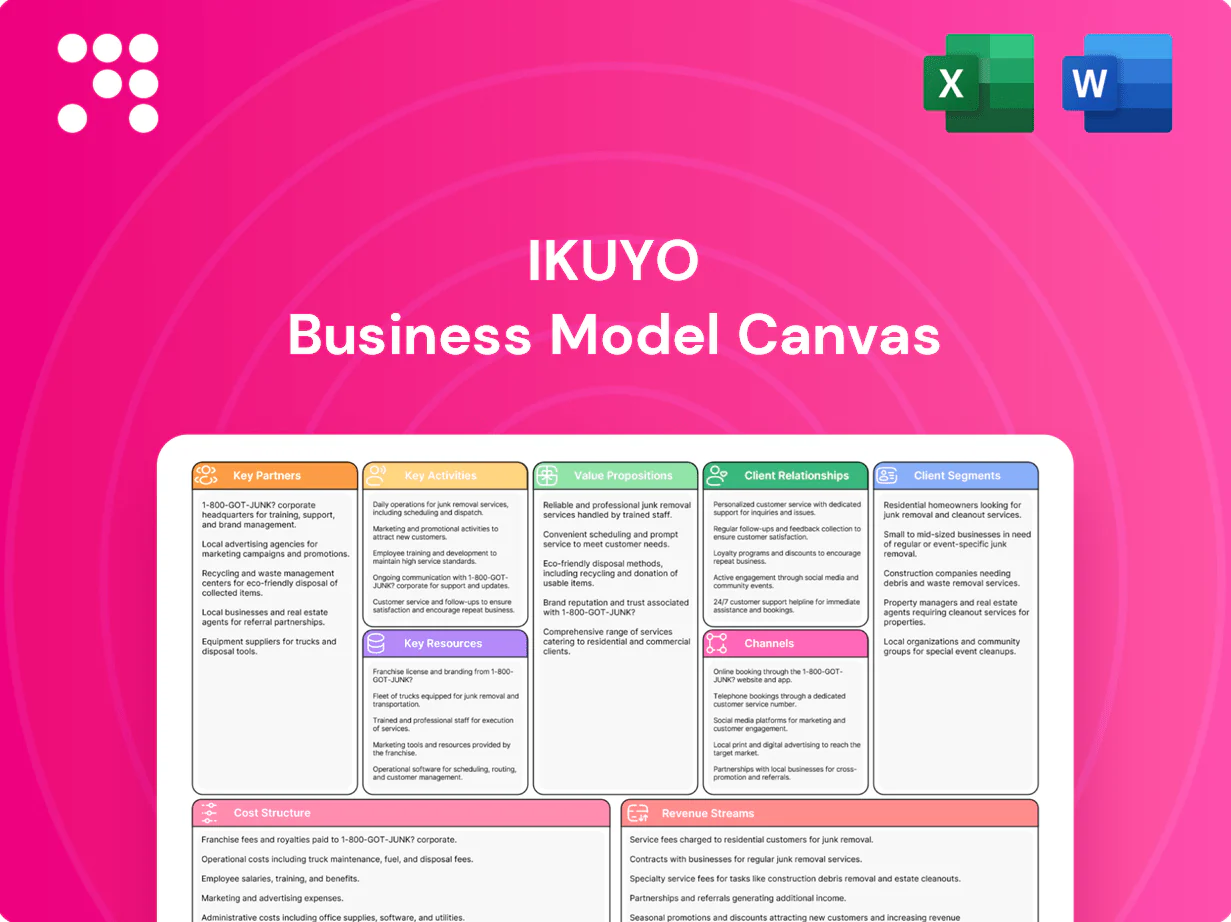
Ikuyo Business Model Canvas

Strategic Business Model Canvas: Map Customers, Partners, Revenue & Competitive Edge
Unlock Ikuyo’s strategic blueprint with a concise Business Model Canvas that maps customer segments, key partners, revenue streams, and cost drivers. The summary highlights where value is created and competitive advantages emerge. Download the full, editable Canvas for detailed, actionable insights to use in strategy, benchmarking, or investor decks.
Partnerships

OEM and Tier-1 integrators
Strategic supply relationships with automotive OEMs and Tier-1 system suppliers anchor demand visibility and technical alignment, supporting program volumes often contracted for 3–7 years. Joint development and APQP collaboration drive manufacturability and quality targets, reducing launch defects and cost overruns. Long-term agreements stabilize volumes and investment planning, with preferred supplier status enabling platform-wide rollouts across multi-year programs and millions of unit opportunities.
Raw material suppliers
Alloy steel, aluminum and precision tubing suppliers deliver traceable material with mill certifications such as IATF 16949 and ISO 9001; dual-sourcing (minimum two qualified mills per alloy) and certified supply chains reduce outage risk. Long-term contracts indexed to LME (aluminum) and HRC benchmarks in 2024 stabilize costs, while close supplier engineering coordination enables typical lightweighting targets of 10–20% for performance specs.

Tooling and equipment vendors
Tooling and equipment partners for CNC, robotics, cutting tools and metrology enable throughput and precision, with co-engineered jigs and fixtures improving takt and repeatability across lines. Preventive maintenance and spares programs, including predictive maintenance, cut unplanned downtime by up to 50% and lower maintenance costs 10–40% (McKinsey 2024). Vendors also drive process upgrades and cycle-time reductions through retrofits and software, accelerating OEE gains.

Logistics and 3PL providers
JIT and sequenced deliveries for Ikuyo depend on reliable domestic and cross-border 3PLs; in 2024 the global 3PL market surpassed 1 trillion USD, enabling scalable capacity. Consolidation, milk-runs and returnable packaging cut logistics costs up to 30% and damage rates significantly. Customs/trade-compliance partners can speed export clearance by ~30% while real-time tracking reduces delivery exceptions by ~25%.
- JIT dependency: 3PL capacity, 2024 >1T USD
- Cost cuts: consolidation, milk-runs, returnables ≈30%
- Compliance: export clearance ~30% faster
- Tracking: delivery exceptions ↓ ≈25%
Universities and certification bodies
Universities drive advanced materials and process research, enabling Ikuyo to access lab-scale validation and PhD talent pipelines; certification bodies ensure IATF 16949 and ISO 14001 compliance across production sites. Joint projects accelerate innovation and workforce upskilling; grants and consortiums, including Horizon Europe (€95.5B 2021–27), de-risk pilot technologies.
- Academic research partnerships: access to labs and talent
- Certification: IATF 16949 / ISO 14001 compliance
- Joint projects: faster innovation and training
- Grants/consortia: Horizon Europe €95.5B de-risking pilots
OEMs, mills, tooling & 3PLs secure 3–7yr programs; 10–20% lightweighting
Ikuyo's key partners—OEMs/Tier‑1s, certified material mills (dual‑sourcing), tooling vendors, 3PLs and universities—secure multi‑year (3–7yr) program volumes, cut launch defects and enable lightweighting (10–20%). Long‑term contracts and JIT 3PLs (global 3PL market >1T USD in 2024) stabilize costs; predictive maintenance halves unplanned downtime (≈50%, McKinsey 2024).
| Partner | Key metric | 2024 data |
|---|---|---|
| 3PLs | Market size | >1T USD |
| Mills | Dual‑sourcing | ≥2 qualified |
| Tooling | Downtime reduction | ≈50% |
| Grants | Horizon Europe | €95.5B (2021–27) |
What is included in the product
 Detailed Word Document
A comprehensive, pre-written Business Model Canvas for Ikuyo that details customer segments, channels, value propositions, revenue streams, key resources and partners, and cost structure. Designed for presentations and funding discussions, it includes SWOT-linked insights and competitive advantages to support strategy, validation, and decision-making.

 Customizable Excel Spreadsheet
High-level editable view of Ikuyo’s business model that condenses strategy into a one-page, shareable snapshot, saving hours of formatting and making it simple to compare, adapt, and workshop ideas with teams.
Activities

Precision machining
High-tolerance CNC turning, milling and grinding produce engine, transmission, fuel and brake parts to automotive tolerances, supporting volumes with precision down to microns. Tight process control delivers quality under 50 PPM and process capability Cpk above 1.67. Continuous improvement targets 12% cycle-time reduction and 25% tool-life gains year-over-year. In-line gauging ensures repeatability and immediate corrective action.
Assembly and testing
Sub-assembly uses torque, leak and functional tests at each station; 2024 pilot runs showed first-pass yield >98% for similar programs. Poka-yoke fixtures and serialized traceability are embedded to reduce errors and support warranty claims. End-of-line validation is certified to OEM specs with targeted defect rates <0.5%. Automation mixes fixed lines and modular cells to boost throughput 20–35% while retaining flexibility.

Quality and compliance
IATF 16949-driven APQP, PPAP (levels 1–4), SPC and MSA activities secure customer approval by standardizing launch and measurement systems. Root-cause analysis via 8D and tracked corrective actions sustain performance and reduce repeat defects. Regular supplier audits push quality upstream, while environmental compliance to REACH and RoHS lowers regulatory and financial risk.

Product and process engineering
Ikuyo provides DFM/DFA support in co-development with customers to align design-for-manufacturability, cutting manufacturing costs up to 25% and ramp time as much as 40% (2024 benchmark). Process simulation and DOE optimize cost and capability, improving yields ~12% on average. Tooling design and CAM programming enable fast ramps, reducing cycle times ~30%. ECN management enforces configuration control, lowering configuration errors ~70%.
- DFM/DFA: cost -25%, ramp -40%
- DOE/simulation: yield +12%
- Tooling/CAM: cycle -30%
- ECN: config errors -70%
Supply chain and production planning
S&OP aligns demand with capacity and materials, improving forecast accuracy (Gartner 2024 reports up to 30% reduction in forecast error) and synchronizing production plans. EDI-driven scheduling enables JIT flows and shorter lead times; digital practices cut working capital needs by up to 20% (McKinsey 2024). Inventory optimization reduces days of inventory and lowers carrying costs while risk management mitigates shortages and disruptions.
- S&OP: aligns demand, capacity, materials (Gartner 2024)
- EDI/JIT: faster scheduling, lower lead times
- Inventory opt.: up to 20% working capital savings (McKinsey 2024)
- Risk mgmt: shortage/disruption mitigation
High-precision machining + automated sub-assembly: <50 PPM, >98% FPY, cost -25%, ramp -40%
High-precision machining (quality <50 PPM, Cpk >1.67) and automated sub-assembly (FPY >98%, end-of-line defects <0.5%) drive volume with in-line gauging and poka-yoke. APQP/PPAP, SPC/MSA and supplier audits ensure IATF 16949 compliance; CI targets cycle -12% and tool-life +25% YoY. DFM/DFA and tooling reduce cost -25%, ramp -40%, yield +12%; S&OP/EDI cut forecast error up to 30% and WC up to 20% (2024).
| Metric | 2024 Value |
|---|---|
| Quality | <50 PPM, Cpk>1.67 |
| FPY | >98% |
| Defects | <0.5% |
| DFM impact | Cost -25%, Ramp -40% |
| S&OP | Forecast error -30%, WC -20% |
Full Document Unlocks After Purchase
Business Model Canvas
The document you're previewing is the actual Ikuyo Business Model Canvas, not a mockup or sample. When you purchase, you'll receive this same complete, editable file ready for use in Word and Excel. No surprises—exact content, structure, and formatting as shown.

Strategic Business Model Canvas: Map Customers, Partners, Revenue & Competitive Edge
Unlock Ikuyo’s strategic blueprint with a concise Business Model Canvas that maps customer segments, key partners, revenue streams, and cost drivers. The summary highlights where value is created and competitive advantages emerge. Download the full, editable Canvas for detailed, actionable insights to use in strategy, benchmarking, or investor decks.
Partnerships
OEM and Tier-1 integrators
Strategic supply relationships with automotive OEMs and Tier-1 system suppliers anchor demand visibility and technical alignment, supporting program volumes often contracted for 3–7 years. Joint development and APQP collaboration drive manufacturability and quality targets, reducing launch defects and cost overruns. Long-term agreements stabilize volumes and investment planning, with preferred supplier status enabling platform-wide rollouts across multi-year programs and millions of unit opportunities.
Raw material suppliers
Alloy steel, aluminum and precision tubing suppliers deliver traceable material with mill certifications such as IATF 16949 and ISO 9001; dual-sourcing (minimum two qualified mills per alloy) and certified supply chains reduce outage risk. Long-term contracts indexed to LME (aluminum) and HRC benchmarks in 2024 stabilize costs, while close supplier engineering coordination enables typical lightweighting targets of 10–20% for performance specs.
Tooling and equipment vendors
Tooling and equipment partners for CNC, robotics, cutting tools and metrology enable throughput and precision, with co-engineered jigs and fixtures improving takt and repeatability across lines. Preventive maintenance and spares programs, including predictive maintenance, cut unplanned downtime by up to 50% and lower maintenance costs 10–40% (McKinsey 2024). Vendors also drive process upgrades and cycle-time reductions through retrofits and software, accelerating OEE gains.
Logistics and 3PL providers
JIT and sequenced deliveries for Ikuyo depend on reliable domestic and cross-border 3PLs; in 2024 the global 3PL market surpassed 1 trillion USD, enabling scalable capacity. Consolidation, milk-runs and returnable packaging cut logistics costs up to 30% and damage rates significantly. Customs/trade-compliance partners can speed export clearance by ~30% while real-time tracking reduces delivery exceptions by ~25%.
- JIT dependency: 3PL capacity, 2024 >1T USD
- Cost cuts: consolidation, milk-runs, returnables ≈30%
- Compliance: export clearance ~30% faster
- Tracking: delivery exceptions ↓ ≈25%
Universities and certification bodies
Universities drive advanced materials and process research, enabling Ikuyo to access lab-scale validation and PhD talent pipelines; certification bodies ensure IATF 16949 and ISO 14001 compliance across production sites. Joint projects accelerate innovation and workforce upskilling; grants and consortiums, including Horizon Europe (€95.5B 2021–27), de-risk pilot technologies.
- Academic research partnerships: access to labs and talent
- Certification: IATF 16949 / ISO 14001 compliance
- Joint projects: faster innovation and training
- Grants/consortia: Horizon Europe €95.5B de-risking pilots
OEMs, mills, tooling & 3PLs secure 3–7yr programs; 10–20% lightweighting
Ikuyo's key partners—OEMs/Tier‑1s, certified material mills (dual‑sourcing), tooling vendors, 3PLs and universities—secure multi‑year (3–7yr) program volumes, cut launch defects and enable lightweighting (10–20%). Long‑term contracts and JIT 3PLs (global 3PL market >1T USD in 2024) stabilize costs; predictive maintenance halves unplanned downtime (≈50%, McKinsey 2024).
| Partner | Key metric | 2024 data |
|---|---|---|
| 3PLs | Market size | >1T USD |
| Mills | Dual‑sourcing | ≥2 qualified |
| Tooling | Downtime reduction | ≈50% |
| Grants | Horizon Europe | €95.5B (2021–27) |
What is included in the product
Detailed Word Document
A comprehensive, pre-written Business Model Canvas for Ikuyo that details customer segments, channels, value propositions, revenue streams, key resources and partners, and cost structure. Designed for presentations and funding discussions, it includes SWOT-linked insights and competitive advantages to support strategy, validation, and decision-making.
Customizable Excel Spreadsheet
High-level editable view of Ikuyo’s business model that condenses strategy into a one-page, shareable snapshot, saving hours of formatting and making it simple to compare, adapt, and workshop ideas with teams.
Activities
Precision machining
High-tolerance CNC turning, milling and grinding produce engine, transmission, fuel and brake parts to automotive tolerances, supporting volumes with precision down to microns. Tight process control delivers quality under 50 PPM and process capability Cpk above 1.67. Continuous improvement targets 12% cycle-time reduction and 25% tool-life gains year-over-year. In-line gauging ensures repeatability and immediate corrective action.
Assembly and testing
Sub-assembly uses torque, leak and functional tests at each station; 2024 pilot runs showed first-pass yield >98% for similar programs. Poka-yoke fixtures and serialized traceability are embedded to reduce errors and support warranty claims. End-of-line validation is certified to OEM specs with targeted defect rates <0.5%. Automation mixes fixed lines and modular cells to boost throughput 20–35% while retaining flexibility.
Quality and compliance
IATF 16949-driven APQP, PPAP (levels 1–4), SPC and MSA activities secure customer approval by standardizing launch and measurement systems. Root-cause analysis via 8D and tracked corrective actions sustain performance and reduce repeat defects. Regular supplier audits push quality upstream, while environmental compliance to REACH and RoHS lowers regulatory and financial risk.
Product and process engineering
Ikuyo provides DFM/DFA support in co-development with customers to align design-for-manufacturability, cutting manufacturing costs up to 25% and ramp time as much as 40% (2024 benchmark). Process simulation and DOE optimize cost and capability, improving yields ~12% on average. Tooling design and CAM programming enable fast ramps, reducing cycle times ~30%. ECN management enforces configuration control, lowering configuration errors ~70%.
- DFM/DFA: cost -25%, ramp -40%
- DOE/simulation: yield +12%
- Tooling/CAM: cycle -30%
- ECN: config errors -70%
Supply chain and production planning
S&OP aligns demand with capacity and materials, improving forecast accuracy (Gartner 2024 reports up to 30% reduction in forecast error) and synchronizing production plans. EDI-driven scheduling enables JIT flows and shorter lead times; digital practices cut working capital needs by up to 20% (McKinsey 2024). Inventory optimization reduces days of inventory and lowers carrying costs while risk management mitigates shortages and disruptions.
- S&OP: aligns demand, capacity, materials (Gartner 2024)
- EDI/JIT: faster scheduling, lower lead times
- Inventory opt.: up to 20% working capital savings (McKinsey 2024)
- Risk mgmt: shortage/disruption mitigation
High-precision machining + automated sub-assembly: <50 PPM, >98% FPY, cost -25%, ramp -40%
High-precision machining (quality <50 PPM, Cpk >1.67) and automated sub-assembly (FPY >98%, end-of-line defects <0.5%) drive volume with in-line gauging and poka-yoke. APQP/PPAP, SPC/MSA and supplier audits ensure IATF 16949 compliance; CI targets cycle -12% and tool-life +25% YoY. DFM/DFA and tooling reduce cost -25%, ramp -40%, yield +12%; S&OP/EDI cut forecast error up to 30% and WC up to 20% (2024).
| Metric | 2024 Value |
|---|---|
| Quality | <50 PPM, Cpk>1.67 |
| FPY | >98% |
| Defects | <0.5% |
| DFM impact | Cost -25%, Ramp -40% |
| S&OP | Forecast error -30%, WC -20% |
Full Document Unlocks After Purchase
Business Model Canvas
The document you're previewing is the actual Ikuyo Business Model Canvas, not a mockup or sample. When you purchase, you'll receive this same complete, editable file ready for use in Word and Excel. No surprises—exact content, structure, and formatting as shown.
Description
Strategic Business Model Canvas: Map Customers, Partners, Revenue & Competitive Edge
Unlock Ikuyo’s strategic blueprint with a concise Business Model Canvas that maps customer segments, key partners, revenue streams, and cost drivers. The summary highlights where value is created and competitive advantages emerge. Download the full, editable Canvas for detailed, actionable insights to use in strategy, benchmarking, or investor decks.
Partnerships
OEM and Tier-1 integrators
Strategic supply relationships with automotive OEMs and Tier-1 system suppliers anchor demand visibility and technical alignment, supporting program volumes often contracted for 3–7 years. Joint development and APQP collaboration drive manufacturability and quality targets, reducing launch defects and cost overruns. Long-term agreements stabilize volumes and investment planning, with preferred supplier status enabling platform-wide rollouts across multi-year programs and millions of unit opportunities.
Raw material suppliers
Alloy steel, aluminum and precision tubing suppliers deliver traceable material with mill certifications such as IATF 16949 and ISO 9001; dual-sourcing (minimum two qualified mills per alloy) and certified supply chains reduce outage risk. Long-term contracts indexed to LME (aluminum) and HRC benchmarks in 2024 stabilize costs, while close supplier engineering coordination enables typical lightweighting targets of 10–20% for performance specs.
Tooling and equipment vendors
Tooling and equipment partners for CNC, robotics, cutting tools and metrology enable throughput and precision, with co-engineered jigs and fixtures improving takt and repeatability across lines. Preventive maintenance and spares programs, including predictive maintenance, cut unplanned downtime by up to 50% and lower maintenance costs 10–40% (McKinsey 2024). Vendors also drive process upgrades and cycle-time reductions through retrofits and software, accelerating OEE gains.
Logistics and 3PL providers
JIT and sequenced deliveries for Ikuyo depend on reliable domestic and cross-border 3PLs; in 2024 the global 3PL market surpassed 1 trillion USD, enabling scalable capacity. Consolidation, milk-runs and returnable packaging cut logistics costs up to 30% and damage rates significantly. Customs/trade-compliance partners can speed export clearance by ~30% while real-time tracking reduces delivery exceptions by ~25%.
- JIT dependency: 3PL capacity, 2024 >1T USD
- Cost cuts: consolidation, milk-runs, returnables ≈30%
- Compliance: export clearance ~30% faster
- Tracking: delivery exceptions ↓ ≈25%
Universities and certification bodies
Universities drive advanced materials and process research, enabling Ikuyo to access lab-scale validation and PhD talent pipelines; certification bodies ensure IATF 16949 and ISO 14001 compliance across production sites. Joint projects accelerate innovation and workforce upskilling; grants and consortiums, including Horizon Europe (€95.5B 2021–27), de-risk pilot technologies.
- Academic research partnerships: access to labs and talent
- Certification: IATF 16949 / ISO 14001 compliance
- Joint projects: faster innovation and training
- Grants/consortia: Horizon Europe €95.5B de-risking pilots
OEMs, mills, tooling & 3PLs secure 3–7yr programs; 10–20% lightweighting
Ikuyo's key partners—OEMs/Tier‑1s, certified material mills (dual‑sourcing), tooling vendors, 3PLs and universities—secure multi‑year (3–7yr) program volumes, cut launch defects and enable lightweighting (10–20%). Long‑term contracts and JIT 3PLs (global 3PL market >1T USD in 2024) stabilize costs; predictive maintenance halves unplanned downtime (≈50%, McKinsey 2024).
| Partner | Key metric | 2024 data |
|---|---|---|
| 3PLs | Market size | >1T USD |
| Mills | Dual‑sourcing | ≥2 qualified |
| Tooling | Downtime reduction | ≈50% |
| Grants | Horizon Europe | €95.5B (2021–27) |
What is included in the product
Detailed Word Document
A comprehensive, pre-written Business Model Canvas for Ikuyo that details customer segments, channels, value propositions, revenue streams, key resources and partners, and cost structure. Designed for presentations and funding discussions, it includes SWOT-linked insights and competitive advantages to support strategy, validation, and decision-making.
Customizable Excel Spreadsheet
High-level editable view of Ikuyo’s business model that condenses strategy into a one-page, shareable snapshot, saving hours of formatting and making it simple to compare, adapt, and workshop ideas with teams.
Activities
Precision machining
High-tolerance CNC turning, milling and grinding produce engine, transmission, fuel and brake parts to automotive tolerances, supporting volumes with precision down to microns. Tight process control delivers quality under 50 PPM and process capability Cpk above 1.67. Continuous improvement targets 12% cycle-time reduction and 25% tool-life gains year-over-year. In-line gauging ensures repeatability and immediate corrective action.
Assembly and testing
Sub-assembly uses torque, leak and functional tests at each station; 2024 pilot runs showed first-pass yield >98% for similar programs. Poka-yoke fixtures and serialized traceability are embedded to reduce errors and support warranty claims. End-of-line validation is certified to OEM specs with targeted defect rates <0.5%. Automation mixes fixed lines and modular cells to boost throughput 20–35% while retaining flexibility.
Quality and compliance
IATF 16949-driven APQP, PPAP (levels 1–4), SPC and MSA activities secure customer approval by standardizing launch and measurement systems. Root-cause analysis via 8D and tracked corrective actions sustain performance and reduce repeat defects. Regular supplier audits push quality upstream, while environmental compliance to REACH and RoHS lowers regulatory and financial risk.
Product and process engineering
Ikuyo provides DFM/DFA support in co-development with customers to align design-for-manufacturability, cutting manufacturing costs up to 25% and ramp time as much as 40% (2024 benchmark). Process simulation and DOE optimize cost and capability, improving yields ~12% on average. Tooling design and CAM programming enable fast ramps, reducing cycle times ~30%. ECN management enforces configuration control, lowering configuration errors ~70%.
- DFM/DFA: cost -25%, ramp -40%
- DOE/simulation: yield +12%
- Tooling/CAM: cycle -30%
- ECN: config errors -70%
Supply chain and production planning
S&OP aligns demand with capacity and materials, improving forecast accuracy (Gartner 2024 reports up to 30% reduction in forecast error) and synchronizing production plans. EDI-driven scheduling enables JIT flows and shorter lead times; digital practices cut working capital needs by up to 20% (McKinsey 2024). Inventory optimization reduces days of inventory and lowers carrying costs while risk management mitigates shortages and disruptions.
- S&OP: aligns demand, capacity, materials (Gartner 2024)
- EDI/JIT: faster scheduling, lower lead times
- Inventory opt.: up to 20% working capital savings (McKinsey 2024)
- Risk mgmt: shortage/disruption mitigation
High-precision machining + automated sub-assembly: <50 PPM, >98% FPY, cost -25%, ramp -40%
High-precision machining (quality <50 PPM, Cpk >1.67) and automated sub-assembly (FPY >98%, end-of-line defects <0.5%) drive volume with in-line gauging and poka-yoke. APQP/PPAP, SPC/MSA and supplier audits ensure IATF 16949 compliance; CI targets cycle -12% and tool-life +25% YoY. DFM/DFA and tooling reduce cost -25%, ramp -40%, yield +12%; S&OP/EDI cut forecast error up to 30% and WC up to 20% (2024).
| Metric | 2024 Value |
|---|---|
| Quality | <50 PPM, Cpk>1.67 |
| FPY | >98% |
| Defects | <0.5% |
| DFM impact | Cost -25%, Ramp -40% |
| S&OP | Forecast error -30%, WC -20% |
Full Document Unlocks After Purchase
Business Model Canvas
The document you're previewing is the actual Ikuyo Business Model Canvas, not a mockup or sample. When you purchase, you'll receive this same complete, editable file ready for use in Word and Excel. No surprises—exact content, structure, and formatting as shown.











