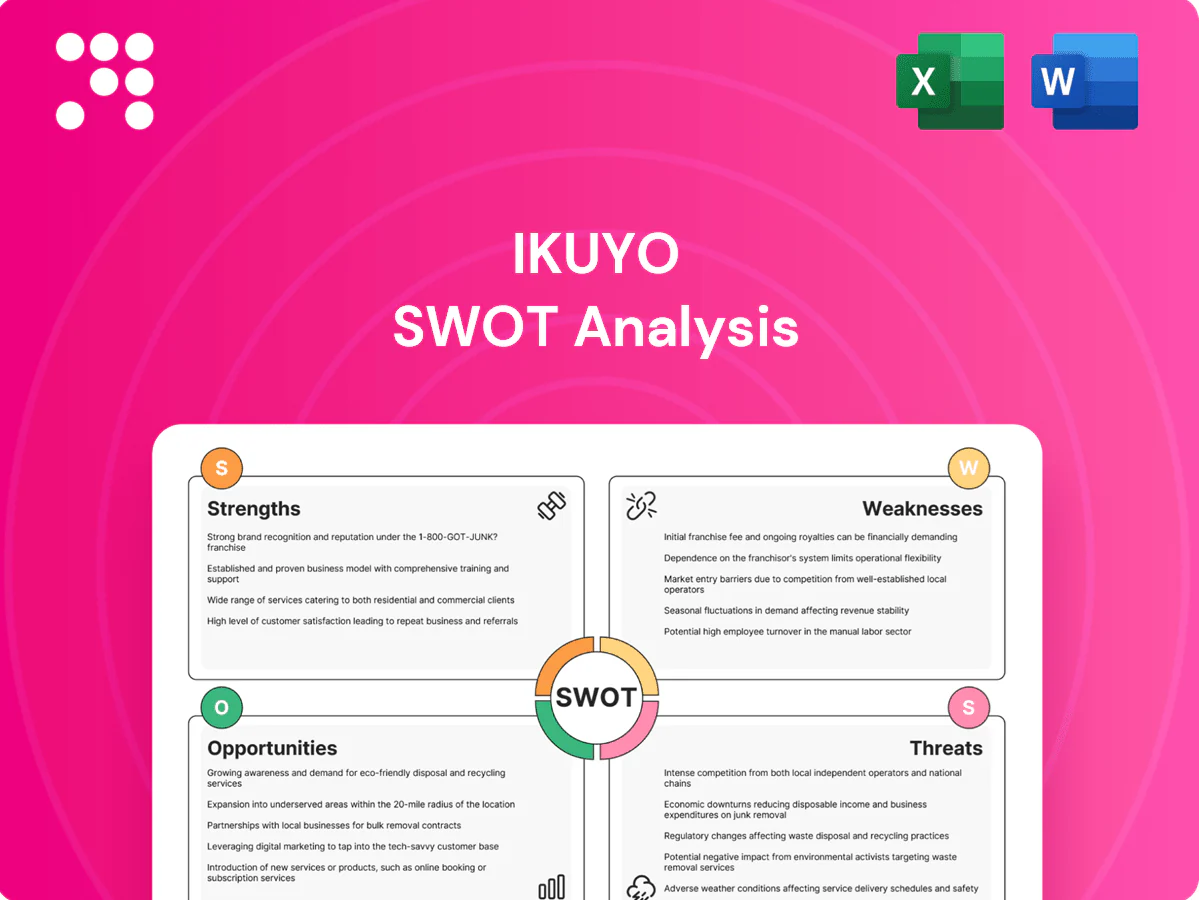
Ikuyo SWOT Analysis

Go Beyond the Preview—Access the Full Strategic Report
Uncover Ikuyo’s competitive edge, hidden risks, and growth levers with our concise SWOT snapshot—perfect for investors and strategists who need clear direction. The full SWOT report delivers research-backed insights, expert commentary, and editable Word/Excel files to support planning, pitches, and valuation. Purchase now to access the complete, investor-ready analysis and turn findings into actionable strategy.
Strengths

Precision machining excellence
Ikuyo’s deep know-how in tight‑tolerance machining and assembly for engine, transmission, fuel and brake systems drives OEM trust, enabling supply of safety‑critical components. 2024 shopfloor metrics show repeatable process capability with defect rates below 50 ppm and Cpk >1.67, creating steep cost and quality barriers to competitors.
Diversified auto components portfolio
Ikuyo’s diversified portfolio spans engines, transmissions, fuel systems, engine control units and brake components, spreading revenue exposure and lowering dependence on any single subsystem or platform.
Cross-learning in materials, coatings and metrology across these lines drives manufacturing efficiency and faster qualification cycles.
Breadth of products enables targeted cross-selling to existing OEM relationships, improving wallet share per customer.

Established OEM relationships
Long-standing supply relationships with major Japanese and global automakers, backed by approved PPAP submissions and documented production approvals, demonstrate Ikuyo’s validated quality and delivery performance. Incumbency on vehicle platforms secures recurring revenue across model refreshes and new-cycle launches through sustained BOM positions. Early supplier involvement and joint engineering deepen technical integration and create switching costs, while strong referenceability shortens qualification timelines and boosts wins on new programs.

Quality and compliance reputation
- Certification: IATF 16949 compliant
- Focus: traceability & audit readiness
- Impact: fewer recalls, lower warranty exposure
Operational agility and customization
Ikuyo tailors machining cells, fixtures and small-lot runs to OEM specifications, coupling APQP-driven responsiveness and hands-on engineering support to enable quick changeovers; SMED-driven practices can cut setup time by up to 90% (Shingo Institute), letting Ikuyo capture niche, higher-margin programs competitors often overlook and shorten time-to-industrialization.
- Tailored cells and fixtures
- APQP + engineering support
- SMED: setup reduction up to 90%
- Wins niche, higher-margin programs
Tight-tolerance machining, under 50 ppm defects and Cpk 1.67+ secure OEM trust
Ikuyo’s deep know‑how in tight‑tolerance machining yields defect rates <50 ppm and Cpk >1.67 (2024 shopfloor metrics), underpinning OEM trust for safety‑critical parts.
Broad portfolio across engines, transmissions, fuel systems and brakes spreads revenue, enables cross‑selling and secures recurring BOM positions via PPAP/production approvals.
IATF 16949, end‑to‑end traceability and SMED (setup reduction up to 90%) shorten qualification and lower warranty/recall risk.
| Metric | Value |
|---|---|
| Defect rate (2024) | <50 ppm |
| Cpk (2024) | >1.67 |
| Certification | IATF 16949 |
| SMED setup reduction | Up to 90% |
What is included in the product
 Detailed Word Document
Provides a concise strategic overview of Ikuyo’s internal strengths and weaknesses and external opportunities and threats, highlighting competitive position, growth drivers, operational gaps, and key risks shaping its future.

 Customizable Excel Spreadsheet
Provides a concise Ikuyo SWOT matrix for fast, visual strategy alignment, reducing decision friction and enabling quick stakeholder buy-in.
Weaknesses

Customer concentration risk
Ikuyo depends heavily on a limited number of major automakers and Tier‑1s, with its top three customers representing about 55% of FY2024 revenue. Platform cancellations or re‑sourcing by those OEMs can materially hit sales—historical shifts have led to revenue declines exceeding 20% on affected programs. Pricing power is tilted toward large OEMs, underscoring the need to broaden the customer mix and grow aftermarket exposure.
Lower brand visibility vs Tier-1s
Ikuyo suffers from limited end-customer recognition versus global Tier-1 integrators, reducing negotiating leverage on pricing and contract terms. Heavy dependence on build-to-print or build-to-spec work confines the company to low-value manufacturing roles, limiting access to system-level margins captured by integrators. Marketing and co-development visibility gaps hinder opportunities to win design-in and shared IP projects, constraining strategic growth.

ICE-heavy product exposure
Ikuyo retains a sizable share of components tied to internal combustion engines and conventional transmissions, leaving revenue exposed as EV penetration climbed to roughly 20% of global new car sales by 2024; this creates structural demand-decline risk. Existing plants face potential stranded capacity and significant retooling costs, underscoring an urgent need to pivot toward e-powertrain and brake-by-wire content to protect margins.

Capital intensity and margin pressure
Ikuyo faces high capital intensity from CNC lines, automation and metrology investments, creating a heavy depreciation burden and sharp sensitivity to plant utilization; OEMs' annual price-downs further compress margins, making continuous cost reduction and OEE improvements critical to protect profitability.
- High capex: CNC, automation, metrology
- Depreciation & utilization sensitivity
- OEM annual price-downs compress margins
- Must prioritize cost cuts and OEE gains
Geographic manufacturing concentration
Ikuyo shows concentrated manufacturing in Japan with limited overseas plants, increasing currency exposure on JPY movements and higher logistics costs for global deliveries; this clustering raises vulnerability to local disruptions such as earthquakes, grid outages and labor strikes and underscores the strategic need to regionalize production closer to OEM hubs.
- Concentration: Japan-centric production
- Currency: JPY exposure on exports
- Logistics: higher cross-border freight costs
- Risk: earthquake, power, labor vulnerability
- Oppty: regionalize near OEM clusters
≈55% top3 conc., cancellations >20% threaten ICE, Japan ops
Ikuyo’s top three customers accounted for about 55% of FY2024 revenue, creating concentration risk; platform cancellations have driven program-specific revenue declines exceeding 20%. EV penetration reached roughly 20% of global new car sales in 2024, exposing Ikuyo’s ICE-linked product mix to structural decline. High capex and Japan-centric production raise utilization, depreciation and disruption vulnerabilities.
| Metric | Value |
|---|---|
| Top 3 customers (FY2024) | ≈55% |
| Program revenue loss on cancellation | >20% |
| EV share of global new car sales (2024) | ≈20% |
| Production concentration | Japan-centric |
Preview the Actual Deliverable
Ikuyo SWOT Analysis
This is the actual Ikuyo SWOT analysis document you’ll receive upon purchase—no surprises, just professional quality. The preview below is taken directly from the full report you'll get, and the content shown is not a sample but the real, editable file. Buy now to unlock the complete, detailed version immediately after checkout.

Go Beyond the Preview—Access the Full Strategic Report
Uncover Ikuyo’s competitive edge, hidden risks, and growth levers with our concise SWOT snapshot—perfect for investors and strategists who need clear direction. The full SWOT report delivers research-backed insights, expert commentary, and editable Word/Excel files to support planning, pitches, and valuation. Purchase now to access the complete, investor-ready analysis and turn findings into actionable strategy.
Strengths
Precision machining excellence
Ikuyo’s deep know-how in tight‑tolerance machining and assembly for engine, transmission, fuel and brake systems drives OEM trust, enabling supply of safety‑critical components. 2024 shopfloor metrics show repeatable process capability with defect rates below 50 ppm and Cpk >1.67, creating steep cost and quality barriers to competitors.
Diversified auto components portfolio
Ikuyo’s diversified portfolio spans engines, transmissions, fuel systems, engine control units and brake components, spreading revenue exposure and lowering dependence on any single subsystem or platform.
Cross-learning in materials, coatings and metrology across these lines drives manufacturing efficiency and faster qualification cycles.
Breadth of products enables targeted cross-selling to existing OEM relationships, improving wallet share per customer.
Established OEM relationships
Long-standing supply relationships with major Japanese and global automakers, backed by approved PPAP submissions and documented production approvals, demonstrate Ikuyo’s validated quality and delivery performance. Incumbency on vehicle platforms secures recurring revenue across model refreshes and new-cycle launches through sustained BOM positions. Early supplier involvement and joint engineering deepen technical integration and create switching costs, while strong referenceability shortens qualification timelines and boosts wins on new programs.
Quality and compliance reputation
- Certification: IATF 16949 compliant
- Focus: traceability & audit readiness
- Impact: fewer recalls, lower warranty exposure
Operational agility and customization
Ikuyo tailors machining cells, fixtures and small-lot runs to OEM specifications, coupling APQP-driven responsiveness and hands-on engineering support to enable quick changeovers; SMED-driven practices can cut setup time by up to 90% (Shingo Institute), letting Ikuyo capture niche, higher-margin programs competitors often overlook and shorten time-to-industrialization.
- Tailored cells and fixtures
- APQP + engineering support
- SMED: setup reduction up to 90%
- Wins niche, higher-margin programs
Tight-tolerance machining, under 50 ppm defects and Cpk 1.67+ secure OEM trust
Ikuyo’s deep know‑how in tight‑tolerance machining yields defect rates <50 ppm and Cpk >1.67 (2024 shopfloor metrics), underpinning OEM trust for safety‑critical parts.
Broad portfolio across engines, transmissions, fuel systems and brakes spreads revenue, enables cross‑selling and secures recurring BOM positions via PPAP/production approvals.
IATF 16949, end‑to‑end traceability and SMED (setup reduction up to 90%) shorten qualification and lower warranty/recall risk.
| Metric | Value |
|---|---|
| Defect rate (2024) | <50 ppm |
| Cpk (2024) | >1.67 |
| Certification | IATF 16949 |
| SMED setup reduction | Up to 90% |
What is included in the product
Detailed Word Document
Provides a concise strategic overview of Ikuyo’s internal strengths and weaknesses and external opportunities and threats, highlighting competitive position, growth drivers, operational gaps, and key risks shaping its future.
Customizable Excel Spreadsheet
Provides a concise Ikuyo SWOT matrix for fast, visual strategy alignment, reducing decision friction and enabling quick stakeholder buy-in.
Weaknesses
Customer concentration risk
Ikuyo depends heavily on a limited number of major automakers and Tier‑1s, with its top three customers representing about 55% of FY2024 revenue. Platform cancellations or re‑sourcing by those OEMs can materially hit sales—historical shifts have led to revenue declines exceeding 20% on affected programs. Pricing power is tilted toward large OEMs, underscoring the need to broaden the customer mix and grow aftermarket exposure.
Lower brand visibility vs Tier-1s
Ikuyo suffers from limited end-customer recognition versus global Tier-1 integrators, reducing negotiating leverage on pricing and contract terms. Heavy dependence on build-to-print or build-to-spec work confines the company to low-value manufacturing roles, limiting access to system-level margins captured by integrators. Marketing and co-development visibility gaps hinder opportunities to win design-in and shared IP projects, constraining strategic growth.
ICE-heavy product exposure
Ikuyo retains a sizable share of components tied to internal combustion engines and conventional transmissions, leaving revenue exposed as EV penetration climbed to roughly 20% of global new car sales by 2024; this creates structural demand-decline risk. Existing plants face potential stranded capacity and significant retooling costs, underscoring an urgent need to pivot toward e-powertrain and brake-by-wire content to protect margins.
Capital intensity and margin pressure
Ikuyo faces high capital intensity from CNC lines, automation and metrology investments, creating a heavy depreciation burden and sharp sensitivity to plant utilization; OEMs' annual price-downs further compress margins, making continuous cost reduction and OEE improvements critical to protect profitability.
- High capex: CNC, automation, metrology
- Depreciation & utilization sensitivity
- OEM annual price-downs compress margins
- Must prioritize cost cuts and OEE gains
Geographic manufacturing concentration
Ikuyo shows concentrated manufacturing in Japan with limited overseas plants, increasing currency exposure on JPY movements and higher logistics costs for global deliveries; this clustering raises vulnerability to local disruptions such as earthquakes, grid outages and labor strikes and underscores the strategic need to regionalize production closer to OEM hubs.
- Concentration: Japan-centric production
- Currency: JPY exposure on exports
- Logistics: higher cross-border freight costs
- Risk: earthquake, power, labor vulnerability
- Oppty: regionalize near OEM clusters
≈55% top3 conc., cancellations >20% threaten ICE, Japan ops
Ikuyo’s top three customers accounted for about 55% of FY2024 revenue, creating concentration risk; platform cancellations have driven program-specific revenue declines exceeding 20%. EV penetration reached roughly 20% of global new car sales in 2024, exposing Ikuyo’s ICE-linked product mix to structural decline. High capex and Japan-centric production raise utilization, depreciation and disruption vulnerabilities.
| Metric | Value |
|---|---|
| Top 3 customers (FY2024) | ≈55% |
| Program revenue loss on cancellation | >20% |
| EV share of global new car sales (2024) | ≈20% |
| Production concentration | Japan-centric |
Preview the Actual Deliverable
Ikuyo SWOT Analysis
This is the actual Ikuyo SWOT analysis document you’ll receive upon purchase—no surprises, just professional quality. The preview below is taken directly from the full report you'll get, and the content shown is not a sample but the real, editable file. Buy now to unlock the complete, detailed version immediately after checkout.
Original: $10.00
-65%$10.00
$3.50Description
Go Beyond the Preview—Access the Full Strategic Report
Uncover Ikuyo’s competitive edge, hidden risks, and growth levers with our concise SWOT snapshot—perfect for investors and strategists who need clear direction. The full SWOT report delivers research-backed insights, expert commentary, and editable Word/Excel files to support planning, pitches, and valuation. Purchase now to access the complete, investor-ready analysis and turn findings into actionable strategy.
Strengths
Precision machining excellence
Ikuyo’s deep know-how in tight‑tolerance machining and assembly for engine, transmission, fuel and brake systems drives OEM trust, enabling supply of safety‑critical components. 2024 shopfloor metrics show repeatable process capability with defect rates below 50 ppm and Cpk >1.67, creating steep cost and quality barriers to competitors.
Diversified auto components portfolio
Ikuyo’s diversified portfolio spans engines, transmissions, fuel systems, engine control units and brake components, spreading revenue exposure and lowering dependence on any single subsystem or platform.
Cross-learning in materials, coatings and metrology across these lines drives manufacturing efficiency and faster qualification cycles.
Breadth of products enables targeted cross-selling to existing OEM relationships, improving wallet share per customer.
Established OEM relationships
Long-standing supply relationships with major Japanese and global automakers, backed by approved PPAP submissions and documented production approvals, demonstrate Ikuyo’s validated quality and delivery performance. Incumbency on vehicle platforms secures recurring revenue across model refreshes and new-cycle launches through sustained BOM positions. Early supplier involvement and joint engineering deepen technical integration and create switching costs, while strong referenceability shortens qualification timelines and boosts wins on new programs.
Quality and compliance reputation
- Certification: IATF 16949 compliant
- Focus: traceability & audit readiness
- Impact: fewer recalls, lower warranty exposure
Operational agility and customization
Ikuyo tailors machining cells, fixtures and small-lot runs to OEM specifications, coupling APQP-driven responsiveness and hands-on engineering support to enable quick changeovers; SMED-driven practices can cut setup time by up to 90% (Shingo Institute), letting Ikuyo capture niche, higher-margin programs competitors often overlook and shorten time-to-industrialization.
- Tailored cells and fixtures
- APQP + engineering support
- SMED: setup reduction up to 90%
- Wins niche, higher-margin programs
Tight-tolerance machining, under 50 ppm defects and Cpk 1.67+ secure OEM trust
Ikuyo’s deep know‑how in tight‑tolerance machining yields defect rates <50 ppm and Cpk >1.67 (2024 shopfloor metrics), underpinning OEM trust for safety‑critical parts.
Broad portfolio across engines, transmissions, fuel systems and brakes spreads revenue, enables cross‑selling and secures recurring BOM positions via PPAP/production approvals.
IATF 16949, end‑to‑end traceability and SMED (setup reduction up to 90%) shorten qualification and lower warranty/recall risk.
| Metric | Value |
|---|---|
| Defect rate (2024) | <50 ppm |
| Cpk (2024) | >1.67 |
| Certification | IATF 16949 |
| SMED setup reduction | Up to 90% |
What is included in the product
Detailed Word Document
Provides a concise strategic overview of Ikuyo’s internal strengths and weaknesses and external opportunities and threats, highlighting competitive position, growth drivers, operational gaps, and key risks shaping its future.
Customizable Excel Spreadsheet
Provides a concise Ikuyo SWOT matrix for fast, visual strategy alignment, reducing decision friction and enabling quick stakeholder buy-in.
Weaknesses
Customer concentration risk
Ikuyo depends heavily on a limited number of major automakers and Tier‑1s, with its top three customers representing about 55% of FY2024 revenue. Platform cancellations or re‑sourcing by those OEMs can materially hit sales—historical shifts have led to revenue declines exceeding 20% on affected programs. Pricing power is tilted toward large OEMs, underscoring the need to broaden the customer mix and grow aftermarket exposure.
Lower brand visibility vs Tier-1s
Ikuyo suffers from limited end-customer recognition versus global Tier-1 integrators, reducing negotiating leverage on pricing and contract terms. Heavy dependence on build-to-print or build-to-spec work confines the company to low-value manufacturing roles, limiting access to system-level margins captured by integrators. Marketing and co-development visibility gaps hinder opportunities to win design-in and shared IP projects, constraining strategic growth.
ICE-heavy product exposure
Ikuyo retains a sizable share of components tied to internal combustion engines and conventional transmissions, leaving revenue exposed as EV penetration climbed to roughly 20% of global new car sales by 2024; this creates structural demand-decline risk. Existing plants face potential stranded capacity and significant retooling costs, underscoring an urgent need to pivot toward e-powertrain and brake-by-wire content to protect margins.
Capital intensity and margin pressure
Ikuyo faces high capital intensity from CNC lines, automation and metrology investments, creating a heavy depreciation burden and sharp sensitivity to plant utilization; OEMs' annual price-downs further compress margins, making continuous cost reduction and OEE improvements critical to protect profitability.
- High capex: CNC, automation, metrology
- Depreciation & utilization sensitivity
- OEM annual price-downs compress margins
- Must prioritize cost cuts and OEE gains
Geographic manufacturing concentration
Ikuyo shows concentrated manufacturing in Japan with limited overseas plants, increasing currency exposure on JPY movements and higher logistics costs for global deliveries; this clustering raises vulnerability to local disruptions such as earthquakes, grid outages and labor strikes and underscores the strategic need to regionalize production closer to OEM hubs.
- Concentration: Japan-centric production
- Currency: JPY exposure on exports
- Logistics: higher cross-border freight costs
- Risk: earthquake, power, labor vulnerability
- Oppty: regionalize near OEM clusters
≈55% top3 conc., cancellations >20% threaten ICE, Japan ops
Ikuyo’s top three customers accounted for about 55% of FY2024 revenue, creating concentration risk; platform cancellations have driven program-specific revenue declines exceeding 20%. EV penetration reached roughly 20% of global new car sales in 2024, exposing Ikuyo’s ICE-linked product mix to structural decline. High capex and Japan-centric production raise utilization, depreciation and disruption vulnerabilities.
| Metric | Value |
|---|---|
| Top 3 customers (FY2024) | ≈55% |
| Program revenue loss on cancellation | >20% |
| EV share of global new car sales (2024) | ≈20% |
| Production concentration | Japan-centric |
Preview the Actual Deliverable
Ikuyo SWOT Analysis
This is the actual Ikuyo SWOT analysis document you’ll receive upon purchase—no surprises, just professional quality. The preview below is taken directly from the full report you'll get, and the content shown is not a sample but the real, editable file. Buy now to unlock the complete, detailed version immediately after checkout.











