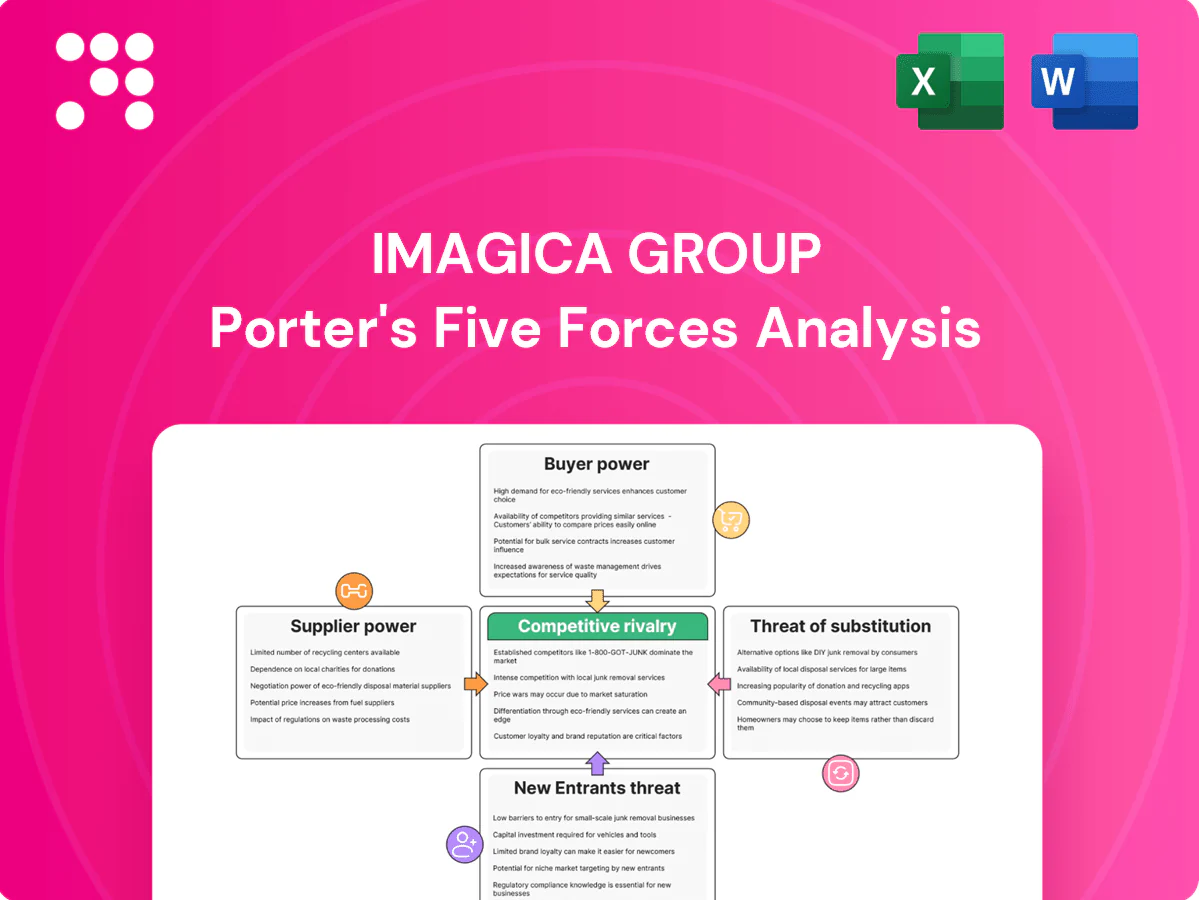
Imagica Group Porter's Five Forces Analysis

From Overview to Strategy Blueprint
Imagica Group faces moderate supplier leverage, rising substitute entertainment options, and intense rivalry for domestic theme-park audiences — this snapshot highlights key competitive tensions and strategic levers. Unlock the full Porter's Five Forces Analysis to see force-by-force ratings, visuals and actionable implications tailored for investors and strategists.
Suppliers Bargaining Power

Specialized Talent Dependence
Highly skilled artists, colorists, and engineers are critical suppliers for Imagica Group’s post, VFX, and CGI work; 2023–24 industry disruptions (SAG-AFTRA 2023 strike and 2024 unionization momentum) pushed rates and bargaining leverage upward. Scarcity of senior talent and rising union activity increase attrition risk and wage pressure. Heavy reliance on freelancers creates availability and pricing volatility, forcing firms to offer premium pay, training budgets, and steady project pipelines to retain staff.
Software and Tool Vendors
Imagica relies on industry staples—Autodesk, Adobe, Foundry, SideFX, Blackmagic—concentrating supplier leverage as subscription models and license audits (now driving over 80% of major creative vendors revenue in 2024) can squeeze margins and cash flow. Limited viable substitutes raise switching costs for proprietary file formats and pipelines. Multi-year enterprise agreements and vendor diversification remain key levers to reduce supplier power.

Hardware/GPU and Cloud Providers
NVIDIA GPUs, high-end workstations, storage arrays and render farms are mission-critical for Imagica; NVIDIA held roughly 80–90% of data-center GPU share in 2024, concentrating supplier power. GPU scarcity and supply shocks have driven component cost spikes of 20–40% and delivery delays. Cloud render via AWS (31%)/Azure (23%)/GCP (11% in 2024) offers OPEX flexibility but risks vendor lock-in; hybrid and multi-cloud deployments mitigate dependency.

Capture/Production Inputs
Camera, lens and LED volume vendors exert tangible upstream pressure on cost and schedules; high-end cine camera rental rates in 2024 commonly ranged about 1,200–3,500 USD/day, tightening timelines for shoots. ACES and HDR mastering require certified capture and grading chains, raising mandatory compliance costs. Studio-bundled packages reduce supplier optionality while preferred-vendor lists and framework agreements stabilize terms.
- Vendor pricing pressure: rental rates 1,200–3,500 USD/day
- Standards: ACES/HDR mandate certified gear
- Mitigation: preferred-vendor lists, framework agreements
Asset Libraries and Plugins
Asset libraries, stock models, textures, plugins and pipelines depend on niche suppliers, so price hikes or deprecated support can halt production and increase costs; compatibility issues from frequent DCC updates amplify this supplier power. Building internal libraries and adopting open-source tools reduces vendor dependence and operational risk; Synopsys OSSRA 2024 reported 99% of codebases include open-source components.
- Supplier concentration: high for specialized plugins
- Risk: price increases or deprecated support disrupt workflows
- Compounding factor: DCC update incompatibility
- Mitigation: internal asset libraries, open-source adoption (99% usage 2024)
Suppliers' leverage: GPUs 80–90%, software ~80%, cameras $1,200–3,500/day
Specialized talent, core creative software and high-end hardware give suppliers strong leverage over Imagica; 2023–24 union activity and talent scarcity raised wage and attrition risk. NVIDIA GPU dominance (80–90% DC share in 2024), software subscription pricing (~80% vendor revenue) and camera rental rates ($1,200–3,500/day) compress margins and increase switching costs.
| Supplier | 2024 metric |
|---|---|
| Creative software | ~80% subscription revenue |
| GPUs | NVIDIA 80–90% data-center share |
| Camera rentals | $1,200–3,500/day |
What is included in the product
 Detailed Word Document
Tailored Porter's Five Forces analysis for Imagica Group uncovering competitive intensity, buyer and supplier bargaining power, threat of new entrants and substitutes, and industry rivalry; highlights disruptive threats and strategic levers to protect margins and market share. Ideal for investor reports, strategy decks, and business plans, fully editable for customization.

 Customizable Excel Spreadsheet
One-sheet Porter's Five Forces for Imagica Group that converts industry data into a clear radar chart for instant strategic clarity, customizable pressure levels for evolving market trends and ready-to-drop into decks—no macros or finance jargon required.
Customers Bargaining Power

Consolidated Media Buyers
Studios, broadcasters, streamers and major agencies buy at scale—Netflix alone had a content budget of about 17 billion USD (2024) and global ad spend approached 800 billion USD (2024)—allowing buyers to negotiate aggressively. Framework deals and global preferred-vendor lists compress supplier margins and shift leverage. Extended payment terms often stretch working capital cycles for suppliers, but demonstrable quality and on‑time delivery enable Imagica to defend pricing.
Project-Based Bidding
Tenders for shots or shows foster price shopping among vendors, and in 2024 transparent shot breakdowns increased comparability, squeezing rates. Differentiation via IP, proprietary tech and specialized capabilities raises win rates by shifting selection to value metrics. Case studies and outcome-based SLAs help counter pure cost competition and are increasingly required in bids.

Switching Costs Are Moderate
Standardized formats and pipelines make mid-season vendor swaps feasible, keeping switching costs moderate; industry adoption of cloud-based production tools rose to about 40% in 2024, lowering integration barriers. Deep show-specific tooling and bespoke asset structures create stickiness for long-running series. A strong PMO and secure data-ops reduce perceived switching risk, while client portals and shared dailies workflows increase operational lock-in.

Insourcing Pressures
Large platforms and studios expand in-house post/VFX to control cost and schedule, with Netflix (~260 million subscribers in 2024) and Disney+ (~150 million in 2024) notably strengthening internal pipelines; this raises insourcing pressure on Imagica Group. Build-operate-transfer models reduce client dependency on vendors, while co-development and capacity‑overflow agreements preserve vendor relevance; advisory and education services deepen strategic ties.
- Insourcing: platforms bring post/VFX in-house
- BOT: lowers vendor dependence
- Co-dev/overflow: maintains vendor volume
- Advisory/education: increases strategic lock-in
Outcome and Speed Sensitivity
- Time-first purchasing
- Penalty leverage
- 10–25% premium possible
- Real-time review +18% retention
Large buyers wield leverage: premium pricing, insourcing and cloud lower switching costs
Large buyers wield strong leverage—Netflix content budget ~$17B (2024), global ad spend ~$800B (2024), Netflix 260M/Disney+150M subscribers—driving aggressive negotiation, insourcing and BOT pressure; cloud adoption ~40% lowers switching costs. 62% of buyers switched after missed deadlines (2024); premium pricing 10–25% for guaranteed capacity; real-time review raised retention ~18% (2024).
| Metric | 2024 |
|---|---|
| Netflix content budget | $17B |
| Global ad spend | $800B |
| Cloud adoption (production) | 40% |
| Buyer churn after delays | 62% |
| Premium rates | 10–25% |
Full Version Awaits
Imagica Group Porter's Five Forces Analysis
This preview shows the exact Porter's Five Forces analysis for Imagica Group you'll receive immediately after purchase—no surprises or placeholders. It delivers a concise evaluation of competitive rivalry, threat of new entrants, bargaining power of suppliers and buyers, and threat of substitutes. The document is fully formatted and ready to download and use instantly.

From Overview to Strategy Blueprint
Imagica Group faces moderate supplier leverage, rising substitute entertainment options, and intense rivalry for domestic theme-park audiences — this snapshot highlights key competitive tensions and strategic levers. Unlock the full Porter's Five Forces Analysis to see force-by-force ratings, visuals and actionable implications tailored for investors and strategists.
Suppliers Bargaining Power
Specialized Talent Dependence
Highly skilled artists, colorists, and engineers are critical suppliers for Imagica Group’s post, VFX, and CGI work; 2023–24 industry disruptions (SAG-AFTRA 2023 strike and 2024 unionization momentum) pushed rates and bargaining leverage upward. Scarcity of senior talent and rising union activity increase attrition risk and wage pressure. Heavy reliance on freelancers creates availability and pricing volatility, forcing firms to offer premium pay, training budgets, and steady project pipelines to retain staff.
Software and Tool Vendors
Imagica relies on industry staples—Autodesk, Adobe, Foundry, SideFX, Blackmagic—concentrating supplier leverage as subscription models and license audits (now driving over 80% of major creative vendors revenue in 2024) can squeeze margins and cash flow. Limited viable substitutes raise switching costs for proprietary file formats and pipelines. Multi-year enterprise agreements and vendor diversification remain key levers to reduce supplier power.
Hardware/GPU and Cloud Providers
NVIDIA GPUs, high-end workstations, storage arrays and render farms are mission-critical for Imagica; NVIDIA held roughly 80–90% of data-center GPU share in 2024, concentrating supplier power. GPU scarcity and supply shocks have driven component cost spikes of 20–40% and delivery delays. Cloud render via AWS (31%)/Azure (23%)/GCP (11% in 2024) offers OPEX flexibility but risks vendor lock-in; hybrid and multi-cloud deployments mitigate dependency.
Capture/Production Inputs
Camera, lens and LED volume vendors exert tangible upstream pressure on cost and schedules; high-end cine camera rental rates in 2024 commonly ranged about 1,200–3,500 USD/day, tightening timelines for shoots. ACES and HDR mastering require certified capture and grading chains, raising mandatory compliance costs. Studio-bundled packages reduce supplier optionality while preferred-vendor lists and framework agreements stabilize terms.
- Vendor pricing pressure: rental rates 1,200–3,500 USD/day
- Standards: ACES/HDR mandate certified gear
- Mitigation: preferred-vendor lists, framework agreements
Asset Libraries and Plugins
Asset libraries, stock models, textures, plugins and pipelines depend on niche suppliers, so price hikes or deprecated support can halt production and increase costs; compatibility issues from frequent DCC updates amplify this supplier power. Building internal libraries and adopting open-source tools reduces vendor dependence and operational risk; Synopsys OSSRA 2024 reported 99% of codebases include open-source components.
- Supplier concentration: high for specialized plugins
- Risk: price increases or deprecated support disrupt workflows
- Compounding factor: DCC update incompatibility
- Mitigation: internal asset libraries, open-source adoption (99% usage 2024)
Suppliers' leverage: GPUs 80–90%, software ~80%, cameras $1,200–3,500/day
Specialized talent, core creative software and high-end hardware give suppliers strong leverage over Imagica; 2023–24 union activity and talent scarcity raised wage and attrition risk. NVIDIA GPU dominance (80–90% DC share in 2024), software subscription pricing (~80% vendor revenue) and camera rental rates ($1,200–3,500/day) compress margins and increase switching costs.
| Supplier | 2024 metric |
|---|---|
| Creative software | ~80% subscription revenue |
| GPUs | NVIDIA 80–90% data-center share |
| Camera rentals | $1,200–3,500/day |
What is included in the product
Detailed Word Document
Tailored Porter's Five Forces analysis for Imagica Group uncovering competitive intensity, buyer and supplier bargaining power, threat of new entrants and substitutes, and industry rivalry; highlights disruptive threats and strategic levers to protect margins and market share. Ideal for investor reports, strategy decks, and business plans, fully editable for customization.
Customizable Excel Spreadsheet
One-sheet Porter's Five Forces for Imagica Group that converts industry data into a clear radar chart for instant strategic clarity, customizable pressure levels for evolving market trends and ready-to-drop into decks—no macros or finance jargon required.
Customers Bargaining Power
Consolidated Media Buyers
Studios, broadcasters, streamers and major agencies buy at scale—Netflix alone had a content budget of about 17 billion USD (2024) and global ad spend approached 800 billion USD (2024)—allowing buyers to negotiate aggressively. Framework deals and global preferred-vendor lists compress supplier margins and shift leverage. Extended payment terms often stretch working capital cycles for suppliers, but demonstrable quality and on‑time delivery enable Imagica to defend pricing.
Project-Based Bidding
Tenders for shots or shows foster price shopping among vendors, and in 2024 transparent shot breakdowns increased comparability, squeezing rates. Differentiation via IP, proprietary tech and specialized capabilities raises win rates by shifting selection to value metrics. Case studies and outcome-based SLAs help counter pure cost competition and are increasingly required in bids.
Switching Costs Are Moderate
Standardized formats and pipelines make mid-season vendor swaps feasible, keeping switching costs moderate; industry adoption of cloud-based production tools rose to about 40% in 2024, lowering integration barriers. Deep show-specific tooling and bespoke asset structures create stickiness for long-running series. A strong PMO and secure data-ops reduce perceived switching risk, while client portals and shared dailies workflows increase operational lock-in.
Insourcing Pressures
Large platforms and studios expand in-house post/VFX to control cost and schedule, with Netflix (~260 million subscribers in 2024) and Disney+ (~150 million in 2024) notably strengthening internal pipelines; this raises insourcing pressure on Imagica Group. Build-operate-transfer models reduce client dependency on vendors, while co-development and capacity‑overflow agreements preserve vendor relevance; advisory and education services deepen strategic ties.
- Insourcing: platforms bring post/VFX in-house
- BOT: lowers vendor dependence
- Co-dev/overflow: maintains vendor volume
- Advisory/education: increases strategic lock-in
Outcome and Speed Sensitivity
- Time-first purchasing
- Penalty leverage
- 10–25% premium possible
- Real-time review +18% retention
Large buyers wield leverage: premium pricing, insourcing and cloud lower switching costs
Large buyers wield strong leverage—Netflix content budget ~$17B (2024), global ad spend ~$800B (2024), Netflix 260M/Disney+150M subscribers—driving aggressive negotiation, insourcing and BOT pressure; cloud adoption ~40% lowers switching costs. 62% of buyers switched after missed deadlines (2024); premium pricing 10–25% for guaranteed capacity; real-time review raised retention ~18% (2024).
| Metric | 2024 |
|---|---|
| Netflix content budget | $17B |
| Global ad spend | $800B |
| Cloud adoption (production) | 40% |
| Buyer churn after delays | 62% |
| Premium rates | 10–25% |
Full Version Awaits
Imagica Group Porter's Five Forces Analysis
This preview shows the exact Porter's Five Forces analysis for Imagica Group you'll receive immediately after purchase—no surprises or placeholders. It delivers a concise evaluation of competitive rivalry, threat of new entrants, bargaining power of suppliers and buyers, and threat of substitutes. The document is fully formatted and ready to download and use instantly.
Original: $10.00
-65%$10.00
$3.50Description
From Overview to Strategy Blueprint
Imagica Group faces moderate supplier leverage, rising substitute entertainment options, and intense rivalry for domestic theme-park audiences — this snapshot highlights key competitive tensions and strategic levers. Unlock the full Porter's Five Forces Analysis to see force-by-force ratings, visuals and actionable implications tailored for investors and strategists.
Suppliers Bargaining Power
Specialized Talent Dependence
Highly skilled artists, colorists, and engineers are critical suppliers for Imagica Group’s post, VFX, and CGI work; 2023–24 industry disruptions (SAG-AFTRA 2023 strike and 2024 unionization momentum) pushed rates and bargaining leverage upward. Scarcity of senior talent and rising union activity increase attrition risk and wage pressure. Heavy reliance on freelancers creates availability and pricing volatility, forcing firms to offer premium pay, training budgets, and steady project pipelines to retain staff.
Software and Tool Vendors
Imagica relies on industry staples—Autodesk, Adobe, Foundry, SideFX, Blackmagic—concentrating supplier leverage as subscription models and license audits (now driving over 80% of major creative vendors revenue in 2024) can squeeze margins and cash flow. Limited viable substitutes raise switching costs for proprietary file formats and pipelines. Multi-year enterprise agreements and vendor diversification remain key levers to reduce supplier power.
Hardware/GPU and Cloud Providers
NVIDIA GPUs, high-end workstations, storage arrays and render farms are mission-critical for Imagica; NVIDIA held roughly 80–90% of data-center GPU share in 2024, concentrating supplier power. GPU scarcity and supply shocks have driven component cost spikes of 20–40% and delivery delays. Cloud render via AWS (31%)/Azure (23%)/GCP (11% in 2024) offers OPEX flexibility but risks vendor lock-in; hybrid and multi-cloud deployments mitigate dependency.
Capture/Production Inputs
Camera, lens and LED volume vendors exert tangible upstream pressure on cost and schedules; high-end cine camera rental rates in 2024 commonly ranged about 1,200–3,500 USD/day, tightening timelines for shoots. ACES and HDR mastering require certified capture and grading chains, raising mandatory compliance costs. Studio-bundled packages reduce supplier optionality while preferred-vendor lists and framework agreements stabilize terms.
- Vendor pricing pressure: rental rates 1,200–3,500 USD/day
- Standards: ACES/HDR mandate certified gear
- Mitigation: preferred-vendor lists, framework agreements
Asset Libraries and Plugins
Asset libraries, stock models, textures, plugins and pipelines depend on niche suppliers, so price hikes or deprecated support can halt production and increase costs; compatibility issues from frequent DCC updates amplify this supplier power. Building internal libraries and adopting open-source tools reduces vendor dependence and operational risk; Synopsys OSSRA 2024 reported 99% of codebases include open-source components.
- Supplier concentration: high for specialized plugins
- Risk: price increases or deprecated support disrupt workflows
- Compounding factor: DCC update incompatibility
- Mitigation: internal asset libraries, open-source adoption (99% usage 2024)
Suppliers' leverage: GPUs 80–90%, software ~80%, cameras $1,200–3,500/day
Specialized talent, core creative software and high-end hardware give suppliers strong leverage over Imagica; 2023–24 union activity and talent scarcity raised wage and attrition risk. NVIDIA GPU dominance (80–90% DC share in 2024), software subscription pricing (~80% vendor revenue) and camera rental rates ($1,200–3,500/day) compress margins and increase switching costs.
| Supplier | 2024 metric |
|---|---|
| Creative software | ~80% subscription revenue |
| GPUs | NVIDIA 80–90% data-center share |
| Camera rentals | $1,200–3,500/day |
What is included in the product
Detailed Word Document
Tailored Porter's Five Forces analysis for Imagica Group uncovering competitive intensity, buyer and supplier bargaining power, threat of new entrants and substitutes, and industry rivalry; highlights disruptive threats and strategic levers to protect margins and market share. Ideal for investor reports, strategy decks, and business plans, fully editable for customization.
Customizable Excel Spreadsheet
One-sheet Porter's Five Forces for Imagica Group that converts industry data into a clear radar chart for instant strategic clarity, customizable pressure levels for evolving market trends and ready-to-drop into decks—no macros or finance jargon required.
Customers Bargaining Power
Consolidated Media Buyers
Studios, broadcasters, streamers and major agencies buy at scale—Netflix alone had a content budget of about 17 billion USD (2024) and global ad spend approached 800 billion USD (2024)—allowing buyers to negotiate aggressively. Framework deals and global preferred-vendor lists compress supplier margins and shift leverage. Extended payment terms often stretch working capital cycles for suppliers, but demonstrable quality and on‑time delivery enable Imagica to defend pricing.
Project-Based Bidding
Tenders for shots or shows foster price shopping among vendors, and in 2024 transparent shot breakdowns increased comparability, squeezing rates. Differentiation via IP, proprietary tech and specialized capabilities raises win rates by shifting selection to value metrics. Case studies and outcome-based SLAs help counter pure cost competition and are increasingly required in bids.
Switching Costs Are Moderate
Standardized formats and pipelines make mid-season vendor swaps feasible, keeping switching costs moderate; industry adoption of cloud-based production tools rose to about 40% in 2024, lowering integration barriers. Deep show-specific tooling and bespoke asset structures create stickiness for long-running series. A strong PMO and secure data-ops reduce perceived switching risk, while client portals and shared dailies workflows increase operational lock-in.
Insourcing Pressures
Large platforms and studios expand in-house post/VFX to control cost and schedule, with Netflix (~260 million subscribers in 2024) and Disney+ (~150 million in 2024) notably strengthening internal pipelines; this raises insourcing pressure on Imagica Group. Build-operate-transfer models reduce client dependency on vendors, while co-development and capacity‑overflow agreements preserve vendor relevance; advisory and education services deepen strategic ties.
- Insourcing: platforms bring post/VFX in-house
- BOT: lowers vendor dependence
- Co-dev/overflow: maintains vendor volume
- Advisory/education: increases strategic lock-in
Outcome and Speed Sensitivity
- Time-first purchasing
- Penalty leverage
- 10–25% premium possible
- Real-time review +18% retention
Large buyers wield leverage: premium pricing, insourcing and cloud lower switching costs
Large buyers wield strong leverage—Netflix content budget ~$17B (2024), global ad spend ~$800B (2024), Netflix 260M/Disney+150M subscribers—driving aggressive negotiation, insourcing and BOT pressure; cloud adoption ~40% lowers switching costs. 62% of buyers switched after missed deadlines (2024); premium pricing 10–25% for guaranteed capacity; real-time review raised retention ~18% (2024).
| Metric | 2024 |
|---|---|
| Netflix content budget | $17B |
| Global ad spend | $800B |
| Cloud adoption (production) | 40% |
| Buyer churn after delays | 62% |
| Premium rates | 10–25% |
Full Version Awaits
Imagica Group Porter's Five Forces Analysis
This preview shows the exact Porter's Five Forces analysis for Imagica Group you'll receive immediately after purchase—no surprises or placeholders. It delivers a concise evaluation of competitive rivalry, threat of new entrants, bargaining power of suppliers and buyers, and threat of substitutes. The document is fully formatted and ready to download and use instantly.











