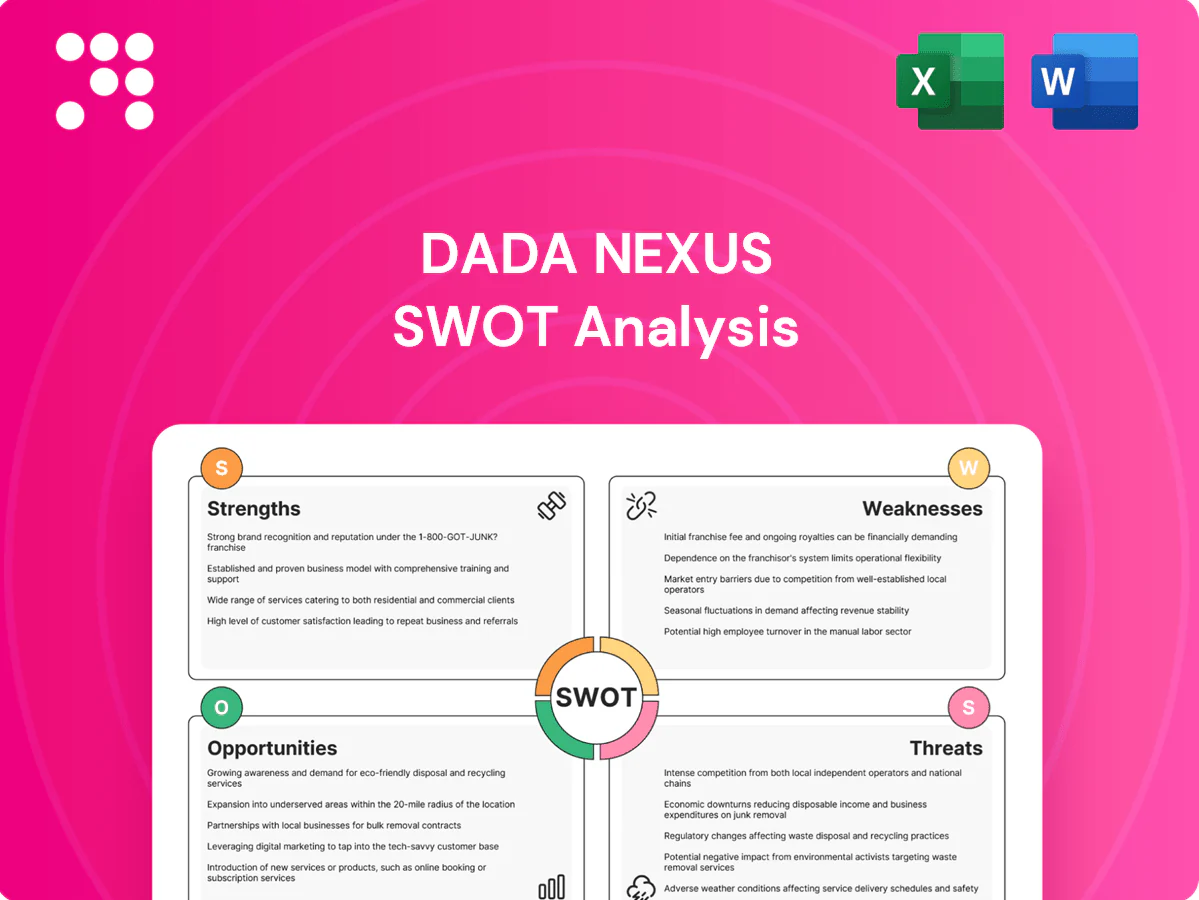
Dada Nexus SWOT Analysis

Make Insightful Decisions Backed by Expert Research
Our Dada Nexus SWOT analysis highlights core strengths in last-mile logistics and tech integration, flags competitive and regulatory threats, and outlines growth opportunities in B2B expansion. Want the full strategic picture? Purchase the complete SWOT for a detailed, editable report and Excel tools to guide investment or planning.
Strengths

Two-sided network scale
Dada Nexus operates large, dense networks—over 400,000 retail partners and roughly 1.5 million riders—creating strong two-sided network effects that boost repeat usage and merchant onboarding. Higher order density in its core urban clusters shortens fulfillment windows and lowers per-order costs, supporting unit economics. This scale is hard for smaller rivals to replicate and strengthens service reliability and breadth of merchant selection.
Category breadth & immediacy
Dada Nexus spans groceries, FMCG and pharmaceuticals with 30–60 minute on-demand delivery, driving frequent usage and strong stickiness for time-sensitive SKUs. Broad assortments lift cross-category conversion and basket size, supporting resilient demand across seasons. The platform’s extensive local fulfillment network (coverage in 2,800+ counties) underpins repeat purchases and stable GMV streams.

Tech-driven dispatch & routing
Algorithmic batching, dynamic pricing and route optimization lift on-time rates and ETA accuracy—Dada reports ETA accuracy near 90% and 1.6x rider utilization in dense zones. Better utilization cuts idle time and can lower cost per drop by up to 20%, boosting margin on urban orders. Continuous model tuning and real-time data pipelines enable scaling across cities with sustained delivery SLAs.

Strong retailer partnerships
Deep integrations with supermarkets, pharmacies and chain retailers give Dada Nexus real-time inventory visibility and seamless order orchestration, reducing stockouts and speeding fulfillment.
Co-marketing programs with major merchants consistently drive traffic and conversion while enterprise relationships and proprietary merchant tools increase switching costs and improve store-level operational performance.
- Inventory visibility
- Order orchestration
- Co-marketing lift
- High switching costs
- Operational tools
JD ecosystem synergies
Connectivity to JD’s platform, which serves over 500 million annual active users (2024), lowers Dada Nexus customer acquisition costs by tapping JD traffic, merchants, and fulfillment know-how. Omni-channel enablement strengthens alignment with JD’s retail strategy, expanding offline-online reach. JD’s brand trust and halo accelerate consumer adoption while shared data insights sharpen targeting and assortment optimization.
- Lower CAC via JD traffic
- Omni-channel retail alignment
- Brand trust boosts adoption
- Data-driven targeting & assortment
400k retailers, 1.5M riders, 90% ETA cut costs and boost reliability
Dada Nexus leverages scale—~400,000 retail partners, ~1.5M riders and 2,800+ county coverage—driving dense urban density, ~90% ETA accuracy and 1.6x rider utilization to lower per-order costs and boost reliability. Broad assortments (grocery/FMCG/pharma) and JD connectivity (500M AAU, 2024) cut CAC, raise stickiness and create high merchant switching costs.
| Metric | Value |
|---|---|
| Retail partners | ~400,000 |
| Riders | ~1.5M |
| Coverage | 2,800+ counties |
| ETA accuracy | ~90% |
| JD AAU (2024) | 500M |
What is included in the product
 Detailed Word Document
Delivers a strategic overview of Dada Nexus’s internal and external business factors, outlining strengths, weaknesses, opportunities, and threats to map growth drivers, operational gaps, and market risks.

 Customizable Excel Spreadsheet
Provides a concise, editable SWOT matrix that streamlines identification and communication of Dada Nexus pain points for fast stakeholder alignment and decision-making. Ideal for executives and teams needing a clear, at-a-glance view to prioritize fixes and track changing risks and opportunities.
Weaknesses

Thin unit economics
On-demand delivery has structurally low margins—last-mile contribution margins often run 3–5%—while high variable costs for drivers and fulfillment pressure unit economics. Subsidies and promotions (commonly 20–30% of ticket value in China instant retail) further depress profitability. Small basket sizes (average order ~RMB 30–40) limit per-order contribution. Profitability therefore hinges on very high density and sub-minute operational precision.
High operational complexity
Real-time logistics across thousands of SKUs, stores, and cities makes execution-heavy operations for Dada Nexus, with peak order volumes that can spike 3–5x during promotions and holidays. Weather, traffic, and volatility strain SLAs and increase late-delivery risk. Rider management, background checks, and compliance add substantial overhead. Operational errors quickly erode customer and merchant satisfaction and retention.

Reliance on key partners
Reliance on key partners like Walmart China and Carrefour means Dada Nexus' traffic, inventory access and co-marketing often hinge on a few anchor retailers and platforms. Changes in partner strategy or fee structures could materially reduce volumes or raise fulfillment costs. Limited bargaining power versus large chains constrains margin recovery and pricing flexibility. Integration dependencies with partner systems slow product release and innovation cycles.

Rider churn & labor intensity
Gig workforce models drive high rider churn—industry turnover often exceeds 60% annually—requiring continual recruitment and training that elevate per-order labor costs. To preserve promised delivery speeds, Dada relies on incentives and surge pay, pushing fulfillment costs higher and compressing margins. Stringent safety and local compliance add operational friction, and service quality shows meaningful city-by-city variance.
- churn: industry turnover >60%/yr
- costs: incentive-driven fulfillment inflation
- compliance: safety/regulatory frictions
- variance: inconsistent city-level quality
Limited differentiation moat
Core features like fast delivery and broad selection are easily replicable by well-funded rivals; China’s online retail market was about RMB 13.6 trillion in 2024, so scale advantages are limited. Price, subsidies and promotions (often 20–30% discounts in instant retail campaigns) drive switching, making brand loyalty fragile in commoditized local services. Marketing spend can escalate quickly as companies chase share, pressuring margins.
- replicable core features
- price-driven switching (20–30% promo range)
- fragile brand loyalty
- rising marketing intensity
Last-mile: thin margins, heavy subsidies, high churn in RMB 13.6T market
Low last-mile contribution margins (~3–5%) and heavy subsidies (20–30% of ticket) compress profitability; avg order ~RMB 30–40 limits per-order contribution. Operations are execution-heavy with peak spikes 3–5x and rider churn >60%/yr raising costs. Dependence on anchor partners (Walmart, Carrefour) and easily replicated service weaken pricing power in a RMB 13.6T 2024 market.
| Metric | Value |
|---|---|
| Last-mile margin | 3–5% |
| Subsidies/promos | 20–30% |
| Avg order | RMB 30–40 |
| Rider churn | >60%/yr |
| Market size (2024) | RMB 13.6T |
Preview the Actual Deliverable
Dada Nexus SWOT Analysis
This is the actual Dada Nexus SWOT analysis document you’ll receive upon purchase—no surprises, just professional quality. The preview below is taken directly from the full report and reflects the same structured, editable file included in your download. Buy now to unlock the complete, detailed version immediately after checkout.

Make Insightful Decisions Backed by Expert Research
Our Dada Nexus SWOT analysis highlights core strengths in last-mile logistics and tech integration, flags competitive and regulatory threats, and outlines growth opportunities in B2B expansion. Want the full strategic picture? Purchase the complete SWOT for a detailed, editable report and Excel tools to guide investment or planning.
Strengths
Two-sided network scale
Dada Nexus operates large, dense networks—over 400,000 retail partners and roughly 1.5 million riders—creating strong two-sided network effects that boost repeat usage and merchant onboarding. Higher order density in its core urban clusters shortens fulfillment windows and lowers per-order costs, supporting unit economics. This scale is hard for smaller rivals to replicate and strengthens service reliability and breadth of merchant selection.
Category breadth & immediacy
Dada Nexus spans groceries, FMCG and pharmaceuticals with 30–60 minute on-demand delivery, driving frequent usage and strong stickiness for time-sensitive SKUs. Broad assortments lift cross-category conversion and basket size, supporting resilient demand across seasons. The platform’s extensive local fulfillment network (coverage in 2,800+ counties) underpins repeat purchases and stable GMV streams.
Tech-driven dispatch & routing
Algorithmic batching, dynamic pricing and route optimization lift on-time rates and ETA accuracy—Dada reports ETA accuracy near 90% and 1.6x rider utilization in dense zones. Better utilization cuts idle time and can lower cost per drop by up to 20%, boosting margin on urban orders. Continuous model tuning and real-time data pipelines enable scaling across cities with sustained delivery SLAs.
Strong retailer partnerships
Deep integrations with supermarkets, pharmacies and chain retailers give Dada Nexus real-time inventory visibility and seamless order orchestration, reducing stockouts and speeding fulfillment.
Co-marketing programs with major merchants consistently drive traffic and conversion while enterprise relationships and proprietary merchant tools increase switching costs and improve store-level operational performance.
- Inventory visibility
- Order orchestration
- Co-marketing lift
- High switching costs
- Operational tools
JD ecosystem synergies
Connectivity to JD’s platform, which serves over 500 million annual active users (2024), lowers Dada Nexus customer acquisition costs by tapping JD traffic, merchants, and fulfillment know-how. Omni-channel enablement strengthens alignment with JD’s retail strategy, expanding offline-online reach. JD’s brand trust and halo accelerate consumer adoption while shared data insights sharpen targeting and assortment optimization.
- Lower CAC via JD traffic
- Omni-channel retail alignment
- Brand trust boosts adoption
- Data-driven targeting & assortment
400k retailers, 1.5M riders, 90% ETA cut costs and boost reliability
Dada Nexus leverages scale—~400,000 retail partners, ~1.5M riders and 2,800+ county coverage—driving dense urban density, ~90% ETA accuracy and 1.6x rider utilization to lower per-order costs and boost reliability. Broad assortments (grocery/FMCG/pharma) and JD connectivity (500M AAU, 2024) cut CAC, raise stickiness and create high merchant switching costs.
| Metric | Value |
|---|---|
| Retail partners | ~400,000 |
| Riders | ~1.5M |
| Coverage | 2,800+ counties |
| ETA accuracy | ~90% |
| JD AAU (2024) | 500M |
What is included in the product
Detailed Word Document
Delivers a strategic overview of Dada Nexus’s internal and external business factors, outlining strengths, weaknesses, opportunities, and threats to map growth drivers, operational gaps, and market risks.
Customizable Excel Spreadsheet
Provides a concise, editable SWOT matrix that streamlines identification and communication of Dada Nexus pain points for fast stakeholder alignment and decision-making. Ideal for executives and teams needing a clear, at-a-glance view to prioritize fixes and track changing risks and opportunities.
Weaknesses
Thin unit economics
On-demand delivery has structurally low margins—last-mile contribution margins often run 3–5%—while high variable costs for drivers and fulfillment pressure unit economics. Subsidies and promotions (commonly 20–30% of ticket value in China instant retail) further depress profitability. Small basket sizes (average order ~RMB 30–40) limit per-order contribution. Profitability therefore hinges on very high density and sub-minute operational precision.
High operational complexity
Real-time logistics across thousands of SKUs, stores, and cities makes execution-heavy operations for Dada Nexus, with peak order volumes that can spike 3–5x during promotions and holidays. Weather, traffic, and volatility strain SLAs and increase late-delivery risk. Rider management, background checks, and compliance add substantial overhead. Operational errors quickly erode customer and merchant satisfaction and retention.
Reliance on key partners
Reliance on key partners like Walmart China and Carrefour means Dada Nexus' traffic, inventory access and co-marketing often hinge on a few anchor retailers and platforms. Changes in partner strategy or fee structures could materially reduce volumes or raise fulfillment costs. Limited bargaining power versus large chains constrains margin recovery and pricing flexibility. Integration dependencies with partner systems slow product release and innovation cycles.
Rider churn & labor intensity
Gig workforce models drive high rider churn—industry turnover often exceeds 60% annually—requiring continual recruitment and training that elevate per-order labor costs. To preserve promised delivery speeds, Dada relies on incentives and surge pay, pushing fulfillment costs higher and compressing margins. Stringent safety and local compliance add operational friction, and service quality shows meaningful city-by-city variance.
- churn: industry turnover >60%/yr
- costs: incentive-driven fulfillment inflation
- compliance: safety/regulatory frictions
- variance: inconsistent city-level quality
Limited differentiation moat
Core features like fast delivery and broad selection are easily replicable by well-funded rivals; China’s online retail market was about RMB 13.6 trillion in 2024, so scale advantages are limited. Price, subsidies and promotions (often 20–30% discounts in instant retail campaigns) drive switching, making brand loyalty fragile in commoditized local services. Marketing spend can escalate quickly as companies chase share, pressuring margins.
- replicable core features
- price-driven switching (20–30% promo range)
- fragile brand loyalty
- rising marketing intensity
Last-mile: thin margins, heavy subsidies, high churn in RMB 13.6T market
Low last-mile contribution margins (~3–5%) and heavy subsidies (20–30% of ticket) compress profitability; avg order ~RMB 30–40 limits per-order contribution. Operations are execution-heavy with peak spikes 3–5x and rider churn >60%/yr raising costs. Dependence on anchor partners (Walmart, Carrefour) and easily replicated service weaken pricing power in a RMB 13.6T 2024 market.
| Metric | Value |
|---|---|
| Last-mile margin | 3–5% |
| Subsidies/promos | 20–30% |
| Avg order | RMB 30–40 |
| Rider churn | >60%/yr |
| Market size (2024) | RMB 13.6T |
Preview the Actual Deliverable
Dada Nexus SWOT Analysis
This is the actual Dada Nexus SWOT analysis document you’ll receive upon purchase—no surprises, just professional quality. The preview below is taken directly from the full report and reflects the same structured, editable file included in your download. Buy now to unlock the complete, detailed version immediately after checkout.
Description
Make Insightful Decisions Backed by Expert Research
Our Dada Nexus SWOT analysis highlights core strengths in last-mile logistics and tech integration, flags competitive and regulatory threats, and outlines growth opportunities in B2B expansion. Want the full strategic picture? Purchase the complete SWOT for a detailed, editable report and Excel tools to guide investment or planning.
Strengths
Two-sided network scale
Dada Nexus operates large, dense networks—over 400,000 retail partners and roughly 1.5 million riders—creating strong two-sided network effects that boost repeat usage and merchant onboarding. Higher order density in its core urban clusters shortens fulfillment windows and lowers per-order costs, supporting unit economics. This scale is hard for smaller rivals to replicate and strengthens service reliability and breadth of merchant selection.
Category breadth & immediacy
Dada Nexus spans groceries, FMCG and pharmaceuticals with 30–60 minute on-demand delivery, driving frequent usage and strong stickiness for time-sensitive SKUs. Broad assortments lift cross-category conversion and basket size, supporting resilient demand across seasons. The platform’s extensive local fulfillment network (coverage in 2,800+ counties) underpins repeat purchases and stable GMV streams.
Tech-driven dispatch & routing
Algorithmic batching, dynamic pricing and route optimization lift on-time rates and ETA accuracy—Dada reports ETA accuracy near 90% and 1.6x rider utilization in dense zones. Better utilization cuts idle time and can lower cost per drop by up to 20%, boosting margin on urban orders. Continuous model tuning and real-time data pipelines enable scaling across cities with sustained delivery SLAs.
Strong retailer partnerships
Deep integrations with supermarkets, pharmacies and chain retailers give Dada Nexus real-time inventory visibility and seamless order orchestration, reducing stockouts and speeding fulfillment.
Co-marketing programs with major merchants consistently drive traffic and conversion while enterprise relationships and proprietary merchant tools increase switching costs and improve store-level operational performance.
- Inventory visibility
- Order orchestration
- Co-marketing lift
- High switching costs
- Operational tools
JD ecosystem synergies
Connectivity to JD’s platform, which serves over 500 million annual active users (2024), lowers Dada Nexus customer acquisition costs by tapping JD traffic, merchants, and fulfillment know-how. Omni-channel enablement strengthens alignment with JD’s retail strategy, expanding offline-online reach. JD’s brand trust and halo accelerate consumer adoption while shared data insights sharpen targeting and assortment optimization.
- Lower CAC via JD traffic
- Omni-channel retail alignment
- Brand trust boosts adoption
- Data-driven targeting & assortment
400k retailers, 1.5M riders, 90% ETA cut costs and boost reliability
Dada Nexus leverages scale—~400,000 retail partners, ~1.5M riders and 2,800+ county coverage—driving dense urban density, ~90% ETA accuracy and 1.6x rider utilization to lower per-order costs and boost reliability. Broad assortments (grocery/FMCG/pharma) and JD connectivity (500M AAU, 2024) cut CAC, raise stickiness and create high merchant switching costs.
| Metric | Value |
|---|---|
| Retail partners | ~400,000 |
| Riders | ~1.5M |
| Coverage | 2,800+ counties |
| ETA accuracy | ~90% |
| JD AAU (2024) | 500M |
What is included in the product
Detailed Word Document
Delivers a strategic overview of Dada Nexus’s internal and external business factors, outlining strengths, weaknesses, opportunities, and threats to map growth drivers, operational gaps, and market risks.
Customizable Excel Spreadsheet
Provides a concise, editable SWOT matrix that streamlines identification and communication of Dada Nexus pain points for fast stakeholder alignment and decision-making. Ideal for executives and teams needing a clear, at-a-glance view to prioritize fixes and track changing risks and opportunities.
Weaknesses
Thin unit economics
On-demand delivery has structurally low margins—last-mile contribution margins often run 3–5%—while high variable costs for drivers and fulfillment pressure unit economics. Subsidies and promotions (commonly 20–30% of ticket value in China instant retail) further depress profitability. Small basket sizes (average order ~RMB 30–40) limit per-order contribution. Profitability therefore hinges on very high density and sub-minute operational precision.
High operational complexity
Real-time logistics across thousands of SKUs, stores, and cities makes execution-heavy operations for Dada Nexus, with peak order volumes that can spike 3–5x during promotions and holidays. Weather, traffic, and volatility strain SLAs and increase late-delivery risk. Rider management, background checks, and compliance add substantial overhead. Operational errors quickly erode customer and merchant satisfaction and retention.
Reliance on key partners
Reliance on key partners like Walmart China and Carrefour means Dada Nexus' traffic, inventory access and co-marketing often hinge on a few anchor retailers and platforms. Changes in partner strategy or fee structures could materially reduce volumes or raise fulfillment costs. Limited bargaining power versus large chains constrains margin recovery and pricing flexibility. Integration dependencies with partner systems slow product release and innovation cycles.
Rider churn & labor intensity
Gig workforce models drive high rider churn—industry turnover often exceeds 60% annually—requiring continual recruitment and training that elevate per-order labor costs. To preserve promised delivery speeds, Dada relies on incentives and surge pay, pushing fulfillment costs higher and compressing margins. Stringent safety and local compliance add operational friction, and service quality shows meaningful city-by-city variance.
- churn: industry turnover >60%/yr
- costs: incentive-driven fulfillment inflation
- compliance: safety/regulatory frictions
- variance: inconsistent city-level quality
Limited differentiation moat
Core features like fast delivery and broad selection are easily replicable by well-funded rivals; China’s online retail market was about RMB 13.6 trillion in 2024, so scale advantages are limited. Price, subsidies and promotions (often 20–30% discounts in instant retail campaigns) drive switching, making brand loyalty fragile in commoditized local services. Marketing spend can escalate quickly as companies chase share, pressuring margins.
- replicable core features
- price-driven switching (20–30% promo range)
- fragile brand loyalty
- rising marketing intensity
Last-mile: thin margins, heavy subsidies, high churn in RMB 13.6T market
Low last-mile contribution margins (~3–5%) and heavy subsidies (20–30% of ticket) compress profitability; avg order ~RMB 30–40 limits per-order contribution. Operations are execution-heavy with peak spikes 3–5x and rider churn >60%/yr raising costs. Dependence on anchor partners (Walmart, Carrefour) and easily replicated service weaken pricing power in a RMB 13.6T 2024 market.
| Metric | Value |
|---|---|
| Last-mile margin | 3–5% |
| Subsidies/promos | 20–30% |
| Avg order | RMB 30–40 |
| Rider churn | >60%/yr |
| Market size (2024) | RMB 13.6T |
Preview the Actual Deliverable
Dada Nexus SWOT Analysis
This is the actual Dada Nexus SWOT analysis document you’ll receive upon purchase—no surprises, just professional quality. The preview below is taken directly from the full report and reflects the same structured, editable file included in your download. Buy now to unlock the complete, detailed version immediately after checkout.











