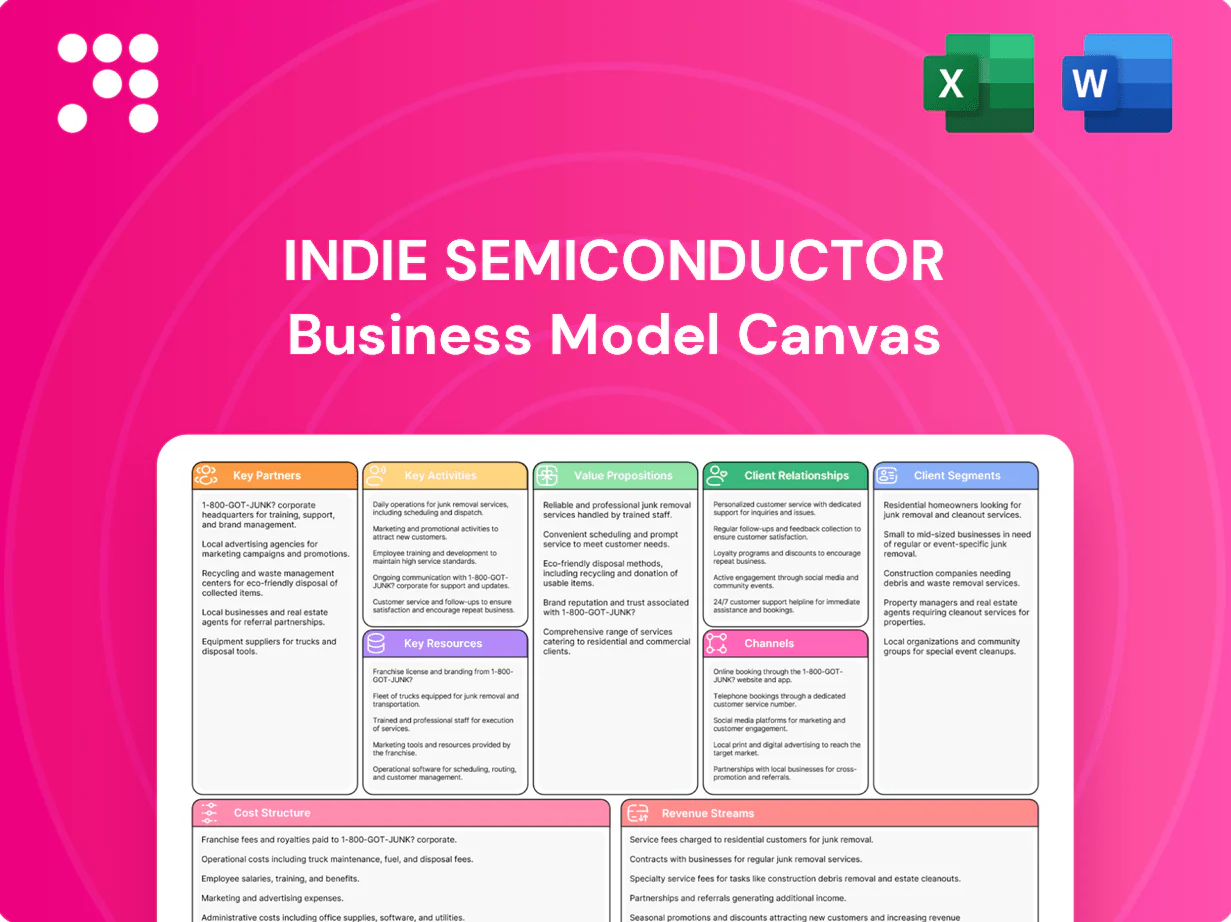
indie semiconductor Business Model Canvas

Concise Business Model Canvas for independent semiconductor investors and founders
Unlock indie semiconductor’s strategic blueprint with our concise Business Model Canvas — revealing its core value propositions, customer segments, partnerships, and revenue mechanics. This actionable snapshot is perfect for investors, advisors, and founders seeking competitive insight. Purchase the full, editable Word & Excel canvas to benchmark, plan, and scale with clarity.
Partnerships

Automotive Tier-1 integrators
Partner with leading Tier-1 integrators to secure design-ins for ADAS, autonomy and in-cabin systems, aligning sensor IC roadmaps with system-level requirements and vehicle platform timelines. Joint validation and PPAP-driven processes shorten OEM approval cycles. Multi-year supply frameworks, typically 3–5 year contracts, reduce demand volatility and support predictable revenue planning.
Foundry and OSAT ecosystem
Foundry and OSAT partnerships secure advanced automotive-grade nodes and proven packaging/test partners to hit AEC-Q100 requirements and IATF 16949 traceability, with qualification cycles typically spanning 12–18 months. Co-optimization of process variants targets radar, lidar, vision and ultrasonic trade-offs for RF, mixed-signal and imaging performance. Capacity reservations and multi-sourcing across foundries/OSATs mitigate supply disruption and stockout risk.

Software, toolchain, and IP vendors
Integrate AUTOSAR Classic/Adaptive and ISO 26262:2018 functional-safety libraries alongside security IP to meet UNECE R155 (in force since 2021) and OEM cybersecurity requirements. Partner with EDA vendors such as Synopsys, Cadence, and Siemens EDA for design, verification, and DFT. License processor, DSP and RF IP from suppliers like Arm and CEVA to accelerate time-to-market. Co-market turnkey hardware-software stacks to OEMs and Tier 1s.

Automotive OEM co-development
Engage early with OEM advanced engineering and sourcing teams to align safety, thermal, EMC and lifecycle specs, leveraging 2024 pilot commitments often ranging 10k–100k units/year to de-risk platform launches and secure volume ramps; real-world pilots reduced time-to-production in similar programs by months while locking multi-year supply agreements. Feedback loops with OEMs directly shape next-gen product features and roadmap.
- Early OEM engagement
- Align specs: safety, thermal, EMC, lifecycle
- Pilot programs: 10k–100k units/yr
- Lock volume ramps & multi-year agreements
- Continuous OEM feedback => product evolution
Standards bodies and test labs
- Standards: ISO, IEEE, AUTOSAR (>200)
- NCAP reach: 30+ countries (2024)
- Testing: accredited EMC/safety/reliability labs
- Benefit: faster global market access via certification partners
Accelerate ADAS market access with Tier-1 design-ins, 3-5yr supply and AEC-Q100 foundry quals
Partner with Tier‑1s for ADAS/autonomy design‑ins, using 3–5 year supply frameworks and PPAP to shorten OEM approvals. Foundry/OSAT alliances secure AEC‑Q100 nodes with 12–18 month qualifications and multi‑sourcing to limit stockouts. AUTOSAR, ISO26262, UNECE R155 compliance plus pilots (10k–100k units/yr in 2024) de‑risk ramps and speed market access.
| Partnership | Metric | 2024 |
|---|---|---|
| Supply contracts | Duration | 3–5 yr |
| Foundry qual | Cycle | 12–18 mo |
| Pilots | Volume | 10k–100k units/yr |
| AUTOSAR | Members | >200 |
What is included in the product
 Detailed Word Document
A comprehensive, pre-written Business Model Canvas for indie semiconductor detailing customer segments, channels, value propositions, revenue streams, key partners, activities, resources, cost structure, and stakeholder relationships aligned with the company’s go-to-market strategy and product roadmap. Ideal for presentations, investor discussions, and strategic planning with SWOT-linked insights and competitive advantage analysis.

 Customizable Excel Spreadsheet
Condenses indie semiconductor’s strategy into a digestible one-page canvas, highlighting value proposition, key partners, and revenue streams to quickly relieve strategic blind spots and streamline product and go-to-market decisions.
Activities

Automotive IC design and verification
Architect mixed-signal, RF, and digital SoCs for sensing and edge AI, targeting automotive supply rails (12V/48V) and operating ranges from -40°C to +125°C; designs follow ISO 26262 up to ASIL-D with FMEDA-driven safety analysis. Perform stringent verification, implement DFT and BIST to support high-yield production and reduce test time, and optimize power, thermal, and EMI to meet CISPR 25 and single-digit-watt edge-AI budgets.
Functional safety and cybersecurity
Execute ISO 26262 processes across four ASIL targets (A–D) to certify functional safety for automotive-grade ICs.
Build cybersecurity by design aligned with ISO/SAE 21434 and UNECE R155 to meet regulatory and OEM expectations.
Maintain SBOMs, secure boot and OTA update readiness, and perform regular penetration testing with continuous vulnerability management.

Qualification and industrialization
Run AEC-Q100 qualification and APQP processes and submit PPAP (levels 1–5) to meet automotive quality gates; establish test programs, burn-in and reliability screens per industry norms. Scale volume through foundry/OSAT partners and ramp wafer starts as demand grows. Manage obsolescence and product change notifications across typical 10–15 year automotive lifecycles (as of 2024).

Reference designs and software enablement
Reference designs and software enablement deliver SDKs, drivers, and example pipelines for radar, lidar, vision, and ultrasound, plus calibration tools and sample algorithms to shorten time-to-integration; EVB/kit documentation and middleware support accelerate OEM adoption and AUTOSAR integration. In 2024 the AUTOSAR consortium exceeded 200 members, underscoring ecosystem demand for compliant stacks.
- SDKs/drivers
- Example pipelines (radar/lidar/vision/ultrasound)
- Calibration tools & sample algorithms
- EVB/kit docs for faster integration
- Middleware & AUTOSAR support
Customer support and field engineering
Customer support and field engineering provide onsite FAEs for design-in, bring-up, and validation, deliver rapid issue resolution with documented root-cause analysis, run training, application notes and knowledge bases, and maintain forecast collaboration and supply planning to align production and logistics. Indie Semiconductor is an automotive-focused semiconductor company trading on NASDAQ as INDI in 2024.
- Onsite FAEs: design-in, bring-up, validation
- Rapid issue resolution with RCA
- Training, app notes, KBs
- Forecast collaboration & supply planning
ASIL A–D RF SoCs: ISO 26262 & 21434, CISPR25, -40°C/+125°C, 10–15yr lifecycle
Architect and verify automotive mixed-signal/RF SoCs to ISO 26262 ASIL-A–D with FMEDA; implement DFT/BIST, CISPR 25 compliance, -40°C to +125°C operation; enforce ISO/SAE 21434 and UNECE R155 cybersecurity, SBOMs and OTA readiness; run AEC-Q100, APQP/PPAP, scale via foundry/OSAT and manage 10–15 year lifecycles; provide SDKs, AUTOSAR-aligned middleware and onsite FAEs; INDI listed on NASDAQ in 2024; AUTOSAR >200 members.
| Metric | 2024 / Value |
|---|---|
| Product lifecycle | 10–15 years |
| Temp range | -40°C to +125°C |
| Safety | ASIL A–D |
| AUTOSAR members | >200 |
| NASDAQ ticker | INDI |
Full Document Unlocks After Purchase
Business Model Canvas
The Business Model Canvas for Indie Semiconductor you’re previewing is the actual deliverable, not a mockup. When you purchase, you’ll receive this same complete and editable document ready for presentation and analysis. Files are provided in Word and Excel, formatted exactly as shown—no surprises.

Concise Business Model Canvas for independent semiconductor investors and founders
Unlock indie semiconductor’s strategic blueprint with our concise Business Model Canvas — revealing its core value propositions, customer segments, partnerships, and revenue mechanics. This actionable snapshot is perfect for investors, advisors, and founders seeking competitive insight. Purchase the full, editable Word & Excel canvas to benchmark, plan, and scale with clarity.
Partnerships
Automotive Tier-1 integrators
Partner with leading Tier-1 integrators to secure design-ins for ADAS, autonomy and in-cabin systems, aligning sensor IC roadmaps with system-level requirements and vehicle platform timelines. Joint validation and PPAP-driven processes shorten OEM approval cycles. Multi-year supply frameworks, typically 3–5 year contracts, reduce demand volatility and support predictable revenue planning.
Foundry and OSAT ecosystem
Foundry and OSAT partnerships secure advanced automotive-grade nodes and proven packaging/test partners to hit AEC-Q100 requirements and IATF 16949 traceability, with qualification cycles typically spanning 12–18 months. Co-optimization of process variants targets radar, lidar, vision and ultrasonic trade-offs for RF, mixed-signal and imaging performance. Capacity reservations and multi-sourcing across foundries/OSATs mitigate supply disruption and stockout risk.
Software, toolchain, and IP vendors
Integrate AUTOSAR Classic/Adaptive and ISO 26262:2018 functional-safety libraries alongside security IP to meet UNECE R155 (in force since 2021) and OEM cybersecurity requirements. Partner with EDA vendors such as Synopsys, Cadence, and Siemens EDA for design, verification, and DFT. License processor, DSP and RF IP from suppliers like Arm and CEVA to accelerate time-to-market. Co-market turnkey hardware-software stacks to OEMs and Tier 1s.
Automotive OEM co-development
Engage early with OEM advanced engineering and sourcing teams to align safety, thermal, EMC and lifecycle specs, leveraging 2024 pilot commitments often ranging 10k–100k units/year to de-risk platform launches and secure volume ramps; real-world pilots reduced time-to-production in similar programs by months while locking multi-year supply agreements. Feedback loops with OEMs directly shape next-gen product features and roadmap.
- Early OEM engagement
- Align specs: safety, thermal, EMC, lifecycle
- Pilot programs: 10k–100k units/yr
- Lock volume ramps & multi-year agreements
- Continuous OEM feedback => product evolution
Standards bodies and test labs
- Standards: ISO, IEEE, AUTOSAR (>200)
- NCAP reach: 30+ countries (2024)
- Testing: accredited EMC/safety/reliability labs
- Benefit: faster global market access via certification partners
Accelerate ADAS market access with Tier-1 design-ins, 3-5yr supply and AEC-Q100 foundry quals
Partner with Tier‑1s for ADAS/autonomy design‑ins, using 3–5 year supply frameworks and PPAP to shorten OEM approvals. Foundry/OSAT alliances secure AEC‑Q100 nodes with 12–18 month qualifications and multi‑sourcing to limit stockouts. AUTOSAR, ISO26262, UNECE R155 compliance plus pilots (10k–100k units/yr in 2024) de‑risk ramps and speed market access.
| Partnership | Metric | 2024 |
|---|---|---|
| Supply contracts | Duration | 3–5 yr |
| Foundry qual | Cycle | 12–18 mo |
| Pilots | Volume | 10k–100k units/yr |
| AUTOSAR | Members | >200 |
What is included in the product
Detailed Word Document
A comprehensive, pre-written Business Model Canvas for indie semiconductor detailing customer segments, channels, value propositions, revenue streams, key partners, activities, resources, cost structure, and stakeholder relationships aligned with the company’s go-to-market strategy and product roadmap. Ideal for presentations, investor discussions, and strategic planning with SWOT-linked insights and competitive advantage analysis.
Customizable Excel Spreadsheet
Condenses indie semiconductor’s strategy into a digestible one-page canvas, highlighting value proposition, key partners, and revenue streams to quickly relieve strategic blind spots and streamline product and go-to-market decisions.
Activities
Automotive IC design and verification
Architect mixed-signal, RF, and digital SoCs for sensing and edge AI, targeting automotive supply rails (12V/48V) and operating ranges from -40°C to +125°C; designs follow ISO 26262 up to ASIL-D with FMEDA-driven safety analysis. Perform stringent verification, implement DFT and BIST to support high-yield production and reduce test time, and optimize power, thermal, and EMI to meet CISPR 25 and single-digit-watt edge-AI budgets.
Functional safety and cybersecurity
Execute ISO 26262 processes across four ASIL targets (A–D) to certify functional safety for automotive-grade ICs.
Build cybersecurity by design aligned with ISO/SAE 21434 and UNECE R155 to meet regulatory and OEM expectations.
Maintain SBOMs, secure boot and OTA update readiness, and perform regular penetration testing with continuous vulnerability management.
Qualification and industrialization
Run AEC-Q100 qualification and APQP processes and submit PPAP (levels 1–5) to meet automotive quality gates; establish test programs, burn-in and reliability screens per industry norms. Scale volume through foundry/OSAT partners and ramp wafer starts as demand grows. Manage obsolescence and product change notifications across typical 10–15 year automotive lifecycles (as of 2024).
Reference designs and software enablement
Reference designs and software enablement deliver SDKs, drivers, and example pipelines for radar, lidar, vision, and ultrasound, plus calibration tools and sample algorithms to shorten time-to-integration; EVB/kit documentation and middleware support accelerate OEM adoption and AUTOSAR integration. In 2024 the AUTOSAR consortium exceeded 200 members, underscoring ecosystem demand for compliant stacks.
- SDKs/drivers
- Example pipelines (radar/lidar/vision/ultrasound)
- Calibration tools & sample algorithms
- EVB/kit docs for faster integration
- Middleware & AUTOSAR support
Customer support and field engineering
Customer support and field engineering provide onsite FAEs for design-in, bring-up, and validation, deliver rapid issue resolution with documented root-cause analysis, run training, application notes and knowledge bases, and maintain forecast collaboration and supply planning to align production and logistics. Indie Semiconductor is an automotive-focused semiconductor company trading on NASDAQ as INDI in 2024.
- Onsite FAEs: design-in, bring-up, validation
- Rapid issue resolution with RCA
- Training, app notes, KBs
- Forecast collaboration & supply planning
ASIL A–D RF SoCs: ISO 26262 & 21434, CISPR25, -40°C/+125°C, 10–15yr lifecycle
Architect and verify automotive mixed-signal/RF SoCs to ISO 26262 ASIL-A–D with FMEDA; implement DFT/BIST, CISPR 25 compliance, -40°C to +125°C operation; enforce ISO/SAE 21434 and UNECE R155 cybersecurity, SBOMs and OTA readiness; run AEC-Q100, APQP/PPAP, scale via foundry/OSAT and manage 10–15 year lifecycles; provide SDKs, AUTOSAR-aligned middleware and onsite FAEs; INDI listed on NASDAQ in 2024; AUTOSAR >200 members.
| Metric | 2024 / Value |
|---|---|
| Product lifecycle | 10–15 years |
| Temp range | -40°C to +125°C |
| Safety | ASIL A–D |
| AUTOSAR members | >200 |
| NASDAQ ticker | INDI |
Full Document Unlocks After Purchase
Business Model Canvas
The Business Model Canvas for Indie Semiconductor you’re previewing is the actual deliverable, not a mockup. When you purchase, you’ll receive this same complete and editable document ready for presentation and analysis. Files are provided in Word and Excel, formatted exactly as shown—no surprises.
Original: $10.00
-65%$10.00
$3.50Description
Concise Business Model Canvas for independent semiconductor investors and founders
Unlock indie semiconductor’s strategic blueprint with our concise Business Model Canvas — revealing its core value propositions, customer segments, partnerships, and revenue mechanics. This actionable snapshot is perfect for investors, advisors, and founders seeking competitive insight. Purchase the full, editable Word & Excel canvas to benchmark, plan, and scale with clarity.
Partnerships
Automotive Tier-1 integrators
Partner with leading Tier-1 integrators to secure design-ins for ADAS, autonomy and in-cabin systems, aligning sensor IC roadmaps with system-level requirements and vehicle platform timelines. Joint validation and PPAP-driven processes shorten OEM approval cycles. Multi-year supply frameworks, typically 3–5 year contracts, reduce demand volatility and support predictable revenue planning.
Foundry and OSAT ecosystem
Foundry and OSAT partnerships secure advanced automotive-grade nodes and proven packaging/test partners to hit AEC-Q100 requirements and IATF 16949 traceability, with qualification cycles typically spanning 12–18 months. Co-optimization of process variants targets radar, lidar, vision and ultrasonic trade-offs for RF, mixed-signal and imaging performance. Capacity reservations and multi-sourcing across foundries/OSATs mitigate supply disruption and stockout risk.
Software, toolchain, and IP vendors
Integrate AUTOSAR Classic/Adaptive and ISO 26262:2018 functional-safety libraries alongside security IP to meet UNECE R155 (in force since 2021) and OEM cybersecurity requirements. Partner with EDA vendors such as Synopsys, Cadence, and Siemens EDA for design, verification, and DFT. License processor, DSP and RF IP from suppliers like Arm and CEVA to accelerate time-to-market. Co-market turnkey hardware-software stacks to OEMs and Tier 1s.
Automotive OEM co-development
Engage early with OEM advanced engineering and sourcing teams to align safety, thermal, EMC and lifecycle specs, leveraging 2024 pilot commitments often ranging 10k–100k units/year to de-risk platform launches and secure volume ramps; real-world pilots reduced time-to-production in similar programs by months while locking multi-year supply agreements. Feedback loops with OEMs directly shape next-gen product features and roadmap.
- Early OEM engagement
- Align specs: safety, thermal, EMC, lifecycle
- Pilot programs: 10k–100k units/yr
- Lock volume ramps & multi-year agreements
- Continuous OEM feedback => product evolution
Standards bodies and test labs
- Standards: ISO, IEEE, AUTOSAR (>200)
- NCAP reach: 30+ countries (2024)
- Testing: accredited EMC/safety/reliability labs
- Benefit: faster global market access via certification partners
Accelerate ADAS market access with Tier-1 design-ins, 3-5yr supply and AEC-Q100 foundry quals
Partner with Tier‑1s for ADAS/autonomy design‑ins, using 3–5 year supply frameworks and PPAP to shorten OEM approvals. Foundry/OSAT alliances secure AEC‑Q100 nodes with 12–18 month qualifications and multi‑sourcing to limit stockouts. AUTOSAR, ISO26262, UNECE R155 compliance plus pilots (10k–100k units/yr in 2024) de‑risk ramps and speed market access.
| Partnership | Metric | 2024 |
|---|---|---|
| Supply contracts | Duration | 3–5 yr |
| Foundry qual | Cycle | 12–18 mo |
| Pilots | Volume | 10k–100k units/yr |
| AUTOSAR | Members | >200 |
What is included in the product
Detailed Word Document
A comprehensive, pre-written Business Model Canvas for indie semiconductor detailing customer segments, channels, value propositions, revenue streams, key partners, activities, resources, cost structure, and stakeholder relationships aligned with the company’s go-to-market strategy and product roadmap. Ideal for presentations, investor discussions, and strategic planning with SWOT-linked insights and competitive advantage analysis.
Customizable Excel Spreadsheet
Condenses indie semiconductor’s strategy into a digestible one-page canvas, highlighting value proposition, key partners, and revenue streams to quickly relieve strategic blind spots and streamline product and go-to-market decisions.
Activities
Automotive IC design and verification
Architect mixed-signal, RF, and digital SoCs for sensing and edge AI, targeting automotive supply rails (12V/48V) and operating ranges from -40°C to +125°C; designs follow ISO 26262 up to ASIL-D with FMEDA-driven safety analysis. Perform stringent verification, implement DFT and BIST to support high-yield production and reduce test time, and optimize power, thermal, and EMI to meet CISPR 25 and single-digit-watt edge-AI budgets.
Functional safety and cybersecurity
Execute ISO 26262 processes across four ASIL targets (A–D) to certify functional safety for automotive-grade ICs.
Build cybersecurity by design aligned with ISO/SAE 21434 and UNECE R155 to meet regulatory and OEM expectations.
Maintain SBOMs, secure boot and OTA update readiness, and perform regular penetration testing with continuous vulnerability management.
Qualification and industrialization
Run AEC-Q100 qualification and APQP processes and submit PPAP (levels 1–5) to meet automotive quality gates; establish test programs, burn-in and reliability screens per industry norms. Scale volume through foundry/OSAT partners and ramp wafer starts as demand grows. Manage obsolescence and product change notifications across typical 10–15 year automotive lifecycles (as of 2024).
Reference designs and software enablement
Reference designs and software enablement deliver SDKs, drivers, and example pipelines for radar, lidar, vision, and ultrasound, plus calibration tools and sample algorithms to shorten time-to-integration; EVB/kit documentation and middleware support accelerate OEM adoption and AUTOSAR integration. In 2024 the AUTOSAR consortium exceeded 200 members, underscoring ecosystem demand for compliant stacks.
- SDKs/drivers
- Example pipelines (radar/lidar/vision/ultrasound)
- Calibration tools & sample algorithms
- EVB/kit docs for faster integration
- Middleware & AUTOSAR support
Customer support and field engineering
Customer support and field engineering provide onsite FAEs for design-in, bring-up, and validation, deliver rapid issue resolution with documented root-cause analysis, run training, application notes and knowledge bases, and maintain forecast collaboration and supply planning to align production and logistics. Indie Semiconductor is an automotive-focused semiconductor company trading on NASDAQ as INDI in 2024.
- Onsite FAEs: design-in, bring-up, validation
- Rapid issue resolution with RCA
- Training, app notes, KBs
- Forecast collaboration & supply planning
ASIL A–D RF SoCs: ISO 26262 & 21434, CISPR25, -40°C/+125°C, 10–15yr lifecycle
Architect and verify automotive mixed-signal/RF SoCs to ISO 26262 ASIL-A–D with FMEDA; implement DFT/BIST, CISPR 25 compliance, -40°C to +125°C operation; enforce ISO/SAE 21434 and UNECE R155 cybersecurity, SBOMs and OTA readiness; run AEC-Q100, APQP/PPAP, scale via foundry/OSAT and manage 10–15 year lifecycles; provide SDKs, AUTOSAR-aligned middleware and onsite FAEs; INDI listed on NASDAQ in 2024; AUTOSAR >200 members.
| Metric | 2024 / Value |
|---|---|
| Product lifecycle | 10–15 years |
| Temp range | -40°C to +125°C |
| Safety | ASIL A–D |
| AUTOSAR members | >200 |
| NASDAQ ticker | INDI |
Full Document Unlocks After Purchase
Business Model Canvas
The Business Model Canvas for Indie Semiconductor you’re previewing is the actual deliverable, not a mockup. When you purchase, you’ll receive this same complete and editable document ready for presentation and analysis. Files are provided in Word and Excel, formatted exactly as shown—no surprises.











