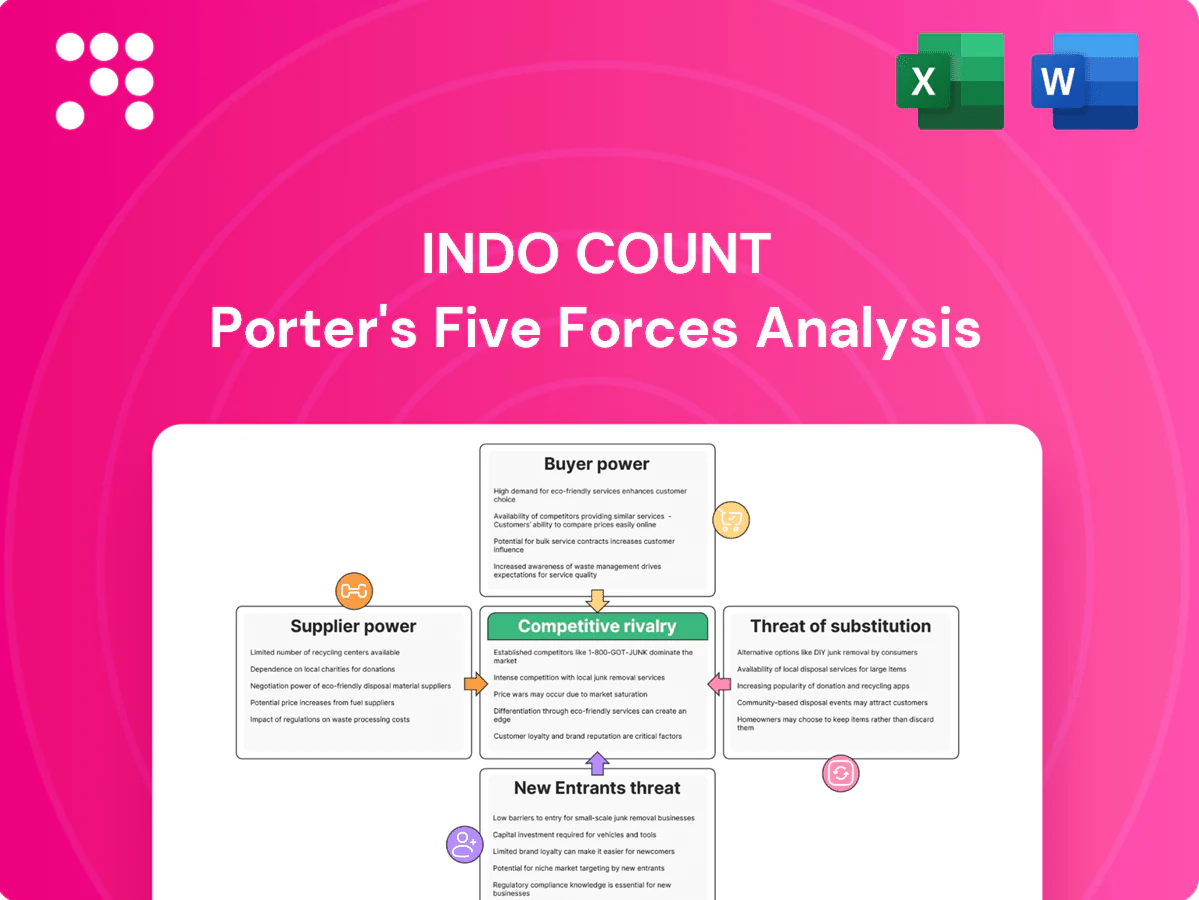
Indo Count Porter's Five Forces Analysis

Elevate Your Analysis with the Complete Porter's Five Forces Analysis
Indo Count faces moderate buyer power and intense competition from low‑cost global textile players. Supplier concentration and raw‑material volatility pressure margins, while entry barriers and scale economies temper new entrants. This brief snapshot only scratches the surface. Unlock the full Porter's Five Forces Analysis to explore Indo Count’s competitive dynamics and strategic implications in detail.
Suppliers Bargaining Power

Dependence on premium cotton
Bed linen quality depends on long-staple cotton, concentrating bargaining power with premium-fiber growers and ginners; supply shocks from weather and export policy drive price swings that compress margins. Hedging and diversified sourcing materially reduce exposure but cannot eliminate volatility. In highly competitive home-textile markets, scope to pass higher input costs to buyers is constrained.
Diverse but spec-driven spinner base
Multiple yarn spinners (over 1,000 in India) exist, but Indo Count’s tight specs on yarn count, contamination and consistency limit eligible suppliers to a small approved list, raising supplier influence despite broad market supply.
Approved-vendor lists and supplier audits create procurement stickiness; long-term ties secured allocations during 2023–24 tightness in cotton/yarn markets, while switching remains feasible but requires weeks-months of qualification and quality risk.

Chemicals, dyes, and energy inputs
Reactive dyes, specialty finishes and auxiliaries are supplied by a concentrated set of compliant firms such as Archroma, Huntsman and DyStar as of 2024. Processing is energy‑intensive, exposing Indo Count to electricity and gas price volatility that can compress margins. Sustainability standards like ZDHC and OEKO‑TEX restrict low‑cost substitutes. Supplier bargaining power rises sharply when compliant capacity is tight.

Logistics and lead-time constraints
Global container rates fell roughly 60% from 2021 peaks to about USD 2,000 per 40ft in 2024 (Drewry World Container Index), but volatility and scarce boxes still push delivered costs and unpredictability for Indo Count; port congestion and sudden policy shifts empower freight forwarders and carriers; time-sensitive retail windows heighten supplier leverage while limited nearshoring options constrain Indian exporters.
- WCI ~USD 2,000/40ft (2024)
- Port congestion increases transit variability
- Retail calendars raise penalty risk
- Nearshoring alternatives limited for India
Limited upstream integration
Limited upstream integration means Indo Count lacks deep backward assets in spinning/ginning, so supplier leverage over raw cotton remains; partial integration secures certain yarns but not cotton feedstock, keeping input cost exposure. Large, cyclical capex to add ginning/spinning deters full integration, so strategic alliances and seasonal contracts reduce but do not remove supplier power.
- Partial integration: secures yarn, not raw cotton
- High cyclical capex: barrier to full backward integration
- Alliances/contracts: mitigate but don’t eliminate supplier leverage
Cotton volatility and limited approved yarn vendors drive supplier leverage
Suppliers hold moderate-to-high power: cotton price volatility (MCX cotton ~INR 92,000/100 bales in 2024) and tight compliant-chemical suppliers concentrate leverage. Indo Count limits eligible yarn vendors despite >1,000 spinners in India, raising switching costs. Partial backward integration and long-term contracts mitigate but do not remove supplier influence.
| Metric | 2024 |
|---|---|
| MCX cotton (₹/100 bales) | ~92,000 |
| Indian yarn spinners | >1,000 (few approved) |
| WCI (USD/40ft) | ~2,000 |
What is included in the product
 Detailed Word Document
Tailored Porter's Five Forces analysis for Indo Count uncovering key drivers of competition, buyer and supplier power, threats from substitutes and new entrants, and identifying disruptive forces that could erode market share and profitability.

 Customizable Excel Spreadsheet
A concise, one-sheet Porter’s Five Forces for Indo Count—customize pressure levels with current data and view strategic intensity via an instant spider chart, ready to drop into pitch decks.
Customers Bargaining Power

Concentrated global retailers
Global big-box and department retailers—Walmart (2024 revenue $611.3B), Amazon ($643.9B in 2024) and Target ($107.6B in FY2024)—dominate home-textile demand and wield strong negotiating power over suppliers.
They force sharp pricing, strict payment terms and chargebacks, while retail consolidation and private labels amplify leverage; losing a key account can materially dent supplier volumes and margins.
Price transparency and bid cycles
Frequent RFQs and benchmarked pricing compress Indo Count's margins as buyers routinely push prices to market lows, with open-costing and volume-linked rebates commonplace in 2024 sourcing contracts. Buyers freely switch sourcing among India, Pakistan and China, increasing competitive pressure and shortening bid cycles. Cost inflation, especially for cotton and energy, is difficult to pass through mid-contract, squeezing operating leverage and margin stability.

High compliance and design demands
ESG, product-safety and traceability audits in 2024 raised the execution bar, with 72% of consumers rating sustainability as important, forcing tighter supplier controls. Rapid design refreshes and custom SKUs increase complexity and raise working-capital and compliance costs. Failures can trigger delisting or penalties and cut orders materially. Meeting standards builds stickiness but does not eliminate strong buyer leverage.

Multi-sourcing and country diversification
Buyers hedge risk by splitting programs across 2–4 suppliers and 2–3 countries, limiting Indo Count’s pricing power as alternate sources cap margins. Currency terms and INCOTERMS are used as negotiation levers, with buyers pressing for USD pricing or DDP to shift FX and logistics risk. Only truly unique designs or patented finishes meaningfully reduce substitution and restore pricing leverage.
- Multi-sourcing: 2–4 suppliers, 2–3 countries
- Negotiation levers: currency denomination, INCOTERMS
- Defensive moat: patented finishes/unique designs
Private label dominance over brands
- Value over brand: lowers margins
- Rapid volume shifts: increases volatility
- Co-development: partial lock-in
- Branded deals: premium pricing, scarce
RFQs, multi-sourcing and rebates squeeze margins; traceability 72%
Large global retailers (Walmart $611.3B, Amazon $643.9B, Target $107.6B in 2024) exert strong price and terms pressure, driving RFQs, benchmarked pricing and volume-linked rebates that compress Indo Count margins. Multi-sourcing (2–4 suppliers, 2–3 countries), USD/DDP negotiation levers and rapid SKU churn increase volatility and limit pass-through of cotton/energy inflation. ESG and traceability (72% consumer importance 2024) raise compliance costs and can trigger delisting despite creating partial stickiness.
| Metric | 2024 | Impact |
|---|---|---|
| Top retailer revenue | WAL $611.3B AMZN $643.9B TGT $107.6B | High buyer power |
| Multi-sourcing | 2–4 suppliers; | Price caps |
| ESG importance | 72% | Compliance costs |
Same Document Delivered
Indo Count Porter's Five Forces Analysis
This preview shows the exact Indo Count Porter's Five Forces analysis you'll receive immediately after purchase—no placeholders or samples. It is the fully formatted strategic assessment covering competitive rivalry, supplier and buyer power, and the threats of substitutes and new entrants. You'll get this same ready-to-use document instantly upon payment.

Elevate Your Analysis with the Complete Porter's Five Forces Analysis
Indo Count faces moderate buyer power and intense competition from low‑cost global textile players. Supplier concentration and raw‑material volatility pressure margins, while entry barriers and scale economies temper new entrants. This brief snapshot only scratches the surface. Unlock the full Porter's Five Forces Analysis to explore Indo Count’s competitive dynamics and strategic implications in detail.
Suppliers Bargaining Power
Dependence on premium cotton
Bed linen quality depends on long-staple cotton, concentrating bargaining power with premium-fiber growers and ginners; supply shocks from weather and export policy drive price swings that compress margins. Hedging and diversified sourcing materially reduce exposure but cannot eliminate volatility. In highly competitive home-textile markets, scope to pass higher input costs to buyers is constrained.
Diverse but spec-driven spinner base
Multiple yarn spinners (over 1,000 in India) exist, but Indo Count’s tight specs on yarn count, contamination and consistency limit eligible suppliers to a small approved list, raising supplier influence despite broad market supply.
Approved-vendor lists and supplier audits create procurement stickiness; long-term ties secured allocations during 2023–24 tightness in cotton/yarn markets, while switching remains feasible but requires weeks-months of qualification and quality risk.
Chemicals, dyes, and energy inputs
Reactive dyes, specialty finishes and auxiliaries are supplied by a concentrated set of compliant firms such as Archroma, Huntsman and DyStar as of 2024. Processing is energy‑intensive, exposing Indo Count to electricity and gas price volatility that can compress margins. Sustainability standards like ZDHC and OEKO‑TEX restrict low‑cost substitutes. Supplier bargaining power rises sharply when compliant capacity is tight.
Logistics and lead-time constraints
Global container rates fell roughly 60% from 2021 peaks to about USD 2,000 per 40ft in 2024 (Drewry World Container Index), but volatility and scarce boxes still push delivered costs and unpredictability for Indo Count; port congestion and sudden policy shifts empower freight forwarders and carriers; time-sensitive retail windows heighten supplier leverage while limited nearshoring options constrain Indian exporters.
- WCI ~USD 2,000/40ft (2024)
- Port congestion increases transit variability
- Retail calendars raise penalty risk
- Nearshoring alternatives limited for India
Limited upstream integration
Limited upstream integration means Indo Count lacks deep backward assets in spinning/ginning, so supplier leverage over raw cotton remains; partial integration secures certain yarns but not cotton feedstock, keeping input cost exposure. Large, cyclical capex to add ginning/spinning deters full integration, so strategic alliances and seasonal contracts reduce but do not remove supplier power.
- Partial integration: secures yarn, not raw cotton
- High cyclical capex: barrier to full backward integration
- Alliances/contracts: mitigate but don’t eliminate supplier leverage
Cotton volatility and limited approved yarn vendors drive supplier leverage
Suppliers hold moderate-to-high power: cotton price volatility (MCX cotton ~INR 92,000/100 bales in 2024) and tight compliant-chemical suppliers concentrate leverage. Indo Count limits eligible yarn vendors despite >1,000 spinners in India, raising switching costs. Partial backward integration and long-term contracts mitigate but do not remove supplier influence.
| Metric | 2024 |
|---|---|
| MCX cotton (₹/100 bales) | ~92,000 |
| Indian yarn spinners | >1,000 (few approved) |
| WCI (USD/40ft) | ~2,000 |
What is included in the product
Detailed Word Document
Tailored Porter's Five Forces analysis for Indo Count uncovering key drivers of competition, buyer and supplier power, threats from substitutes and new entrants, and identifying disruptive forces that could erode market share and profitability.
Customizable Excel Spreadsheet
A concise, one-sheet Porter’s Five Forces for Indo Count—customize pressure levels with current data and view strategic intensity via an instant spider chart, ready to drop into pitch decks.
Customers Bargaining Power
Concentrated global retailers
Global big-box and department retailers—Walmart (2024 revenue $611.3B), Amazon ($643.9B in 2024) and Target ($107.6B in FY2024)—dominate home-textile demand and wield strong negotiating power over suppliers.
They force sharp pricing, strict payment terms and chargebacks, while retail consolidation and private labels amplify leverage; losing a key account can materially dent supplier volumes and margins.
Price transparency and bid cycles
Frequent RFQs and benchmarked pricing compress Indo Count's margins as buyers routinely push prices to market lows, with open-costing and volume-linked rebates commonplace in 2024 sourcing contracts. Buyers freely switch sourcing among India, Pakistan and China, increasing competitive pressure and shortening bid cycles. Cost inflation, especially for cotton and energy, is difficult to pass through mid-contract, squeezing operating leverage and margin stability.
High compliance and design demands
ESG, product-safety and traceability audits in 2024 raised the execution bar, with 72% of consumers rating sustainability as important, forcing tighter supplier controls. Rapid design refreshes and custom SKUs increase complexity and raise working-capital and compliance costs. Failures can trigger delisting or penalties and cut orders materially. Meeting standards builds stickiness but does not eliminate strong buyer leverage.
Multi-sourcing and country diversification
Buyers hedge risk by splitting programs across 2–4 suppliers and 2–3 countries, limiting Indo Count’s pricing power as alternate sources cap margins. Currency terms and INCOTERMS are used as negotiation levers, with buyers pressing for USD pricing or DDP to shift FX and logistics risk. Only truly unique designs or patented finishes meaningfully reduce substitution and restore pricing leverage.
- Multi-sourcing: 2–4 suppliers, 2–3 countries
- Negotiation levers: currency denomination, INCOTERMS
- Defensive moat: patented finishes/unique designs
Private label dominance over brands
- Value over brand: lowers margins
- Rapid volume shifts: increases volatility
- Co-development: partial lock-in
- Branded deals: premium pricing, scarce
RFQs, multi-sourcing and rebates squeeze margins; traceability 72%
Large global retailers (Walmart $611.3B, Amazon $643.9B, Target $107.6B in 2024) exert strong price and terms pressure, driving RFQs, benchmarked pricing and volume-linked rebates that compress Indo Count margins. Multi-sourcing (2–4 suppliers, 2–3 countries), USD/DDP negotiation levers and rapid SKU churn increase volatility and limit pass-through of cotton/energy inflation. ESG and traceability (72% consumer importance 2024) raise compliance costs and can trigger delisting despite creating partial stickiness.
| Metric | 2024 | Impact |
|---|---|---|
| Top retailer revenue | WAL $611.3B AMZN $643.9B TGT $107.6B | High buyer power |
| Multi-sourcing | 2–4 suppliers; | Price caps |
| ESG importance | 72% | Compliance costs |
Same Document Delivered
Indo Count Porter's Five Forces Analysis
This preview shows the exact Indo Count Porter's Five Forces analysis you'll receive immediately after purchase—no placeholders or samples. It is the fully formatted strategic assessment covering competitive rivalry, supplier and buyer power, and the threats of substitutes and new entrants. You'll get this same ready-to-use document instantly upon payment.
Original: $10.00
-65%$10.00
$3.50Description
Elevate Your Analysis with the Complete Porter's Five Forces Analysis
Indo Count faces moderate buyer power and intense competition from low‑cost global textile players. Supplier concentration and raw‑material volatility pressure margins, while entry barriers and scale economies temper new entrants. This brief snapshot only scratches the surface. Unlock the full Porter's Five Forces Analysis to explore Indo Count’s competitive dynamics and strategic implications in detail.
Suppliers Bargaining Power
Dependence on premium cotton
Bed linen quality depends on long-staple cotton, concentrating bargaining power with premium-fiber growers and ginners; supply shocks from weather and export policy drive price swings that compress margins. Hedging and diversified sourcing materially reduce exposure but cannot eliminate volatility. In highly competitive home-textile markets, scope to pass higher input costs to buyers is constrained.
Diverse but spec-driven spinner base
Multiple yarn spinners (over 1,000 in India) exist, but Indo Count’s tight specs on yarn count, contamination and consistency limit eligible suppliers to a small approved list, raising supplier influence despite broad market supply.
Approved-vendor lists and supplier audits create procurement stickiness; long-term ties secured allocations during 2023–24 tightness in cotton/yarn markets, while switching remains feasible but requires weeks-months of qualification and quality risk.
Chemicals, dyes, and energy inputs
Reactive dyes, specialty finishes and auxiliaries are supplied by a concentrated set of compliant firms such as Archroma, Huntsman and DyStar as of 2024. Processing is energy‑intensive, exposing Indo Count to electricity and gas price volatility that can compress margins. Sustainability standards like ZDHC and OEKO‑TEX restrict low‑cost substitutes. Supplier bargaining power rises sharply when compliant capacity is tight.
Logistics and lead-time constraints
Global container rates fell roughly 60% from 2021 peaks to about USD 2,000 per 40ft in 2024 (Drewry World Container Index), but volatility and scarce boxes still push delivered costs and unpredictability for Indo Count; port congestion and sudden policy shifts empower freight forwarders and carriers; time-sensitive retail windows heighten supplier leverage while limited nearshoring options constrain Indian exporters.
- WCI ~USD 2,000/40ft (2024)
- Port congestion increases transit variability
- Retail calendars raise penalty risk
- Nearshoring alternatives limited for India
Limited upstream integration
Limited upstream integration means Indo Count lacks deep backward assets in spinning/ginning, so supplier leverage over raw cotton remains; partial integration secures certain yarns but not cotton feedstock, keeping input cost exposure. Large, cyclical capex to add ginning/spinning deters full integration, so strategic alliances and seasonal contracts reduce but do not remove supplier power.
- Partial integration: secures yarn, not raw cotton
- High cyclical capex: barrier to full backward integration
- Alliances/contracts: mitigate but don’t eliminate supplier leverage
Cotton volatility and limited approved yarn vendors drive supplier leverage
Suppliers hold moderate-to-high power: cotton price volatility (MCX cotton ~INR 92,000/100 bales in 2024) and tight compliant-chemical suppliers concentrate leverage. Indo Count limits eligible yarn vendors despite >1,000 spinners in India, raising switching costs. Partial backward integration and long-term contracts mitigate but do not remove supplier influence.
| Metric | 2024 |
|---|---|
| MCX cotton (₹/100 bales) | ~92,000 |
| Indian yarn spinners | >1,000 (few approved) |
| WCI (USD/40ft) | ~2,000 |
What is included in the product
Detailed Word Document
Tailored Porter's Five Forces analysis for Indo Count uncovering key drivers of competition, buyer and supplier power, threats from substitutes and new entrants, and identifying disruptive forces that could erode market share and profitability.
Customizable Excel Spreadsheet
A concise, one-sheet Porter’s Five Forces for Indo Count—customize pressure levels with current data and view strategic intensity via an instant spider chart, ready to drop into pitch decks.
Customers Bargaining Power
Concentrated global retailers
Global big-box and department retailers—Walmart (2024 revenue $611.3B), Amazon ($643.9B in 2024) and Target ($107.6B in FY2024)—dominate home-textile demand and wield strong negotiating power over suppliers.
They force sharp pricing, strict payment terms and chargebacks, while retail consolidation and private labels amplify leverage; losing a key account can materially dent supplier volumes and margins.
Price transparency and bid cycles
Frequent RFQs and benchmarked pricing compress Indo Count's margins as buyers routinely push prices to market lows, with open-costing and volume-linked rebates commonplace in 2024 sourcing contracts. Buyers freely switch sourcing among India, Pakistan and China, increasing competitive pressure and shortening bid cycles. Cost inflation, especially for cotton and energy, is difficult to pass through mid-contract, squeezing operating leverage and margin stability.
High compliance and design demands
ESG, product-safety and traceability audits in 2024 raised the execution bar, with 72% of consumers rating sustainability as important, forcing tighter supplier controls. Rapid design refreshes and custom SKUs increase complexity and raise working-capital and compliance costs. Failures can trigger delisting or penalties and cut orders materially. Meeting standards builds stickiness but does not eliminate strong buyer leverage.
Multi-sourcing and country diversification
Buyers hedge risk by splitting programs across 2–4 suppliers and 2–3 countries, limiting Indo Count’s pricing power as alternate sources cap margins. Currency terms and INCOTERMS are used as negotiation levers, with buyers pressing for USD pricing or DDP to shift FX and logistics risk. Only truly unique designs or patented finishes meaningfully reduce substitution and restore pricing leverage.
- Multi-sourcing: 2–4 suppliers, 2–3 countries
- Negotiation levers: currency denomination, INCOTERMS
- Defensive moat: patented finishes/unique designs
Private label dominance over brands
- Value over brand: lowers margins
- Rapid volume shifts: increases volatility
- Co-development: partial lock-in
- Branded deals: premium pricing, scarce
RFQs, multi-sourcing and rebates squeeze margins; traceability 72%
Large global retailers (Walmart $611.3B, Amazon $643.9B, Target $107.6B in 2024) exert strong price and terms pressure, driving RFQs, benchmarked pricing and volume-linked rebates that compress Indo Count margins. Multi-sourcing (2–4 suppliers, 2–3 countries), USD/DDP negotiation levers and rapid SKU churn increase volatility and limit pass-through of cotton/energy inflation. ESG and traceability (72% consumer importance 2024) raise compliance costs and can trigger delisting despite creating partial stickiness.
| Metric | 2024 | Impact |
|---|---|---|
| Top retailer revenue | WAL $611.3B AMZN $643.9B TGT $107.6B | High buyer power |
| Multi-sourcing | 2–4 suppliers; | Price caps |
| ESG importance | 72% | Compliance costs |
Same Document Delivered
Indo Count Porter's Five Forces Analysis
This preview shows the exact Indo Count Porter's Five Forces analysis you'll receive immediately after purchase—no placeholders or samples. It is the fully formatted strategic assessment covering competitive rivalry, supplier and buyer power, and the threats of substitutes and new entrants. You'll get this same ready-to-use document instantly upon payment.











